Tag Archives: 1919

Private Osborne Robinson

Private Osborne Robinson

Osborne Robinson was born in the autumn of 1891. The middle of three children, he was the only son to Edward and Edith Robinson. Edward was a merchant of foreign products from West Hartlepool, County Durham, and this is where the family were raised.

Edward died in 1905, and this provided a marked change for the Robinsons. Edith moved the family to Richmond, Yorkshire, which is where her widowed mother still lived. The 1911 census recorded a divided family. Osborne’s older sister, Mary, was employed as a housekeeper for a widowed farmer in Thornton Watless, south of Richmond. His younger sister, Elsie, was living with her maternal grandmother and aunt in Richmond.

Edith and Osborne, meanwhile, were living at Swale Farm, Ellerton Abbey, to the west of Richmond. Edith recorded herself as living on private means, while her son was employed as a grazing farmer, presumably connected to the farm they were living on.

Osborne wanted to expand his horizons and, at the beginning of 1914, took the decision to seek a new life overseas. On 30th January, he boarded the SS Norman, bound for Brisbane, Queensland, Australia. Within a matter of months, war had broken out, and Osborne felt he needed to play his part for King and Empire.

On 25th July 1915, while working near Cootamundra, New South Wales, Osborne enlisted, joining the Australian Imperial Force as a Private. His service papers show that at 23 years of age, he was 5ft 5.5ins (1.66m) tall and weighed 140lbs (63.5kg). He had dark brown hair, blue eyes and a dark complexion, presumably from working outside.

Private Robinson left Australia on 5th October 1915, travelling on board HMAT A32 Themistocles for his journey to Europe. His unit – the 1st Australian Pioneer Battalion – spent time in Egypt, before moving on to Marseilles, France, in April 1916. By the autumn Osborne was on the Western Front, and, on 3rd September, during the Battle of Pozières, he was wounded in his left hand.

Initially treated at the 17th Casualty Clearing Station, Private Robinson was stoon transferred to the 1st Southern General Hospital in Birmingham. His injury took close to six weeks to heal, and he returned to an ANZAC base in Wareham, Dorset, towards the end of October.

Osborne spent a good few months on home soil, eventually re-joining his unit in France on 18th October 1917. Over the next year, he served on the Western Front, with two periods of leave – a week in Paris in March 1918 and a fortnight in the UK the following October. The Armistice declared, Private Robinson’s unit returned to its base near Warminster, Wiltshire, in January 1919.

Osborne had fallen ill with influenza by this point and his condition was to worsen to pneumonia. He died at a private address in Warminster on 8th February 1919: he was 28 years of age.

The body of Osborne Robinson was laid to rest in St John’s Churchyard, Warminster. It is unclear why Edith chose not to bring her son home, but the 1921 census recorded her, Mary and Elsie (neither of whom were married) living in the village of Reeth, on the edge of the Yorkshire Dales. All three were noted as being employed with home duties.
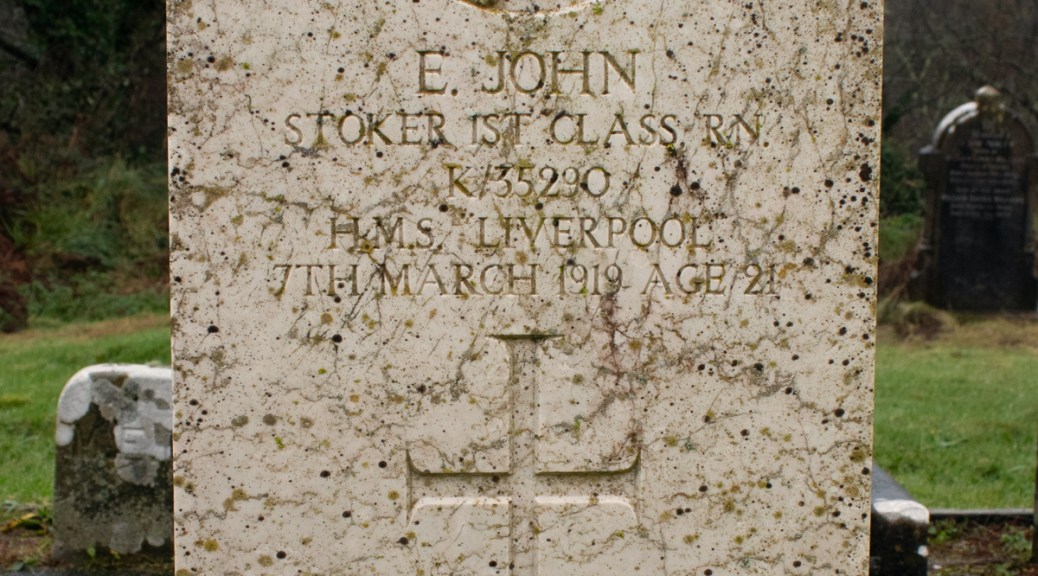
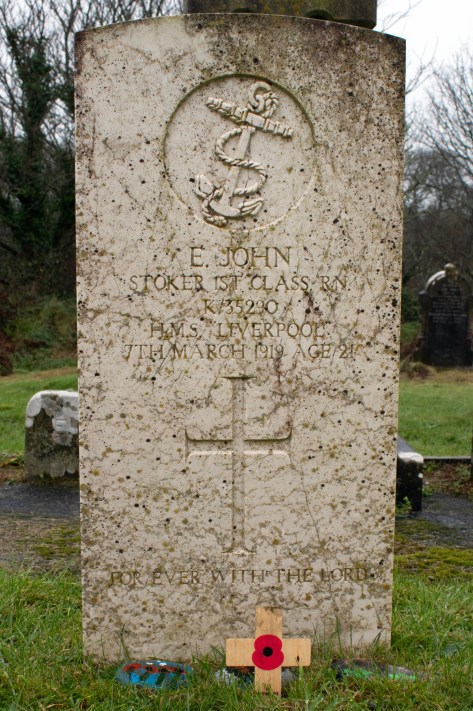
Stoker 1st Class Edwin John

Stoker 1st Class Edwin John

Edwin John was born in St David’s, Pembrokeshire, on 18th February 1898. The youngest of nine children, he was the son of farmer Henry John and his wife, Caroline. Edwin’s mum died when he was just five years old, and Henry was left to raise the family alone.

When he finished his schooling, Edwin found work on the farm. When war broke out, however, he was called upon to play his part and, on 19th July 1916, he enlisted in the Royal Navy. His service papers show that he was 5ft 4ins (1.63m) tall, with dark hair, grey eyes and a dark complexion.

Stoker 2nd Class John was sent to HMS Vivid, the Royal Naval Dockyard in Devonport, Devon, for his training. He remained there for three months, before being given his first assignment, the light cruiser HMS Liverpool. She spent the second half of the conflict patrolling the Mediterranean, and this is where Edwin would serve his time.

Edwin’s time in the navy was uneventful. He was promoted to Stoker 1st Class in March 1917, and, while he was consistently noted as being of very good character, his ability was recorded as being satisfactory.

On 28th April 1918, Stoker 1st Class John returned to shore to be demobbed. Given the war had another seven months to run, it is unclear why he was stood down, although it may have been on medical grounds. At this point his trail goes cold, but it is likely that he returned home.

Edwin’s health was certainly suffering by this point, and, on 7th March 1919 he passed away from bronchitis. He was just 21 years of age.

Edwin John’s body was laid to rest in St David’s Parish Cemetery, Pembrokeshire, not far from where his father and siblings still lived.


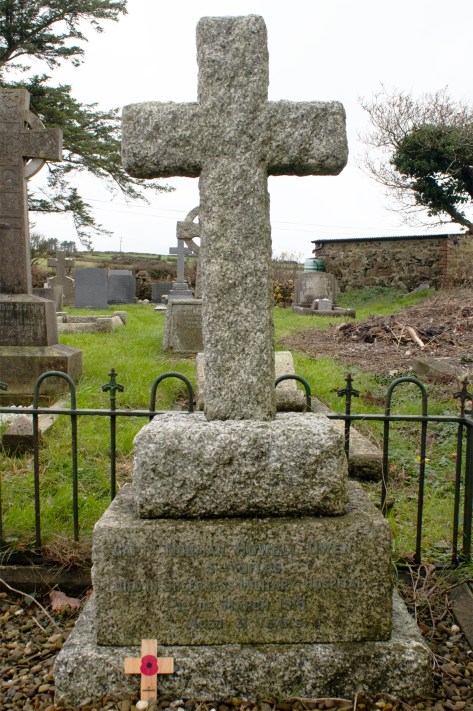
Captain Norman Owen

Captain Norman Owen

Norman Howell Owen was born in the spring of 1888, and was the third of four children – all boys – to John and Elizabeth. John was a surgeon from Pembroke Dock, Pembrokeshire, but the family were raised in Fishguard, where his practice was based.

Norman was an educated young man and, in 1906, attended the Sir Isaac Pitman & Son Phonetic Institute in Bath Somerset. He was studying shorthand, passing an examination in the subject after just three months. He passed an entrance exam for the National and Provincial Bank the following year, and, by the time of the 1911 census, he was working in the Fishguard branch and living back with his parents.

When war came to Europe, Norman was called upon to play his part. Full details of his service have been lost to time, but what remains paints an interesting picture of his time in the army. He appears to have enlisted in the King’s Liverpool Regiment as a Private, before transferring to the Labour Corps, then the Army Ordnance Corps.

By 1918 the Pembrokeshire Voters List noted Norman and two of his brothers as absentee voters – serving in the army, so not at home. Norman is recorded as being a Captain in the Army Service Corps, having received a commission on 8th February 1915. His older brother John is recorded as being a Captain in the Royal Army Medical Corps, while his younger brother, Lionel, was a Captain in the Royal Field Artillery.

The mystery of Norman continued: he survived the conflict, but by February 1919 had been admitted to the Broadway Military Hospital in Sheerness, Kent. He passed away on 1st March, the cause of his passing not readily available. Captain Owen was 31 years of age.

The body of Norman Howell Owen was taken back to Pembrokeshire for burial. He was laid to rest in Fishguard Church Cemetery.


Norman died intestate: his family went through probate, and his effects – totalling £1003 8s 10d (approximately £67,000 today) were left to his father.


Captain Percy Rawlings

Captain Percy Rawlings

Percy Townley Rawlings was born on 22nd September 1887 in Clapham, Surrey. Details of his early life are sketchy, and most of the information comes from second hand accounts. His baptism record gives his parents as Edward and Lizzie Rawlings. Edward was listed as being a gentleman, but there is no record of the family on the 1891, or 1901 census returns.

He was educated at Westminster School and Cambridge University, where he obtained honours in the Mechanical Sciences Tripos.

In 1910 he went to Woolwich Arsenal as [an] advanced workshop student, and in the following year he obtained a Commission in the Royal Engineers…

In 1912 he entered the Public Works Department of the Sudan Government, and during 1913-14 acted as engineer to the Egyptian Irrigation Service on the construction of the Blue Nile Dam.

On the outbreak of the War he was sent to France [as a Lieutenant in the Royal Engineers], in the 2nd Field Co., being transferred in the following year to the [Royal Naval Volunteer Reserve], for engineering duties with the [Royal Naval Air Service].

In 1917 he flew to Constantinople in a Handley-Page machine, and bombed the Goeben, for which he received the DSC.

[1921 Institution of Mechanical Engineers: Obituaries]

By the end of the conflict, Percy had been promoted to Captain. After the Armistice he remained involved in the Royal Air Force, and was involved in testing the rapidly changing technology of flight.

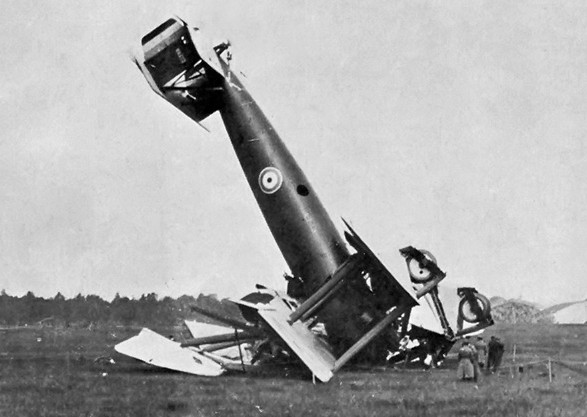
A Tarrant triplane, constructed at the Royal Aircraft Factory, Farnborough, was wrecked on a trial flight on Monday. The machine, which had six engines, each developing 500 horse power, after running along the ground toppled forward and seemed to bury itself in the earth. One of the pilots… Captain Rawlings, has died, and the other, Capt. Dunn, is in a very grave condition.

[Waterford Standard: Wednesday 28th May 1919]

Captain Percy Rawlings’ Tarrant triplane after the crash

Captain Dunn also died in the crash, which happened on 26th May 1919. Percy was 31 years of age when he died.

A close friend, Henry Edmunds, wrote to the Flight Magazine to express his sympathy at the loss:

As a boy, Rawlings was always interested in scientific matters, particularly photography and motors..

He was manly, open, and frank, fearless and honest, of an enquiring mind, and fond of experimenting. I remember his pre-heating paraffin vapour electrically, as a fuel for explosive engines…

It was at my house at Brighton that Rawlings met Mr. W. G. Tarrant, who was spending the week-end with me. Rawlings had just returned from the famous flight in the Handley Page to Constantinople, where he bombed the ‘Goeben.’ I remember his describing vividly his impressions of that memorable journey. If I recollect correctly, he motored down to Folkestone somewhat rapidly. He told me he believed the police were on the look-out for him for exceeding the speed-limit; but he went from Folkestone by air, proceeding to Naples. It was delightful to hear him recount that remarkable voyage. Their fears lest they should not be able to cross some of the high mountain ranges with the heavy load they were carrying, and where, had anything happened, they would have been out of the reach of all human aid. How he availed himself of a special camera for photographing portions of his trip, the results of which he feared it might be unwise to disclose at that time, so he brought the negatives back with him, and I believe they wore kept personally until after the War.

He and Mr. Tarrant were mutually attracted to each other, and discussed with much seriousness the construction of a new type of bombing-plane, which eventuated in the great Tarrant machine. Rawlings joined Tarrant shortly afterwards, and devoted all his energies to carrying on the work of design and construction. On several occasions he came down to see me, and related his experiences. He was full of confidence as to the future of his work; and invited me to take my first flight with him.

Townley Rawlings was a gallant gentleman. Those whom the gods love are taken early.

[Flight Magazine: 29th May 1919]

The speeding incident is an interesting anecdote, another similar incident recorded in a separate newspaper report:

Chauffeur Summoned for Fast Driving

Capt. Rawlings, who was killed in the Tarrant triplane accident, should have appeared as a witness yesterday in the Kingston court.

His chauffeur, Arthur B Cogger, of West Byfleet, summoned for exceeding the limit, was driving Captain Rawlings to Farnborough on Saturday, before the accident.

He said the captain told him he wanted to get along as quickly as possible as he was going to test an aeroplane. He had intended to come to court.

The summons was dismissed.

[Dublin Daily Express: Saturday 31st May 1919]

Percy Townley Rawlings was laid to rest in Highgate Cemetery, possibly close to where he or his family had been living.


Serjeant Richard Ford

Serjeant Richard Ford

Richard Oscar Ford was born in Williamstown, Australia, in July 1891. The oldest of four children – and the only son – his parents were Anthony and Mary Ford. Anthony was a soldier, but Richard chose a different route and took work as a labourer when he completed his schooling.

There is little information available about Richard’s early life, but when war broke out, he stepped up to play his part. He enlisted in the Australian Imperial Force on 9th November 1914.

By this point he was working as a bushman, and his service papers reveal something of the man he had become. Standing 5ft 7ins (1.7m) tall, he weighed 140lbs (63.5kg), Private Ford had auburn hair, blue eyes and a fair complexion.

Assigned to the Light Horse Regiment, Richard left Australia for Europe on in March 1915. His unit arrived on the Gallipoli Peninsula on 15th July, and he would remain there for the next five months.

In December 1915, Richard came down with a bout of influenza, and was medically evacuated to the island of Mudros, then on to Alexandria, Egypt. In January 1916, he was admitted to hospital again, this time suffering from gonorrhoea and, after treatment, he re-joined his unit on 2nd February.

Private Ford’s unit spent that spring training in Egypt, but on 29th May, they set sail for the Western Front. Within a week they had disembarked in the French port of Marseilles and headed north to Etaples.

The next couple of years would prove a little disjointed. Richard switched units in August 1916, and given the rank of Gunner, but within two months his role had changed to Driver. His service records suggest that he managed to avoid injury during the fighting he was involved in, but that did not mean that he avoided hospital completely.

In January 1917 Driver Ford was admitted to the 51st General Hospital with a heart murmur, returning to his unit on 16th March. He had a second spell in hospital in February 1918, having come down with laryngitis.

In July 1918, having spent some time at the 4th Army Corporal School, Richard was reassigned to the 3rd Australian Field Artillery. This move seemed to have been the focus he needed. Initially promoted to Bombardier, within a month he rose to Lance Corporal, and by December 1918 he was a full Sergeant.

After the Armistice was signed, Richard was given three weeks’ leave, which he spent in Britain. By January 1919, however, his health was becoming an issue again, and he was admitted to the military hospital in Fovant, Wiltshire, suffering from influenza. The condition worsened, and Sergeant Ford passed away from bronchopneumonia on 4th February 1919. He was 27 years of age.

Richard Oscar Ford was laid to rest in Highgate Cemetery, Middlesex. While there seems to be no direct connection between the location and the man, his father, Anthony, had been born in Hackney, so it can be assumed that there was a family link to the area.


Private Frank Buck

Private Frank Buck

Frank Ernest Brydgnes Buck was born in Islington, Middlesex, early in 1889, his mother’s name was Rosina, but his father’s details have been lost to time, the 1901 census confirming that she was a widow. The document notes that Frank was the youngest of four children, and the family had taken rooms in a three-storey house on Yerbury Road.

By the summer of 1917, Frank had emigrated to Australia. Settling in the town of Inverell, New South Wales, he took employment as a clerk. However, when war came to Europe, he was called on to play his part, and enlisted in the Australian Imperial Force on 16th July 1917.

Private Buck’s service records confirm that he was 5ft 11.5ins (1.82m) tall and weighed 11st 4lbs (71.7kg). He was recorded as having dark hair, blue eyes and a dark complexion. He had a burn scar on his right forearm, and a third nipple on the right side of his chest.

Frank’s unit departed from Sydney on 31st October 1917, and he spent the next two months on board the SS Euripides. During that time he was promoted to Acting Corporal and, when he disembarked in Devonport, Devon, on 26th December, he marched to the ANZAC camp in Fovant, Wiltshire.

Assigned to the 5th Training Battalion, Frank seems to have taken this unexpected return to Britain as a free ticket home: on 6th February 1918 he went AWOL, and only surrendered back to his unit on 9th April. Help in detention for a day, he forfeited 63 days’ pay, and was demoted to the rank of Private for his actions.

On 13th May, Private Buck was dispatched to France. He was assigned to the 17th Battalion of the Australian Infantry, but his time overseas was not to be a lengthy one. In July he was admitted to the 5th Australian Field Ambulance with gastritis: he was then transferred to the 5th Casualty Clearing Station, then the 3rd General Hospital in Le Treport. Medically evacuated to Britain for treatment, he ended up in Reading War Hospital for ongoing treatment.

Placed on furlough on 16th September, Private Buck went AWOL again on just two weeks later. Arrested on 26th November 1918, he was hauled before a judge at Highgate Police Court: his crimes amounted to being absent without leave, but also stealing three blank cheques and forgery. Pleading guilty, he was sent to Wormwood Scrubs for nine months.

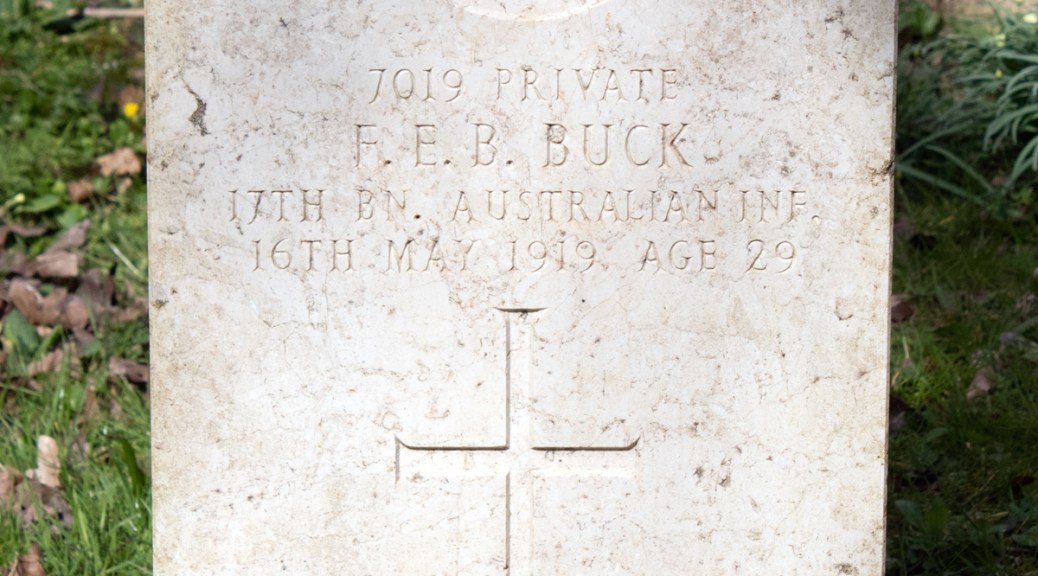
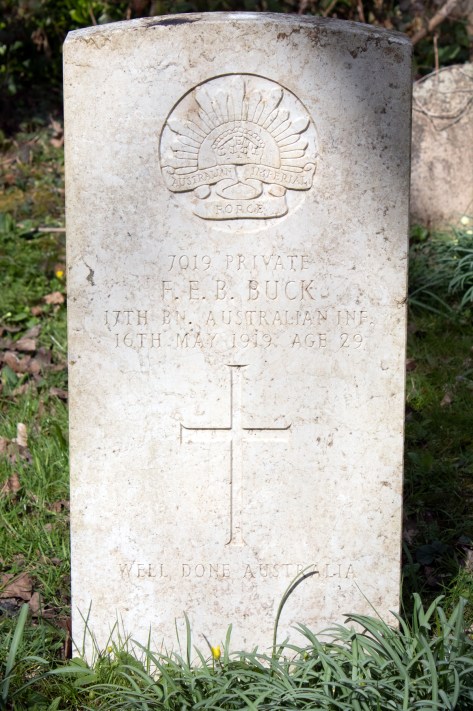
Frank would not end up serving his time, however. He was admitted to the infirmary with a perforated duodenal ulcer, and died from exhaustion on 16th May 1919. He was 29 years of age.

Frank Ernest Brydgnes Buck was laid to rest in Highgate Cemetery.


Private Joseph Walls

Private Joseph Walls

Joseph Walls was born in Tortington, near Arundel, in West Sussex, on 13th November 1880. The youngest of four children, his parents were gamekeeper James Walls and his wife Annie. James moved the family to where his work took him and, by the time of the 1891 census, they had settled in the New Forest village of Sway, Hampshire.

When Joseph finished his schooling, he found work as a horseman and groom. The 1901 census found him living with his parents and older sister in a house in Brockenhurst. He seems to have taken his work seriously, and soon found himself a position as a chauffeur. The next census, taken in 1911, recorded him as working for Ann Libbey and her family in the village of Boldre.

On 18th February 1914, Joseph married Edith Perry. A carpenter’s daughter, she was working as a domestic servant when the couple exchanged vows. Their wedding certificate confirms that Joseph was ten years his new wife’s senior, and that they ceremony was witnessed by his older brother Frederick and her younger sister, Esther.

Joseph and Edith would go on to have two children: Vera was born in 1915, while Daphne came along three years later. During this time, however, war was raging across Europe, and Joseph had stepped up to play his part.

Private Walls enlisted within weeks of war being declared, on 10th December 1914. His service papers show that he was living at Hospital Cottage in Lyndhurst when he joined up. He was 5ft 8ins (1.72m) tall, with black hair, grey eyes and a dark complexion. He was also noted as being asthmatic since he was a child.

Assigned to the 1st/4th Battalion of the Hampshire Regiment, over the next few years, Private Wallis would see the world. Within days of enlisting, he was shipped out to India, where he would spend nearly three years (apart from the in the summer of 1917, when he served as part of the Mediterranean Expeditionary Force). During this time, Joseph was promoted to Lance Corporal, although by the time he left the army, he had returned to the tank of Private.

By the beginning of September 1917, Joseph was back on home soil. A spell of malaria that spring had impacted his asthma, and at the end of November, he was deemed no longer fit for war service. Private Walls was medically discharged from the army on 29th November 1917.

At this point, Joseph’s trail goes cold. He definitely returned home – Daphne was born just a few days after the Armistice – but it is unclear whether he was it enough to work.

Joseph Walls died on 14th February 1919: he was 38 years of age. He was laid to rest in Lyndhurst Cemetery, not far from where Edith and their children lived.


Private Joseph Walls
(from ancestry.co.uk)

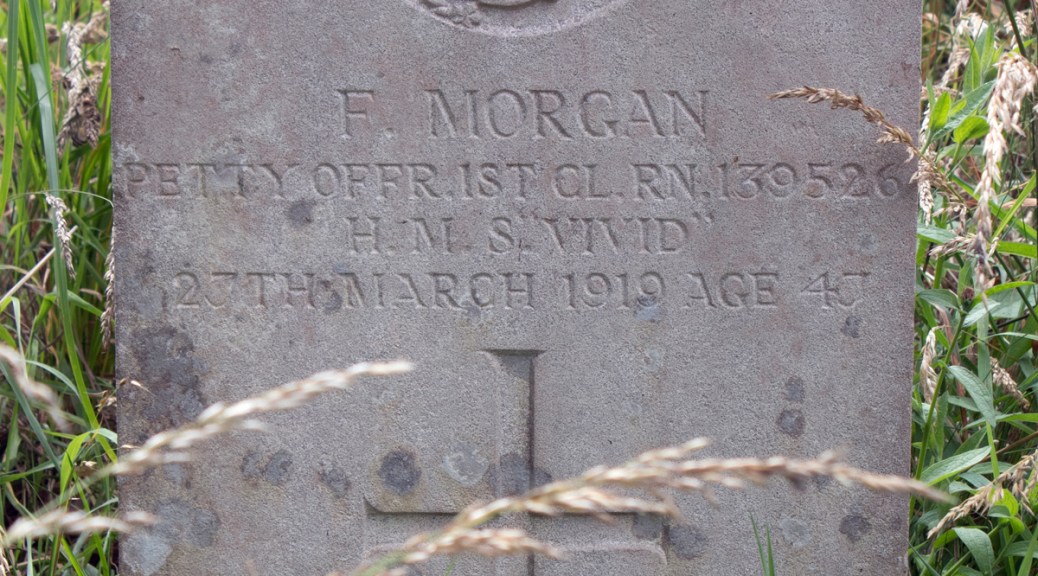
Petty Officer 1st Class Frederick Morgan

Petty Officer 1st Class Frederick Morgan

Frederick Morgan was born on 15th July 1871, the oldest of four children to Samuel and Selina. Samuel was a miner from Bristol, Gloucestershire, but it was in the Staffordshire town of Tipton that he and local girl Selina married and raised their family. The 1881 census found the Morgans living at 17 Brewery Street, to the south of the town centre.

Frederick was not destined to follow in his father’s footsteps, however, and had his sights set on a life at sea, rather than in the depths of a coal mine. On 23rd November 1896 he joined the Royal Navy, and was sent to HMS Impregnable, the training base in Devonport, Devon, for his induction.

Being too young to formally enlist, Frederick was given the rank of Boy 2nd Class. Over the next three years, he learnt the tools of his trade, and served at three further bases: HMS Lion, HMS Penelope and HMS Raleigh. During this time, he was promoted to Boy 1st Class and, on 15th July 1889, when he turned 18, he was formally inducted into the Royal Navy.

Ordinary Seaman Morgan’s service records show that he was just 5ft 2.5ins (1.59m) tall. He had light brown hair, blue eyes and a fair complexion. He also had a tattoo by this point, of a dancing sailor on the inside of his right arm.

Frederick remained at HMS Raleigh for the next couple of years, and was promoted to Able Seaman on 1st July 1891. From the autumn, however, his sea-going life really took hold. Over the next ten years, he served on five ships, and was to be based at HMS Vivid, the Royal Naval Dockyard in Devonport, in between voyages. His dedication to the service was recognised – his annual reviews regularly noted his character as very good, and he rose through the ranks to Leading Seaman in May 1898, Petty Officer 2nd Class that October, and Petty Officer 1st Class in January 1901.

Away from work, Frederick’s love life was blossoming. In the autumn of 1893 he married Zipporah Elizabeth Beatrice Griffiths. Better known as Beatrice, she was the daughter of waterman Thomas Griffiths and his wife, Zipporah. The family came from Dartmouth, and this is likely where the young couple got to know each other. They married in St Clement’s Church, Dartmouth, and went on to have two children, George and Kathleen.

On 15th July 1901, Petty Officer Morgan’s initial contract with the Royal Navy came to an end. He renewed it straight away, and would spend the next decade sailing the world. Again Frederick was based at HMS Vivid in between voyages. On 11th July 1911, after 21 years in service, he was formally stood down to reserve status, and he returned to shore.

Frederick’s trail goes cold over the next couple of years, but when war broke out, he was called into service once more. Petty Officer Morgan would serve on the depot ships HMS Leander and Cyclops, which served out of Scapa Flow. He also spent time at HMS Gunner, the naval base to the north of Edinburgh. By March 1919, with the Armistice signed, he found himself based back in Devon.

At the Royal Naval Hospital, Plymouth, on Saturday, an inquest was held relative to the death of Fredk Morgan, 47, a naval pensioner, who died suddenly in the train on Thursday last.

Wm. Griffiths, inspector, GWR, at Millbay, said that PO Morgan was removed from the 6.20 train from Saltash on Thursday, apparently in a fit. He was laid on a seat, and a doctor who was about to travel on another train pronounced life extinct.

Charles Evans Jenkins, surgeon-lieutenant at the Naval Hospital said death was due to fatty degeneration of the heart.

The Coroner, who expressed his sympathy with the widow, declared that death was due to natural causes.

[Western Times: Tuesday 1st April 1919]

Frederick Morgan died of a heart attack on 27th Match 1919. He was laid to rest in the graveyard of St Clement’s Churchyard, Dartmouth, where he and Beatrice had been married.


Lance Corporal Thomas Thorne

Lance Corporal Thomas Thorne

Thomas Thorne was born in Tiverton, Devon, in the spring of 1895. The older of two children, he was the only son to Thomas and Louisa Thorne. Thomas Sr was a carriage manufacture for a lace factory, and by the time of the 1911 census, the family of four were living in a small terraced house at 19 John Street in Tiverton.

At this point, Thomas Jr had completed his schooling, and had also found work at the lace factory. War was on the horizon, however, and things were to change.

On 6th December 1915, Thomas Jr made his way to Exeter to enlist. He joined the Devonshire Regiment as a Private, and his service records show that he was 5ft 4.5ins (1.63m) tall and weighed 112lbs (50.8kgs). He was of fair physical development, although there were issues with his teeth and he had a higher than normal heart rate.

Private Thorne was formally mobilised in July 1916. Initially assigned to the 13th (Works) Battalion, he spent his time on home soil. By the following spring, he transferred to the 311th Home Service Labour Company, and seems to have moved from Devon to Hampshire.

Thomas spent the next three years serving in the Labour Corps. By the winter of 1918/19, his health was becoming impacted, and he was admitted to the Shirley Warren Auxiliary Hospital in Southampton, suffering from a combination of influenza and pneumonia. The conditions were to prove fatal, and he passed away on 17th February 1919, aged just 24 years of age.

Thomas Thorne’s body was taken back to Devon for burial. He was laid to rest in Tiverton Cemetery, not far from the family home.


Interestingly, Thomas’ rank differs depending on the document you are looking at. I have used Lance Corporal, as this is what is recorded by the Commonwealth War Graves Commission, although his service papers state he was a Private.


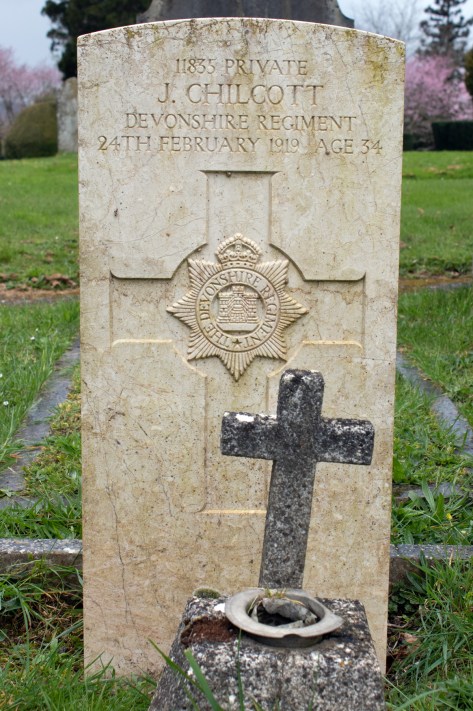
Private James Chilcott

Private James Chilcott

James Chilcott was born in Eccles, Lancashire, in the autumn of 1885. One of twelve children, his parents were William and Mary Chilcott. William seemed to be able to turn his hand to most things: the 1891 census recorded him as a hawker of fish, while ten years later he was employed as an insurance agent.

The Chilcotts had moved to Tiverton in Devon in around 1891, setting up home on St Andrew’s Street, to the south of the town centre. James initially found work as a bookseller’s assistant when he left school, but things were to change.

In the autumn of 1908, James married Mabel Candey. The couple moved to Nottinghamshire, settling in the village of Cresswell, where they lived in a small cottage at 6 John Street. James had found work as a coal miner in the area, which had taken the couple away from the comfort of Devon.

Over the next four years, James and Mabel would have four children, all of whom died before they celebrated their first birthday. The series of tragic events may have driven a need for Mabel to be with family, and by 1913, the couple had moved back to Tiverton. Daughter Dorothy was born in 1914.

When conflict his Europe the following year, James stepped up to play his part. Full details of his military service hare long since lost, but it is clear that he enlisted in the Devonshire Regiment, and had done so at the beginning of the war.

Attached to the 2nd Battalion, Private Chilcott was in France by 9th February 1915. Over the next few years, the unit saw fighting in most areas of the Western Front, including the Somme and Ypres. It is unclear how much of this James was involved in, but it is unlikely that he would have come away completely unscathed.

Pte. James Chilcott, of the 2nd Devons, who went through the dispersal camp at Fovant on February 20, died at Exeter on Monday from influenza. A son of Mr WH Chilcott, of St Andrew-street, Tiverton, he joined up at the beginning of the war, and had seen considerable service. He leaves a widow and one child.

[Western Times: Wednesday 26th February 1919]

James Chilcott died on 24th February 1919: he was 33 years of age. His body was taken back to Tiverton for burial, and he was laid to rest in the town’s cemetery.


“He leaves a widow and one child” does no justice to the pain that Mabel had to go through, having lost four children and her husband in a matter of six years. The 1921 census recorded her living on St Andrew Street with Dorothy, and showing she was undertaking home duties. She had two lodgers, who helped bring in a little more money.

Mabel Chilcott never remarried: she passed away in Tiverton in January 1946, at the age of 62.