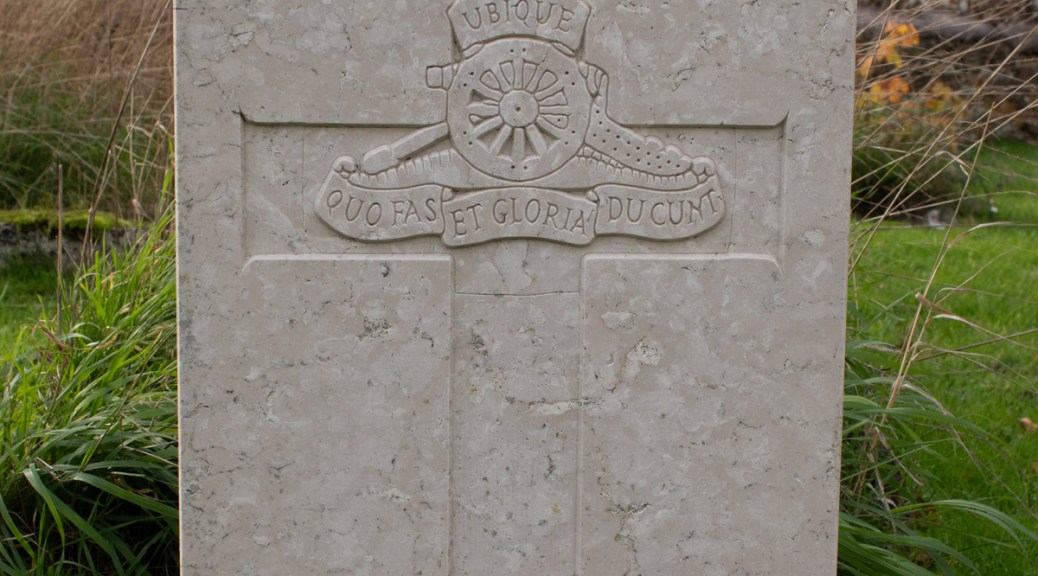
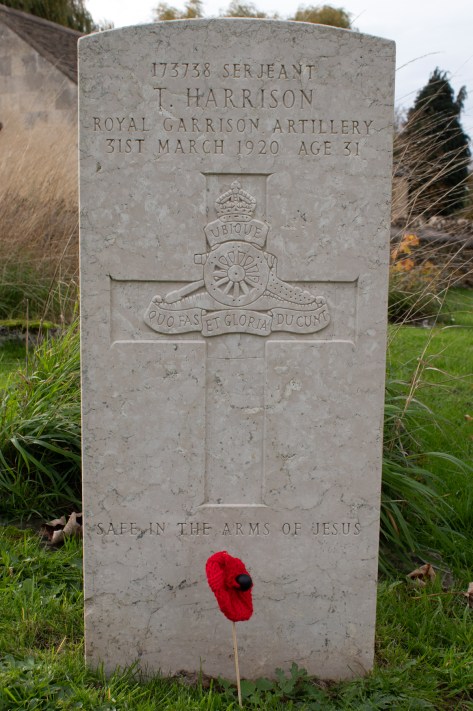
The life of Thomas Harrison, buried in Holt Old Cemetery, Wiltshire, is a challenge to unpick. No service papers remain, but the Commonwealth War Graves Commission note that he was married to Annie Harrison, who lived in Trowbridge, Wiltshire.
The couple do not appear together in the 1911 census, so it is likely that they exchanged vows after this date. There is a Thomas Harrison recorded in the return: he was an Acting Bombardier in the Royal Horse Artillery, billeted in the barracks in Trowbridge. It is likely that he is the gentleman buried in Holt Cemetery, but it cannot be confirmed either way.
Acting Bombardier Harrison was born in Motherwell, Lanarkshire, in around 1889, but his name is not uncommon, so it is not possible to identify his parents or early life.
Thomas served during the First World War, rising to the rank of Serjeant in the Anti-Aircraft Depot of the Royal Garrison Artillery. He and Annie had two children: Vera, who was born in 1912, and Ivy, who was four years younger.
When the Armistice was declared, Serjeant Harrison returned home, but, in the spring of 1920, he suffered a bout of gastritis. The condition was to prove fatal, and he passed away on 31st March 1920. He was 31 years of age.
The body of Thomas Harrison was laid to rest in Holt Old Cemetery, not far from where Annie and the girls lived.
Walter James Ricketts was born in the summer of 1893, the fifth of ten children to James and Elizabeth (and, tragically, the first to survive childhood). James was a farm labourer from the Herefordshire village of Dilwyn, and this is where the family were born and raised.
When he completed his schooling, Walter found work as a groom. The 1911 census recorded him as living at the Moorhampton Hotel, seven miles (11km) to the south west of his home. His employer, Edith Pearman, is recorded as a hotel keeper and farrier, and he was one of two live-in staff.
Walter married Lucy Godwin in the spring of 1918. The oldest daughter of a clerk, she had been born in Lugwardine, near Hereford. By the time the couple married, Walter had enlisted in the army, and was serving in the Royal Field Artillery.
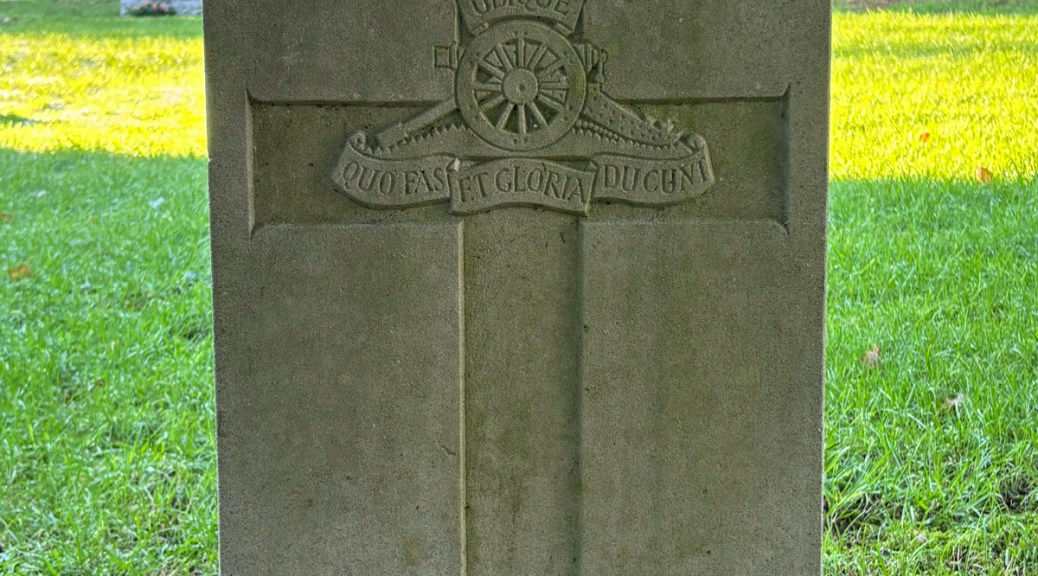
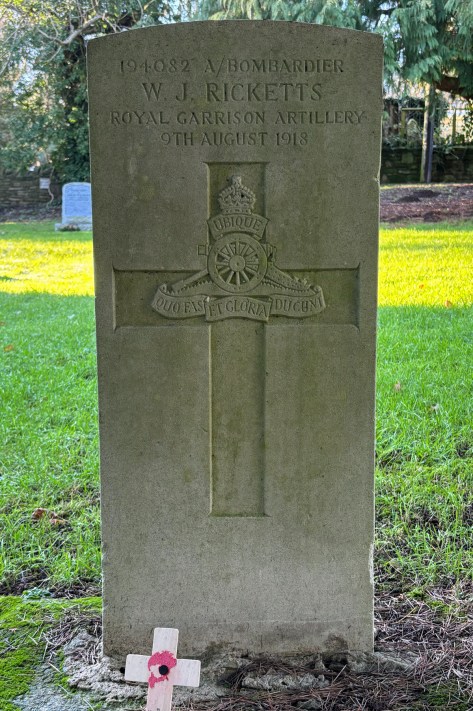
Full details of Gunner Ricketts’ service have been lost, but it is clear that he made the move to the Royal Garrison Artillery at some point. By the summer of 1918, the newly promoted Acting Bombardier was attached to the 57th Company, and based at a gun station in Dulwich, Surrey.
The only other record for Walter is his Pension Ledger card. This confirms that he died on 9th August 1918, following accidental contact with an electric current. There is no further information about the incident, but he was 25 years of age when he died.
The body of Walter James Ricketts was taken back to Herefordshire for burial. He was laid to rest in the tranquil setting of St Mary’s Churchyard in his home village, Dilwyn.
Richard Oscar Ford was born in Williamstown, Australia, in July 1891. The oldest of four children – and the only son – his parents were Anthony and Mary Ford. Anthony was a soldier, but Richard chose a different route and took work as a labourer when he completed his schooling.
There is little information available about Richard’s early life, but when war broke out, he stepped up to play his part. He enlisted in the Australian Imperial Force on 9th November 1914.
By this point he was working as a bushman, and his service papers reveal something of the man he had become. Standing 5ft 7ins (1.7m) tall, he weighed 140lbs (63.5kg), Private Ford had auburn hair, blue eyes and a fair complexion.
Assigned to the Light Horse Regiment, Richard left Australia for Europe on in March 1915. His unit arrived on the Gallipoli Peninsula on 15th July, and he would remain there for the next five months.
In December 1915, Richard came down with a bout of influenza, and was medically evacuated to the island of Mudros, then on to Alexandria, Egypt. In January 1916, he was admitted to hospital again, this time suffering from gonorrhoea and, after treatment, he re-joined his unit on 2nd February.
Private Ford’s unit spent that spring training in Egypt, but on 29th May, they set sail for the Western Front. Within a week they had disembarked in the French port of Marseilles and headed north to Etaples.
The next couple of years would prove a little disjointed. Richard switched units in August 1916, and given the rank of Gunner, but within two months his role had changed to Driver. His service records suggest that he managed to avoid injury during the fighting he was involved in, but that did not mean that he avoided hospital completely.
In January 1917 Driver Ford was admitted to the 51st General Hospital with a heart murmur, returning to his unit on 16th March. He had a second spell in hospital in February 1918, having come down with laryngitis.
In July 1918, having spent some time at the 4th Army Corporal School, Richard was reassigned to the 3rd Australian Field Artillery. This move seemed to have been the focus he needed. Initially promoted to Bombardier, within a month he rose to Lance Corporal, and by December 1918 he was a full Sergeant.
After the Armistice was signed, Richard was given three weeks’ leave, which he spent in Britain. By January 1919, however, his health was becoming an issue again, and he was admitted to the military hospital in Fovant, Wiltshire, suffering from influenza. The condition worsened, and Sergeant Ford passed away from bronchopneumonia on 4th February 1919. He was 27 years of age.
Richard Oscar Ford was laid to rest in Highgate Cemetery, Middlesex. While there seems to be no direct connection between the location and the man, his father, Anthony, had been born in Hackney, so it can be assumed that there was a family link to the area.
Frank Sloman was born in the autumn of 1887, and was the youngest of five children to Frank and Emma. Frank Sr was a mason from Jersey, in the Channel Islands, but it was in Tiverton, Devon, that he and Emma made their home and raised their family. The 1891 census found the family living on Castle Street, but by 1901 they had moved down the road to St Peter’s Street.
Frank Jr found work as a painter when he finished his schooling, but he sought adventure and a career. He was already a volunteer for the Devonshire Regiment, and, on 7th May 1904, he officially enlisted as a paid member of the troop. Private Sloman’s records show that he was 5th 10.5ins (1.79m) tall, and weighed 129lbs (58.5kg). He was noted as having brown hair, grey eyes and a fresh complexion.
Private Sloman spent two years on home soil. He quickly extended his contract, and this led to more opportunities. By December 1906 his unit was in India, and he would go on to spend five and a half years there.
In December 1907, Frank transferred to the Royal Garrison Artillery. He initially held the rank of Gunner, before being promoted to Bombardier in January 1912, and Corporal just three months later. In October, Frank returned to Britain, and was stood down to reserve status. He returned to Tiverton, and found work as a porter at the local station.
War was on the horizon, however, and when conflict broke out, Frank was called upon to play his part once more. Initially taking up the rank of Corporal in the Royal Field Artillery, he reverted to the role of Gunner at his own request. By this point, his unit was in France, and he would remain there for the next eight months.
On 6th May 1915, Frank returned to Britain, and was attached to 2B Reserve Brigade. He was based at the training facility in Bettisfield Park in Clwyd, and would spend the next eighteen months there. In June 1916, he was once again promoted to the rank of Bombardier.
Love was on the cards, and, on 17th June 1916, Frank married Frances Hadlow. There is little information available for her, but the couple exchanged vows at the Register Office in Windsor, Berkshire.
By the autumn of 1916, Frank’s health was becoming an issue. He contracted phthisis, or tuberculosis, and was sent to the the south coast for recuperation. His condition would ultimately render him unfit for continued military service, and Bombardier Sloman was discharged from the army on 17th December 1916.
His papers show that he had grown to 6ft 2.5ins (1.89m) in height, and, while physically unfit, he was a steady, sober and reliable man. He and Frances had taken rooms at 7 Hawley Street, Margate, Kent, but it seems that the couple soon moved back to Devon. Their new home was a small cottage at 3 Westbrook Place in Tiverton.
At this point, Frank’s trail goes cold. It is unclear whether he took up work again – or was able to do so – but his lung condition was ultimately to get the better of him. He passed away on 3rd June 1918, at the age of 30 years old.
Frank Sloman was laid to rest in Tiverton Cemetery, on the outskirts of the town in which he had grown up.
Frederick William Lavers was born in Paignton, Devon, on 5th November 1889. The middle of five children, and the only son, his parents were John and Jane Lavers. John was a carman, and the family had rooms in a house on Winner Street in the town.
When Frederick finished his schooling, he found work as a butcher’s boy. This wasn’t the career for him, however, and, on 16th January 1905, he signed up to join the Royal Navy. His service records suggest that he had said he was a year older, and confirm that he was 5ft 3ins (1.6m) tall, with light brown hair, blue eyes and a fresh complexion.
As he was under the age to formally enlist with the Royal Navy, Frederick was given the rank of Boy, and dispatched to HMS Vivid, the dockyard in Devonport, for his training. Something was amiss, however, and, after eighteen months, he was discharged as being unsuitable.
Undeterred, Frederick tried another tack and, on 26th April 1909, he enlisted in the Royal Garrison Artillery. By the time of the 1911 census Gunner Lavers was stationed at West Ridge in Rawalpindi, India. There is little information available about his service, however, and Frederick is only picked up again on 30th December 1918.
At this point, the now Acting Bombardier Lavers was put on a hospital train from Marseilles, as he was suffering from psoriasis. He disembarked three days later in Le Havre, and, is appears, then returned to Britain for treatment. On 24th February 1919 he was medically discharged from army service, and awarded the Silver War Badge.
Frederick’s trail goes cold again after this. He appears to have returned home, and passed away on 20th October 1920. He was 28 years of age.
Frederick William Lavers was laid to rest in Paignton Cemetery, overlooking his home town.
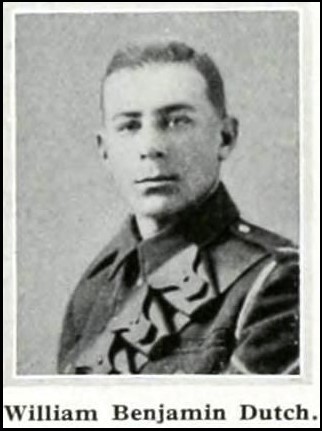
DUTCH, WILLIAM BENJAMIN, Sergt., No. 83812, 47th Brigade, Royal Field Artillery, [son] of William Dutch, of Bladud House, Bath, Accountant, by his wife, Alice, [daughter] of Alderman Alfred Taylor, of The Red House, Bath; b. Lower Weston, Bath, 21 April 1894; educ. Bathforum, and Bath City Secondary School 93 years’ Scholarship), and was employed in the engineering works of Stothert and Pitt Ltd., of Bath. He joined the Army, 17th Aug. 1914; was made Bombardier, 1 November 1914; Corpl., 14 November 1914; and Sergt., 1 January 1915; and died at the Thornhill Isolation Hospital, Aldershot, 11 April 1915, of septic scarlet fever; [unmarried]. He was buried at Locksbrook Cemetery, Bath, will full military honours. His Capt. wrote: “I cannot exaggerate the loss he is to me personally and to the whole battery, had picked up a wonderful knowledge of gunnery and his work in general was out and out the best sergeant I had, and would have gone far in the service.” He was a keen sportsman and a popular football player.
[De Ruvigny’s Roll of Honour, 1914-1919]
William Benjamin Dutch was the second of five children to William and Alice. His father initially worked as a grocer and wine and spirit shopkeeper, and the 1901 census found the family living above the shop on the corner of Chelsea Road and Park Road, Bath.
By the time of the 1911 census, however, things had changed. The Dutches had moved to Walcot, nearer the centre of Bath, and William was working as a tramway clerk. Alice was running the family home – 3 Bladud Buildings – as a boarding house, and employed a housemaid and kitchen maid to help look after the lodgings.
William’s dedication to his army role – and his rapid rise through the ranks – is outlined in the article above. He seems, however, to have spent his time on home soil, remaining at his Hampshire base from his enlistment to his passing. His service records give an insight into his physical nature: he stood 5ft 6.5ins (1.69m) tall, and weighed 153lbs (69.4kg). He had light brown hair, grey eyes and a fresh complexion.
Serjeant Dutch’s illness seems to have come on him quickly:
On Sunday a telegram reached [his parents] saying that their son… was seriously ill in hospital at Aldershot. Mr Dutch went thither at once, only to find that his son had passed away. He was attacked last week with bronchial pneumonia, and tracheotomy was performed in the hope of saving his life, but in vain. The deceased was… a young soldier of rare promise and fine physique.
[Bath Chronicle and Weekly Gazette – Saturday 17 April 1915]
William Benjamin Dutch was just 20 years old when he passed away. His body was taken back to Somerset for burial. He was laid to rest in the family plot in Bath’s sweeping Locksbrook Cemetery, within sight of William Sr’s former shop on Chelsea Road.
Albert Edward Farvis Packer was born in Bristol, Gloucestershire, in 1890. The middle of three children, his parents were Francis and Eliza. Francis was a grocer, and when Albert finished his schooling, he worked as his father’s assistant.
Albert went on to work as a butcher’s manager for Messers. John Lewis and Sons in Midsomer Norton. By the time of the 1911 census, he was living in Batheaston with his parents and younger sister, Elsie. When war broke out, Albert stepped up to play his part, following in his older brother’s footsteps. He enlisted in Taunton on 9th December 1915: his service records showed that he was 5ft 10.5ins (1.79m) tall.
Gunner Packer was assigned to the Royal Garrison Artillery. Initially posted to a depot in Cornwall, he was soon assigned to the 173rd Siege Battery, and found himself in France by the beginning of October 1916. Albert remained overseas for the next fourteen months and, in March 1917, was appointed Acting Bombardier.
On 12th December 1917, Albert returned home on leave and, five days later, he married his sweetheart, stationery shop assistant Dorothy Flower, in St Paul’s Church, Bath. The couple made their way to Bristol, to stay with Dorothy’s parents, but Albert fell ill. He was admitted to the 2nd Southern General Hospital in Bristol, suffering from pleurisy and double pneumonia. The condition was to prove too much for his body, and he passed away, while still admitted, on 27th December 1917. He was just 27 years of age.
Albert Edward Farvis Packer was taken back to Bath for burial. He was laid to rest in the sweeping vista of the city’s Locksbrook Cemetery.
In less than a fortnight, Dorothy had become the blushing bride and a widow. She was to go on and find happiness, however. On 20th February 1920, she married Sapper Sidney Bethell, of the Royal Engineers. Their wedding was in Jamaica, where he was based, and the couple went on to have a daughter, Phyllis, the following year.
Sidney and Dorothy eventually settled in Hertfordshire. He died in 1953, at the age of 59: Dorothy passed the next 38 years as a widow again, passing away on 26th December 1991 – almost exactly 74 year after Albert – at the age of 93.
Albert’s older brother, Francis Packer, also fought and died in the First World War. His story can be found here.
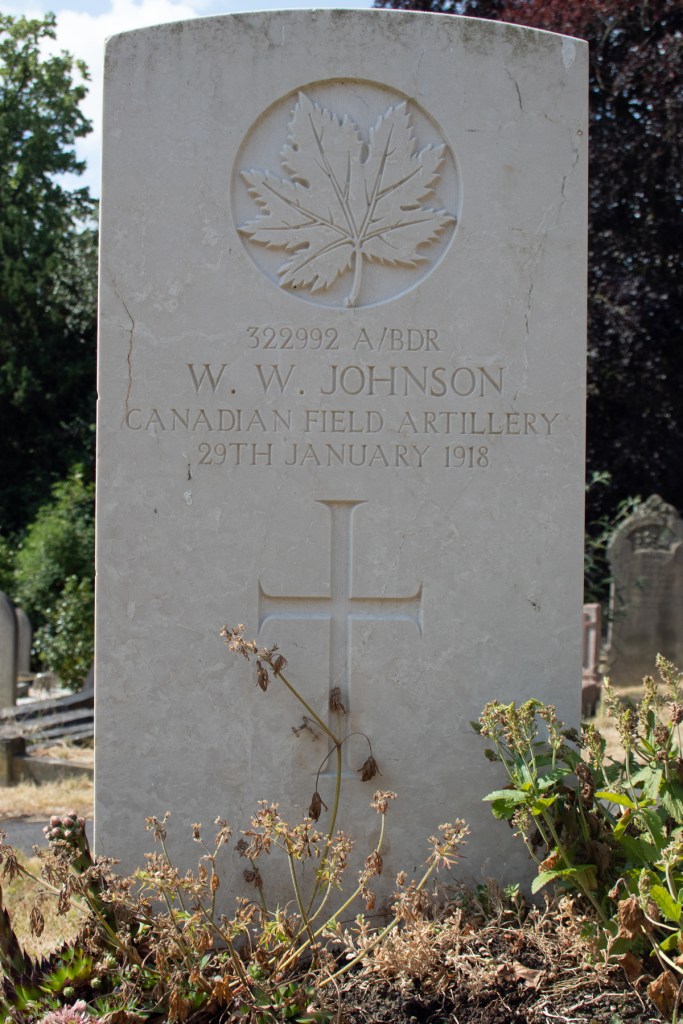
William Wilbur Johnson was born in Wingham, Ontario, Canada, on 25th August 1889, and was the son of John and Barbara Johnson. Little information is available about his early life, but he found work as a saddler when he finished his schooling.
In his free time, William volunteered in the 20th Border Horse Regiment. When war broke out in Europe, he was called upon to play his part, and joined the Canadian Expeditionary Force. His service records confirm he was 5ft 8ins (1.73m) tall, with brown hair, blue eyes and a dark complexion. He was also noted as having two scars both on his inner left forearm.
Private Johnson arrived in England in May 1916, and was initially billeted in Shorncliffe, Kent. He did not remain in Britain for long, however, and, assigned to the 2nd Brigade of the Canadian Field Artillery, he arrived in France on 1st June 1916. William would have been in the thick of things, caught up in the bloody stalemate of the Somme for most of the rest of the year.
In November 1916, William was promoted to Acting Bombardier. After a miserable winter on the Front Line, he became ill, and was admitted to a field hospital for a week with bronchitis and influenza. He recovered and remained on the Western Front during 1917, fighting at both Vimy Ridge and Passchendaele.
By the end of November 1917, Acting Bombardier Johnson’s health was suffering once more. He became jaundiced and, after some time spent in a field hospital, he was medically evacuated to Britain for further treatment. He was admitted to the Bath War Hospital in Somerset, with what turned out to be cirrhosis of the liver. This was something his body was unable to overcome: William passed away on 29th January 1918, at the age of 28 years old.
With all of his family overseas, it was not practical for the body of William Wilbur Johnson to be returned to Canada. Instead, he was laid to rest in the sweeping grounds of the Locksbrook Cemetery, not far from the hospital in which he had breathed his last.
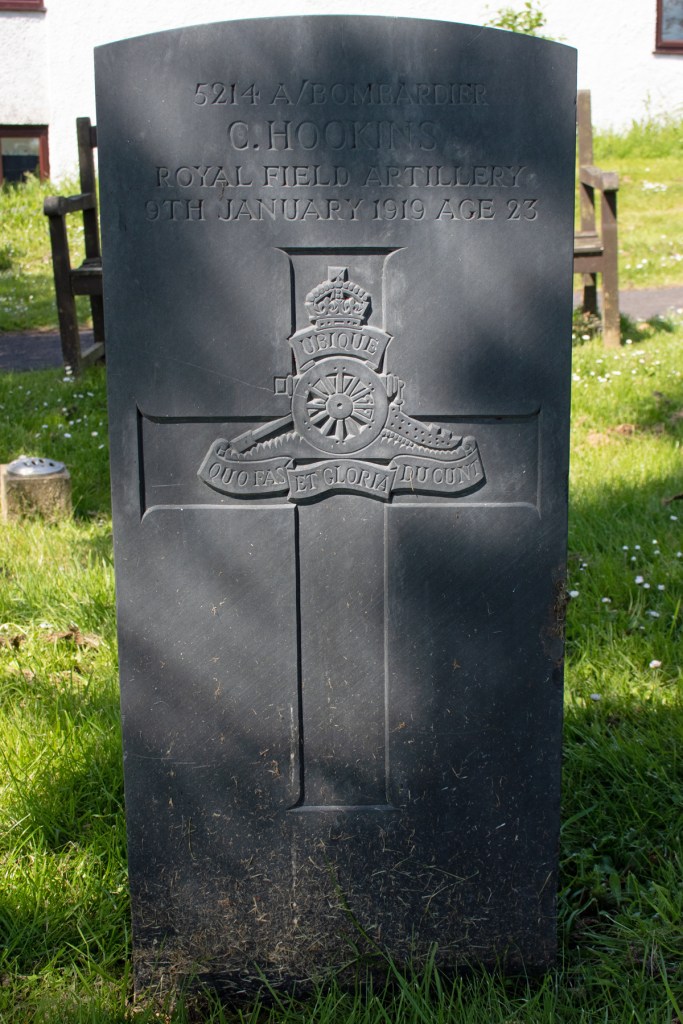
Charles Hookins was born on 15th October 1895 in Pawlett, Somerset. The eighth of nine children, his parents were William and Susan Hookins. William was a labourer in a brickyard, but when he finished his schooling, Charles went to work on his cousin’s farm in neighbouring Huntspill.
Farming was not what Charles had in his mind as a career, however, and on 7th April 1913, he joined the Great Western Railway. Initially employed as an engine cleaner, he was sent to work at the Duffryn Yard, South Wales. He soon moved on again, however, and by October 1913, he was living in Tondu, to the north of Bridgend, where he worked as an engine fireman.
War came to Europe in 1914, and, within weeks of hostilities being declared, Charles volunteered for service. He enlisted on 1st September 1914 in Bridgend, joining the Royal Field Artillery. His service records confirm that he was 19 years of age, stood 5ft 7.5ins (1.71m) tall, and weighed 135lbs (61.2kg). He was noted as having brown eyes, brown hair and a fresh complexion.
Gunner Hookins spent most of the next year on home soil training and became attached to the 57th Brigade. On 2nd August 1915 he set off for the Mediterranean, his troop unusually making their way across mainland France, rather than sailing around Spain and Portugal. They left European shores from Marseille on 7th August, and arrived at Suvla Bay on the Gallipoli peninsula just nine days later.
The 57th Brigade remained at Gallipoli for the next five months, and during this time, in November 1915, the now Acting Bombardier Hookins spent a week in the local field ambulance, through causes unknown.
Charles’ health seemed to be suffering by this point. On 17th January 1916, he was moved to Alexandria, Egypt, where he spent another week admitted to a field hospital. After a couple of months’ grace, he was transferred back to France, again disembarking at Marseille. After another week’s admission to hospital, he was invalided back to England, eventually arriving back home at the end of April.
Acting Bombardier Hookins had contracted pulmonary tuberculosis, and the risk to others, as well as his own health, led to him being discharged from military service on 15th July 1916, having served for just under two years.
Charles’ trail goes cold at this point. He returned home, but his medical condition was ultimately to get the better of him. He passed away on 9th January 1919, at the age of just 23 years old.
Charles Hookins was laid to rest in the quiet graveyard of St John the Baptist Church in his home village of Pawlett, Somerset.
Frederick Chilcott was born in Bridgwater, Somerset, early in 1867. He was the fifth of thirteen children to labourer and kiln worker Henry Chilcott and his wife, Ellen.
When he finished his schooling, Frederick also found labouring work. He wanted bigger and better things, however, and the opportunity for a career in the army offered him just that. On 14th January 1888 he enlisted in the Royal Artillery. His service records confirm he was 5ft 6ins (1.68m) tall, and weighed 119lbs (54kg). He was noted as having dark brown hair, dark hazel eyes and a fresh complexion. He also had a scar on his forehead and a tattooed dot on his right forearm.
Frederick was initially given the rank of Driver and was assigned to the regiment’s 3rd Brigade Depot. He was sent to India in February 1889, and remained there until November the following year, when his troop returned to Britain.
Back on home soil Frederick’s role changed and he was given the rank of Gunner. On 1st January 1892, he was promoted to Acting Bombardier, but, on his own request, he reverted to his previous rank just three months later. On 15th January 1895, Gunner Chilcott was stood down to reserve status, having completed seven years’ service.
On 16th April 1895, Frederick married Eliza Stockham. She was a labourer’s daughter from the village of Puriton, to the north of Bridgwater, and it was here that the couple settled. Living in a small cottage, they went on to have six children between 1898 and 1911.
Frederick’s time in the army, however, wasn’t quite done. With the Second Boer War breaking out, he was recalled to the now Royal Field Artillery in January 1900. Sent to South Africa, Gunner Chilcott remained overseas for a year and was recognised for his commitment in the campaign.
Frederick returned to Britain on 3rd January 1901, and was finally stood down from the army in March that year, having fulfilled his twelve years’ contract. He returned home to Puriton, his service records noting that his character was ‘very good’.
The 1911 census found Frederick employed as a labourer in the local cement works. He and Eliza living in a small cottage in Puriton with four of the children (their oldest son was with Eliza’s parents, while she was pregnant with their youngest).
Conflict was knocking on England’s shore by this point, and when conflict broke out, Frederick appears to have stepped up to play his part once more. He was 47 years old when war was declared and, as such, would not have been required to enlist. Full details of his service are no longer available, but he had certainly joined the Army Veterinary Corps by the summer of 1917.
Private Chilcott is likely to have remained on home soil, but towards the end of his service was based in Curragh, County Kildare, Ireland. It was while here, on 23rd December 1917, that he suffered an aneurysm, passing away in the town’s military hospital as a result. He was 50 years of age.
Frederick Chilcott’s body was brought back to Somerset for burial. He was laid to rest in the quiet graveyard of St Michael’s Church in his home village, Puriton.









 Death and Service