Tag Archives: bronchitis

Sapper Walter Wigginton

Sapper Walter Wigginton

Walter Wigginton was born in the Leicestershire village of Illston-on-the-Hill in the summer of 1880. The second of seven children, his father John was a grazier, managing cows over a six-acre pasture. His mother, Rebecca, who was also born in Leicestershire, raised the family and managed the home.

Walter turned his hand to carpentry, and, by the time of the 1901 census, he was boarding with a widow in Frimley, Surrey, employed for his woodworking skills. By 1905, his journeyman life had taken him to the Somerset village of Trull. It was here that he met and married Annie Oaten, and here that the couple settled down to raise their family. They had two children, Dorothy, born in 1906, and Winifred, who was born two years later.

War was closing in on Europe and, by the summer of 1916, Walter had joined up to play his part. Initially assigned to the 65th Training Reserve Battalion, he had not long transferred across to the Royal Engineers as a Sapper when he fell ill.

Sapper Wigginton was admitted to the Kinmel Park Military Hospital near Abergele on the North Wales coast, suffering from bronchial pneumonia. Sadly, this lung condition was to get the better of him, and he passed away at the hospital on 29th December 1916, at the age of 36 years old.

Walter Wigginton’s body was brought back to Somerset for burial. He was laid to rest in the graveyard of All Saints’ Church in Trull, where his widow and children still lived.
Private Albert Blackwell

Private Albert Blackwell

Albert Edward Blackwell was born in Corfe, Somerset, in the autumn of 1872. He was the third of eight children to Francis and Harriet Blackwell. Francis was a farm labourer, while Harriet supplemented their income by taking in washing. Albert didn’t follow in his father’s footsteps, however, but found work as a ropemaker when he left school.

On 21st September 1905, Albert married Mabel Hellen Fry, a factory hand and porter’s daughter from Wellington, Somerset. The couple began their married life living with Mabel’s parents, and went on to have five children. By the time of the 1911 census, Albert was working as a carter for a local coal merchant, but war was on the way.

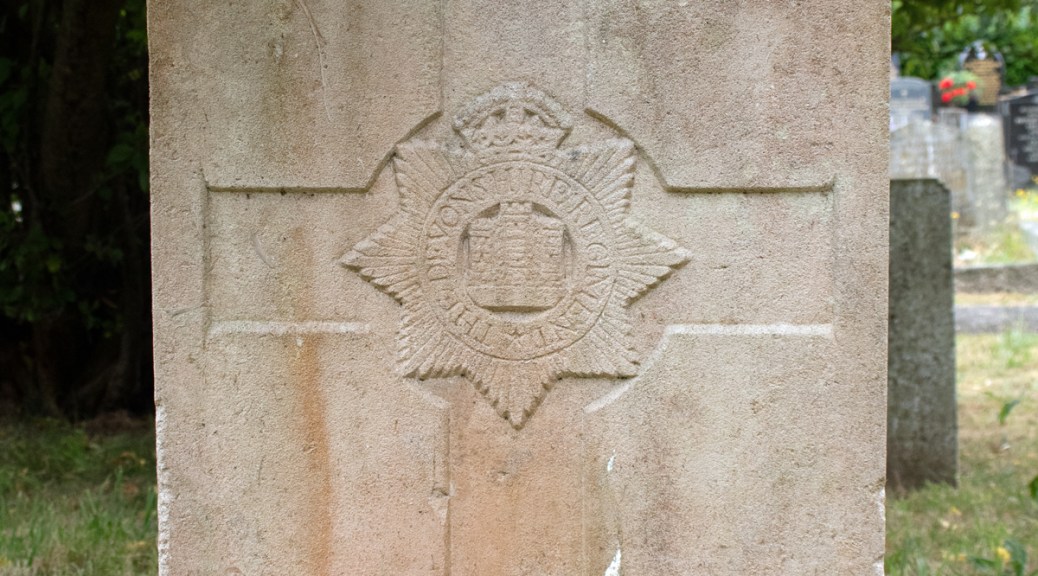
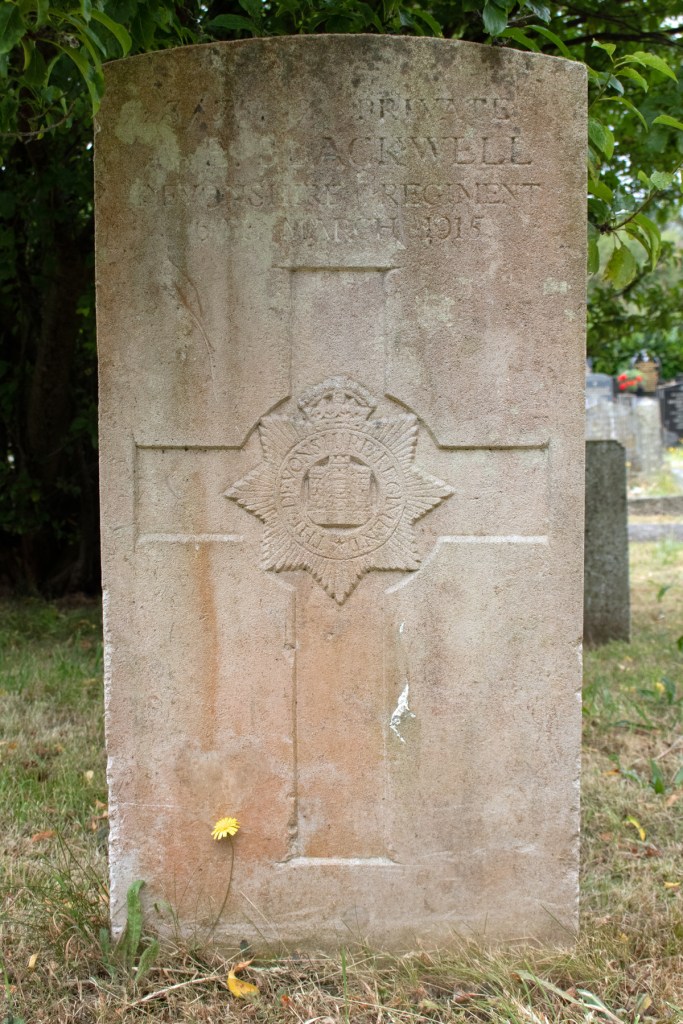
There is little information available about Albert’s military service. He enlisted at the start of the conflict, joining the 9th Service Battalion of the Devonshire Regiment by September 1914. Private Blackwell was based at Aldershot, Hampshire, but his service was not to be a long one.

Albert was admitted to the Connaught Military Hospital near Marlborough, suffering from tuberculosis. This became bronchitis, and the lung conditions proved too much for Private Blackwell’s constitution to take. He passed away at the hospital on 6th March 1915, at the age of 42 years old.

Albert Edward Blackwell was brought back to Somerset for burial. He was laid to rest in Wellington Cemetery, not far from where Mabel was still living.


Now widowed, Mabel still had children to raise. In the spring of 1916, she married Alfred Barnfield, a greengrocer from Bath. He had served in the Coldstream Guards for two years, before he was discharged for misconduct in May 1911. Sadly, no further information is available for him and Mabel’s trail also goes cold at this point.


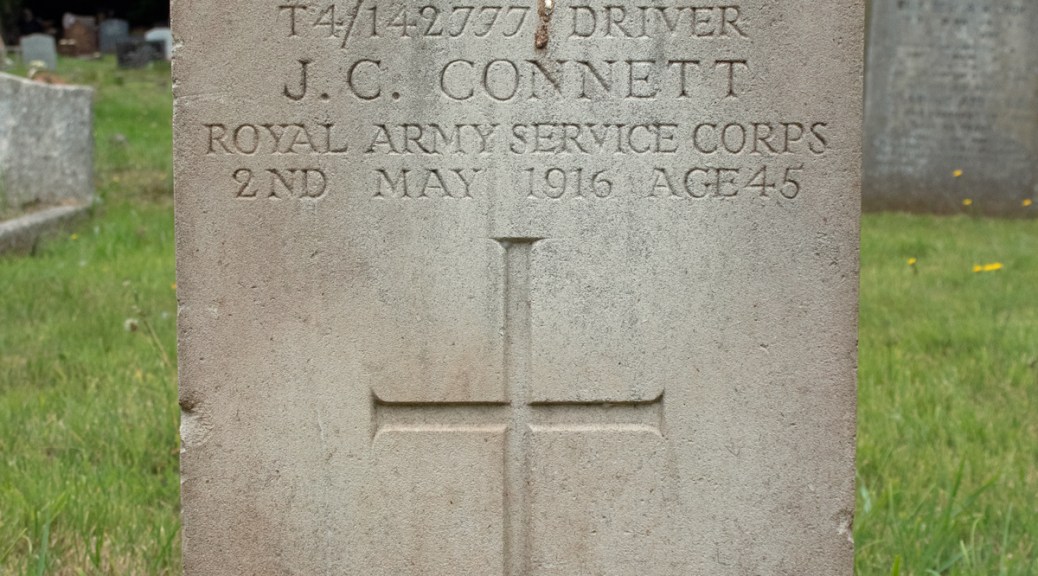
Driver John Connett

Driver John Connett

John Charles Connett was born at the end of 1870 in Holway, on the outskirts of Taunton, Somerset. He was one of seven children to Charles and Thursa Connett. Charles was a farm labourer and, in John’s early years, Thursa worked from home as a glover to bring in a little extra money for the growing family.

In 1897, John married a woman called Annie; the couple settled down in a small cottage near the centre of Wellington, Somerset. John found work as a coachman, and the couple went on to have one child, a daughter called Ethel, in 1900.

When war came to Europe, John was keen to play his part, even though he had turned 43 by the time hostilities were declared. He enlisted, joining the Royal Army Service Corps by November 1915, and was assigned to the 663rd Company.

Driver Connett’s time in the army was to be tragically short, however. He is recorded as passing away at home on 2nd May 1916, having contracted bronchitis and pneumonia while on active service. He was 45 years old.

John Charles Connett was laid to rest in Wellington Cemetery, within walking distance of where his widow and daughter still lived.


Sapper John Spry

Sapper John Spry

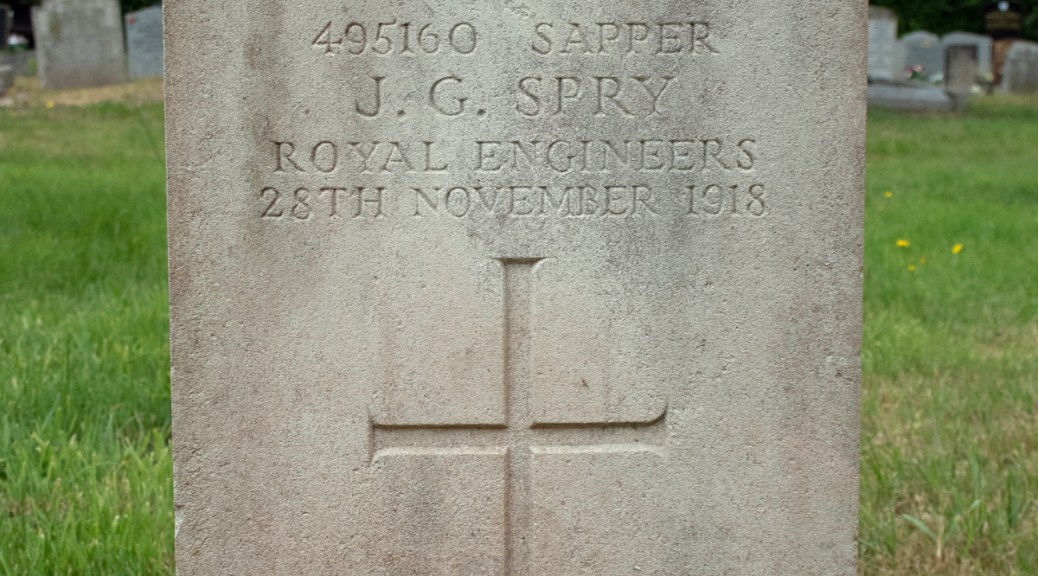
Details of John George Spry’s life remain tantalisingly out of reach. He was born in around 1874 in the Devon village of Woolfardisworthy, and was one of eight children to John and Ann Spry. John Sr was a general labourer who died in 1891. By this point the family were living at 14 Honestone Lane, Bideford, and John Jr was working as a stone mason.

John married Emily Langford. She was a blacksmith’s daughter from Taunton, Somerset, but the couple set up home in nearby Wellington, before moving to Twerton, Bath. The went on to have three children: Ivy, Ruby and Frederick. Interestingly, Ivy seems to have been taken in by Emily’s mother, Emma, while Ruby and Frederick remained with their parents.

The 1911 census found Emily, Ruby and Frederick living with John’s mother in Bideford. Ivy was in Wellington with Emma, but John is missing from the records.

When war broke out, John joined up. He enlisted in the Royal Engineers, and was assigned the rank of Sapper. Dates for his service – and where that service was carried out – are lost to time, but by the autumn of 1918, John was based in barracks in Fovant, Wiltshire.

By this time, Sapper Spry had fallen ill. Suffering from influenza and bronchial pneumonia, he was to succumb to the lung diseases, as so many other returning servicemen did. John passed away on 28th November 1918, aged 45 years of age.

John George Spry was brought back to Somerset for burial. He was laid to rest in Wellington Cemetery, not far from where his widow had relocated.


What became of the Spry family after John’s death is unclear. Emily cannot be tracked down in the 1921 census, nor can her middle child, Ruby.

Ivy was boarding at 55 Harrow Road, Paddington, Middlesex, where she was working as a Lieutenant in the Salvation Army. Frederick, meanwhile, had found work as a steersman on a steamroller, and, according to the census, was living with his maternal uncle, Charles, in Bideford.

The 1939 Register picks up Emily once more, living in a small end-of-terrace cottage on the outskirts of Wellington. Now 70 years of age, she was noted as being incapacitated, no doubt being tended to by Ruby, who was also living there, employed as a puttee machinist.


Private Thomas Salter

Private Thomas Salter

Thomas Salter – better known as Tom – was born on 5th June 1877, in the Devon village of Uffculme. He was the only child to John and Selina Salter. John was seventeen years older than his wife and, by the time his son was born, was 57 years old. Selina had been married before and widowed, and had had five children of her own.

When he left school, Tom found work as a butcher’s assistant at the Uffculme’s Commercial Hotel (now the Ostler Inn on Commercial Road). Food was not destined to be his career, however. By the time of the 1901 census, he had moved from Devon to Gloucestershire, and found employment as a labourer in the engine works at Knowle, Bristol.

His landlady was an Elizabeth Bobbett, who had been born in Trull, near Taunton, and this connection may have pre-destined what was to come. In the spring of 1908, Tom married Florence Taylor, a labourer’s daughter from Wellington, Somerset, five miles (8km) from his landlady’s home village.

Tom and Florence settled in Wellington, close to the centre of the town. They had four children – Harold (born in 1909), Evelyn (1912), Irene (1914) and Edna (1916). Tom found work as a packer at the Fox Bros. woollen mill in nearby Tonedale.

War was coming to Europe by this point and, in January 1917, Tom enlisted. Private Salter joined the 11th Battalion of the Somerset Light Infantry: this was a territorial troop, and Tom found himself based in Yeovil.

There is little concrete information about Private Salter’s military life. All that can be confirmed is that within a couple of months of joining up, he had been admitted to hospital, suffering from bronchial pneumonia. Sadly, he was not to recover from the lung condition: he passed away on 10th May 1917, at the age of 37 years old.

Tom Salter was brought back to Wellington for burial. He was laid to rest in the town’s cemetery.


Private Joseph Vickery

Private Joseph Vickery

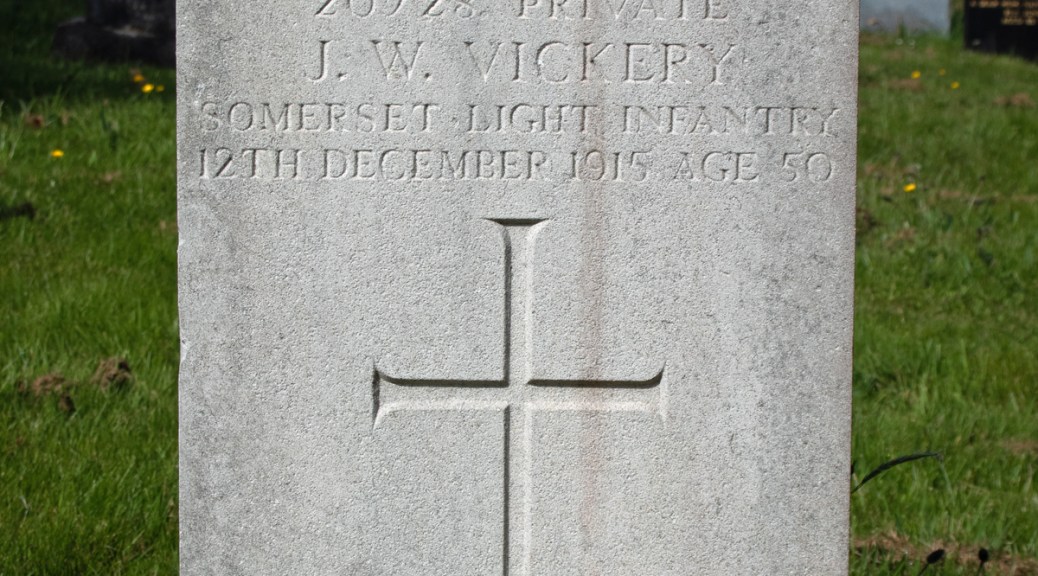
Joseph William Vickery was born in the spring of 1865 in the Somerset village of Isle Abbots. He was the older of two children to farm carter James Vickery and his wife Sarah. James died when Joseph was around six years old, and Sarah remarried, going on to have five children with her new husband, John Kitch.

The new family moved to North Curry, where Joseph found work as a farm labourer when he finished school. The years passed and, on 15th September 1894, Joseph married Elizabeth Ann Saturday, a labourer’s daughter from Chard. The couple settled in the town, and went on to have five children.

By the time war broke out in 1914, Joseph was approaching 50 years old. He still felt a duty to play his part, however, and enlisted towards the end of the following year. Little information survives of Joseph’s military career, but he enlisted in the Somerset Light Infantry and was assigned to the 1/5th Battalion.

Sent to Salisbury Plain for training, Private Vickery was billeted at Tidworth, Wiltshire. While there, he contracted bronchitis and was admitted to hospital. Sadly, the lung condition was to prove too much for his body to bear, and he passed away on 12th December 1915, at the age of 50 years old.

Joseph William Vickery was brought back to Somerset for burial. He was laid to rest in Chard Cemetery.


Joseph and Elizabeth’s son Victor also played his part in the conflict.

Born in 1900, he was too young to enlist at the start of the war, but, by April 1918, he had joined the Scots Guards as a Private. There is no evidence of him serving overseas, and his service seems to have passed uneventfully. He was demobbed in February 1919, and returned to Somerset to continue his work as a furnaceman.


Sergeant James Owen

Sergeant James Owen

James Alfred Owen was born on 4th August 1877 and was the middle of three children to James and Sarah Owen. James Sr was a woodman from Herefordshire, who had moved the family to Radnor in mid-Wales.

James Jr’s early life has been lost to time, but by the time he turned 30, he had emigrated to Canada. He settled in the west coast town of Prince Rupert and found work as a salesman. On 28th January 1910 he married Hattie Whidden: the couple went on to have three children – Annie, Louisa and Dorothy.

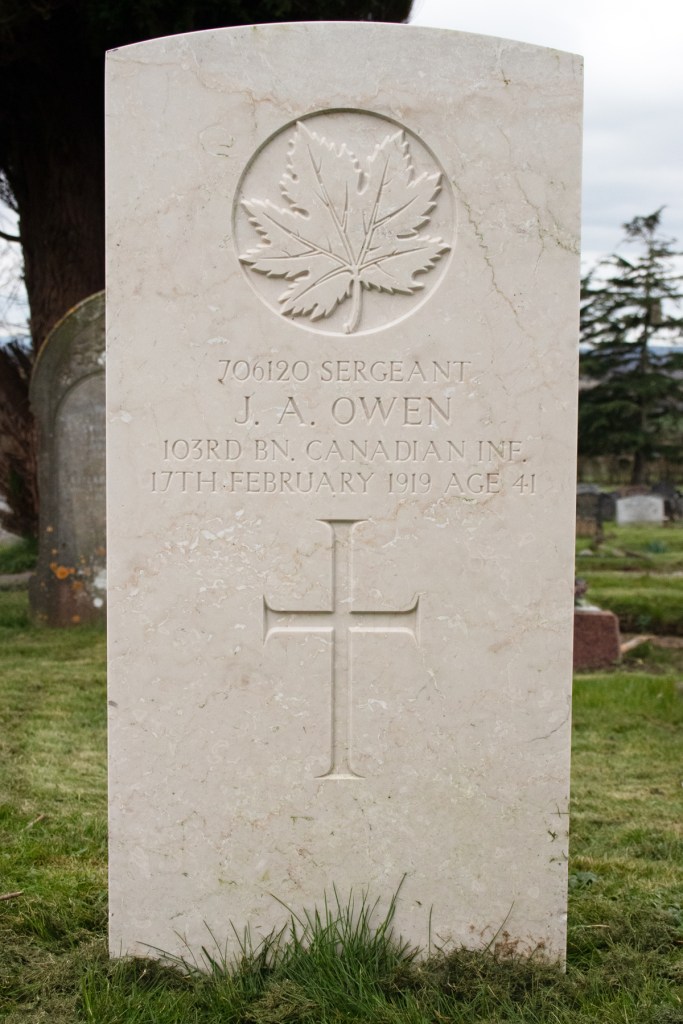
War was coming to Europe, and James wanted to play his part for King and Country. He enlisted on 4th December 1915, joining the 103rd Battalion of the Canadian Infantry. His service records show that he stood 5ft 9ins (1.75m) tall and weighed 156lbs (70.8kg). His physical development was recorded as ‘average’, he had a ruddy complexion, brown hair and brown eyes. It was also noted that he had a birthmark in his left groin and his teeth were poor and required attention.

Private Owen departed for England in July 1916 and was assigned to the Oxney Camp in Hampshire. He was promoted to Corporal and then to Sergeant and, over the next few years, he remained in England. He was primarily based in barracks at Bramshott – also in Hampshire – though did spend time in Seaford in Sussex.

Sergeant Owen survived the war, but was admitted to the Ripon Military Hospital on 8th February 1919, having contracted bronchitis and malaria. The hospital didn’t have any specific expertise in contagious diseases, so it is likely that his move to Ripon was one stage of his move back to Canada.

Sadly, the conditions proved too much for James. He passed away on 17th February 1919, at the age of 41 years of age.

James Alfred Owen’s body was brought to Castle Cary in Somerset, where his sister Eleanor lived with her family. He was laid to rest in the town’s cemetery.


Able Seaman Michael Goulding

Able Seaman Michael Goulding

Michael Joseph O’Neill Goulding was born on 5th May 1884, the oldest of six children to Michael and Ellen Goulding (née O’Neill). Michael Sr worked for the inland revenue and his job took him around most parts of the British Isles.

Michael Jr had been born in Limerick – both of his parents came from Ireland – but his subsequent three siblings (Patrick, Margaret and William) had all been born in Scotland. His second youngest sibling, Lily, was born in County Durham, the youngest back in Scotland, while, by the time of the 1901 census, the whole family were living in Forest Gate, East London.

The census also shows that Michael Jr, having left school, was working at Customs House (presumably where his father was employed), as a boy copyist on tea accounts. The inland revenue at that time was a career for life; by the next census in 1911, the family had moved to Hertford, where Michael Sr was a customs and excise supervisor, and Michael Jr was an assistant clerk at the same place of employment.

War was on its way, but Michael seems not to have enlisted immediately. While specific dates for his joining up are not available, it appears that he was still working for the Inland Revenue when he got married in Shoreditch, in April 1917. His wife was called Bridget Mary Gough (known as Bryde), and she had also been born in Ireland. The couple went on to have a daughter, Ellen (or Eileen), the following year.

By this time, Michael had definitely enlisted. He joined the Royal Naval Volunteer Reserve, and was based at HMS Pembroke, the shore-based establishment in Chatham, Kent. This was the location for the Navy’s main accounting base, so it is likely that he was employed for financial, rather than his military, skills.

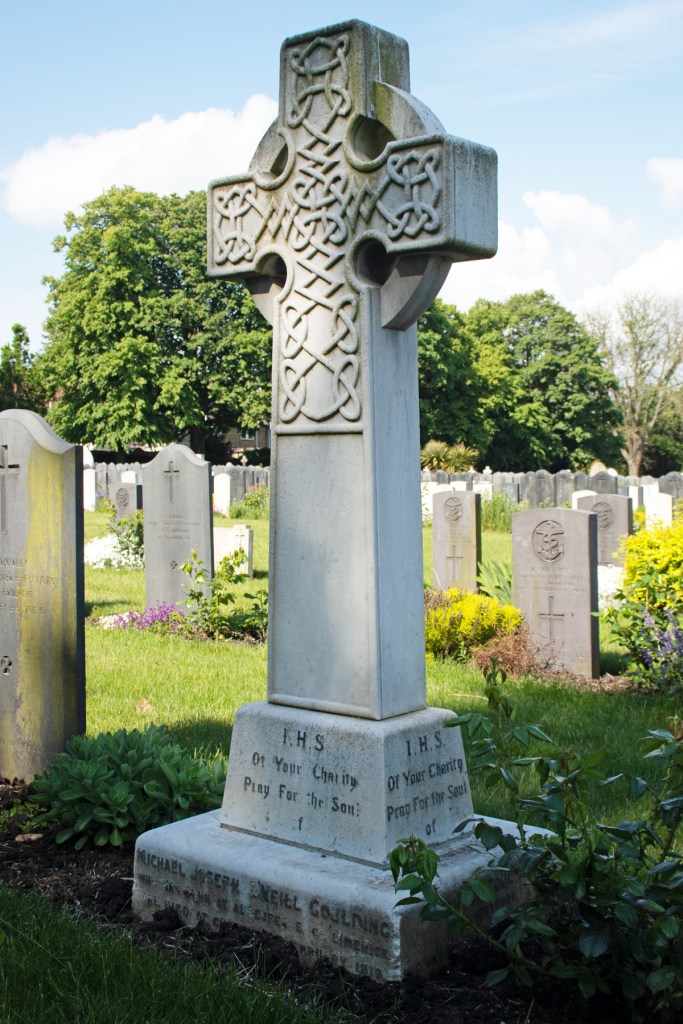
Able Seaman Goulding served through to the end of the war and beyond, and it was while he was based in Kent that he became unwell. Admitted to the Royal Naval Hospital in Chatham, he succumbed to a combination of bronchitis and pneumonia on 22nd February 1919. He was 34 years of age.

Michael Joseph O’Neill Goulding was laid to rest in the Woodlands Cemetery in nearby Gillingham. His family were still in Hertford, while his widow and daughter moved back to Ireland.


Michael Joseph O’Neill Goulding
(courtesy of ancestry.co.uk)

Trooper William Rhodes

Trooper William Rhodes

William Henry Rhodes was born in the summer of 1886 and was the youngest of six children. His father Reuben was a gardener who, with his wife Ellen, raised their family in a small cottage near the central station in Worthing, West Sussex.

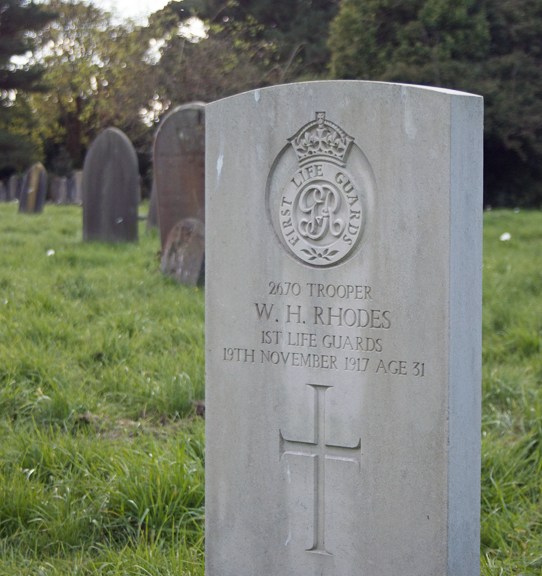
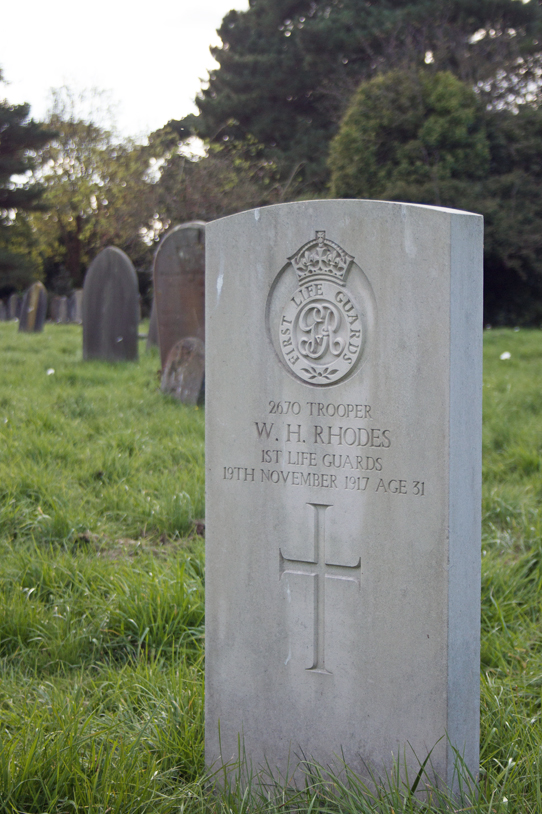
When he left school, William found work as an assistant in a bookshop. This was just a stepping stone, however, and his mind was on a life of adventures. In March 1908, he enlisted in the army, joining the Household Cavalry, and was assigned to the 1st Life Guards. William’s medical report showed that he stood at just under 6ft (1.83m) tall, and weighed 141lbs (64kg). He had a fresh complexion, grey eyes and brown hair.

Trooper Rhodes was initially based on home soil; his barracks were in London and he served in Hyde Park, Regents Park and at Windsor, where he would have been called upon to be involved in royal duties that would have taken place. This changed when the Great War broke out, however, and his division was sent out to northern France as part of the British Expeditionary Force.

The 1st Life Guards were involved in the First Battle of Ypres, and went on to fight in many of the fiercest battles of the conflict. His service record identifies that he was wounded in February 1915, when he received a gunshot wound to the head, although, surprisingly, there is nothing in his medical record that suggests any subsequent hospital admission.

In fact, Trooper Rhodes did receive hospital treatment during his military service; he was admitted for bronchial catarrh in April 1908 and May 1909 and headaches in June 1911. Four years later, he contracted tuberculosis while in action in France, and moved back to London for treatment.

William’s condition was serious enough for him to be medically discharged form the army; having spent more than a month in hospital, he was released from duty on 31st August 1915.

There is little further information about William’s life back home. The next document on him confirms that he died on 19th November 1917. While the cause is not noted, it seems likely to have been connected to the lung conditions he suffered during the war. William was 31 years of age.

William Henry Rhodes was laid to rest in Broadwater Cemetery in the town of his birth, Worthing, West Sussex.


Private Raymond Champ

Private Raymond Champ

Raymond Champ was born on 30th March 1880, one of eight children to coachman William Champ and his wife Eliza. While Raymond was born in the West Sussex village of Cowfold, within a year, the family had moved to Worthing, settling in the Broadwater area of the town.

The 1901 census gives more of an insight into Champ family life. William by now is listed as unable to work and gives his infirmity as paralysed. There are no newspaper records evident to highlight an accident of any sort, so the cause of his paralysis, and his inability to work, are destined to remain a mystery. The document does show, however, that the other members of the family stepped up to fill in the shortfall of money; Eliza was working as a laundress, Raymond was a bricklayer’s labourer, and his younger brother Francis (or Frank) was employed as a milk boy.

Fast forward ten years, and the next census give further information. It confirms that William was paralysed when he was 45 years old (in around 1894/1895). Raymond, now aged 30, was still working as a bricklayer, Frank was an iron founder, and the youngest brother, George, was a baker.

Raymond was a keen footballer, and went on to captain the Silverdale Football Club. By the time war broke out, he had found work at Wenban Smith, a renowned timber supplier in the town. The call to arms came, however, and, in September 1914, he enlisted.

Private Champ joined the Royal Sussex Regiment, and was assigned to the 2nd Battalion. Shipped overseas in February 1915, he served on the Western Front, but his time there was not to be a lengthy one. A local newspaper report picked up Raymond’s story:

The wretched conditions which our Troops had to contend with during February and March proved too much for his constitution, and having the misfortune to contract bronchitis, he was invalided home in April, being taken to one of the Military Hospitals in Manchester.

His recovery was regarded as hopeless from the first, but the careful nursing and attention which he received there brought about a temporary improvement, and he was eventually discharged in order that he might return to his home, where his death occurred on Sunday week.

The funeral on Thursday afternoon was of a very impressive character, and despite a heavy deluge of rain, there was a large number of sympathising friends at the Cemetery to pay the last tribute of respect.

Worthing Gazette: Wednesday 14th July 1915

Private Raymond Champ passed away on 4th July 1915 and just 35 years old. His body was laid to rest in Broadwater Cemetery, Worthing, not far from where his family were living.