Joseph Arthur Barnes was born in the spring of 1887, and was the youngest of four children to George and Hannah Barnes. George was a farm labourer from Longbridge Deverill, Wiltshire, and this is where he and Hannah – or Anna – raised their family.
When he completed his schooling, Joseph found work as a horseman on the farm, alongside his older brother, George. On 30th July 1913, he married Minnie Ring, a furniture maker’s daughter from the village. The couple exchanged vows in the parish church.
War was on the horizon, and a little over a year after their marriage, Joseph stepped up to play his part. He joined the Wiltshire Regiment and was assigned to the 3rd Battalion. Private Barnes was sent to Dorset for training, but his time in the army would not be a lengthy one.
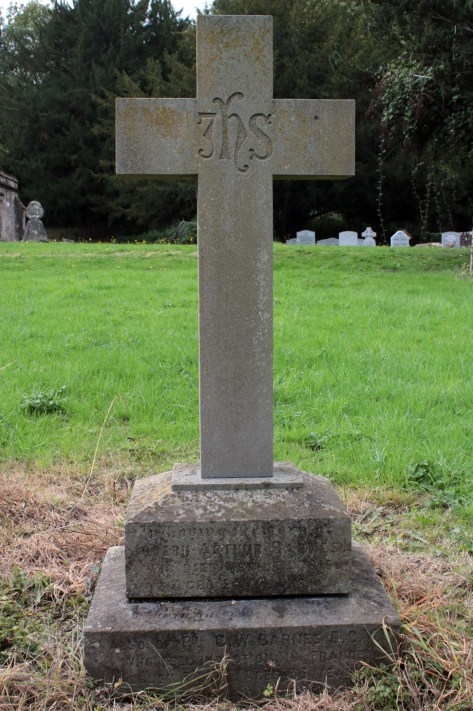
Joseph contracted pneumonia, and was admitted to hospital in Weymouth. The condition would provide to severe, however, and he passed away on 9th April 1915: he was 27 years of age.
The body of Joseph Arthur Barnes was taken back to Wiltshire for burial: he was laid to rest in the tranquil surrounds of St Peter & St Paul’s Church, Longbridge Deverill.
Joseph’s brother George also served in the First World War. Assigned to the 1st Battalion of the Wiltshire Regiment, he served on the Western Front. Private Barnes was killed in action on 5th August 1917, at the age of 33. He is commemorated on the Menin Gate.
Frederick Charles Cox was born in the Dorset village of Kington Magna in the spring of 1897. One of seven children, his parents were agricultural labourer William Cox and his wife, Kate.
When Frederick completed his schooling, he also found work as a farm labourer. However, when war broke out, he was keen to play his part, possibly having seen his older brother, William Jr, also join up.
Unlike his sibling, Frederick enlisted in the Dorsetshire Regiment. His service papers have been lost to time, but it is clear that he took the role of Private, and that he was assigned to the 1st/4th Battalion. His unit began the war in India, but had moved to Basra in February 1916, remaining in Mesopotamia for the remainder of the conflict.
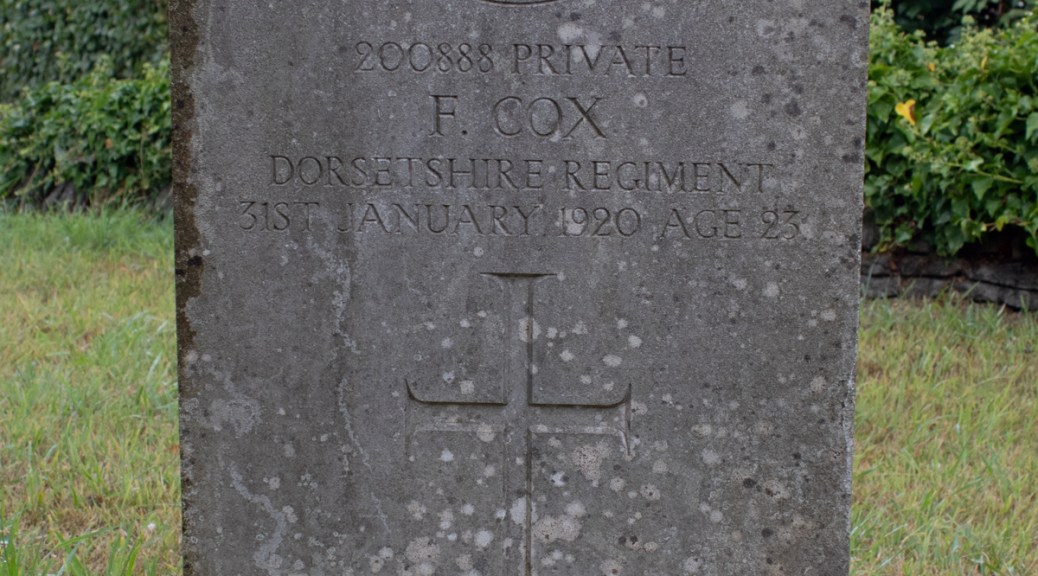
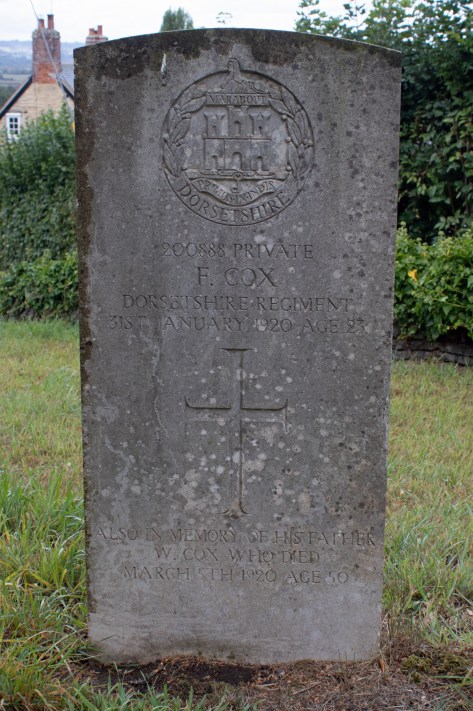
Private Cox survived the war, and had returned home by the end of 1919. His time in the army would impact his health, however, and during the winter of 1919/20, he came down with malaria, a condition which would prove fatal. Frederick passed away in hospital in Shaftesbury, on 31st January 1920: he was 23 years of age.
The body of Frederick Charles Cox was taken back to Kington Magna for burial. He was laid to rest in All Saints’ Churchyard, close to his brother, who had died a few years before.
Kate had lost two adult sons in a matter of years, and her tragedy was not to end. William Sr passed away less than five weeks after Frederick. He was buried close to his sons.
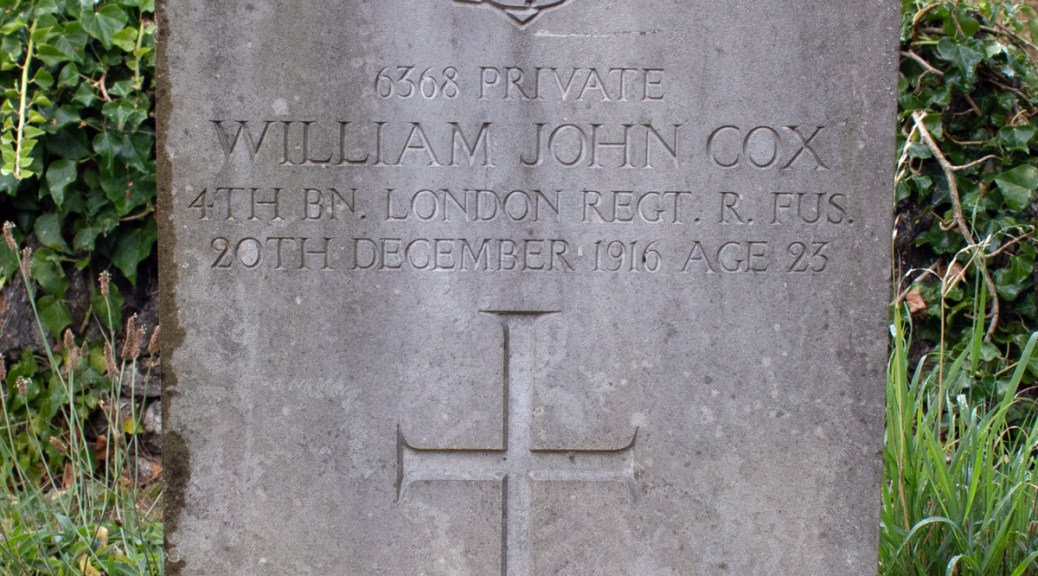
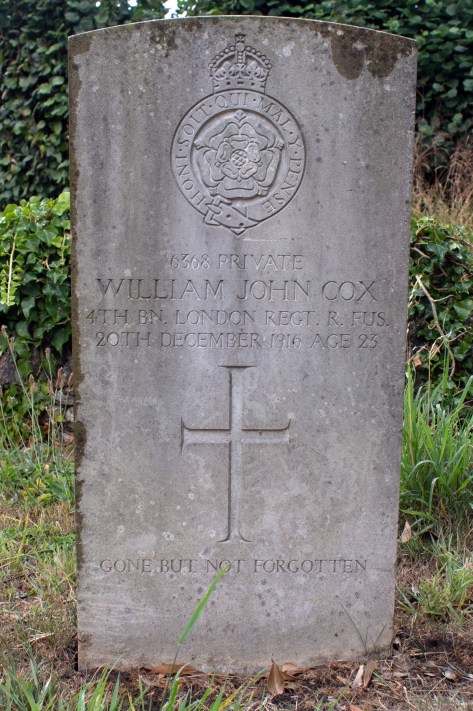
William John Cox was born in the autumn of 1893, and was the second of seven children. His parents – William and Kate Cox – were from Kington Magna, Dorset, and this is where they would raise their family.
William Sr was a farm labourer, and this is work into which his son would follow. By the time of the 1911 census, the family were living in a cottage on Church Street, with William Jr and his younger brother, Frederick, both agricultural workers.
When war came to Europe, William would step up to play his part. Full service details have been lost, but it is clear that he had enlisted in the army by the summer of 1916. As a Private, he was assigned to the 4th Battalion of the London Regiment (Royal Fusiliers).
Private Cox certainly saw action overseas, and would find himself entrenched at the Somme. At some point, he was wounded, and his injuries were bad enough for him to be sent back to Britain for treatment. He was admitted to hospital in Chatham, Kent, but his wounds would prove to be too severe. William passed away on 20th December 1916: he was 23 years of age.
The body of William John Cox was taken back to Dorset for burial. He was laid to rest in the tranquil surrounds of All Saints’ Churchyard in Kington Magna.
William’s younger brother, Frederick, also fought in the First World War. Read his story here.
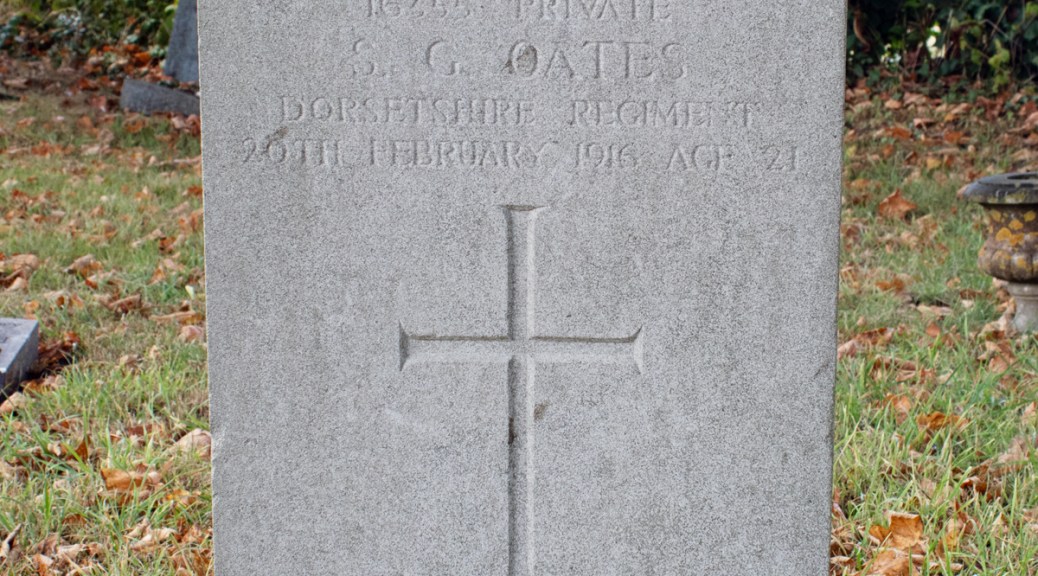
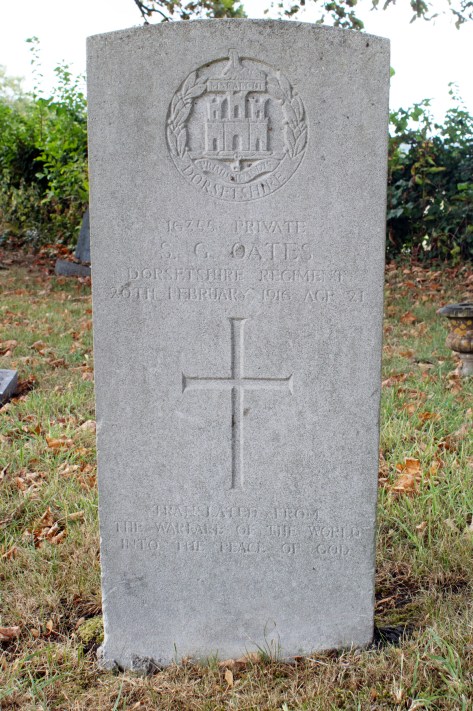
Sidney George Oates was born in the spring of 1895, and was the oldest of three children – all boys – to John and Eliza Oates. John was a general labourer from Parkstone, Dorset, but it was in the village of Odcombe in Somerset that the family were born and raised.
Eliza died in 1899, and John was left to raise three young children on his own. He re-married, to a Lucy Moores, but the a split of the family followed the wedding. Sidney’s younger brothers stayed with their father and his new wife, while Sidney himself was looked after by his maternal grandparents. Job and Elizabeth Green lived in Buckhorn Weston, a village to the west of Gillingham, Dorset.
When he finished his schooling, Sidney was apprenticed to a carpenter. War was on the horizon, however, and he soon stepped up to play his part. As with many others, his service papers have been lost to time, but it is clear that he had enlisted in the Dorsetshire Regiment no earlier than August 1915.
Private Oates was assigned to the 7th (Reserve) Battalion and sent to a training camp near Wool, Dorset. While there, however, he caught pneumonia, and was admitted to a military hospital in the village. The condition was to prove fatal: he passed away on 20th February 1916, aged just 21 years old.
The body of Sidney George Oates was taken back to Buckhorn Weston for burial. He was laid to rest in the village’s cemetery.
Sidney’s younger brother Edward also served in the First World War. A Pioneer in the Royal Engineers, he was killed in action in northern France on 12th April 1917. He was buried in Mory Abbey Military Cemetery to the north of Bapaume.
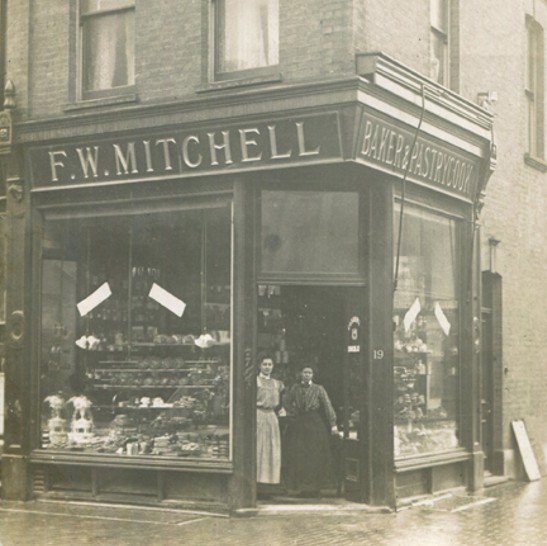
Ernest Henry Mitchell was born in the autumn of 1889 in Worthing, West Sussex. The second of five children, he was the eldest son of Frederick and Rhoda Mitchell. Frederick was a baker and confectioner, and the family lived in and around the town centre. The 1891 census found them at 29 West Buildings; ten years later they were living at 7 Clifton Road; the 1911 census recorded the family at 62 Chapel Road.
By this point, FW Mitchell’s was a well known bakery, and would remain so through to the 1960s. The Chapel Road shop was bombed during the Second World War, and the family moved the business to North Road.
The 1911 census showed what the bakery has become. Frederick and Rhoda were running the business, while their three sons – Ernest, Reginald and Frederick Jr – were also involved. Their eldest daughter, Rhoda Jr, was an elementary school teacher, while their youngest child, Edgar, was still at school. The Chapel Road property was a bustling affair: the Mitchells employed four live-in servants: Emily Lyon, Annie Dannage, and Mabel Swan as shop assistants, and Edith Blunden as a domestic.
FW Mitchell’s bakery, Worthing
Away from work, Ernest showed other talents. “He was possessed of musical inclinations, and was at one time a member of the Choir of the Congregational Church, as well as of the Choral Society.” [Worthing Gazette: Wednesday 31st October 1917]
In January 1913, Ernest married Constance Banwell. She was the eldest daughter of nurseryman Henry Banwell and his wife, Ellen, and lived on Christchurch Road, not far from the Mitchells’ shop.
When war broke out, Ernest stepped up to serve his country. His service records show that, while he enlisted on 9th December 1915, he was not formally mobilised until March 1917. As a Trooper, he was assigned to the Household Battalion, and, after a brief period of training, he soon found himself in the thick of things.
The Household Battalion fought at Arras in the spring of 1917, but it was at Passchendaele that Ernest’s war was to come to an end. Wounded in the leg on 6th October – just three months after arriving in France – he was medically evacuated to Britain for treatment. Admitted to No. 2 War Hospital in Birmingham, he initially recuperated, but pneumonia took over and Trooper Mitchell succumbed. He passed away on 26th October 1917, at the age of 28 years old.
The body was removed from Birmingham, arriving in Worthing at midnight on Monday; and the internment took place at the Cemetery yesterday afternoon [20th October]. Among those who attended the ceremony were two soldier brothers of the deceased – RA Mitchell, who is in the Royal Flying Corps; and FE Mitchell, of the Middlesex Regiment. Still another brother is serving his Country in a Military capacity. This is Fred Mitchell, formally Organist of the Congregational Church, who is in the Army Service Corps, and was unable to be present yesterday, for he is now in Hospital in Wiltshire.
[Worthing Gazette: Wednesday 31th October 1917]
Ultimately, Ernest Henry Mitchell would be the only one of his siblings to pay the ultimate price while serving his country. He was laid to rest in the family plot in Broadwater Cemetery, on the then outskirts of the home town.
Ernest’s headstone also pays tribute to Alan Frederick Gill, who died in April 1925. This was his sister Rhoda’s child, who died at just four-and-a-half years old.
Ernest Harold Prince was born in the spring of 1891 in Warminster, Wiltshire. The eighth of eleven children, he was one of five boys to William and Mary Prince. William was a quarry worker, and the family lived at 33 Brook Street to the south of the town.
Ernest followed his father into quarry labouring. William was working in Abercarn, Monmouthshire, at the time of the 1901 census, and had returned to Wiltshire by 1911. Ernest, on the other hand, had sought work in Wales himself by this point, and is recorded as boarding with the Courtney family at 39 Rhyswg Road. The document notes that he was employed as a labourer below ground in a local colliery.
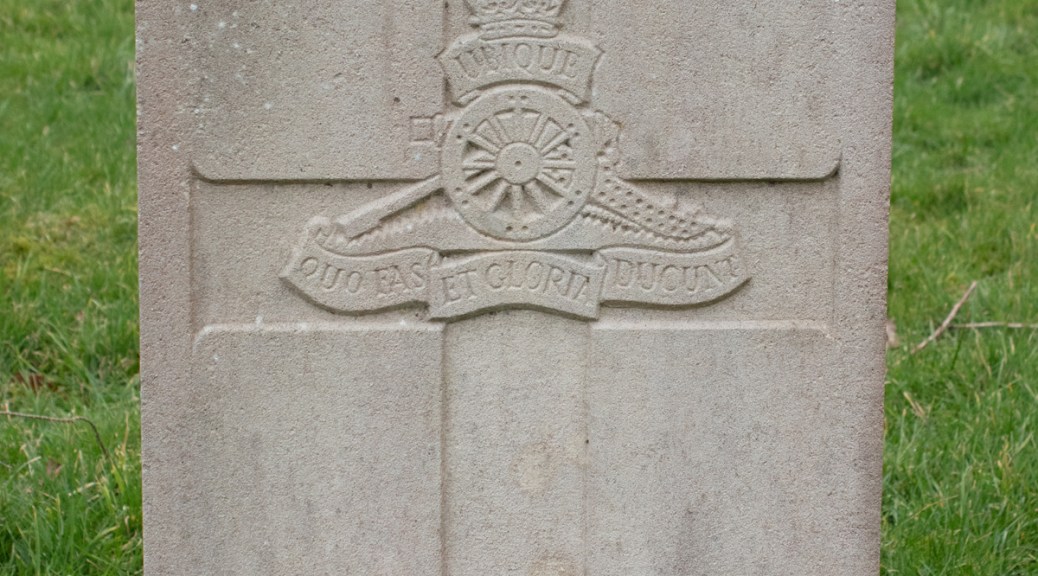
When war broke out, Ernest stepped up to play his part. Full details of his service have been lost to time, and it is unclear whether he was still working in the colliery, and therefore exempt from joining up initially because of his reserved occupation. What is certain, however, is that he had enlisted by the spring of 1918, and, as a Gunner, had joined the Royal Horse Artillery A Battery.
The next record for Gunner Prince relates to his passing. He is recorded as having died of disease on 29th October 1918. His death was recorded in Warminster, so it is safe to assume that he had been at home, or at least in his home town, when he passed. He was 27 years of age.
The body of Ernest Harold Prince was laid to rest in the graveyard of Christ Church in Warminster.
Ernest’s younger brother, Walter, also fought in the First World War. A Private in the 2nd Battalion of the Wiltshire Regiment, he had served on the Western Front during 1915.
Private Prince fought at Loos and was killed on 26th September 1915. He is commemorated on Panel 102 of the Loos Memorial.
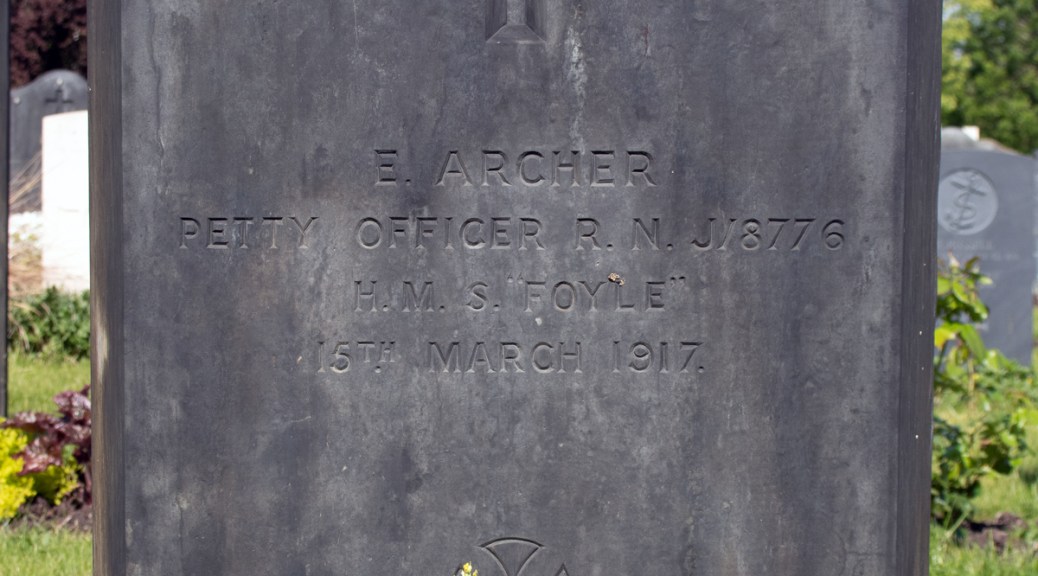
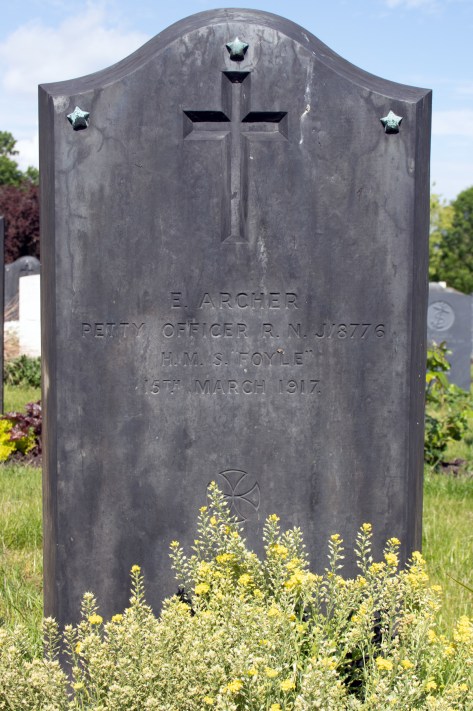
The life of Ernest Archer is challenging to piece together. His headstone, in Woodlands Cemetery, Gillingham, Kent, confirms he was a Petty Officer on HMS Foyle, which was a Royal Navy destroyer. She hit a mine in the English Channel off the Devon coast on 15th March 1917, and foundered while being towed to safety in Plymouth. A total of 28 crew members, Petty Officer Archer included, were killed.
Ernest’s service papers have been lost to time, but his Dependent’s Pension record gives his beneficiary as his aunt, Mrs H Greenhow, of 8 Kinmel Street, Liverpool. This would suggest that his parents had passed by 1917, but it’s not been possible to track her down through contemporary documents.
The same record notes that Ernest had a brother, James, and that he was an Able Seaman in the Howe Battalion of the Royal Naval Division. He was killed in action on 17th February 1917 – four weeks before his brother – and is commemorated on the Thiepval Memorial.
Further information on the lives of the siblings, however, is lost in the mists of time, Ernest Archer’s story taken to his grave with him.
William George Foxworthy was born in Dartmouth, Devon early in 1880. The middle of five children, his parents were William and Mary Foxworthy. William Sr (whose full name was William George Foxworthy, and who was known by his middle name) was a house painter, but when he finished his schooling, William Jr found work as a boat builder.
The 1901 census found the family living in a small house on Crowther’s Hill, to the Dartmouth town centre. The cottage would have been cramped, but there were five wages coming in from George, William and William’s siblings.
William does not appear on the 1911 census, and it seems that he took the step from building boats to sailing on them. When war broke out, he was quick to step up and play his part, enlisting in Exeter on the 22nd October 1914. While he had previously been a volunteer in the Devonshire Regiment, William was assigned to the Royal Garrison Artillery.
Gunner Foxworthy’s service records show that he was 5ft 4.5ins (1.64m) tall, and weighed 121lbs (54.9kg). He was noted as having brown hair, hazel eyes and a fresh complexion. Deemed fit for military service, he was packed off to a base in Sheerness, Kent.
William spent the next year on the north Kent coast, before being reassigned. By 1st November 1915 he was on the Front Line, and remained in France until the following June.
In the spring of 1916, Gunner Foxworthy fell ill. He contracted tuberculosis, and this was to dog him for the rest of his life. The contagious nature of the condition meant that he was no longer fit for military service, and he was medically discharged on 11th July 1916.
The death occurred on Tuesday of last week at Roseville Street, of Mr William George Foxworthy, second son of Mr and Mrs Foxworthy, after a long and painful illness. In 1914 deceased joined the [Royal Garrison Artillery] as a gunner, and saw much fighting around Ypres in the winter of 1915-16, during which time he contracted the disease which has now terminated fatally. This is the second son Mr and Mrs Foxworthy have lost in the war, their youngest boy having been killed some two months ago. Great sympathy has been shown the parents in their second bereavement.
[Dartmouth & South Hams Chronicle: Friday 20th December 1918]
William George Foxworthy was 38 years of age when he died on 10th December 1918. He was laid to rest in the graveyard of St Clement’s Church in his home town, Dartmouth.
William’s younger brother, Louis Henry Foxworthy, was a Corporal in the 9th (Service) Battalion of the Devonshire Regiment. He served on the Western Front as well and, in September 1918, he was caught up in the fighting in St Riquier, near Abbeville. Corporal Foxworthy was killed in action on 8th October 1918: he was 31 years of age.
Louis’ body was not recovered, and he is commemorated on the Vis-en-Artois British Memorial in Harcourt, France.
A verdict of drowned was returned at the inquest at Dartmouth on Saturday evening on James Lineham (18), a seaman, whose body was recovered from the sea. Lineham was bathing in Dartmouth harbour nine days ago. He called for help, and a comrade with him caught him by the hair, but could not retain his hold. The skipper found the body drifting towards the ship on Saturday.
[Western Times: Tuesday 13th August 1918]
Beyond the newspaper report on James Lineham’s death, there is tantalisingly little information about him or his life. The Commonwealth War Graves Commission confirm he was a Deck Hand in the Mercantile Marine Reserve, and that he was assigned to the HM Drifter Niedra.
James’ pension record add a little more light and a little more confusion to the matter. This names Miss Beatrice Lineham as his dependant, and confirms she was in the care of Mrs Buchly of 22 Vera Road Fulham.
The document has another name on it, written in red, that of a Acting Corporal Thomas Lineham of the Army Service Corps, who died from disease on 7th February 1917. The word daughter is also written in red, so it would seem that Beatrice was Thomas’ child, and potentially James’ niece.
Frustratingly, Thomas’ service number is the same as Deck Hand Lineham’s so it is not possible to trace any more information about his army service.
A more general search of census records draws a blank too: there is no combination of James and Thomas Lineham, with or without Beatrice, in the Fulham area in the 1901 or 1911 records.
It would seem, therefore, that the life of Deck Hand James Lineham , who drowned in the River Dart on 2nd August 1918, is destined to remain lost to time. His secrets were buried with him in St Clements’ Churchyard, Dartmouth, Devon.
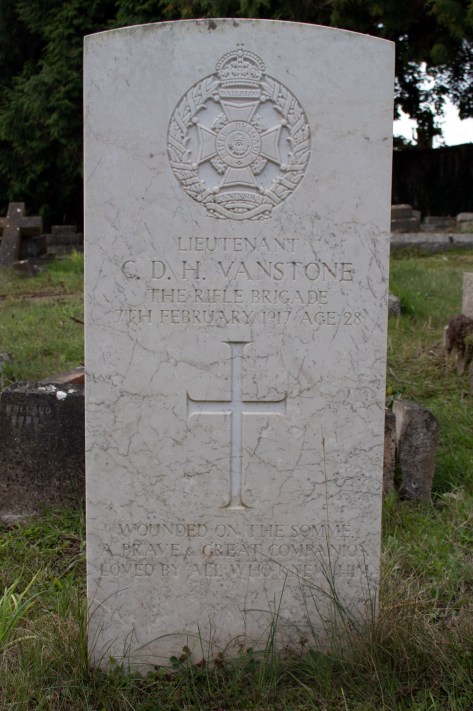
Charles Douglas Howard Vanstone was born in Paignton, Devon, on 27th October 1888. The fourth of seven children, he was the second son to Frederick and Charlotte Vanstone. Frederick was an architect’s surveyor and civil engineer, and the family lived comfortably in the seaside town.
The 1891 census found them living at Sorrento, a villa on Esplanade Road, overlooking the sea. By the time of the next census, they had moved to Torbay Park, and lived in a 12-room property. The family’s three sons all followed in their father’s trade, and, according to the 1911 return, four of the Vanstones were recorded as being civil engineer architects and surveyors.
When war came to Europe, Charles stepped up to play his part. He received a commission in August 1915 and, as a Second Lieutenant, was assigned to the Rifle Brigade. Attached to the 15th (Reserve) Battalion, the records suggest that he was in France by 23rd March 1916.
Lieutenant Vanstone seems to have been part of a Trench Mortar unit at the Somme. Wounded during the battle, he was medically evacuated to Britain for treatment. Admitted to the Reading War Hospital in Berkshire, his injuries were to prove too severe. Charles passed away on 7th February 1917: he was 28 years of age.
Charles Douglas Howard Vanstone’s body was brought back to Devon for burial. He was laid to rest in his home town’s sweeping cemetery.
Charles’ death was the third loss for the Vanstone family in as many years. His older sister, Constance, had died in 1914, while his younger brother, Stanley, a Lieutenant in the 20th Royal Fusiliers, died of wounds he received on the Western Front in October 1915. Just 25 years of age, he is buried in Merville Communal Cemetery, France.






 Death and Service