Angus McLeod was born on 18th April 1881 in the hamlet of Deiraclete (or Diraclett) on the Isle of Harris, Scotland. Little information is available about his early life, but a later record suggests his parents were called Norman and Mary.
Given the remote location of his birth, it is unsurprising that Angus was to gain knowledge of a life a sea, whether for work, or as a mode of transport. When war broke out, his expertise was called upon, and he joined the Royal Naval Reserve as a Seaman. He enlisted on 31st October 1916, and his records show that he was 5ft 9.5ins (1.77m) tall, with grey eyes and a fresh complexion.
Over the next fifteen months, Seaman McLeod was based out of HMS Pembroke – the Royal Naval Dockyard in Chatham, Kent. His exact records are unclear, although it seems that he served mainly on merchant vessels and travelled as far as India.
By the end of 1917, Angus was becoming unwell. He was suffering from stomach cancer, and was medically discharged from naval service on 1st February 1918. He had been admitted to the Royal Naval Hospital in Chatham by this point, but his condition was to get the better of him. He passed away on 14th February, at the age of 36 years old.
More than 500 miles from his home – and his widow, Johanna – Angus McLeod was laid to rest in the naval section of Woodlands Cemetery, Gillingham, Kent.
Andrew Dryden Blakey was born on 14th October 1873 in Jarrow, County Durham. One of twelve children, his parents were John and Jane Blakey. John was a joiner by trade, and the family were brought up at 71 Hedley Street, South Shields.
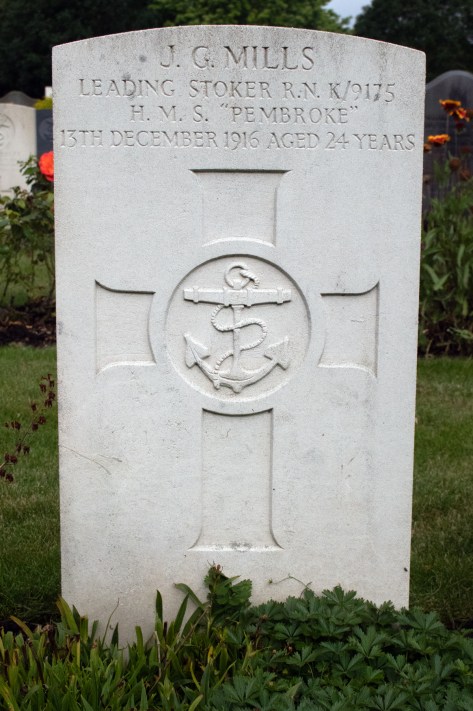
When he completed his schooling, Andrew was set on broadening his horizons. On 21st January 1899 he enlisted in the Royal Navy as a Stoker. Full details of his time in the navy have been lost to time, but by the time he reached the end of his contract, he had spent thirteen years at sea, and had risen to the rank of Leading Stoker.
On 4th February 1902, Andrew married Eleanor Slater, a labourer’s daughter from South Shields. The have five children, and, while her husband was at sea, she would take rooms with her uncle.
Leading Stoker Blakey was stood down to reserve status on 30th July 1913. His service records at that point show that he was 5ft 3.5ins (1.61m) tall, with blue eyes and a fair complexion. He was also noted as having a number of tattoos: clasped hands and a star on his right forearm, and his initials on the left.
When war broke out, Leading Stoker Blakey was called into action once more. After an initial assignment on board the battleship HMS Duncan, his time was split between HMS Pembroke and HMS Wildfire, the Kent shore bases at Chatham and Sheerness respectively.
Andrew’s health was becoming impacted by this point, however, and, in the spring of 1917, he was admitted to the Royal Naval Hospital in Chatham with carcinoma of the colon. The condition would ultimately take his life: he died on 4th May 1917, at the age of 43 years old.
The body of Andrew Dryden Blakey was laid to rest in the naval section of Woodlands Cemetery, Gillingham, Kent, not far from the Chatham Dockyard, he had for so long called home.
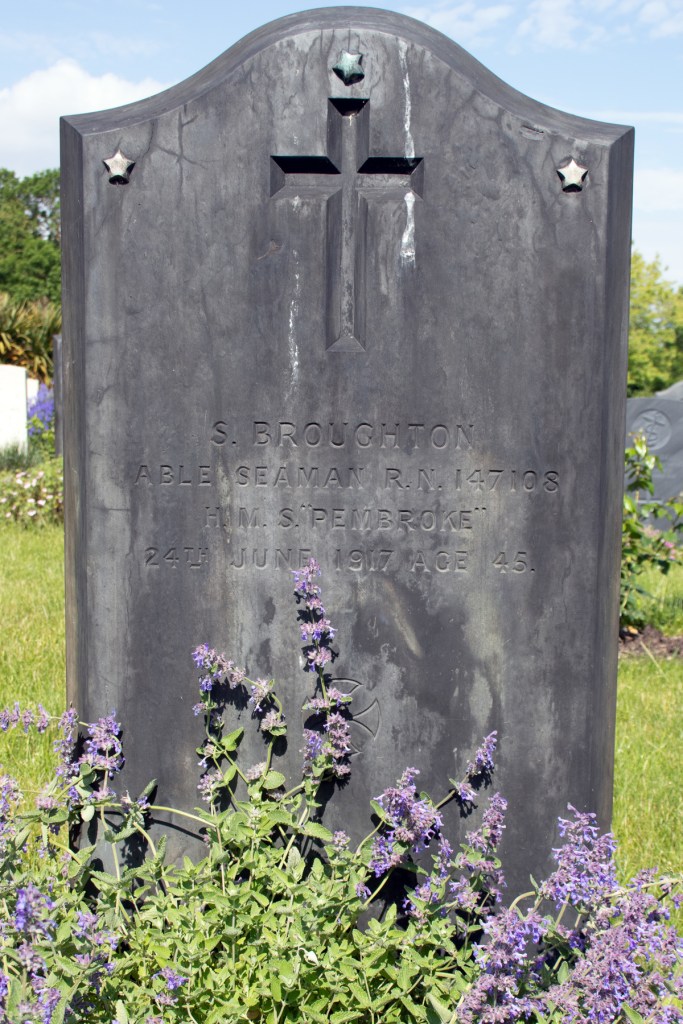
Sydney Broughton was born on 21st November 1872 in the Lincolnshire village of East Halton. The sixth of nine children – of whom eight were boys – his parents were William and Emma Broughton.
William was a boot an shoe dealer, and his older sons were destined to follow him into the business. Sydney, however, sought bigger and better things and, on 13th November 1888, he joined the Royal Navy. Being only 15 years of age, he wasn’t able to full enlist, and was taken on as a Boy 2nd Class.
Sydney was sent to Devonport, Devon, for his training. Assigned to the training vessel HMS Impregnable, she would become his home for just over two years. On 12th March 1890 he was promoted to Boy 1st Class and on his eighteenth birthday, he was formally enlisted in the Royal Navy.
Ordinary Seaman Broughton’s service records show that he was 5ft 4ins (1.63m) tall, with dark brown hair, light grey eyes and a fair complexion. He was also noted as having a slight scar under his right eye. Now of age, Sydney was moved to barracks at HMS Vivid, onshore at the heart of Devonport itself.
On 28th January 1891, Ordinary Seaman Broughton was given his first posting, on board the cruiser HMS Tauranga. He would remain there for only six months, however, as the ship was in the process of being transferred to the Australian Navy. His new assignment would be the survey sloop HMS Penguin, and she would be his home for the next two years.
Shortly before leaving Penguin, Sydney was promoted to the rank of Able Seaman. He spent the next nine months split between HMS Victory, the Royal Naval Dockyard in Portsmouth, and HMS Excellent, a base that was also connected to the dockyard.
On 26th January 1894 Able Seaman Broughton was posted to the cruiser HMS Galatea. He remained there for the rest of the year, including fourteen days spent in cells for an unknown offence that April. He then moved to the battleship HMS Edinburgh, with whose crew he would spend the next two years.
In September 1896, Sydney transferred to what would become his home base, HMS Pembroke, also known as the Royal Naval Dockyard in Chatham, Kent. Over the remaining six years of his twelve year contract, he would keep returning there, also spending time in the dockyard’s training base, HMS Wildfire.
On 10th February 1901, Able Seaman Broughton was imprisoned for 42 days for misappropriating mess funds, while based in the Dockyard. Surprisingly, the misdemeanour seems not too have impacted his career too adversely, however, and when his contract came up for renewal the following year, he voluntarily remained with the navy.
Sydney was on board the cruiser HMS Amphritite when his new term of service began. In March 1902 he was promoted to Leading Seaman and, over the next five years, he would go on to serve on a further five ships. In October 1907 he was reduced in rank to Able Seaman once more, although his service records don’t confirm whether this was through his own choice or not.
Over the next six years, Sydney would serve on three further ships. When was formally stood down to reserve status on 19th January 1913, his home was HMS Actaeon, the navy’s torpedo school in Chatham: he had been assigned there for nearly three years, and in the Royal Navy as a whole for more than 24 years.
When war broke out in the summer of 1914, Able Seaman Broughton was called back into action. He remained on solid ground, however, and split the next three years between HMS Pembroke and HMS Wildfire, places he knew well. Sydney’s health may have been a factor in his lack of seaworthiness: in the spring of 1917 he was admitted to the Royal Naval Hospital in Chatham, suffering from mouth cancer. The condition was to prove fatal: he passed away on 24th June 1917, at the age of 44 years old.
Sydney Broughton’s body was laid to rest in the naval section of Woodlands Cemetery in Gillingham, Kent, not far from his beloved dockyard.
Sydney’s next-of-kin was noted as being his wife, Edith Mary Broughton. There is no record of their marriage, but her details on his records correspond to an entry on the 1921 census.
The document recorded Edith living in Sittingbourne, Kent. 45 years and seven months old, she was sharing her home with her widowed mother, Harriett Pearce, and her two-year-old granddaughter, Edith May.
Further digging suggests that Edith had been a widow when she and Sydney exchanged vows: the 1911 census found her married to Herbert Busbridge, the couple having a daughter, Edith Nellie, who had been born in 1896.
Widowed twice, Edith Mary carried on as best she could: she passed away in the spring of 1963, at the age of 87.
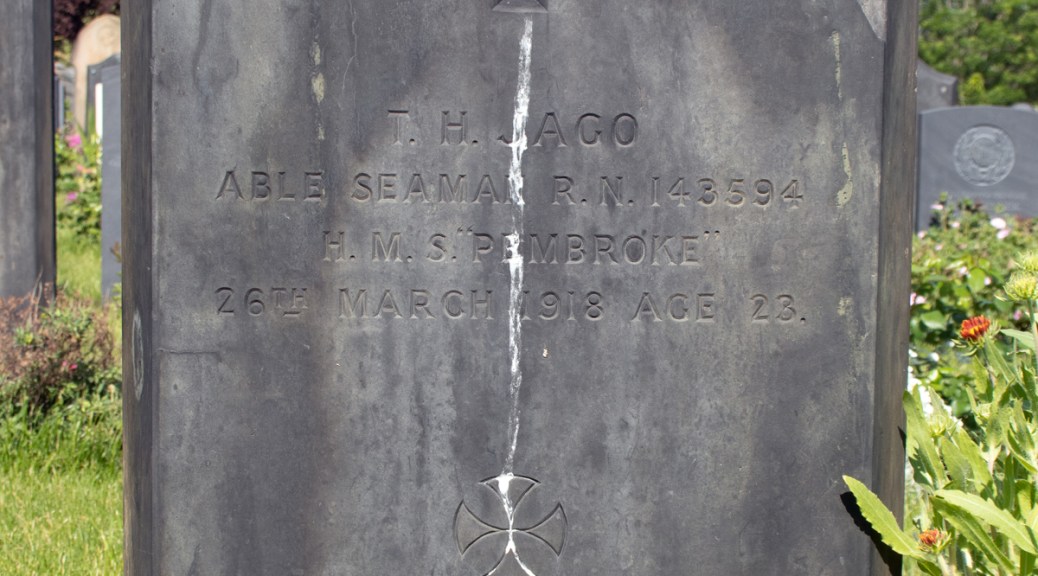
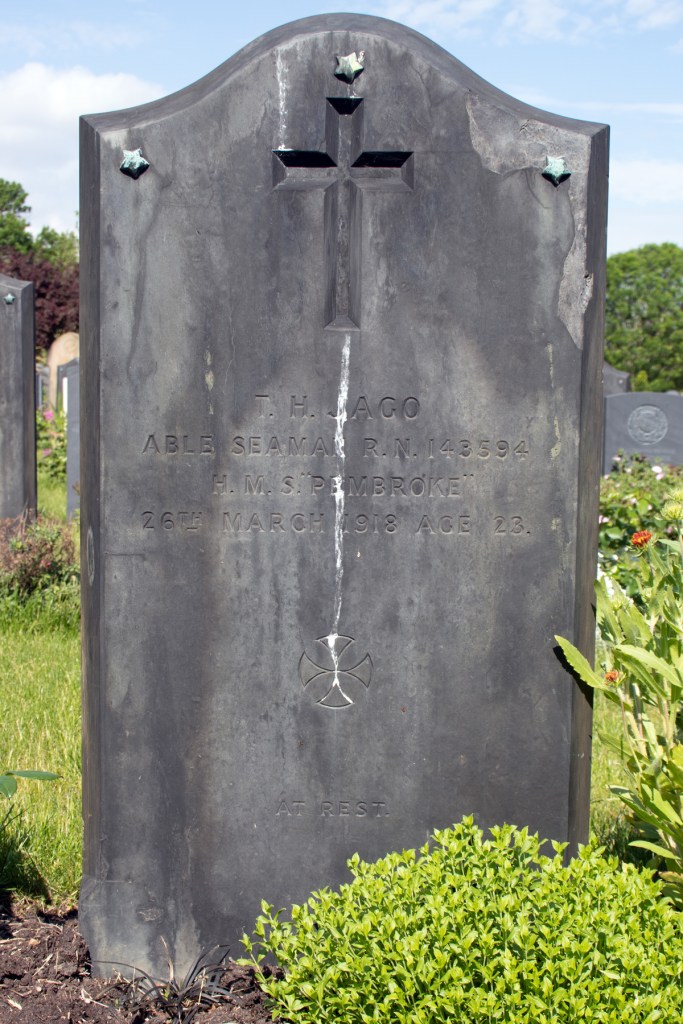
Thomas Henry Jago was born on 3rd June 1872 in Romney Marsh, Kent. The second of ten children, his parents were James and Elizabeth. James was a coastguardman, and his son was destined to be connected to the sea.
Thomas joined the Royal Navy on 19th December 1887. Given the rank of Boy 2nd Class, his records show that he was just 5ft (1.52m) tall, with dark brown hair, grey eyes and a fresh complexion. He was sent to HMS St Vincent, the training ship based in Haslar, Hampshire, and would remain there until June 1889. During this time, he was promoted and given the new rank of Boy 1st Class.
Thomas’ first ocean assignment was on board the corvette HMS Active. She would be his home for the next three years. In June 1890 he came of age, and was formally inducted into the Royal Navy as an Ordinary Seaman. By November 1890, he had proved his worth again, and was promoted to Able Seaman.
Over the next seventeen years, Thomas would serve on 21 ships. Frustratingly, the dates on his service records become a little muddled as time goes on, but it was while he was on board the RMS Empress of India in the late 1890s that he was promoted to Leading Seaman, then Petty Officer 2nd Class and Petty Officer 1st Class, all within a matter of three years.
In March 1903 he was demoted to Petty Officer 2nd Class, but the higher rank was reinstated eighteen months later. In September 1907, while serving on HMS Magnificent, Thomas seems to have been in some sort of trouble. This resulted in the removal of his ranking, and he was downgraded to Able Seaman once more, a rank that he would then hold until the end of his naval career.
In between voyages, Able Seaman Jago would have a shore base to return back to. His most common port seems to have been Chatham, and HMS Pembroke, the town’s Royal Naval Dockyard, features on his records more and more as time goes by.
In June 1912, after 22 years of service, Thomas was stood down to reserve status. Over the next few years his trail goes cold, although a later document suggests that he had moved to Sandgate, Kent, where he was renting rooms at 18 High Street.
War was soon raging across the world, and Able Seaman Jago was called upon to serve again. Assigned to London’s HMS President in December 1915, he quickly returned to Chatham Dockyard again. Over the next couple of years, Thomas serves on two further ships – HMS Diligence and HMS Mars – but HMS Pembroke definitely became a home from home.
In February 1918, Able Seaman Jago returned to the Royal Naval Dockyard in Chatham one last time. He was unwell by this point, and was admitted to the the town’s Royal Naval Hospital for an operation on his mouth. Thomas was suffering from carcinoma of the tongue, and the condition was to prove fatal. He passed away on 26th March 1918, at the age of 45 years old.
Thomas Henry Jago was laid to rest in the naval section of Woodlands Cemetery in Gillingham, Kent, not far from the base he had called home for so many years.
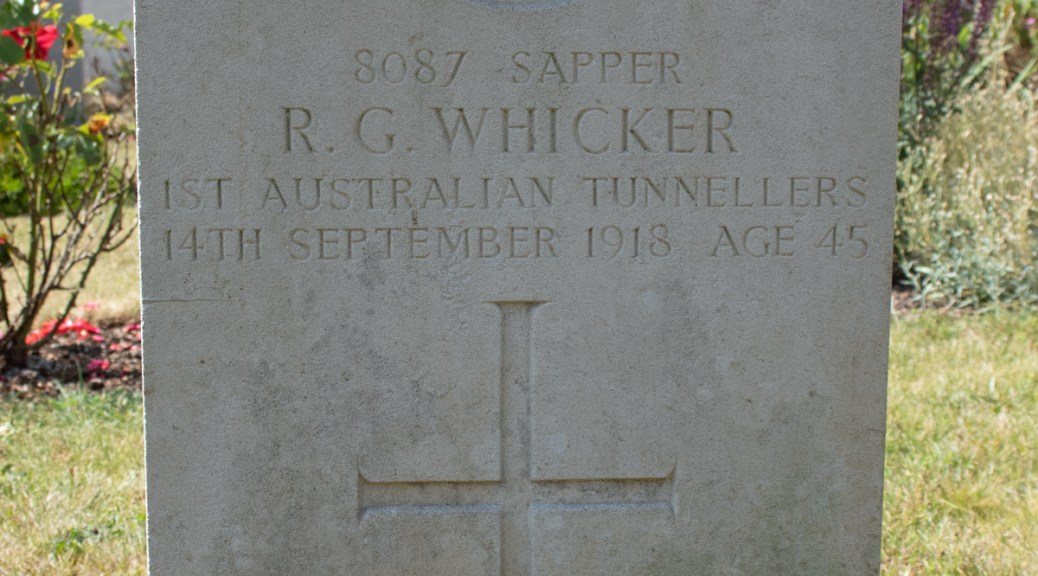
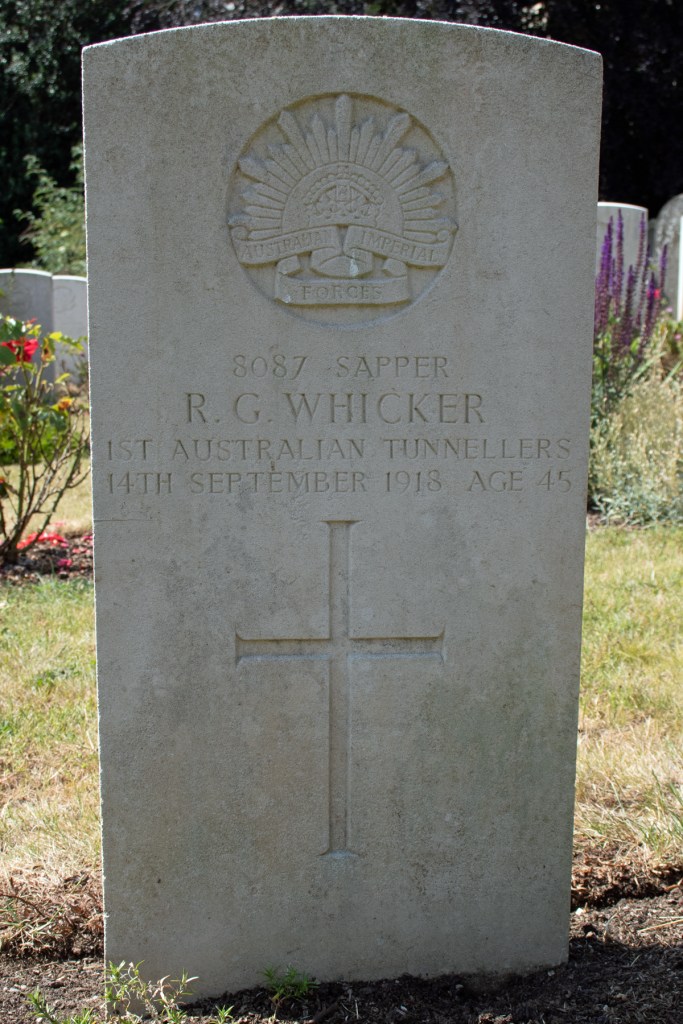
Rupert Gilchrist Whicker was born in Derby, Derbyshire, on 6th February 1873, one of eight children to Walter and Susannah Whicker. There is little information about the family’s early life, and it appears than one of both of Rupert’s parents had died by the time he was 14 years of age.
The Whicker siblings seemed to have gone their own ways at this point, emigrating to the United States and Australia, and it was to Ballarat in Victoria, Australia, that Rupert sailed in 1896. His trail goes cold for then nine years, at which point he married the Australian-born Ellen Ward. The couple would go on to have six children, eventually setting up home in Melbourne.
It is only Rupert’s military records – from when he enlisted on 21st September 1917 – that we discover more about what he had been doing. He gave his trade as miner, and the document suggests that he had tried to join up earlier in the war, but had been rejected as being under height: he was just 5ft 1.5in (1.56m) tall. Rupert’s medical also confirmed that he was 107lbs (48.5kg) in weight, and had auburn hair, hazel eyes and a fair complexion. He was noted as having a birth mark on the side of his left foot and two scars on his left cheek, between the eye and the bone.
Sapper Whicker was assigned to the 1st Battalion of the Australian Tunnellers. He left Australia on board the SS Indarra on 26th November 1917, bound for Europe. After leaving Port Said, Egypt, on 9th January 1918, Rupert’s unit landed in the south of France eleven days later. They travelled to Cherbourg by train, and finally landed in Southampton, Hampshire, on 2nd February 1918.
Rupert would remain on British soil until the beginning of April. His unit arrived in Caëstre in the middle of the month, and he then found himself on the Western Front. Sapper Whicker would serve there for the next four months, and it was only because of illness – a bout of gastritis – that he was brought back from the Front Line.
The stomach condition was severe enough to warrant Rupert’s medical evacuation to Britain for treatment, and he was admitted to Bath War Hospital in Somerset. What was initially thought to be an infection turned out to be far more serious. Sapper Whicker was diagnosed as having stomach cancer, and it has quickly taken hold. Sadly, it would prove fatal, and Rupert passed away on 14th September 1918: he was 45 years of age.
Rupert Gilchrist Whicker had died thousands of miles from his home. He was laid to rest in the military section of Bath’s Locksbrook Cemetery, not far from the hospital in which he had breathed his last.
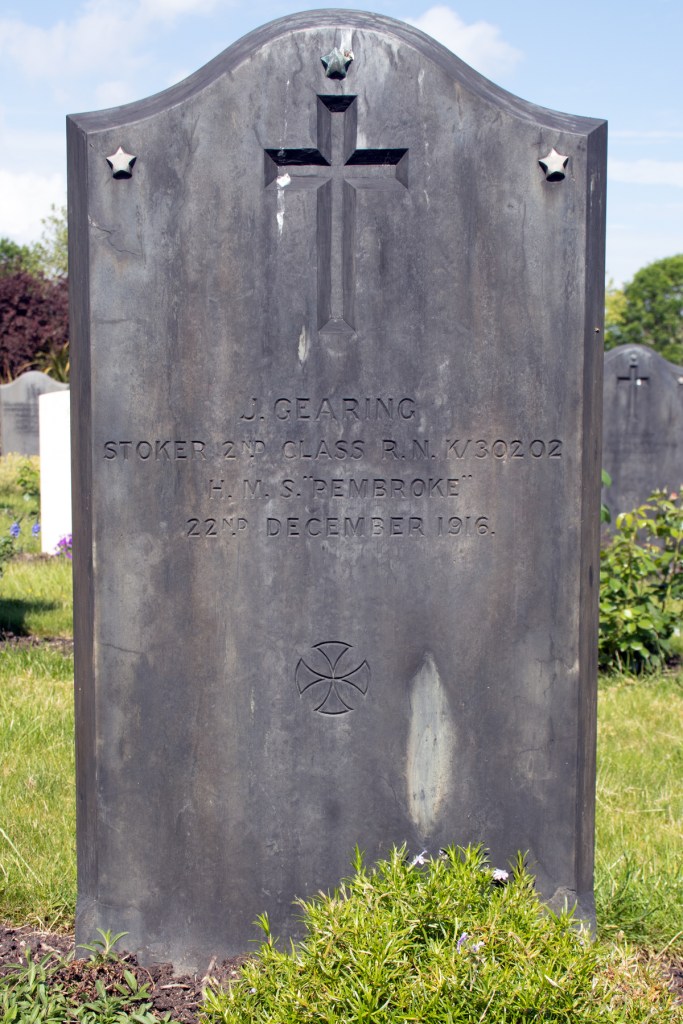
John Gearing was born in Paddington, Middlesex, on 12th August 1894. There is little concrete information about his early life, although a later document confirms he was the son of Mrs E Gearing, of 5 York Place, Hammersmith.
John was working as a fireman when war was declared. When he was called upon to serve his King and Country, he chose to enlist in the Royal Navy, joining up on 5th January 1916. His service records show that he was 5ft 9.5ins (1.76m) tall, with brown hair, blue eyes and a fresh complexion.
Stoker 2nd Class Gearing was initially sent to HMS Pembroke, the Royal Naval Dockyard in Chatham, Kent, for his training. He would remain attached to the base, and was assigned to HMS Victorious, the dockyard’s repair ship, from April 1916.
John’s time in the navy was not to be a lengthy one. Transferred back to HMS Pembroke in September, it seems that his health was becoming affected by the work he was doing. He was admitted to the Royal Naval Hospital in Chatham, suffering from what was later identified as carcinoma of the intestines. He passed away from the condition on 22nd December 1916, aged just 22 years old.
John Gearing was laid to rest in the Woodlands Cemetery, Gillingham, not far from the naval base he had come to call home.
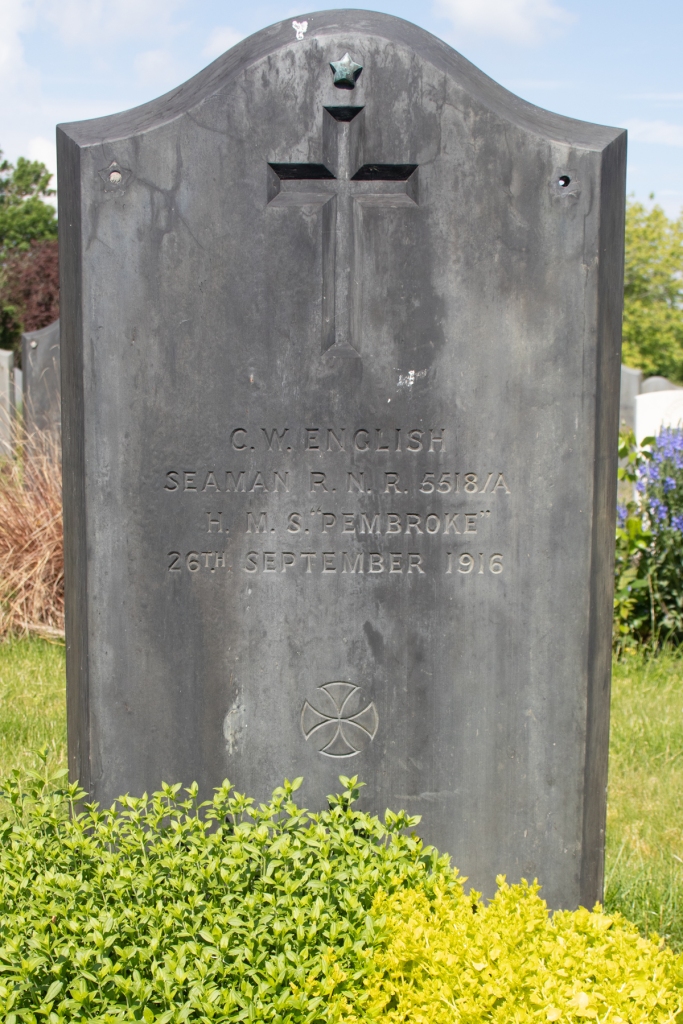
Charles William English was born on 30th August 1895 in the Suffolk town of Southwold. According to his later naval service records, his parents were Ellis and Sarah English, although there is little other information available to back this up.
Charles evidently had a draw to the sea and, when he enlisted in the Royal Naval Reserve on 10th January 1914, he was working as a fisherman. His service records confirm that he was 5ft 9ins (1.75m) tall, with grey eyes and a fresh complexion.
Over the next few years, Seaman English served off the east coast, and was attached to HMS Mantua, a former cruise ship taken over by the Royal Navy to patrol the North Sea. In between trips, Charles made HMS Pembroke, the Royal Naval Dockyard in Chatham, Kent, his home and it was to here that he returned in the autumn of 1916 when he fell ill.
Charles was admitted to the Royal Naval Hospital in the town, tests showing that he was suffering from lymphatic leukaemia. This was to prove fatal, and Seaman English passed away on 26th September 1916, aged just 21 years of age.
It seems likely that Charles William English’s family were unable to foot the bill for bringing their son back to Suffolk. Instead, he was laid to rest in Woodlands Cemetery, Gillingham, not far from the base he had come to call home.
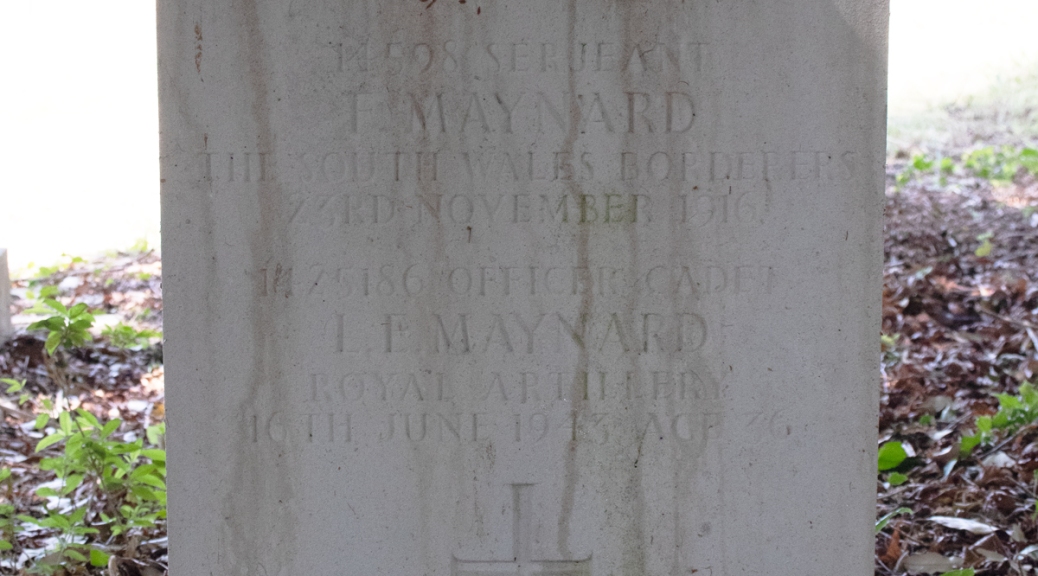
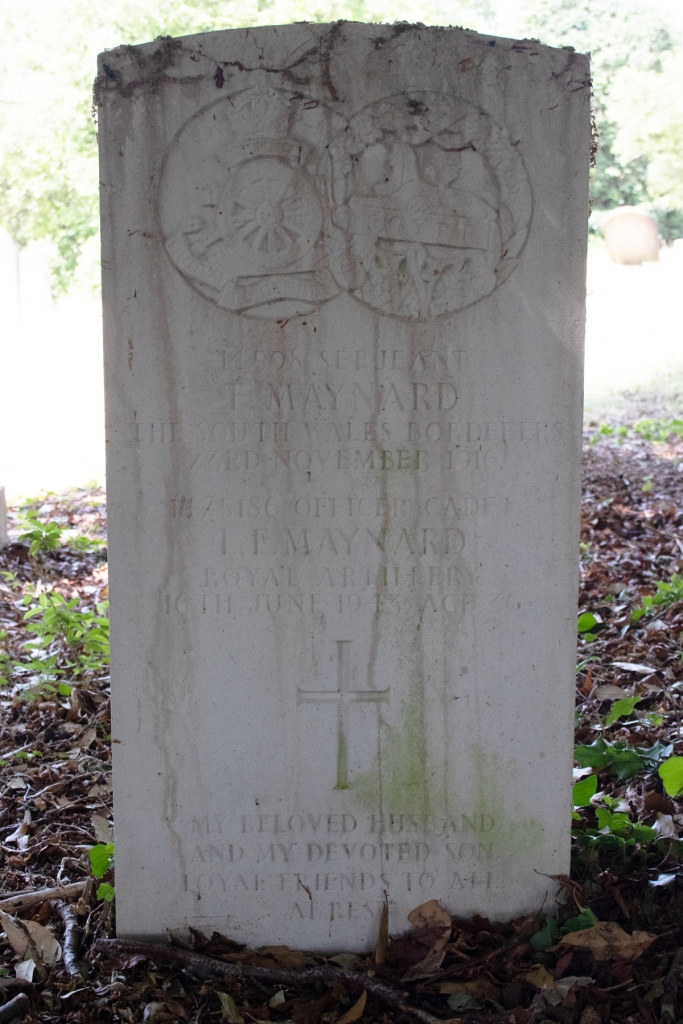
Details of Fred Maynard’s early life are a challenge to piece together. His First World War service records give his age as 44 years old when he enlisted in September 1914, and confirm his place of birth as Melksham, Wiltshire.
A newspaper report of his funeral gives the name of three brothers – Charles, Frank and Arthur – while only one census return, from 1881, provides a potential match for the family. This suggests Fred’s parents were iron fitter Alfred Maynard and his wife, Deborah, and gives the family’s address as Waterworks Road in Trowbridge.
Fred joined the army in the autumn of 1888. Initially assigned to the Gloucestershire Regiment, he had transferred to the Wiltshire Regiment by the following spring. Private Maynard showed a commitment to duty: in December 1890 he was promoted to Lance Corporal, rising to Corporal in the summer of 1893.
Fred was stood down to reserve status after his seven years’ active duty, but was recalled to the army in December 1899, when war broke out in South Africa. Promoted to Serjeant, he was sent to fight in the Boer War, and was mentioned in dispatches on 2nd April 1901 for special and meritorious service in South Africa. He was stood back down to reserve status in October 1901.
On 21st November 1895, Fred had married Louisa Card. The couple set up home in Trowbridge, but soon moved to London. They went on to have six children: Ernest, Nora and Leslie, who were all born in the London; and Arthur, Martha and Stuart, who were born in Cardiff, the family having moved to Wales by 1910.
The army was not finished with Fred, however, and, within weeks of war breaking out in the summer of 1914, he was called back into service. Given the rank of Serjeant again, he was attached to the South Wales Borderers. Fred was 44 years of age by this point, his service records confirming that he stood 5ft 8ins (1.73m) tall, weighed 164lbs (74.4kg) and had brown hair and hazel eyes.
Attached to one of the regiment’s depots, it seems unlikely that Fred saw service overseas this time around. He was discharged from the army on 1st September 1916 and this seems to have been on medical grounds. Later documents suggest that Serjeant Maynard had been diagnosed with carcinoma of the pylorus, or stomach cancer.
Fred returned to Cardiff, but his time back home was to be short. He was admitted to the Lansdown Road Military Hospital, and passed away on 23rd November 1916. He was 46 years of age.
It seems that Fred’s brother’s had some sway in his funeral. Instead of being laid to rest in Cardiff, where Louisa and the children were living, he was, instead, buried in the Locksbrook Cemetery, Bath, Somerset. His sibling Charles, who was a sergeant in Bath City Police, lived in the city, as did another brother, Frank.
Fred’s headstone also commemorates his and Louisa’s son, Leslie. He had joined the army in the 1920s and, in the summer of 1943, was in Yorkshire, undergoing officer training.
The death of an officer cadet through the accidental discharge of a rifle whose bolt had jammed was described at an inquest…
Captain WH Price said he was in charge of an exercise on the moors which involved the used of small arms and the firing of live ammunition. A squad of cadets lay on the ground in front of a trench firing over a range. All finished firing except Cadet Frank Holroyd, who said his bolt had hammed while firing a second round. [Price] told him to release the bolt by knocking the cocking piece up and back.
This attempt failed, and he told Holroyd to get back into the trench, turn the rifle magazine upwards, place the butt on the side of the trench, and kick the bolt down with his foot. While Holroyd was doing this he noticed Maynard standing in the trench about 4ft away from Holroyd and on his right-hand side.
Captain Price said he saw the rifle was pointing down the range when Holroyd kicked the butt. The cartridge suddenly exploded and Maynard dropped into the trench, shot in the head, and was dead when they reached him.
[Bradford Observer: Saturday 19th June 1943]
Officer Cadet Leslie Maynard was 36 years of age when he was killed. His body was taken back to Somerset for burial: he was laid to rest in the same grave as Fred, father and son reunited after 27 years.
Louisa remained somewhat elusive as time wore on. Fred’s military records confirm that she had moved from Cardiff to the Isle of Wight by 1922. By the time of her son’s death, she was living in Sidcup, Kent.
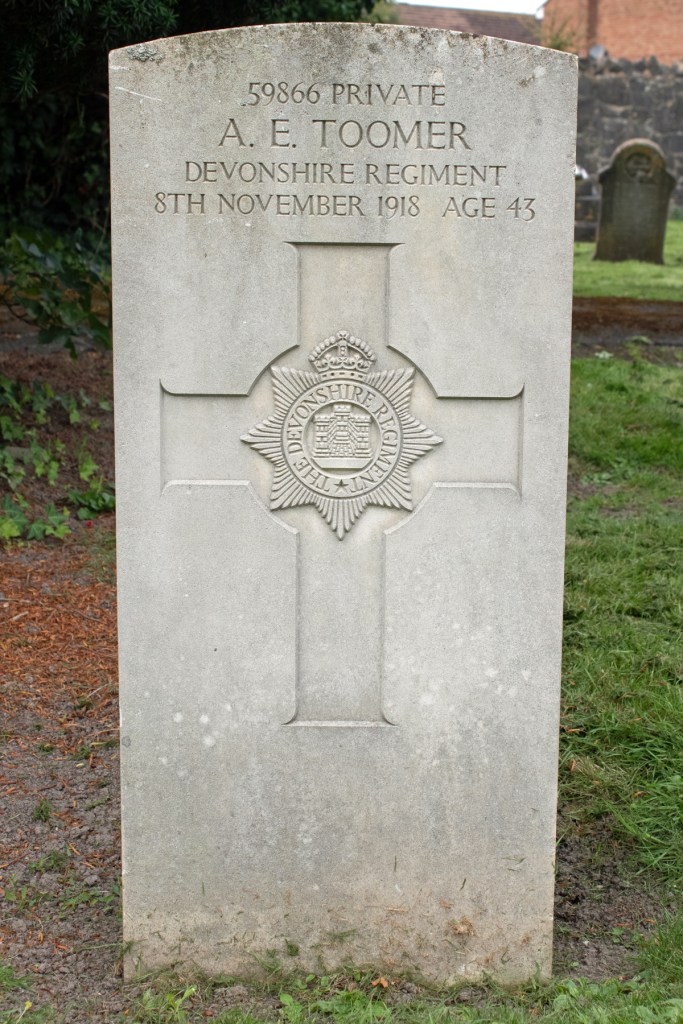
Albert Edward Toomer was born in the summer of 1875, one of eleven children to Joseph and Harriet Toomer. Joseph was a labourer from Meare in Somerset, but it was in Highbridge, near Burnham-on-Sea that the family were born and raised.
When he finished his schooling, Albert found work in a local brickyard and, by the time of the 1911 census, when he was the only Toomer child to still be living at home, he was employed as a tile maker. By this point he was 35 years of age, and, as a single man, was in a position to support his parents, who were both in their 70s.
Harriet died in 1914, Joseph following a year later. On 9th January 1915, Albert married Louisa Clark at the Ebenezer Chapel in Brent Knoll. The couple went on to have a child, Arthur, later that year.
By this point, war was raging across Europe. Despite his age, Albert stepped up to play his part, enlisting on 27th November 1915, at the age of 40 years old. Private Toomer’s service documents confirm he was 5ft 3ins (1.6m) tall, and weighed 110lbs (50kg). He was placed in the Army Reserve, and was not formally mobilised until March 1917.
Assigned to the 11th (Reserve) Battalion of the Devonshire Regiment, Albert was sent to France within weeks of being mobilised. He was transferred to the Labour Corps two months later, and remained in France until the autumn of 1918.
By this point, Albert’s health seems to have been suffering. In September, he was admitted to the 7th Canadian General Hospital in Northern France. He was suffering from a carcinoma, although his medical records are not legible enough to confirm what type of cancer. Invalided back to Britain, Private Toomer was sent to a military hospital in Whalley, Lancashire.
Albert’s time in hospital was not to be a lengthy one. He passed away on 8th November 1918, from a combination of the cancer and tuberculous peritonitis. He was 43 years of age.
Albert Edward Toomer was taken back to Somerset for burial. He was laid to rest in Highbridge Cemetery, not far from where his widow and son lived.
Henry Gibbs was born in Wiveliscombe, Somerset at the start of 1871. The youngest of five children, he was the second son to John and Emma Gibbs. John was a farm labourer, but when he finished his schooling, Henry went in a different direction.
By the time of the 1891 census, Henry was boarding with his sister Lucy and her husband and young son. The extended family were living in Taunton, Somerset, where Henry was employed as a boot and shoemaker. This appears not to have satisfied him, however, and he soon found other work, enlisting in the Royal Field Artillery. While his army records are lost to time, he seems to have spent twelve years in service.
By the early 1900s Henry living back in Somerset, settling in Bishops Lydeard, to the west of Taunton. On 2nd May 1906, he married a young woman called Florence Gange. Fifteen years his junior – she was 20 years old to her husband’s 35, even though the marriage certificate gave his age as 30 – she a labourer’s daughter from the village, who was working at the Lethbridge Arms public house at the time of their marriage. The couple set up home in a small cottage, and went on to have four children: Ernest, Florence, Mabel and Arthur.
Henry’s work seems to have been transient. On his marriage certificate, he was noted as being a groom, but the next census return, taken in 1911, gave his employment as a labourer for a corn miller.
When war came to European shores, despite his growing family, Henry felt the pull to serve once more. He enlisted in the Royal Army Service Corps in the summer of 1915, with the rank of Driver. As with his previous time in the army, details are scarce, but Henry seems to have been based in Aldershot, Hampshire, or at least this is where he was based towards the end of the conflict.
Driver Gibbs had become unwell by this point, and he was suffering from oesophageal cancer. He was admitted to the military hospital in Farnham Hill, but was to succumb to the condition. He passed away on 1st September 1918, at the age of 47 years of age.
Henry Gibbs was brought back to Somerset for burial. He was laid to rest in the quiet graveyard of St Mary’s Church in his adopted home village, Bishops Lydeard.