Tag Archives: Corporal

Serjeant Major Frederick Pearce

Serjeant Major Frederick Pearce

Frederick Charles Pearce was born in the spring of 1873 in the Gloucestershire town of Thornbury. The youngest of six children, his parents were Thomas and Elizabeth Pearce. Thomas was an agricultural labourer and, when he finished school, Frederick found work as a ‘rural messenger’.

This was only a step towards the career that Frederick sought, however, and on 12th July 1892, he enlisted in the Gloucestershire Regiment a a Private. His service records show that he was 5ft 5ins (1.65m) tall and weighed 128lbs (58kg). He was noted as having a fresh complexion, blue eyes and brown hair.

Private Pearce spent twelve years in the army, serving in Malta, Egypt, India and Ceylon (Sri Lanka). He had two stints in South Africa, including the 1899-1900 campaign, during which he was wounded in his chest in the battle at Farquhar’s Farm.

By the time he was discharged on 11th July 1904, he had risen through the ranks to Sergeant, his service records noting that his conduct had been “very good” (in capitals and underlined).

Thomas had died in 1896, and Frederick’s widowed brother William moved back in with his mother to help support her. Frederick also returned to Gloucestershire and, on 30th March 1905, he married Mary Rugman in the parish church in Olveston. The couple may have been childhood sweethearts, as the Pearces and Rugmans were Thornbury neighbours.

The marriage certificate noted Frederick as a groom, and it is likely that he was able to turn his hand to any role after his army career. The couple had a son Leslie, who was born in 1909, and, with the new responsibility of fatherhood, Frederick sought a more permanent career.

The 1911 census found the family living in Somerset, where Frederick was employed as a gardener at the Kingswood Reformatory School. This was a boarding school on an estate to the north of Bath, set in 57 acres of grounds, and again it seems likely that his military career stood him in good stead for such a prestigious role.

When war came to Europe, Frederick felt the pull of his military career once more. While his age did not compel it, on 20th November 1914, he re-enlisted in the Gloucester Regiment. He was enlisted with his previous rank, but within a year has been promoted to Acting Colour Sergeant.

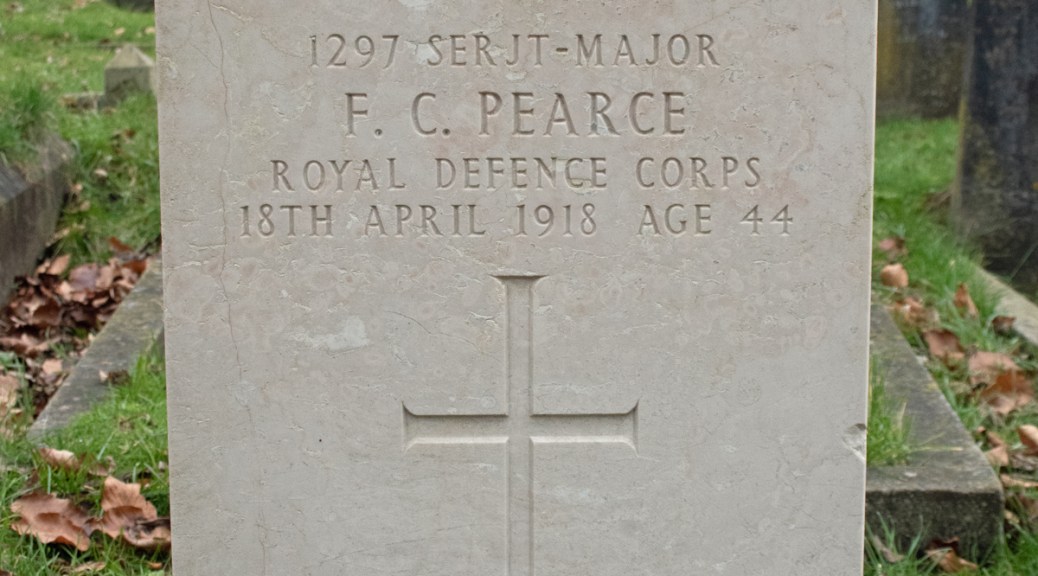
In the spring of 1916, the Royal Defence Corps was formed, and, given his experience and age, Frederick was transferred across to the new regiment. Colour Sergeant Pearce was based in London and, over the next eighteen months served in four troops: 109, 149 and 150 Protection Companies and the 10th City of London Volunteers’ Regiment.

Frederick’s age and the demands of his role were beginning to take their toll by this point, and by the end of 1917, he had developed nephritis, or inflamed kidneys. The condition was severe enough to warrant his discharge from service, and the now Sergeant Major Pearce’s military career came to an end on 17th January 1918.

Frederick returned home to Bath, to the bosom of his family. He and Mary three children by this point, Violet and Freddie being two younger siblings to Leslie. Tragically for the Pearces, however, the family life was not to to last for long: Frederick’s condition was to get the better of him just three months later. He passed away on 18th April 1918, at the age of 44 years old.

Frederick Charles Pearce was laid to rest in St James’ Cemetery in Bath; a man of duty resting at last.


Tragedy was to strike again for poor Mary, when just six months later her youngest child, Freddie, also passed away. Details of his death are vague, but he was buried with his father, the two Fredericks reunited too soon.

Serjeant John Carthew

Serjeant John Carthew

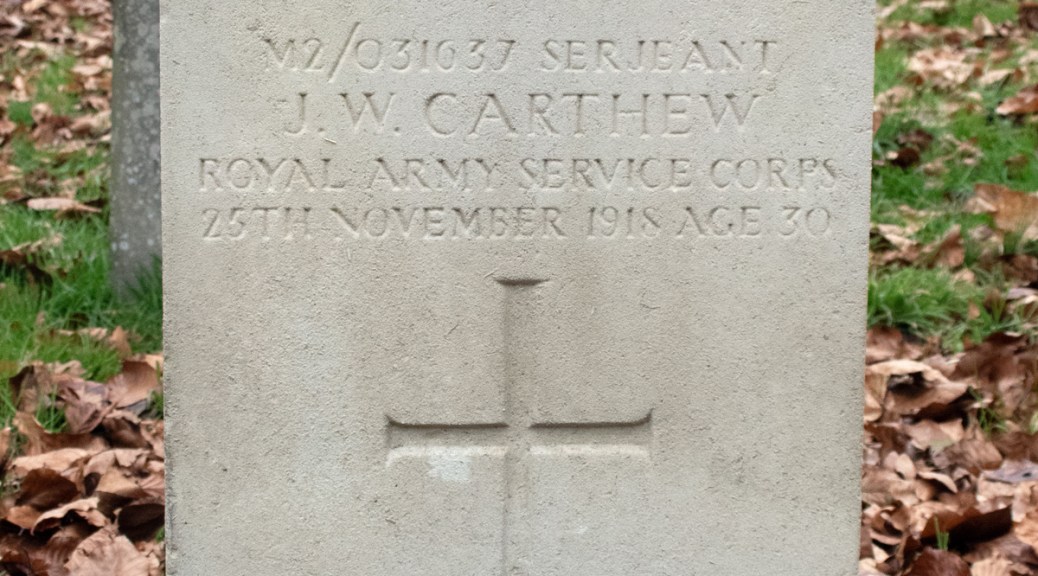
John Wallace Carthew was born in Warminster, Wiltshire, in the spring of 1892. The second youngest of seven children – three of whom did not survive childhood – his parents were miller James Carthew and his tailoress wife, Sarah.

John was destined to make a path for himself. By the time of the 1911 census, he was boarding with the Southon family in Aldershot, and working as a chauffeur.

On 22nd March 1914, John married Caroline Hamilton, a parlour maid for Captain Charles Woodroffe and his family in Aldershot. The couple set up home in Queensgate Mews, London, and having had a daughter, Cecilia, who was born that February.

When war came to Europe, John was quick to enlist. He joined up on the 21st December 1914, and was assigned to the Mechanical Transport section of the Royal Army Service Corps. His service records note that he was 6ft 1in (1.85m) tall, with a scar on his right eyebrow.

Private Carthew rose through the ranks, becoming a Corporal in 1916, and a Serjeant in 1918. During this time he acted almost exclusively as chauffeur to General Sir William Robertson. His duties were mainly based on home soil, but he did spend a year in France, while Robertson was Chief of the General Staff there.

As the war came to a close, Serjeant Carthew fell ill. Based in a camp in Aldershot, he contracted influenza, and this developed into pneumonia. This was to take his life, and he passed away at the town’s Connaught Hospital on 25th November 1918. He was just 26 years of age.

Caroline was living in Bath, Somerset by this point, and this is where the body of her husband was brought for burial. John Wallace Carthew was laid to rest in St James’ Cemetery, in the family plot where his father, who had died in 1911, was also buried.


Gunner William Merritt

Gunner William Merritt

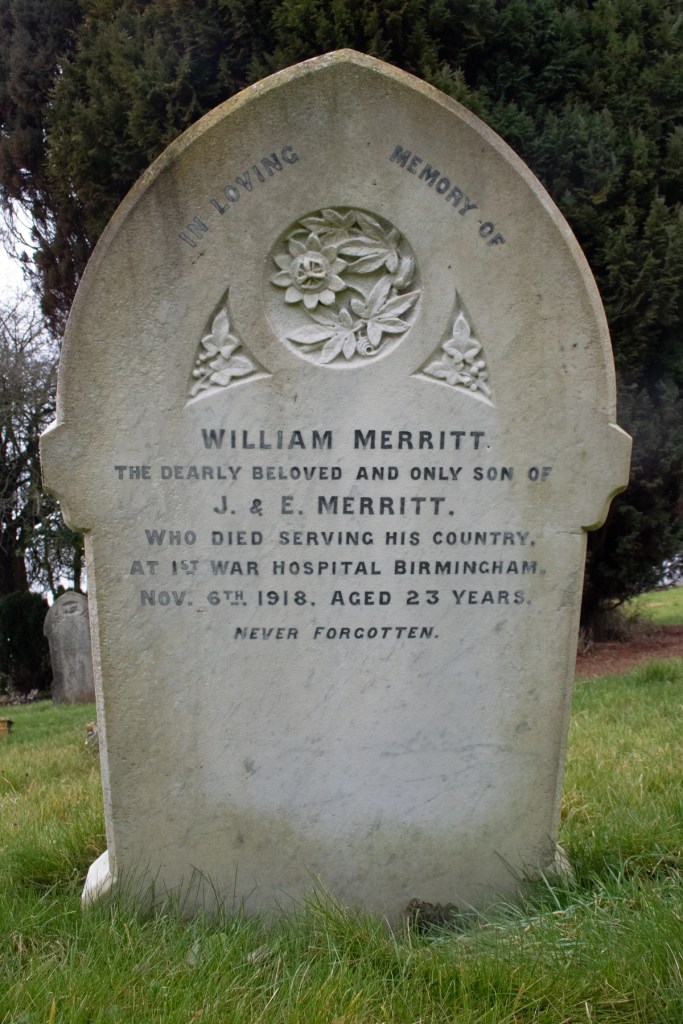
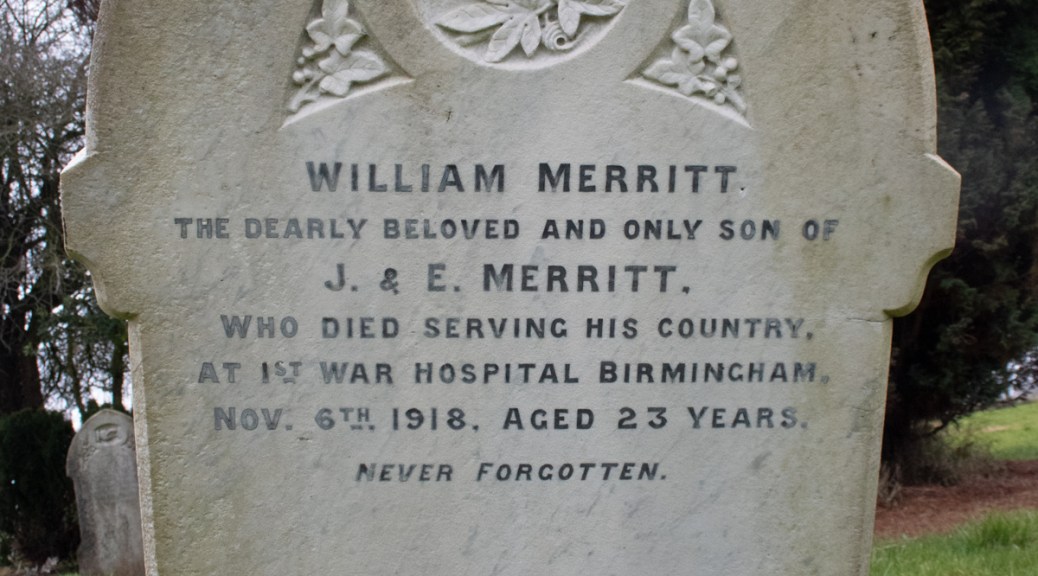
William Merritt was born in the summer of 1895 in Chippenham, Wiltshire. He was the youngest of three children to John and Elizabeth Merritt. John was a blacksmith, and he moved the family to Milborne Port, Somerset, when William was just a boy.

William found work as a shoesmith when he left school, but was one of the first to enlist when war broke out in 1914. He had his medical examination on 17th November, which confirmed that he was 5ft 5ins (1.65m) tall, had good vision and was of good physical development.

Initially assigned to the Dorset Yeomanry, Private Merritt’s trade soon found him taking on the role of Shoeing Smith for the battalion. He was obviously good at what he did, because by May 1915, he had been promoted to the rank of Corporal Shoeing Smith.

William had not enlisted in the army to make and mend shoes, however, and, in March 1916, he transferred to the Royal Garrison Artillery, back with the rank of Gunner. Rather than being sent to the Western Front, however, he found himself billeted at a camp in the West Midlands.

Little further information about Gunner Merritt’s service is available for the next couple of years. The next record for him comes on 5th November 1918, confirming his admission to the Birmingham War Hospital, as he was suffering from influenza and pneumonia. Sadly, his admittance to hospital was to prove too late: he passed away from heart failure the following day. Gunner Merritt was just 23 years of age.

William Merritt’s body was brought back to Somerset for burial. He was laid to rest in the cemetery of the town in which he had plied his trade before the war, Milborne Port.


William’s sparse personal effects were also returned to his parents. The records note that these included: “pair [of] boots, 6 postcards, razor, comb, toothbrush, shaving soap and brush, letter, pair of socks, bell.”

Another bureaucratic error is highlighted in a letter sent from the hospital in which William passed to his regiment’s records office notes that “I have to inform you that the body was forwarded to his Wife for burial…” William was unmarried, and his body was actually returned to his mother, Elizabeth.


Korporaal Paul Vandermersch

Korporaal Paul Vandermersch

The funeral took place on Friday last, at Bath, of Paul Vandermersch, second son of Paul Vandermersch, Divisional Chief, Provincial Administration, Western Flanders. Deceased passed away the previous Tuesday at 86, Shakespeare-avenue, Bath, at the early age of 22. He had served in the Belgian Army, but suffering from phthisis, he was invalided out.

Catholic Times and Catholic Opinion: Friday 14th January 1916

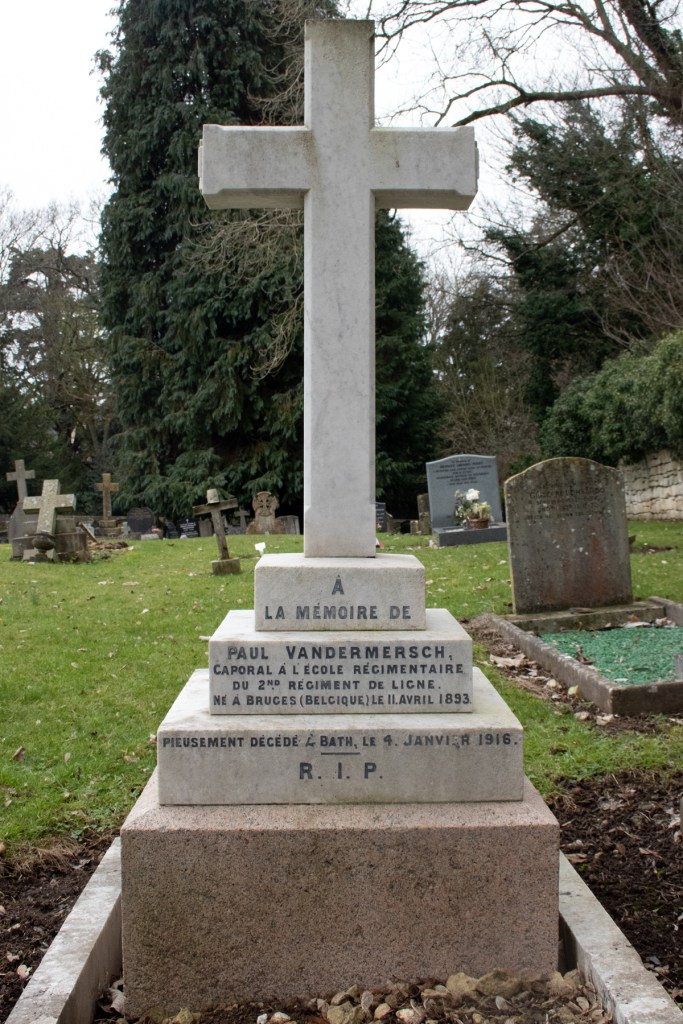
Paul Pierre Arnold Joseph Vandermersch was born on 11th April 1893 in Bruges, Belgium. Details of his early life are scarce, but it is clear that he was the son of Paul and Louise Vandermersch.

During the First World War, Paul served as a Korporaal (Corporal) in the Belgian Army, and was assigned to the 2 Linie 1/1 (second line). Full service records are not available, but having contracted tuberculosis, and with the influx of Belgian refugees to Britain during the conflict, it is likely that, having been medically discharged from the army, he was sent to Somerset to recuperate.

Korporaal Paul Pierre Arnold Joseph Vandermersch died on 4th January 1916, and was laid to rest in the Roman Catholic Cemetery in Bath.


Gunner Theophilus Burdock

Gunner Theophilus Burdock

Theophilus Walter Burdock was born on 18th June 1871 in Whitminster, Gloucestershire. One of nine children, his parents were painter and decorator Nathaniel Burdock and his wife, Mary.

While he found labouring work when he left school, Theophilus – who went by his middle name, Walter – decided that he wanted bigger and better things and, on 30th December 1889, he enlisted in the Royal Artillery. His service records show that he was 5ft 5ins (1.65m) tall and weighed 115lbs (52kg). The document also records that he has a tattoo of a man, star and crown on his left forearm.

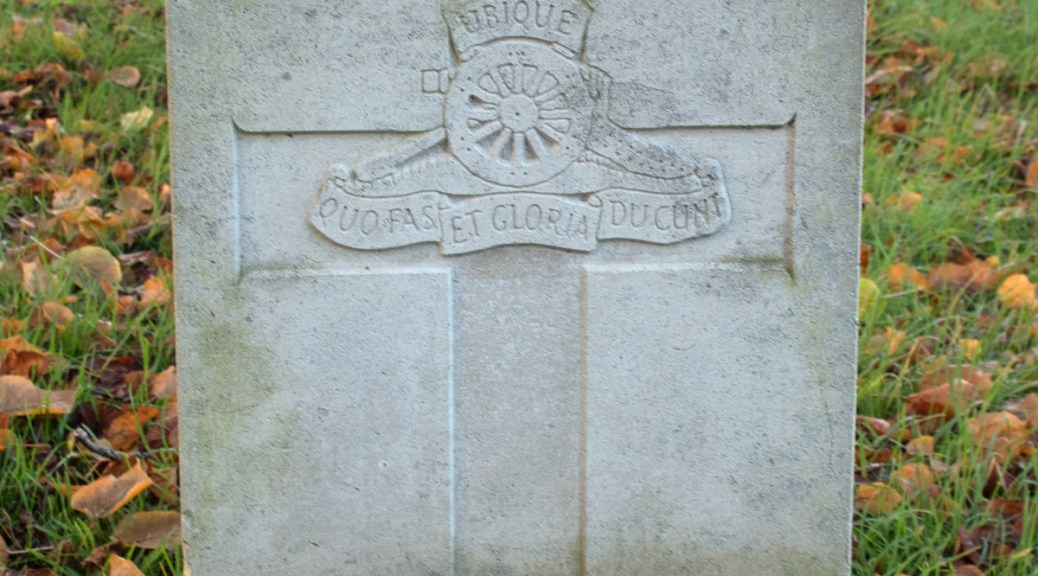
Initially assigned to the 1st Depot 2nd Battery as a Driver, over the next couple of years Walter made solid progress within the regiment. By September 1892, he was promoted to Gunner, within a couple of years he was raised to Bombardier, and by April 1895 he had made the rank of Corporal.

By his last formal year in the ranks, things seemed to take a different turn. On 9th March 1896, Corporal Burdock received a contusion to his face. He was formally transferred to the Army Reserve when his contract of service ended in December 1896, but within eighteen months he re-enlisted.

At this point, however, Corporal Burdock’s conduct began to race downhill. In August 1898 he was tried for an undisclosed reason, and his rank was reduced to Bombardier. Within a couple of months, he was tried for a second crime, and reduced in rank again, back to Gunner.

For a time Walter kept his nose clean, and, in February 1900, he was promoted back to the rank of Bombardier. This was to be only a fleeting move, however, as he reverted back to Gunner less than two months later.

Over the next couple of years, Walter generally kept his head down. On 30th April 1901 he was injured by a kick in the eye, although, again, details are tantalisingly scarce. By April 1902, his contract came to an end and this time he was stood down and formally demobbed.

Civilian life seemed to be something to which Walter was not to be destined. He enlisted again almost immediately, joining the Imperial Yeomanry in May 1902. He lasted less than a year with the regiment, however, having served ten months in South Africa.

In January 1904, was recalled to the Royal Artillery for further service in South Africa. His medical report showed the man he had become in the fifteen years since he had first joined up: he was now 5ft 7ins (1.7m) tall, and weighed 141lbs (64kg).

Private Burdock served six months on home soil, but in July 1904, he was sent to South Africa, having never actually seen any overseas service before. He returned to Britain in September 1905, and was discharged from service, specifically so that he could re-enlist with the Royal Artillery and complete his fourteen years’ service with them.

Gunner Burdock remained with the Royal Artillery until February 1906, presumably as he had finished his fourteen years. Interestingly, his discharge papers noted his conduct as ‘indifferent’.

Walter’s trail goes at this point. His mother, Annie, passed away in Gloucestershire in the spring of 1908. His father, Nathaniel, died Bristol in 1912. The next evidence for their son comes in September 1914, in attestation papers for the Canadian Expeditionary Force.

Walter was, by this point, living in Victoria, British Colombia, and working as a lumberjack. He had been unable to completely leave his army days behind him, and his service records give his year of birth as 1876, five years younger than he actually was at the time.

Those service records give similar physical characteristics to his 1904 papers, and confirm the presence of some additional tattoos: a butterfly and pair of hands with the words true love.

Walter was assigned to the Royal Canadian Horse Artillery, and given the rank of Gunner. He arrived back in Britain in October 1914, but his previous indifference seems to have recurred. He was imprisoned for a week from 21st October for having been absent without leave, and was found to be absent again at reveille on the morning of 30th October.

Yesterday afternoon the body of a man was found floating in the Avon just below Bathampton Weirs, and close to the entrance to the back-water on the Batheaston side of the river.

The body was floating face downwards some yards from the bank, and only the top of the head was visible.

The body was recovered shortly before five o’clock. It appeared to be that of a middle-aged man of medium height. The trousers had something of the appearance of a mechanic’s overall and deceased was wearing a sleeve vest.

The conjecture naturally arises whether the body is that of the missing Canadian soldier Burdock, whose clothes were discovered on the bank at Batheaston on Saturday, October 31st, and of whom nothing has been heard since. Burdock was a member of the Canadian contingent now in training on Salisbury Plain. It is known that the missing soldier had several tattoo marks on his arms… so the question will not long remain in doubt when the body has been brought to the bank.

Bath Chronicle and Weekly Gazette: Saturday 14th November 1914

The body did indeed turn out to be that of Gunner Burdock. An inquest reached a verdict of suicide while temporarily insane. He was 43 years of age.

Theophilus Walter Burdock was laid to rest in the graveyard of St John the Baptist Church in Batheaston. Interestingly, while his next of kin was identified as his brother Frederick Burdock, Walter’s service records add a further dimension to his passing:

A maple tree has since been planted at the head of the grave by Miss Henderson, The Hill, Batheaston, who took a great interest in the case. Miss Henderson also sent a beautiful wreath when deceased was buried.


Corporal James Stuckey

Corporal James Stuckey

James Oscar Stuckey was born in the summer of 1886, in Milford Haven, Pembrokeshire. The second of eight children, his parents were James and Minnie Stuckey. James Sr was a carter from Langport in Somerset, and his work took him across the country. James Jr’s older sister was born in Sandown, on the Isle of Wight, and, when his next sibling was born, the family had moved back to Somerset and were living in the village of Curry Rivel.

By the time of the 1901 census James Sr was working as a warehouseman. James Jr had also left school and found employment as an agricultural labourer.

On 24th March 1913, James married Margaret Beatrice Tilley – who was better known as Beattie. The couple set up home in Curry Rivel, and went on to have two children, Cecil and James.

By this time war was coming to Europe and, in January 1915, James stepped up to play his part for King and Country. He enlisted in the Royal Field Artillery, and was given the rank of Gunner. Over the next couple of years, he served in France and Italy, rising through the ranks to Bombardier and Corporal.

During this time, however, James’ health was being impacted. His troop was gassed while in France, and he was hospitalised a couple of times with bronchitis and tuberculosis, and it was TB that saw him evacuated to Britain for treatment in September 1918.

His condition was such that Corporal Stuckey was medically discharged from the army on 23rd November 1918, as he was no longer fit for duty. He returned to civilian life, and settled back into Curry Rivel.

He was well-known in the district, and being of a jovial disposition, was liked by everyone with whom he came into contact. He was a member of the Curry Rivel Male Friendly Society.

Langport & Somerton Herald: Saturday 11th December 1920

James’ lung conditions were to get the better of him. After a protracted illness, he finally succumbed, breathing his last on 3rd December 1920. He was just 34 years of age.

James Oscar Stuckey was laid to rest in the graveyard of St Andrew’s Church, in Curry Rivel.


Corporal Thomas Teague

Corporal Thomas Teague

Thomas Teague was born in the spring of 1884 in the Cornish town of Tintagel. He was one of ten children to quarryman and road labourer John Teague and his wife, Ellen. When he first left school, Thomas found work as a farm labourer. By the time of the 1911 census, he was still living in the family home, but had found more skilled work as a stone mason.

Much of the rest of Thomas’ life remains a mystery. John passed away in September 1914, and it is clear that, with war now raging across Europe, Thomas stepped up to play his part. He enlisted in the Royal Dublin Fusiliers, and was assigned to the 7th Battalion. The regiment served in Gallipoli, Salonika and Egypt, although it is not possible to identify where Private Teague served.

At some point, potentially because of health reasons, Thomas was transferred to the 655 Home Service Coy of the Labour Corps. Again, exact details of his service are unclear, but he had been promoted to the rank of Corporal, and appears to have been based in Curragh Camp, not far from Kildare, Southern Ireland.

The only other confirmed record relating to Corporal Teague is that of his passing. He died of heart disease in the camp, on the 2nd October 1917. He was 33 years of age.

Thomas Teague’s body was brought back to Cornwall for burial. He was laid to rest in the peaceful graveyard of St Materiana’s Church, overlooking his home village of Tintagel.


Thomas was buried in the family plot, alongside his father. When his mother, Ellen, passed away in 1930, she was reunited with her husband and son.


Sapper William Dove

Sapper William Dove

William Henry Dove was born in the autumn of 1871 in Stafford, Staffordshire and was one of seven children to William and Louisa Dove. William Sr was a gardener by trade, but his son wanted bigger and better things.

On leaving school, he initially took up a post as a junior teacher, but military service was calling him and, on 21st February 1891 he enlisted in the Royal Lancaster Regiment. Private Dove’s service records show that he was 5ft 7ins (1.70cm) tall and 136lbs (61.8kg) in weight. He had sandy hair, grey eyes and a fair complexion. He also gave his age as 18 years and 3 months, although he was actually a year older.

Private Dove signed up for seven years’ service and completed this on home soil. In October 1891 he was promoted to Lance Corporal, and a year later he was promoted again, this time to Corporal.

In November 1894, William was found guilty of ‘conduct to the prejudice of good order and drunkenness‘ and was sentenced to be reduced in rank, so became a Private again. He learnt the error of his ways, though, and was reinstated to Lance Corporal in March 1897.

William’s service was completed in February 1898, and he was transferred across to the Army Reserve. This was intended to be for a further five years, but on 15th February 1900, he was discharged from future active service, having been found to be medically unfit. During his time in the army, William had been treated for a two bouts of gonorrhoea, as well as four further infections. The cause of his final medical discharge, however, is unclear.

While on reserve, William had found employment as a railway porter. His work took him to Llangollen, Denbighshire and, this is where he set up home. On 18th April 1899, he married Ellenor Roberts, a labourer’s daughter from the town: the young couple set up home in Ashfield House, Regent Street – now the busy A5.

The 1911 census records William as a porter: the couple had no children of their own, but had adopted a girl, Cissie, who was then eight years old. A live-in domestic servant – Esther Williams – was also recorded on the census.

War was coming to Europe by this point and, while details of his service are unclear, William stepped up to play his part once more. He enlisted in the Royal Engineers as a Sapper, at some point during the conflict, although exact details are lost to time.

Sapper Dove survived the war and returned to Llangollen. The 1921 census records him Ellenor and Cissie living at Bronhaul, and that William was working as a parcel’s porter for Great Western Railways. On 18th August 1921, he collapsed and died with a brain aneurysm. He was 39 years of age.

William Henry Dove was buried in the graveyard of St John’s Church in Llangollen, a short distance from the station at which he portered for so long.


Ellenor lived on until her late 70s. When she passed away, she was laid to rest in the family plot, reunited with her husband after 35 years.


Corporal de Courcy Raymond

Corporal de Courcy Raymond

de Courcy William Raymond was born in the summer of 1883 in the Somerset village of West Camel. He was one of six children to carpenter George Raymond and his wife, Anne. de Courcy – whose name may have had family connections – followed his father into carpentry and, by the time of the 1911 census, the family had moved to nearby South Barrow, where George had been born.

When war came to Europe, de Courcy was keen to play his part. Sadly, full details of his military service no longer survive, but what can be determined is that he had enlisted by March 1915, joining the North Somerset Yeomanry.

Private Raymond was assigned to the 2nd/1st Battalion, which was a second-line troop, and remained on home soil, moving from Somerset to Wiltshire to Kent by the autumn of 1915. He was evidently good at his job as he was soon promoted to the rank of Corporal for his efforts.

It was while he was based in Kent that de Courcy fell ill. He contracted pneumonia, and was admitted to a military hospital in Canterbury. Sadly, the condition was to prove too much, and he passed away from the condition on 9th October 1915. He was 32 years of age.

The body of de Courcy William Raymond was brought back to Somerset for burial. He was laid to rest in the family plot in the graveyard of St Peter’s Church in South Barrow.


Corporal John Cudby

Corporal John Cudby

Frederick John Cudby – who was known by his middle name – was born in the summer of 1884 in Farnham, Surrey. The fourth of six children, his parents were William and Caroline Cudby. William was a bricklayer from Essex, while his wife was from Ramsgate in Kent. The family went where his work was, and by the mid-1890s, they had moved to Blaenavon in Monmouthshire.

When he left school, John found employment as a mechanic, working as an engine oiler at a local works. William passed away in 1901, and by the time of the next census, in 1911, John was working as a mason’s labourer. The family were all still living in Blaenavon, helping Caroline by keeping money coming in .

When war came to Europe, John was quick to serve King and Country. He enlisted in the Monmouthshire Regiment and, as a Private, was assigned to the 2nd Battalion. His troop was soon sent to France and, by November 1914, he was entrenched at Ypres, near Ploegsteert Wood.

Promoted to Corporal, little of John’s service information survives. It is clear that he was wounded during a skirmish and that he was medically evacuated back to Britain. It seems likely that he was admitted to the Preston Hall Military Hospital in Aylesford, Kent, and that this is where he subsequently succumbed to his injuries.

Corporal Frederick John Cudby died on 6th June 1915, at the age of just 30 years old. He was laid to rest in the graveyard of St Peter and St Paul’s Church in Aylesford, Kent.


While buried in the churchyard, the location of John’s grave is not known. Instead, he is commemorated on a joint headstone in the First World War section of the graveyard.