Herbert Perry was born in Sampford Brett, Somerset, on 2nd July 1887. One of fifteen children, his parents were Henry and Mary Perry. Henry was a groom and gardener, and the family were raised in a small cottage in the centre of the village.
Herbert and his siblings attended the local Church of England school, but once he finished his education his own trail goes cold. The next records relate to his military service, although they are also a bit scarce.
What is clear is that Herbert enlisted early in the war. He joined the 1st Battalion of the Devonshire Regiment, and was in France as soon as January 1915. Private Perry found himself at Ypres, and it was here, in July, that he was badly injured.
Private Perry was medically evacuated to Britain for treatment, and he was admitted to the 5th Northern General Hospital in Leicester. Sadly, this was to be where he would breathe his last: his wounds were to prove too severe, and he succumbed to them on 1st August 1915. He had not long turned 28 years of age.
Herbert Perry’s body was taken back to Somerset for burial. He was laid to rest in the family plot in the peaceful graveyard of St George’s Church. There he was reunited with his mother, Mary, who had died three years before.
Herbert’s older brother, William, joined the Duke of Cornwall’s Light Infantry when war broke out. Assigned to the 1st Battalion, he rose to the rank of Lance Corporal. William fought at the Somme, and was killed there. He is commemorated at the Thiepval Memorial, and remembered on the family headstone in Sampford Brett.
Edward John Ham was born in Berrow, Somerset, in the spring of 1886. The second of seven children – all boys – his parents were Edward and Mary Ham. Edward Sr was a plasterer, but when he finished his schooling, his son found work as a jobbing gardener and nurseryman.
On 2nd October 1906, Edward married Annie Paddy. A carter’s daughter, three years older than her new husband, she was working as a domestic servant when the couple wed at St John the Evangelist’s Church in nearby Highbridge. They went on to have four children: Edward, Rose, Gladys and Horace.
The 1911 census recorded the family as living in Love Lane, Burnham-on-Sea, Edward continuing with his gardening work. War was on the horizon, though, and he was soon called upon to play his part.
Full service records are not available for Edward, but he had enlisted by the summer of 1917. Private Ham initially joined the Devonshire Regiment, but at some point transferred across the to Labour Corps. Edward was attached to the 149th Company and was based in Enfield, Middlesex.
At this point, Private Ham’s trail starts to cool. He passed away on 25th December 1917 at the age of 31 years old. The cause of his death is unclear, but his body was brought back to Somerset for burial.
After a service in Burnham’s St Andrew’s Church, Edward John Ham was laid to rest in the town’s cemetery.
William Richard Griffin was born in the summer of 1899, the fourth of six children to James and Joice Griffin. James was from Somerset and worked as a superintendent for a life assurance company. He met his wife while working in Wales, and this is where their oldest three children had been born. By the time of William’s birth, however, James had moved the family back to Somerset, setting up home in the Weston area of Bath.
There is little information about William’s life. When war was declared, he joined the Devonshire Regiment, and was assigned to the 51st (Graduated) Battalion. His troop remained on home soil – remaining in Norfolk for the duration – so it is unlikely that Private Griffin saw any active service overseas.
William survived the conflict and returned home. He passed away, possibly due to an infection, based on what little is documented, on 22nd July 1920. He had not long turned 21 years of age.
William Richard Griffin was laid to rest in the graveyard of St Martin’s Church in Worle, near Weston-super-Mare.
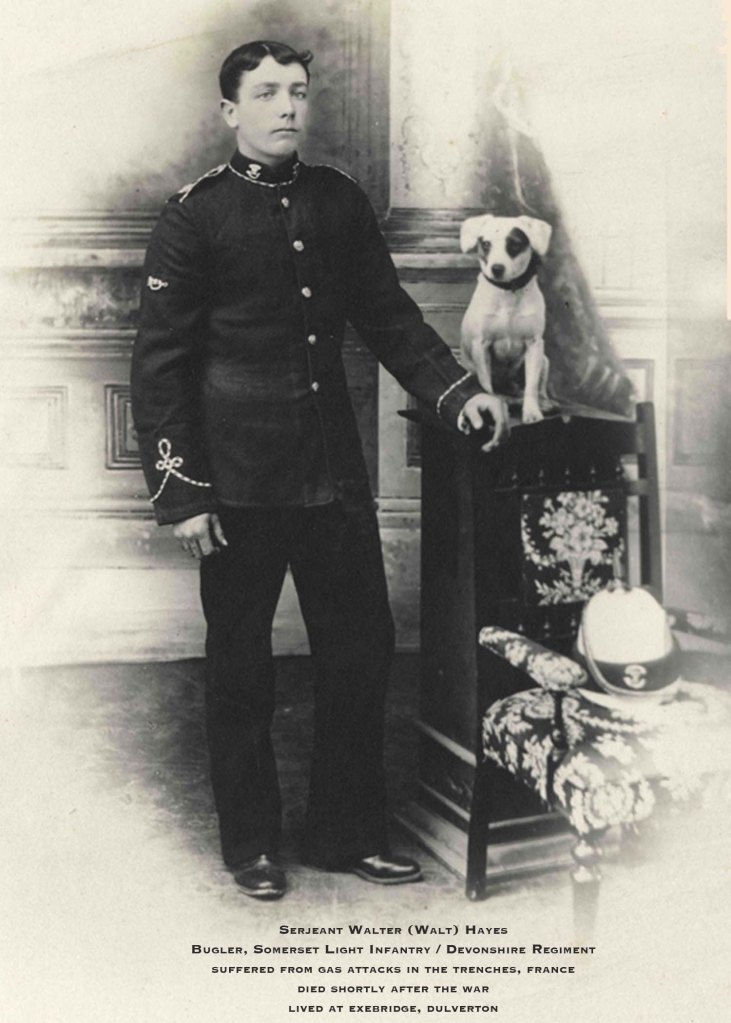
Walter Hayes was born in Somerset in 1883. The oldest of seven children, his parents were William and Mary Hayes. William was an agricultural labourer, and the family lived and worked at Houndhill, to the south east of Stogumber.
Walter also fell into farm work and, in the spring of 1914, he married Emily Mary Tarr. The wedding took place in Tiverton, Devon, but the couple did not stay there for long as, just weeks after their wedding day, Emily gave birth to a daughter, Edith, over the Somerset border in Dulverton.
Storm clouds were brewing over European shores, and Walter was called upon to play his part. His service records are also sparse, but they confirm that he initially joined the Somerset Light Infantry, before moving across to the Devonshire Regiment.
Walter had either been in the army earlier in his life, or he worked his way up during the war, and at some point he reached the rank of Serjeant. He saw fighting overseas and, according to later documentation, was caught up in a gas attack. This was to have an impact on his health and he was discharged from army service sooner than he might otherwise have done. Officially stood down in March 1919, he returned home to his wife and family.
Emily and Walter had a second child, William, later that year, and the family were finally able to settle into a routine. Walter’s health, however, was severely impacted and, on 12th January 1921, he passed away from bronchitis. The lung condition was found to be directly attributable to his war service, and that gas attack, Walter was 38 years of age.
Walter Hayes was laid to rest in the quiet graveyard of All Saints’ Church in Dulverton.
Emily was pregnant when her husband died: she gave birth to their third child, a son she named Walter, just a few months later. She did not re-marry, and, according to the 1939 Register, she was boarding in a house in Dulverton and carrying out unpaid domestic duties.
Emily lived on until the autumn of 1973, passing away in Taunton at the age of 85.
Serjeant Walter Hayes (courtesy of Trevor Hayes)
The early life of Walter Hayes was a challenge to piece together, as his was not an uncommon name in the area at the time. My thanks go to his great nephew, Trevor Hayes, for his help in pulling together the story and for the image of his great uncle.
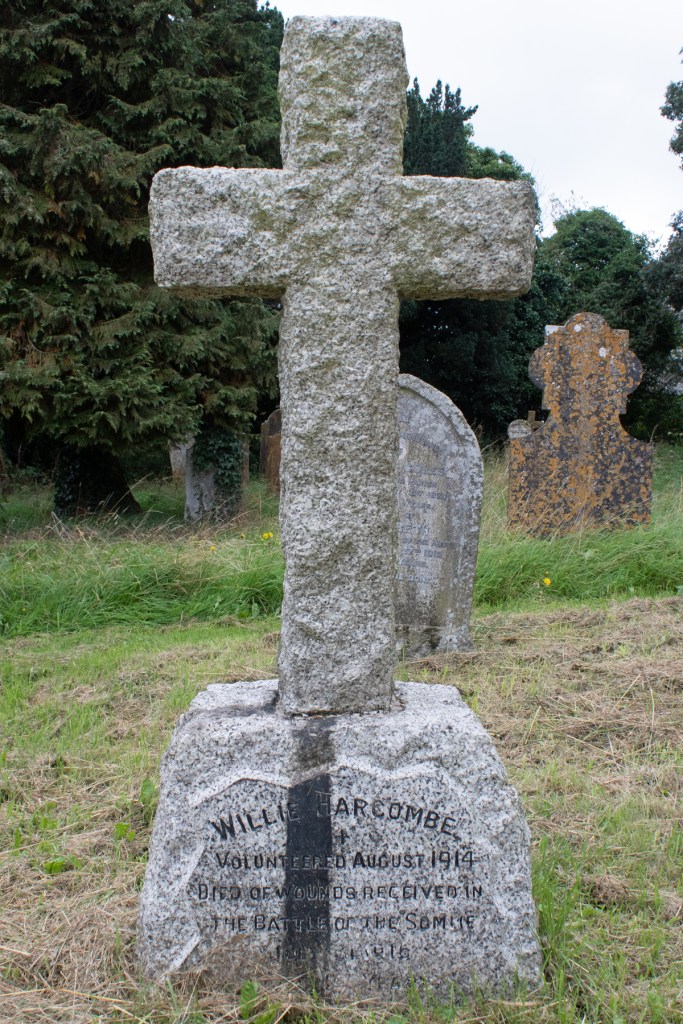
William Harold Harcombe was born on 25th September 1897 in Sampford Arundel, Somerset. One of twelve children, his parents were William and Jane Harcombe. William was an agricultural engine driver who, by the time of the 1911 census, had moved the family five miles north west to Ashbrittle.
When war came to Europe, William was one of the first to enlist, joining the Devonshire Regiment in August 1914. He was assigned to the 8th Battalion, and after nine months’ training, he found himself in Northern France.
Private Harcombe’s troop was involved in some of the fiercest skirmishes of the conflict, at Loos in the autumn of 1915, and at the Somme the following year. It was during this battle – probably at Delville or High Wood – that he was injured.
William was medically evacuated to Britain for treatment, and was admitted to a military hospital in Mile End, London. His injuries were to prove too severe, however, and he succumbed to them on 31st July 1916: he was just 18 years of age.
The body of William Harold Harcombe was brought back to Somerset for burial. He was laid to rest in the tranquil graveyard of St John the Baptist Church in Ashbrittle.
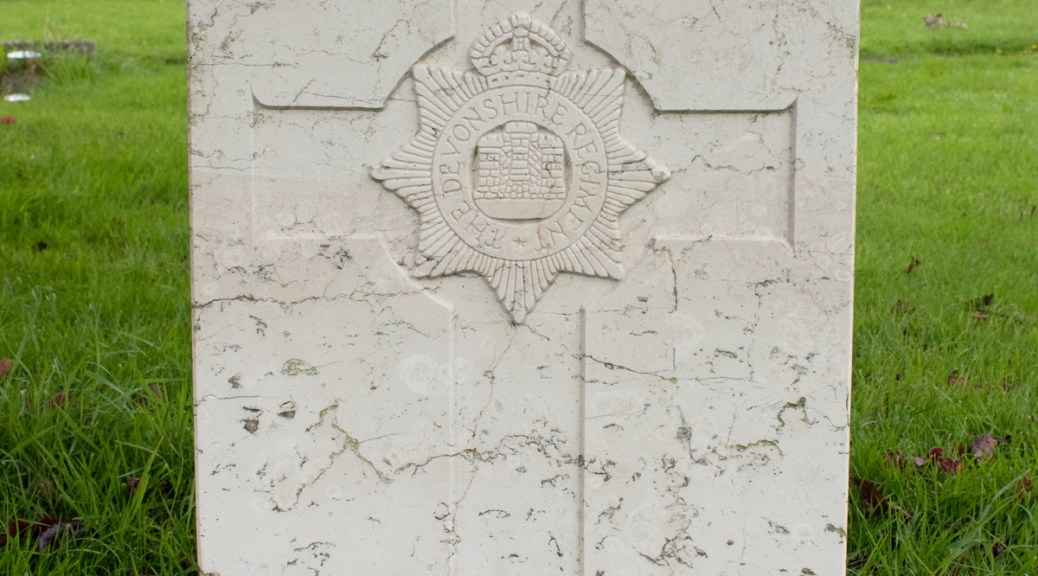
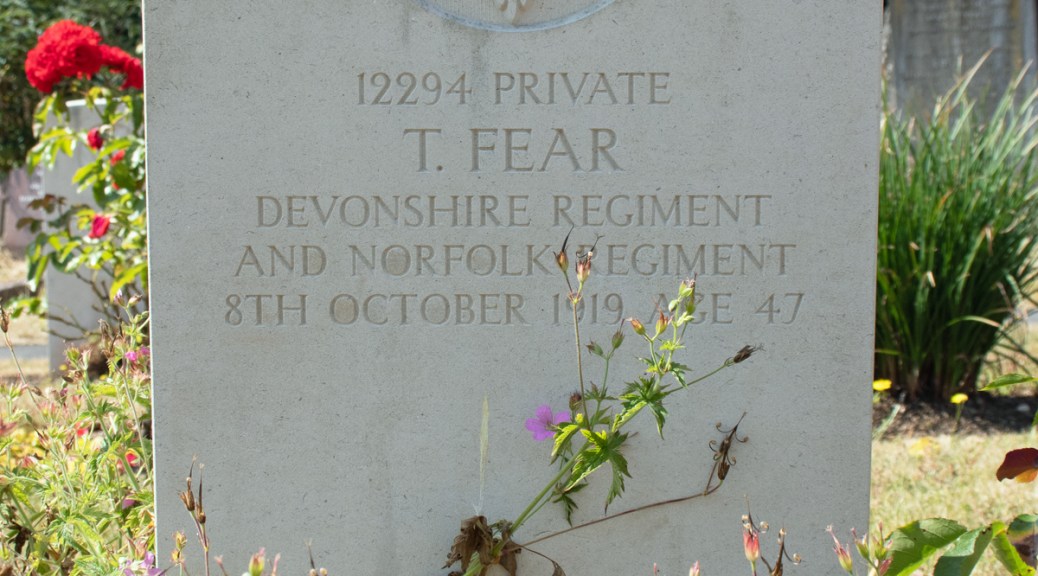
Thomas Fear was born in around 1872 in East Pennard, Somerset. The youngest of six children, his parents were Thomas and Harriet Fear. Thomas Sr was a general labourer, who had moved his family to Bath, where work was more plentiful, by the time of the 1881 census.
When Thomas Jr finished his schooling, he sought bigger and better things. He enlisted in the Devonshire Regiment, and while his service records no longer exist, other documents confirm that he fought in the Second Boer War in South Africa at the turn of the century.
On 5th August 1893, Thomas had married Bath-born Sarah Hughes, who was the daughter of a printer’s machinist. The couple went on to have three children: Albert, Nora and Rose. By the time of the 1911 census, the family were living in a four-roomed apartment near the centre of Bath. Thomas was employed as a stoker for a gas company, Albert was working as a tailor’s errand boy, and Nora had found employment at a lace factory.
When war broke out, Thomas felt the calling to serve his country once more. He enlisted on 1st September 1914, just weeks after conflict had broken out, joining the Somerset Light Infantry. His service records confirm that he was 5ft 5ins (1,65m) tall and weighed 136lbs (61.7kg). He was noted as having brown hair, blue eyes and a fair complexion.
Private Fear was transferred to his old regiment – the Devonshire – at the end of September, remaining on home soil until September 1915. At this point, his troop was sent to France, but he was not to remain on the Western Front for long. In November, his troop was sent to the Eastern Mediterranean, and for the next year, Thomas was based in Salonika.
While in Greece, Thomas contracted malaria, and this was to continue to affect his health in the months and years to come. By Christmas 1916, he had been sent back to Britain, and the following September, he was medically discharged from the army as he was no longer physically fit to continue.
At this point, Thomas’ trail goes cold. At the end of December 1917, “after much suffering patiently borne” [Bath Chronicle and Weekly Gazette: Saturday 5th January 1918], Sarah passed away, aged just 44 years of age. All of the children were of age by this point, and it can only be assumed that Rose, at least, was still residing in the family home.
The funeral took place at Locksbrook on Monday of the late Private Fear, whose death occurred at the [Bath] War Hospital. Private Fear, whose age was 45 [sic], was an old soldier, and had seen service in the South African and the late European Wars. In the latter he served with the 2nd/4th Battalion of the Norfolk Regiment, from which he was discharged in May, 1916. As an army pensioner, he was sent to the War Hospital by the Ministry of Pensions, but, unfortunately, his case proved fatal.
Bath Chronicle and Weekly Gazette: Saturday 18th October 1919
Thomas was actually 47 at the time of his passing, and it seems likely that he died of the condition that had resulted in his medical discharge from the army, malaria.
Thomas Fear was laid to rest in the military section of Locksbrook Cemetery, Bath, not far from where Sarah had also been buried.
William Reginald Hunt was born in the Somerset village of Butcombe on 14th September 1900. The youngest of six children, his parents were farmers Walter and Bertha Hunt.
Little information about William – who was known in the family as Reggie – is available. He was still at school at the time of the 1911 census and enlisted in the army in the summer of 1918. His service papers no longer exist, and his life in between these points is lost to time.
Private Hunt joined the Devonshire Regiment, and was attached to the 53rd (Young Soldier) Battalion. He was based at Rolleston Camp in Wiltshire and, while billeted there, in the cramped and overcrowded conditions of the army barracks, he contracted pneumonia.
William was admitted to the camp’s hospital, but the condition was to prove too much. He passed away on 23rd November 1918, aged just eighteen years old.
The body of William Reginald Hunt was brought back to Somerset for burial. He was laid to rest in the graveyard of St Michael’s Church, in his home village of Butcombe.
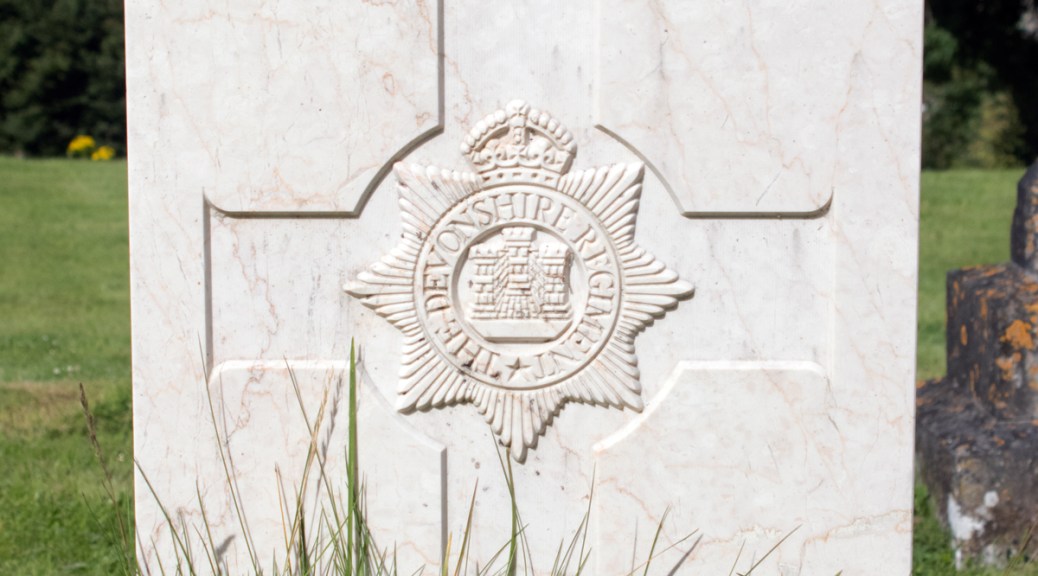
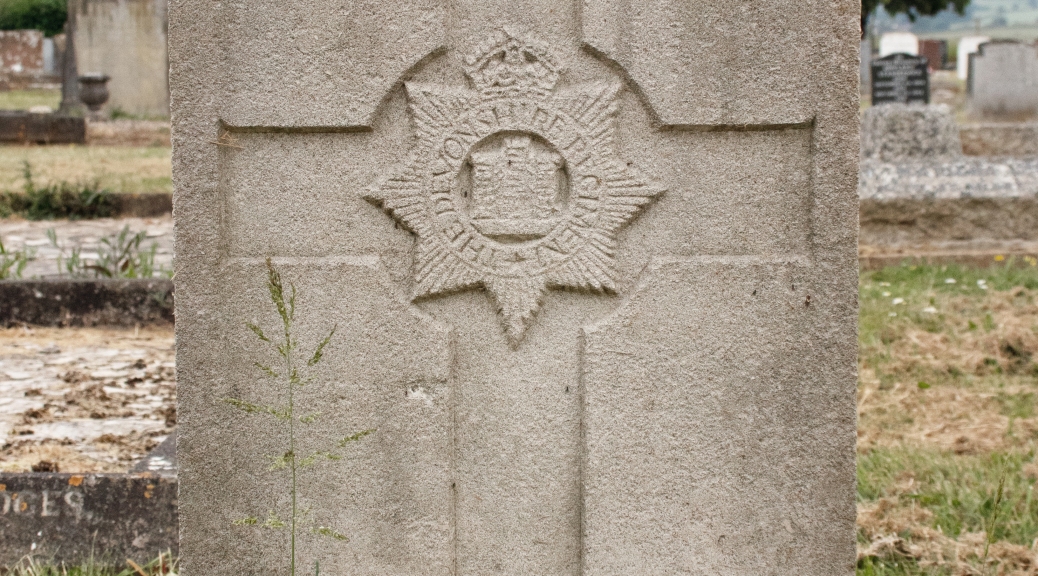
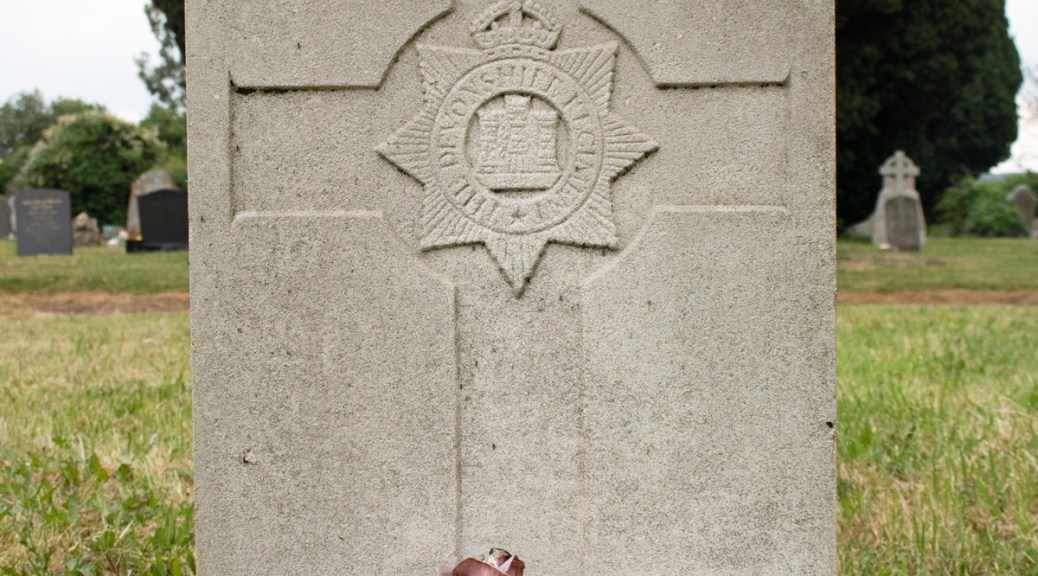
James Baker was born in 1884, and was the youngest of three children to William and Martha Baker. The family were from Kentisbeare in Devon, and tragedy was to strike James early in life, when Martha passed away in 1890, followed by William just five years later.
By the time of the 1901 census, James had moved to the nearby village of Uffculme, where he was employed as a cowman on William Stevens’ farm. At the same time, he was gaining some military experience, volunteering for the Devonshire Regiment. This seemed to offer him a way out, and on 19th October 1903, he formally enlisted in the army.
Private Baker’s service records show that he was 5ft 9ins (1.75m) tall, and weighed 127lbs (57.6kg). He had blue eyes, brown hair and a fresh complexion. James served for 16 months on home soil, but was sent to India in February 1905. He remained there until November 1906, when he returned to England’s shores once more.
James was transferred to the Army Reserve at this point, and returned to farm labouring. He found work in Somerset and, on 31st December 1910, he married Clara Pike. She was the daughter of a farm labourer, and the following year’s census found the newlyweds living with Clara’s widowed father, George, in Tapper’s Lane, North Petherton. James and Clara had a daughter, Clara, who was born in July 1912.
When war came to Europe, James was mobilised once more, and was assigned to the 2nd Battalion in the Devonshire Regiment. Within weeks of conflict erupting, he was in France, remaining there for six months. Over the next four years, Private Baker had two further tours of duty in France, as well as spending considerable time on the Home Front. He had a number of bouts in hospital, suffering from rheumatism, particularly in the winter months.
In the spring of 1918, Private James was caught up in the actions of Villers-Bretonneux, to the east of Amiens. He was badly wounded in the chest and abdomen, and medically evacuated to Britain. He was admitted to the 3rd Western General Hospital in Cardiff, where he spent time recovering. He was declared unlikely to be fully fit for war service, and, on 5th August 1918, he was formally discharged from military duty.
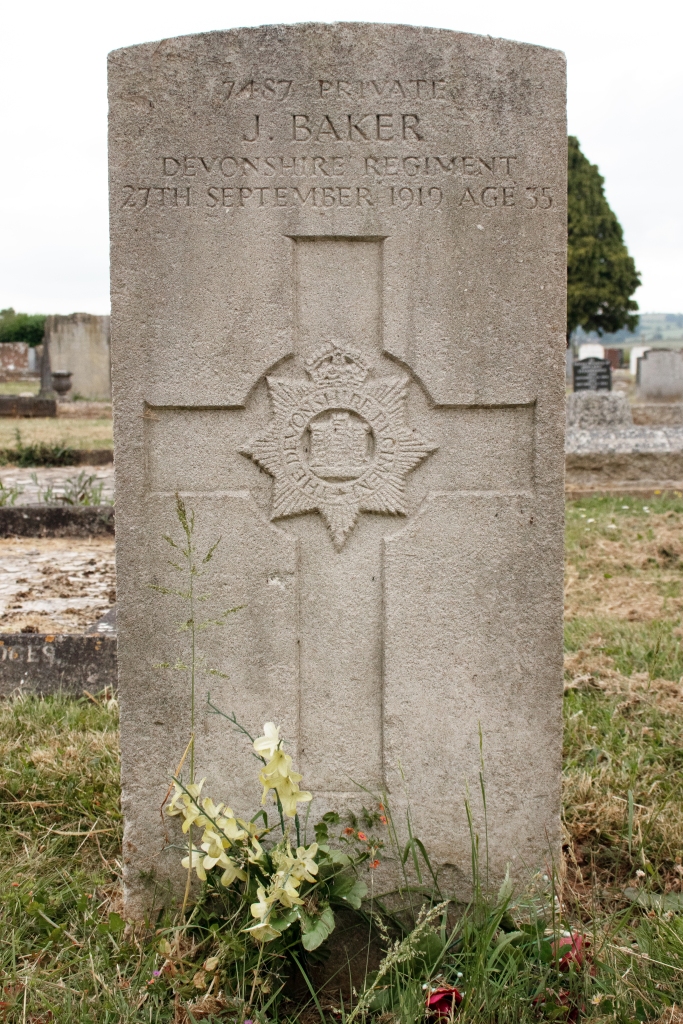
At this point, James’ trail goes cold. He returned to Somerset, and settled back into family life with his wife, daughter and son, Sidney, who had been born in 1915. James passed away at home, through causes unknown, on 27th September 1919, at the age of 35 years of age.
James Baker was laid to rest in the peaceful North Petherton Cemetery, within walking distance from the family home.
In a quiet spot in North Petherton Cemetery, Somerset, is a headstone dedicated to Private J Mahaffey of the Devonshire Regiment. He died on 5th February 1916, but there is little further information available for him.
Private Mahaffey’s service number leads you to one military record, his army pension ledger card. This confirms a little more information: his first name was John, he had two children noted (underage, and therefore eligible for part of his pension) – Elsie and Thomas – and a guardian is also given – Mrs Elizabeth Broom, who lived in Kentisbeare, Devon. The pension card also confirms the cause of John’s death: heart failure due to disease contracted on active service.
An unusual surname made searching contemporary newspapers easier, and a mystery was unveiled:
Private John Mahaffey, a native of Devonport.. was found dead in the Great Western Railway train at Durston on Saturday.
Deceased, who was in the Devon Regiment (86th Battalion Provisional Territorial Force), was 49 years of age, and had served twelve years in the Army. At the outbreak of war he re-enlisted, and latterly had been quartered at Blythe. It appears that he had been on a visit to his children at Devonport, and was upon his return journey when his death occurred. At Taunton he conversed with the guard of the train by while he travelled, and was then apparently in good health.
PS Hill, North Petherton, state that on Saturday, he… saw the body of the deceased… He examined the body, and found a bruise above the left eye and a scar on the nose. He found upon him his regimental pass and the return railway ticket. There was also money in his pockets.
George William Grinnett, a guard on the GWR, said… he was approached by deceased, who asked as to the train service to Newcastle. Witness understood that he had travelled from Exeter… He advised him to… change at Bristol. He then appeared to be all right, and in good health. On arrival at Durston [George] walked the train, and when passing the compartment that deceased entered at Taunton he noticed a man on the floor in the corridor. He went inside and found that the man was dead. He then communicated with three soldiers, who said they had not travelled with deceased. They had merely opened the door, and, seeing a man there, had walked away without telling anybody.
Dr William C Ghent… said her was called to see deceased. He was quite unable to form an opinion as to the cause of death. There was a good deal of blood on the face, and a slight wound on the nose. From a post-mortem examination he found that one of the valves of the heart was incompetent, and in his opinion death was due to heart failure. The blood on the nose might have been caused by a fall. There was no serious injury from the blow which would cause death.
Taunton Courier and Western Advertiser: Wednesday 9th February 1916
John’s previous twelve years in the army may relate to a Royal Marine Light Infantry service document for a John Mahaffoy. Born on 24th May 1864 in Newcastle-upon-Tyne, he enlisted in Bristol as a Private on 24th April 1888. Primarily based out of Plymouth, he served until the summer of 1900, and was assigned to the Royal Fleet Reserve for a further seven years.
Further complexity is added to John’s story, with a marriage record for 6th April 1896. This confirms his wife’s name as Elizabeth Brown, the couple marrying in Devon. The 1901 census confirms two older children for the couple, Kathleen (mentioned in the newspaper report, who was born in 1897) and Margaret, who came along two years later.
The next census, however, shows a divided family. John was recorded as being one of 1200 patients in the Devon County Lunatic Asylum in Exminster. Elizabeth was living in Portsmouth, with their son, Thomas. She also had a boarder, Bertram Bound, an Able Seaman in the Merchant Navy. Kathleen was a patient in the Sanatorium for Devon and Cornwall Consumptive Patients in South Brent, Devon. Elsie, meanwhile, was recorded as living in Kentisbeare with her grandparents, Edmund and Elizabeth Broom.
This would suggest that John’s wife Elizabeth had died by the time of his death, and that guardianship of his children passed to his mother-in-law when he too passed away.
The last sad element of this tale is that John Mahaffey was not to be reunited with his children. There may have been a financial element, with the Brooms possibly unable to cover the cost of bringing him down to Devon. John was laid to rest in North Petherton Cemetery, a few miles from Durston Station, where his body had been discovered.
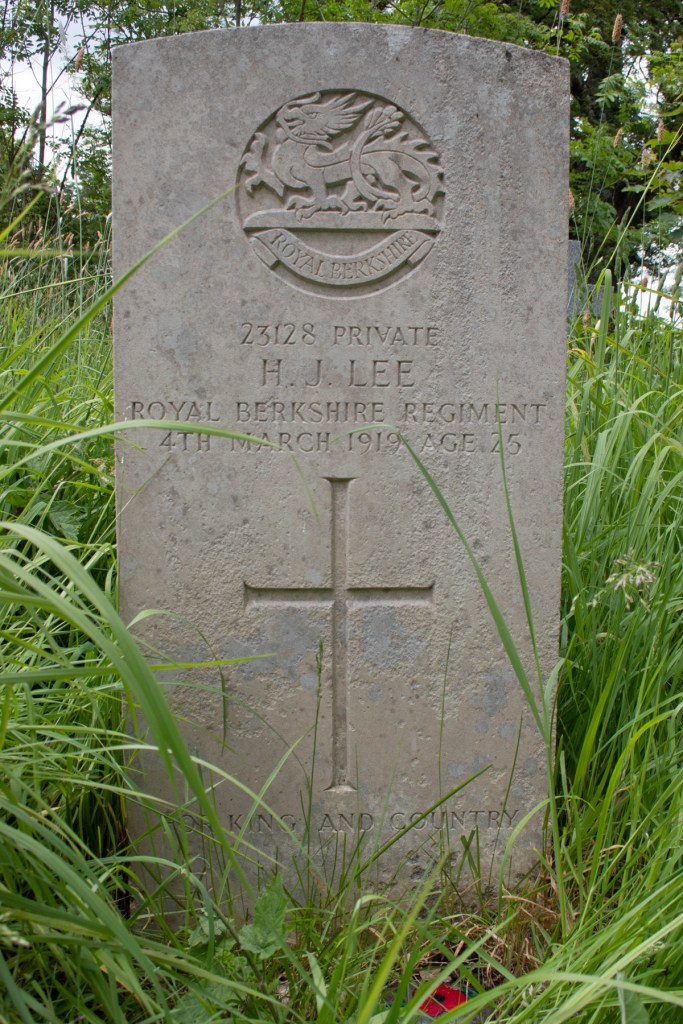
Herbert Jack Lee was born in the autumn of 1893 and was one of twelve children. His parents were Devon-born John Lee and his wife, Emily, who came from Churchstanton, Somerset, and it was here that the young family were raised. John was a bootmaker-turned-innkeeper, and the Lees lived in the village’s Rising Sun Inn.
By the time of the 1911 census, John had returned to boot-making once more. Herbert, meanwhile, had found work as a domestic gardener, bringing in a second wage to a household that included his parents and two younger siblings.
When war came to Europe, Herbert – who was better known by his middle name – stepped up to serve his King and Country. Little of his service documentation remains, but a contemporary newspaper report outlined his time in the army:
[Jack] joined the service in January, 1916, and was posted to the Wilts Regiment. He was subsequently transferred to the Royal Berks, and with them proceeded to France, returning to England suffering from trench feet at Easter, 1917. He was then posted to the Devon Regiment, and put into an Agricultural Company, and employed at Offwell, near Honiton.
Taunton Courier and Western Advertiser: Wednesday 12th March 1919
Private Lee’s health had suffered badly during the winter of 1916/17 and, in the spring of 1919, he came down with a severe bout of influenza. His body was too weakened to recover, and he passed away on 4th March 1919, aged just 25 years old.
Herbert Jack Lee was brought back to Somerset for burial. He was laid to rest in the peaceful graveyard of St Paul’s Church, in his home village of Churchstanton.
Interestingly, in the same edition of the Taunton Courier and Western Advertiser that had reported on Herbert’s funeral, was a report on the state of the Lee’s former home, the Rising Sun Inn.
…some of the rooms were very damp through water having come in… [and] was not fit to live in. The house had been very well conducted by the present tenant [Frank Gill], but… trade… had gone down by four-fifths since the war..
Taunton Courier and Western Advertiser: Wednesday 12th March 1919
Frank Gill was applying to the Licensing Board to avoid paying taxes for the year, given the drop in clientele and the number of other public houses in the area to support any customers. His case was referred on.