Tag Archives: family

Serjeant George Constable

Serjeant George Constable

George Constable was born in the summer of 1893 in Findon, West Sussex. His parents were Albert and Ruth Constable, and they had seven children: Ruth Jr, Thomas, Albert Jr, William, George, Arthur and Rachel.

There is little concrete information about George’s early life. The 1901 census found the Constable family living at 2 Mill Cottages in Findon, with George’s oldest brother, Thomas, helping his father’s gardening work.

When war came to Europe, George and his older brothers stepped up to play their part. Thomas joined the Dorsetshire Regiment and worked his way to the rank of Lance Corporal. His time in service was to be tragically brief, however. He was killed in France on 26th October 1914, aged 27 years old. He is commemorated on both the Le Touret Memorial, and on the headstone to the family ploy in St John the Baptist Churchyard, Findon.

George also joined the Dorsetshire Regiment and, like his brother, was assigned to the 1st Battalion. During his short time with the regiment – he enlisted no later than October 1914 – he rose through the ranks, and, by the spring of 1915, had been promoted to Serjeant.

Sent to France, George was wounded in April 1915, and medically evacuated to Britain for treatment. He was admitted to the 1st London General Hospital, but his injuries were to prove too severe. He passed away on 5th April 1915 aged just 21.

Albert and Ruth had lost two of their sons to the conflict within six months. While Thomas’ body lay in France, George was brought back to Sussex for burial.

George Constable was buried in the family plot in the graveyard of St John the Baptist Church, Findon.


William Constable was assigned to the Royal Sussex Regiment when he enlisted. He too rose through the ranks, and would take on the role of Serjeant, like his younger brother. His unit, the 2nd Battalion, fought at Loos in the autumn of 1915, and this is where William would be killed. He died on 25th September 1915, aged just 23 years old.

Serjeant Constable is commemorated on the Loos Memorial, while Albert and Ruth, having now lost three sons within a year, added his name to the family headstone.


Albert Constable Jr, was also involved in the conflict. Along with George and Thomas, he had joined the 1st Battalion of the Devonshire Regiment, but unlike his brothers, he survived the horrors of the Western Front.

By the last months of the war, Lance Corporal Constable was caught on in the Battles of the Hindenburg Line, and, tragically, he too was killed. Albert passed away on 15th September 1918, at the age of 29 years old. He was buried in Cologne Southern Cemetery, Germany.

By this point, the face of the family headstone was already full with commemorations to his three brothers, Albert is remembered in lettering around the edge of the grave marker.


Sapper Joseph Yeoman

Sapper Joseph Yeoman

Joseph Frederick Yeoman was born on 28th December 1880, the sixth of eight children to John and Eliza. John was a brewer’s drayman from Harbertonford in Devon, but it was on the coast in Paignton that the Yeoman family were born and raised.

When he finished school, Joseph found work as a mason’s apprentice. The 1901 census found the family of seven living in a small terrace cottage on Hill Park Terrace, to the south of Paignton town centre, with all but Eliza bringing in a wage.

In 1906, Joseph married Lydia Gill. She was the daughter of a general labourer from Chudleigh, Devon, who was working as a domestic servant for an architectural surveyor and his wife. The couple went on to have two children – Joseph Jr, who was born the following year, and Lilian, who was born in 1910, but who died when just a babe-in-arms.

The 1911 census found Joseph and Lydia living at 20 Nuneham Terrace, Joseph Jr is missing from the document, and it seems likely that, with his sister’s death, he had been taken in by another relative to allow his grieving parents some space.

When war broke out, Joseph stepped up to play his part. Full details of his military service have been lost to time, and a clear chronology is a challenge to piece together. Lydia passed away in January 1915, but it is not clear whether Joseph had enlisted by this point. His entry in the Army Register of Soldiers’ Effects confirms that he had joined up by September 1915 at the latest, and that he was in the Royal Engineers.

Sapper Yeoman was assigned to the 1st/3rd (Wessex) Field Company. It is unclear from his records whether he served overseas, but by the spring of 1916, he was in Kent.

The news will be received with deep regret of the death of Sapper JF Yeoman… which took place on Sunday from enteric fever at Nackington Hospital, Canterbury. Deseased was in the employ of Mr WF Pearce before joining up, and frequently assisted the old Rugby Football Club.

South Devon Weekly Express: Friday 10th March 1916

Joseph Frederick Yeoman was 35 years of age when he died on 5th March. His body was brought back to Devon for burial, and he was laid to rest in Paignton Cemetery.


Joseph Yeoman Jr was just nine years old when his father, and had lost both of his parents within a space of just over a year. Emma Augusta Gill, possibly Lydia’s sister-in-law, was given guardianship of him, and he moved to East Brent, Somerset, for a new life.


Private Alfred King

Private Alfred King

Alfred William King was born in the autumn of 1872, the oldest of eight children to Alfred and Caroline King. Alfred Sr was a labourer from Bath, Somerset, and this is where the family were raised.

Times were tough for the King family. The 1891 census recorded most of them living at 89 Avon Street in the city. Alfred Jr, meanwhile, seems to have been an inmate at the Bath Union Workhouse in Lyncombe.

On 24th May 1896, Alfred Jr married Mary Pemberton. She was the daughter of a coachman, in the next street to her in-laws. Both Alfred and his father were, by this point employed as carters, and the new groom was back living in Avon Street. The young couple went on to have two children, Alfred and Dorothy, and made their home in a small terraced house in Avondale Road, Bath.

The 1911 census recorded Alfred as being an army pensioner and night porter. While previous service records no longer exist, his enlistment papers for the First World War suggest he had spent time in both the Somerset Light Infantry and the Royal Garrison Artillery. Certainly, Alfred’s eagerness to serve his country – he joined up on 18th September 1914, at the age of 42 – suggests he had had military service in the past.

Private King’s medical report confirms that he was 5ft 5.5ins (1.66m) tall and weighed 145lbs (65.8kg). He was noted as having grey hair, light brown hair and webbed toes on both feet.

Alfred’s time in the army was to be brief. A later medical report noted that the had a “dilated stomach of old standing. [He was] absolutely unable to retain food unless stomach is washed out twice a week.” He was medically dismissed from the army on 3rd November 1914, after just 45 days.

Alfred’s incapacity for military service may have been what prompted his son, Alfred, to enlist. After time in the Somerset Light Infantry, and a rise to the rank of Lance Corporal, he was to die of wounds in February 1916. His father would live on for just five more years. He passed away on 1st April 1921 at the age of 48 years.

Alfred William King was buried alongside his son in Bath’s majestic Locksbrook Cemetery.


Read about Lance Corporal Alfred Frederick King here.


Lance Corporal Alfred King

Lance Corporal Alfred King

Alfred Frederick King was born at the start of 1897, and was the oldest of two children to Alfred and Mary. Alfred Sr was an army pensioner-turned-carman, and both he and his wife were born in Bath, Somerset. By the time of the 1911 census, the family of four were living at 31 Avondale Road, in the Walcot area of the city.

Alfred Jr had completed his schooling by this point, and was working as an errand boy. War was not far off, however, and it would result in the ultimate sacrifice for the King family.

Alfred Sr enlisted in the Somerset Light Infantry in September 1914, but was deemed not fit for service, as he was suffering from chronic stomach issues. This may have prompted his son to join up, and he did so in October 1915.

Sadly, Alfred Jr’s full service details no longer remain, but from what is left, it is clear that he joined the Somerset Light Infantry, and was assigned to the 8th (Service) Battalion. His unit was sent to France, and he would spend the rest of the year on the Western Front.

Private King was involved in a number of skirmishes in the coming months, and soon gained a promotion to the rank of Lance Corporal. In late January or early February 1916, he was wounded, and medically evacuated to Britain. He was admitted to the East Suffolk Hospital in Ipswich, but his injuries would prove too great: he passed away on 22nd February 1916, at the age of just 19 years old.

Alfred Frederick King’s body was taken back to Somerset for burial. He was laid to rest in the sweeping grounds of Bath’s Locksbrook Cemetery.


Alfred Sr would be buried alongside his son. You can read more about his life here.


Gunner Eli Trenchard

Gunner Eli Trenchard

Eli Trenchard and his twin Reuben were born on 29th December 1889 in Axminster, Devon. Two of nine children, their parents were George and Mary Trenchard. George was a gamekeeper turned farmer, and the family were brought up at Uphay Farm on the outskirts of the town.

The whole family helped out on the farm and, by the time of the 1911 census, when the twins were 20, seven of the Trenchards – George, Mary, Eli, Reuben and three of their siblings – were all living in the farmhouse and employed in the business.

On 25th March 1913, Eli married Lily Gillingham. Born in Dorset, she was the daughter of the landlord of the Lamb Inn in Axminster, and working as a dressmaker in her own right. The couple moved to the village of Chardstock in Devon, and went on to have a daughter, Lilian, who was born later that year.

In 1915, Eli found himself brought to the Petty Sessions in Axminster, charged with “moving pigs from Dorset to Devon without the necessary license” [Western Times: Wednesday 27th October 1915]. Eli stated that he had purchased the pigs from his brother, Reuben, at Uphay Farm. Despite Reuben confirming this, it was subsequently determined that they had, in fact, been bought from a Mr Wells of Penn in Dorset. Eli have been convicted of a similar offence before, and was fined £10.

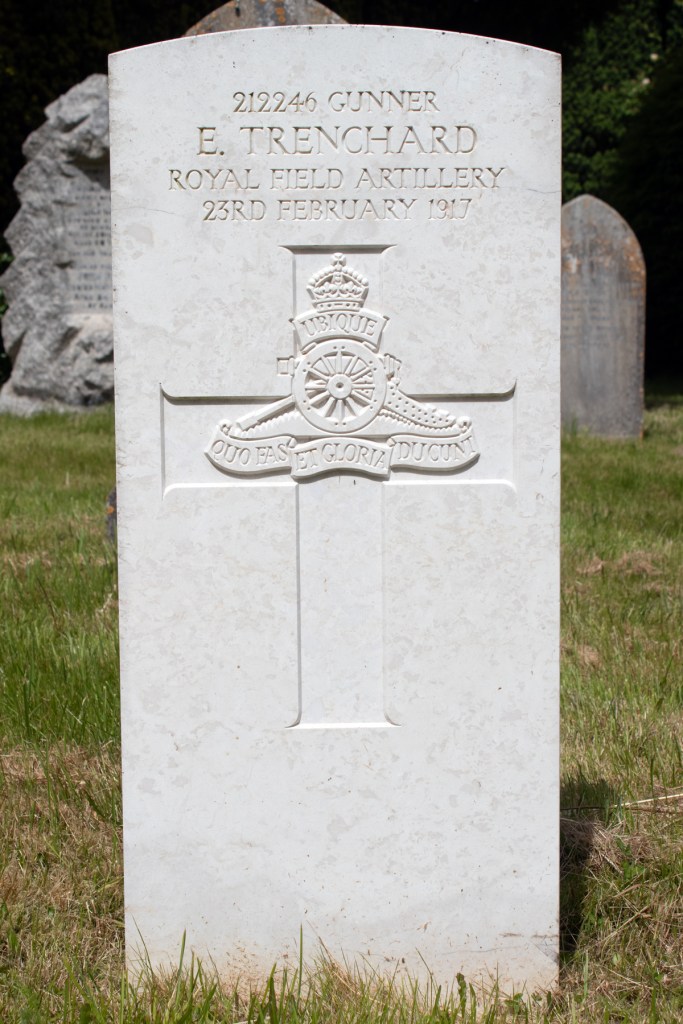
War was raging across Europe by this point, and Eli was called upon to play his part. He enlisted in the Royal Field Artillery in January 1917. Assigned to the 23rd Reserve Battery, Gunner Trenchard was sent to a camp near Sutton Veny in Wiltshire.

Eli’s time in the army was not to be a long one, however, and he was soon admitted to the camp hospital, suffering from pneumonia. The lung condition was to get the better of him, and Eli passed away on 23rd February 1917. He was 27 years of age.

The body of Eli Trenchard was taken back to Devon for burial. He was laid to rest in Axminster Cemetery, not far from where his widow and family still lived.


The Trenchard family were soon back in the court, however, with Lily bringing a lawsuit against her father-in-law, George, in December 1917. The widow said that Eli and his father had agreed her late husband’s immediate tenancy of two fields the month before Eli had been called up for to serve.

However, the month after his death, when she had gone to the fields to sow them for the coming season, the gates had been locked and her entrance barred. George responded by saying that he had agreed to pass the fields to his son, but only on the event of his own death. He subsequently sold the land to another farmer.

The judge in the case found that Lily had “failed to prove that an agreement had been made between [George] and his son” [Western Times: Thursday 6th December 1917] and found in the defendant’s favour.


Private Herbert Smart

Private Herbert Smart

Herbert – or Bertie – Smart was born on 9th February 1885, and was the middle of five children to John and Lucy. John worked as a gardener and the family were raised in the Kent town of Sidcup.

By the early 1900s, Bertie had moved to London, and had settled in Islington, Middlesex. He was working as a fruiterer and, on 19th May 1907, he married Lucy Purton, a policeman’s daughter from the east of the capital.

The couple set up home in Kensington, and went on to have four children: Frank, Herbert, Kathleen and Frederick. The 1911 census found the family renting three rooms in a tenement at 36 Netherwood Road. They were sharing their home with Lucy’s younger brother, Frederick.

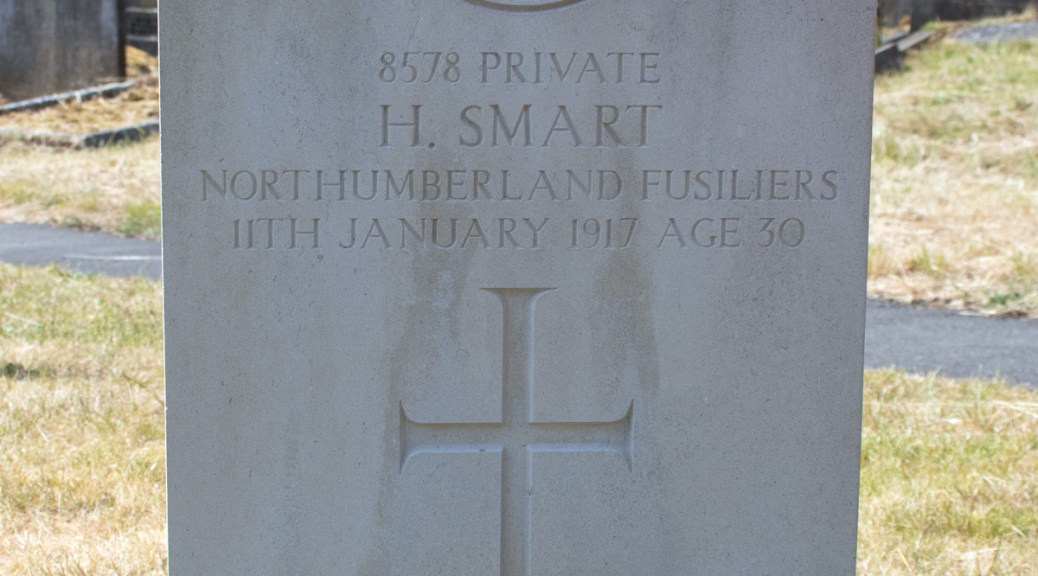
When war broke out across Europe, Bertie was called upon to play his part. Full service details have been lost to time, but it is clear that he enlisted in the second half of 1916, and was assigned to the Northumberland Fusiliers. Attached to the 2nd/4th Battalion, it seems that he may have been sent to the South West for training.

Private Smart’s time in the army was not to be a lengthy one. He came down with cerebrospinal meningitis, and was admitted to the War Hospital in Bath, Somerset. The condition was to get the better of him: he passed away was still admitted, on 11th January 1917. He was 31 years of age.

Herbert Smart was laid to rest in the sweeping grounds of Bath’s Locksbrook Cemetery.


These were tragic times for the Smart family. Lucy’s brother died just four months after her husband, and Lucy herself passed away in February 1918. In just over a year, the four children – Frank, Herbert, Kathleen and Frederick – had become orphans.


Ordinary Signalman Frederick Timms

Ordinary Signalman Frederick Timms

Frederick James Timms was born on 21st January 1897 in Watford, Hertfordshire. One of ten children – and the oldest surviving boy – his parents were Frederick and Rosina Timms. Frederick Sr was a farm labourer, but when his son completed his schooling, he found work with a blacksmith.

Frederick Jr wanted bigger and better things, however, and, on 18th April 1913, he enlisted in the Royal Navy, set on a life at sea. As he was below the age to be a full recruit, he was given the rank of Boy 2nd Class, and was sent to HMS Ganges, the navy’s training base on the outskirts of Ipswich, Suffolk, for his induction.

During his initial training, Boy Timms seems to have had some educational affinity. Seven months after enlisting, he was moved to the signal corps, and ranked as Signal Boy accordingly. In April 1914, a year after enlisting, he was transferred to HMS Victory, the Royal Naval Dockyard in Portsmouth, Hampshire, for posting. He was assigned to the battleship HMS Duncan, his first formal service at sea.

Over the next year, Frederick served on three further ships, coming of age on board the cruiser HMS Latona. Now formally inducted into to the Royal Navy, he was assigned the rank of Ordinary Signalman.

In March 1915, Frederick was transferred again, to HMS Princess Irene, an ocean liner built in 1914 for the Canadian Pacific Railway. With the outbreak of the war, she was requisitioned by the Royal Navy, and converted to a minelayer. In the spring of 1915, she was involved in laying a minefield to the north west of Heligoland, but spent much of her time in and around the Thames Estuary.

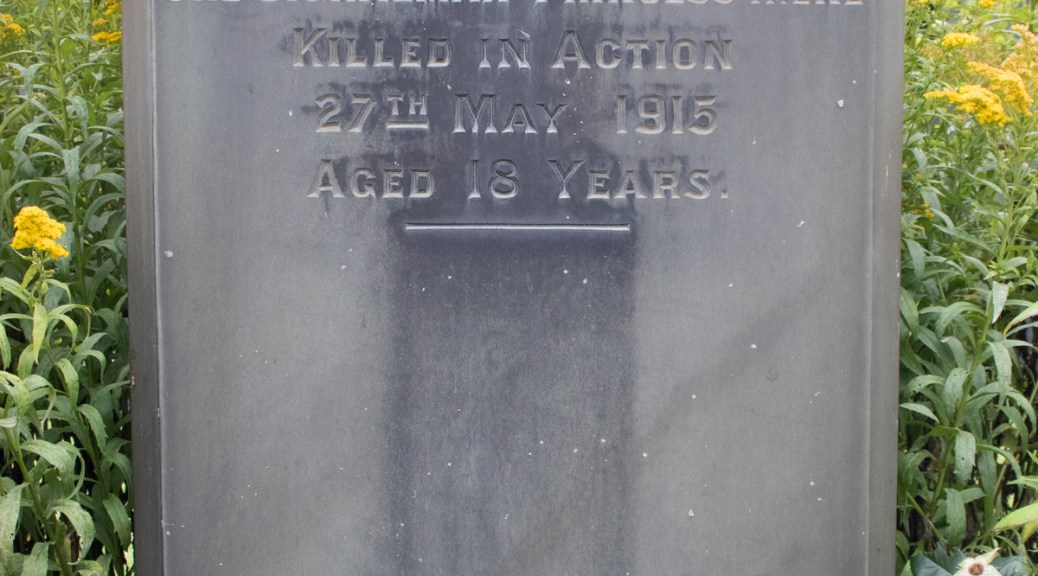
On the morning of 27th May 1915, Princess Irene was moored in the Medway Estuary and was being loaded with mines in preparation for a mission. At 11:14am, she exploded and disintegrated, taking two neighbouring barges with her. More than 250 crew – including Ordinary Signalman Timms – were killed. He was just 18 years of age.

Frederick James Timms body was laid to rest in the Woodlands Cemetery in Gillingham, Kent, alongside some of the other crew whose bodies had been rescued and identified.


Frederick’s death was the second tragedy to strike the Timms family in less than a fortnight. Back in Hertfordshire, Rosina had been pregnant with her eleventh child. On 16th May, she had had an internal haemorrhage, which resulted in the loss of both mother and child.


Lance Corporal Frank Page

Lance Corporal Frank Page

Frank Arthur Page was born early in 1891, and was one of seven children – and the youngest son – to Matthew and Emily Page. Matthew was a bricklayer’s labourer from Lancing in Sussex, while Emily had been born in Norfolk. It was in the village of Steyning, however, that the couple raised their family.

By the time of the 1901 census, Matthew had been invalided out of work. The family had moved to a small cottage in Lancing by this point, and Frank’s older brothers were working to bring in some money for the family.

The next census return, taken in 1911, found Matthew and Emily living Frank and his older brother Sydney at 2 Ivy Cottages in Lancing. Both of the Page siblings were working as market gardeners by this point, bringing in some money to help support the family.

War came to Europe in the summer of 1914, and Frank stepped up to serve his King and Country. Full details of his military service are lost in the mists of time, but it is clear that he enlisted in the Royal Fusiliers, and was attached to the 26th (Service) Battalion (Bankers).

Frank’s unit served in both France and Italy, although, without his documents, it isn’t possible to determine where, and for how long, he served. During his time in the army, however, he was promoted to the rank of Lance Corporal, underlining a level of dedication on his part.

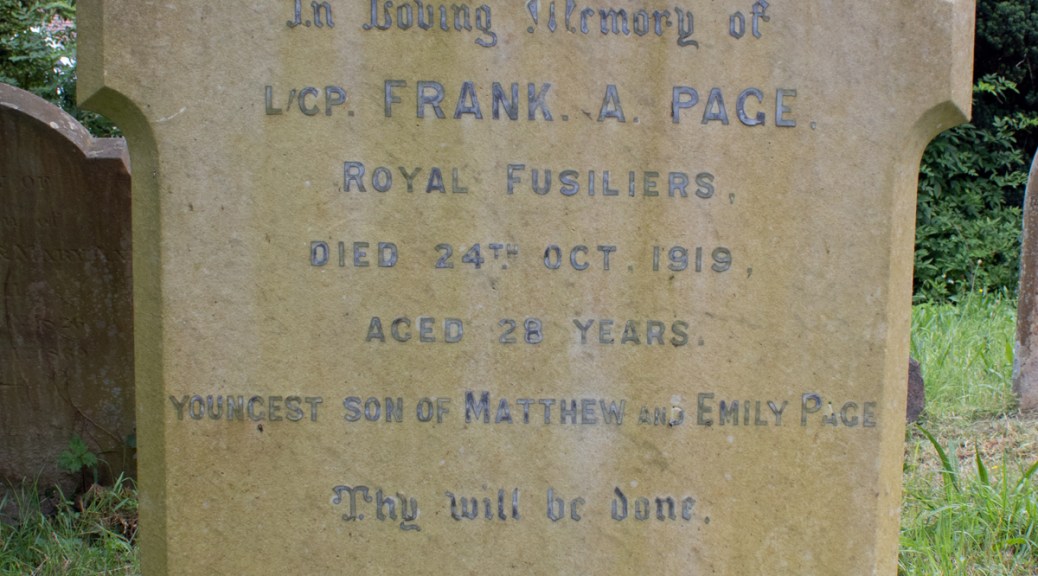
Matthew passed away in the spring of 1917, and it appears that Frank was demobbed at some point after the Armistice. By the autumn of 1919, he was back in Sussex, living with his now widowed mother. His time in the army seems to have impacted on Frank’s health by this point, and he died ‘from disease’ on 24th October 1919. He was 28 years of age.

Frank Arthur Page was laid to rest in the graveyard of St James the Lesser Church in Lancing, not far from where his father had been buried.


Private John Gaunt

Private John Gaunt

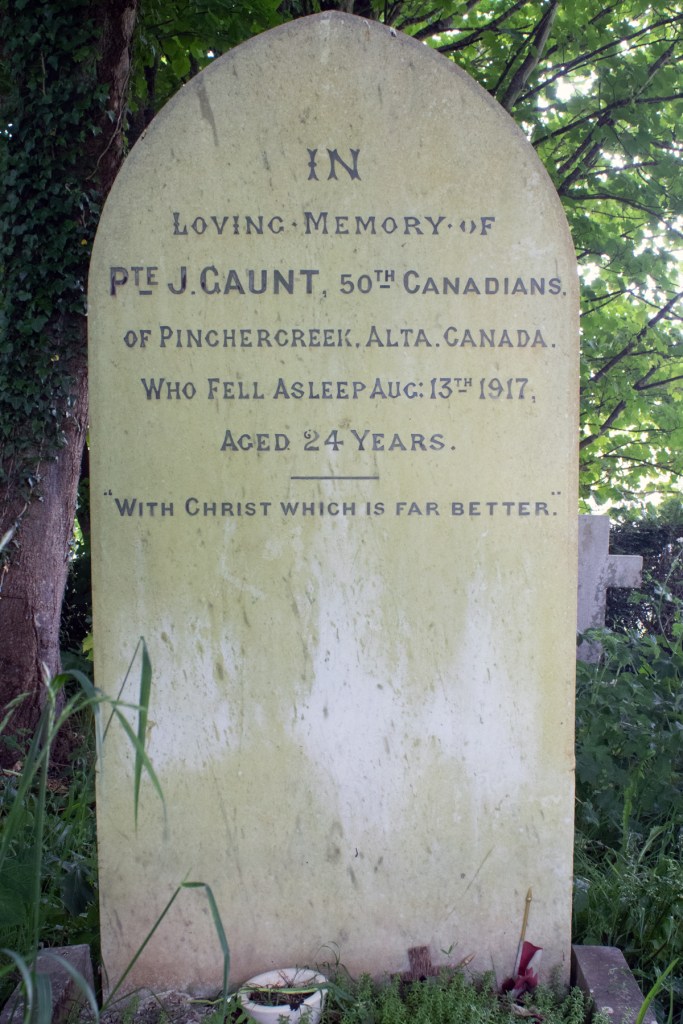
John Alfred Gaunt was born on 15th October 1893, the fourth of five children to John and Jane Gaunt. John Sr was a cattle dealer from St Ives in Huntingdonshire, and it was in the nearby village of Needingworth that the family were born and raised.

John Sr sought out opportunities to support his wife and children and, in 1902 he moved the family to Canada, settling in Pincher Creek, Alberta. There isn’t a great deal of detail available about the Gaunts’ time in North America, but it is likely that farming became their way of life.

Tragedy struck the family in October 1912, when John Sr died, at the age of 61. By this point it seems that they had moved on to British Colombia. Just six months later, Jane also died, John Jr was left an orphan while still a teenager.

Most of the family seemed to remain on the west coast – a later document shows John’s older sister Julia living in Cranbrook, British Colombia – but John was working as a farmer by this point and had either returned to Pincher Creek after his parents’ deaths, or had remained there when they went west.

When war broke out in Europe in the summer of 1914, the Empire were called upon to serve, and John was to return to the country he had left more than a decade earlier. He enlisted on 20th January 1916, joining the Canadian Expeditionary Force.

Private Gaunt’s service records show that he was 5ft 8ins (1.72m) tall, 130lbs (59kg) in weight and had light brown hair, blue eyes and a fresh complexion. It was also noted that he had a fine scar, some 3.5ins (9cm) long, on his upper left arm and had a slight defect in his speech (although this is not elaborated on).

John departed for Europe on 21st August 1916, boarding the HMS Olympic for Liverpool, Lancashire. His unit was initially based in Witley Camps near Aldershot, Hampshire, and he would remain on base until the end of the year. This included eight weeks admitted to the Connaught Hospital, when he was suffering from a bout of syphilis.

By January 1917, John was transferred to the 21st Reserve Battalion, which meant a move to Seaford, East Sussex. He transferred again to the 50th Battalion on 19th March, a move which included being shipped off to France.

Over the next couple of months, things were to change dramatically for Private Gaunt. His service records note that he was wounded on 10th May, but that he remained on duty. On 21st July, he wad admitted to the No. 11 Ambulance Station in Rouen, suffering from jaundice.

He was medically evacuated to Britain for treatment, initially to the Auxiliary Hospital in Exeter, Devon, then to Uplyme Hospital, just to the north of Lyme Regis. By this point, John was severely ill. He passed away on 13th August 1917, at the age of 23 years of age.

With the majority of his family living on the other side of the Atlantic, John Alfred Gaunt was, instead, laid to rest in the churchyard of Ss. Peter & Paul Church in Uplyme, not fat from where he had breathed his last. He is also among those servicemen to be commemorated on the Pincher Creek War Memorial.


Sub-Lieutenant Denys Puttock

Sub-Lieutenant Denys Puttock

Denys Ernest Puttock was born on 14th September 1895 in the Devon village of Halwill. The middle of three children, his parents were Edward and Alice Puttock. Edward was a vicar of the village’s St Peter & St James’ Church, but died tragically early:

The Red. E Puttock, Rector of Hallwill died on Wednesday, after a brief illness… Mr Puttock had been in charge… for six and a half years. He was much beloved by those among whom he labourer and universally respected. His devotion to the due performance of all his sacred duties was unceasing and his visitations among the poor and afflicted were much appreciated by the whole parish. He was fond of all manly sports, and under his captaincy the Cricket Club at Halwill attained considerable success. Up to the day of his death he could hardly believe that he was ill, and up to the last it was hoped that his wonderful constitution might have carried him through the illness. About a fortnight since he contracted a chill. He would not be deterred from carrying out his duties, and against the advice of his friends, he persisted in taking every service at the church long after he was fit for it. On Sunday, the 24th January, although then in a high fever, he took both the morning and evening services at Halwill Church unassisted, and also the Sunday School in the afternoon. Pneumonia set in at the end of last week, and on Tuesday evening, the 2nd February, the action of the heart failed. He leaves a widow and three young children to mourn their loss.

[Exeter and Plymouth Gazette: Friday 5th February 1897]

After Edward’s death, Alice moved the children to Okehampton. The 1901 census found the family living at 4 Brondage Park, Alice by this time living off her own means. She felt that learning was important, and Denys was sent to Twyford School and St Edmund’s School in Canterbury, Kent. From here he took up a career in the Royal Navy, enlisting in September 1913.

He served in the Highflyer as a Cadet, and was Midshipman in HMS Conqueror, and later Sub-Lieutenant in the destroyers Patriot and Valorous. Long exposure to the rough weather in the North Sea during the winters of 1916 and 1917 brought on tuberculosis, which incapacitated him for further war service. He was invalided our of the Navy and spent many months in a Sanitorium.

[Exeter and Plymouth Gazette: Friday 4th April 1919]

Denys Ernest Puttock’s health was failing him, and he passed away on 20th March 1919, while still admitted. He was 23 years of age. The report of his funeral included comments from those who knew him:

His Headmaster writes: “He has not lived in vain, for he has exercised the power of unconscious influence on all those around him. He knew the secret of happiness – purity of soul and unselfishness of heart.” His Commanding Officer has written: “He was a zealous and capable young officer. Possessed of great charm of manner, he was popular with both officers and men.”

[Exeter and Plymouth Gazette: Friday 4th April 1919]

Alice, having moved to Paignton by this point, laid her son to rest in the town’s cemetery. When she passed away in 1932, she was buried alongside him.