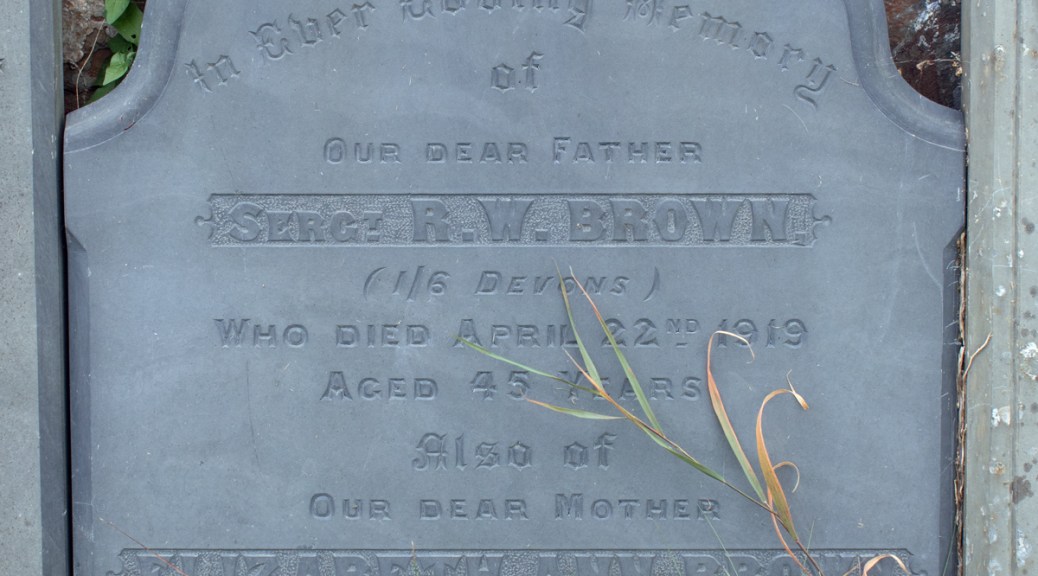
Reginald William Brown was born in South Molton, Devon, the summer of 1873. The second of four children – all boys – his parents were William and Mary Brown. William died when Reginald was just a child, and the 1881 census found Mary supporting her children by working as a mangler.
Details of Reginald’s early life are sparse. In the autumn of 1898 he married Elizabeth Mayne and the couple set up home at 13 Cook’s Cross. The couple went on to have six children, and Reginald supported his family with work as a gardener.
Alongside his gardening work, Reginald volunteered for army service. Again, full details are unclear, but he was attached to the Devonshire Regiment from 1908. Initially for a year’s contract, he seemed to renew this on-and-off for the next six years.
When war broke out, Reginald was formally called into service. HIs time in the army resulted in him being given the rank of Sergeant, and by October 1914, his unit – the 4th Battalion – was sent to India.
Reginald spent the next couple of years overseas, before being posted back to Britain in the spring of 1916. That November he spent six weeks admitted to the Manor County of London War Hospital in Epsom, Surrey, suffering from bronchitis. This was the result of malaria, and he would continue to suffer from lung complaints for the next few years.
In September 1917, Elizabeth passed away, and Reginald was left, at a distance at least, to raise his children. By now, his health was being severely impacted, and in April 1919, he was medically discharged from army service.
Reginald returned home, but he would quickly succumb to illness. He passed away at 43 South Street, South Molton, on 22nd April 1919. He was 45 years of age.
Reginald William Brown was laid to rest in South Molton Cemetery. His was a family plot, and he was reunited with his beloved Elizabeth.
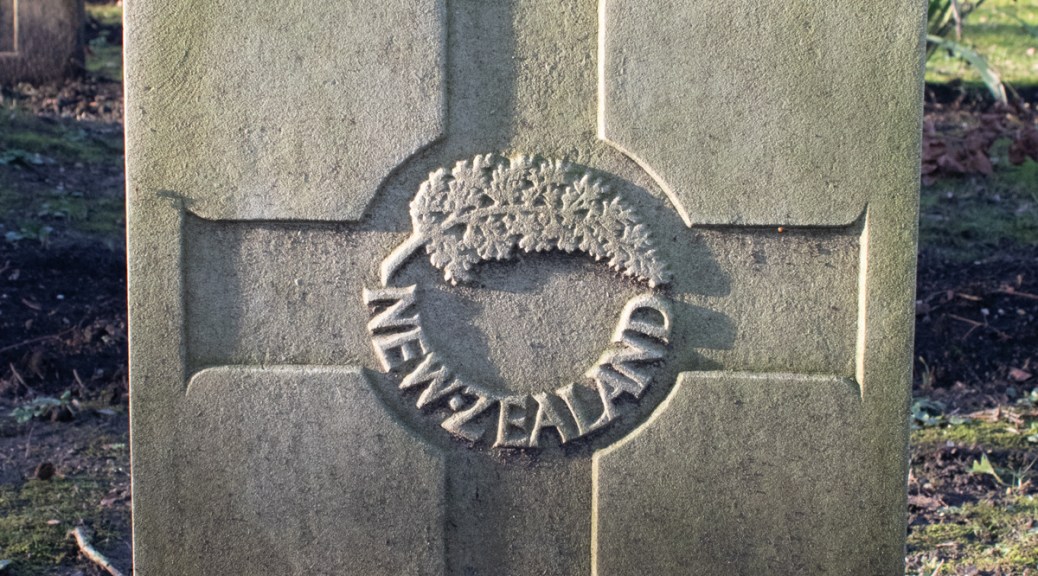
Charles Tombs was born on 26th November 1875 in Sefton, New Zealand. The seventh of eight children, his parents were Job and Elizabeth Tombs.
There is little information available about Charles’ early life. He found work as a chainman, working as a labourer in a sawmill.
On 11th December 1899, Charles married Eliza Pound, the daughter of immigrants from Somerset. The couple settled in Wairau, and went on to have six children: John, Charles, Arthur, William, Ronald and Alice.
(The Tombs and Pounds seemed to have been closely connected: Charles’ younger brother John, went on to marry Eliza’s younger sister, Elizabeth.)
Sadly, Eliza died in 1910, leaving Charles to raise four children (John and Alice having died when just babes-in-arms), alone. A later document gives Charles’ next-of-kin as Mrs R Register, who was, in fact, his younger sister, Mary (who had married Robert Register in 1907).
War was coming, and Charles would be called upon to serve his long-distant King and Empire. On 26th July 1916, he stepped up, and enlisted in the New Zealand Canterbury Regiment. His service records show that, at 40 years of age, he was 5ft 5ins (1.65m) tall, and weighed 119lbs (54kg). He had brown hair, blue eyes and a dark complexion.
Private Tombs’ unit departed from New Zealand on 15th November 1916, making the journey to Britain on the RMS Tahiti. The journey took nearly three months, and Charles arrived in Devonport, Devon, on 29th January 1917.
The ANZAC camp near Codford, Wiltshire, was to be Private Tombs ultimate destination, and he arrived there a couple of days after landing in Britain. After a lengthy journey, his health had been impacted, as had many of the men he had travelled with.
Suffering from bronchitis, Charles was admitted to the No. 3 New Zealand General Hospital on the outskirts of the camp. The condition was to prove his undoing, and he passed away on 17th February 1917. He was 41 years of age.
Charles Tombs was laid to rest in the ANZAC extension to St Mary’s Churchyard in Codford, Wiltshire.
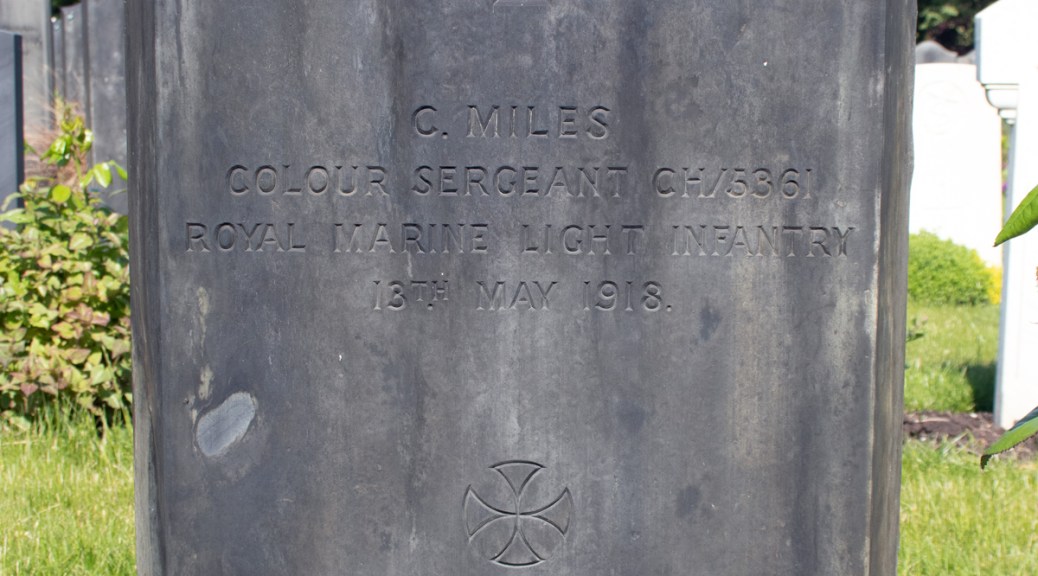
The early life of Charles Miles, whose body lies at rest in the Woodlands Cemetery in Gillingham, Kent, is a challenge to unpick, and the starting point is the last document relating to him.
His military Pension Ledger confirms that he died on 13th May 1918, from empyema, a bacterial infection affecting the lungs. The document cites his next-of-kin as Miss Hilda Miles, of 15 St John’s Road in Gillingham. She is noted as being the guardian of two children – Ada, born in 1905, and George, born the following year – because their mother, Charles’ wife, had passed away on 30th May 1912.
An online search for Ada and George gives an entry in the 1911 census. This finds them as the youngest two of six children to Charles and Elizabeth Miles. The document also gives a clue about their future guardian, Hilda: she is their older sister.
The Miles family were living at 45 Commercial Street in Whitechapel, East London. Charles, at 39, was recorded as a Royal Marines Pensioner and schoolkeeper. His wife, Elizabeth, was assisting with this role, and the couple had two other surviving children, Charles Jr and Walter.
While it is still difficult to piece together Charles’ childhood, his Royal Marine service records do shed a little light onto it. Born in Hampstead on 23rd November 1871, he was working as an ironmonger’s assistant when he enlisted. He joined up on 23rd August 1889, the document showing that he was 5ft 6ins (1.68m) tall, with brown hair, grey eyes and a fresh complexion. He also had a tattoo on his right forearm.
Private Miles had joined up in London but, as with most Royal Marine recruits, he was sent to the base in Walmer, Kent, for his initial training. In the spring of 1890 he moved to the Royal Naval Dockyard in Chatham, Kent, and this would become his regular port for the remainder of his service.
Charles’ service proved to be a committed one. Over the next decade he would serve on five ships, and would rise through the ranks. In October 1894 he was promoted to Lance Corporal, making full Corporal less than a year later. On 1st January 1899 he was promoted to Sergeant, and by the start of 1908, he held the rank of Colour Sergeant. Formally stood down to reserve status on 22nd November 1910, he was noted as having a very good character.
Away from the service, there is no record for Charles and Elizabeth’s marriage. She had been born in Sheerness, Kent, and was a year younger than her husband. It is likely that they were married by 1897, as this is when their oldest child was born. The 1901 census recorded them living on Manor Street in Gillingham, but, once Charles had been stood down, the school keeper’s position in the East End came up.
When war broke out, Charles was called upon to play his part once more. He returned to Chatham, leaving his younger children in Hilda’s care. By September 1914 he had moved to HMS Victory, the Royal Naval Dockyard in Portsmouth, Hampshire, and he would remain there for the next eighteen months. His shore base and naval experience suggest that, at 43 years of age, his was more of a training or mentoring role, although there is nothing in his records to confirm this.
In February 1916, Colour Sergeant Miles returned once more to Chatham, and the naval base there would be his home for the next few years. He was admitted to the Royal Naval Hospital in the spring of 1918, and passed away from the infection on 13th May 1918. He was 46 years old.
Charles Miles was laid to rest in Woodlands Cemetery, Gillingham.
After their father’s death, the Miles siblings found their own way in life.
By the time of the 1921 census, Ada, now 16 years old, was working as a domestic servant for Henry Chapman, a ship’s surveyor, and his family. They were living at 73 Milton Street in Fleetwood, a short stroll from the Lancashire coast.
Hilda, into whose care Charles had given his youngest children, was now 22 years of age. She had married William Swift, a pattern maker for the Admiralty, in the summer of 1918. They would not have any children, and the 1921 census found the couple living at 15 Milner Road, Gillingham. She too was just a short walk from the shoreline, but was also within walking distance from the cemetery in which her father had been buried.
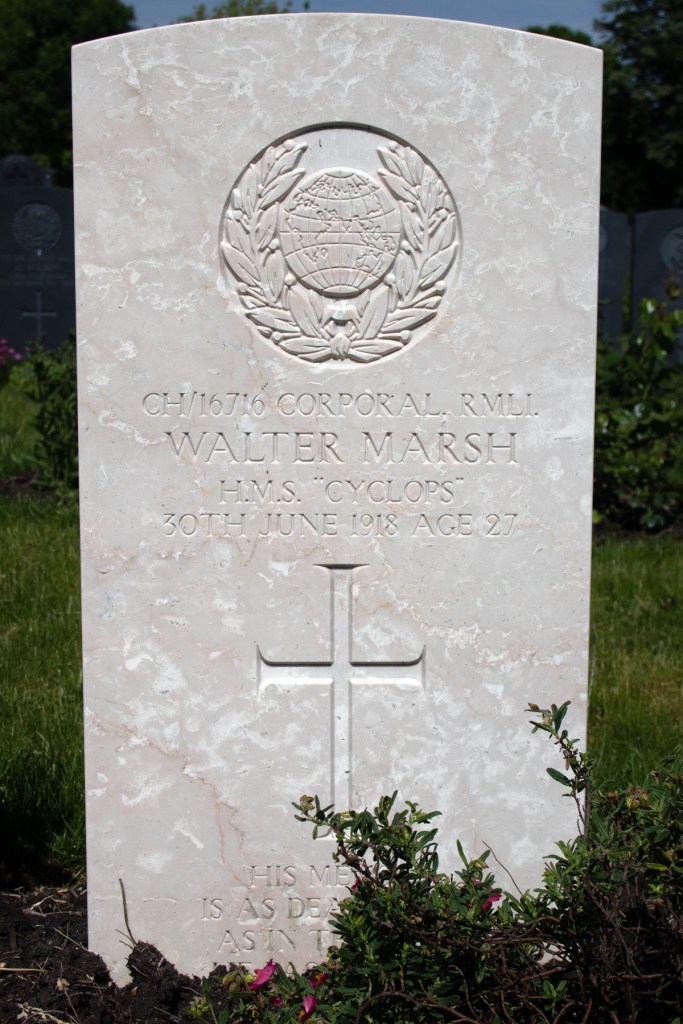
Walter Marsh was born on 17th April 1891 in Beckenham, Kent. The fifth of thirteen children, his parents were Harry and Louisa Marsh. Harry was a bricklayer from Doncaster, Yorkshire, while his wife was from Enfield, Middlesex. By the time their first child was born, however, they had moved to Kent, and the 1901 census found the family living in a small terrace at 77 Birkbeck Road.
In such a large family, it would have been a challenge to find your place. It seems that Walter wasn’t able to make his mark on the world within the constrains of his siblings and so, on 11th August 1910, he enlisted in the Royal Marine Light Infantry. His service records confirm that he was 5ft 6ins (1.68m) tall, with brown hair, blue eyes and a dark complexion. He was also noted as having a scar on his back, and passed his swimming exam when he was tested on 4th November.
Private Marsh’s initial training was undertaken in Deal, Kent, but over the following eight years, his main base was to be the Royal Naval Dockyard in Chatham. In six separate postings, he would spend more than three-and-a-half years at sea, including a year on the battleship HMS Russell and the submarine depot ship HMS Cyclops.
In January 1915 Walter was promoted to the rank of Corporal, and it was around this time that he got married. In the summer of that year, he tied the knot with Gertrude Crozier, a domestic servant, and daughter of a Chatham flour mill labourer.
Corporal Marsh would continue in the Royal Marine Light Infantry until January 1918. Medically discharged, he was seen to no longer be fit for military service, although it is unclear what condition or injury led to the end of his eight year career.
As this point, Walter’s trail goes cold, and the next record relates to his passing. He died in Chatham on 30th June 1918, at the age of 27 years old. Gertrude had given birth to their first child, a daughter named after her mother, just six months before.
The body of Walter Marsh was laid to rest in the naval section of Woodlands Cemetery, Gillingham, Kent, not far from the base that had become a home from home.
After the loss of her husband, Gertrude would go on to marry again, wedding Royal Navy Petty Officer Frederick Harris on 1st January 1920. The couple went on to have a child of their own, daughter Florence, towards the end of that year.
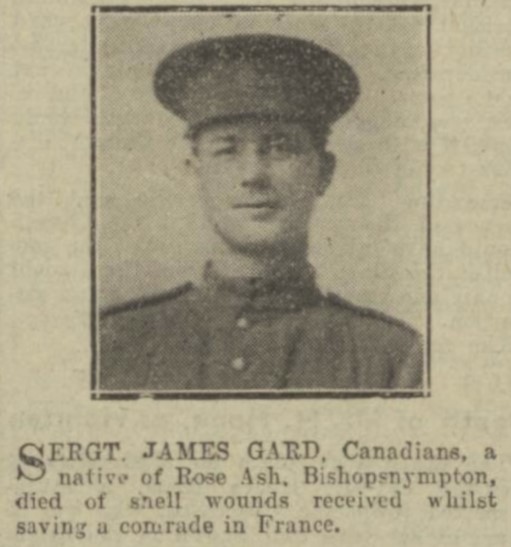
James Gard was born on 8th March 1889 in the Devon village of Rose Ash. One of fourteen children, he was the fourth of six sons to George and Mary Gard. George was a poultry dealer, but when both he and Mary died within two months of each other in 1897, their children were suddenly left as orphans.
The 1901 census found 12-year-old James visiting the Cole family, farmers who lived a few miles away in Bishops Nympton. James’ older brother Philip had plans, however, and in 1907, the two of them set out for a new life in Canada.
Boarding the SS Saxonia in Liverpool, they arrived in Boston with 50s (approx. £390 in today’s money) between them. Their final destination was to be Winnipeg in Manitoba, but the soon moved further north, setting up neighbouring homes in the town of Fisher Branch.
Both siblings found farming work, but when war broke out in Europe, James stepped up to play his part. On 24th February 1916 he enlisted in the Canadian Expeditionary Force, and was assigned to the Canadian Infantry. His service records show that he was 6ft (1.83m) tall and weighed 155lbs (70.3kg). He had dark brown hair, blue eyes and a ruddy complexion.
Private Gard set sail for Britain within a matter of weeks, arriving in Shorncliffe, Kent, on 12th May 1916. His unit – the 44th Battalion – moved to their base in Bramshott, Hampshire, and this is where he would receive his training.
James’ unit was involved in the fighting at the Somme and Ancre, and his commitment was rewarded when, on 20th January 1917, he was promoted to the rank of Sergeant. Just days later, however, he was badly injured.
A high explosive shell exploded near Sergeant Gard that day, bursting both of his eardrums. Initially treated on site, he was medically evacuated to Britain for treatment, and was admitted to the Military Hospital in Tooting, Surrey. He developed mastoiditis in both ears, and this, combined with septicaemia, lead to his ultimate death. He passed away on 1st April 1917, at the age of 28 years of age.
The body of James Gard was taken back to Devon for burial. He was laid to rest in the graveyard of St Peter’s Church in his home village, Rose Ash.
Albert Chapple was born early in 1895, and was the son of Elizabeth Chapple. She was just 16 years of age when he was born, and her parents, John and Sarah, unofficially adopted him as their own. John was a church sexton from the village of Knowstone, Devon, and this is where the Chapple family were raised.
Elizabeth married William Dart, a fishmonger from Dawlish, in 1909, and by the time of the census two years later, they had set up home in Beach Street, close to the town’s railway station.
Albert, meanwhile, was still living with his grandparents back in Knowstone. John, now 66 years of age, was employed as an agricultural labourer, while his grandson was working as a cattle boy on the same farm.
When war broke out, Albert was called upon to play his part. Sadly, full details of his military service have been lost, but it is clear that he had enlisted by June 1916. He enlisted in the Royal Army Medical Corps as a Private, with his entry in the British Army of Soldiers’ Effects suggesting that his unit was attached to the 2nd/1st Wessex Field Artillery.
Private Chapple’s pension record confirms that he had been admitted to the 2nd Western General Hospital in Exeter, Devon. He passed away on 10th December 1916, following an operation, although the document gives no clue as to why he had needed surgery. He was just 21 years of age.
Albert Chapple’s body was taken back to Knowstone for burial. He was laid to rest in the graveyard of St Peter’s Hospital in the village.
The next census return, taken in 1921, found Elizabeth and William still plying their trade in fish in Dawlish. By this point, they had had a son, Edmund, who was five years old. Elizabeth’s sister, Rosie, was living with them, and assisting in the business.
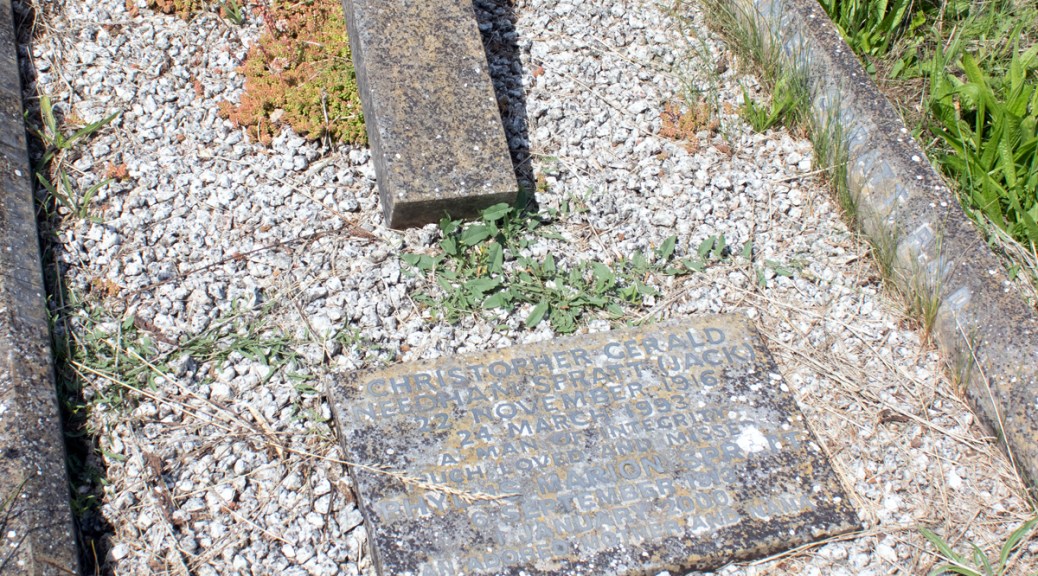
Christopher Templar Spratt was born on 23rd August 1889 in Streatham, Surrey. The youngest of three children, his parents were James and Elizabeth. James was an electrician by trade, and the 1891 census recorded the family as living at 58 Limes Road, between Selhurst and West Croydon.
The Spratts seem to have been a divided family. By the time of the 1901 census, James appears to have emigrated to Australia, presumably to earn money in the burgeoning country. Elizabeth and their younger two children were visiting Worthing, West Sussex.
At this point, and the decision seems to have been made for them to move to Sussex permanently, as the 1911 census found her and Christopher living at 87 Westcourt Road, Worthing. Elizabeth was noted as living on her own means; Christopher was working as a solicitor’s clerk, and they had a boarder, governess Nettie Buckler, to help bring in some additional money.
In January 1912, Christopher married Edith Green, a dressmaker from just along the coast in Goring-by-Sea. The couple moved in with Elizabeth, and went on to have two children: Florence, who was born that June; and Christopher Jr, who was born in November 1916.
By this point, war was raging across Europe, and Christopher stepped up to serve his King and Country. He had enlisted the Royal Naval Volunteer Reserve on 9th December 1915, but was not formally mobilised until the following June. Given the rank of Ordinary Seaman, Christopher’s service records note that he was 5ft 9ins (1.75m) tall, with dark brown hair, grey eyes and a fair complexion. He was also noted as having a mole on his left thigh.
Christopher was assigned to the Nelson Battalion of the Royal Naval Division, and sent to Dorset for training. While details of his service as more haphazard than usual, it seems that he served time overseas, and was promoted to Able Seaman on 1st October 1916. He became unwell in February 1917, as was admitted to the 18th General Hospital in Dannes-Camiers, on the French coast.
Suffering from cellulitis, Able Seaman Spratt was medically evacuated to Britain for treatment, and ended up as a patient in the 2nd Western General Hospital in Manchester. The condition was to prove fatal: he passed away on 12th February 1917, at the age of 27 years old.
The body of Christopher Templar Spratt was brought back to Sussex for burial. He was laid to rest in the churchyard of St Mary’s in Goring-by-Sea.
Elizabeth went on to re-marry and, by the time of the 1921 census, was living in East Preston, Sussex, with her new husband, Edward Neal, Christopher Jr and her new daughter, Enid. There is no evidence of Elizabeth’s older daughter, Christopher, although there is a Florence Spratt recorded as a patient in White Oak Schools (Homes for Ophthalmic Children) in Swanley, Kent.
Christopher Jr went on to marry Phyllis Bennett in the autumn of 1946. They remained in the Worthing area until his death in March 1993: he was laid to rest alongside the father he would not have remembered, in St Mary’s Churchyard. When Phyllis died seven years later, she was buried alongside her husband and father-in-law.
George Constable was born in the summer of 1893 in Findon, West Sussex. His parents were Albert and Ruth Constable, and they had seven children: Ruth Jr, Thomas, Albert Jr, William, George, Arthur and Rachel.
There is little concrete information about George’s early life. The 1901 census found the Constable family living at 2 Mill Cottages in Findon, with George’s oldest brother, Thomas, helping his father’s gardening work.
When war came to Europe, George and his older brothers stepped up to play their part. Thomas joined the Dorsetshire Regiment and worked his way to the rank of Lance Corporal. His time in service was to be tragically brief, however. He was killed in France on 26th October 1914, aged 27 years old. He is commemorated on both the Le Touret Memorial, and on the headstone to the family ploy in St John the Baptist Churchyard, Findon.
George also joined the Dorsetshire Regiment and, like his brother, was assigned to the 1st Battalion. During his short time with the regiment – he enlisted no later than October 1914 – he rose through the ranks, and, by the spring of 1915, had been promoted to Serjeant.
Sent to France, George was wounded in April 1915, and medically evacuated to Britain for treatment. He was admitted to the 1st London General Hospital, but his injuries were to prove too severe. He passed away on 5th April 1915 aged just 21.
Albert and Ruth had lost two of their sons to the conflict within six months. While Thomas’ body lay in France, George was brought back to Sussex for burial.
George Constable was buried in the family plot in the graveyard of St John the Baptist Church, Findon.
William Constable was assigned to the Royal Sussex Regiment when he enlisted. He too rose through the ranks, and would take on the role of Serjeant, like his younger brother. His unit, the 2nd Battalion, fought at Loos in the autumn of 1915, and this is where William would be killed. He died on 25th September 1915, aged just 23 years old.
Serjeant Constable is commemorated on the Loos Memorial, while Albert and Ruth, having now lost three sons within a year, added his name to the family headstone.
Albert Constable Jr, was also involved in the conflict. Along with George and Thomas, he had joined the 1st Battalion of the Devonshire Regiment, but unlike his brothers, he survived the horrors of the Western Front.
By the last months of the war, Lance Corporal Constable was caught on in the Battles of the Hindenburg Line, and, tragically, he too was killed. Albert passed away on 15th September 1918, at the age of 29 years old. He was buried in Cologne Southern Cemetery, Germany.
By this point, the face of the family headstone was already full with commemorations to his three brothers, Albert is remembered in lettering around the edge of the grave marker.
Joseph Frederick Yeoman was born on 28th December 1880, the sixth of eight children to John and Eliza. John was a brewer’s drayman from Harbertonford in Devon, but it was on the coast in Paignton that the Yeoman family were born and raised.
When he finished school, Joseph found work as a mason’s apprentice. The 1901 census found the family of seven living in a small terrace cottage on Hill Park Terrace, to the south of Paignton town centre, with all but Eliza bringing in a wage.
In 1906, Joseph married Lydia Gill. She was the daughter of a general labourer from Chudleigh, Devon, who was working as a domestic servant for an architectural surveyor and his wife. The couple went on to have two children – Joseph Jr, who was born the following year, and Lilian, who was born in 1910, but who died when just a babe-in-arms.
The 1911 census found Joseph and Lydia living at 20 Nuneham Terrace, Joseph Jr is missing from the document, and it seems likely that, with his sister’s death, he had been taken in by another relative to allow his grieving parents some space.
When war broke out, Joseph stepped up to play his part. Full details of his military service have been lost to time, and a clear chronology is a challenge to piece together. Lydia passed away in January 1915, but it is not clear whether Joseph had enlisted by this point. His entry in the Army Register of Soldiers’ Effects confirms that he had joined up by September 1915 at the latest, and that he was in the Royal Engineers.
Sapper Yeoman was assigned to the 1st/3rd (Wessex) Field Company. It is unclear from his records whether he served overseas, but by the spring of 1916, he was in Kent.
The news will be received with deep regret of the death of Sapper JF Yeoman… which took place on Sunday from enteric fever at Nackington Hospital, Canterbury. Deseased was in the employ of Mr WF Pearce before joining up, and frequently assisted the old Rugby Football Club.
South Devon Weekly Express: Friday 10th March 1916
Joseph Frederick Yeoman was 35 years of age when he died on 5th March. His body was brought back to Devon for burial, and he was laid to rest in Paignton Cemetery.
Joseph Yeoman Jr was just nine years old when his father, and had lost both of his parents within a space of just over a year. Emma Augusta Gill, possibly Lydia’s sister-in-law, was given guardianship of him, and he moved to East Brent, Somerset, for a new life.
Alfred William King was born in the autumn of 1872, the oldest of eight children to Alfred and Caroline King. Alfred Sr was a labourer from Bath, Somerset, and this is where the family were raised.
Times were tough for the King family. The 1891 census recorded most of them living at 89 Avon Street in the city. Alfred Jr, meanwhile, seems to have been an inmate at the Bath Union Workhouse in Lyncombe.
On 24th May 1896, Alfred Jr married Mary Pemberton. She was the daughter of a coachman, in the next street to her in-laws. Both Alfred and his father were, by this point employed as carters, and the new groom was back living in Avon Street. The young couple went on to have two children, Alfred and Dorothy, and made their home in a small terraced house in Avondale Road, Bath.
The 1911 census recorded Alfred as being an army pensioner and night porter. While previous service records no longer exist, his enlistment papers for the First World War suggest he had spent time in both the Somerset Light Infantry and the Royal Garrison Artillery. Certainly, Alfred’s eagerness to serve his country – he joined up on 18th September 1914, at the age of 42 – suggests he had had military service in the past.
Private King’s medical report confirms that he was 5ft 5.5ins (1.66m) tall and weighed 145lbs (65.8kg). He was noted as having grey hair, light brown hair and webbed toes on both feet.
Alfred’s time in the army was to be brief. A later medical report noted that the had a “dilated stomach of old standing. [He was] absolutely unable to retain food unless stomach is washed out twice a week.” He was medically dismissed from the army on 3rd November 1914, after just 45 days.
Alfred’s incapacity for military service may have been what prompted his son, Alfred, to enlist. After time in the Somerset Light Infantry, and a rise to the rank of Lance Corporal, he was to die of wounds in February 1916. His father would live on for just five more years. He passed away on 1st April 1921 at the age of 48 years.
Alfred William King was buried alongside his son in Bath’s majestic Locksbrook Cemetery.
Read about Lance Corporal Alfred Frederick King here.











 Death and Service