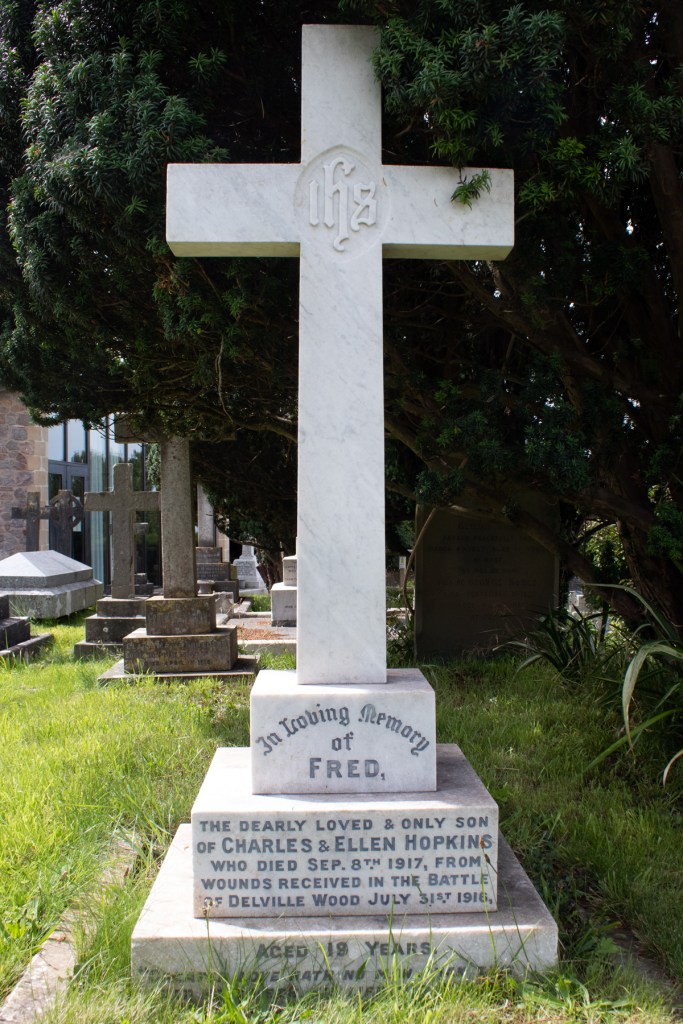
Frederick Charles Hopkins was born in the spring of 1898 in the sleepy Somerset village of Hinton Charterhouse. The younger of two children, his parents were Charles and Ellen Hopkins. Charles was a gardener who, not long after the 1911 census, moved the family west, to the village of Backwell.
When Frederick finished his schooling, he found work as a porter. When war broke out, however, he was keen to play his part, and enlisted at the end of December 1914. His service records note that he was 5ft 4ins (1.63m) tall, and that his apparent age was 19 years and one month. This highlights Frederick’s keenness to fight, as he was actually over two years younger than this at the time he signed the paperwork.
Private Hopkins was attached to the Gloucestershire Regiment, and assigned to the 12th (Service) Battalion. After his initial training on Salisbury, his troop was sent to the Western Front on 21st November 1915.
Frederick would have been involved in a number of the key skirmishes at the Somme, in July 1916, including at Albert and Bazentin. An epitaph on his gravestone suggests that he was injured at Delville Wood, although while his battalion was not actually involved in that specific battle, it is likely that he was injured at around the same time.
Wherever he was wounded, Private Hopkins was sent back to Britain. His service records suggest that he was transferred to the regimental depot but by July 1917, he was medically discharged from the army as being no longer fit for active service.
At this point, Frederick’s trail goes cold. He passed away on 8th September 1917, aged just 19 years old. He was buried in the peaceful St Andrew’s Churchyard in his adopted home village of Backwell.
Abraham James Scott was born in Bathford, Somerset, in the spring of 1893. He was one of fourteen children to Abraham and Lucy Scott, and became known as James, to avoid any confusion with his father. Abraham was a shepherd, who travelled where work took him: both he and Lucy were from Wiltshire, but had moved to Somerset by the end of the 1880s. When James was just a babe-in-arms, the family had relocated to Gloucestershire, but by the time of the 1901 census, they were back in Wiltshire once more.
Abraham Sr died in 1910, at the age of just 41 years old. The following year’s census found the now widowed Lucy living in North Wraxhall, Wiltshire, with eight of her children. Abraham Jr is absent, and, indeed, does not appear on any of the 1911 censuses.
Lucy needed options and, on Christmas Day 1912, she married carter William Amblin in the village church. Abraham was, by this time, living in Bath and working as a carter.
When war came to Europe, Abraham felt the need to step up and play his part and, on 15th December 1915, he enlisted in the army. His service records show that he was 5ft 5ins (1.65m) tall and weighed 132lbs (59.9kg). He had a vaccination mark on his left arm which, according to the document’s section on ‘distinctive marks’, has a tendency to rupture.
Private Scott was mobilised in March 1916, and was assigned to the 1st/5th Gloucestershire Regiment. He soon found himself on the Western Front, and, having transferred to the 1st/4th Battalion, served at the Somme.
Abraham was in for a chequered time in Northern France. On 26th August 1916, he was injured when he received a gunshot wound to his scalp. He was admitted to the 1st Canadian General Hospital in Etaples, the moved to Rouen to recuperate. Private Scott rejoined his unit on 21st October 1916.
Just weeks later, however, Abraham was back in a hospital in Rouen, having fractured his ankle. After a couple of weeks in the 1st Australian General Hospital, the injury was deemed severe enough for him to be evacuated back to Britain for recuperation, and he was posted to Ballyvonare Camp in County Cork. Abraham returned to his unit in France in September 1917, nine months after his ankle injury.
On 1st March 1918, Abraham transferred to the Royal Engineers where, as a Sapper, he was attached to the Depot in Rouen. He remained there for more than a year, during which time he was admitted to hospital once more, this time with trench fever. Little additional information is available about this spell in hospital, other than that Lucy had written to the regiment thanking them for informing her of her son’s illness, and confirming a new address for her.
Sapper Scott’s health continued to suffer, however. In May 1919, he was admitted to a camp hospital, suffering from appendicitis. He was operated on, and medically evacuated to Britain for further treatment and recuperation. Abraham was admitted to the Bath War Hospital on 25th July 1919, and remained there for four months.
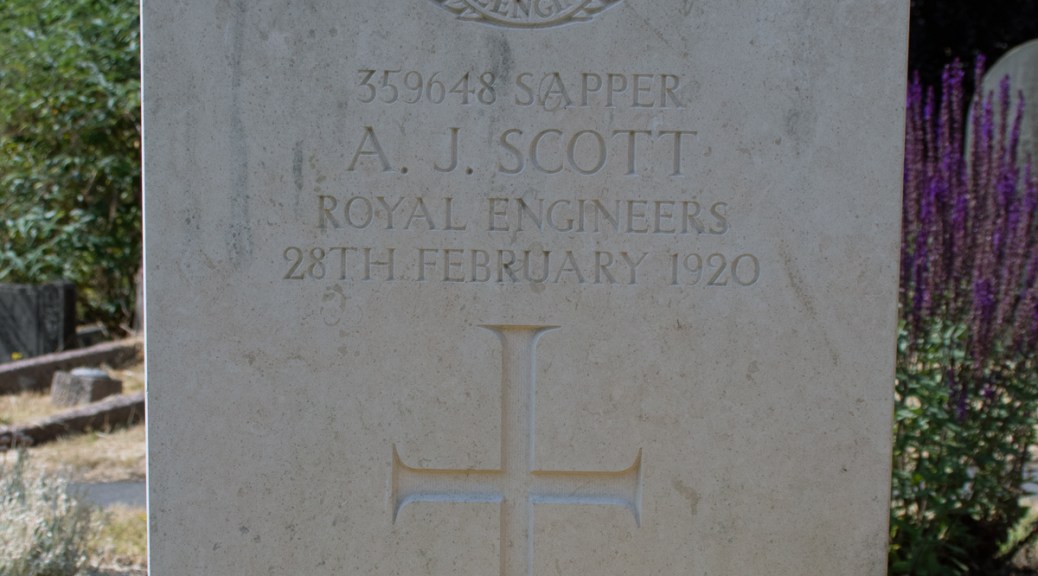
Abraham’s health seemed to improve, albeit slowly, and he was moved to the Pension’s Hospital in Bath on 27th November. The head wound, broken ankle and bout of trench fever appear to have taken their toll on his body which, by this point, seems to have been too weak to recover. On 28th February 1920, two months after being transferred to the Pension’s Hospital, he passed away there from a combination of appendicitis and pelvic cellulitis. He was just 26 years of age.
Abraham James Scott’s body did not have to travel far after this point. He was laid to rest in the sprawling Locksbrook Cemetery in his adopted home city of Bath.
Claude John Howard Rawlings was born on 5th November 1896 in the Monmouthshire village of Aberbeeg. One of three children, his parents were Sidney and Alice Rawlings. Sidney was a brewer from Bath, Somerset, while Alice was born in the Welsh village and this is where the couple raised their family.
By the time of the 1911 census, Claude had been sent to Weston-super-Mare, Somerset, and was a boarding student at the Brynmalyn Private School to the north of the town centre. His heritage would not have been out of place, though, as nine of the 25 live-in students were from Wales. Claude’s parents seemed to have taken the opportunity to visit Sidney’s mother in Bath, a possible prequel to them moving back to Somerset permanently.
Claude completed his schooling at Brynmalyn the following year, and took up a place as an agricultural student in Broadstone, Dorset. When war broke out, however, he was called upon to play his part.
Details of Claude’s military service are sketchy, but he initially enlisted in the Gloucestershire Regiment and was assigned to the 4th (City of Bristol) Battalion. The regiment service in France and Italy from 1915 onwards, but there is no evidence of Private Rawlings serving anywhere other than on home soil.
Claude wanted greater things, and was drawn to a life in the sky. In the spring of 1918, he transferred to the Royal Air Force, and was attached to 125 Squadron. Sent to Fowlmere Airfield near Royston, Hertfordshire, Flight Cadet Rawlings began his training. Over the next couple of months, he learnt to fly a Royal Aircraft Factory R.E.8 biplane.
Flight Cadet Rawlings was dong a routine practice flight on 12th August 1918, when, during a left hand turn, the aircraft’s side slipped and nose dived. The plane crashed to the ground, and Claude was killed instantly. He was just 21 years of age.
The body of Claude John Howard Rawlings was brought back to Somerset for burial. He was laid to rest in Bath Abbey Cemetery.
Flight Cadet Claude Rawlings (from britishnewspaperarchive.co.uk)
Claude’s grave was a family plot, and he was reunited with his parents when Alice and Sidney died in 1933 and 1945 respectively.
The inscription on the family headstone gives Claude’s date of death as October 1918. All other records confirm the crash took place on 12th August, and that he died at the scene.
The youngest of three children to William and Annie, Walter Harold Fry was born in the summer of 1897 in Shepton Mallet, Somerset. William’s job as a railway guard and porter meant the family moved around the area and, by the time of the 1901 census, they had settled in Twerton, to the west of Bath.
Little information is available about Walter’s early life and, indeed, documents from that time seem to record him as both Walter Harold and Harold Walter. When war came to Europe, He was keen to serve his country, presumably because his older brother, William Jr, was already serving overseas in the Somerset Light Infantry.
Walter enlisted in the Gloucestershire Regiment, and, as a Private, was assigned to the 4th (City of Bristol) Battalion. His initial training took place in Wiltshire and Essex, but by March 1915, the battalion had been sent to the Western Front.
Private Fry’s service records no longer exist, by his headstone, in the family plot, suggests that he was injured in France in March 1916. He was medically evacuated back to Britain, although, again, details are sketchy, and admitted to a military hospital in Aldershot, Hampshire.
At this point, Walter’s trail goes cold. The next record for him is that of his passing, while still admitted to the hospital, on 31st December 1916. He was just 19 years of age.
The body of Walter Harold Fry was brought back to Somerset for burial. He was laid to rest in Bath’s Twerton cemetery, a short walk from the family home.
Walter’s brother William had enlisted in the Somerset Light Infantry by 1911. That year’s census recorded him as being billeted at St Andrew’s Barracks in Malta, but by the time war broke out, his troop, the 2nd Battalion, was based in Quetta, India.
He remained based in this far outpost for the duration of the conflict and, while his service records are no longer available, he seemed to have been dedicated to his job as, by October 1918, he had risen to the rank of Sergeant.
William was based in Rawalpindi by that point, and it was here that he died, through causes unknown, on 31st October 1918. He was 26 years of age.
Buried in Rawalpindi Military Cemetery, Sergeant William Fry is also commemorated on the family grave in Twerton.
Stanley George Oliver Biffen was born in the autumn of 1894 in the Somerset village of East Huntspill. He was the second child to Oliver and Fanny Biffen, although his older sibling, sister Florence, had passed away at just three months of age.
Oliver was a carter and farm labourer, and the family went where the work was. The 1901 census found them living in Eastover, Bridgwater, Fanny’s widowed father, George, also living there. Ten years later, the four of them had moved to the village of Stawell. Stanley had finished his schooling, and had also taken up farm work.
When war came, Stanley stepped up to play his part. Full details of his service are lost to time, but he had enlisted in the Army by the spring of 1915. He initially joined the 1st Battalion of the Somerset Light Infantry, and by May that year, was in France.
It is not possible to track Private Biffen’s movements during the conflict, but he did transfer across to the Gloucestershire Regiment at some point. Assigned to the 7th (Service) Battalion, his was a troop that served at Gallipoli and in North Africa, although there is no evidence that Stanley fought in there.
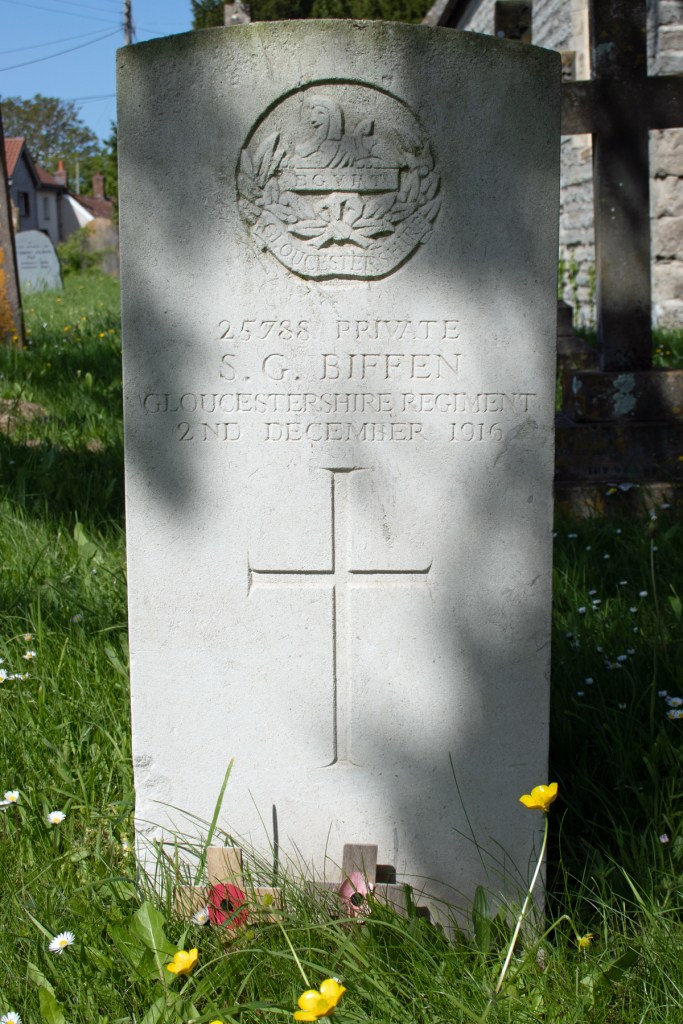
The only other concrete evidence available for Private Biffen relates to his passing. By the autumn of 1916, he had been admitted to the 1st Western General Hospital in Fazakerley, Liverpool. He was suffering from phthitis, or tuberculosis, and this was the condition that was to get the better of him. He passed away on 2nd December 1916, at the age of just 22 years old.
The body of Stanley George Oliver Biffen was brought back to Somerset for burial. He was laid to rest in the quiet graveyard of Stawell Church.
Stanley’s parents had now lost both of their children, and this is likely to have taken a toll on them. Fanny passed away in December 1924, at the age of 64 years old. Oliver died just a year later aged 54 years old.
Arthur Turner was born in East Brent, Somerset, in the spring of 1892. The younger of two children to Thomas and Lucinda Turner, his older sister had passed away while Lucinda was pregnant with him. Thomas was a vicar for the Church of England, and baptised both children, although the records suggest that he did not lead his daughter’s funeral service.
In 1900, the Turners had moved on to a new parish, setting up home in the rectory in Chelwood, to the south of Bristol. They settled in well, and Thomas remained vicar of St Leonard’s Church there until the summer of 1914, when he passed away after a short illness, at the age of 64.
Conflict had not long darkened Europe by this point, and Arthur felt compelled to play his part. Full details of his military service are not available, but records suggest that he had enlisted in the Gloucestershire Regiment by March 1915.
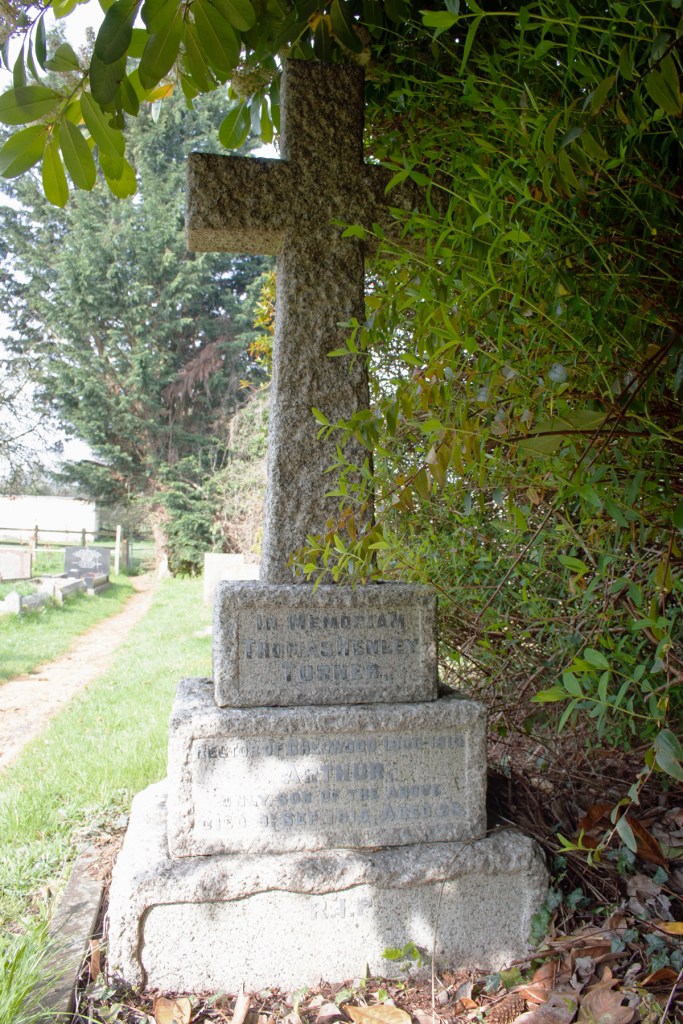
Assigned to the 12th (Service) Battalion, Private Turner was sent north for training. Billeted in a camp in Wensleydale, North Yorkshire, Arthur would have moved south to Salisbury Plain with his troop, had he not fallen ill. He was admitted to a hospital in Darlington, in neighbouring County Durham, suffering from typhoid. The condition was to get the better of him, and he passed away on 9th September 1915. He was just 23 years of age.
Arthur Turner was brought back to Somerset for burial. He was laid to rest in the family plot in St Leonard’s Churchyard, Chelwood, alongside his father, Thomas.
Whatever her late husband’s calling, Lucinda’s own faith must have been strong. Having lost her eldest child young, she then stood witness to the burials of her husband and son within eighteen months.
The 1921 census recorded Lucinda living with her sister, Charlotte, in Bromley, Kent. Eighteen years later, the 1939 Register found her back in Somerset, where she was living in Clutton, providing support and companionship to Letty Collinson, a retired kindergarten mistress.
Lucinda passed away in March 1942, at the age of 88 years old. She was brought back to Chelwood, and buried alongside her husband and son, the family reunited at last.
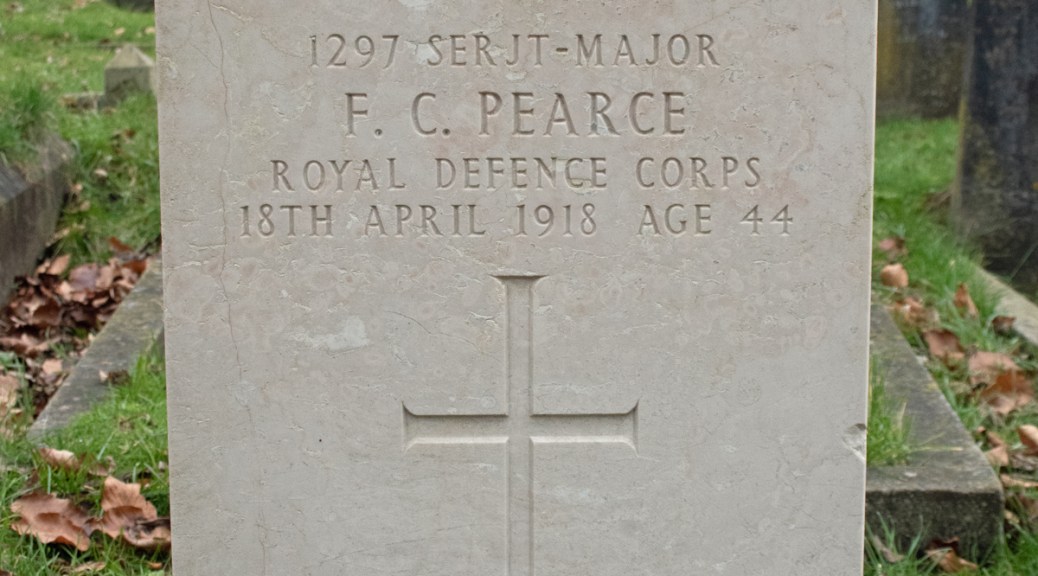
Frederick Charles Pearce was born in the spring of 1873 in the Gloucestershire town of Thornbury. The youngest of six children, his parents were Thomas and Elizabeth Pearce. Thomas was an agricultural labourer and, when he finished school, Frederick found work as a ‘rural messenger’.
This was only a step towards the career that Frederick sought, however, and on 12th July 1892, he enlisted in the Gloucestershire Regiment a a Private. His service records show that he was 5ft 5ins (1.65m) tall and weighed 128lbs (58kg). He was noted as having a fresh complexion, blue eyes and brown hair.
Private Pearce spent twelve years in the army, serving in Malta, Egypt, India and Ceylon (Sri Lanka). He had two stints in South Africa, including the 1899-1900 campaign, during which he was wounded in his chest in the battle at Farquhar’s Farm.
By the time he was discharged on 11th July 1904, he had risen through the ranks to Sergeant, his service records noting that his conduct had been “very good” (in capitals and underlined).
Thomas had died in 1896, and Frederick’s widowed brother William moved back in with his mother to help support her. Frederick also returned to Gloucestershire and, on 30th March 1905, he married Mary Rugman in the parish church in Olveston. The couple may have been childhood sweethearts, as the Pearces and Rugmans were Thornbury neighbours.
The marriage certificate noted Frederick as a groom, and it is likely that he was able to turn his hand to any role after his army career. The couple had a son Leslie, who was born in 1909, and, with the new responsibility of fatherhood, Frederick sought a more permanent career.
The 1911 census found the family living in Somerset, where Frederick was employed as a gardener at the Kingswood Reformatory School. This was a boarding school on an estate to the north of Bath, set in 57 acres of grounds, and again it seems likely that his military career stood him in good stead for such a prestigious role.
When war came to Europe, Frederick felt the pull of his military career once more. While his age did not compel it, on 20th November 1914, he re-enlisted in the Gloucester Regiment. He was enlisted with his previous rank, but within a year has been promoted to Acting Colour Sergeant.
In the spring of 1916, the Royal Defence Corps was formed, and, given his experience and age, Frederick was transferred across to the new regiment. Colour Sergeant Pearce was based in London and, over the next eighteen months served in four troops: 109, 149 and 150 Protection Companies and the 10th City of London Volunteers’ Regiment.
Frederick’s age and the demands of his role were beginning to take their toll by this point, and by the end of 1917, he had developed nephritis, or inflamed kidneys. The condition was severe enough to warrant his discharge from service, and the now Sergeant Major Pearce’s military career came to an end on 17th January 1918.
Frederick returned home to Bath, to the bosom of his family. He and Mary three children by this point, Violet and Freddie being two younger siblings to Leslie. Tragically for the Pearces, however, the family life was not to to last for long: Frederick’s condition was to get the better of him just three months later. He passed away on 18th April 1918, at the age of 44 years old.
Frederick Charles Pearce was laid to rest in St James’ Cemetery in Bath; a man of duty resting at last.
Tragedy was to strike again for poor Mary, when just six months later her youngest child, Freddie, also passed away. Details of his death are vague, but he was buried with his father, the two Fredericks reunited too soon.
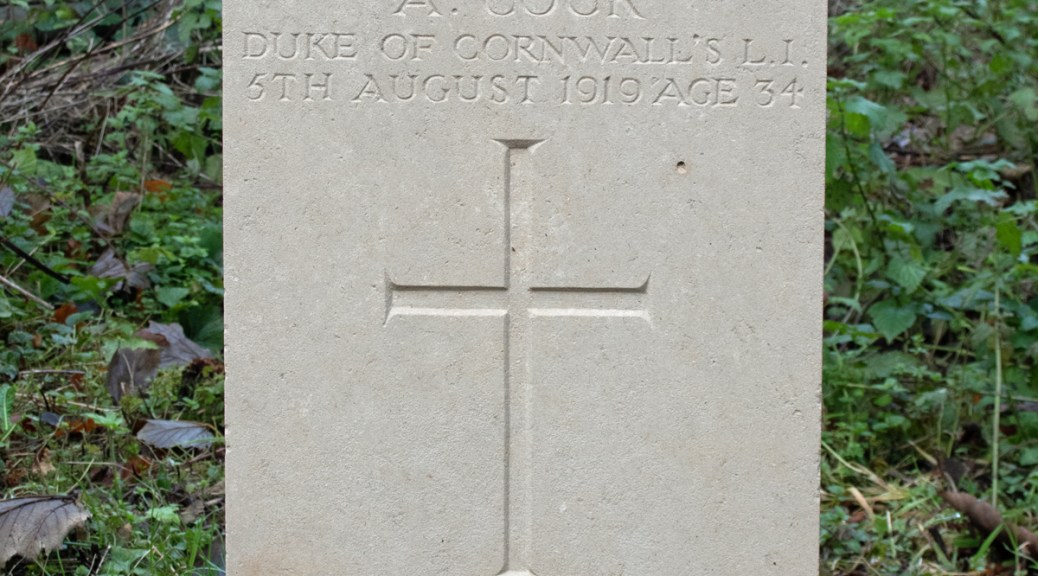
Arthur Cock was born in around 1885 in Wadebridge, Cornwall. One of eleven children, he was the son of mortar mason William Cock, and his wife, Louisa.
When he left school Arthur helper his father out in the business, but when war came to Europe’s shores, he stepped up to play his part. Sadly, his service records are lost to time, and it is a challenge to piece together his time during the conflict from a confusion of other documents.
It is clear that Arthur enlisted in the Duke of Cornwall’s Light Infantry, as this is what is engraved on his headstone. However, his Medal Roll suggests that he also served in the Gloucestershire Regiment and the Labour Corps. He seems not to have fought overseas, and was awarded the Victory and British Medals for doing his duty.
Private Cock’s entry in the Army Register of Soldier’s Effects confirms that he must have enlisted before February 1919, and that he passed away at Whitchurch Hospital.
An entry in the local newspaper, reporting on his death, reads as follows:
In loving memory of Pte. Arthur Cock, son of William, and the late Louisa Cock, of Wadebridge, who died August 5th, at Whitchurch War Hospital, Cardiff.
Cornish Guardian: Friday 8th August 1919
Interestingly, the facility Arthur had been admitted to was a psychiatric hospital, but with no other confirmation as to his passing, it is only possible to assume the cause of his death. He was 34 years old when he passed away.
Arthur Cock’s body was brought back to Cornwall for burial. He was laid to rest in the peaceful, wooded graveyard of St Breoke’s Church, next to the family grave in which Louisa had been buried three years previously.
The family grave, by this time, was tragically quite full. William was able to mourn his son, wife and six of Arthur’s siblings – Mary, William, John, Fred, Charles and Ernest – who had all passed in childhood and were laid to rest there.
Arthur’s younger brother – another William – also fought in the First World War. His service records reveal a lot about his life.
Private Cock enlisted in the Australian Imperial Force on 7th September 1914. At the time he was working as a railway porter in Morphettville, now a suburb of Adelaide, Australia. His records confirm that he was 5ft 8.5ins (1.74m) tall, and weighed 158lbs (72kg). He had brown hair, brown eyes an a fresh complexion.
William left Australia for the battlefield on 20th October 1914, and soon found himself in the Eastern Mediterranean. Sadly, this was to be the end of the line for him: he was killed on the battlefields of Gallipoli on 23rd March 1915, aged just 28 year of age.
William Cock was laid to rest in the Shrapnel Valley Cemetery in Gallipoli. He is commemorated on the headstone of the family grave back in St Breock.
Frederick Leonard Johnson was born in the spring of 1898, in Wandsworth, South London. His parents are recorded as Frederick and Catherine Johnson, although no other information about his early life remains.
On 16th February 1918, Frederick married Winifred Peters. She was a dock labourer’s daughter from Aberavon in Glamorganshire, and the couple wed at the parish church in the town. The marriage certificate confirms that Frederick was living in Port Talbot and working as a carpenter. It also notes that his father had died by this point.
It seems likely that the young couple married because Winifred was pregnant. The couple had a son, who they called Frederick, on 1st August 1918.
Frederick had enlisted in the army by this point. While his service records no longer exist, he joined up at some point towards the end of the war – no earlier than May 1918 – and was assigned to the 3rd (Reserve) Battalion of the Gloucestershire Regiment. This was a territorial force, and Private Johnson would have been based in Kent as part of the Thames and Medway Garrison.
Little else is known about Frederick’s service. The only other thing that can be confirmed is that he was admitted to the Preston Hall Military Hospital in Aylesford, Kent, in the autumn of 1918, suffering from a combination of influenza and pneumonia. Sadly, the lung conditions were to get the better of him and he passed away on 27th November 1918, at the age of just 20 years old.
Frederick Leonard Johnson was laid to rest in the graveyard of St Peter and St Paul’s Church, Aylesford, not far from the hospital in which he had passed. It is unclear whether he ever met his son.
In a quiet corner of St Peter & St Paul’s Churchyard in Aylesford, Kent, is a headstone dedicated to 35013 Private F Neale of the Gloucestershire Regiment. The memorial confirms that he died on 24th November 1918, but little more information remains on his life.
The Army Record of Soldiers’ Effects confirms his first name as Frederick, but that he was not eligible for the War Gratuity payment, which suggests that he had less than six months’ service when he passed.
The document also confirms that he was assigned to the 3rd Battalion of the Gloucesters, and that he had passed away at the Preston Hall Military Hospital in Aylesford. There is no next of kin of beneficiary for his personal effects, and so the trail goes cold.
With no age or date of birth it is impossible to trace any further details for Frederick. No other military records survive, nor is there any note of his passing or funeral in contemporary newspapers. Frederick Neale’s life is destined to remain lost to time.








 Death and Service