Tag Archives: heart

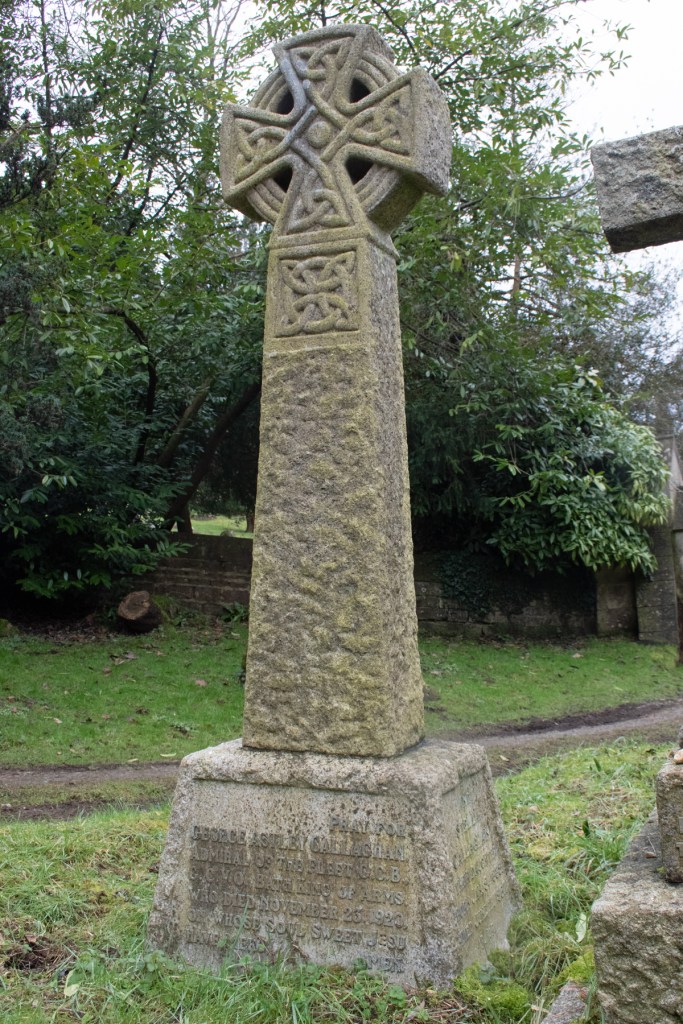
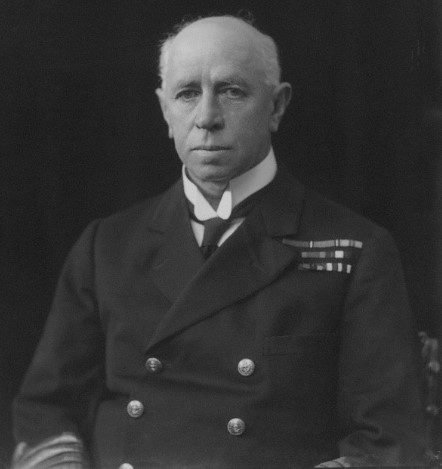
Admiral of the Fleet Sir George Callaghan

Admiral of the Fleet Sir George Callaghan

George Astley Callaghan was born in London on 21st December 1852, the third of six children to Frederic and Georgiana Callaghan. Frederic was born in Ireland and was the son of MP and landowner Daniel Callaghan. He built a career for himself as a magistrate and set up home in Bath, Somerset with Cheltenham-born Georgiana.

The family had means and the 1861 census records them living at a five-storey Georgian house in Catharine Place, Bath, with five live-in servants: a butler, cook, housemaid, nursemaid and nurse.

George enlisted in the Royal Navy in January 1866, and was assigned to the training ship HMS Britannia. From here, his career was to prove meteoric. He was promoted to the rank of Midshipman in October 1867 and by 1870 he was serving in the East Indies. On 15th April 1872 he gained the rank of Sub-Lieutenant, and was promoted to full Lieutenant exactly three years later.

In 1877, Lieutenant Callaghan received a commendation for saving the lives of sailor whose boat had capsized in the Irrawaddy River. George was assigned to HMS Excellent, a gunnery school, in 1880, and formally joined the staff there in 1882. Back on the open seas by 1885, he was promoted to Commander on 31st December 1887 and given control of the battleship HMS Bellerophon. By 1894, George had been promoted again, to the rank of Captain, and took on the additional duties of naval advisor to the War Office.

As the new century dawned, George was mentioned in dispatches for his support during the Boxer Rebellion. Further commands followed, including HMS Edgar and HMS Caesar, both in 1901. He was made Captain of Portsmouth Dockyard and then naval aide-de-camp to the King in 1904. By the following year, he was given the rank of Rear Admiral, became Second-in-Command of the Channel Fleet in 1906, Second-in-Command of the Mediterranean Fleet in 1908. In December that year he was awarded Knight Commander of the Royal Victorian Order for the aid he provided to survivors of the Messina earthquake.

In April 1910, George was knighted and promoted to Vice Admiral, and within eighteen months he was made Commander-in-Chief of the Home Fleet, gaining the rank of Admiral in November 1911.

During this time of military promotion, George had also had his own family. On 2nd February 1876, he had married Edith Grosvenor in St Andrew’s Church, Walcot, Bath. The couple went on to have four children: Dorothy, Cyril, Noël and Stella.

A naval officer’s wife was destined to be a lonely life, and the census records seem to reflect this. In 1881, Edith and Dorothy were visiting a curate and his family in Wiltshire. Ten years later, Edith and her four children were living at the family home in Bathwick, with one visitor and three servants. The 1901 census found Edith, Cyril (who was now a midshipman himself) and Noël living in Devonport with a cook and two other servants. By 1911, Edith had moved again. She was 54 by this point, and based at a house in Havant, Hampshire, with a cook and two maids. All of this time, of course, George was away at sea, performing his duties.

George, by this point, had spent years preparing for the war he knew was coming. However, in July 1914, the First Lord of the Admiralty, Winston Churchill, commanded Sir John Jellicoe to relieve George of his position as Commander-in-Chief of the Home Fleet. Whether Churchill believed that Sir Callaghan was now too old to successfully carry out the duties the advancing conflict would impose upon him is unclear. It must have disappointed the 62-year-old George, however.

His work continued, however: he was appointed First an Principal Naval Aide-de-Camp to the King in September 1914, and became Commander-in-Chief of The Nore in three months later. He was promoted again, to Admiral of the Fleet, in April 1917, but subsequently retired less than a year later.

George’s life over the next couple of years goes a little quiet. Indeed it is only in November 1920 that further information is available.

The death occurred in London yesterday afternoon of Admiral of the Fleet Sir George Callaghan KCB. He had been ill for some months, and the immediate cause of death was an affection of the heart.

The Scotsman: Wednesday 24th November 1920

Sir George’s passing at his London home was reported in most of the press, highlighting his military achievements and decorations. His funeral was held at Westminster Abbey, and he was then laid to rest in the graveyard of St Mary’s Church in Bathwick, not far from his and Edith’s main home.


Sir George Callaghan

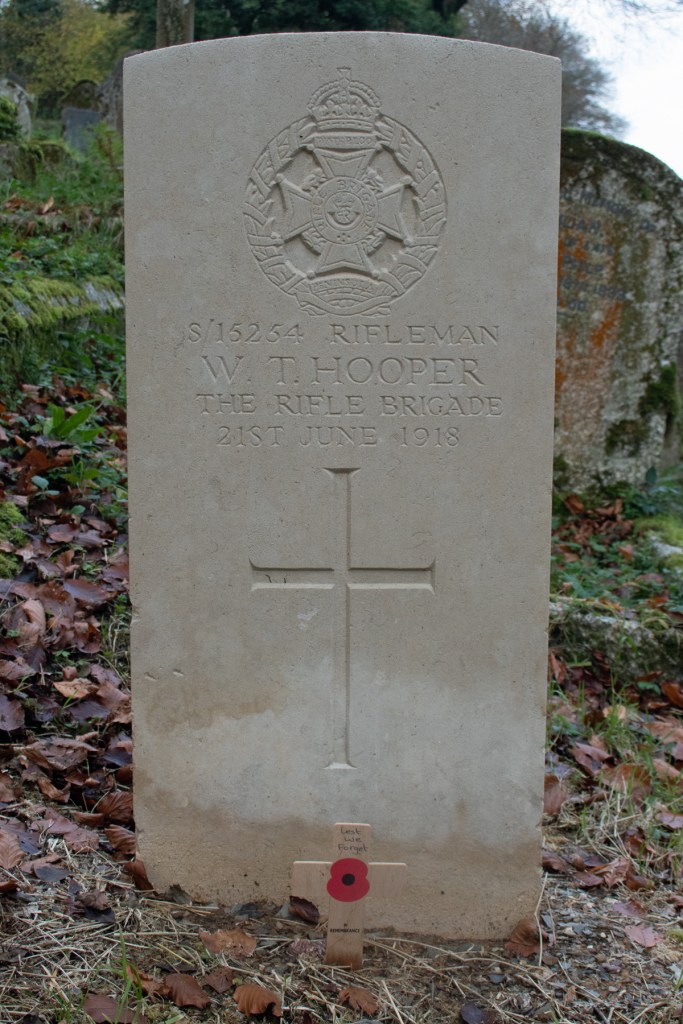
Rifleman William Hooper

Rifleman William Hooper

William Thomas Hooper was born in St Breock, near Wadebridge, Cornwall, in the summer of 1890. One of three children his parents were gardener William Hooper and his wife, Sarah.

When he left school, William Jr found work as a warehouseman and salesman, up in London, but when war broke out, he stepped up to play his part. He enlisted in December 1915, joining the Rifle Brigade, but was not formally mobilised for another couple of months.

Little detail of Rifleman Hooper’s military service survives, but records confirm that he was 5ft 6ins (1.68m) tall, and weighed 124lbs (56.3kg). It also notes that his left testicle had not descended, but that his condition was not severe enough for William to be refused for military service.

Rifleman Hooper’s was initially assigned to the 5th Battalion, based on the Isle of Sheppey, Kent, as part of the Thames & Medway Garrison. By the spring of 1916, however, he had been transferred to the 1st Battalion, and sent to France. He was involved in the Battle of Albert, and returned to the UK in August 1916 .

William appears to have been transferred back to the 5th Battalion and, in the spring of 1917, was hospitalised for three month, suffering from trench foot and rheumatism. By September that year, however, he was back with his unit.

Rifleman Hooper’s service documents become a little confused at this point. One record suggests that he was discharged from the army on 2nd January 1918 as being no longer medically fit for duty, while a second entry confirms that he passed away while on leave pending discharge.

Either way, William was back at home in St Breock when, on 21st June 1918, he passed away from a combination of pericarditis and pericardial effusion. He was just 27 years of age.

William Thomas Hooper was laid to rest in the wooded graveyard of St Breoke’s Church, in his home village.


An entry in the local newspaper confirmed that “Mr and Mrs Hooper and family… and Miss Ive Jones, London” [Cornish Guardian: Friday 18th June 1918] offered their thanks for the sympathy they had been shown in the bereavement. This suggests that, when he passed, William had been courting, his loss felt further.


Corporal Thomas Teague

Corporal Thomas Teague

Thomas Teague was born in the spring of 1884 in the Cornish town of Tintagel. He was one of ten children to quarryman and road labourer John Teague and his wife, Ellen. When he first left school, Thomas found work as a farm labourer. By the time of the 1911 census, he was still living in the family home, but had found more skilled work as a stone mason.

Much of the rest of Thomas’ life remains a mystery. John passed away in September 1914, and it is clear that, with war now raging across Europe, Thomas stepped up to play his part. He enlisted in the Royal Dublin Fusiliers, and was assigned to the 7th Battalion. The regiment served in Gallipoli, Salonika and Egypt, although it is not possible to identify where Private Teague served.

At some point, potentially because of health reasons, Thomas was transferred to the 655 Home Service Coy of the Labour Corps. Again, exact details of his service are unclear, but he had been promoted to the rank of Corporal, and appears to have been based in Curragh Camp, not far from Kildare, Southern Ireland.

The only other confirmed record relating to Corporal Teague is that of his passing. He died of heart disease in the camp, on the 2nd October 1917. He was 33 years of age.

Thomas Teague’s body was brought back to Cornwall for burial. He was laid to rest in the peaceful graveyard of St Materiana’s Church, overlooking his home village of Tintagel.


Thomas was buried in the family plot, alongside his father. When his mother, Ellen, passed away in 1930, she was reunited with her husband and son.


Serjeant Albert Rumbelow

Serjeant Albert Rumbelow

Albert Edward Rumbelow was born in 1879 in Wycombe Marsh, Buckinghamshire. One of eleven children, his parents were Suffolk-born paper maker Philip Rumbelow and his wife, Jane.

Little information is available about Albert’s early life, although by the time of the 1901 census, he is recorded as being a Private in the Rifle Brigade. The family had moved to the village of Little Chart in Kent by this point, where his father was still continuing in the manufacture of paper.

Private Rumbelow’s military service is evidenced in later documents. He served with the 1st Battalion from 1895 to 1907, was awarded the South Africa medals for 1901 and 1902: he was also granted the clasp for his involvement in the defence of Ladysmith. He appears to have been wounded at this point, and was invalided out of full military service and placed on reserve.

In 1904, Albert was back in England, and living in London. That year he married Ellen Sillis, a cordwainer’s daughter from Norfolk. The couple set up home in Fulham, and went on to have five children: Abert Jr, Iris, Florence, Doris and Hilda.

By the time of the 1911 census, Albert was working at the local Public Hall, as a labourer, hall attendant and cleaner. The family were living at 9 Crabtree Lane in Fulham, sharing the property with the Fitzgerald family.

War was closing in on Europe by this point, and, once again, Albert stepped up to plat his part. He enlisted within days of conflict being declared, and within weeks had been given the rank of Corporal. His service records note that he was 5ft 10ins (1.78m) tall, weighed 156lbs (70.8kg), had brown hair and blue eyes. He was also recorded as having a tattoo of crossed rifles and a crown on his right forearm, and scared on his left calf, knee and eyebrow.

By the spring of 1915, Albert had been promoted again, to the rank of Serjeant. He was sent to France on 19th May, having been assigned to the 7th (Service) Battalion. Serjeant Rumbelow was involved at the Somme and was awarded the Distinguished Conduct Medal “for conspicuous gallantry” on 3rd June 1916. “He exposed himself to machine-gun and rifle fire when going across the open to rescue a wounded man. Later he went under fire to fetch a stretcher.”

Serjeant Rumbelow appears to have been injured in the skirmish, and was invalided to the UK later that month. When he recovered he was posted again, this time to the 18th (London) Battalion of the Rifle Brigade.

The following February he made the transfer across to the Labour Corps, and by March 1917, Serjeant Rumbelow was back in France. In August he was promoted to Company Sergeant Major, but was invalided back to England with bronchitis in February 1918.

When he recovered Albert was assigned to the 364th Area Employment Coy. in Kent, and seems to have voluntarily taken a drop in rank – back to Serjeant – in doing so. His health was dogging him by this point and in the late summer of 1918, he was admitted to Preston Hall Military Hospital in Aylesford, suffering from VDH, or heart disease.

Sadly, the strain of his military service was to be his undoing. He passed away from the heart condition on 21st September 1918, at the age of 39 years of age.

Albert Edward Rumbelow was laid to rest in the graveyard of St Peter & St Paul’s Church in Aylesford, not far from the hospital where he had breathed his last.


Now widowed, Ellen was left with the unenviable task of raising five young children on her own. She married again, to Private William Lake, on 8th June 1919, and the family moved to Essex. She lived until the age of 79, and was laid to rest in Sutton Road Cemetery in Southend.


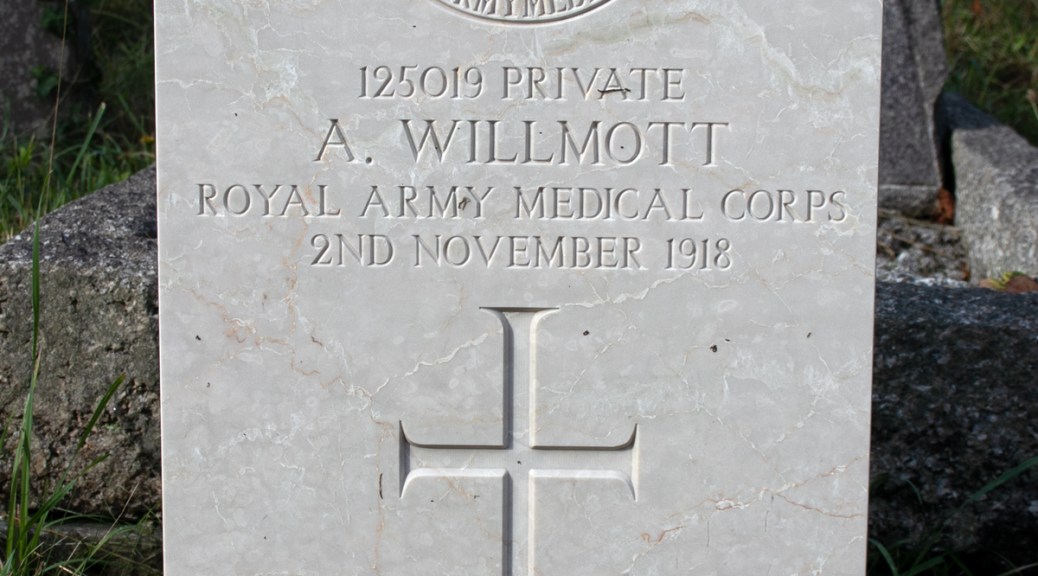
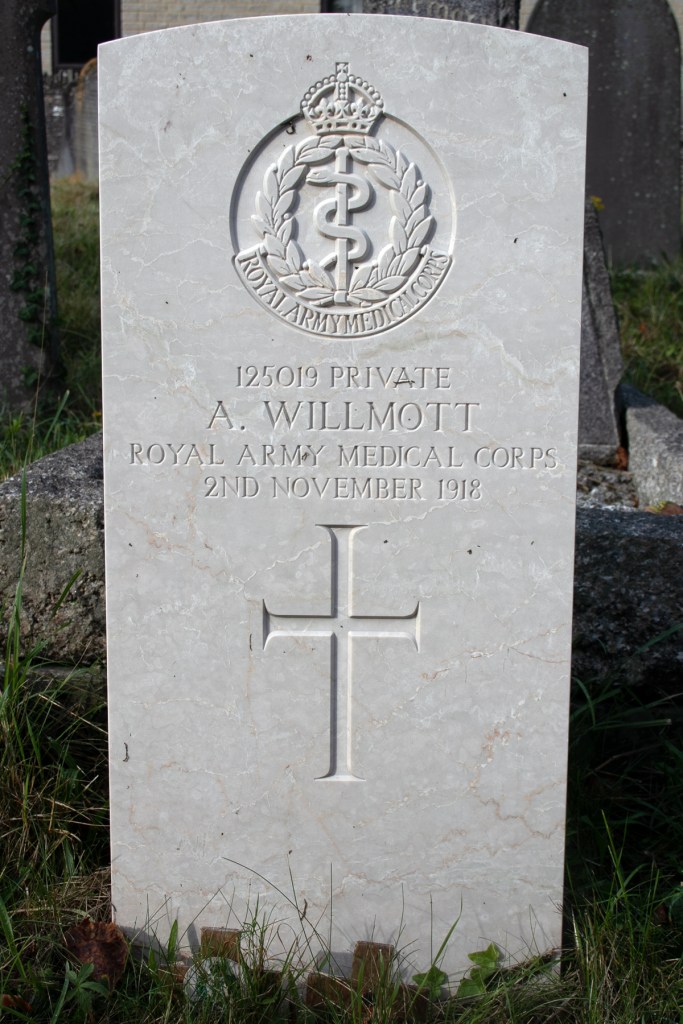
Private Alec Willmott

Private Alec Willmott

Alec William Willmott was born in 1886 and was one of six children to Henry and Ellen Willmott. Henry was a farm labourer from Oldland in Gloucestershire, and this is where the family were raised.

When he left school, Alec found work making shoes and boots at a local factory – this was work most of the Willmott children went into. On 24th April 1916, he married Elsie Frost in the local church. The couple set up home in Keynsham, and went on to have a son, Cecil, who was born in August 1917.

Alec played his part during the war. Full service details are not available, but it is clear that he had enlisted in the Royal Army Medical Corps by the spring of 1918. There is no confirmation of whether Private Willmott served at home or overseas, but, by October 1918, he had been admitted to the 2nd London General Hospital in Chelsea, suffering from a combination of influenza and pneumonia.

Sadly, these conditions put a strong pressure on his heart: Private Willmott passed away from cardiac failure on 2nd November 1918, at the age of just 32 years old.

Alec William Willmott was brought back to Gloucestershire for burial. He was laid to rest in the graveyard of St Anne’s Church in his home village, Oldland.


Private Frank Mayo

Private Frank Mayo

Francis James Stephen Mayo was born on 24th November 1894 in Oldland, a small Gloucestershire village near Bristol. One of eight children, his parents were collier Samuel Mayo and his wife, Diana.

Frank, as he was known, sought a life of adventure from the start. In July 1911, not content with life as a farm labourer, he enlisted in the Royal Navy as a Boy 2nd Class. His service records show that he was 5ft 5ins (1.65m) tall, had light hair, blue eyes and a fair complexion.

Sent to the training ship HMS Impregnable, Boy 2nd Class Mayo’s time there was short. When Samuel found out what his son had done, he paid £10 (the equivalent of around £1250 in today’s money) for his discharge.

Frank went back to farm work, but, with storm clouds brewing on European shores, his time was to come again. On 8th September 1914, just a month after war was declared, he enlisted. His service records show that he had gained an inch (2.5cm) in height since his attempt to join the Royal Navy.

Again, Frank’s attempt to escape what he presumably felt to be a humdrum life were thwarted. His service records confirm that he was discharged on medical grounds because he was deemed not likely to become an efficient sailor.

On Christmas Day 1915, Frank married Martha Sweet, the daughter of a chimney sweep. The couple settled down in Keynsham, not far from either of their families, and had a son, Henry. Frank, by this time, seemed to have given in to the inevitable, and looking for a regular wage, began working at one of the local collieries.

Frank still had a dream to fulfil, though, and with no end to the war in sight, he again enlisted, joining the Training Reserve in June 1917. His records show that he had gained another inch in height, and has a number of tattoos on his right forearm. His records this time show that he had a slight heart problem, and was also suffering from a touch of rheumatism.

Private Mayo was assigned to the 440th Company of the Labour Corps, and seemed, at last, to be fulfilling the role he had wanted to be doing for the last six years. As time went on, however, his health seems to have been failing him and, in the summer of 1918, he contracted pulmonary tuberculosis. He passed away from the condition on 30th August 1918, while at camp, aged just 23 years of age.

Brought back to Gloucestershire for burial, Francis James Stephen Mayo – or Frank – was laid to rest in the graveyard of St Anne’s Church in his home village of Oldland.


Corporal Ernest Jenkins

Corporal Ernest Jenkins

Ernest Gilbert Jenkins was born on 4th April 1888, the tenth of eleven children to Eli and Julia Jenkins. Eli was a dairyman from Dorset, but the family were born an raised in Marksbury, a village in Somerset. When Eli passed away in 1910, he was laid to rest in the nearby town of Keynsham, and this is where Julia and the family moved.

Ernest tried to make his mark by finding a career in the army and enlisted in the Royal Field Artillery on 22nd June 1908. He gave his trade as a electrician for the National Telephone Company and his records noted that he stood 5ft 7ins (1.70m) tall, with good vision and good physical development.

The 1911 census records the widowed Julia and five of her children living on Charlton Road, Keynsham, in a 12-roomed house, with a domestic servant and three visitors. While not noted as such, it would seem that Julia was running a boarding house, but without any further details, this is impossible to confirm.

Ernest may have completed his initial term of service by this point and he was recorded as living with his mother and working as a salesman of cattle feed. Bombardier Jenkins’ military records show uninterrupted service from 1908 to 1917, so it is likely that, at the time of the 1911 census, he was, in fact, on reserve.

When war broke out in 1914, Ernest was called back into duty. By March 1915, he found himself in France, having been promoted to Acting Corporal. He served on the Western Front until June 1916, when he was sent back home.

Corporal Jenkins seems to have been suffering with his health and, in July 1916 was admitted to hospital with pyrexia (fever). Medically evacuated to England for treatment, a heart murmur was also identified, and after treatment, he was relieved of active duty and placed on reserve in January 1917. The heart condition continued, however, and by the end of the year, he was medically discharged from the army.

At this point, Ernest’s trail goes cold. He returned to Bristol and is noted in the 1919 edition of Kelly’s Directory, as living back in Charlton Road with Julia.

The next record for Ernest confirms his passing. He died on 25th July 1919 in a nursing home in Bristol. He was just 31 years of age.

Ernest Gilbert Jenkins was laid to rest in the family plot in Keynsham Cemetery. When Julia passed away in 1929, at the age of 78, she was buried there as well, finally reunited with her husband and son.


Private Griffith Hughes

Private Griffith Hughes

Griffith Hughes was born in Llanberis, in modern day Gwynedd, in 1893. Sadly, there is little information about his early life, and records mention his mother – Margaret – but no father. The 1901 census records Griffith as living with his grandmother, Ann Hughes.

Ten year later, the two are living in a two-up, two-down cottage – 19 Snowdon Street, Llanberis – with Griffith’s aunt, Ann’s daughter Jane, and her husband, Thomas. Griffith is earning money by now, working as a slate dresser at one of the local quarries.

War was coming to Europe by this point, and Griffith was called upon to play his part. He initially enlisted in the Welch Regiment as a Private, although he seems to have transferred across to the South Wales Borderers during his service.

Private Hughes’ time in the army was spent on home soil, although he earned the Victory and British Medals for his service. He remained in the army through to the end of the war and beyond until, on 15th August 1919, he was medically discharged. He had developed tachycardia, and this was having an impact on his life.

When Griffith left the army, he was based in Lancashire, and was living in the village of Bryn, to the south of Wigan. He remained in the area for the next year, his health sadly deteriorating. Admitted to the cottage hospital in nearby Pemberton, he passed away from his heart condition on 18th September 1920. He was just 27 years old.

Griffith Hughes was brought back to Wales for burial. He was laid to rest in the quiet graveyard of St Peris Church, in his home village of Llanberis.


Private Herbert Macklin

Private Herbert Macklin

Herbert Macklin was born in Lambeth, Surrey, on 14th August 1897, the youngest of six children to Enos and Sarah Macklin. Enos was a general labourer and, after his mother died in 1909, Herbert worked around his school as a baker’s errand boy, to bring in a little more money for his family.

After Enos passed away in 1912, and with his older sisters all having families of their own, Herbert and his older brother William did what they could to survive, getting some support from the local poor school.

The outbreak of war gave the brothers a sense of purpose, and both enlisted. William joined the Royal Field Artillery, and was sent to France in September 1915.

Herbert, being six years younger than his brother, enlisted later than his sibling. He joined the Middlesex Regiment, on 10th May 1916, and his service records show that he was 5ft 4.5ins (1.64m) tall, 126lbs (57.2kg) in weight and had a fair physical development. While Herbert had a fair physical development, he was also recorded as having flat feet, which somewhat limited his army service.

Private Macklin transferred across to the Devonshire Regiment a few months after enlisting. He was then assigned to the regiment’s Labour Corps in the summer of 1917, and remained with them for the rest of his service.

While William was serving abroad, Herbert remained on home soil for the duration. By the spring of 1918, he was working in Kent, but was admitted to hospital in Faversham, suffering from acute tonsillitis. Sadly, this was to prove too much for Private Macklin’s body to take: he suffered cardiac failure, and died on 12th April 1918. He was 21 years of age.

Herbert Macklin was laid to rest in the Borough Cemetery of the town in which he passed, Faversham.


Tragedy was to strike again for the Macklin brothers: as the war moved into its closing months, Driver William Macklin was based in Salonika, Greece. He was not to see England’s shores again, sadly: he passed away on 23rd November 1918, aged just 27 years old.


Private Edward Hopson

Private Edward Hopson

The life of Edward Hopson looks likely to remain a mystery, and what can be pieced together is done from a few fragmented documents. His gravestone sits in the Faversham Borough Cemetery in Kent.

A local newspaper, contemporary to his passing in January 1915, acts at the starting point:

Edward Hopson, a Maidstone [Kent] man, belonging to the National Reserve Guard doing duty at the Explosives Works at Faversham, died suddenly while proceeding on duty on Tuesday night.

Evidence of identification was given by Joseph Cornelius, a Lance Corporal in the Guard, who stated that so far as was known, the deceased’s only relative was a half-brother. The deceased gave his age as 49 when he enlisted, but witness believed his correct age was 61. He was apparently in good health when passed for duty on Tuesday at the works of the Explosives Loading Company at Uplees.

Charles John Link, engaged on patrol duty at the works, stated that about 10:30 on Tuesday night he was accompanying deceased to the point where he was to do guard duty. On the way deceased complained that he could not see, and shortly afterwards, as they came to a style, he exclaimed “Oh! dear,” and then, dropping his rifle, he fell into the witness’s arms and expired.

South Eastern Gazette: Tuesday 26th January 1915

The cause of death was given to be heart disease, and, at the inquest, a verdict of “Death from Natural Causes” was given.

The report suggests that Edward was born either in around 1866 or 1854. The Commonwealth War Graves Commission give his parents as Jack and Annie Hopson, but there are no surviving census records from the 1800s that would corroborate this.

The 1911 census records an Edward Hopson, aged 57 and from Maidstone, Kent, residing in the Maidstone Union Workhouse. He is listed as a former farm labourer, and his marital stated us given as widowed.

If this is the Edward Hopson commemorated in Faversham Cemetery, it seems likely that he used the outbreak of war – and the opportunity to enlist – as his escape route from the workhouse.

He joined The Buffs (The East Kent Regiment), and was assigned, as a Private, to the 4th Battalion. This particular troop was dispatched to India in October 1914, and it seems likely that Private Hopson was reassigned to the National Reserves Guard, and posted to Faversham.

This is all conjecture, of course, but, either way, Private Hopson died of a heart attack on the night of the 19th January 1915, aged approximately 61 years old.