Tag Archives: history

Private Havelock Webber

Private Havelock Webber

It was with painful regret that the inhabitants of Bratton Fleming heard of the death of Private Havelock Webber… who passed away at Hursley, near Winchester, on Tuesday in last week. On being called to the Colours a few weeks ago, he was attached to the 3/6th Devons. Previous to joining up he followed the occupation of a tailor, and was also a part-time postman. Deceased was well-known and highly respected. He was closely connected with every movement at the Village Hall, and was a member of the Committee of Management.

[North Devon Journal: Thursday 11th May 1916]

Havelock Webber was born in Bratton Fleming early in 1878. There is no information available for his parents, but the 1891 census recorded him as living with his paternal grandparents, George and Grace Webber. At 13 years old, Havelock was already learning the tailoring trade.

Havelock doesn’t appear in the 1901 census, and the 1911 return gives little information away either. At this point he is boarding in a house with either the Bale or Musworthy family (his is a separate record, with those two families adjoining his).

Beyond this, there is little information available about Private Webber’s life or military service. He died from peritonitis on 2nd May 1916 in the Hampshire Camp. He was 38 years of age.

Havelock Webber’s body was brought back to Devon for burial. He was laid to rest in the graveyard of St Peter’s Church in his home village of Bratton Fleming, Devon.


Private Gilbert Smyth

Private Gilbert Smyth

Gilbert Rowland Locke Smyth was born in the summer of 1897, and was the oldest of three children to Charles and Elizabeth. Charles was a postman and bootmaker and both he and his wife came from North Molton in Devon. The 1901 found the young family taking rooms in Dobbs Cottage on East Street, midway between two pubs: the Poltimore Arms and the Miner’s Arms.

Gilbert – who was better known as Roy – found work as a clerk she he finished his schooling. By the time war broke out, he was had moved to East Sheen, Surrey, and was employed by the civil service. He was keen to play his part, and enlisted in the army on 10th December 1915.

Initially assigned to the Suffolk Regiment, Private Smyth’s service records give an insight into the young man he had become. At eighteen years of age, he was 5ft 8.5ins (1.74m) tall, and weighed 112lbs (50.8kg). While he had worn spectacles for a couple of years, he was noted as being of fair physical development. The document confirms that he had a mole on the top of his right arm.

Roy was not formally mobilised until October 1916. After four months’ training on home soil, his unit, the 14th Battalion, was sent to France. Private Smyth remained overseas for nearly a year, during which time he transferred to the 12th Battalion of the York & Lancashire Regiment.

At the end of July 1918 Roy was caught up in a German gas attack, and this would have a long-term effect on his health, particularly his eyesight. He returned to Britain on 30th November 1918, and, after a couple more months spent in France, he was formally discharged from the army on medical grounds on 5th April 1919.

The deepest sympathy is extended to Mr and Mrs C Smyth in the loss of their eldest son, Roy… Deceased, who was employed in London in the Civil Service, was taken ill with pneumonia, and died before his father could arrive.

[Exeter and Plymouth Gazette: Friday 6th August 1920]

Gilbert Rowland Locke Smyth died on 3rd August 1920: he was 22 years of age. He was brought back to Devon for burial, and was laid to rest in All Saints’ Churchyard in his home village of North Molton.


Private John Lethaby

Private John Lethaby

The news of the death of ex-Gunner JC Lethaby, who passed away early on Monday morning last. was received… with deep regret. On the outbreak of war he was only 16 years old, but when the call came for volunteers, he put his age to 19 and enlisted. He proved his worth on the battlefields of Flanders and after being wounded, was gassed, his work as a first class machine gunner calling him into much danger. He recovered from his injuries to some extent, but after demobilisation, his health broke down and he gradually sank. His pain and suffering during the past months were borne with much patience. Last week he earnestly begged to be removed to his home… and he was brought by motor car.. on Sunday afternoon, but he passed away the next morning. He leaves a wife and child to mourn their loss, and sympathy is expressed with them as also with his mother, father, brothers and sisters… Always of a cheerful disposition deceased had a host of friends, especially among the young men of the parish. He was awarded the Meritorious Service Medal and was entitled to the 1915-1915 Bronze Star.

[Tiverton Gazette (Mid-Devon Gazette): Tuesday 15th June 1920]

Despite the John Charles Lethaby’s obituary, there is little additional information about his early life. He does not appear on the 1901 or 1911 census returns, and there is no obvious sign of a birth or marriage certificate.

The Commonwealth War Graves Commission gives his wife’s name as Clara, and a later military record suggests that she moved to Hitchin, Hertfordshire, after her husband’s death. The 1921 census noted that she was living with her parents, Arthur and Eliza King, and had her daughter, Ada, with her.

The newspaper report suggests that John was born in 1898, which would have made him 22 when he died on 7th June 1920. His headstone gives his age as 25, which would fit in with the obituary commenting that he had added three years to his age in order to enlist. He appears to have joined the 3rd Battalion of the Devonshire Regiment, before transferring across to the Machine Gun Corps.

John Charles Lethaby was discharged from army on medical grounds on 19th April 1919. He died of pulmonary tuberculosis just over a year later, and was laid to rest in All Saints’ Churchyard, North Molton, Devon.


Rifleman Thomas Telford

Rifleman Thomas Telford

Thomas Telford was born in Bacchus Marsh, Victoria, Australia, on 31st July 1873. The fifth of eleven children, his parents were James and Mary Telford.

There is little additional information about Thomas’ early life. By the time war broke out, he had moved to New Zealand, and was working as a bushman, based out of Whanganui on the south coast of North Island.

Thomas enlisted on 18th January 1916, and would be assigned to the New Zealand Rifle Brigade. His service records show that, at 42 years of age, he was 5ft 5ins (1.65m) tall, and weighed 149lbs (67.6kg). A Roman Catholic, he had iron grey hair, blue eyes and fair hair.

Rifleman Telford’s unit left New Zealand in the spring of 1916. After five weeks in Egypt, he arrived on British soil on 7th August, marching from Southampton, Hampshire, to the Sling Camp in Wiltshire.

By 20th August, Thomas was in France, fighting on the front line. He was injured less than three weeks later and, after initial treatment in France, he was medically evacuated to Britain at the end of September.

Rifleman Telford spent time convalescing in a military home in Hornchurch, Essex, before being transferred to the ANZAC base in Codford, Wiltshire. That winter he contracted pneumonia, and he was admitted to the No. 3 New Zealand General Hospital on the outskirts of the village.

Sadly, the lung condition was to prove the better of Thomas. He passed away on 2nd February 1917, at the age of 43 years old.

Thousands of miles from home, Thomas Telford was laid to rest in the graveyard extension to St Mary’s Church in Codford, not far from where he had breathed his last.


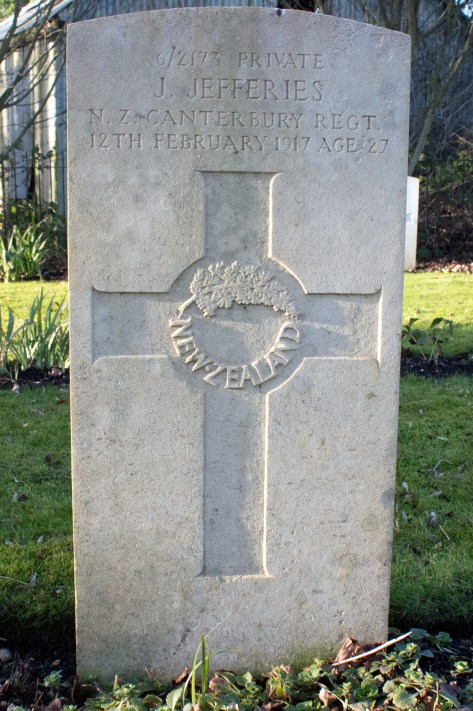
Private James McFarlane

Private James McFarlane

James Malcolm McFarlane was born in Christchurch, New Zealand, on 24th April 1893. Little is known about his early life, although his parents are recorded as Peter and Helen.

When he completed his schooling, James found work on a farm. By the time war broke out, he was employed as a shepherd for Patrick Burke of Woodgrove, in the country’s Canterbury region.

James gave up his work to join the army, enlisting on 24th March 1916. He would have cut a striking figure, standing 6ft 3.5ins (1.92m) tall, and weighing 184lbs (83.5kg). He had dark brown hair, grey eyes and a fresh complexion. His records note that he had a small scar on his right shin, from an old pellet wound.

Assigned to the New Zealand Wellington Regiment, Private McFarlane spend three months in Trentham, on the North Island, for his training. His unit boarded the SS Maunganui and left Wellington for Europe on 26th June 1916. The troop ship arrived in Devonport, Devon, in late August, and James and his colleagues were sent to their camp in Sling, near Bulford, Wiltshire, arriving after a 4-day march.

Private McFarlane would not see any enemy action. In November 1916 he was moved to the ANZAC base near Codford, Wiltshire, and he was admitted to the No 3 New Zealand General Hospital located there. Suffering from pleurisy, he would remain there for the next two months. James passed away from pneumonia on 25th January 1917: he was just 23 years of age.

James Malcolm McFarlane was buried alongside his comrades in the newly extended graveyard attached to St Mary’s Church, Codford.


Private James McFarlane
(from findagrave.com)

Rifleman Alexander Shaw

Rifleman Alexander Shaw

Alexander Richardson Shaw was born in Sandhurst, Victoria, Australia, on 10th February 1884. The second of seven children – although two of his younger siblings died when just babes-in-arms – his parents were Thomas and Elizabeth Shaw.

Little is known about Alexander’s early life. Thomas passed away in 1890, and Elizabeth was left to raise the family alone.

The next document for Alexander is his army service record, confirming that he enlisted on 27th June 1916. By this point he had moved to New Zealand and settled in Wellington. He was employed as a labourer and working for a GG Holmes.

It seems that Alexander had tried to enlist before: his records show that he had previously been turned down because of poor eyesight. At this point, however, with the war raging in Europe, and thousands of New Zealanders being called upon, he was taken on. His service records show that he was 5ft 8ins (1.72m) tall, and weighed 12st 6lbs (78.9kg). Alexander was also noted as having fair (reddish) hair, blue eyes and a fresh complexion.

Rifleman Shaw was sent to Trentham, outside Wellington, for his basic training. His time there was not without incident, however, and on 21st July he was confined to barracks for three days for failing to comply with an order.

On 16th October 1916, Rifleman Shaw’s unit – the New Zealand Rifle Brigade – set sail from Wellington on the SS Willochra for their ten-week voyage to Europe. Discipline remained tight on board and, as the ship was nearing the end of its journey, Alexander was again pulled up. His records simply state that his offence was ‘for clothing issued’, and he was stopped the sum of 3d 6d from his pay.

The Willochra arrived in Devonport, Devon, on 29th December 1916 and, while the rest of his unit was sent to their base at Sling Camp near Bulford, Wiltshire, Rifleman Shaw was admitted to the port’s military hospital. His condition is unclear, but by 10th January he was well enough to be moved to the No. 3 New Zealand General Hospital in Codford, Wiltshire.

Private Shaw was suffering from influenza, and this quickly developed into pneumonia. He passed away on 15th January 1917, just five days after being admitted. He was 32 years of age.

Thousands of miles from home, the body of Alexander Richardson Shaw was laid to rest in the peaceful graveyard extension to St Mary’s Church in Codford, not far from where he had died.


Private James McLeod

Private James McLeod

James McLeod was born on 15th April 1893 in Dunedin, New Zealand. There is little further information about his early life, although the Commonwealth War Graves Commission give his father’s name as Samuel, and his service records note his next-of-kin as his brother, George McLeod.

James was employed by A&T Watt as a French polisher. However, he gave that up on 25th January 1915, when he enlisted in the New Zealand Expeditionary Force. His service records show that he was 5ft 8.5ins (1.74m) tall, and weighed 166lbs (75.3kg). He was recorded a having fair hair, blue eyes and a fair complexion.

Private McLeod was assigned to the New Zealand Otago Regiment, and undertook his initial training on home soil. He evidently showed some promise as, on 1st May, he was promoted to Lance Corporal. Six weeks later his unit was heading for Europe, and by the summer James was in Egypt.

On 20th August 1915, Private McLeod was admitted to the New Zealand and Australian Convalescent Hospital in Mena with a gun shot wound to his finger. He remained there for three weeks, returning to his unit in time for them to leave for the Dardanelles on 7th November 1915.

What happened to James over the next couple of months is uncertain. Certainly he was on the Greek island of Moudros by 18th November and in the Dardanelles on 7th December 1915. Just 20 days later he was back in Alexandria, and he would remain there for the next few months. There is, however, nothing in his medical record to suggest that his return to Egypt was on health reasons.

On 6th April 1916, Private McLeod was on the move again, this time to France. He was wounded again on 14th July 1916, and medically evacuated to Britain for treatment. Details of this injury are not clear, but he was admitted to the 2nd London General Hospital in Chelsea, Middlesex. After a month recuperating, James was released from hospital and sent to camp in Hornchurch, Essex. At this point he was also demoted to Private, although, again, the reason is unclear: it may have been a personal choice, or the reversion may have been connected to his injuries.

In September 1916, Private McLeod was transferred to the ANZAC Camp on the outskirts of Codford, Wiltshire. That winter he contracted pleurisy, and he was admitted to the No. 3 New Zealand Hospital, which was connected to the camp, on Christmas Day. His condition worsened, and James passed away from pneumonia on 28th December 1916. He was just 23 years of age.

Thousands of miles from home, James McLeod was laid to rest alongside his fellow soldiers in the extension to the graveyard of St Mary’s Church, Codford.


Rifleman William Garlick

Rifleman William Garlick

William Garlick was born in Whakatane, New Zealand, on 18th October 1888. The oldest of seven children, his parents were Wiltshire-born Charles and New Zealander Maria Garlick. There is little information about William’s early life, but it is clear that by the outbreak of war he was working as a shearer in Gisborne.

William enlisted on 19th November 1915, and was assigned to the New Zealand Rifle Brigade. His service records show that he was 5ft 9ins (1.75m) tall, and weighed 168lbs (76.2kg). He was noted as having black hair, brown eyes ad a dark complexion. He had a tattoo of an anchor on his upper right arm and a few boil scars on his leg.

Rifleman Garlick spent most of the next year training in the army camp at Trentham. On 25th September 1916 his unit finally left for Europe, and he set foot on British soil two months later. From Devonport, Devon, the battalion made its way to Sling Camp in Wiltshire. William was not to spend much time there, however, and within a fortnight he had fallen ill.

Admitted to the No. 3 New Zealand General Hospital in Codford, Rifleman Garlick had contracted pneumonia, and this was to get the better of him. William passed away on 13th December 1916: he was 28 years of age.

Thousands of miles from home, William Garlick was laid to rest in the ANZAC extension to St Mary’s Churchyard in Codford, not far from the medical facility in which he had breathed his last.


Corporal Alexander Sturrock

Corporal Alexander Sturrock

Alexander Albert Sturrock was born in the autumn of 1877. The second of two children, he was the only son of Alexander and Elizabeth Sturrock. Alexander Sr was a plasterer from Scotland, while his wife had been born in Bristol. It was in the Pimlico area of Middlesex, however, that the couple would raise their two children: Alexander and his older sister Eleanor.

The 1891 census found the family living at 253 Wellington Buildings, on Ebury Bridge Road. According to the next census, however, they had taken rooms at 52 Warriner Gardens, south of the Thames in Battersea.

By 1901, the Sturrocks had moved north again, and were living at 7 Fulham Place in Paddington. One of three families in the house, Alexander Sr and Elizabeth shared the rooms with their son and Eleanor’s son, Leslie. Alexander Sr was still working as a plasterer, while his son was now employed as a clerk.

Alexander Jr married Edith Concanen in 1910. A widow, she had a son, Douglas, and the three of them lived in her family home on Camden Road, Sutton, Surrey. Alexander was working as a commercial accountant, and at some point in the next five years, the family moved to Paignton, Devon.

When war came to Europe, Alexander stepped up to play his part. He enlisted in Exeter on 17th November 1915, and joined the Devonshire Regiment. His service records note that he was 5ft 11ins (1.8m) tall and weighed 185lbs (83.9kg). He was also recorded as having Edith’s name tattooed on his left forearm.

Private Sturrock was mobilised the following June, and was attached the 3rd (Reserve) Battalion. He was promoted to Lance Corporal in August 1916, and transferred to the 8th (Service) Battalion. Shipped to France in December, he would spend the next eighteen months overseas.

Alexander had ongoing issues with his health, however, and was hospitalised at least three times with diarrhoea. In July 1918, he was transferred to the Labour Corps, and reassigned to home soil. Promoted to Corporal by this point, he was attached to the 114th unit, although it is unclear where he served.

Corporal Sturrock’s health continued to dog him. The Armistice signed, he was medically discharged with nephritis on 14th June 1919, and returned home. Sadly, his reunion with Edith was not to be a lengthy one. Alexander passed away on 25th July 1919: he was 41 years of age.

Alexander Albert Sturrock was laid to rest in Paignton Cemetery, overlooking the town he had most recently called home.


Private Bernard King

Private Bernard King

Bernard Gale King was born in the spring of 1881, the seventh of eleven children to Charles and Charity King. Charles was a bookseller from Huntingdonshire, but he and Charity had moved to Wolborough, Devon by the time Bernard was born.

The 1901 census found that the family had moved again and Charles had set up shop in the Tormoham area of Torquay. By this point Bernard and his older sister, Florrie, were helping their father with the business, which was located at 99 Union Street .

On 5th March 1904, Bernard married Lilian Potter at the Wesleyan Chapel in Brixham. Sadly, there is little information available for her, but she was a year older than her husband, and had been born in Exeter. The couple set up home on Rock Road, Torquay, and had three children: Frederick, William and Gladys.

By the time of the 1911 census, Bernard had moved away from selling books, and had become a photographer. Storm clouds were brewing over Europe, however, and things were to change.

When war broke out, Bernard stepped up to play his part. He enlisted on 11th December 1915, and joined the Devonshire Regiment. His service records show that the family had moved along the coast, and were living at 22 Winner Street in Paignton.

Private King was notes as being 5ft 7ins (1.7m) tall and weighing 119lbs (54kg). He had dark brown hair, blue eyes and a pale complexion. Initially assigned to the 4th Battalion, by October 1916, he had transferred to a home service unit, and remained on home soil during his time in the army.

In the spring of 1917, Bernard contracted tuberculosis. The contagious nature of the illness meant that he was deemed no longer fit for any service, and he was medically discharged on 7th April 1917.

At this point Bernard’s trail goes cold. He seemed to have returned home, but would ultimately succumb to the lung condition he had contracted in the army. He passed away on 21st October 1918: he was 37 years of age.

Bernard Gale King was laid to rest in Paignton Cemetery, overlooking the town in which his grieving family still lived.