Tag Archives: illness

Staff Serjeant Henry Dyer

Staff Serjeant Henry Dyer

Henry Charles Dyer was born in January 1865 in the Devon town of Ivybridge. The oldest of five children, his parents were carpenter James and dressmaker Mary Dyer. When he left school, Henry found work as a cordwainer’s apprentice but, after James died in 1886, he sought out a career that would help support his mother.

Henry enlisted in the Army Service Corps on 10th July 1886 and, by the time of the next census was based at barracks in Woolwich, South London. His service records note that he was 5ft 4.5ins (1.64m) tall and weighed 124lbs (56.25kg). He had a dark hair, grey eyes and a dark complexion. He was also noted as having a tattoo of a cross on his left forearm.

Private Dyer served in the regiment on home soil for more than thirteen years, qualifying as a horse collar maker and saddler during this time and rising through the ranks. He was made a Driver in 1889, Corporal in 1895 and Staff Sergeant in October 1899.

Trouble was afoot on the other side of the world by this time and his promotion was linked to Henry being sent to South Africa. He was there for eighteen months, and was awarded the Queen’s South Africa Medal, as well as clasps for service at Tugela Heights, the Relief of Ladysmith, Laing’s Nek, Transvaal and Orange Free State.

Staff Sergeant Dyer went back to Britain in April 1901, where he remained for a further six years. On 4th July 1907, reached the end of his term of service and having completed 21 years with the Army Service Corps he returned to civilian life.

Henry moved back to Devon, moving back in with his mother and younger brother. Mary had remarried after James passed, but her second husband had also passed away, and so having two of her sons home would have been of comfort to her. The 1911 census records the family as living in three rooms of a house in Grenville Street, Plymouth. They shared the property with the Smith family, a husband, wife and two children. Henry was recorded as an army pensioner (saddler), while his brother Ernest was listed as being a watchmaker, while also in the army reserve.

War was on the horizon again, and, Henry was one of the first to step up when it was declared. He was 49 years old by this point, and so technically exempt from enlisting, but as an army life had served him well before, it must have seemed fit for him to serve King and Country once more.

Staff Sergeant Dyer’s new service records noted that he was formally employed as a saddler, and that he had put on 18lbs (8kg) since he initially signed up.

Henry was based firmly on home soil this time round, and while he was initially based in Aldershot, Hampshire, he seems to have been moved to barracks in Kent. He served for more than two and a half years, but his health seems to have been suffering by this point. At a medical on 24th July 1917, he was deemed to be no longer fit enough for war service and was discharged from the army.

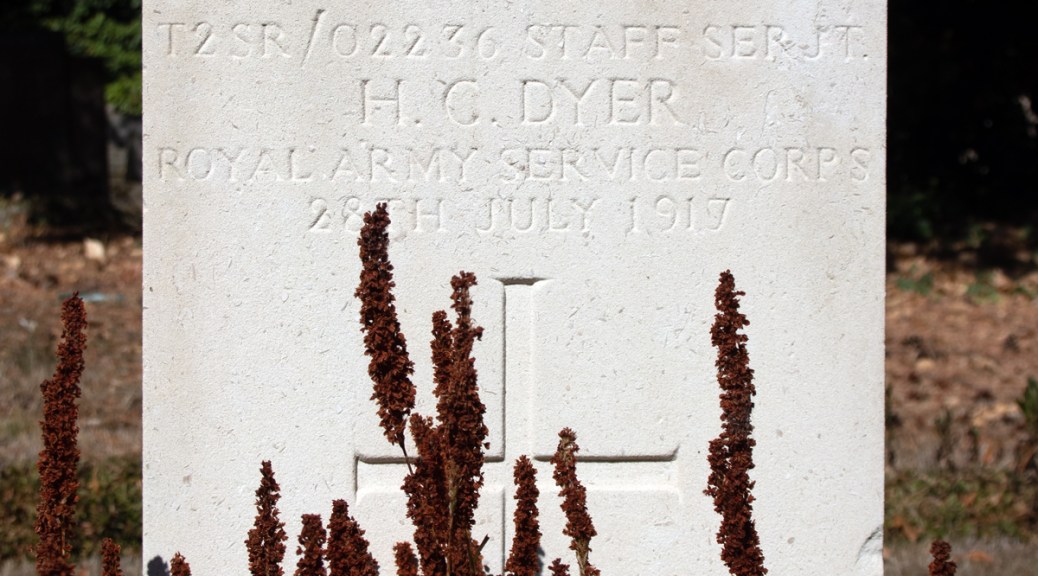
It is likely that this discharge came while he was admitted to the Preston Hall Military Hospital in Aylesford. While Staff Sergeant Dyer’s earlier military service is fairly detailed, his later career is not. What is clear is that, four days after being discharged, he passed away. He was, by this time, 52 years of age.

A lack of funds may have prevented Mary from bringing her son home to Devon. Instead Henry Charles Dyer was laid to rest in the graveyard of St Peter and St Pauls Church in Aylesford, not far from the Kent hospital in which he passed.


Serjeant Albert Rumbelow

Serjeant Albert Rumbelow

Albert Edward Rumbelow was born in 1879 in Wycombe Marsh, Buckinghamshire. One of eleven children, his parents were Suffolk-born paper maker Philip Rumbelow and his wife, Jane.

Little information is available about Albert’s early life, although by the time of the 1901 census, he is recorded as being a Private in the Rifle Brigade. The family had moved to the village of Little Chart in Kent by this point, where his father was still continuing in the manufacture of paper.

Private Rumbelow’s military service is evidenced in later documents. He served with the 1st Battalion from 1895 to 1907, was awarded the South Africa medals for 1901 and 1902: he was also granted the clasp for his involvement in the defence of Ladysmith. He appears to have been wounded at this point, and was invalided out of full military service and placed on reserve.

In 1904, Albert was back in England, and living in London. That year he married Ellen Sillis, a cordwainer’s daughter from Norfolk. The couple set up home in Fulham, and went on to have five children: Abert Jr, Iris, Florence, Doris and Hilda.

By the time of the 1911 census, Albert was working at the local Public Hall, as a labourer, hall attendant and cleaner. The family were living at 9 Crabtree Lane in Fulham, sharing the property with the Fitzgerald family.

War was closing in on Europe by this point, and, once again, Albert stepped up to plat his part. He enlisted within days of conflict being declared, and within weeks had been given the rank of Corporal. His service records note that he was 5ft 10ins (1.78m) tall, weighed 156lbs (70.8kg), had brown hair and blue eyes. He was also recorded as having a tattoo of crossed rifles and a crown on his right forearm, and scared on his left calf, knee and eyebrow.

By the spring of 1915, Albert had been promoted again, to the rank of Serjeant. He was sent to France on 19th May, having been assigned to the 7th (Service) Battalion. Serjeant Rumbelow was involved at the Somme and was awarded the Distinguished Conduct Medal “for conspicuous gallantry” on 3rd June 1916. “He exposed himself to machine-gun and rifle fire when going across the open to rescue a wounded man. Later he went under fire to fetch a stretcher.”

Serjeant Rumbelow appears to have been injured in the skirmish, and was invalided to the UK later that month. When he recovered he was posted again, this time to the 18th (London) Battalion of the Rifle Brigade.

The following February he made the transfer across to the Labour Corps, and by March 1917, Serjeant Rumbelow was back in France. In August he was promoted to Company Sergeant Major, but was invalided back to England with bronchitis in February 1918.

When he recovered Albert was assigned to the 364th Area Employment Coy. in Kent, and seems to have voluntarily taken a drop in rank – back to Serjeant – in doing so. His health was dogging him by this point and in the late summer of 1918, he was admitted to Preston Hall Military Hospital in Aylesford, suffering from VDH, or heart disease.

Sadly, the strain of his military service was to be his undoing. He passed away from the heart condition on 21st September 1918, at the age of 39 years of age.

Albert Edward Rumbelow was laid to rest in the graveyard of St Peter & St Paul’s Church in Aylesford, not far from the hospital where he had breathed his last.


Now widowed, Ellen was left with the unenviable task of raising five young children on her own. She married again, to Private William Lake, on 8th June 1919, and the family moved to Essex. She lived until the age of 79, and was laid to rest in Sutton Road Cemetery in Southend.


Saddler Henry Evans

Saddler Henry Evans

Henry Evans was born in Newport, Monmouthshire, in the summer of 1883. Little concrete information remains about his early life, but it is clear that he was boarding with a dock labourer and his family in the town by the time of the 1901 census.

Henry married Margaret Jane Garner in Pontypridd on 14th March 1909. Within a couple of years, the young couple had moved to Llangollen in Denbighshire, and had had two children, Horace and Emlyn. Henry was now working as a saddler.

War was coming to Europe and, in November 1915, Henry enlisted in the Royal Army Service Corps. His previous trade saw him well, as he was assigned to the regiment’s 1st Company with the rank of Saddler. His service records show that he was 5ft 8.5ins (1.74m) tall, had no distinctive marks, and that his was Wesleyan in his beliefs.

After a few weeks on home soil, Saddler Evans was sent to the Western Front, arriving there just before Christmas 1915. For the next year, he worked in France, returning to Britain 366 days after he left for the continent. By this point, however, his health seems to have been suffering, and it was to prove to be the beginning of the end for him.

Saddler Evans was suffering from transverse myelitis, an inflammation of the spinal cord. Symptoms can be wide-ranging, but in Henry they were severe enough to be viewed as a permanent ailment. At the end of May 1917, while admitted to the Queen Alexandra Hospital on Millbank, London, he was recommended for immediate military discharge.

Unfortunately, as is often the way with bureaucracy, the discharge papers went missing. In July 1917, Henry was moved to the Croesnewydd Hospital in Wrexham, and is was here, a month later, that his documents caught up with him. Saddler Evans was finally discharged from military service on 4th August 1917.

Sadly, his army status was not to have any kind of effect on his health: at 9:30am on 17th August Henry passed away while still admitted to the Wrexham hospital. He was just 34 years of age.

Brought back to Llangollen for burial, Henry Evans was laid to rest in a plot in the town’s Fron Cemetery. He was to be reunited with his family in time: Horace died in 1940, Margaret in 1956 and Emlyn in 1963, and all were laid to rest in the same grave.


Private Norman Roberts

Private Norman Roberts

Norman David Roberts was born on 3rd November 1886 in the North Wales town of Llangollen. He was the youngest of three children to weaver John Roberts and his wife, Emma.

When he left school, Norman found work as a clerk on the railways and, by the time of the 1911 census, he had moved over the English border to Chester, and was boarding with an Emma Matheson.

The move to England may have spurred Norman on to other things. At some point after the census, he made the decision to seek a better life overseas. He emigrated to North America and settled in the town of Everett, to the north of Seattle. He continued his trade, however, and recorded himself as doing clerical work in transportation.

War was coming to Europe by this point and, in December 1917, Norman stood up to play his part. He made the crossing to Victoria, in the Canadian state of British Colombia, and enlisted in the Canadian Expeditionary Force.

Private Roberts’ service records show that he was 5ft 11ins (1.80m) tall, had blue eyes, brown hair and a fair complexion. He had no distinguishing marks, but was recorded as having 20/20 vision. His religion was also recorded as Baptist/Congregationalist.

Norman was assigned to the 53rd Company of the Canadian Forestry Corps, and arrived back in Britain on 26th January 1918. Based in Shorncliffe, Kent, he was involved in felling and trimming trees and wood for the war effort.

Private Roberts was given a couple of periods of leave – five days in July 1918, and nine days in December that year. The latter leave was granted so that he could marry Claudia Griffiths back home in Wales.

While the Armistice had been declared, by January, Norman was back in Kent helping the post-war effort. Things were to take a turn, however, as he caught a severe cold, and a nagging cough. Unable to shake it, he grew progressively weaker and, over the next six months, lost 20lbs (9kg) in weight.

Admitted to the camp hospital in June 1919, Private Roberts was diagnosed with bronchitis. He was moved to another hospital in Orpington, Kent, where his diagnosis was upgraded to tuberculosis. Invalided back to Canada that August, within a matter of weeks he was medically discharged from service. His discharge papers noted that was weighed just 122lbs (55.3kg) and has a long flat chest with prominent clavicles. Norman’s once fair complexion was now dark (a combination of his work outside and his health).

Now out of the army, Norman made the journey back to North Wales, and settled in Llangollen with Claudia. The couple went on to have a daughter in 1920, but Norman’s health was deteriorating. He passed away at home on 23rd February 1921, at the age of 34 years old.

Norman David Roberts was laid to rest in Fron Cemetery in his home town of Llangollen. His was a family plot, and he was reunited with Claudia when she passed away.


Private Benjamin Prytherch

Private Benjamin Prytherch

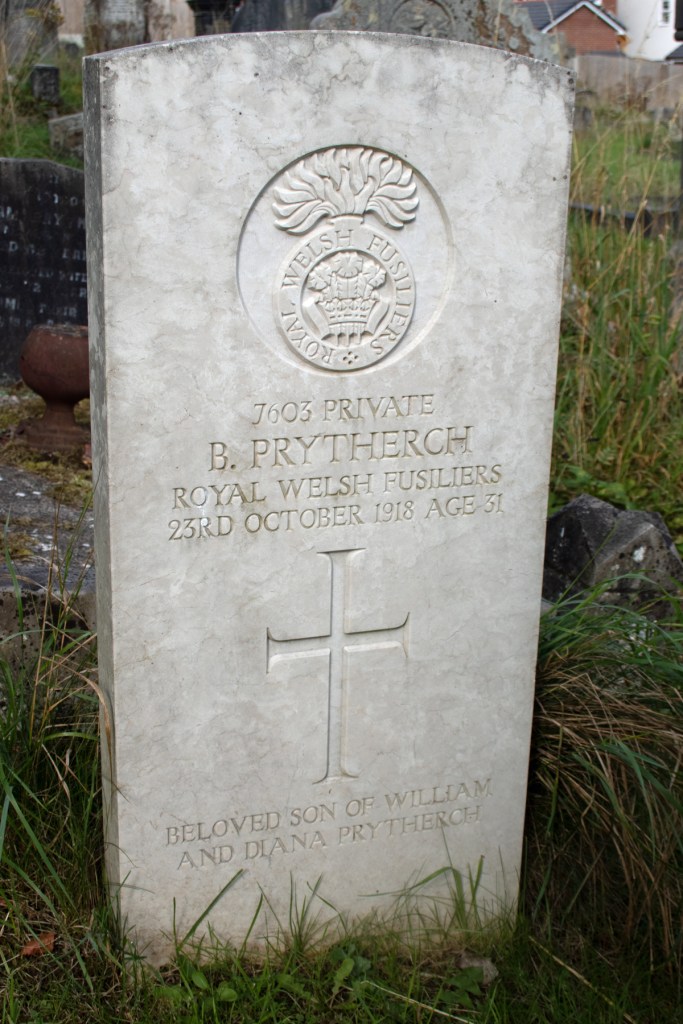
Benjamin Prytherch was born in the summer of 1887 in Cefn Mawr, to the east of Llangollen, Denbighshire. One of eight children, his parents were local blacksmith William and his wife, Diana. The family moved around a little while young Benjamin was growing up, but by 1901 had settled in Llangollen itself.

By the time of the 1901 census, Benjamin was the only one of the Prytherch siblings to still be living with his parents and was employed as a cabinet maker.

When war broke out, Benjamin was quick to enlist. He joined the Royal Welch Fusiliers and was assigned to the 1/4th (Denbighshire) Battalion. His service records show that he was 5ft 3.75ins (1.62m) tall and of good physical development.

While his battalion was part of the regiment’s Territorial Force, by February 1915, Private Prytherch found himself in France. He was caught up in the fighting almost immediately, and was injured during an explosion in a trench in May that year.

Sent to the No. 3 British General Hospital at Le Tréport in Normandy, Private Prytherch remained there for a little over a month to recover. However, when he returned to the front line, his health was impacted and he was unable to perform his duties without his breathing becoming affected. Further assessment revealed a heart murmur and he was sent back to Britain in July 1915.

Benjamin’s condition did not improve, and by October 1916, he was medically discharged as a direct result of the injuries he had sustained in the trench blast.

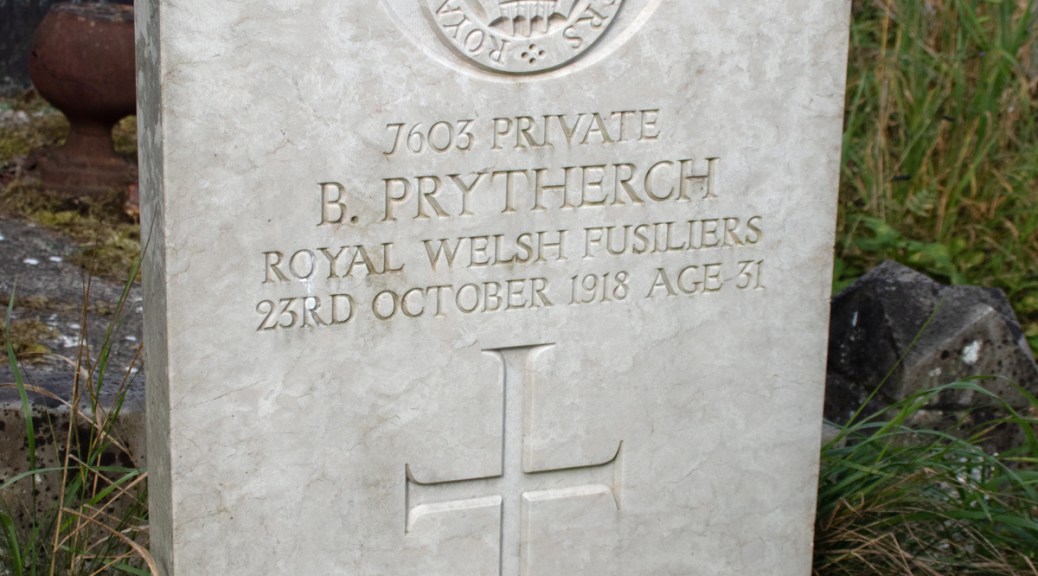
At this point, Benjamin’s trail goes cold. He returned home, but it is unclear whether he was able to work again. All that can be confirmed is that by October 1918 he had contracted pulmonary tuberculosis. He died on the 23rd of that month in the town of Corwen, ten miles to the west of Llangollen. He may have been in respite care of some sort, as his parents were still living in Llangollen itself. He was just 31 years of age when he passed away.

Benjamin Prytherch was brought back to Llangollen for burial: he was laid to rest in what became the family plot in the town’s Fron Cemetery.


Rifleman Harold Dean

Rifleman Harold Dean

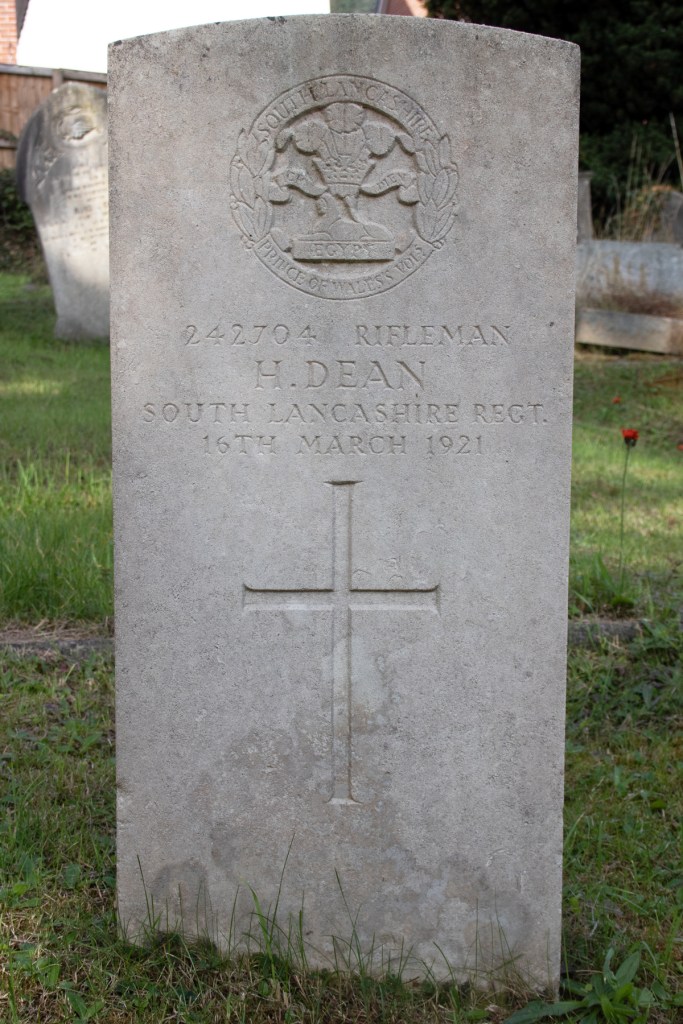
Harold Dean was born in the spring of 1888 in Llangollen, Denbighshire. One of four children to John and Sarah Dean, his father was a waiter at the Hand Hotel in the town until his death in 1905. When Harold left school, he was taken on by the hotel, and, by the time of the 1911 census, was recorded as working as a billiard marker.

War was coming to Europe by this point and, on 24th October 1916, Harold enlisted. He joined the South Lancashire Regiment (also known as The Prince of Wales’s Volunteers) and was assigned to the 2nd/5th Battalion.

After an initial few months’ training, Private Dean was sent to France, and was soon ensconced on the Western Front. Caught up in the fighting, he received a gun shot wound to his left wrist on 7th June 1917 and, after some initial treatment in a camp hospital, he was evacuated to Britain for full recuperation.

Harold remained on home soil for the remainder of the year, He contracted tuberculosis that winter and was medically discharged from the army because of it on 5th December 1917.

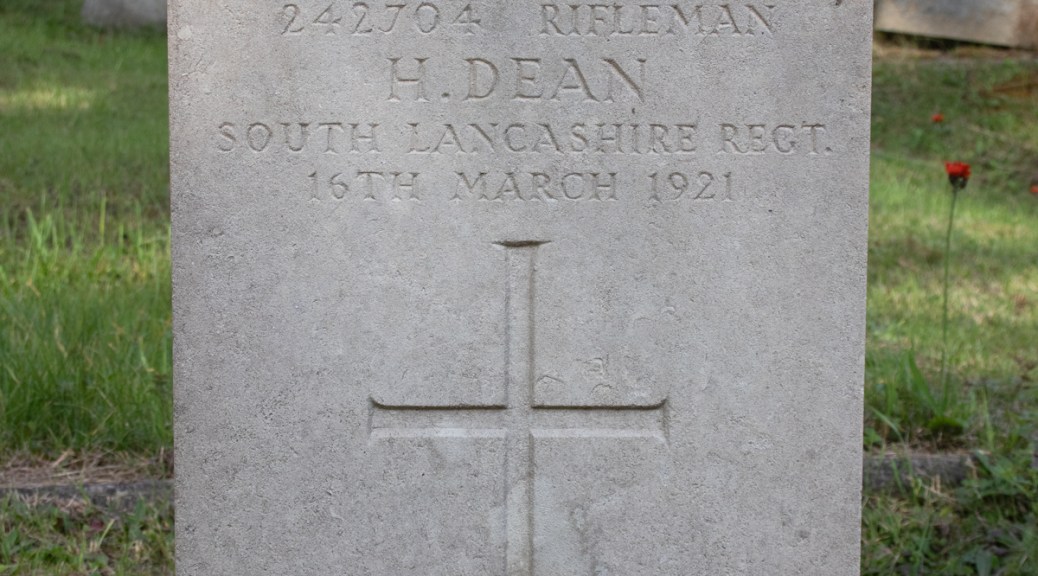
At this point, Harold’s trail goes cold. He returned to Llangollen, and remained there after his mother passed away in 1919. It appears that his lung condition continued to dog him, however, and this was probably the cause of his untimely passing. He died on 16th March 1921, at the age of 33 years old.

Harold Dean was laid to rest in Fron Cemetery, in his home town of Llangollen.


Private Joseph Roe

Private Joseph Roe

Joseph Leonard Roe was born on 16th February 1892 in Totnes, Devon. The older of two children, his parents were Francis and Mary Roe. Mary died in 1898, when Joseph was only six years old, leaving Francis, who was a traveller for a wholesale grocer, to raise his sons. Tragically, he also passed away in 1902, and it seems that Joseph and his brother were left in the care of their paternal grandmother.

Hope was to come out of adversity – the 1911 census recorded Joseph as boarding in a school in Tiverton, while his brother, who was called Francis, found work as a clerk at a chartered accountant. He was living with his grandmother Mary and aunt Marian in Weston-super-Mare, Somerset.

Joseph followed in his father’s footsteps, finding work as a chemist’s merchant, and this took him travelling across the country. When war broke out, he was living in Wallasey, Merseyside, and it was from here that, on 28th August 1914, he was to enlist.

Joseph’s service records show that he was 5ft 11ins (1.80m) tall, was of good physical development and had good vision. He was accepted for enlistment into The King’s (Liverpool Regiment), and was assigned to the 10th (Scottish) Battalion.

After a coupe of months’ training, Private Roe set sail for France, arriving in Le Havre on 1st November 1914. His time overseas, however, was to be cut short, however, when he contracted a combination of myalgia, bronchitis and diarrhoea. He was medically evacuated back to Britain on 30th November, and given time to recover.

Private Roe remained on home soil for the remainder of his time in the army. However, he continued to suffer with his health. In the spring of 1916, he contracted tuberculosis and was at his grandmother’s home when he passed away on 4th April. He was just 24 years of age.

Joseph Leonard Roe was laid to rest in Totnes Cemetery, buried in the family grave, and reunited with his parents at last.


Francis, meanwhile, had also played an active part on the First World War. He joined the 2nd Battalion of the South Lancashire Regiment and fought on the Western Front.

While at Etaples, he was wounded, and succumbed to his injuries on 7th January 1916, aged just 21 years old. Second Lieutenant Francis Roe was buried at Etaples Military Cemetery in Northern France.

His sacrifice is also commemorated on the family monument in Totnes Cemetery.


Lieutenant Arthur Wellacott

Lieutenant Arthur Wellacott

Arthur Cecil Baber Wellacott was born the summer of 1897, in the village of Bradworthy, North Devon. Ond of seven children, his parents were William and Ada Wellacott. William was the parish vicar and with his status came additional support for the family.

The 1901 census saw the vicarage employ three members of staff, and William was hosting two students as well as his and Ada’s own children. Ten years later, with Arthur and his younger brother William, boarding at a school in Bude, Cornwall, the Wellacott retinue remained in place.

On leaving boarding school, Arthur studied at Kelly College in Tavistock and, at around the same time his father took up a new post in Totnes. When Arthur left the college, he joined the 7th (Cyclist) Battalion of the Devonshire Regiment. He was subsequently given a commission in th 3rd Battalion of the Royal Inniskilling Fusiliers, and was based in Londonderry.

At Easter 1916, Lieutenant Wellacott took part in quelling the rebellion in Dublin, and was subsequently sent to France. In the battle for Contalmaison his platoon was gassed and buried, and Arthur was badly injured. Suffering from shell shock, the experience had a lasting impact on him “and from that time his health had given cause for anxiety…” [Western Morning News: Tuesday 18th February 1919]

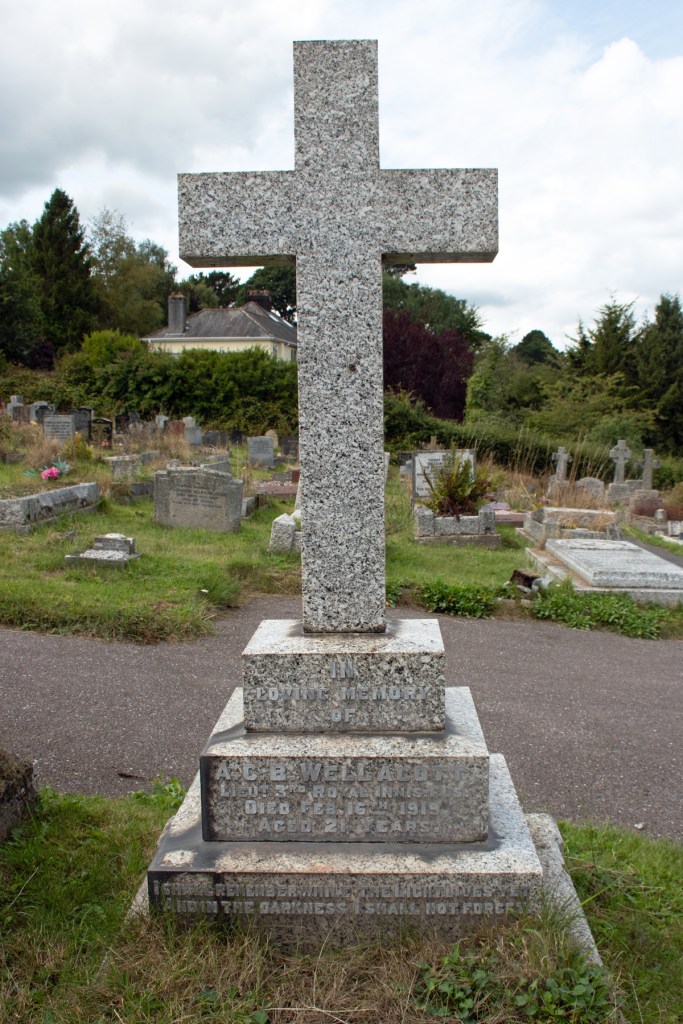
Lieutenant Wellacott returned to England and he was billeted near Leeds. During the winter of 1918/1919, he contracted pneumonia, and was admitted to the Drax Hospital. Sadly, the condition was to prove too much for his already damaged lungs and he died on 16th February 1919. He was just 21 years of age.

Arthur Cecil Baber Wellacott was brought back to Devon for burial. He was laid to rest in the cemetery in Totnes, Devon.


Leading Signalman Albert Pomeroy

Leading Signalman Albert Pomeroy

Albert Pomeroy was born on 22nd May 1882 in Totnes, Devon. The tenth of thirteen children, his parents were William and Susanna Pomeroy. William was a labourer at a cider store, and his son found work as a page when he left school. However, it is clear that he lusted after a life of adventure.

On 2nd September 1897, Albert enlisted in the Royal Navy. Aged just 15 years old, he was initially given the rank of Boy 2nd Class, and sent to HMS Impregnable, a training ship based in Devonport. He remained on board for just over a year, rising to Boy 1st Class in the process.

Boy Pomeroy moved to HMS Vivid, the Royal Naval Dockyard in Plymouth, in December 1898, and remained there until he was given his first formal sea-faring post nine months later. The cruiser HMS Terrible was to be his home from September 1899 until the spring of 1902.

On 22nd May 1900, during his time on board Terrible, Albert came of age, and he was formally enrolled into the Royal Navy. His service records confirm that he was 5ft 3in (1.60m) tall, had dark brown hair, grey eyes and a fresh complexion.

Albert was given the rank of Ordinary Seaman, but seems to have been well thought of as, just over a year later he was promoted to Able Seaman. Over the next eleven years, he served on a further ten ships, returning to HMS Vivid between voyages. On 21st May 1912, having completed the twelve years of his naval contract, Able Seaman Pomeroy was formally stood down to reserve status.

Albert’s trail goes cold for a few years. His father had passed away in 1910, so it seems likely that Albert returned home to Totnes to support his mother.

His time on reserve was not to be long, however, and, in August 1914, he was called back into duty. He received a promotion – to Leading Signalman – and assigned to the troop ship HMS Tamar. He moved to another troop ship – HMS Hardinge – in March 1915, but returned to Devonport a couple of months later.

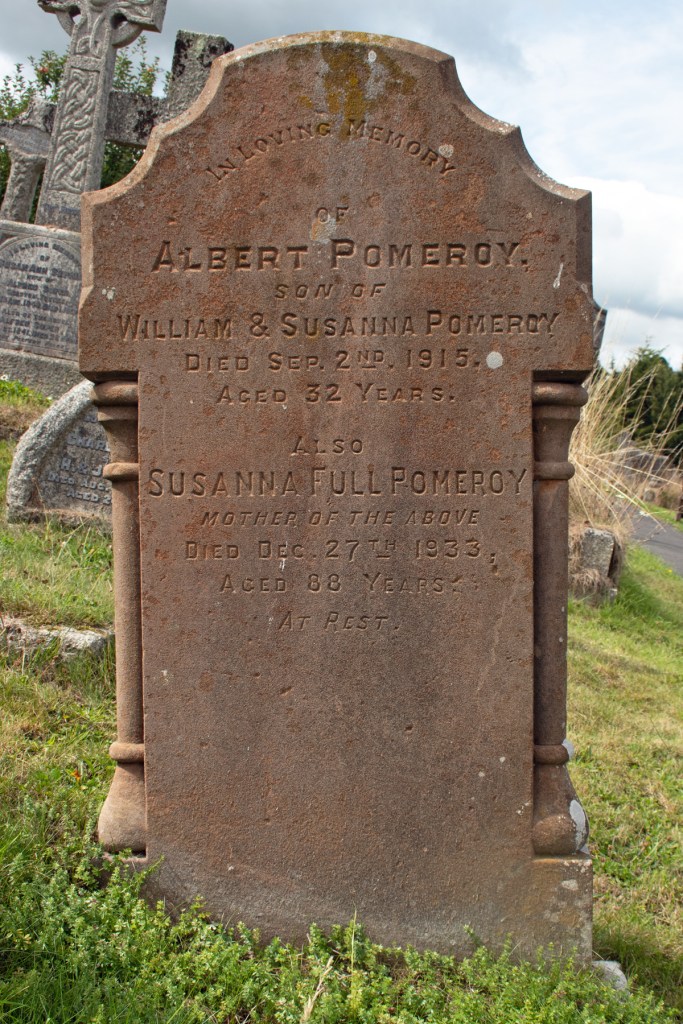
In September, Leading Seaman Pomeroy was back in Totnes, possibly on leave, but had fallen ill. He contracted meningitis, and this was to prove fatal. Albert passed away at his mother’s home on 2nd September 1915, at the age of 33 years old.

Albert… was one of six brothers serving King and country, while another brother, who died some years ago, was in the 20th Hussars, and his late father was a naval pensioner. Albert Pomeroy saw service with Sit Percy Scott in South Africa, went to Pekin [sic] with the Naval Brigade, was engaged in operations in Somaliland, and until a few weeks ago was on active service with the British fleet.

Western Times: Tuesday 7th September 1915

Albert Pomeroy was laid to rest in the cemetery of his home town, Totnes, Devon.


Susanna went on to live into her eighties. Remaining in Totnes, when she passed away, on 27th December 1933, at the age of 88, she was reunited with her son in Totnes Cemetery.


Lieutenant Hugh Punchard

Lieutenant Hugh Punchard

Hugh Punchard was born in February 1895, the oldest of three children to William and Jane Punchard. William was a civil engineer from London, and Hugh was born in Surbiton.

The 1901 census recorded the family living in the 14-room house, Pope’s Garden, in Twickenham. Along with the family, there were four members of staff – a governess, housemaid, cook and a nurse. By the time of the next census, sixteen-year-old Hugh was away at school, boarding with more than 400 others at Haileybury College in Hertfordshire.

War was coming to Europe by this point, and Hugh was keen to play his part. He enlisted in the Royal Navy on 20th October 1914 and, while he was only there for a short period, his records shed some light onto the man he had become. He enlisted as a mechanic, and was noted as being 6ft 4ins (1.93m) tall, with dark brown hair, grey eyes and a fair complexion.

Hugh remained in the Royal Navy for only a month, and, while full details of his service are no longer available, it would seem that it was at this point that he transferred to the Royal Garrison Artillery. He appears to have performed his duties well, and achieved the rank of Lieutenant. He also made another transfer, when he was attached to the Tank Corps.

Lieutenant Punchard was based in Dorset by the last year of the war, and it was while he was serving there that he became unwell. He contracted pneumonia, and was admitted to Wareham Military Hospital. Sadly, the condition was to take his life, and he passed away on 31st October 1918, at the age of just 23 years old.

Hugh Punchard’s paternal grandparents lived in Devon, and, as William had passed away two years earlier, the decision was to lay him to rest in Totnes Cemetery.


Hugh’s will left his estate to his mother, Jane. When he passed, she became the beneficiary of his effects, totally some £3,600 7s 6d (around £250,000 in today’s money).

Jane stayed living in Twickenham: when she passed away on 29th July 1937, she was brought to Devon for burial, and was laid to rest with her son.


A number of documents relating to Hugh give his name as R Hugh Punchard. Sadly, I have not been able to unearth details of what his official first name might have been.