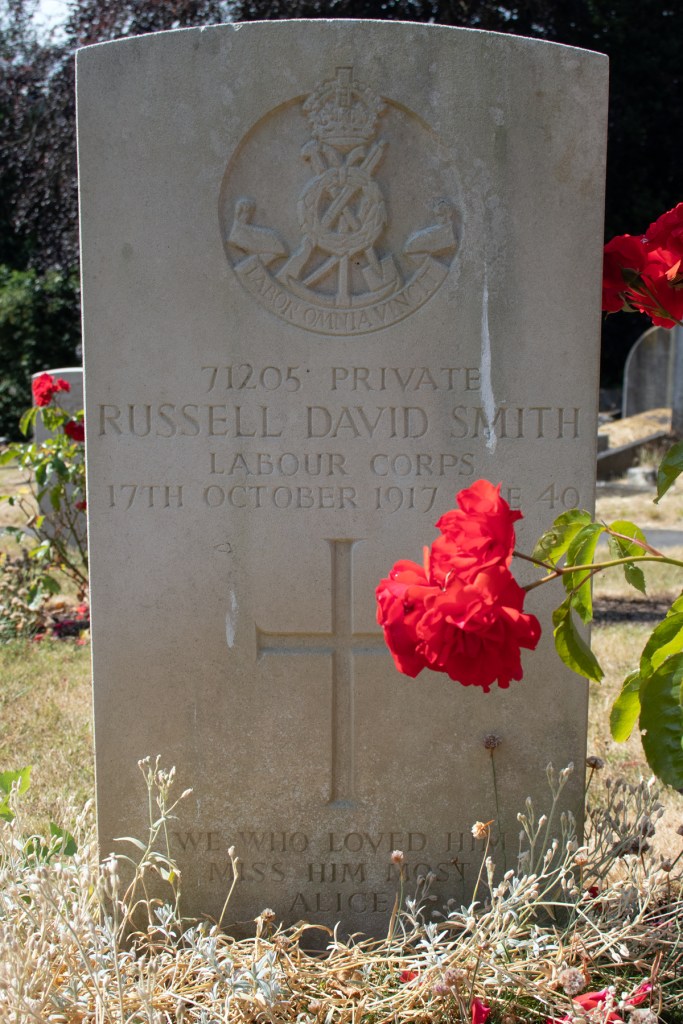
Russell David Smith was born in Shoreditch, London, in the summer of 1877. The second of four children, his parents were tailor Richard Smith and his wife, Emma.
When he finished his schooling, Russell found work as a bookbinder: by the time of the 1901 census, the family had moved to a small terraced house in Cassland Road, Hackney.
On Christmas Day 1902, Russell married Alice Stretch. A year younger than her new husband, she had been born in Islington, and was the youngest child to cabman Edwin Stretch. When the couple married, she was working as a mantle maker’s assistant, making elements for gas lamps.
The newlyweds settled in a cottage in Walthamstow, and went on to have three children. The 1911 census recorded the young family living at 39 Ritchings Avenue: they had taken in a lodger, Alice Carter, to help pay the bills.
War came to Europe in the summer of 1914 and Russell was called upon to play his part. Details of his military service are sketchy, but from the documents available, it is evident that he had enlisted by the summer of 1917 joining the Labour Corps. Private Smith was attached to the 119th Labour Coy. which seems to be been based in Somerset.
It is impossible to trace Russell’s trail any further. The next record for him is that of his passing, on 17th October 1917. The cause of his death is not readily apparent, but he was 40 years old at the time.
Finances seem to have prevented Alice from bringing her husband home. Russell David Smith was, instead, laid to rest in Locksbrook Cemetery, Bath, probably as this might have been the closest burial ground to where he had passed away.
Charles McManus was born in Ballymena, County Antrim, in 1891. The middle of three children, his parents were John and Maryann McManus. John was a horse dealer: when they finished their schooling Charles’ older brother, John Jr, found work as a hawker.
Maryann died in 1907, aged just 47 years of age. The next census record, in 1911, found John Jr living with his wife and family in Ballymena, while John Sr was boarding with a fishmonger elsewhere in the town. Alexander, Charles’ younger brother, was a pupil at an industrial school in Dublin, but Charles himself is missing from the census return.
John Sr passed away in 1913, at the age of 53 years old. Charles was 22 years old and an orphan. The following year war was declared, and Charles was one of the first to step up and serve his country. He joined the Royal Inniskilling Fusiliers on 14th September 1914, and was attached to the 1st Battalion.
Full service records for Private McManus are lost to time. However, his unit was sent to Gallipoli in the spring of 1915, only to be evacuated from the region the following January. The 1st Battalion was then sent to France where it became entrenched at the Somme. For Private McManus and his colleagues, this must have felt like going from the frying pan into the fire, but this time he was not to emerge unscathed.
At some point Charles was wounded. He was medically evacuated to Britain for treatment, and admitted to the King George’s Hospital in London. Whatever his injuries, they were to prove too severe: he died on 24th July 1916, at the age of 25 years old.
Charles McManus’ body was taken back to Antrim for burial. He was laid to rest in the Crebilly Cemetery, overlooking his home town, Ballymena. His pension ledger suggests there was happiness in his life, beyond the killing fields. His next of kin is noted as Miss Mary Gordon of Ballymena, recorded as his unmarried wife.
George Bartraham was born in the autumn of 1868 in the Somerset village of Sampford Brett. One of seven children, his parents were George and Sarah Bartraham. George Sr was a farm labourer and, while his son initially followed suit, he sought a life of adventure in the wilder world.
George Jr had found work as a tailor, and was apprenticed to a Charles Taylor, who lived in the village. That bigger and better life was niggling away, however, and, on 11th June 1888, he enlisted in the Royal Engineers. His service records show that he was 5ft 5.5ins (1.66m) tall, with black hair, dark eyes and a fair complexion. Sapper Bartraham was also noted as having a scar on his left foot.
George initially signed up for seven years’ service, with an additional 5 years on reserve status once that was completed. The 1891 census recorded him as being based at Fort Blockhorse in Alverstoke, Hampshire. Early in 1894, he married Mary Bowden, in Portsmouth: the couple would go on to have two children, George and Albert. The following year, Sapper Bartraham opted to remain on full service with the Royal Engineers, partially, it is fair to assume, as the pay would be better to support his family than on reserve.
By 1901, George had been moved to barracks in Pembroke Docks, Wales. Mary and the children remained in Hampshire, living with her parents in Unicorn Street, close to the town’s naval base. Wales was not to be the last stop for George, however, and in October 1902, he was sent to Ceylon, where he remained for the next three years.
During his time in the army, George did not sit on his laurels. He received a certificate as a master tailor, became skilled in submarine mining, and also received a qualification in signalling. He was promoted to Lance Corporal in 1899, and full Corporal four years later.
George returned to Britain in January 1906, and seems to have returned to a base in Hampshire. It was here, on 28th December 1908, that an altercation led to him being convicted of assault. He was charged with ‘unlawfully and maliciously wounding one Albert Edward Bartraham, by stabbing him with a pair of scissors, at Aldershot… and counts for assault occasioning actual bodily harm and common assault’ [Calendar of Prisoners, 1868-1929]
Albert was George’s older brother, and he was convicted to six months’ hard labour for the assault. Corporal Bartraham returned to base on 6th June 1909, and was discharged a few days later, having completed 21 years’ service in the Royal Engineers.
The next census record, taken in 1911, found a family divided by work or circumstance. Mary and the children remained firmly ensconced in Portsmouth with her parents, while George was living in Aldershot, where he was employed as a tailor. His employer is noted as being the Government, so it seems likely that he was still connected to the army camp there.
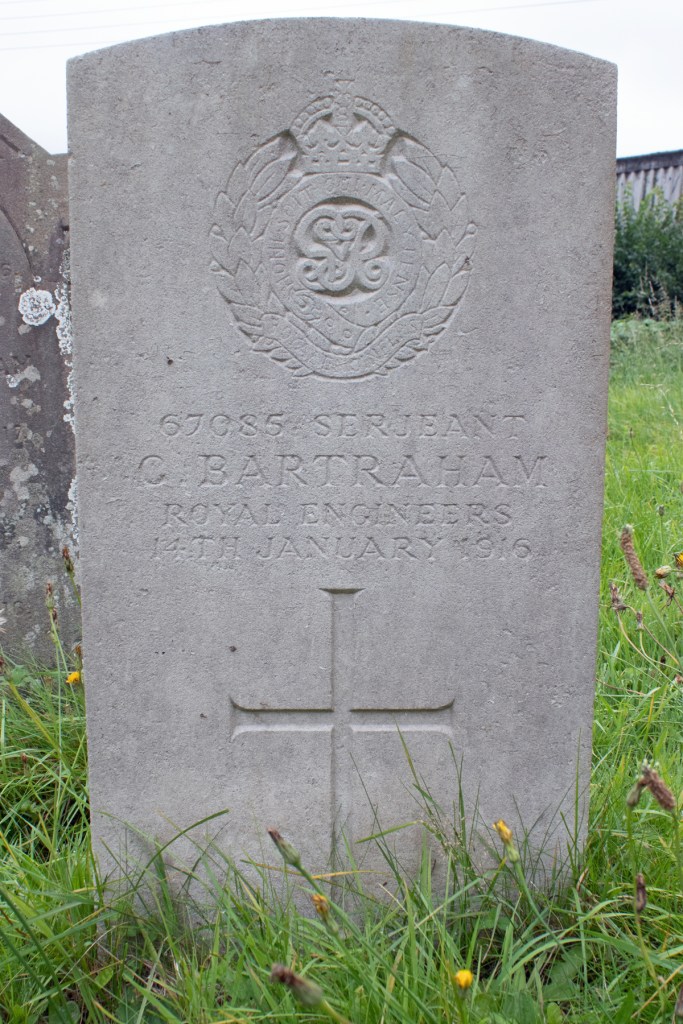
When war came to Europe, George was called upon to play his part once more. Promoted to the rank of Serjeant, he was attached to the 136th Fortress Company of the Royal Engineers. He arrived in Egypt in June 1915, although it is unclear how long he remained overseas.
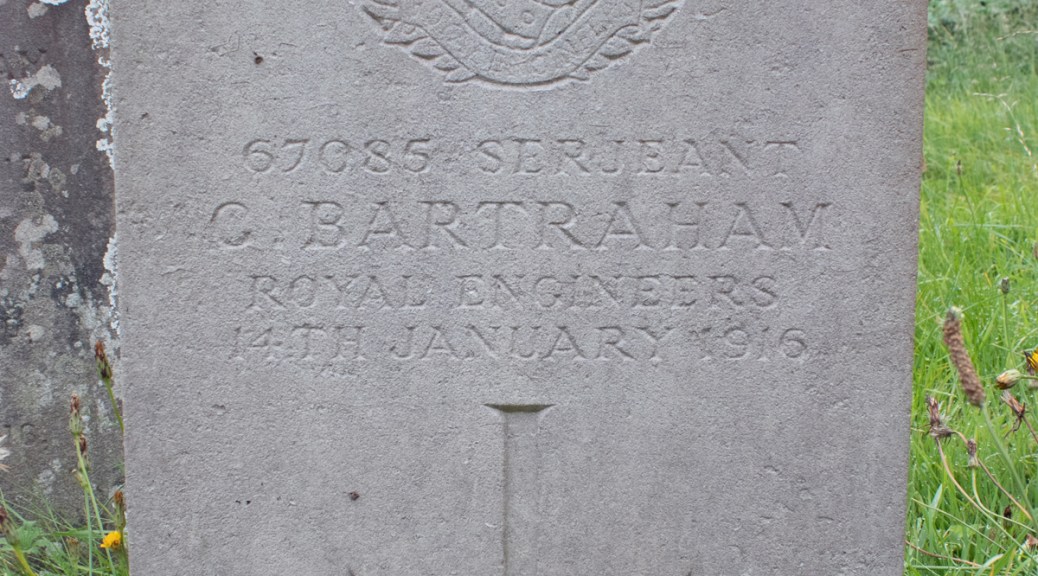
By the start of 1916, Serjeant Bartraham was back in Britain, primarily because of ill health. He had come down with nephritis, or inflamed kidneys. Admitted to hospital in South London, he died from the condition on 14th January 1916, at the age of 47 years old.
Brought back to Somerset, George Bartraham was laid to rest in the peaceful graveyard of St George’s Church in the village of his birth, Sampford Brett.
This was a time of tragedy for the Bartraham family.
George’s father, George, had died around the same time as his son, and was buried near him.
George and Mary’s son, George, had enlisted in the Hampshire Regiment when war was declared and, by the summer of 1916, was based in Iraq. He died on 23rd September 1916, through causes unclear, and was laid to rest in Baghdad War Cemetery.
Three generations of Bartrahams, all called George, had passed away within nine months.
In the summer of 1917, Sarah Bartraham also passed away. She was laid to rest with her husband and son in St George’s Churchyard.
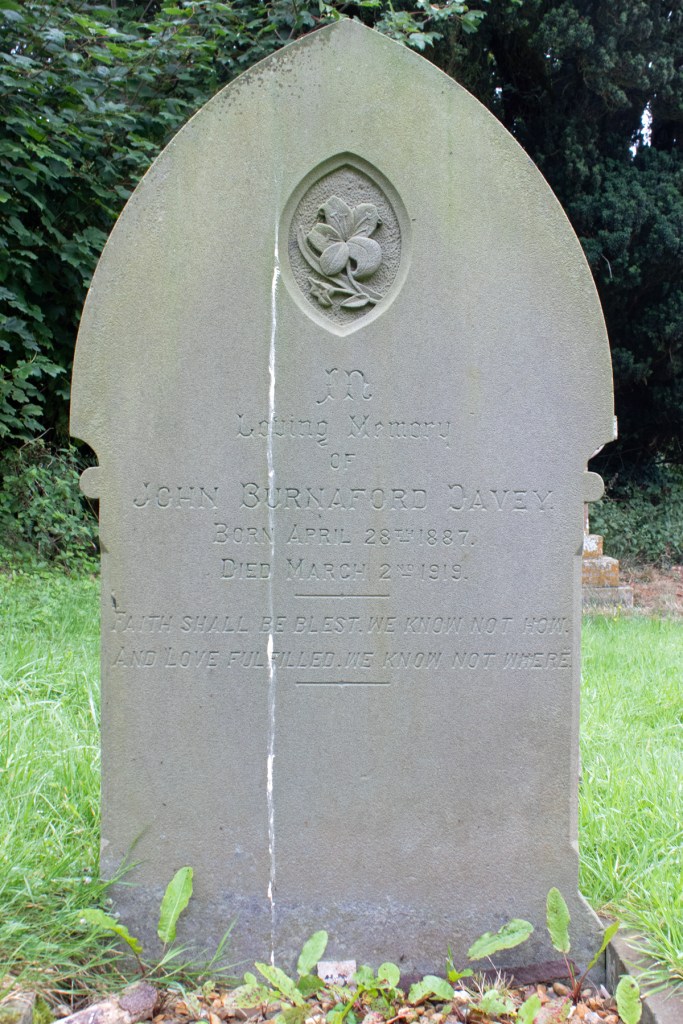
John Burnaford Davey was born on 28th April 1887 in Cannington, Somerset. The youngest of nine children, his parents were farmers Thomas and Emma Davey. Emma died in 1899, and the next census, two years later, found John and two of his siblings living with their father at Beere Manor Farm on the outskirts of the village.
John’s trail goes cold at this point, and it seems that he may have emigrated to South Africa. When war broke out, he enlisted in the Natal Light Horse, and was awarded the 1915 Star in Pretoria for his involvement in fighting in Africa. Private Davey’s troop later moved to England, and it was here that he transferred to the Royal Field Artillery.
The move, in September 1915, included a promotion to Second Lieutenant. Within a couple of years his dedication meant that he advanced to the rank of Lieutenant. By this point, John was based in London, and it was here, on 16th July 1917, that he married Katherine Trayler, a tanner’s daughter from Bridgwater, who had gone on to become a teacher of gymnastics. The couple went on to have a daughter, Jean, who was born in November 1918.
Illness caught up with John and, with the Armistice signed, he was invalided out of service on 8th February 1919. The family were now living in Bridgwater, and this is where John returned. His time back with family was to be tragically short, however, as he passed away just weeks after leaving the army, on 2nd March 1919. He was 31 years of age.
John Burnaford Davey was laid to rest in the peaceful graveyard of St Mary’s Church in Holford, Somerset.
Oliver Banwell was born in Burnham-on-Sea, Somerset, in 1882. One of nine children, his parents were mason William Banwell and his wife Jane. When he completed his schooling, Oliver followed his father into manual work and, by the time of the 1901 census, he was employed as a bricklayer.
In 1910, Oliver married Mary Ann Burrows, a carter’s daughter from Axbridge: the couple settled down in lodgings on Oxford Street, near the centre of Burnham-on-Sea, and went on to have three children: Stanley, Primrose and Violet.
When war came to Europe, Oliver stepped up to serve his King and Country. He gave up his new employment as a groom and enlisted on 13th September 1915, joining the Royal Engineers as a Sapper. His service records give some idea of the man he had become. He was 5ft 8.5ins (1.74m) tall, weighing 141lbs (64kg), and was noted to be of good physical development, although he had slight varicose veins in both legs.
Sapper Banwell found himself in France by the end of April 1916. He spent six months overseas, before being posted back to Britain. Initially attached to the 82nd Training Reserve Battalion at the Royal Engineers Barracks in Chatham, Kent, by July 1917, he had moved again, to the 39th Fortress Company, in Sheerness.
In July 1918, Oliver was back in France again, where he was to remain until after the Armistice. By this point his health was beginning to fail and, on his return to Britain in December 1918, a medical examination deemed him no longer fit for army service. He was formally discharged from the Royal Engineers on 30th January 1919, suffering from cancer of the rectum.
Oliver returned to Burnham-on-Sea, and spent the next ten months with his family. His battle with cancer finally proved too much: he passed away on 4th December 1919, at the age of 37 years old.
Oliver Banwell was laid to rest in the family plot in Burnham Cemetery. Mary Ann was buried alongside him when she passed away in 1965, husband and wife reunited after 46 years.
The death of Capt. James Wilson Pettinger has taken place in a military hospital at Aldershot. Captain Pettinger came to Kingsbridge [Devon] in 1903, entering into partnership with Dr D de Courcy Harston… He made a wide circle of friends, and was appreciated for his professional skill. Previously to coming to Kingsbridge, he was house surgeon at St George’s Hospital, London. In July 1915, Dr Pettinger volunteered for service in the Royal Army Medical Corps, being appointed Lieutenant to the Plymouth Military Hospital. He quickly gained promotion to captain, and was appointed to a hospital ship, and served in the Mediterranean for several months. He contracted blood poisoning in the arm, and was sent to Netley Hospital [Hampshire]. On recovery he was placed in charge of an infections hospital for several months at Salisbury. He was later ordered to France, and being taken ill was transferred to an Aldershot hospital, where he died from pneumonia. He leaves a widow and one son. Dr Pettinger was 43 years of age.
Western Times: Tuesday 16th October 1917
James Wilson Pettinger was born in the spring of 1874 in Moss Side, Lancashire. The youngest of four children, his parents were doctor and surgeon George Pettinger and his wife, Sarah.
James may have been a sickly child: the 1901 census recorded him as being a patient in community hospital in North Meols, near Southport, Lancashire. The oldest of only three patients, the facility was overseen by caretaker John Carr and his matron wife, Susan.
Having gone on to study at Cambridge University, James was carving a career for himself. By the time of the next census he was living in Shaftesbury, Dorset, he was recorded as being a medical practitioner, living on his own in a house near the centre of town.
As the Western Times was to report, James moved to Devon in 1903. On 8th January, he married Clara Risdon, a nursing sister seven years his senior. She came from the Somerset village of Old Cleeve, and the couple married in her local parish church. The couple set up home in Ewart House in Kingsbridge, and went on to have a son, Geoffrey, who was born that November.
James’ career continues to flourish. The 1910 medical directory noted that he was the Honourable Medical Officer for Kingsbridge & District Cottage Hospital, and noted that he had previously worked as an Honourable Physician, Honourable Surgeon, Ophthalmologist, Aural, Obstetric and Dental Assistant and Assistant Surgical Registrar at St George’s Hospital in London.
Little information relating to James’ time in the armed forces is available, and so it falls to his obituary in the Western Times to fill in the gaps. It would seem that Clara and Geoffrey moved to Minehead, Somerset, while James was serving overseas. The town was not far from where she had been born, and family connections may have helped with her husband’s absence.
When James Wilson Pettinger died, on 6th October 1917, his body was brought to Minehead for burial. He was laid to rest in the town’s sweeping cemetery, and was joined there by Clara when she passed away in 1945: a husband and wife reunited.
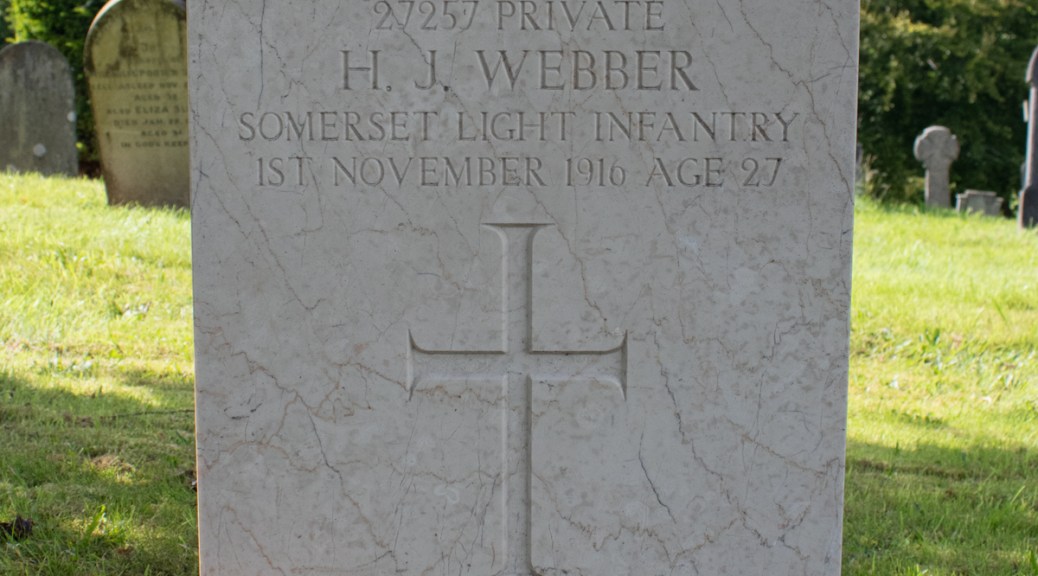
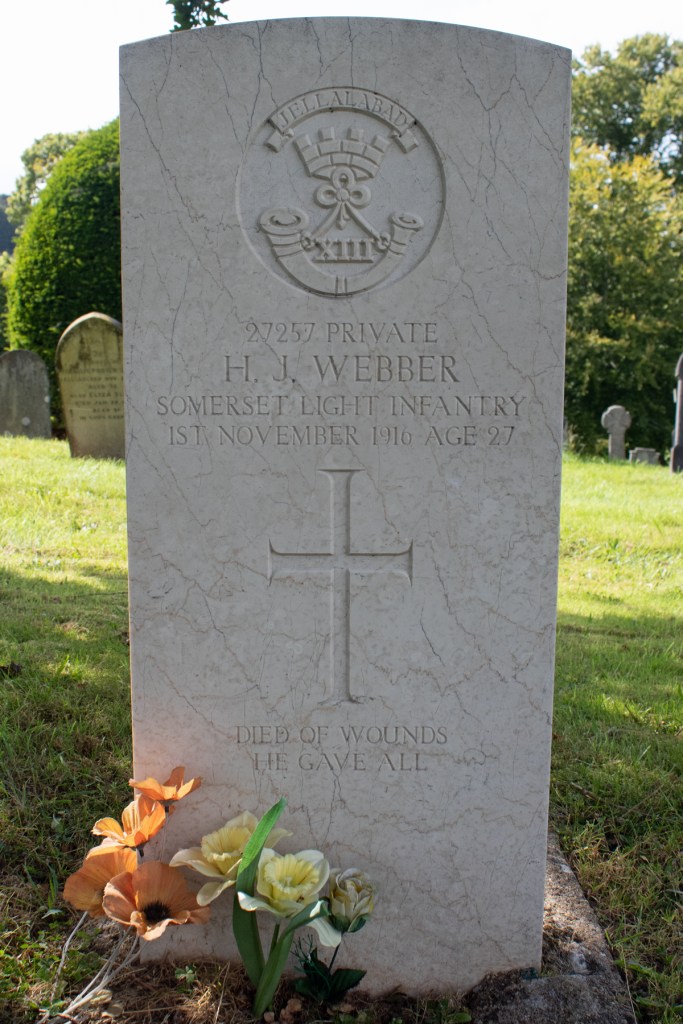
Henry James Webber was born in Plaistow, Essex, in 1889. One of ten children, his parents were Frederick and Etty Webber. Frederick hailed from Somerset, but worked as a sergeant in the Metropolitan Police. By the time of the 1901 census, he had been promoted to Inspector: the family moved to Somerset when he retired in around 1905, settling in Minehead.
Of Henry, there is little information documented. He does not appear on the 1911 census, and there are no military records to confirm his service in the army. He had certainly enlisted by the summer of 1916, joining the Somerset Light Infantry.
Private Webber was attached to the 7th (Service) Battalion and certainly saw action overseas. His troop was heavily involved in the Battles of the Somme in 1916, and it was here that he was injured. Again, full details are not available, but his wounds were severe enough for him to be medically evacuated to Britain for treatment.
Henry was admitted to the 1st Southern General Hospital in Birmingham, but his injuries proved too severe. He died on 1st November 1916, at the age of 27 years old.
Henry James Webber’s body was taken back to Somerset for burial. He was laid to rest in Minehead Cemetery, not far from where his grieving family were living in Cher Street.
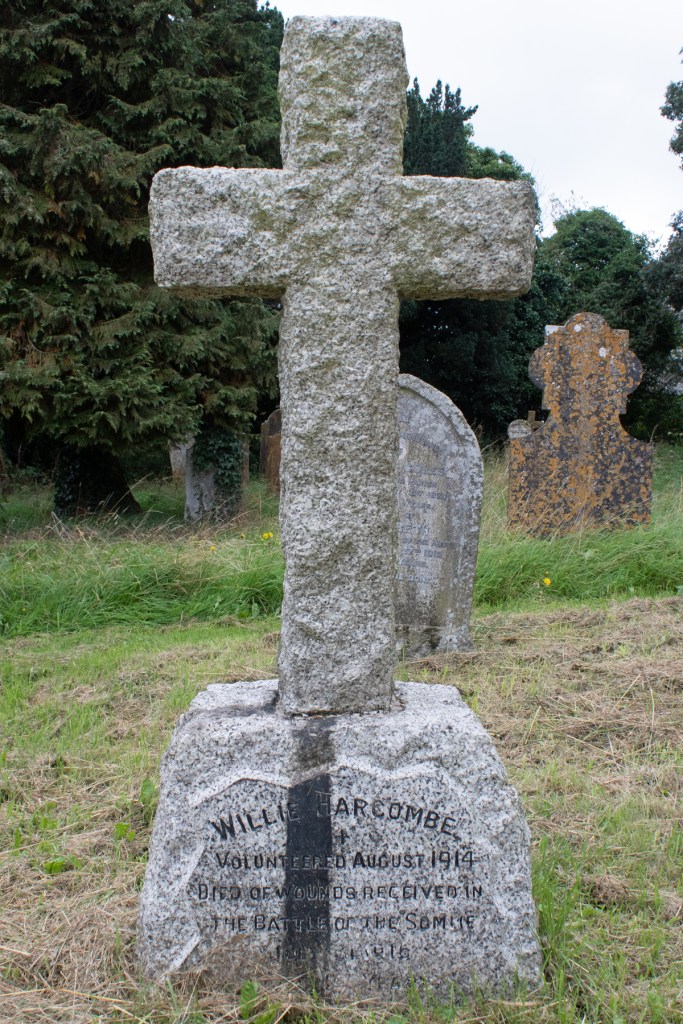
William Harold Harcombe was born on 25th September 1897 in Sampford Arundel, Somerset. One of twelve children, his parents were William and Jane Harcombe. William was an agricultural engine driver who, by the time of the 1911 census, had moved the family five miles north west to Ashbrittle.
When war came to Europe, William was one of the first to enlist, joining the Devonshire Regiment in August 1914. He was assigned to the 8th Battalion, and after nine months’ training, he found himself in Northern France.
Private Harcombe’s troop was involved in some of the fiercest skirmishes of the conflict, at Loos in the autumn of 1915, and at the Somme the following year. It was during this battle – probably at Delville or High Wood – that he was injured.
William was medically evacuated to Britain for treatment, and was admitted to a military hospital in Mile End, London. His injuries were to prove too severe, however, and he succumbed to them on 31st July 1916: he was just 18 years of age.
The body of William Harold Harcombe was brought back to Somerset for burial. He was laid to rest in the tranquil graveyard of St John the Baptist Church in Ashbrittle.
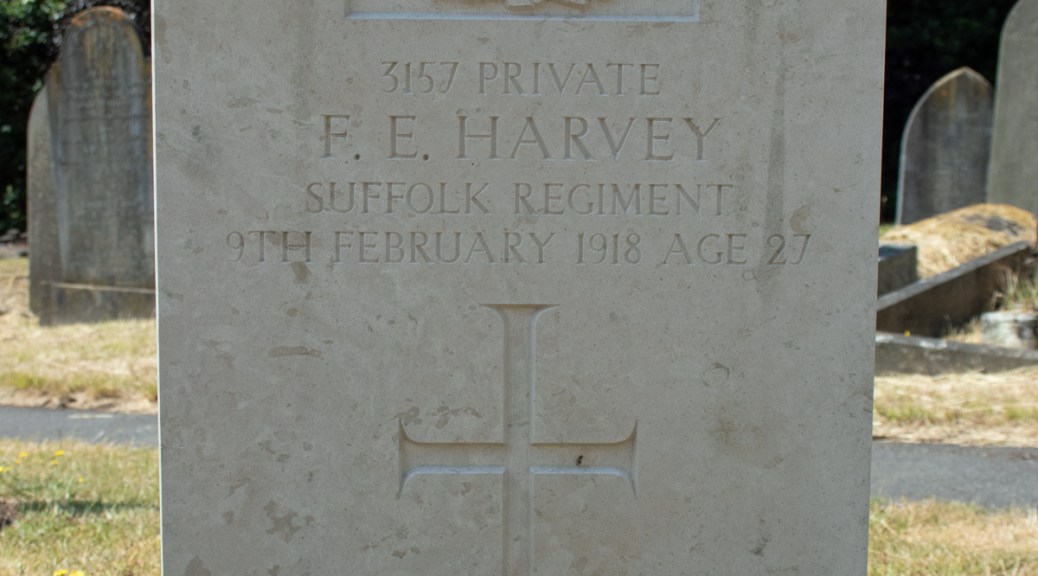
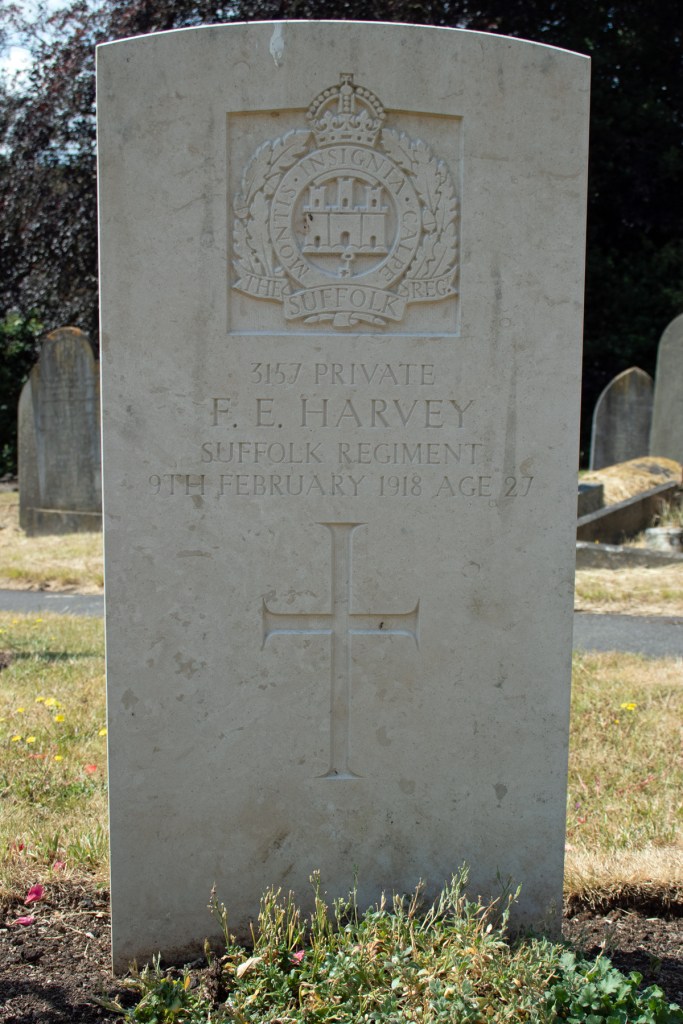
Frank Ernest Harvey was born at the start of 1892, the youngest of seven children to George and Clara Harvey. George was from Bethnal Green, London, and worked as a telegraphist clerk for the Post Office. By the time Frank was born, the family had moved to Leytonstone, while the 1901 census records them as living in Ilford.
On the day of the next census, in 1911, George and Clara were visiting friends in Guildford, Surrey. The four of their children who were still living with them were all at the family home. Ida, their daughter, was not listed as having any employment, while her three brothers were all working a clerks: one for an ironmonger, one for a stockbroker and Frank for an electrical engineer.
When war broke out, Frank stepped up to serve his king and his country. Little information is available about his military career, and, while his headstone confirms he was in the Suffolk Regiment, other records suggest that he had transferred to the regiment from the Royal Army Service Corps.
There is also little information about Private Harvey’s passing. Based on the fact that he was laid to rest in the Locksbrook Cemetery, Bath, it is likely that he had been admitted to the city’s War Hospital. This did not specialise in any single condition or set of conditions, so it could be that Frank was sent there to recuperate from an injury, or to recover from an illness.
Sadly, neither was to be the case, and Private Frank Ernest Harvey passed away on 9th February 1918. He was 26 years of age.
Samuel Treeby was born in December 1865 in Taunton, Somerset. The third of seven children, his parents were cordwainer Thomas Treeby and his wife, Anna (or Hannah).
When he finished his schooling, Samuel found work as a blacksmith at a collar factory in Taunton. His trade stood him in good stead away from the forge: he volunteered for the Royal Horse Artillery, becoming adept at shoeing the animals.
In 1906, Samuel married Sarah Parker. She was from Enmore, between Bridgwater and Taunton, although the couple married in Cardiff, Glamorgan. The couple settled back in Enmore, where Samuel continued his smithing trade.
War came to Europe in 1914 and, although he was 49 years old, Samuel stepped up to play his part. He was attached to the Royal Army Service Corps and given a rank that echoed his civilian profession, that of Shoeing Smith. His service records show that he was of average height – 5ft 6ins (1.68m) tall – but that he was illiterate: he signed his declaration with a cross.
Samuel spent several months on home soil, before being sent out to France in March 1916. He spent six months overseas, before being shipped back to Britain, suffering from rheumatism. Shoeing Smith Treeby was admitted to the East Leeds War Hospital before being discharged to the regiment’s Remount Depot in Woolwich, Kent.
Samuel returned home to Somerset, but his poor health still dogged him during the winter of 1916/17. He contracted bronchitis, and died of the condition on 27th February 1917, while still based in London. He was 51 years of age.
Samuel’s body was taken back to Somerset for burial. He was laid to rest in the peaceful graveyard of St Michael’s Church in Enmore, not far from where his widow still lived.










 Death and Service