John Lawson Kinnear was born on 9th February 1890 in the Yorkshire village of Copgrove. The youngest of six children, his parents were Henry and Frances Kinnear. Henry was the vicar of St Bartholomew’s Church, and, at the time of the 1891 census, the family lived in the rectory with four servants: a governess, a cook, a housemaid and a nurse.
When he completed his schooling, John was drawn to a career in the military. His full service papers have been lost, but it is clear that he joined the King’s (Liverpool Regiment) with a commission. He held the rank of Second Lieutenant when he joined the battalion in October 1910, rose to Lieutenant in March 1913, and transferred to the Royal Flying Corps not long after the First World War broke out. By June 1915, he had been made a Captain.
By the time of the Royal Air Force’s foundation in April 1918, John had risen to the rank of Major. He had also been awarded both the Military Cross and the Distinguished Service Order. Attached to the 1st Training Squadron, he was based at East Boldre, Hampshire.
On 28th April 1918, Major Kinnear was piloting his Sopwith Camel, when it stalled at a height of 200ft and fell to the ground. John was killed instantly. The RAF Casualty Card noted: “The court having carefully considered the evidence, viewed the scene of the accident and examined the wreckage are of the opinion that the smash was caused by an error of judgement on the part of the pilot.”
John Lawson Kinnear was 28 years of age when he died. His body was laid to rest in the graveyard of St Paul’s Church, East Boldre, not far from the airfield which he had called home.
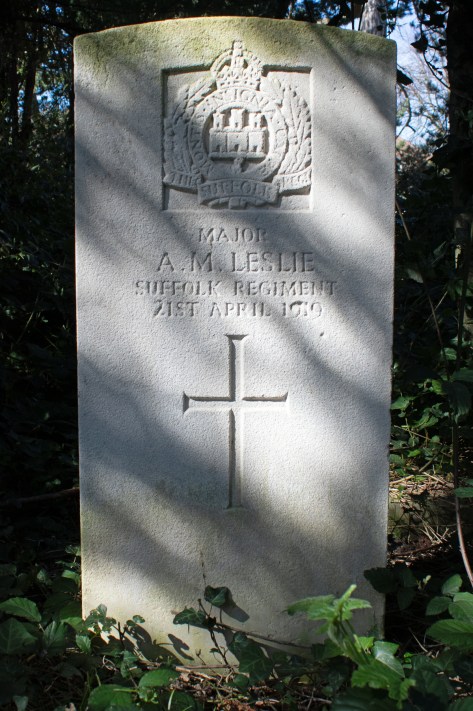
Alexander Augustus Maurice Leslie was born in France in 1852. One of five children, his parents were Government Secretary of State Francis Leslie and his French wife, Josephine.
Alexander’s mother died when he was 8 years old, by which point the family had moved back to Britain. Francis had set up home in Ealing, Middlesex, and they were living at 15 Castlebar Road, a Victorian villa.
When he completed his schooling, Alexander sought out a military life. The 1881 census recorded him as a Lieutenant in the Suffolk Regiment, living in St Helier, Jersey. He had married the year before, to Louisa Cumming, a surgeon’s daughter from Devon. They had a son, Maurice, by this point, and a daughter, Ida, was born the following year.
Lieutenant Leslie’s service records are sparse, but a later newspaper report fills in some of the gaps: “Leslie’s military experience, which extended… over a period of about 25 years, included participation in the Egyptian campaign in 1884, and service on the West Coast of Africa, in Jamaica, and in India.” [Worthing Gazette: Wednesday 30th April 1919]
During her husband’s time overseas, Louisa raised the children back home in Devon. She passed away in 1901, but which point, Alexander had retired with the rank of Captain. That year’s census found him living with Maurice and Ida at 14 Spencer Hill in Wimbledon, Surrey, a large detached villa. Maurice, now 20 years of age, was working as an accountant’s clerk, and the family had a live-in servant called Rose.
The next census record, from 1911, recorded Alexander living in rooms at 46 Leinster Gardens, Paddington. A substantial Georgian property, his landlady was Eveline Giradet, whose other residents included a barrister and a banker. Alexander’s occupation was now noted as Retired Major in the British Army.
From this point, Alexander’s trail grows cold. It is likely that he was called upon to play a part in the global conflict that broke out in 1914, though exactly when and how he did so is unclear. Records suggest he was admitted to Queen Alexandra’s Military Hospital on Millbank, Middlesex on 28th September 1916, suffering from syphilis. He only remained there for a couple of days, and his increasing age and health may have led to his retirement from duty.
For the past four years Major Alexander Maurice Leslie, who was for a period of a quarter of a century connected with the Royal Sussex Regiment, had been a resident of Worthing, and a brief intimation was given in the last issue… that he had died suddenly.
The circumstances were duly investigated by… the Deputy Coroner for West Sussex, on Wednesday afternoon, the inquiry taking place at the Central Fire Station, in High-street.
Evidence of identification was given by Colonel Francis Seymour Leslie… late of the Royal Engineers, who stated that the deceased, who was his brother, had lived at Worthing for the past four years, more or less all the time, though he had no permanent address…
Mrs Ethel William, a widow, at whose house… Major Leslie had lodged, stated that he had complained of indigestion and ate light food. On Monday evening he had his supper at half-past seven o’clock, going upstairs about half an hour later. About nine o’clock witness went to his room and found him lying in bed in great agony, and he exclaimed: “Oh, my poor heart!” Witness gave him some hot water to drink and sent for a doctor.
Dr Bernard Lees stated that he was sent for, but he found Major Leslie was dead when he got to the house. He had since made a post-mortem examination, which showed that the stomach and intestines were much distended, and there were signs of chronic gastric catarrh. The heart was fatty, but the valves were healthy. Death was due to syncope, the result of acute indigestion and the fatty condition of the heart.
A verdict of “Death from natural causes” was recorded.
[Worthing Gazette: Wednesday 30th April 1919]
[It should be noted that Alexander had been attached to the Suffolk Regiment throughout his military career. The error in the newspaper report is likely because of the Sussex town he had moved to in the mid-1910s.]
Alexander Augustus Maurice Leslie was 67 years of age when he passed away on 21st April 1919. His body was laid to rest in Broadwater Cemetery, to the north of the town he had called his home for more than four years.
Thomas Hulkes Bingham Day was born on 2nd January 1855 in Frindsbury, Kent. The youngest of four children, his parents were Thomas and Emma Day. Thomas Sr was a banker and a justice of the peace. He died when his youngest was just a child, and Emma was left to raise the family, albeit with the help of five servants.
Thomas sought out a life in the military. After volunteering in the local militia, for a number of years, he gained a commission in the Dorsetshire Regiment. He took on the role of Lieutenant on 29th November 1876.
Over the next two decades, Thomas served around the world, spending time in Malta, Gibraltar, and the East Indies. He was also promoted through the ranks, rising to Captain in 1883 and Major in 1893.
On 25th March 1884, while serving in India, Thomas married Katharine Watts. The couple had a daughter, Winifred, who was born in July 1885, and, eventually they settled in Wiltshire as their base in Britain.
Major Bingham Day served in South Africa during the Boer War, taking part “in the operations at Parde Kraal, and in the operations at Poplar Grove… Vet River, Zand River, Johannesberg and Pretoria. He had the Queen’s and the King’s medals with five bars.” [Lincoln Leader and County Advertiser – Saturday 28 April 1917]
Thomas retired in 1903, and his trail goes cold until the time of the 1911 census. He and Katherine were on holiday when it was taken, and they were listed as boarding at the Beach Lodge on Roseville Street in St Helier, Jersey.
When war broke out, Thomas stepped up to play his part once more. He was put in charge of the 4th (Reserve) Battalion of the Devonshire Regiment, which was based at Sutton Veny in Wiltshire. It seems that he lived off site, as he and Katherine moved into a house in nearby Warminster.
A military funeral took place… on Monday, when Lieutenant-Colonel TH Bingham-Day, in command of a regiment at Sutton Veny, was laid to rest in the churchyard. The deceased officer died suddenly while at mess, as the result of a seizure.
[Devizes and Wilts Advertiser: Thursday 19th April 1917]
Lieutenant Colonel Thomas Hulkes Bingham Day was 62 years of age when he passed away on 11th April 1917. He was laid to rest in the graveyard of St Aldhelm’s Church in Bishopstrow, Wiltshire, not far from the base at which he had so dutifully served.
Cecil Robert Stevens was born in Arrah, India, on 14th March 1867. One of six children, his parents were Charles and Mary Stevens. Charles was a civil servant who had been born in the South Sea Islands, while Mary has been born in Bengal.
The family appear to have moved to the United Kingdom by the late 1870s. Census records for them are a bit sparse, but the 1881 document found Mary living in Honiton, Devon, with four of Cecil’s siblings and three servants. Cecil, meanwhile, was a boarding student at Malvern College, Worcestershire.
By 1891, Cecil had moved to St Columb in Cornwall. He was boarding at a hotel on Fore Street, and was employed as a general medical practitioner.
Charles was later rewarded for his service to the Empire, and received a knighthood. The 1901 census found him residing in Harcourt Terrace, Kensington, Middlesex, while his wife, now Dame Mary Stevens, was visiting a friend from India in Devon. Sir Charles died at home in 1909, following a bout of influenza.
Cecil, meanwhile, had been making his own way in the world. A qualified surgeon, he married Katharine Duff, a nurse from Aberdeen. They went on to have two children, son Cecil Jr and daughter Mignonette.
On 29th July 1893, Cecil joined the Indian Medical Service as a Lieutenant. Three years later, he was promoted to Captain, and in July 1905, he rose to the rank of Major. His commitment to duty is evident: he spent many years overseas, separated from his wife and young family, and in January 1913, was promoted to the rank of Lieutenant Colonel.
Cecil’s time in the Indian Medical Service was not without danger. In 1895, he was involved in the Relief of Chitral, for which he received a medal and clasp. He was caught up in the Tirah Campaign of 1897/98, and received a further two clasps for his role.
Lieutenant Colonel Stevens’ role during the First World War is lost in the mists of time. Given his role in the Indian Medical Service, it is likely that he served overseas, but he returned to Britain after the war, coming by way of Egypt.
By the autumn of 1919, he was back in Devon, at the family home on Elmsleigh Park Road in Paignton. His health was failing at this point, having come down with diabetes while in North Africa. him. Cecil passed away on 18th November 1919: he was 52 years of age.
Cecil Robert Stevens was laid to rest in the sprawling grounds of Paignton Cemetery.
Lieutenant Colonel Stevens’ will left £4123 13s 10d (around £180,000 today) to his sister-in-law, Alice Duff.
Katharine outlived her husband by only eight years. She passed away on 22nd December 1927 at the Field Officers’ Quarters in Gibraltar: she was 61 years of age.
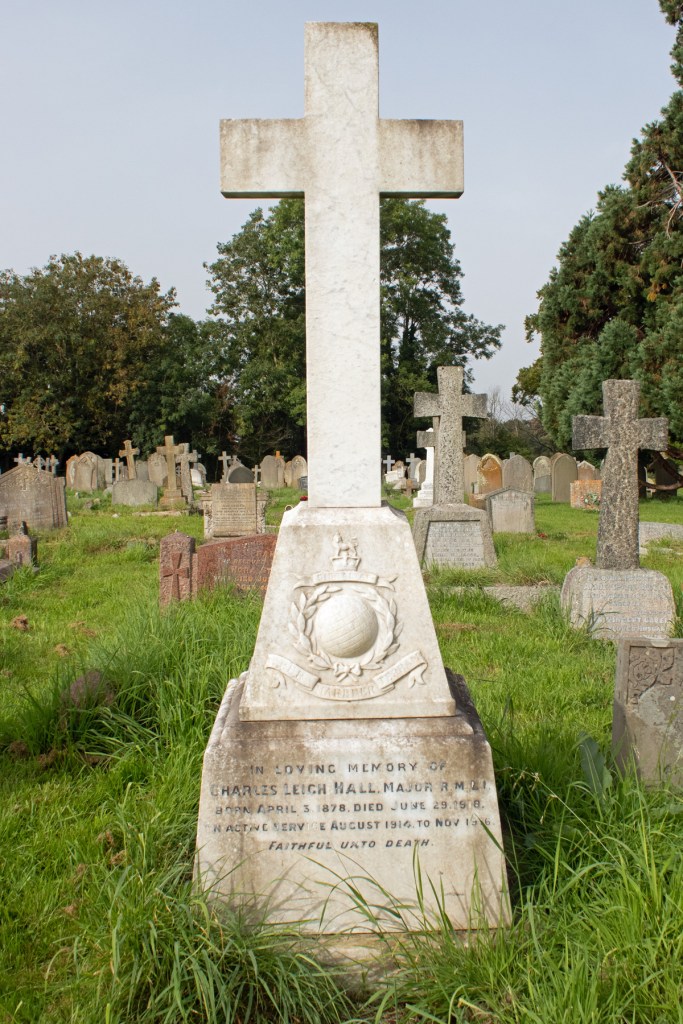
Charles Leigh Hall and his twin Maud, were born on 3rd April 1878 in Clifton, Gloucestershire. Two of eight children, their parents were Pedro and Anne Hall. Pedro, whose full name was Pedro Henrique Sinclair Hall, was better known as Henry, and was a mathematics tutor and Assistant Master at Clifton College, and it goes without saying that the Hall children had a educated upbringing.
Charles was always to be destined for great things. By the time of the 1901 census, when he was 22 years of age, he was a Lieutenant in the Royal Marines Light Infantry. Based on the cruiser HMS Amphion, he travelled the Pacific and, on the night the return was taken, was moored in Vancouver, Canada.
On 15th June 1910, Charles married Sophia Elinor Veale. Born in Caledon, South Africa, the couple wed in the village of Littleham, Devon. They set up home in Gosport, Hampshire – presumably as the now Captain Hall’s work was based from the docks there – and went on to have two children, Anthony and Nicholas.
By September 1915, Charles had been promoted again, this time to the rank of Major. His wartime service included a lot of work in Africa, including in Cameroon in 1914 – for which he was mentioned in Dispatches – German East Africa (Burundi, Rwanda and Tanzania today) in 1915 and Saadani (Tanzania) in 1916.
In October 1916, he was invalided out of the Royal Marine Light Infantry for reasons that are unclear, and returned to Britain from Simonstown, South Africa. While Charles seems not to have gone to sea any more, his experience was still respected, and, on 15th January 1917, he was promoted to Brigade Major.
The family settled back down in Portsmouth, Hampshire, and remained there for the next eighteen months. By the summer of 1918, Charles was in Bristol – either based at the docks there, or hospitalised in the city – and passed away on 29th July 1918. He was 40 years of age.
Sophia and her boys were still in Portsmouth, but Charles Leigh Hall was laid to rest in the graveyard of St George’s Church in Easton-in-Gordano, Somerset. The headstone incorrectly gives the month of death as June. Charles’ will divided his estate – £4467 (£318,000 in today’s money) – between his brother, Arthur, and Charles Garnett, a barrister, possibly as a trust for his sons.
Montgomerie Boyle was born on 20th March 1859 in Hendon, London. The youngest of three children, his parents were John and Jane Boyle. John was a barrister, and the family lived in some comfort – the 1861 census found them living in a house in Harrow, Middlesex, with four live-in servants and a groom.
[Montgomerie] joined the South Notts Yeomanry 22 years ago. Subsequently he obtained an appointment at Weston-super-Mare, under the Somerset Territorial Force Association, and did much useful work in co-ordinating the Army Service Corps in the county.
Taunton Courier and Western Advertiser: Wednesday 2nd April 1919
In the spring of 1891, Montgomerie married Constance Smith. She was a banker’s daughter from Nottingham, and the couple tied the knot in Basford, now a suburb of the larger city. They went on to have a daughter, Marion, who was born the following year.
By the 1901 census, the young family had moved to Timsbury, Somerset. Montgomerie was recorded as living on his own means, and the family had a retinue of servants to support them. A decade later, they had moved into the manor house in Staple Fitzpaine, Somerset. Montgomerie was now listed as a Captain in the Army Service Corps.
Storm clouds were gathering over the continent and, when war broke out, Captain Boyle was called back into active service.
…he was stationed with his Regiment on the East Coast for twelve months, and then went to France, where he remained for six months. He was re-called for service with the Mechanical Transport Section of the Army Service Corps in German East Africa, contracted malaria at the end of fifteen months and was invalided home. On his recovery he was despatched to the Egyptian front, and was with the British troops in Jerusalem. He became ill while there, and, on going down to the base at Cairo, was for a month in the Citadel Hospital, where he was treated for a malignant disease. By slow stages, first in a hospital ship, then in a Red Cross train through France, he was conveyed to [Le] Havre. Here, curiously enough, the doctor in charge of the hospital ship upon which he was placed happened to be… an old friend and medical attendant. Major Boyle landed at Southampton, and went immediately to the 3rd London General Hospital at Wandsworth [Surrey], where he was examined by an eminent specialist. His condition was serious but on Monday week last he arrived at his old home, where, despite the devoted care of his wife and daughter, he passed away quietly.
Taunton Courier and Western Advertiser: Wednesday 2nd April 1919
Major Montgomerie Boyle passed away on 27th March 1919, a week after his sixtieth birthday. He was laid to rest in the quiet graveyard of St Peter’s Church, on the outskirts of the grounds of the manor house the Boyles had made their home ten years before.
When Constance died ten years later, at the age of 70 years old, she was laid to rest in the family plot, reunited with her late husband once more.
Cyril Spencer Wilson was born on 12th July 1883 in Charlcombe, Somerset. The youngest of three children, his parents were John and Edith Wilson. John was a solicitor who went on to become President of the Bath Law Society and, because of his standing, Cyril and his siblings had a comfortable upbringing: all three censuses covering his life – in 1891, 1901 and 1911 – all show the family living in a large villa in Charlcombe, with a cook and a housemaid to support them.
[Cyril] was educated at Bath College and Lancing College, and then studied engineering at Bristol University. He then became an articled pupil at the Great Western Railway Works at Swindon. Very interested in, and a keen supporter of, the Territorial movement, he was a Captain of the [Royal Engineers] Wilts Fortress Engineers when war broke out.
Bath Chronicle and Weekly Gazette: Saturday 2nd November 1918
Cyril had begun work for the Great Western Railway in July 1902, and became attached to the Institute of Civil Engineers the following January.
Captain Wilson formally enlisted when war was declared, and was soon sent to France. “He was awarded the Military Cross early in the summer of 1917, after being twice mentioned in despatches for excellent work.” [Bath Chronicle and Weekly Gazette: Saturday 2nd November 1918]
Cyril was promoted to Major soon after this, and would go on to serve in France for more than a year more. In February 1918 he married Amy Pounds, the daughter of a bank clerk from East London and the couple exchanged vows in the city.
Major Wilson returned to France, but contracted dysentery that summer. He returned to Britain to recuperate, but came down with pneumonia, and this was to take his life. He died on 27th October 1918, aged 35 years old.
Cyril Spencer Wilson’s body was brought back to Somerset for burial. He was laid to rest in the family plot in St Mary’s Churchyard, Charlcombe.
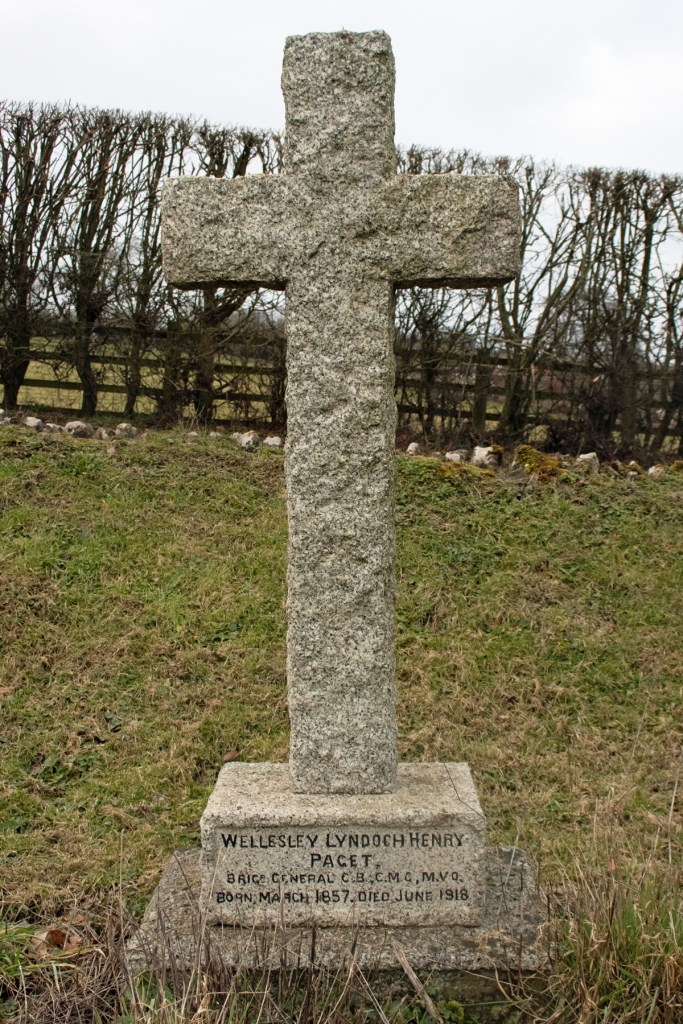
Wellesley Lyndoch Henry Paget was born on 2nd March 1858 in Belgaum, India. The sixth of nine children – all boys – his parents were Leopold and Georgina Paget. Leopold was a Colonel in the Royal Artillery, and Wellesley was always destined to follow a military career.
The young Wellesley was schooled at Wellington College, Sandhurst and, went straight into the army: the 1881 census records him as being a Lieutenant in the Royal Artillery, based at the barracks in Newcastle-upon-Tyne. While a baptism record confirms the location of his birth, Wellesley may have been prone to embellishment – the census record suggests he was born on board the ship HMS Charlotte, off Goa in the East Indies.
On 29th February 1888, Wellesley married Isabelle Swire, a merchant’s daughter from Liverpool. The couple made their vows in All Saints’ Church, Leighton Buzzard, presumably not far from where Lieutenant Paget was then based. The couple went on to have two children, Leo and Mary.
[Wellesley] became Adjutant of the Royal Horse Artillery in 1895… He served in the South African War, where he commanded the 2nd Brigade Division, Royal Field Artillery, and took part in the relief of Ladysmith and operations in Natal and in the Transvaal. He took command of the A Battery (the Chestnut Troop), Royal Horse Artillery, in 1900 and went on service with them in the North-East Transvaal. He was mentioned three times in dispatches for his services in South Africa, was promoted Brevet-Lieutenant-Colonel, and received the Queen’s Medal with six clasps.
Somerset Standard: Friday 21st June 1918
The now Major Paget returned to Britain, and set up home with Isabelle in Dorchester, Dorset. They lived comfortably in a villa in Cornwall Road, and had four servants – a nurse, a cook and two housemaids – to tend their needs.
Leo was sent away to school, and followed his father – and grandfather – into the army. He joined the Rifle Brigade, while his family moved to pastures new. By 1911, Wellesley and Isabelle had moved to Ireland, settling in the village of Ballyellis, near Mallow in County Cork. Again, the family had a retinue of staff, including a teacher for Mary, a cook, a kitchen maid, parlour maid and two housemaids.
Despite being in his fifties when war was declared in 1914, Wellesley stepped up again to play his part. With the rank of Brigadier General, he was again mentioned twice in dispatches for his actions, and was awarded the Companion of the Order of Bath in 1914, and made Companion of the Most Distinguished Order of Saint Michael and Saint George in the King’s Birthday Honours the following year.
By 1916, Wellesley seems to have taken a step back from military life. The Pagets moved to Somerset, setting up home in North Cheriton, near Wincanton. The Brigadier General kept himself busy, however, and, in 1917, was appointed Agricultural Commissioner for Somerset.
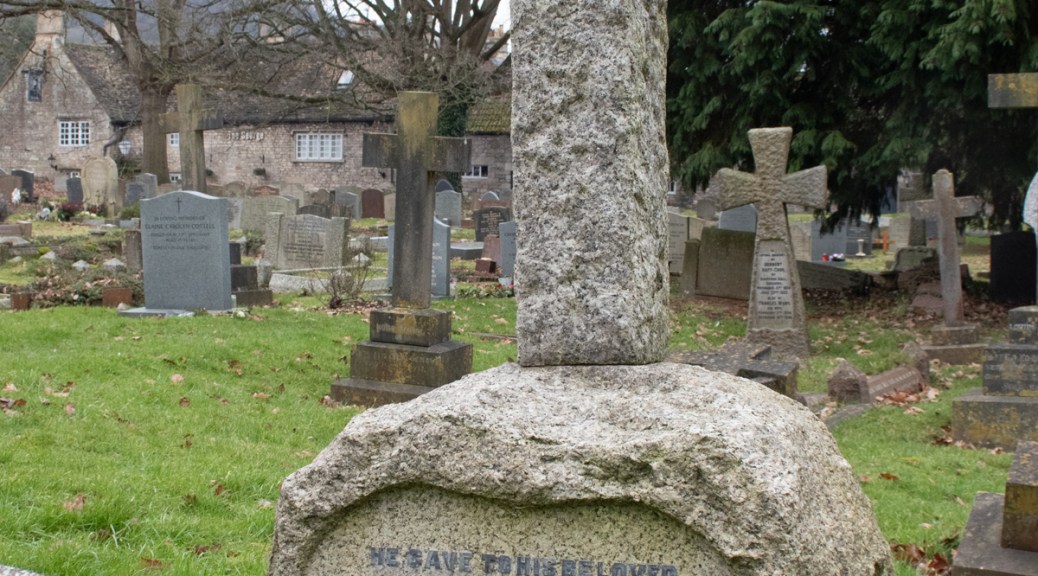
At this point, Wellesley Lyndoch Henry Paget’s trail goes cold. He passed away at his home on 11th June 1918, at the age of 60 years old. He was laid to rest in the North Cheriton Cemetery, not far from where his widow still lived.
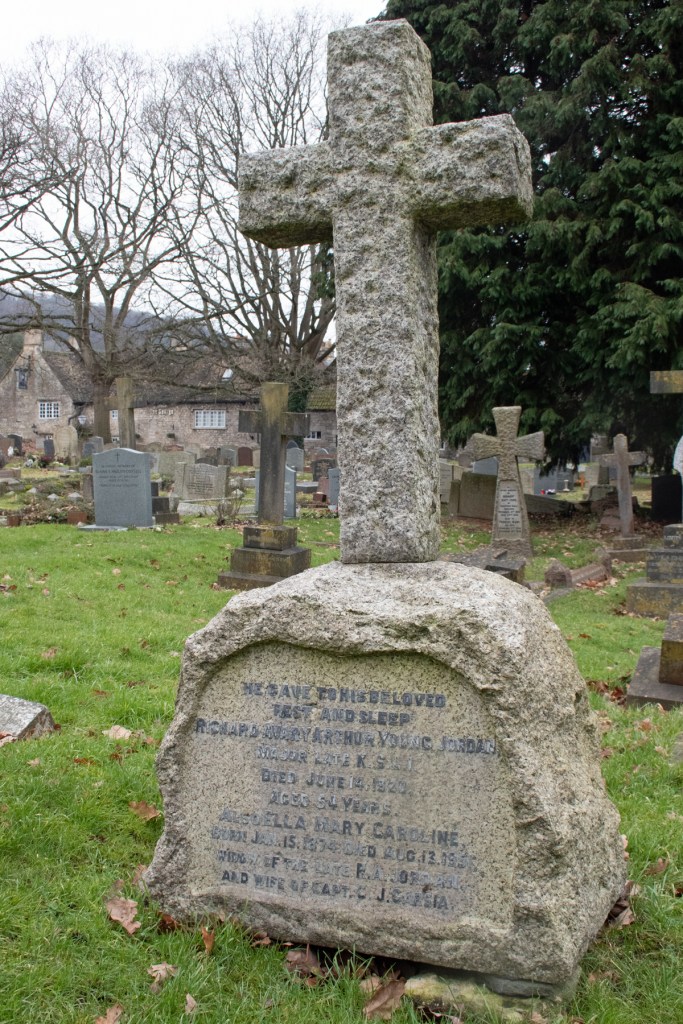
Richard Avary Arthur Young Jordan was born on 24th May 1866 in Cashel, Tipperary, Ireland. His father, Richard Jordan, died a week after his son’s birth, leaving his mother, Annabella, to raise him.
The 1871 census records mother and son living in Woolwich, London, with Annabella’s widowed mother, Grace. They were obviously a well-connected family, with Grace living as an annuitant, or pensioner, one son a Surgeon Major in the army and another as a Colonel in a different regiment. Annabella herself was recorded as a landowner, and the family had support with a cook and housemaid living in.
Surrounded by army servicemen as he was, it is no surprise that a military career called to Richard. He enlisted on 10th November 1886, joining the King’s Shropshire Light Infantry as a Lieutenant. Assigned to the 1st Battalion, his service records confirm that he had attended Burney’s Gosport School – a military academy – and was 5ft 7.5ins (1.71m) tall.
Richard was sent to Egypt just before Christmas that year, and over the next five years, he served both there and in Malta. On 11th May 1889 he attained the rank of Captain and, in December 1891 he was sent further afield, to Hong Kong.
After three years in the Far East, returned to Britain, and spent the majority of 1895 back on home soil. His travels were not at an end, however, and by the end of the year, Captain Jordan found himself in India. He spent three-and-a-half years in the sub continent, returning to the UK in May 1899.
At this point, details of Richard’s life get a little sketchy. He seems to have settled in Pembroke Dock, South Wales, and, on 18th April 1904, he married Ella Mary Caroline Grove. She was eight years his junior, and the daughter of a late Lieutenant in the Highland Light Infantry. The couple married at St George’s Church, Hanover Square, London.
Richard’s trail goes gold again, for a couple of years. He retired from the army on 8th August 1906, after nearly twenty years’ service. By the time of the 1911 census, he and Ella had set up home in Heywood House, on the outskirts of Tenby, Pembrokeshire, with two servants – Beatrice and Edith – as two live-in staff.
War came to Europe in the summer of 1914, and Richard seemed to keen to play his part once again. He enlisted again in August 1915, and was assigned the rank of Major in his former regiment. While it is not possible to determine Major Jordan’s complete service at this time, he definitely arrived in France the following month. If he remained in France, it is likely that he saw fighting at the Somme in 1916, Cambrai in 1917 and at Lys and on the Hindenburg Line in 1918.
Again, Major Jordan’s post-war life remains tantalisingly elusive. By the summer of 1920, he and Ella were living at Holcombe Lodge in Bathampton, on the outskirts of Bath. It was here on 14th June, that Richard passed away. He was 54 years of age.
Despite all his travelling, it seems that Ella was comfortable living in Bathampton, and this is where she laid her late husband to rest. Richard Avary Arthur Young Jordan was buried in the graveyard of St Nicholas’ Church in the village.
The widowed Ella married again, to Captain Clare Garsia, on 9th October 1921. She remained in Bathampton, and lived to the age of 77, passing away on 13th August 1951. She was laid to rest in the same plot as her late husband.
When Captain Garsia died the following year, he was also buried in St Nicholas’ Churchyard, in a neighbouring plot to his beloved Ella.
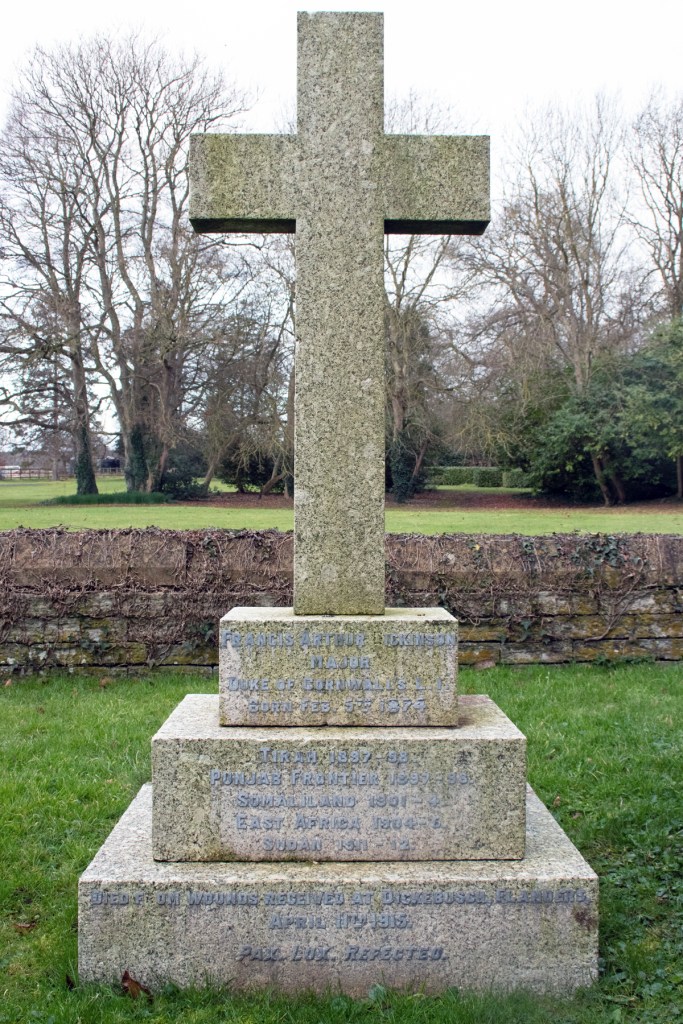
Francis Arthur Dickinson was born on 5th February 1874 in Lufton, near Yeovil, Somerset. The elder of two children, his parents were banker Arthur Dickinson, and his wife, Alice.
Francis was drawn to a military life. The 1891 census lists him as an army student at a boarding school in Cornwall, and by the end of the decade, he had enlisted in the Duke of Cornwall’s Light Infantry.
Over the next fifteen years, Francis served around the world, fighting in India, South and East Africa and in the Middle East. By the end of his term of service, he had risen to the rank of Major. During this time, he had been awarded a number of decorations, and had been mentioned in dispatches twice for his gallantry.
On 23rd July 1914, Francis married Clare Phipps, the daughter of a man of private means from Dilton Marsh, near Westbury, Wiltshire. The couple married in Clare’s home village, but set up residence in the Dickinson family home in Kingweston, Somerset.
When war was declared in 1914, the newlyweds were on their honeymoon. Francis returned to the army and was offered the rank of Colonel, but turned it down, in order to return to the Duke of Cornwall’s Light Infantry. He soon found himself in the thick of things again, and was caught up in the fighting at Mons, Marne, Aisne and Messines.
In April the following year, Major Dickinson was wounded. Evacuated to a camp hospital in Boulogne, he was not to survive his injuries this time round. He passed away at the hospital on 11th April 1915, at the age of 41 years old.
Due to the masses of servicemen being killed, a decision had been taken by the government of the time to not repatriate the dead to Britain, but to bury them in cemeteries close to where they fell. However, whether because of his family’s connections, or because he passed on the Channel coast, Major Dickinson’s body was, in fact, brought back to Somerset.
Francis Arthur Dickinson was laid to rest with full military honours in the graveyard of All Saints’ Church. He was buried alongside other family members, and in the shadow of the family manor.









 Death and Service