William Richard Radford was born in the spring of 1900 in Cogan, on the outskirts of Penarth, Glamorgan. He was one of eight children to coal trimmer turned dock labourer Richard Radford and his wife, Susan.
Little information is available about William’s life. What is documented is that he enlisted in the Royal Navy, and, by the time he came of age in 1918, he held the rank of Ordinary Seaman. William was serving at HMS Victory, the Royal Naval Dockyard, by the end of the war.
At this point, details of Ordinary Seaman Radford’s life become a little unclear. He seems to have been stepped down to the Marine Mercantile Reserve, returning home in January 1919, when he passed away. His Pension Ledger Card gives the cause of death as a fractured shoulder, while another document states that he died from a sarcoma.
Whatever the cause of his passing, William Richard Radford was laid to rest in the graveyard of St Augustine’s Church in Penarth. He shared his grave with his mother, who had passed away the previous year. Richard Radford was also buried in the same plot when he passed away in 1926.
William John Nolan was born in County Kildare, Ireland, on the 8th October 1892, one of ten children to agricultural labourer Thomas Nolan and his wife, Anna.
There is little documentation connected to his early life, but when he left school, William found work as a porter, and is was this that he was doing up until war broke out in 1914.
William was conscripted on 1st March 1915, joining the Royal Navy as an Ordinary Seaman. His service records show that he stood 5ft 5.5ins (1.66m) tall, had brown hair, brown eyes and a fresh complexion. He was also noted as having tattoos on his forearms, and a scar on his right one.
Ordinary Seaman Nolan was sent to HMS Pembroke, the Naval Dockyard in Chatham, Kent, for training. Within a month, he was given his first posting, on board the armoured cruiser HMS Lancaster. He spent fifteen weeks aboard and, over the next two years, he served on four more ships, returning to his base in Chatham after each voyage.
William came back to HMS Pembroke in July 1917: the base was particularly busy and cramped that summer, so much so that additional temporary accommodation was set up in the barracks’ Drill Hall. This is where Ordinary Seaman Nolan was billeted.
On the night of the 3rd September 1917, Chatham was bombarded by a German air raid, and the Drill Hall received a direct hit. Tragically, Ordinary Seamen Nolan was amongst those killed. He was just 24 years old.
William John Nolan’s body was laid to rest in the Woodlands Cemetery in Gillingham, alongside the other victims of the Chatham Air Raid.
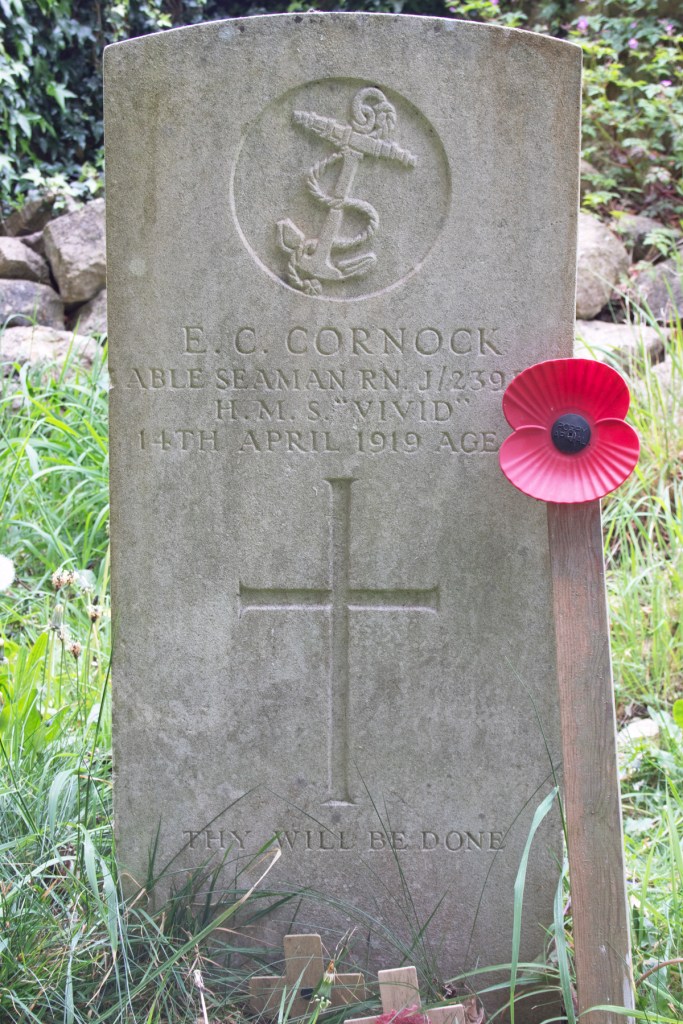
Ernest Charles Cornock was born on 16th June 1896, in the Gloucestershire town of Wotton-under-Edge. His parents were carter Charles Cornock and his wife, Millicent, both born and bred in the town, and he was one of eight children.
When he left school, Ernest found work as a rubber winder in the local mill. However, he wanted bigger and better things and so, on 8th April 1913, he enlisted in the Royal Navy. His service records show that he stood just 5ft 3ins (1.60m) tall, had brown hair grey eyes and a fresh complexion. He was also noted as having a scar on his right cheek.
As Ernest was under age when he joined up, he was initially given the rank of Boy 2nd Class. He was sent to HMS Vivid, the Naval Dockyard in Devonport and, after four months’ training, during which he was promoted to Boy 1st Class, he was given his first posting on board the battleship HMS Queen.
After five months on board, Boy Cornock was given another assignment, and was transferred to HMS Lion. While on board, a number of things happened: the First World War broke out, and the battle cruiser fought at Heligoland Bight and Dogger Bank; Ernest came of age, and was given the rank of Ordinary Seaman on his 18th birthday; with ongoing good conduct, in September 1915, he was then given a promotion to Able Seaman.
After a short spell back in Devonport, Ernest served on a further five ships, taking him through to the end of the war. By the start of 1919, however, Able Seaman Cornock’s health was beginning to suffer. Having contracted tuberculosis, he was medically discharged from service on 19th February, and was admitted to a sanatorium back in Gloucestershire. Sadly the condition was to get the better of him, and he passed away on 14th April 1919, at the age of just 22 years old.
Ernest Charles Cornock was brought back to Wotton-under-Edge for burial. He was laid to rest in the graveyard of St Mary the Virgin Church in the town, not far from his second cousin, Albert Cornock, who had been buried just the week before.
As an aside to Ernest’s tale, the newspaper that reported on his funeral also noted that his grandmother, Ruth Cornock, had not long received a message from the King, congratulating her on the fact that nine of her sons had served in the conflict
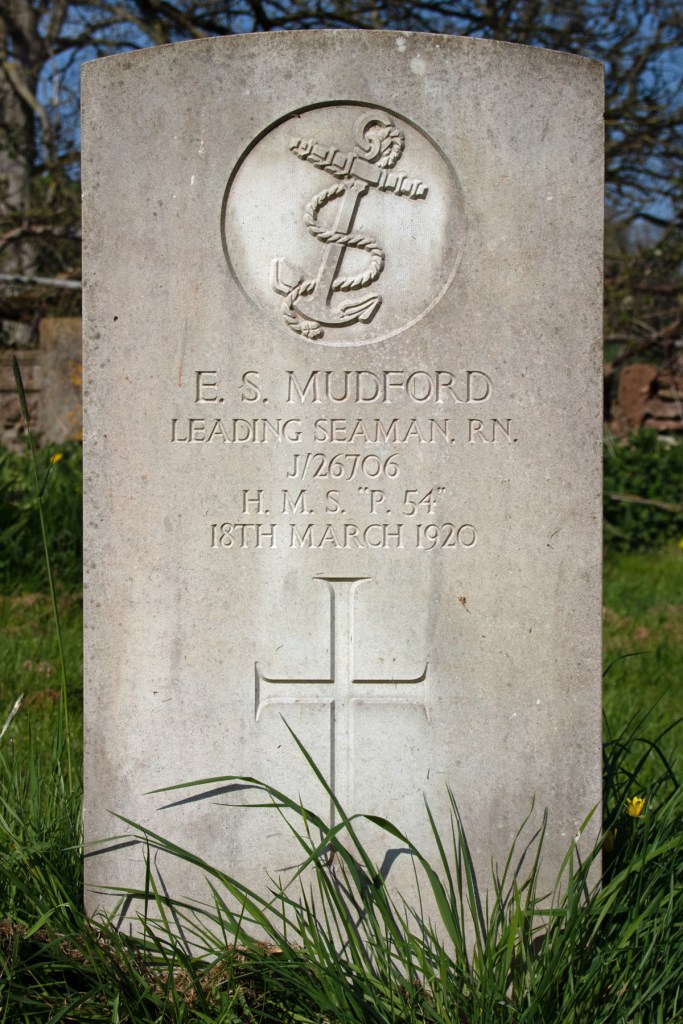
Edward Short Mudford was born on 29th March 1898 in the Somerset village of Stratton-on-the-Fosse. He was one of nine children to Joseph and Mary Mudford.
Information about his early life is confusing: the 1901 census gives his name as Edwin, rather than Edward; his father appears to have died by this point, leaving Mary to raise the family alone. The 1911 census records Edward and a younger sister living in the Union Workhouse in Shepton Mallet, while Mary has apparently remarried and was living in Radstock with two of Edward’s siblings and a daughter from her second marriage, although her new husband is noticeable in his absence from the document.
From this shaky start, however, Edward sought a new life for himself. On 21st August 1913 he enlists in the Royal Navy. His service records show that he stood just 5ft 1ins (1.55m) tall, had fair hair, hazel eyes and a fresh complexion. Being under age at the time, he was given the rank of Boy 2nd Class.
Edward was initially sent to HMS Ganges, the naval training establishment outside Ipswich, Suffolk. Promoted to Boy 1st Class in February 1914, he was soon given his first posting, on the cruiser HMS Crescent.
After another short spell at HMS Vivid, the Naval Dockyard in Plymouth, Boy Mudford found himself on board HMS Thunderer. Edward spent nearly four years aboard the battleship, coming of age and gaining the rank of Ordinary Seaman, while also being promoted to Able Seaman in March 1916.
Edward returned to Plymouth in February 1918, and spent the next couple of years between there, Portsmouth and Woolwich Dockyards. He was again promoted, given the rank of Leading Seaman in September 1918.
Life at sea and in barracks took its toll, however, and, in in the spring of 1920, Leading Seaman Mudford contracted influenza and pneumonia. Sadly the conditions proved too much to bear: he passed away on 20th March 1920, a week shy of his 22nd birthday.
Brought back to Somerset, where, presumably some of his family still lived, Edward Short Mudford was laid to rest in the graveyard of St John the Baptist Church in Chilcompton.
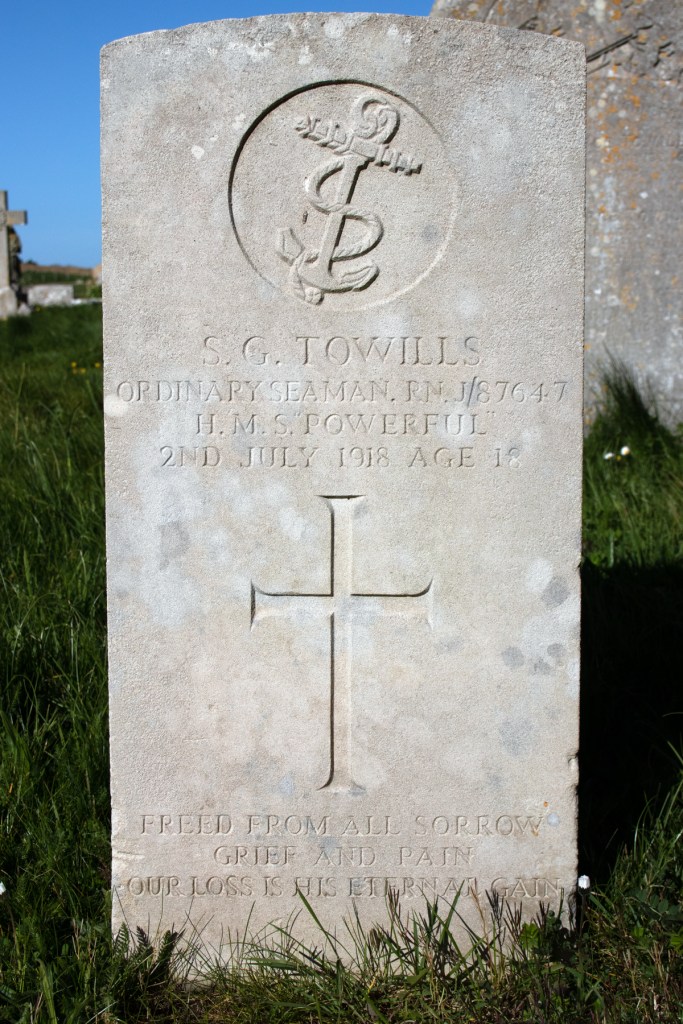
Sidney George Towills was born in Soho, London, on 14th May 1900. He was the youngest of two children to Henry and Maria Towills. Both had been born in Dorset, but Henry had found work as a constable for the Metropolitan Police and they had moved to London by the early 1890s.
The 1901 census recorded the family as living in Plaistow, but ten years later the family had moved back to Dorset, and were ensconced back in Maria’s home village of Abbotsbury.
When war broke out, Sidney was only 14 years old. He wanted to play his part, however, and as soon as he was able to enlist, he did so. He joined the Royal Navy on 9th April 1918 and, because of his age, was given the rank of Boy 2nd Class.
Sidney’s service records show that he was 5ft 9ins (1.75m) tall, had brown hair, blue eyes and a health complexion. He was assigned to the cruiser HMS Powerful and, on his eighteenth birthday, just over a month after enlisting, he was awarded the rank of Ordinary Seaman.
Tragically, Ordinary Seaman Towills’ service was not destined to be a long one. In June, he was admitted to the Royal Naval Hospital in Plymouth with empyema, a lung disease; he passed away from the condition on 2nd July 1918. He was barely 18 years of age and had served in the Royal Navy for 96 days.
Sidney George Towills was brought back to Abbotsbury for burial. He was laid to rest in the graveyard of St Nicholas’ Church in the heart of the village.
Knight Cooke was born in Vancouver, Canada, on 10th December 1892. He was one of nine children to John and Mary Cooke. John was a tallyman, selling goods by instalments. Knight, however, preferred working with his hands, and when he left school, found a job in a wood mill, as a planer.
When war came to Europe, those in the Commonwealth were asked to play their part. Knight enlisted, joining the Canadian Expeditionary Force on 22nd April 1916. His service records show that he stood 5ft 9ins (1.75m) tall and weighed 135lbs (61kg): he had dark brown hair, brown eyes and a dark complexion.
When he arrived in England, Knight was initially transferred to the 72nd Regiment of the Seaforth Highlanders, although he was quickly moved again to the 13th Field Ambulance. Within a matter of weeks, Knight was discharged under the King’s Regulations that suggested he would not become an efficient soldier.
At this point, Knight’s trail goes cold. It seems that he remained in England, and it seems that he was still keen to play his part. What is clear is that he enlisted in the Royal Naval Canadian Volunteer Reserve at some point in the months after being discharged from the army.
Knight was given the rank of Ordinary Seaman, and was, by the summer of 1917, based at HMS Pembroke, the Royal Naval Dockyard at Chatham in Kent. This was a busy, overcrowded place at that time, and Knight found himself billeted in temporary accommodation at Chatham Drill Hall.
On the 3rd September 1917, the German Air Force carried out its first night-time air raid: Chatham was heavily bombed and the Drill Hall received a direct hit; Ordinary Seaman Cooke was among those who were killed. He was just 24 years of age.
Knight Cooke was laid to rest alongside the other victims of the Chatham Air Raid, in the Woodlands Cemetery, Gillingham, not far from the Dockyard in which he finally managed to serve.
Knight’s headstone gives his surname as Cook, although his service records – and signature – give the spelling as Cooke.
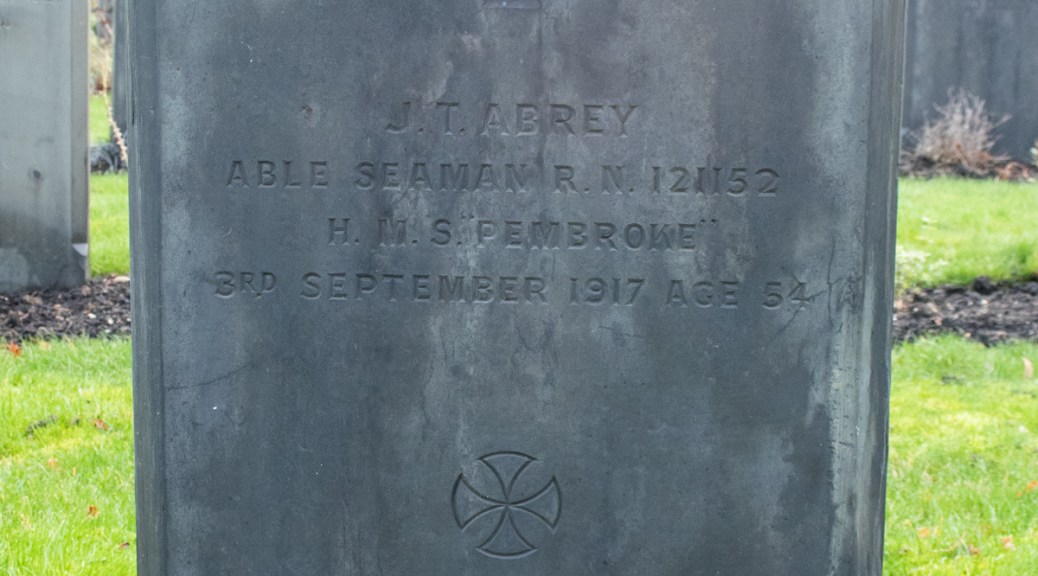
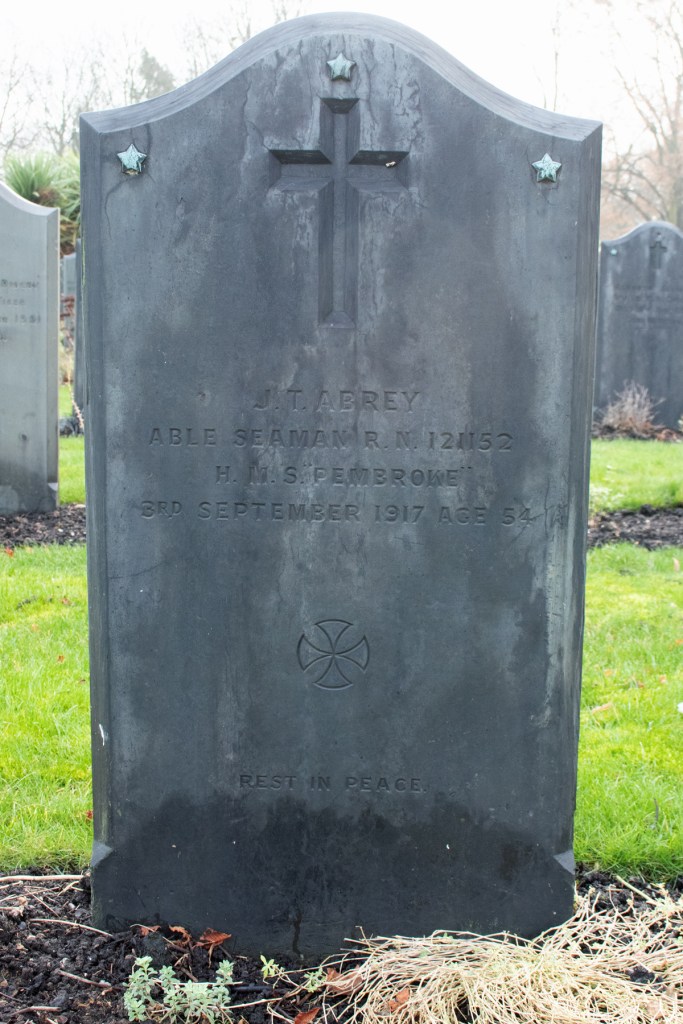
John Thomas Abrey was born in Earl’s Court on 12th August 1867, the middle of five children to John and Anne Abrey. John Sr was a carpenter and labourer from Suffolk, and Anne was from Suffolk. By the time they married, however, the couple had settled in London.
When he left school, John Jr found work as a printer, but he was after bigger and better things and, on 4th October 1882, he joined the Royal Navy. He was only 15 at this point, and so was given the rank of Boy 2nd Class. His service document record that he was 5ft 2ins (1.57m) tall, had brown hair, brown eyes and a sallow complexion.
John received his training at HMS Ganges, the shore-based establishment near Ipswich, Suffolk, and gained promotion to Boy 1st Class. He then spent six months on the training ship HMS Impregnable, before being given his first posting on HMS Minotaur. He served aboard for just over a year, during which he turned 18, and so was formally inducted in the Royal Navy, and was given the rank of Ordinary Seaman.
At this point, John signed up for a period of ten years and, over that time, he served on board seven further ships, and was promoted to the rank of Able Seaman.
On 25th May 1890, John married Christiana Ann Hamshaw at All Saints Battle Bridge in Islington. Christiana had been married and widowed twice, and had two teenaged daughters. The couple settled down – as much as a sailor can – and had two children of their own, John and William.
In August 1895, having completed ten years’ naval service, Able Seaman Abrey was stood down to the Royal Naval Reserve. Over the next few years, he maintained this service, while finding work as a labourer.
When war broke out, John was recalled to active duty and, over the next three years, served on a number of vessels. Between each assignment, however, he returned to HMS Pembroke, the Royal Naval Dockyard in Chatham, Kent, which had become his base. It was here that he was barracked in the summer of 1917.
It was a particularly busy for the base, and temporary accommodation was set up in the Drill Hall; this is where John was billeted.
On the night of 3rd September 1917, Chatham suddenly found itself in the firing line as a wave of German aircraft bombed the town. The Drill Hall received a direct hit, and Able Seaman Abrey was amongst those to be instantly killed. He had celebrated his 50th birthday the month before.
John Thomas Abrey was laid to rest in the Woodlands Cemetery in Gillingham along with the other servicemen who had perished during the Chatham Air Raid that night.
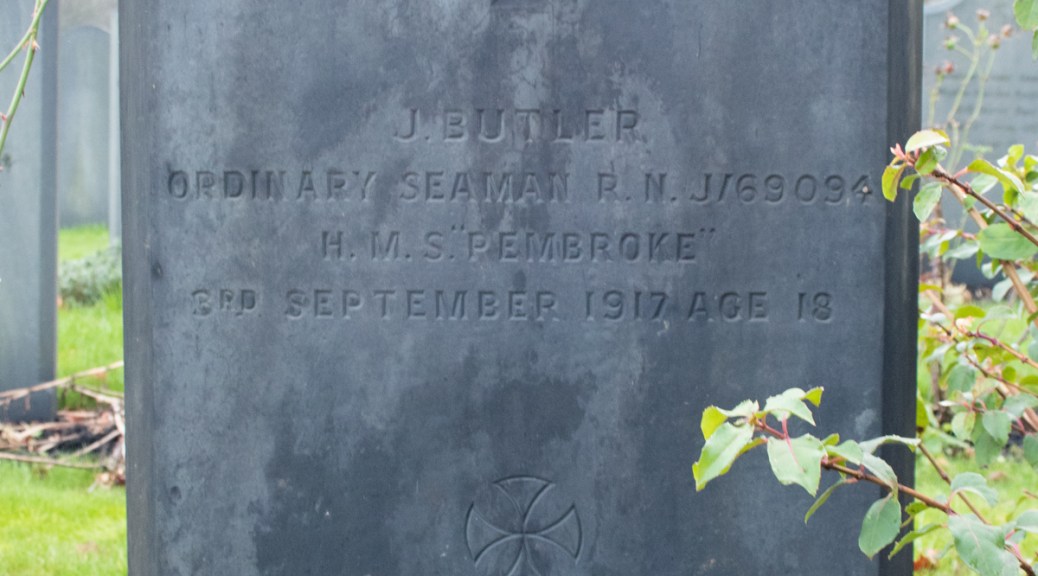
George Butler was born in Willesden, Middlesex, on 16th January 1899 and was the oldest of three children. His father, George Sr, was a bricklayer, while his mother, Sarah, worked as a laundress to help bring in some extra money.
Sadly, because of his age, there is little concrete information on George Jr’s early life. What can be confirmed is that, on 21st March 1917, having not long turned 18 years of age, and with the Great War well under way, he was keen to play his part for King and Country. He joined the Royal Navy for the duration of the conflict and was given the rank of Ordinary Seaman.
George’s service records show that he was 5ft 10ins (1.78m) tall, had brown hair, grey eyes and a fair complexion. It was also noted that he had a scar on his left leg. The document also confirms that he was employed as a bus washer.
Ordinary Seaman Butler was based at HMS Pembroke, the Royal Naval Dockyard in Chatham, Kent. It was a busy place that summer, and temporary accommodation was needed quickly. Chatham Drill Hall was brought into service, and George found himself billeted there.
On the 3rd September 1917, the German Air Force carried out its first night air raid: Chatham was heavily bombed and the Drill Hall received a direct hit; Ordinary Seaman Butler was among those killed instantly. He was just 18 years of age.
George Butler was laid to rest, alongside the other victims of the Chatham Air Raid, in the Woodlands Cemetery, Gillingham.
George’s headstone gives the incorrect initial, but the location is correct.
Leonard Frederick John Gigg was born in Silverton, Devon, on 9th May 1882. He was one of six children to Matthew and Sarah Gigg, both of whom were born Ottery St Mary, but who moved the young family to Chudleigh in the late 1880s.
Matthew was a domestic gardener, and his son initially joined him in this trade. However, as the third of five sons, Leonard obviously wanted to carve out a life for himself and so, on 21st August 1897, he enlisted in the Royal Navy.
Leonard’s naval records shows that he was 5ft 3ins (1.60m) tall, had light brown hair, blue-grey eyes and a fresh complexion. He also gave his year of birth as 1880 so he would be accepted in the navy.
Even with this altered date of birth, Leonard was still under age, and so was given the rank of Boy 2nd Class. He was obviously dedicated to his career, however, and, on his “eighteenth” birthday in 1898, he was officially enrolled as an Ordinary Seaman.
Over the course of his twelve years’ service, Leonard served on ten vessels; after each voyage, however, he returned to HMS Vivid – the Royal Naval Dockyard at Devonport, Portsmouth. During his time at sea, he also progressed through the ranks, becoming an Able Seaman as early as 1900.
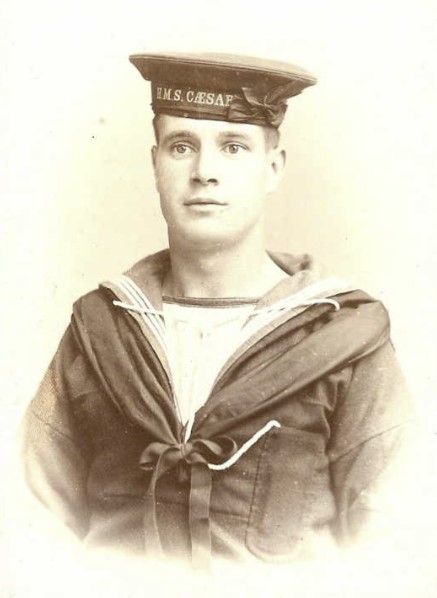
When Leonard’s initial contract came to an end, he volunteered for a further term. Up until the outbreak of war, Able Seaman Gigg served on another six ships, but after falling ill while on board HMS Caesar in the summer of 1914, he returned again to Portsmouth.
Leonard had contracted cancer of the mouth, and, as a result of the condition, he was formally invalided out of the Royal Navy in May 1915. He returned home but, in spite of a couple of operations, he succumbed to the cancer, passing away on 9th October 1915. He was just 33 years of age (his gravestone gives a different age).
Leonard Frederick John Gigg was laid to rest in the cemetery in Chudleigh.
Able Seaman Leonard Gigg (from findagrave.com)
The local newspaper reported on Leonard’s funeral:
The death has taken place at his father’s residence of Mr Leonard FJ Gigg, third son of Mr M Gigg, after a painful illness. The deceased had served in the Royal Navy for 18 years and was only invalided out in May last, owing to cancer of the tongue. Although undergoing three operations, he was no better, and expired form the effects of that dreadful malady at the early age of 33 years. In the service he was extremely well liked and highly respected both by officers and men, and always had a pleasant word for everyone.
The deceased’s four brothers, Mr Charles Gigg (now in Canada), Chief Petty Officer H Gigg (HMAS Australia), Able Seaman Walter Gigg (HMS Carnarvon), and Private Albert Gigg (4th Devons, now in India) were prevented from attending.
George James Henry Shuttle was born in Brentford, Middlesex, on 12th July 1899. His mother was Helen (or Ellen or Nellie) Shuttle, but he does not seem to have had a close connection to her and, according to the records, there was no father on the scene. Initially fostered out to Noah and Carmina Scott as a nurse child, by the time of the 1911 census, the couple had adopted him.
When he left school, George worked as a milk boy, but he seemed to know that a life of adventure awaited him. In June 1915, he joined the Royal Navy; being only 15 at the time, he was given the rank of Boy 2nd Class.
His initial posting was on board the cruiser HMS Powerful, and his training there paid off, as he quickly rose to Boy 1st Class. After a couple of months’ at HMS Victory – the Royal Naval Dockyard in Portsmouth – George was assigned to his second ship, HMS Malaya. Within weeks, the brand new battleship had cut her teeth in the Battle of Jutland, during which 65 of her crew were killed.
George spent more than eighteen months on Malaya; his time on board saw him turn eighteen, and gain the rank of Ordinary Seaman. His service records at the time show that he was 5ft 3.5ins (1.61m) tall, had brown hair, grey eyes and a fresh complexion.
By August 1917 Ordinary Seaman Shuttle had returned to shore, and was assigned to HMS Pembroke, the Royal Naval Dockyard in Chatham, Kent. The base was particularly busy when he arrived. Temporary accommodation at Chatham Drill Hall had been set up, and George found himself billeted there for the summer.
On the 3rd September 1917, the German Air Force carried out one of the first night-time air raids on England: an unprepared Chatham was heavily bombed and the Drill Hall received a direct hit. Ordinary Seaman Shuttle was badly injured and died of his wounds in hospital the following day.
George James Henry Shuttle was laid to rest, along with the other victims of the Chatham Air Raid, in the Woodlands Cemetery, Gillingham.
George’s mother, Helen, had continued with her life. A year after George was born, she had another son, Cyril, but he also seems to have been fostered out to enable her to work.
In 1903, she married musician Harry Burgiss-Brown, and the couple set up home in Richmond, Surrey. They went on to have two children, and Helen seemed focused on her new life, rather than the one she had before marrying.
Helen died in 1949, just short of her 70th birthday.