Tag Archives: Royal Air Force

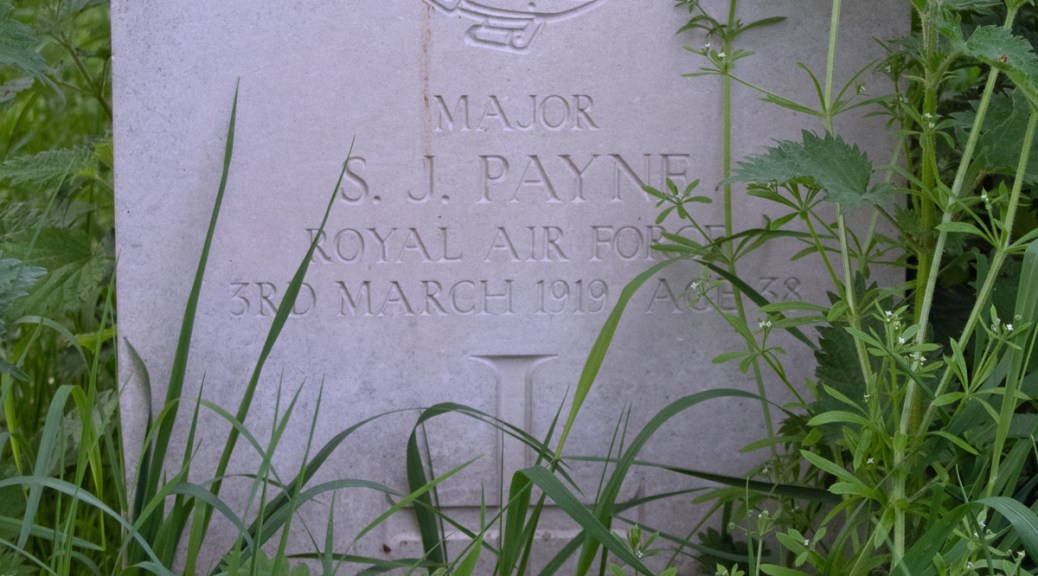
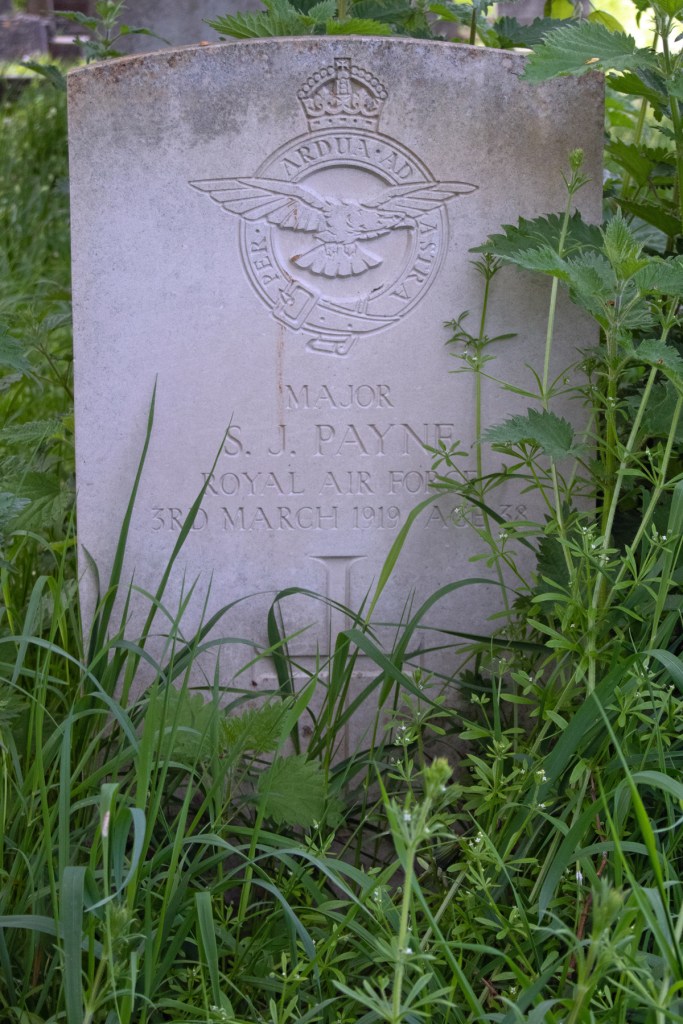
Major Stanley Payne

Major Stanley Payne

Stanley James Payne was born towards the end of 1882, one of eleven children to Stephen and Elizabeth Payne. Stephen was a leather salesman from Essex, who had moved his family to Weston-super-Mare in Somerset in around 1880.

Stanley seems to have been drawn in to a military life from an early age. In January 1900, he enlisted as a Private in the Somerset Light Infantry, and the 1901 census listed him as living at the Raglan Barracks in Devonport, near Plymouth.

Military service took Private Payne to India, where he served for six years. His success and ambition were clear; in 1906 he was promoted to first to Corporal and then to Sergeant. By 1911 – and now back in England – as a Lance Sergeant, Stanley was working as a military clerk at the Royal Horse Artillery Barracks in Dorchester, although he was still attached to the Somerset Light Infantry.

Stanley’s ambition and sense of adventure continued; by July 1912 he had made the transfer over to the newly-formed Royal Flying Corps, as a Sergeant.

It was while he was based in Dorchester that he met Winifred Bell. She was the daughter of a local council worker, and the couple married in the town in September 1912. Stanley and Winifred went on to have a daughter, Doris, who was born in July 1914.

War had arrived in Europe, and on 7th October, the now Warrant Officer Payne was shipped to France. During his nine months on the Western Front, he was mentioned in despatches and received the Croix de Guerre for his gallantry. The local newspaper also reported that he:

…had also the honour of being presented to the King on the occasion of His Majesty’s last visit to the front, and at a home station had also been presented to Queen Mary.

Western Daily Press: Saturday 8th March 1919

Returning to England on 1st June 1915, he was again promoted to Lieutenant and Quartermaster, although here his military records dry up. By this time, he had been in the armed forces for more than fifteen years, but his military records seem to confirm this as the last day of his service.

The next record for Stanley confirms his passing. Admitted to the Central Air Force Hospital in Hampstead with a combination of influenza and pneumonia, he died on 3rd March 1919. He was just 36 years of age.

Brought back to Weston-super-Mare, where his now widowed father was still living, Stanley James Payne was laid to rest in the Milton Cemetery in his home town.


Stanley’s gravestone gives his rank as Major. While there is no documented evidence of any additional promotions after June 1915, the rank is the equivalent of Quartermaster in the Army Reserve. It seems likely, therefore, that the end date of his military service marked the start of his time in the reserves.


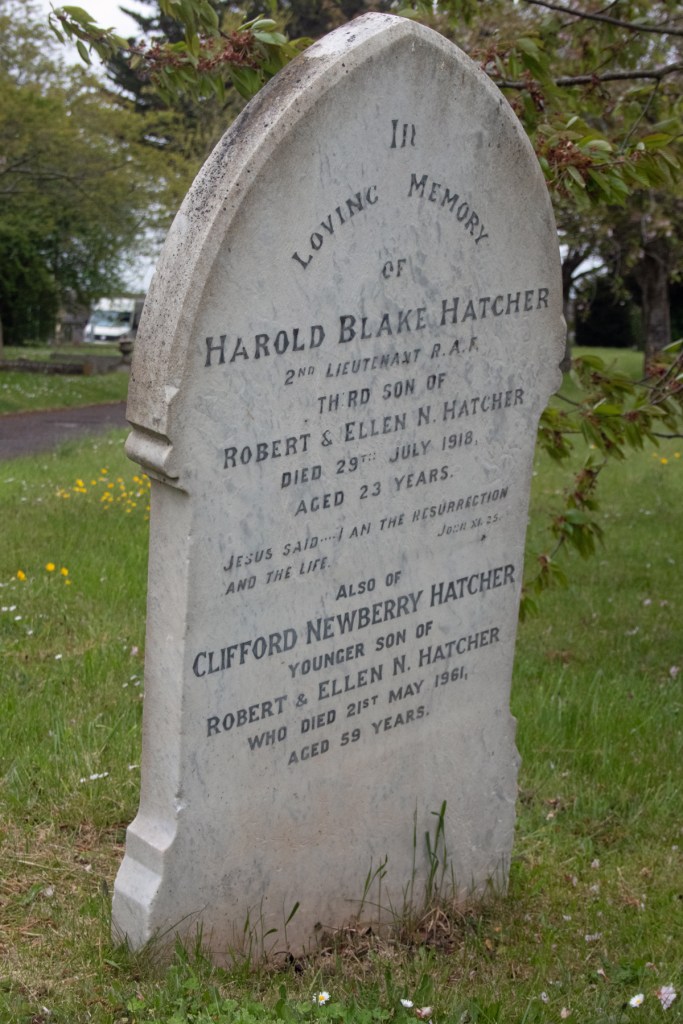
Second Lieutenant Harold Hatcher

Second Lieutenant Harold Hatcher

Harold Blake Hatcher was born on 11th February 1895, one of nine children to Robert Hatcher and his wife Ellen. Robert was a draper, and brought his family up in his home town of Taunton in Somerset. At least one of his children followed him into the cloth business, and, after he died in 1908, this seems to have fallen to Harold’s older brothers, Arthur and Ernest.

After leaving school, Harold became a dental student. Initially studying with Kendrick’s in his home town, he was about to begin training at Guy’s Hospital in London when war broke out.

Harold joined up in May 1915, and was initially assigned as a Lance Corporal to the 6th Battalion of the Somerset Light Infantry, before being transferred to the Middlesex Regiment.

In November 1917, he was badly injured in while fighting at Bourlon Woods, as part of the Battle of Cambrai. It was while he was recuperating that he transferred again, this time to the fledgling Royal Air Force.

Second Lieutenant Hatcher gained his wings in June 1918, and soon became a flying instructor. It was while he was working at RAF Fairlop in North West London, that an incident occurred. A local newspaper picked up the story.

Many in Taunton have learnt with sincere regret of the accidental death whilst flying of Lieutenant Harold Blake Hatcher of the Royal Air Force, third son of the late Mr Robert Hatcher of Taunton, and of Mrs Hatcher, now of Bristol.

The accident in which he met his death on Monday was a triple fatality, two other airmen being killed at the same time, Second Lieutenant Laurie Bell, of Bournemouth, and Flight Sergeant AR Bean, of Burslem.

At the inquest… it was stated in evidence that while Lieutenant Hatcher and Sergeant Bean were flying at a height of about 500ft, Second Lieutenant Bell, who w flying a single-seater, dived from a position some 700 feet higher, his machine striking and cutting clean through the double-seater, which folded its wings, hovered a few second, and then crashed to the earth. The three men were instantaneously killed.

A verdict of Accidental Death was returned.

Taunton Courier and Western Advertiser: Wednesday 7th August 1918

Further witness testimony described how the Sopwith Camel, piloted by Bell, cutting the AVRO airplane it in two. Hatcher fell out of the wrecked two-seater as the Camel’s wings slowly folded into a V and fluttered free following the fuselage to the ground. All three airmen lost their lives. Bean was found in a sitting position, still strapped in the front half of the AVRO’s fuselage, his instructor’s body was found unmarked thirty yards away in the grass where it had fallen. The wingless Camel crashed close by and Bell was found to have almost every bone in his body broken.

The accident took place on 30th July 1918. Second Lieutenant Hatcher was just 23 years old.

Harold Blake Hatcher lies at rest in St Mary’s Cemetery in his home town of Taunton, Somerset.


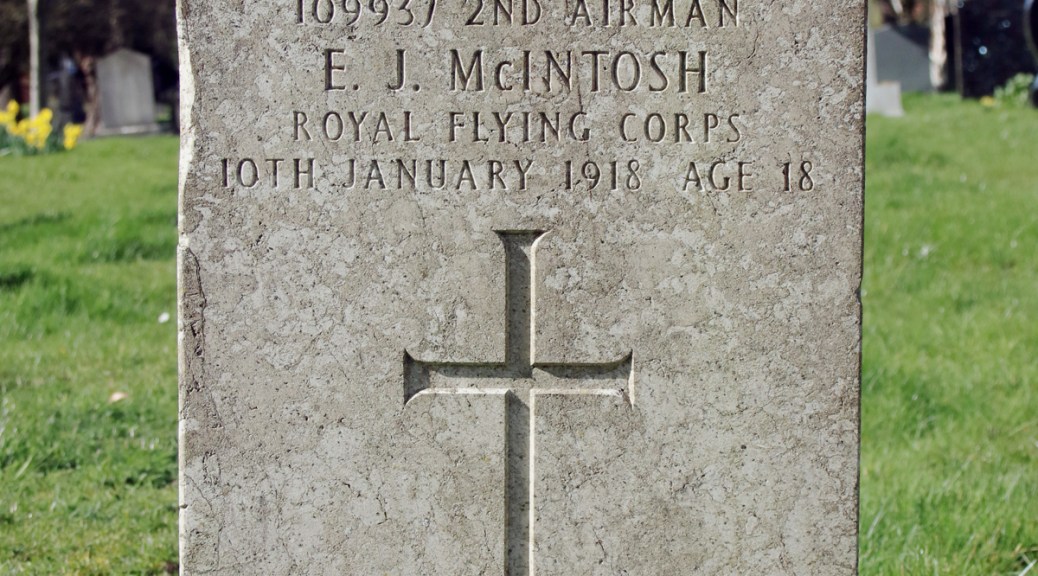
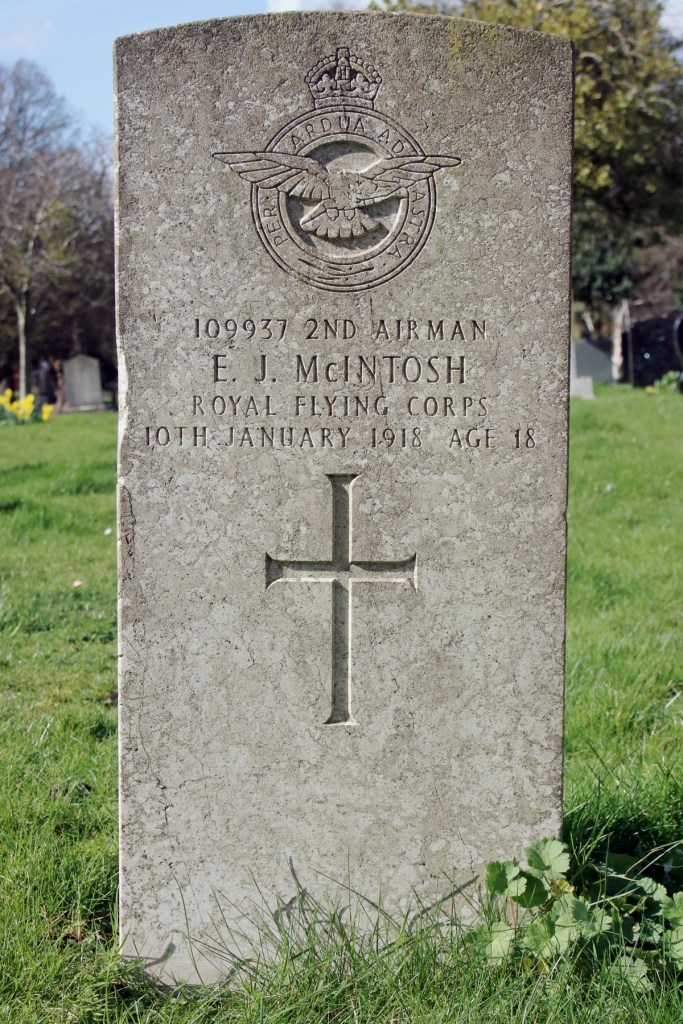
Air Mechanic 2nd Class Edward McIntosh

Air Mechanic 2nd Class Edward McIntosh

Edward James McIntosh was born in January 1899, the youngest of four children to Henry and Caroline McIntosh from Gillingham in Kent. Henry and Caroline ran a greengrocer’s and their eldest son, Harry, followed them into the business when he left school. One of Edward’s sisters Beatrice became a dressmaker, while the other, Gertrude, became a servant for the secretary to an engineering company.

Sadly, little else remains of young Edward’s life. He enlisted in the Royal Flying Corps when war broke out; given his age, it is unlikely that he signed up before 1917, although there is no record to confirm this.

Edward achieved the rank of Air Mechanic 2nd Class (although his gravestone gives his rank as Second Airman), but there is little more documentation to flesh out his military service.

Edward was admitted to the Military Hospital in Aldershot in January 1918, suffering from meningitis. Sadly this was to take his life, and he passed away on 10th January 1918, having just turned 18 years old.

Edward James McIntosh lies at rest in the Woodlands Cemetery in his home town of Gillingham, Kent.


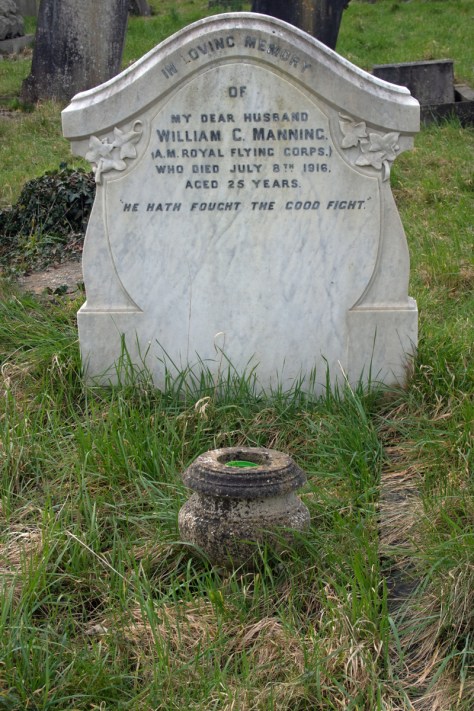
Air Mechanic William Manning

Air Mechanic William Manning

William Charles Manning – known as Willie – was born in Bridgwater in 1890, one of ten children to Samuel and Emily Manning. Samuel was a cabinet maker, and at least of three of his sons, Willie included, went into the family business.

There is little information available on Willie’s life, but he married Nellie Dodden, also from Bridgwater, in November 1915. Sadly, this was around the time that Nellie’s father passed away; tragedy for Nellie was still close by.

Willie’s military records are minimal, although details of his passing can be determined from the subsequent newspaper report.

He had enlisted in the Royal Flying Corps around October 1915, certainly around the time he and Nellie married. He was an air mechanic, something his woodworking skills probably drew him to and was based at Manston Airfield in Kent.

On 8th July 1916, Willie was a passenger in a flight piloted by Lieutenant Bidie. It seems that Bidie was turning the plane while at low altitude, while attempting to land. The plane crashed, and both Bidie and Willie were killed. Air Mechanic Manning was just 25 years old.

William Charles Manning lies at rest in the Wembdon Road Cemetery in his home town of Bridgwater, Somerset.


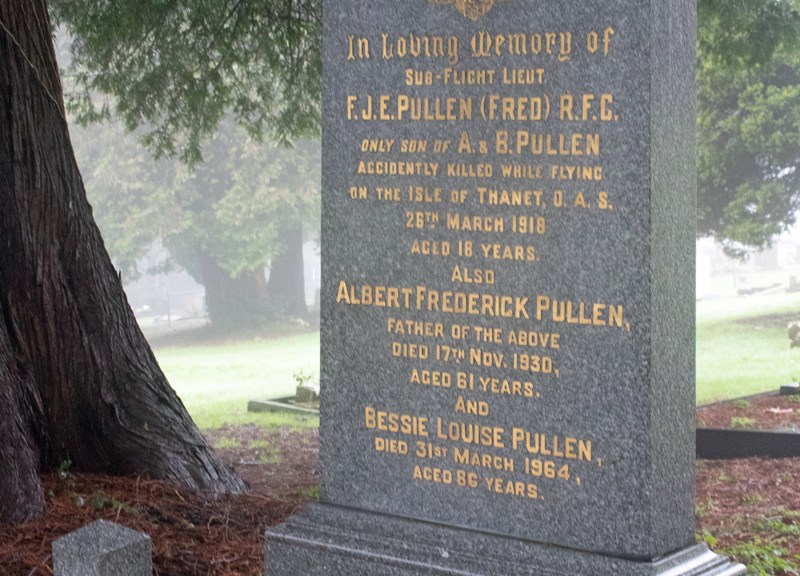
Second Lieutenant Frederick Pullen

Second Lieutenant Frederick Pullen

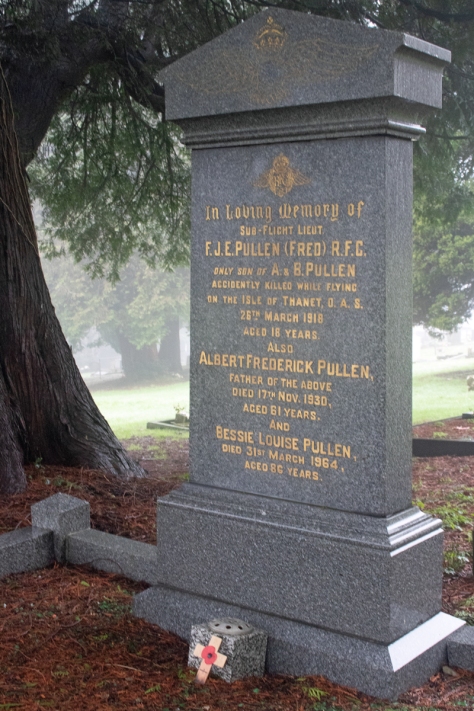
Frederick John Edward Pullen was born in May 1899, the only son to Albert and Bessie Pullen from Shepton Mallet in Somerset. Albert worked at the local prison, acting as clerk, warden and school master to the inmates.

Little else survives to expand on Fred’s military life; his gravestone confirms that he had enlisted in the Royal Flying Corps and, although no date can be attributed to this, it is likely to have been almost as soon as he turned 17.

A report of the young man’s funeral does give a little insight into the young man.


…before entering the service of his country, Lieutenant Pullen was in the Civil Service, and a letter from his late surveyor at Oxford, speaks in high terms of his character and abilities.

He graduated to the rank of Service Pilot in February last, and was gazetted in March. By the Naval authorities he was considered a very good pilot, and was graded as Class A (exemplary).

Shepton Mallet Journal: Friday 5th April 1918

Alongside the Edwardian trait of listing the chief mourners and floral tributes, the newspaper also gives an in-depth report of the cause of Second Lieutenant Pullen’s demise.


The brave young office, who was at a war school [Manston Airfield, Kent], was engaged in ‘stunting’ or trick flying, absolutely necessary in warfare, when from some unknown cause, he fell into a field, and was instantly killed.

A farmer who was ploughing near the spot said he was not conscious of the presence of an aeroplane in the vicinity till this one seemed to drop from the clouds. It nose-dived, but righted on coming near the earth, and seemed to swoop up again, but before going far turned turtle and fell, upside down.

The poor lad was found crushed beneath his gun, and had met instantaneous death. Letters received from witnesses of the accident stated that people living in the neighbourhood hurried to the spot with remedies of all sorts, and were much saddened to find that nothing that they could do was of any avail.

Shepton Mallet Journal: Friday 5th April 1918


Second Lieutenant Pullen met his death in a flying accident on 26th March 1918. He was just 18 years old.

Frederick John Edward Pullen lies at rest in the cemetery of his home town of Shepton Mallet.


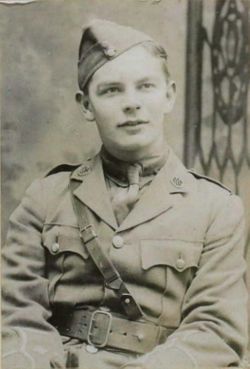
Second Lieutenant Fred Pullen (courtesy of findagrave.com)

Corporal Ossian Richards

Corporal Ossian Richards

Ossian Emanuel Richards was born in Westonzoyland, Somerset, in December 1897. He was the youngest of two children and his parents – Emmanuel and Jane – were farmers in the area.

Ossian enlisted later in the war, joining the RAF in June 1918. While little detail of his service is available, he had been a fitter before joining up, so it may well have been on the mechanical side of things that he was involved.

After nine months’ service, Ossian has been promoted to Corporal, and, with the war over, he was transferred to the RAF Reserves in March 1919.

Sadly, as with many young men of his generation, Corporal Richards succumbed to the flu pandemic that followed the war. He died on 15th September 1919, aged just 21 years old.

Ossian Emanuel Richards lies at rest in the cemetery of his home village of Westonzoyland.


Air Mechanic 2nd Class Eustace Bourne

Air Mechanic Eustace Bourne

Eustace Lionel Bourne was born in 1897, one of six children to Robert and Eve, from Westonzoyland, Somerset. Robert was a wheelwright and carpenter and, after leaving school, Eustace followed in a similar vein, becoming an apprentice to an ironmonger.

When war broke out, Eustace’s interest in engineering led him to join the Royal Flying Corps, where he was appointed as an Air Mechanic. His enlistment papers – dated November 1915 – give his trade or calling as “motor cyclist”, so it is obviously a passion that he had.

Air Mechanic Bourne was assigned to Milton Airfield near Abingdon, Oxfordshire and it was there that he served for nearly eighteen months. He seems to have enjoyed his time off as much as his time working, and boating on the Thames nearby was a hobby. Sadly, it was also to be his undoing.

On 2nd May 1917, he was out on the river at Culham Reach; the local newspaper account picked up the story.

Accidentally drowned was the verdict returned at the inquest last Saturday on Eustace Lionel Bourne, 21 [sic], attached to the mechanical department of the RFC, stationed at Milton.

It appeared that while sculling with a colleague in Culham Reach on May 2nd, he lost a scull. His companion, who had dropped a rudder-line, was turning round at the time. Deceased, in leaning over to pick up the scull, fell into the river and disappeared. It was twilight at the time, and a search was unavailing.

The other man, who could neither swim nor scull, was left in the boat, which was half filled with water.

The body was discovered on Friday morning near Sutton Weirs.

Reading Mercury: Saturday 19th May 1917

Eustace Lionel Bourne was just 20 years old when he drowned. He lies at rest in the cemetery of Westonzoyland, his home village.


Air Mechanic Hedley Chinn

Air Mechanic Hedley Chinn

Hedley Walter Chinn was born in April 1900, one of six children to Walter and Kate Chinn. Walter was the butcher in the Somerset village of Middlezoy, and this is where the family had made their home.

There is little information on Hedley’s pre-war life, beyond the two census records of 1901 and 1911. With war breaking out and his older sister Lilian dying while nursing the troops (see below), it seems that Hedley was eager to do his duty.

Within months of Lilian’s death in 1917 – and basically as soon as his age allowed – Hedley enlisted in the Royal Naval Air Service as a mechanic. He carried out his initial training on the land-based ships President II, Impregnable and Cranwell, before officially joining the newly-formed Royal Air Force in May 1918.

Air Mechanic Chinn continued his service at Calshott, where he worked as a wireless operator for the flying boats guarding the Solent around Southampton. He continued in the role for the remainder of the war and beyond.

Hedley was eventually transferred to the RAF Reserve in February 1920, when, presumably, he returned to the family home in Somerset.

Little further is evident of Hedley’s life; but he passed away less than a year after being demobbed. There is nothing to confirm the cause of his death; given he died more than two years after the war, it is likely that it was as a result of an illness, although this is a presumption on my part. Either way, he died on 2nd January 1921, aged just 20 years old.

Hedley Walter Chinn lies at rest in the peaceful graveyard of Holy Cross Church in Middlezoy, Somerset.


It is worth noting that Hedley’s sister Lilian also served – and perished as a result of the Great War. Click here to learn more.


When I was researching Hedley’s life, I ran through the contemporary newspapers to trace his name. Nothing evident came up, although Hedley’s father, Walter’s name did appear.

In 1910, he declared himself bankrupt after being unable to pay for meat for his shop, that he had bought at auction. It appears that he had run up debts of over £300 (approximately £23,500 in today’s money) over a number of years; he put these debts down to a number of factors – “illness of my children, bad debts, having to maintain my mother for 14 years; and loss on sale of Middlezoy House, Middlezoy, three years ago, which realised £200 less than the amount I gave for it, and the amount expended on improvements”.

The 1921 census found Walter and Kate still running the butcher in Middezoy, their home empty but for each other. Walter’s debts were finally cleared in 1928 and the bankruptcy annulled.


The gravestone in Holy Cross Churchyard is a haunting memorial to the tragic lives of the Chinn family.

Walter and Kat had six children, and would outlive every one of them. The stone confirms that each of their children lies in the grave:

  • Clarence Joseph (born 1891, died 1907)
  • Myrtle Amy (born 1892, died 1893)
  • Lilian Ella (born 1893, died 1917)
  • Hilda Kate (born 1895, died 1896)
  • Hedley Walter (born 1900, died 1921)
  • Hilda Godfrey (born 1903, died 1904)

The grave’s epitaph – God moves in a mysterious way, his wonders to perform – sounds cruelly hollow to 21st century ears. The only comfort to take, I guess, is that the whole family was destined to be together again: both Kate (who died in 1927) and Walter (who died in 1933) are also buried in the family grave.


Flight Lieutenant Ronald Knight

Flight Lieutenant Ronald Knight

Ronald Victor Knight was born in March 1894, the youngest of two children – both sons – to John Knight, an Ironmonger from London, and his Swiss wife, Marie.

Ronald was well educated – being taught at Wells and Bedford Grammar Schools in the UK and Neuchatel in Switzerland, not far from where his mother was born. After studying at Bristol University, he went to work at Guys Hospital in London, training as a dental student.

When war broke out, he volunteered at once, being enlisted in the 8th Battalion London Regiment. Lieutenant Knight went with his regiment to France, and was involved in the Battle of Festubert and the fighting at Loos.

Returning home towards the end of 1915, Ronald married Gwendoline Dawkes, in a ceremony overseen by the Bishop of Bath & Wells.

Rather than returning to the front line, Lieutenant Knight accepted a commission to lead a section of the London Cyclist Corps, a position he held for a year or do. While in this service, Ronald and Gwendoline had their one and only child, a little girl they called Beryl.

In 1916, Ronald accepted a further move to the Royal Naval Air Service, becoming involved in flying as a Flight Lieutenant. It was while he was based at RNAS Cranwell that he was involved in the accident that led to his death.

An inquest was held into the incident, and evidence was taken.

Air Mechanic Charles Deboo [said] that the machine had been recently inspected, and that it was alright. He did not see the deceased flying, but saw the machine come down, nose first, in corkscrew fashion. He saw it at a height of 400ft. He went to the machine after it had fallen and found the officer was dead. The machine struck the ground and smashed up, but he could not say how the accident happened.

Charles Barrett, air mechanic, said he saw the accident. The deceased seemed as if he was going to turn towards the wind to land, and, as he turned, he banked, but he never righted himself. He nose-dived and spun round to the earth. He thought he lost control as he was turning, or the wind might have caught him. The machine was smashed, except for the tail.

The jury returned a verdict that deceased accidentally met his death while flying.

Retford and Workshop Herald and North Notts Advertiser: Tuesday 20th March 1917.

Flight Lieutenant Knight died in an aeroplane crash on 12th March 1917. He was 22 years old.

Ronald Victor Knight lies at rest in Wells Cemetery, Somerset.


Sadly, Ronald’s daughter, Beryl, died in the spring of 1923, when she was only 7 years old. She is buried with her father.

Gwendoline went on to marry Henri Booth in months after the death of her daughter. The couple went on to have two children, Elizabeth and William. She requested that her late husband’s war medals be given to his father, John.


Second Lieutenant Victor Bracey

Second Lieutenant Victor Bracey

Victor Charles Edelsten Bracey was born in October 1897, the only child of William and Florence Bracey. William was a physician and surgeon, practicing in Lancashire when Victor was born. The young family soon moved south, however, and by the time of the 1901 census, they were living in Wedmore, Somerset, where William had taken up as the village’s general practitioner.

Military records for Victor are not available, but his life can readily be pieced together from newspaper reports of his death and the de Ruvigny’s Roll of Honour, published after the war.


TWO PILOTS KILLED IN THE NEW FOREST

Two air fatalities have occurred within twenty-four hours of each other in the New Forest. On Saturday [22nd September 1917] Second Lieutenant Ernest Hargrave’s machine nose-dived from the height of 200ft, and crashed to earth.

Second Lieutenant Victor Bracey was flying on Sunday morning at a height of 300ft, when his machine turned and came down in a spinning nose-dive.

At the inquests verdicts of “Death by misadventure” were returned.

Western Gazette: Friday 28th September 1917

BRACEY, VICTOR CHARLES EDELSTEN, 2nd Lieut., RFC, only child of William Edelsten Bracey, LRCP [Licentiate of the Royal College of Physicians], Lieut. (Hon.) RAMC (retired), by his wife, Florence Marion, dau. of the late James Canning Gould.

[Victor was] educated St Peter’s School, Weston-super-Mare, and Blundell’s School, Tiverton, where he was a member of the OTC [Officers’ Training Corps]; passed into the Royal Military Academy in April 1915; joined the Inns of Court OTC in December 1916; was gazetted 2nd Lieut. RFC [Royal Flying Corps] 27 April 1917, obtaining his wings in July, and was killed in an aerial accident at the Beaulieu Aerodrome, Hampshire, 23 September, while testing a new machine.

A brother officer wrote that he was a gallant gentleman and a most skilful pilot.” He was a keen cricketer and footballer, and while at Blundell’s played in the First Cricket XI and the Second Football XV, and was also captain of the First Hockey XI; later played for the Royal Military Academy, Woolwich, and the RFC Rugby Football XV at Oxford.

de Ruvigny’s Roll of Honour, 1914-1919

A note on Second Lieutenant Bracey’s Roll of Honour states that he was ineligible for medals as he saw no overseas service; this seems to have been challenged by Victor’s father in 1921, but nothing confirms whether this anything was subsequently awarded.

Victor Charles Edelsten Bracey lies at rest in the churchyard of St Mary’s in Wedmore, where his father continued to practice. He died, aged just 19 years of age.


William’s prominence in the village played a big part in Victor’s legacy. A Memorial Fund was set up; this helped fund “necessitous cases for medical requirements and for conveying patients to hospitals“. The Victor Bracey Cup was also awarded into the 1940s for sporting achievement in the schools he had attended.