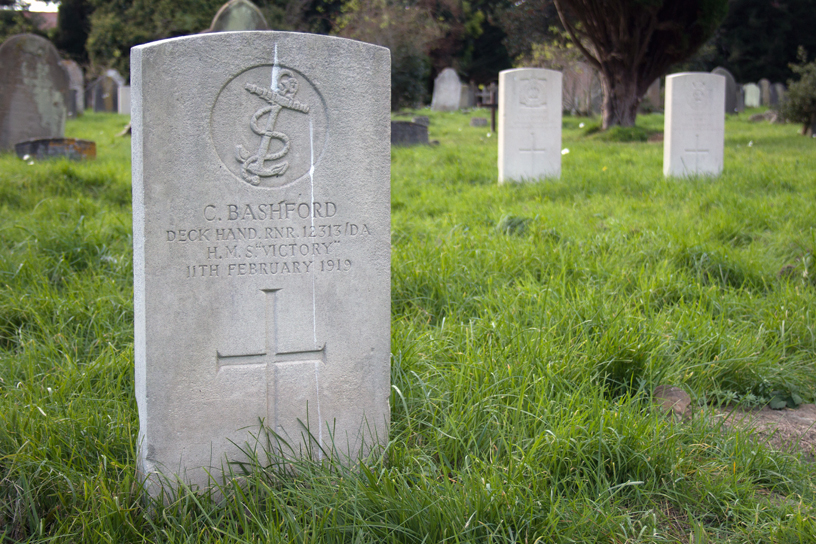
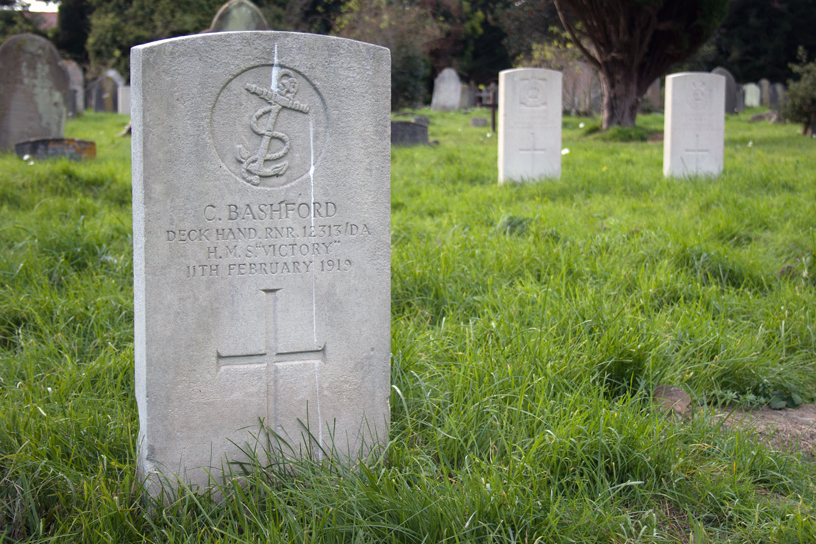
Charles Bashford was born on 10th August 1890, one of fifteen children to James and Mary Ann Bashford. James was a fisherman, and the family lived in Field Row, a narrow lane in the centre of Worthing, West Sussex.
The seaside town was a centre of fishing activity, so it is no surprise that most of James and Mary Ann’s children went into it in some way, and Charles was no exception. The 1911 census list him as the youngest of four siblings still living at home, and three of those gave their trade as fisherman, as well as James. Charles’ older brother William was the only sibling not to, and he was working as a printer.
War was coming to Europe, and, given his seafaring experience, it is no surprise that Charles sought to enlist in the Royal Navy. He joined up on 12th August 1916 and, after six weeks’ training, was assigned to the Royal Navy Reserve (Trawler Section). During his service he would have been involved in minesweeping and anti-submarine activities, using his own boat – or his family’s one – to do so.
Little further information is available for Deck Hand Bashford. He survived the war, but passed away on 11th August 1919 at the Royal Haslar Hospital, where he had been admitted, suffering from pneumonia. He was 28 years old.
Charles Bashford was brought back to his home town of Worthing; he was laid to rest in the Broadwater Cemetery there.
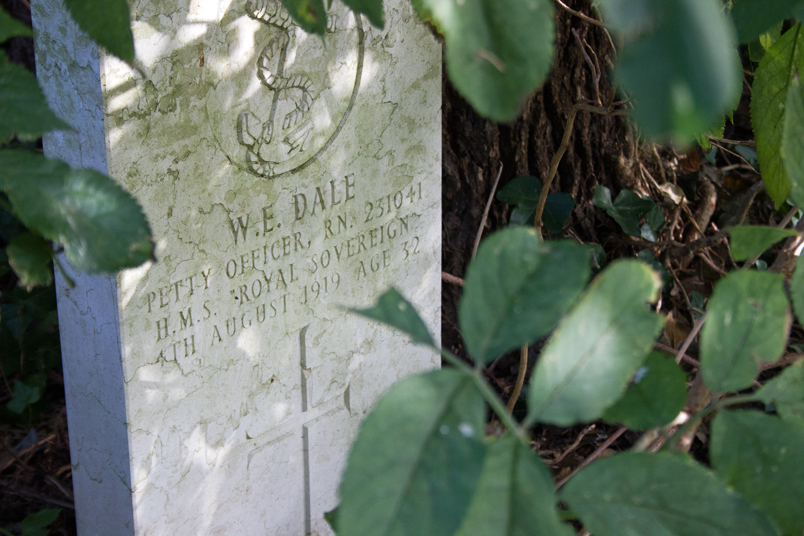
William Edmund Dale was born in Worthing, West Sussex on 25th November 1886 and was the older of six children. His father, also called William, was a carman, and he and William’s mother, Eliza, brought the family up in the Sussex town.
William Jr seems to have had a number of jobs, working as a draper’s errand boy, a milkman’s assistant and a gardener. He found his true calling at the age of 12, however, when he enlisted in the Royal Navy.
Initially acting as a Boy 2nd Class, over his initial twelve years’ employ he served on eleven vessels, and rose through the ranks to Boy, Ordinary Seaman and Able Seaman.
It was while serving on HMS Blake in 1910, that he married Mary Williams. The couple went on to have two children, William, born in 1910, and Harry, born the following year. The family set up home in Portsmouth, where the sailor was based.
With his initial service complete in 1916, William’s term of duty was extended until the end of hostilities. A promotion to Leading Seaman followed, and he was assigned to HMS Attentive, part of the Dover Patrol guard.
In 1917, William was promoted again, this time to the role of Petty Officer, and was assigned to HMS Royal Sovereign, the Navy’s new battleship. He served on the vessel for the remainder of the way, and through into the summer of 1919.
It was in the last month of his service, that Petty Officer Dale fell ill. He was taken ashore, and sent to the Royal Naval Hospital in Chatham, Kent. He had contracted meningitis, and sadly succumbed to it within days of being admitted. He died on 4th August 1919, at the age of just 32 years old.
William Edmund Dale was brought back to the town of his birth; he lies at rest in a quiet corner of the Broadwater Cemetery in Worthing, West Sussex.
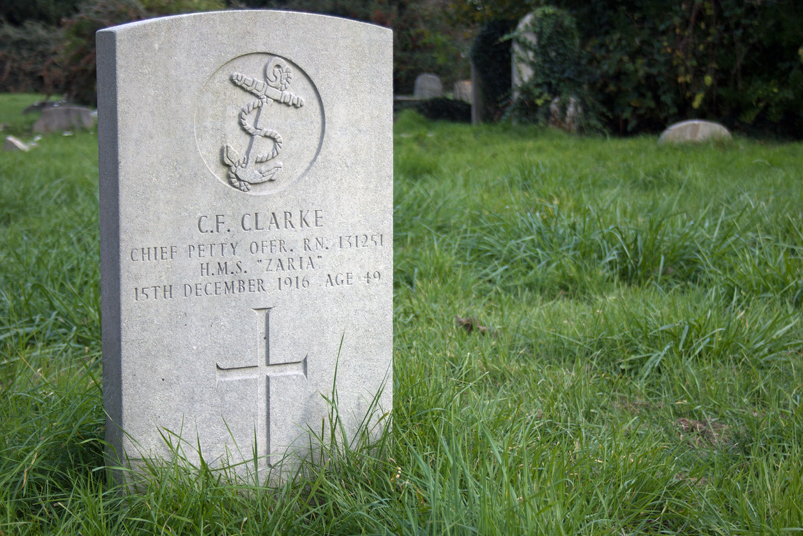
Charles Frederick Clarke was born on the 14th April 1869 to James and Jane Clarke. James was born in Suffolk, but moved to London, where he found work as a watchman (guarding the city streets at night). Jane was from Essex, and the couple went on to have five children, of whom Charles was the middle child.
Charles was set on a life of adventure, joining the Royal Navy in 1887, for a period of twelve years. During this time, he served on eleven vessels, working his way up through the ranks from Boy to Ordinary Seaman to Able Seaman, Leading Seaman and eventually Petty Officer.
In October 1895, he married Lydia Rogers, a sailor’s daughter from Portsmouth. The couple would go on to have nine children, eventually settling in Sussex.
When his naval service ended in 1899, Charles enlisted again. Within six years, he had achieved the rank of Chief Petty Officer, and in March 1909, after 22 years’ service, retired from active duty. He was obviously well respected, however, and was selected to serve on the staff of the Royal Naval Recruiting Office in Portsmouth. His service records suggest that he resigned from this role on 14th April 1914.
It seems that Chief Petty Office Clarke took on a role on the vessel HMS Zaria. This was a ship that was requisitioned by the Royal Navy, which acted as a patrol ship, guarding the coastal waters around the UK. While details are scant, Charles certainly served on board for a couple of years, and he died on board, from causes undisclosed, on 16th December 1916, at the age of 47 years old.
Brought back to West Sussex, Charles Frederick Clarke was laid to rest in the Broadwater Cemetery in Worthing. This was where Lydia was now living; she was buried in the same grave, when she passed away eight years after her husband.
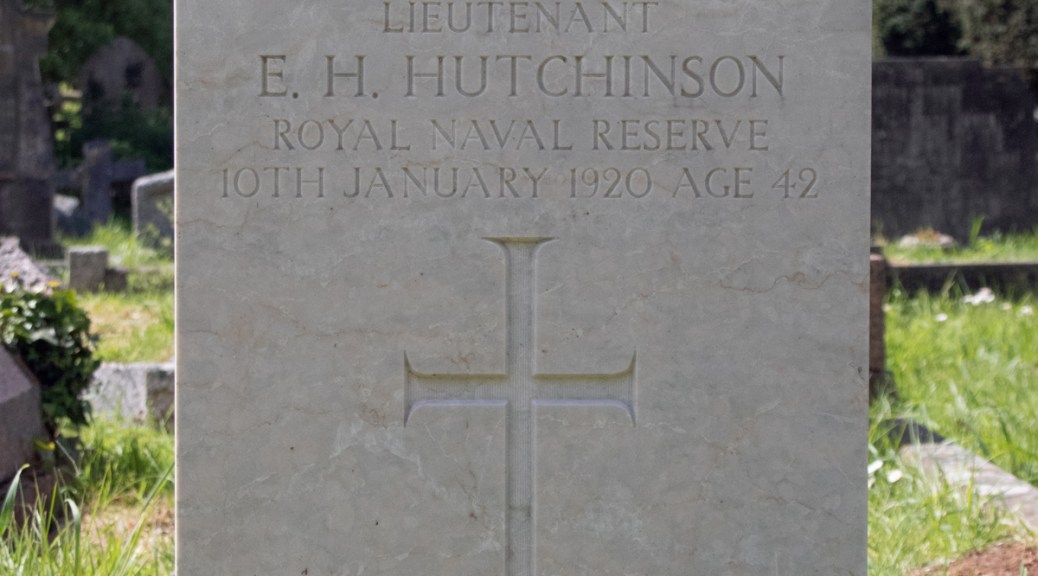
Ernest Henry Hutchinson was born in January 1878, one of four children to Dorothy Hutchinson, from Blyth, Northumberland. Details of Ernest’s father are sketchy and, by the time of the 1891 census, Dorothy seems to have been widowed and remarried, as her surname was now Alexander.
By this time Ernest was at school, and boarding with his aunt and uncle, but his siblings were all living with Dorothy and listed as ‘step-children’. Dorothy gave her employment as ‘housewife; husband at sea’, and it seems that this was likely her first husband’s job and, in fact, it would turn out to be her eldest son’s as well.
Ernest disappears from the census records for a while, but had readily taken to a life at sea. Over the next few years, he became certified as a Second Mate of a Foreign-Going Ship (1897), First Mate of a Foreign-Going Ship (1899) and Master of a Foreign-Going Ship (1904).
When war broke out, Ernest was seconded into the Merchant Navy. Sadly, his military records no longer exist, but during his time he attained the rank of Lieutenant. Ernest survived the war, and was retained as part of the Royal Naval Reserve, while continuing with his own sailing work.
At some point, Ernest married a woman called Emma Jane; documentation on the couple is scarce, so the date of the marriage is lost to time. The couple settled, however, in Weston-super-Mare, Somerset, but do not appear to have had any children.
Ernest’s maritime career continued after the war. One of his commissions was as First Mate aboard the SS Treveal. This was a new vessel in 1919, making its maiden voyage from Glasgow to the Middle East. It then sailed on to Calcutta, and was on its way back to Dundee by the beginning of 1920.
A local Cornish newspaper took up the story.
The terrible toll of 36 lives were levied by the wreck of the St Ives steamer Treveal, off the Dorset Coast on Saturday morning. The crew totalled 43, only seven surviving.
The Treveal, 5,200 tons, one of the Hain fleet of steamers, was caught by a fierce gale during Friday night and was firmly wedged on the Kimmeridge Ledge, near St Alban’s Head.
A Portland tug and Swanage lifeboat came to her assistance, but were unable to lend any practical aid, and on Saturday morning the Treveal was abandoned in favour of the ship’s boats. The latter were soon capsized and only seven of the crew succeeded in reaching the shore.
West Briton and Cornwall Advertiser: Monday 12th January 1920.
The report went into much more detail about the tragedy, including “a warm tribute to the vicar of a parish nearby, the Revd. Pearce, who stood up to his neck helping to pull the men in. The vicar tried for an hour to resuscitate the First Mate [Ernest Hutchinson], but without success.“
Another newspaper gave further information about Ernest’s funeral, and the impact of the shipwreck on his widow.
There was a simple but affecting scene in Weston-super-Mare Cemetery on Saturday afternoon, when the body of Chief Officer EH Hutchinson, one of the 35 victims in the wreck of the SS Treveal… was laid to rest.
It will be recollected that… the first tidings of his tragic fate reached the widow… through the columns of a Sunday newspaper. Only on the previous morning she had received a letter notifying the date on which the Treveal was due to reach Dundee – whither the major portion of her cargo has been consigned from Calcutta – asking him to meet her there.
Western Daily Press: Monday 19th January 1920
Ernest Henry Hutchinson drowned at the age of 42 years old. He was buried in the Milton Cemetery in his adopted home town of Weston-super-Mare in Somerset.
John Thomas Harriss was born on 22nd February 1878, one of seven children to George and Mary. George was a jeweller, who moved the family from London to Weston-Super-Mare when John was three or four years old.
Following in his father’s footsteps was not something John was going to do, and the move to the coast seemed to have sparked an interest in the sea. He enlisted for twelve years’ service in the Royal Navy in March 1900, working as a stoker.
After initial training at HMS Pembroke in Chatham, Kent, Stoker 2nd Class Harriss was assigned to HMS Terpsichore and, over the length of his service, he worked on a further ten vessels. During this time, he was promoted a couple of times, reaching the role of Leading Stoker by 1911, while he was serving aboard HMS Magnificent.
With war imminent, when John completed his period of service, his term was extended until the end of hostilities. He had, by the beginning of 1914, attained the rank of Stoker Petty Officer, and was assigned to HMS Russell.
After the start of the war, this ship was assigned to the Grand Fleet and worked on the Northern Patrol, and in November 1914, she bombarded German-occupied Zeebrugge. The following year, HMS Russell was sent to the Mediterranean to support the Dardanelles Campaign, though she did not see extensive use there.
On 27 April 1916 HMS Russell was sailing off Malta when she struck two mines laid by a German U-boat. Most of her crew survived the sinking, though 125 souls lost their lives. Stoker Petty Office Harriss was one of the survivors; his service records note that he was ‘commended for [the] great coolness shown on the occasion of the loss of HMS Russell’.
Brought back to the UK, John contracted pneumonia, and spent time at home with his family, in Weston-Super-Mare. It was here, sadly, that he was to succumb to the lung condition, and he passed away on 7th June 1916. He was 38 years old.
John Thomas Harriss lies at rest in Milton Cemetery in Weston-Super-Mare.
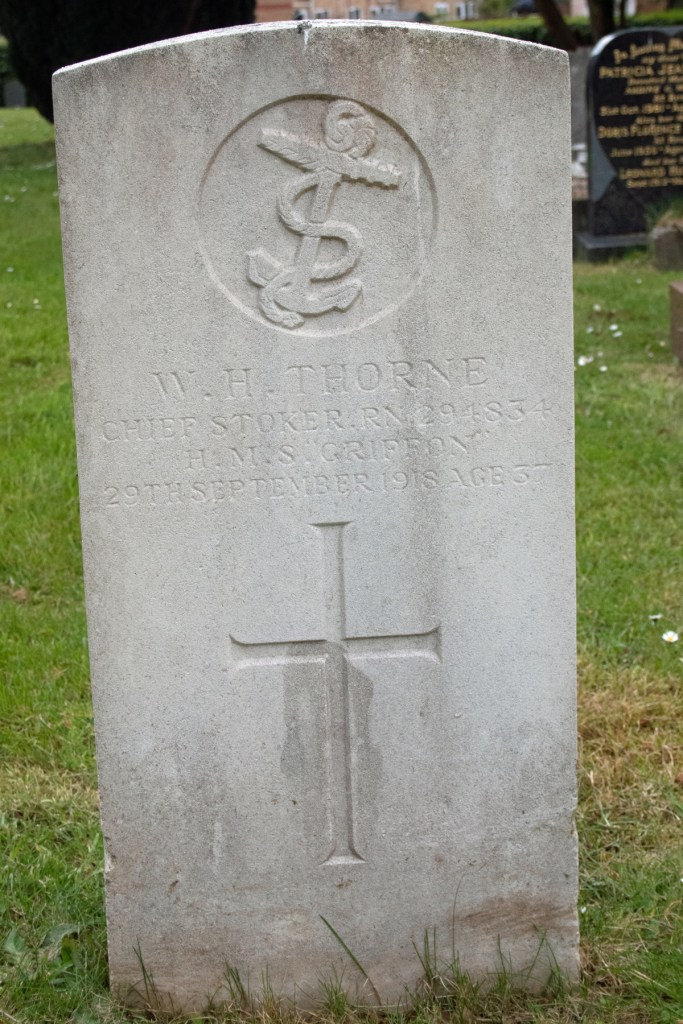
William Henry Thorne was born on 28th July 1881 in the Somerset village of Milverton. He was the oldest of five children to farm labourer Henry Thorne and his wife Mary.
William was a young man with a keen sense of adventure. In February 1900, he joined the Royal Navy as a Stoker. After his initial training in Devonport, he was assigned to HMS Thunderer and, after six months, joined HMS Hood, where he spent the next two years.
Over his twelve years of his service, Stoker Thorne served on six further vessels, attaining the rank of Stoker Petty Officer.
In 1907, William had married Mabel Cross, a young woman from Taunton. While her husband was away from England – the marriage certificate gives his address as ‘on the high seas’ – she set up home near the centre of town. The young couple went on to have two children, twins Phyllis and Doris, who were born in 1911.
Back at sea, and Stoker Petty Officer Thorne’s terms of service were extended in 1912, so that he would continue to be a part of the Royal Navy until the cessation of hostilities. He served on a further six vessels and was promoted to Chief Stoker in June 1917.
It was while he was serving on HMS Griffon in the autumn of 1918 that William fell ill. Brought back to shore, he was admitted to the Military Hospital in Taunton. There is nothing to confirm the illness he contracted, but it was one he would succumb to. Chief Stoker Thorne passed away on 29th September. He was 37 years old.
William Henry Thorne lies at peace in the St James Cemetery in his home town of Taunton.
Cecil Walter Thomas Scribbens was born on 27th June 1885 in Taunton, Somerset. He was one of five children to George and Ann Scribbens. Sadly, George passed away when Cecil was a toddler, leaving his widow to raise her young family alone.
Ann initially found work as a laundress, and her eldest daughter, Alice, began working at the local silk mill when she left school. This brought in a little money, but with five children to feed and clothe, it must have been a struggle.
In 1894, Ann found love again, and married George Sully, a scull labourer, on Christmas Day 1894. The couple went on to have a child together, a son they called Arthur, and the new family set up home in Taunton.
When he left school, Cecil found work as a labourer, but he had a sense of adventure and a life on the ocean was calling him. In July 1903 he joined the Royal Navy as a Stoker 2nd Class and, after his initial training in Plymouth he was assigned to HMS Russell.
Stoker Scribbens’ term of service was twelve years and, during that time, he served aboard five vessels, and was promoted to Leading Stoker. War had broken out when his initial contract ended, so it was extended until the end of the hostilities.
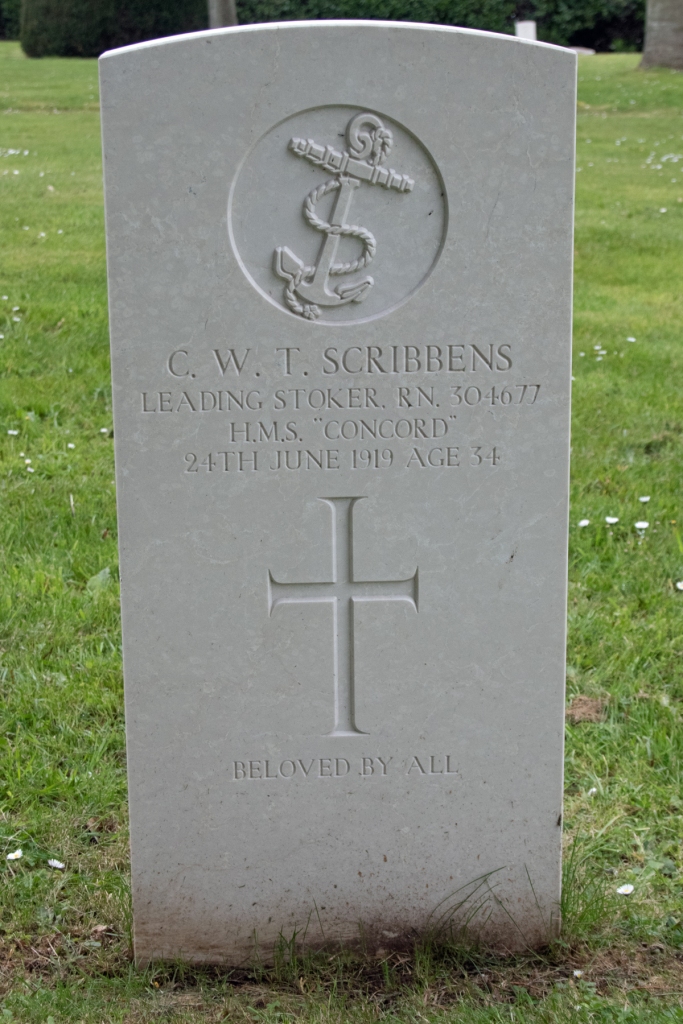
After five years aboard HMS Cornwall and eighteen months on HMS Cleopatra, Leading Stoker Scribbens was assigned to HMS Concord, which would turn out to be his last vessel, in December 1916. He stayed with this ship for nearly three years until falling ill in June 1919.
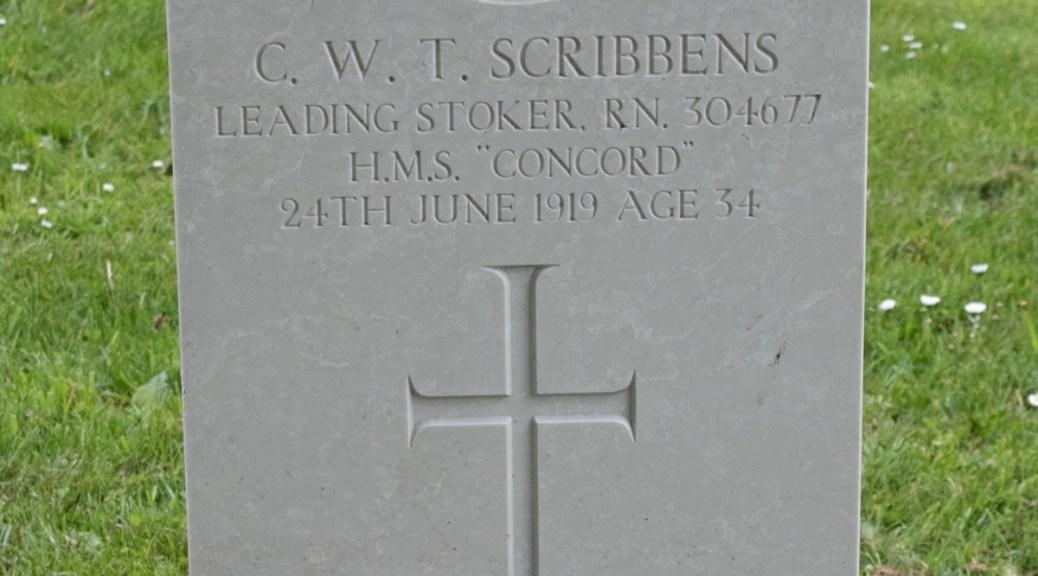
Brought back to England, he was admitted to the Military Hospital in Taunton with pneumonia. Leading Stoker Scribbens died from this lung disease on 24th June 1919, at the age of 34 years old.
Cecil Walter Thomas Scribbens was laid to rest in the St James’ Cemetery in his home town.
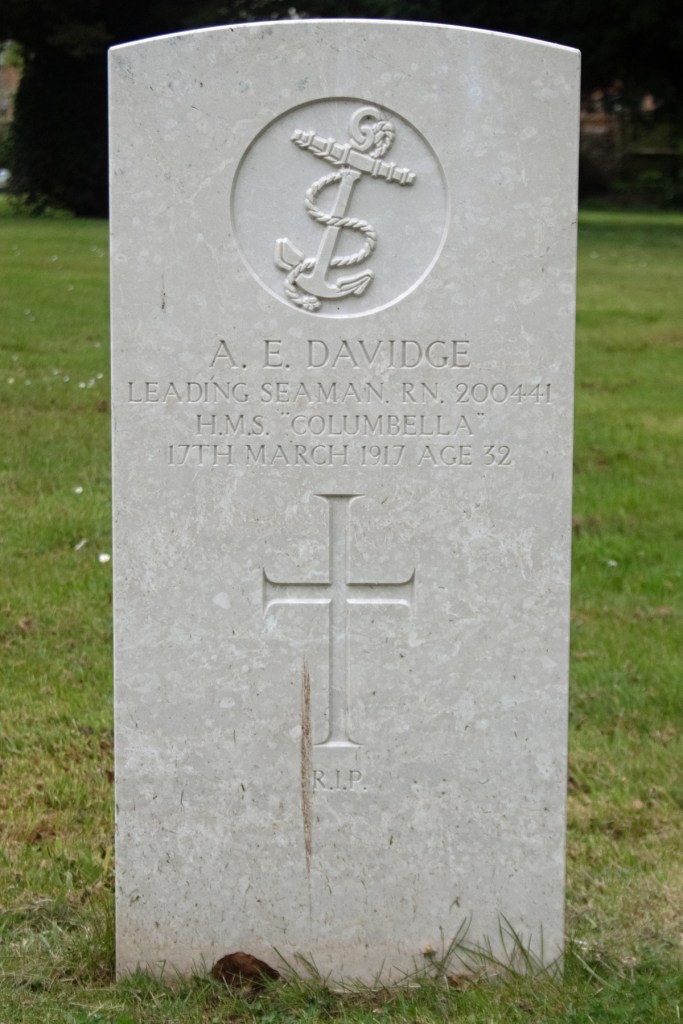
Alfred Ernest Davidge was born on 22nd July 1882, one of six children to Richard and Ermina. Richard was a boilermaker from Bristol, but brought his family up in the Wiltshire town of Swindon.
Alfred was keen on adventure, and sought out a live on the open seas. In August 1898, at the age of sixteen, he joined the Royal Navy. After serving two years at the rank of Boy, he officially enlisted for a term of twelve years.
Starting as an Ordinary Seaman, Alfred had worked his way up to Leading Seaman by 1905. He continued in this role until 7th June 1909, when he was knocked back a rank for misconduct. He evidently realised the error of his ways, however, as, just over a year later, he was promoted again.
Leading Seaman Davidge’s term of service came to an end in July 1912, and, having been assigned to seventeen vessels during that time, he became part of the Royal Naval Reserve.
Back on home soil, and Alfred set up home in Taunton. He found work as a labourer and, in October 1913, married local lady Louisa Pomeroy. The couple went on to have a daughter, Hilda.
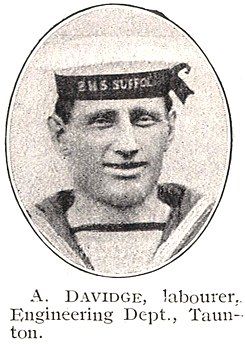
Storm clouds were gathering over Europe by now, and Alfred was soon recalled to the Royal Navy. He took up his previous role, and, after a period of training at HMS Vivid in Plymouth, he was assigned to HMS Suffolk.
Leading Seaman Davidge spent eighteen months aboard HMS Suffolk (during which time the photo below was taken), before being transferred to HMS Columbella in November 1916. His time there was short, however, as he became unwell.
Admitted to the Royal Infirmary in Glasgow with influenza, Leading Seaman Davidge sadly succumbed to the condition on 17th March 1917. He was 34 years old.
Alfred Ernest Davidge was brought back to Taunton for burial. He lies at rest in the St James Cemetery in the town.
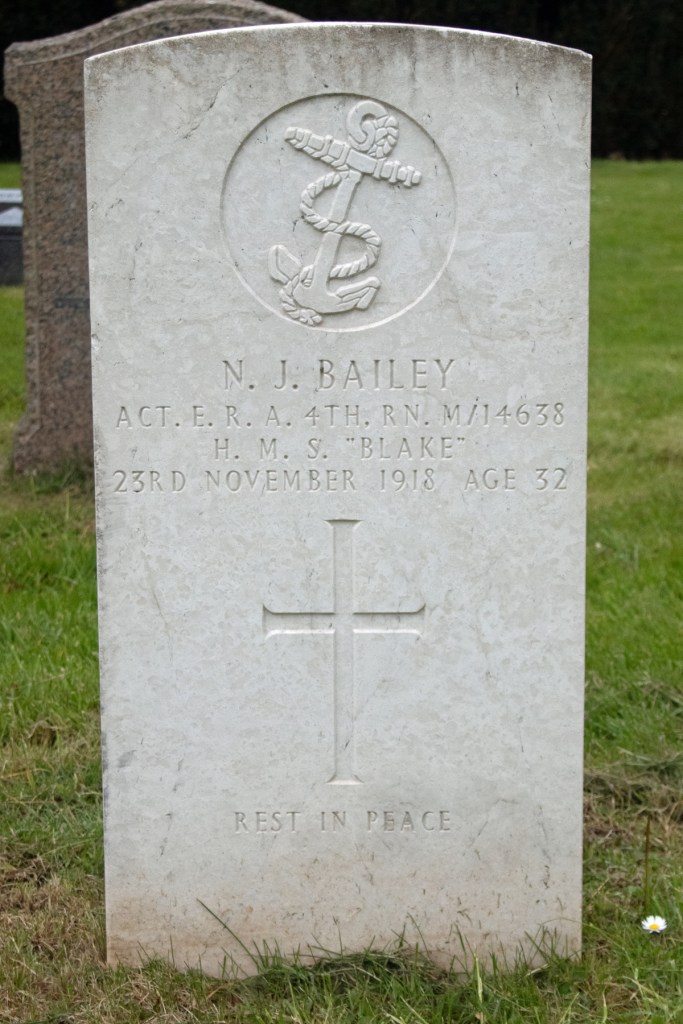
Newman Joynt Bailey was born on 1st August 1887, the eldest of five children to Newman Bailey and his wife Anna (née Joynt). Newman Sr worked as a switchman and signalman for Great Western Railway and had been born in Bath. He married Anna (whose maiden name was Joynt, and who had been born in Ireland) in 1885 and, after a short stint living across the county border in Devon – where Newman Jr was born – he settled his young family in Taunton.
When Newman Jr left school, he became an office boy, but he soon found himself following in his father’s footsteps. He became a fitter for the railways and, by 1910, was living with spitting distance of the GWR depot in the town.
It was here, in William Street, that he set up home with his new wife, Lily Gill, who he had married on 31t July 1910. Lily was the daughter of a Taunton lamplighter, and, to help make ends meet, worked as an ironer at the town’s collar factory.
War was on the way, and in July 1915, Newman enlisted in the Royal Navy. After initial training aboard Vivid II, the shore establishment in Devonport, he was deployed on HMS Blake as an Engine Room Artificer.
HMS Blake was an auxiliary ship designed to provide maintenance support to a flotilla of destroyers or other small warships. With his experience with steam engines at GWR, his knowledge of mechanics would have made him ideally suited to this type of role.
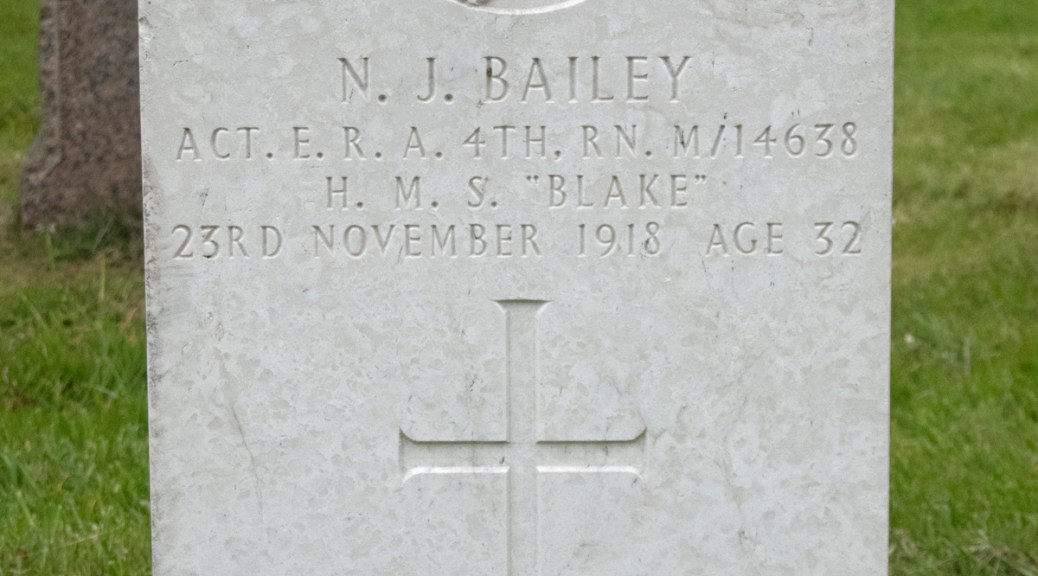
While he survived the war, Artificer Bailey was to be struck down with something much closer to home. In the immediate post-war period, the Spanish Flu pandemic swept the globe, and Newman was to fall victim to it. Admitted to the Royal Naval Hospital in South Queensferry, near Edinburgh, he passed away from the lung condition on 23rd November 1918. He was just 32 years old.
Brought back home, Newman Joynt Bailey was laid to rest in St James Cemetery in his home town of Taunton.
Ernest Frederick Hawkins was born in Street, Somerset, in 1884. He was the youngest of six children to Charles Hawkins and his wife Elizabeth. Both of Ernest’s parents were shoemakers in the Clark’s Factory in the town, and this was the trade Elizabeth continued in after her husband’s death in 1887.
Ernest’s life has some mysteries about it and there is a sense that he spent time trying to escape from something. In August 1904, he enlisted in the army, joining the Scottish Rifles (also known as the Cameronians). He did this under an assumed name, preferring to be called James Fisher.
“James” gave his next of kin as his parents, listing them as George and Annie in South Acton (even though these were not his actual parents’ names, and that his father had passed away 17 years previously).
His enlistment papers give an interesting insight into the young man. He was listed as 22 years old, 5ft 4ins (1.62m) tall, with brown eyes, black hair and a sallow complexion. His arms were adorned with a number of tattoos, including Buffalo Bill on his upper right arm and a ship surrounded by flags on his upper left.
Private Fisher served for a year on home soil, before being shipped out to India. He returned to the UK in October 1907, and transferred to the Army Reserve.
Ernest returned to Somerset, and it was here that he met Sarah Jane Manning. The couple married in a registry office in Bristol, and went on to have two children, Hubert and Iris.
War broke out, and Private Fisher was remobilised. By August 1914 he was promoted to Lance Corporal, and sent to France as part of the British Expeditionary Force. Here he became caught up in a number of the key battles of the conflict.
On 24th July 1916, during the British attacks on High Wood at the Somme, he was wounded in the right arm, and invalided back to England for treatment. Admitted to the War Hospital in Guildford, Surrey, it was confirmed that he had received a gun-shot wound to his right arm, which had resulted in a compound fracture of the humerus, radius and ulna. Sadly for Ernest, the only option was a full amputation of his right arm.
After some time to recover, Ernest was transferred to the Pavilion Military Hospital in Brighton where he was fitted for an artificial limb. He spent three months in the Brighton facility, before being moved to the Queen Mary’s Convalescent Home in Roehampton to recuperate. He was eventually discharged – from the hospital and the army – on 10th March 1917, and returned to his wife and family in Somerset.
There is little further documented information about Ernest. He and Sarah went on to have a further child – Leslie – in 1917. Sadly, where Ernest had been a toddler when his father had died, Leslie was consigned to be a babe-in-arms when Ernest passed away.
Ernest Frederick Hawkins – also known as James Fisher – died in Swindon on 2nd July 1918, at the age of 34. He lies at rest in St Mary’s Cemetery in his adopted home town of Taunton, Somerset.
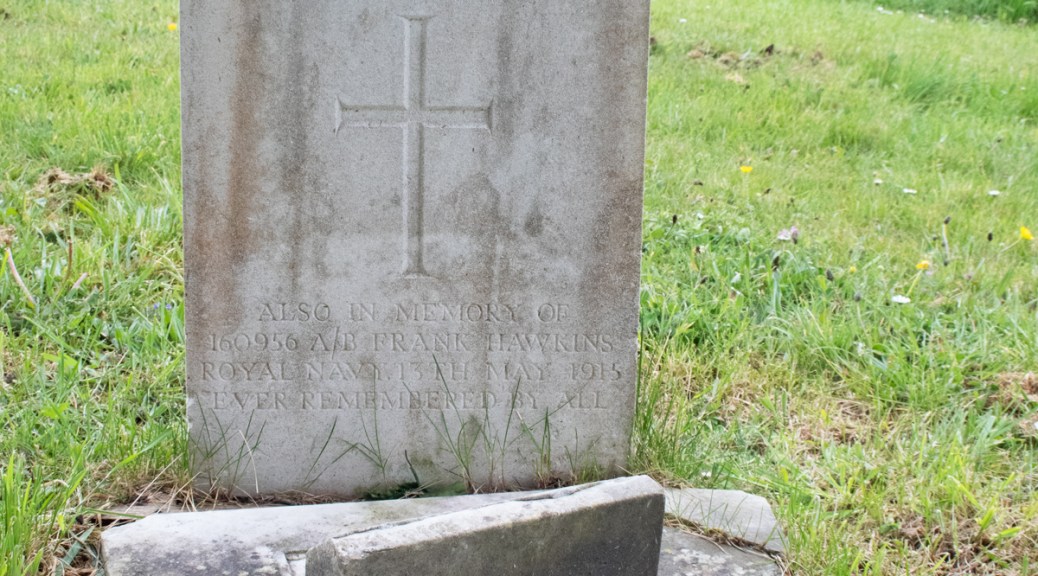
Ernest’s gravestone also commemorates his brother Frank Hawkins. Frank was nine years older than Ernest, and, like his younger brother, had decided that the military life was for him.
Frank enlisted in the Royal Navy in November 1894 and was assigned a Boy 2nd Class on HMS Impregnable – the training ship based in Chatham, Kent. Over the period of his twelve years’ service, Frank rose through the ranks to Able Seaman. When his term was up, he joined the Royal Fleet Reserve for a further five years.
When war came, Able Seaman Hawkins was immediately called back into action. He was assigned to HMS Goliath, serving off German East Africa and the Dardanelles. On the night of the 12th May 1915, the ship was guarding the water off Gallipoli, when it was struck by three Ottoman torpedoes. The resulting explosions caused the ship to sink quickly, and 570 souls – out of a total complement of 750 crew – were lost.
Able Seaman Hawkins was one of those lost, and was subsequently commemorated on his brother’s gravestone.







 Death and Service