Tag Archives: Suffolk

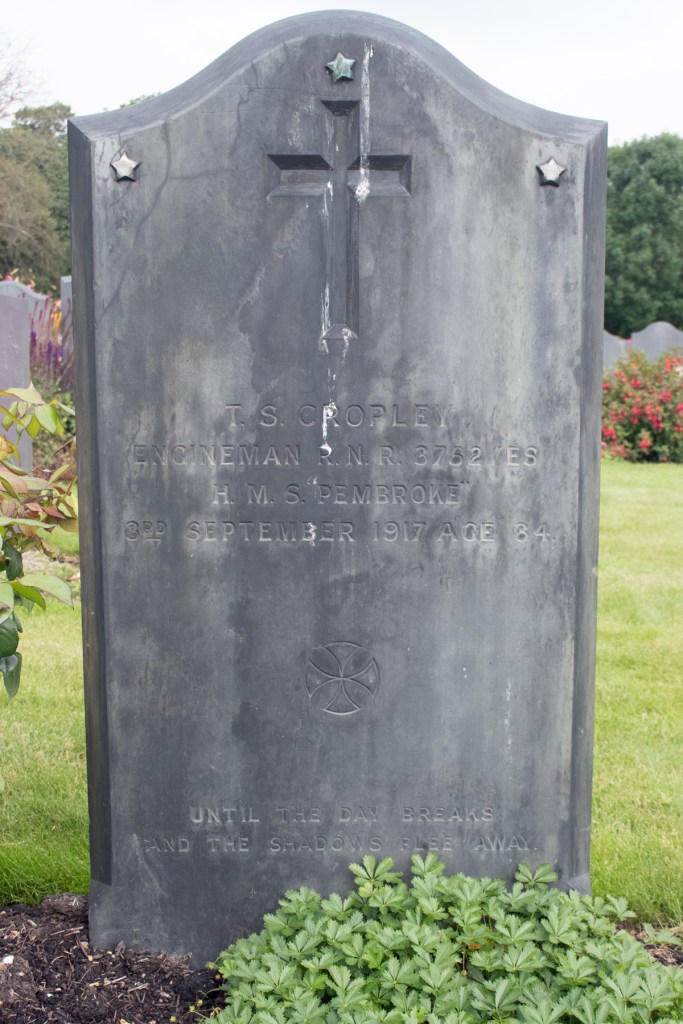
Engineman Thomas Cropley

Engineman Thomas Cropley

Thomas Samuel Cropley was born on 16th November 1882 in the Suffolk village of Mutford. The fifth of eight children, his parents were Robert and Hannah Cropley. Given Mutford’s proximity to the Hundred River Hundred and the coastal town of Lowestoft, it is little surprise that Thomas’ father was a ropemaker. Hannah was also employed, the 1901 census recording her as a monthly nurse – helping women during the month after childbirth.

Thomas’ location to the coast made fishing an ideal choice of work for him, and when he left school he followed his three older brothers into the trade. Indeed, he listed his trade as a deep sea fisherman on his marriage records.

As a young man, he had met bricklayer’s daughter Edith Tuttle, and they tied the knot on 29th May 1906. The couple set up home in Factory Street, Lowestoft, and went on to have seven children.

Sadly, little information on Thomas’ wartime service remains documented. His knowledge of boats and the sea made the navy an obvious option for him, and he enlisted in the Royal Naval Reserve.

Engineman Cropley was assigned to HMS Pembroke – this Royal Naval Dockyard at Chatham in Kent. While it is likely that he served on ships as well, this is certainly the base to which he returned.

Thomas found himself based here in the summer of 1917, which was a particularly busy place at that point in the war. Additional accommodation was desperately needed and he found himself billeted at Chatham Drill Hall, away from the main barracks.

By 1917, the German Air Force had suffered huge losses during the daylight bombing raids it had been undertaking. It was imperative for them to minimise these losses, and so a new tactic – night time raids – was employed.

The first trial of this approach was on the night of 3rd September 1917, and Chatham suddenly found itself in the firing line, startlingly unready and fundamentally unprotected. One of the German bombers landed a direct hit on the Drill Hall, and Engineman Cropley was killed. He was just 34 years old.

Ninety-eight servicemen perished during the Chatham Air Raid that night. They were buried in a mass funeral at the Woodlands Cemetery in nearby Gillingham. This, too, is where Thomas Samuel Cropley was laid to rest.


The lives of Thomas’ family outlines a lot about living conditions in the late nineteenth and early twentieth centuries, with a large number of his relatives dying young.

His father was 68 when he died in 1916; Hannah had passed away fourteen years before, when she was 56 years old. Of his siblings, two did not survive childhood, one died their 20s, one was aged 40, while three reached their late sixties.

Thomas’ widow died in 1921, at the age of 35; their two youngest children died before their first birthdays. Of the other five, one was 31 when he died, while the others lived much longer – one was in their mid-70s, two in their eighties, and the oldest reached her hundredth birthday. A varied legacy indeed.


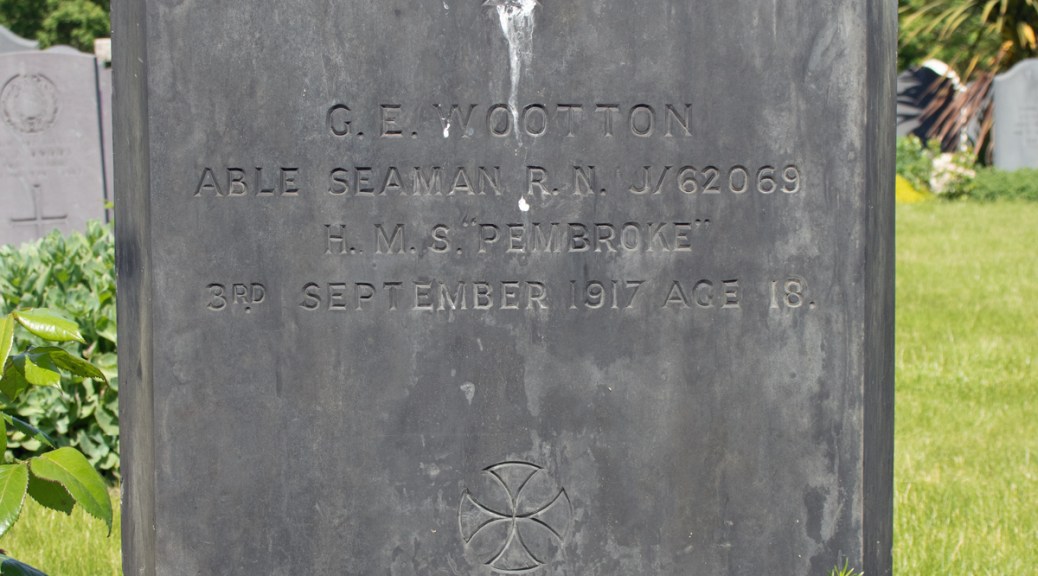
Able Seaman Gregory Wootton

Able Seaman Gregory Wootton

Gregory Ernest Wootton was born on 28th October 1898, the only child of Henry and Isabella Wootton. The family lived in East London, and the year of Gregory’s birth was a challenging one. His parents married that year, and Henry also passed away, leaving Isabella to raise her son on her own.

She was made of stern stuff, however, and moved back in with her father, Joseph, while finding employment as a florist, working with artificial flowers. By 1909, Isabella had remarried, wedding policeman Harry Mee, and moving to South London, where the couple had a child of their own, Gregory’s half-brother, Leonard.

War was edging close to Europe, although Gregory was underage when hostilities broke out. By late 1916, however, this was no longer the case, and he was drawn to the Royal Navy. On 6th November, he gave up his job as a case maker, and enlisted as an Ordinary Seaman. His sign-up papers show that he stood 5ft 4ins (1.62m) tall, had brown hair, brown eyes and a fresh complexion.

Ordinary Seaman Wootton’s first posting was at HMS Pembroke, the shore-based establishment at the Naval Dockyard in Chatham, Kent. After a couple of months, he was moved north, to HMS Ganges, which was a similar training base in Suffolk. While here, he was promoted to Able Seaman.

In June 1917, Gregory was on the move again, returning to Chatham. While here, at a particularly crowded time for the dockyard, he was billeted at the nearby Drill Hall. On the night of the 3rd September, while resting, the first German night raid dropped bombs on Chatham, directly hitting the Drill Hall. Able Seaman Wootton was killed instantly. He was just 18 years of age.

Gregory Ernest Wootton was laid to rest in the Woodlands Cemetery in nearby Gillingham. He was buried with the other 97 victims of the Chatham Air Raid.


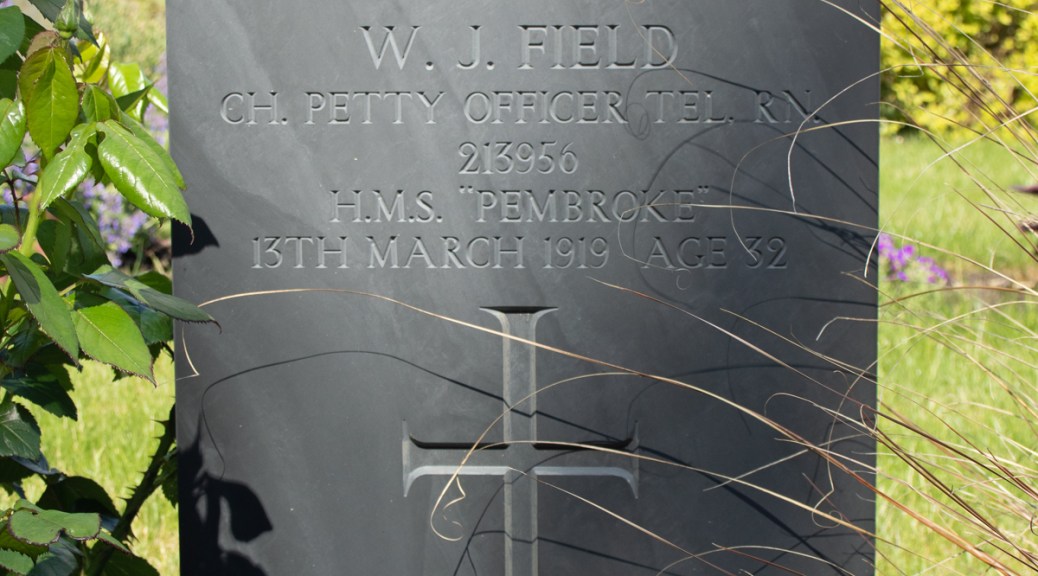
Chief Petty Officer Telegraphist William Field

Chief Petty Officer Telegraphist William Field

William John Field was born on 8th October 1885 in Boston, Lincolnshire. The eldest of four children, his parents were Charles and Ellen. Charles was a boatman for the coastguard; his job, by the time of the 1891 census, had taken the family to the village of Dawdon on the County Durham coastline.

Given his father’s job, it is not unsurprising that William was destined for a life at sea. As soon as he left school in the spring of 1901, he joined the Royal Navy and was sent to HMS Ganges, the shore-based training establishment in Suffolk. Being underage, he was initially assigned the role of Boy, moving, after a year, to HMS Pembroke, also known as the Naval Dockyard in Chatham, Kent.

By November 1902 Boy Field was moved to HMS Venerable, a ship that was to be his home for the next three years. During this time, William came of age, and was formally enrolled in the Royal Navy as a Signalman. He evidently worked hard on the Venerable, rising through the ranks to Qualified Signalman and Leading Signalman.

In June 1905, William was moved to HMS Leviathan, where he was again promoted, to Second Yeoman of Signals, before again being assigned to Chatham Naval Dockyard six months later.

While based in Kent, William met Nelly Watt, the daughter of a labourer at the dockyard. The couple married in 1906, and went on to have four children.

Over the next few years, the now Petty Officer Telegraphist Field spent an almost equal amount of time at sea and on shore. War was coming and when his initial term of service came to an end in October 1915, he immediately renewed his contract through to the end of the hostilities.

All of William’s time was now spent on land, primarily at HMS Pembroke, but also at HMS Actaeon in Portsmouth, HMS Victory VI at Crystal Palace, London and HMS Bacchante in Aberdeen.

While Chief Petty Officer Telegraphist Field’s naval service records are quite detailed, his passing is anything but. The war over, he moved back to Chatham Dockyard in January 1919. At some point he was admitted to the Royal Naval Hospital in the town, and died from ‘disease’ on 13th March that year. He was just 33 years of age.

William John Field was laid to rest in the Woodlands Cemetery in nearby Gillingham.


A sad aside to the story is that, at the time of he husband’s death, Nellie was pregnant with the couple’s fourth child. John William Field was born on 16th October 1919, destined never to know his father.


Petty Officer William Coughlan

Petty Officer William Coughlan

William Henry Coughlan was born on 16th November 1891, one of thirteen children to William and Catherine Coughlan. William Sr was a labourer, born and bred in the East End of London, who raised his family in Hackney.

William Jr seemed keen for a way to improve himself and in May 1909, enlisted in the Royal Navy. Initially given the rank of Boy, this was due to his age; on his eighteenth birthday a few months later, he was formally enrolled in the navy as an Ordinary Seaman.

To begin with, he was billeted at HMS Ganges II, the shore-based training ship in Harwich, Suffolk, but within a matter of weeks he was on board a sea-going destroyer, HMS Antrim.

Ordinary Seaman Coughlan was obviously a keen young man; by the time the Great War broke out, he had served on four further ships, as well as another shore base, HMS Pembroke I. He rose through the ranks to Able Seaman and, by 1915, had reached the role of Leading Seaman.

Most of his service was spent upon HMS Agamemnon, initially in the Channel, but was then moved to the Mediterranean. On the night of the 5th May 1916, the ship was moored in the harbour at Thessaloniki (Salonika). A Zeppelin, the LZ55, made a bombing raid, but when the searchlights caught it, the Agamemnon fired on it and hit the aircraft, breaking it in two. It crashed in the swamps around the Vardar river and its crew were captured.

Leading Seaman Coughlan remained on the Agamemnon, before returning to England in November 1917, where he received further training at the Naval Dockyard in Chatham. He was promoted to Petty Officer a couple of months later, and began three years of shore- and ship-based service.

In the summer of 1921, while again based in Chatham, he contracted pneumonia, succumbing to the lung condition in a matter of weeks. Petty Officer Coughlan died on 26th July 1921, aged just 29 years old.

William Henry Coughlan was laid to rest in the Woodlands Cemetery in Gillingham; within walking distance of the naval base that had become his home.


Officer’s Steward 2nd Class Frederick Shiplee

Steward 2nd Class Frederick Shiplee

Frederick John Shiplee was born on 15th November 1895 in the Essex town of Harwich. The oldest of eight children, his parents were Frederick and Matilda. Frederick Sr worked as a carter for the local railway, while his son found employment as a butcher’s errand boy when he left school.

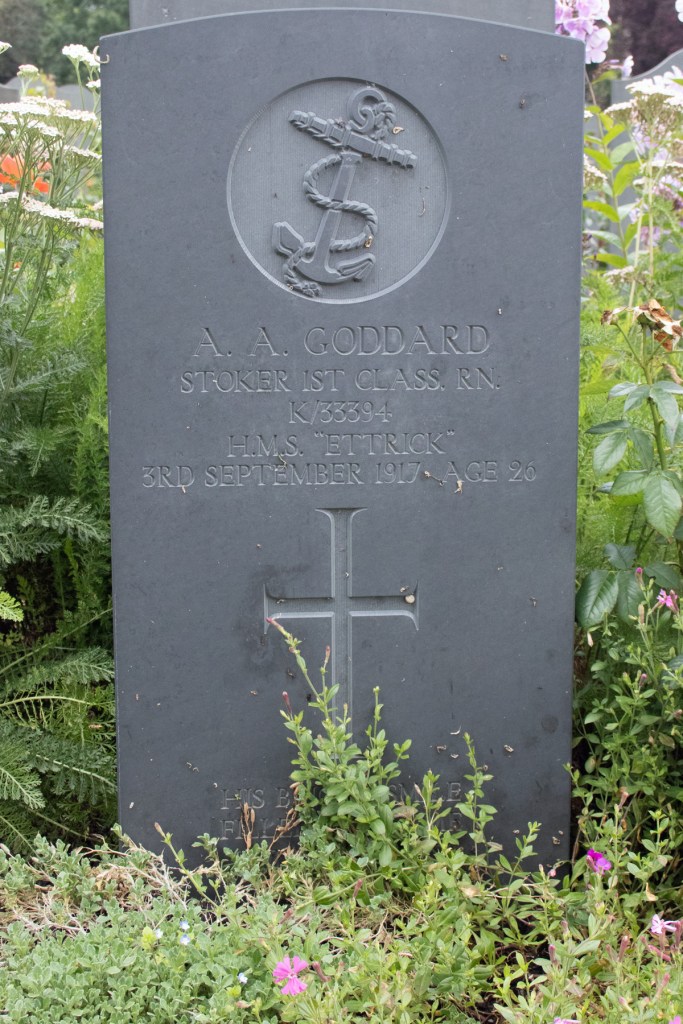
In November 1913, having just turned 18, Frederick Jr enlisted in the Royal Navy as an Officer’s Steward, and spent three years training and serving on board HMS Ganges, the shore establishment at Shotley, near Ipswich.

From Suffolk, Frederick moved to Kent, and was based at the HMS Pembroke in Chatham. From here, he was involved in trips on HMS Spey, an old river gunboat that had been converted for use as a diving tender. It was during one of these trips that tragedy struck.

STORY OF A COLLISION IN THE THAMES

Mr CB Sewell resumed the inquest at Chatham, on Monday, on the 13 naval men who lost their lives after a collision between the London County Council steam hopper Belvedere and an old naval vessel in the Thames on March 7th [1917]…

The collision occurred shortly before four o’clock in the afternoon, the weather being bitterly cold and boisterous, and the sea extremely rough. The men, who had taken to a raft, were drifting about till 9pm before the raft was driven ashore. On the raft, when discovered, were a pile of dead men, who had been rendered unconscious by the cold and subsequently drowned through the raft being partly submerged. Lieutenant Humphreys, Royal Naval Reserve, and the other officers were all drowned. In all, 30 of the 37 members of the ship’s company lost their lived, and several bodies have not been recovered. Thirteen of the ship’s crew managed to get ashore at Sheerness in the cutter and three reached the shore at the Isle of Grain in the gig, while one was saved by the hopper.

Arthur George Chick, able seaman, said he was at the wheel of the naval vessel, which was steaming up river at six knots an hour to secure shelter from the weather. Lieutenant Humphreys and a warrant officer were on the bridge, and there were two look-out men. All were now missing. He saw the hopper coming down the river when she was two miles away. When the vessels were nearing each other, the hopper suddenly altered her course to starboard. The witness then altered his course to port by his officer’s orders, but the hopper crashed into his ship, stroking it a glancing blow in line with the forepart of the bridge on the starboard side. The ship sank in three minutes.

Alfred Rawlings, leading signalman, stated that the hopper changed her course when almost abreast of the naval vessel. The hopper’s alteration of course was, he considered, the cause of the collision.

Henry Davies, second officer, and Joseph Beard Hasdell, master of the hopper, gave evidence that they considered the collision was caused through the naval vessel’s error of judgment in starboarding, instead of going to port. The hopper, they stated, ported its helm in accordance with the ‘rule of the road’.

South Eastern Gazette: Tuesday 27th March 1917

While not mentioned in the newspaper report for security reasons, the ‘old naval vessel’ was, in fact HMS Spey. Annoyingly, I can trace no further report of the inquest, other than the conclusion that the deaths were due to drowning following a collision at sea.

Officer’s Steward Shiplee was one of the twenty men who died that day. He was just 21 years of age.

Frederick John Shiplee’s body was laid to rest in the Woodlands Cemetery in Gillingham, not far from the Naval Dockyard in Chatham, where he had been based.


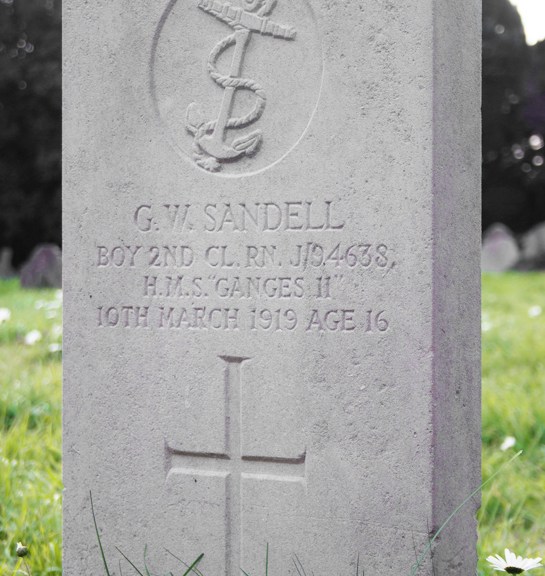
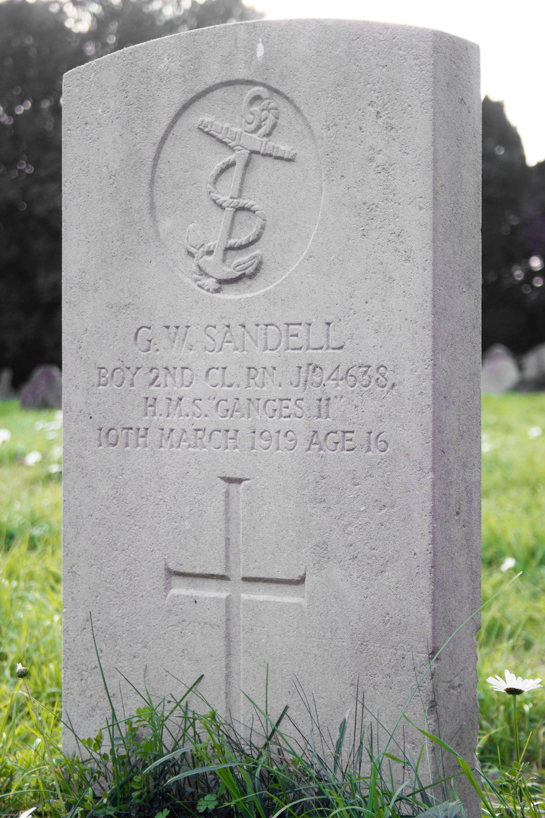
Boy 2nd Class George Sandell

Boy George Sandell

George William Sandell was born on 13th August 1902, the oldest of five children to William and Mary Sandell. While George was born in Chichester, William raised the family in Worthing; he was a carpenter and joiner by trade, and came from a local building family.

When George left school, he found work as a porter on the railways. Too young to be directly involved in the 1914-1918 conflict, he was definitely for adventure, and, on 5th February 1919, he enlisted in the Royal Navy.

Assigned the rank of Boy – because of his age – he was sent to HMS Ganges II, a training establishment in Suffolk. His decision to enlist was set to be young George’s undoing; within weeks he had contracted pneumonia, and he passed away on 10th March 1919. Tragically, he was just 16 years old.

William and Mary brought their boy back to Worthing; he was buried in the Broadwater Cemetery there, within walking distance of their home.


For me, a huge coincidence to this story is that I lived in the house George was brought up in. He was raised at 27 Southfield Road, in Worthing, up until he was sent for training in 1919. I lived at the same address for a number of years in the early 2000s.


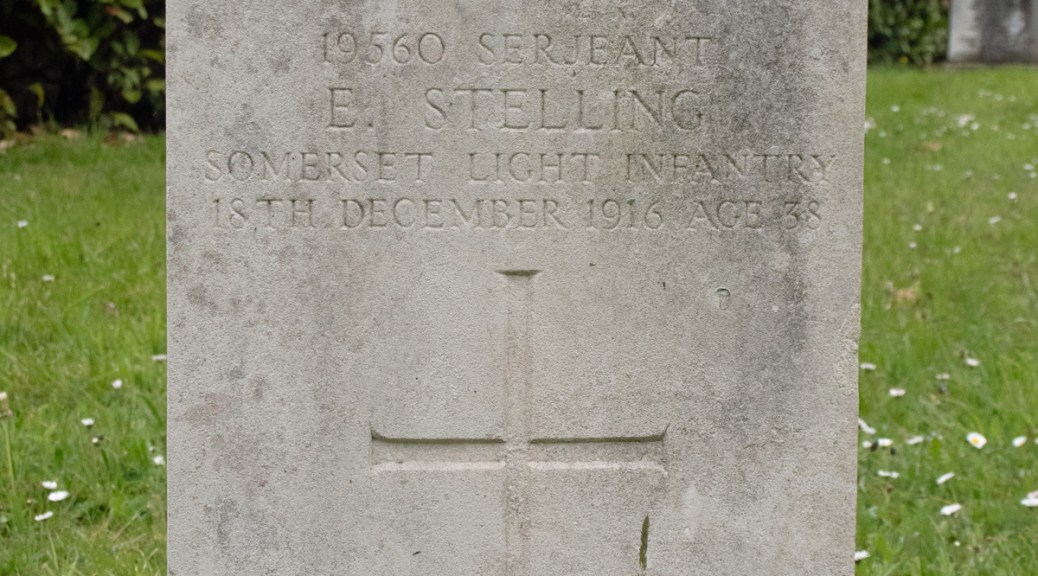
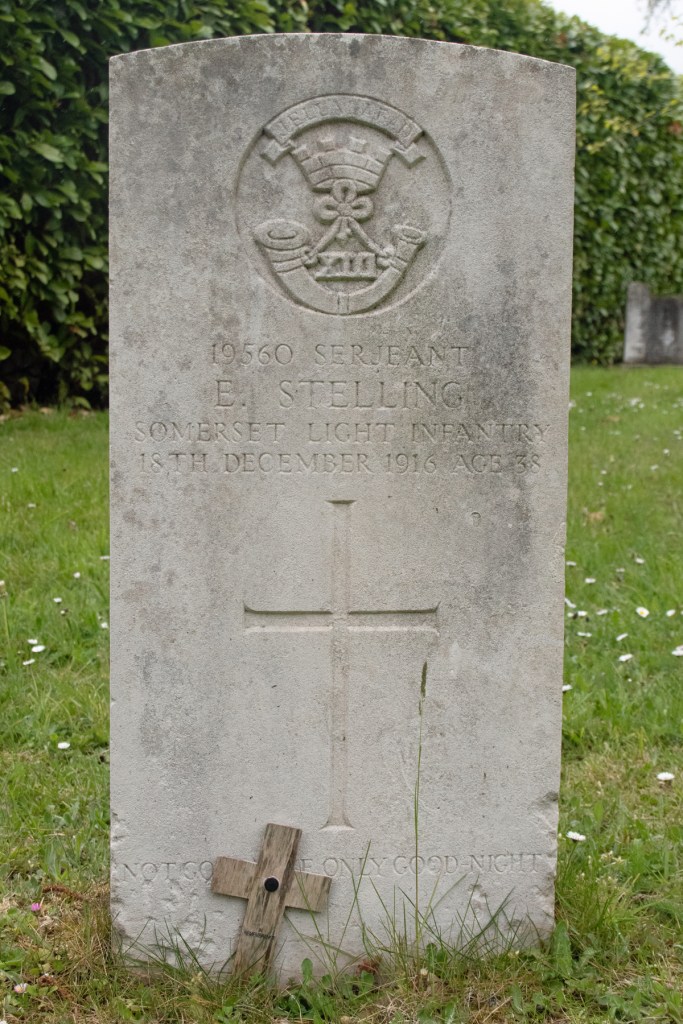
Serjeant Ernest Stelling

Serjeant Ernest Stelling

Ernest Leonard Stelling was born in the summer of 1881, the oldest of six children to Charles and Bertha Stelling. Charles was a tailor from London, and while Ernest was born in Suffolk, by the time of the 1891 census, the family had settled in Reading, Berkshire.

Ernest followed in his father’s footsteps, becoming a tailor and cutter in his own right. He met a woman from Reading called Lettie Eliza Mazey, and the couple married in 1904. The couple set up home with Lettie’s brother and his family in Tilehurst, but didn’t go on to have any children themselves.

Details of Ernest’s military service are a bit scarce. He initially enlisted in the Royal Berkshire Regiment, but quickly moved to the Somerset Light Infantry in the early stages of the First World War.

Sadly, no formal documents of Ernest’s time in the army are available, but a local newspaper gave a good insight into his Somerset service.

Death of a Master Tailor

After an illness of only seven days, the death took place at the military hospital on Monday afternoon of Sergeant EL Stelling, who has been master tailor of the Depot for the past two years. The cause of death was pneumonia, and the loss of so popular a member of the Depot staff is deeply regretted by all ranks.

Sergeant Stelling, who was 37 years of age, came to the Somersets from the Royal Berkshire Regiment, and succeeded the late Sergeant-Master-Tailor Chambers. He was a native of Reading, and one of four brothers serving their King and country. His father, Mr Charles Stelling, for many years carried on business as a master tailor in Reading.

Since he had been at Taunton barracks, Sergeant Stelling had made many friends, and actively identified himself with the social life of the sergeants’ mess, taking a prominent part in the arrangement of concerts, etc.

He was of a bright, generous disposition, and before his illness he was making a collection at the Depot on behalf of the Buffaloes’ Christmas treat to poor children of the town. He was a valued member of the local Lodge of the Royal Order of Buffaloes, and his death is greatly regretted by all the brethren.

He leaves a widow but no family. Much sympathy is felt for Mrs Stelling, who has for some years been a confirmed invalid.

The funeral took place with full military honours at St Mary’s Cemetery on Friday afternoon.

Taunton Courier and Western Advertiser: Wednesday 27th December 1916

This gives a real insight into Ernest’s personal life. He was obviously very active socially, and committed to the community. Whether Lettie’s infirmity contributed to the couple’s lack of family will never be known, but, from his support of the poor children of Taunton, it seems evident that he would have been a good family man.

The next document relating to Serjeant Stelling is his pension record; this confirms the news article’s report that he contracted pneumonia and influenza, and he succumbed to the conditions on 18th December 1916. He had, in fact, just turned 38 years old.

Ernest Leonard Stelling lies at rest in St Mary’s Cemetery in his wartime adopted home town of Taunton, Somerset.


Serjeant Ernest Stelling (from Ancestry.co.uk)

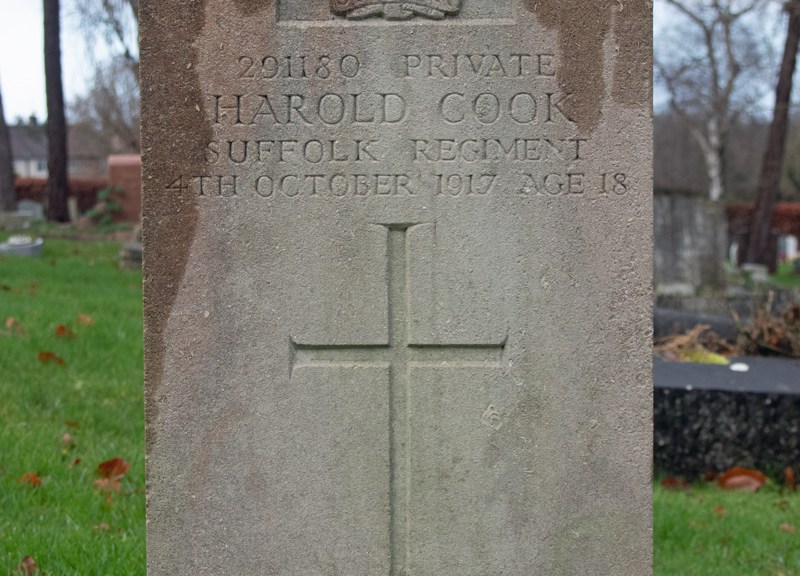
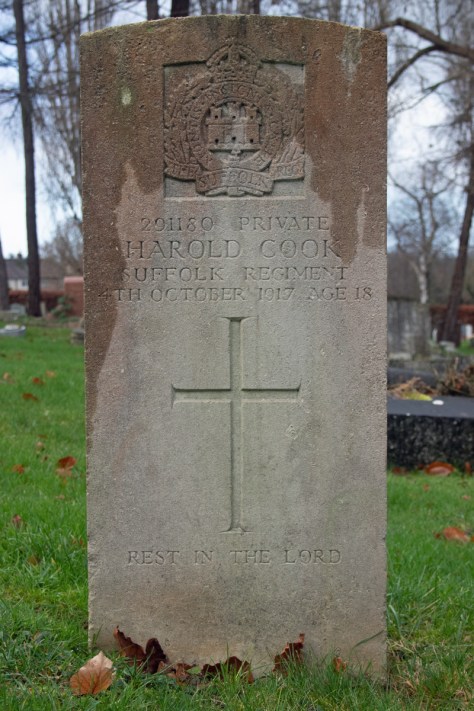
Private Harold Cook

Private Harold Cook

Harold Cook was born in February 1899, the youngest of nine children to George and Amelia Cook from the Somerset town of Street. George worked as a bootmaker, presumably for the Clark’s factory in the town.

Harold lost his mother at a young age; Amelia passed away in 1901, aged just 41 years old.

By the time of the 1911 census, George, his two older sons – Maurice and George Jr – and his four daughters – Beatrice, Florence, Alice and Gladys – were all employed by the factory. In fact, the only member of the family not employed by Clark’s was Harold himself, who was still at school.

Harold’s military records are not available, but, from the information I have been able to gather, it appears that he enlisted as soon as his age allowed. He joined the Suffolk Regiment, and was in training when an accident occurred.

The local newspaper – the Central Somerset Gazette – picks up his story:

It appears that about 11pm on August 24th [Private Cook was] in bed and suddenly got up, saying he was lying on something. This proved to be the oil bottle of his rifle and he said he would put it away. He got hold of his rifle and turned it muzzle downwards in order to put the oil bottle in the butt. When he closed the butt-trap the rifle went off.

He at once exclaimed “Who put the safety catch forward?”. Corporal Butler and [Private Johnson] then bandaged Private Cook’s foot (which was drilled clean through) and he was taken away at once.

From subsequent evidence by the Adjutant, it transpired than the rifle had been faultily loaded and that the safety catch had been broken.

Deceased had received every possible attention at the American Hospital in Cambridge, but his leg had to be amputated and subsequently septicaemia set in and to this he succumbed.

The jury, in accordance with the Coroner’s summing up, returned a verdict of “Accidental Death.”

Central Somerset Gazette: Friday 19th October 1917

Private Cook died on 4th October 1917, aged just 18 years old.

His body was brought back to his home town of Street and he lies at rest in the local cemetery.


Private Harry Pullen

Private Harry Pullen

What I have discovered while researching the Commonwealth War Graves, is that, despite the general themes I find, the people behind the names always have an individual story to tell. Sometimes that story raises an eyebrow, or produces a gasp.

Such was the story of Private Harry Pullen.

What raised the eyebrow? Two words, written on the Army Records of Soldiers’ Effects.

Accidentally Drowned.


Harry Pullen was born in Shirehampton, Gloucestershire in 1886. His father, Robert Edward Pullen, was a carpenter; he and his wife Hannah Presulga Cissy Pullen had three other children, Gwendoline, Herbert and John.

By the time of the 1901 census, Robert is boarding in a house in Bristol with his three sons; Hannah and Gwendoline are not listed (nor do they appear on any other census records I have been able to locate).

Harry is listed as a Telegraph Boy, as is his brother Herbert, but he seemed to have wanted to take up a trade; by 1910 he had moved up to London.

In March of that year, Harry married Harriet Critchell, a spinster fifteen years his senior. On their marriage records for Christ Church, St Pancras, Harry lists himself as a tradesman. The census a year later confirms this – head of the household, he is an Agent for the Provident Clothing Supply Company. (Founded in Bradford, West Yorkshire, Provident’s mission was to help working-class families provide for themselves through the use of vouchers. These were exchanged for goods in local shops, and paid for in affordable instalments.)

Harry enlisted at some point after 1916. His regiment, the 1st (Reserve) Garrison Battalion of the Suffolk Regiment, was not formed until March of that year, and, after starting in Buckinghamshire, it moved to Tilbury in Essex and Gravesend in Kent. The battalion was finally settled in Grain, North Kent in 1918, and it was here that he served.

Here the trail goes frustratingly cold…

Private Pullen’s enlistment and service records are not available, so research is limited to the Army Register of Soldier’s Effects and the Pension Ledgers.

All we have about his death are those two words – Accidental Drowning. There are no contemporary news reports of his passing, which you might expect given the circumstances, so the circumstances surrounding his death are elusive.

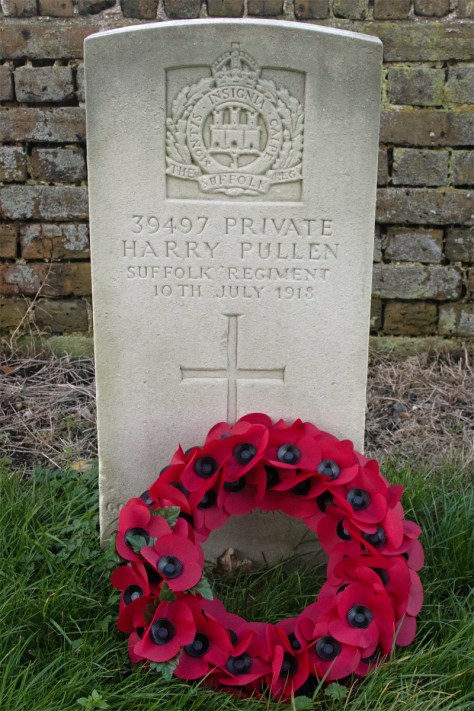
Private Pullen died on 10th July 1918. He was 31 years old.

His records confirm that Harriet was entitled to a weekly pension of 15s for the duration of the war and twelves months after.

Harry Pullen is buried in the graveyard of St James’ Church in Grain, Kent, close to where he was stationed.