Tag Archives: Surrey

Private William Stringer

Private William Stringer

William Stringer was born in Warlingham, Surrey, on 4th December 1885, and was one of nine children to Stephen and Jane Stringer. Stephen was a carter, but is seems that William wanted an escape.

On 18th April 1901, he enlisted in the Royal Navy and, because of his age, he was granted the rank of Boy 2nd Class. He was initially sent to HMS Impregnable, the school ship, and remained there for just over a year, during which his hard work paid off and he was promoted to Boy 1st Class.

His basic training complete, and after a short stint at HMS Vivid, the Royal Naval Dockyard at Devonport, he was assigned to HMS Collingwood. Over the next couple of years, William served on a couple more vessels and, in 1903, when he came of age, he was formally inducted into the navy, and given the rank of Ordinary Seaman.

William’s service records show that he was 5ft 4ins (1.63m) tall, had auburn hair, brown eyes and a fresh complexion. For distinguishing marks, he was noted as having two dots on his left forearm and scars on his legs.

Now that he was tied to a twelve year contract, Ordinary Seaman Stringer’s seems to have viewed his life in a different light. His ‘very good’ conduct quickly changed to ‘fair’ and, at the end of 1904, he spent two separate stints in the cells, presumably because of his attitude or behaviour.

This shock to the system seems to have been what William needed, however, as in 1905, he took to the new role, and his ratings improved once more. Over the next couple of years, he served on HMS Montagu and HMS Diamond, returning to Devonport in between voyages. In January 1907 he was promoted again, this time to Able Seaman, but, as with the previous promotion, things began to go downhill again.

In March, he spent two weeks in Diamond’s brig, a punishment that was repeated in September. The following month Able Seaman Stringer’s service records not his character as ‘indifferent’ and, the following month he was discharged from the Royal Navy, having refused to work for 42 days.

It was while he was serving on board HMS Diamond that William met Lena Cropp, who was presumably working in one of the ports on the South Coast. She was the daughter of labourer Jesse Cropp and his wife, Philadelphia. When Jesse died in 1897, Philadelphia married bricklayer James Smith, who had boarded with the family for a number of years.

William and Lena had a son, Joseph, on Christmas Day 1907. Now removed from the Navy, William moved his young family back to Surrey, where he found work as a cowman, and Lena took in laundry to bring in an extra income. The couple went on to marry in 1911, and went on to have two further children – Elsie, who was born in 1912, but who died when just a toddler; and Gladys, who was born in the summer of 1918.

When war closed in on Europe, something of a sense of duty must have pulled on William. He enlisted in the summer of 1915, joining the East Surrey Regiment. He seems to have quickly transferred across to the Labour Corps, and arrived in France on 15th July.

It is unclear for how long Private Stringer served in France, but at some point he returned to Britain. In October 1918, he was admitted to the War Hospital in Bath, suffering from stomach problems. His health was to prove his undoing, and he passed away from a biliary calculi peritonitis on 8th October 1918, at the age of 34 years of age.

Finances may have been tight for Lena, as William was buried in the city where he died, rather than being brought back to Surrey, where she was living. Because of this, it is unlikely that he ever met his daughter, who had been born just two months before.

William Stringer was laid to rest in the Roman Catholic Cemetery in Bath.


William’s Pension Ledger notes Lena as his widow, but only mentions one child – Joseph – as a dependent. The document also records him as an illegitimate stepchild, as he had been born a couple of years before the couple married.

The record notes that it, while Joseph’s legitimacy meant he was not eligible for a share of his William’s pension, it had been decided that the basic rate should be provided while he remained in Lena’s care.


Second Lieutenant Charles Hales

Second Lieutenant Charles Hales

Charles Edward Hoare Hales was born in Bournemouth, Dorset, in the summer of 1886. The fourth of five children, his parents were Arthur Hales – a Major General in the Royal Inniskilling Fusiliers – and his wife, Maria.

Arthur’s career stood the family in good stead: the 1891 census records the Hales living in a house in Crystal Palace Park, South London, with five servants supporting their – and their two visitors’ – every need. Arthur also believed in education for this two sons: Charles was dispatched to Hartwood House School in Hartley Wintney, Hampshire.

Arthur died in 1904 and at this point the Hales family disappears – there is no record for Maria or her five children in any of the 1911 census returns.

When war came to Europe, Charles and his older brother Arthur, stepped up to play their part. Both joined the Wiltshire Regiment, both being attached to the 1st Battalion. Sadly, neither of the brothers’ service records remain, so it is difficult to piece together their military careers.

Arthur achieved the rank of Captain, gained a Military Cross for his dedication and service. He was caught up in the Battle of Albert – one of the phases of the fighting at The Somme – in 1916. He was initially reported killed in action, then, to the elation of Maria, this was changed to missing. Tragically, he was subsequently confirmed as dead, having passed away on 6th July 1916, aged 34 years of age. He is commemorated on the Thiepval memorial in Northern France.

A further tragedy was to strike the Hales family the following year, when Charles, who had risen to the rank of Second Lieutenant, also passed away.

The internment took place in Bathwick Cemetery on Monday, of Mr Chas. Edward Hoare Hales, 2nd-Lieutenant Wiltshire Regiment, who died on Thursday, after a long illness contracted on active service. He was the last surviving son of the late Major-General A Hales, Royal Inniskilling Fusiliers, Commandant of the Straits Settlements, and of Mrs Hales… The young officer, whose body was brought from Buxton, was buried in the same grave where rest the remains of his father, who died in April 1904.

Bath Chronicle and Weekly Gazette: Saturday 1st December 1917

Details of Charles’ illness, from which he passed on 22nd November 1917, are unclear. He was 31 years old when he died. He left his estate – which amounted to £6524 18s 1d (the equivalent of £579,000 in today’s money) to his youngest sister, Sophia.


Maria Hales passed away in 1924, at the age of 74. She was buried in the family ploy, reunited with husband and younger son once more.


Second Lieutenant Charles Hales
(from findagrave.com)

Captain Arthur Hales
(from findagrave.com)

Private Louis Stevens

Private Louis Stevens

Louis Blake Stevens was born in the spring of 1870 in Pilton, now a suburb of Barnstaple, Devon. One of nine children, his parents were Devon-born sawyer John Stevens and his wife Mary, who was from Swansea.

When he left school, Louis found work in the leather industry, working as a parer and grinder. In the autumn of 1890, he married an Edith Turner, the couple went on to have two children – Edith and Albert – although they seem to have parted company soon after.

On 4th April 1896, Louis married again, this time to a Mary Webber. The couple set up home in Stoke-under-Hamdon (now Stoke-sub-Hamdon), Somerset, and went on to have seven children of their own. By the time of the 1911 census, the family had moved to South Petherton, Somerset, where Louis and Albert were working as a glovers.

Storm clouds were brewing over Europe and, despite his age, Louis was keen to step up and play his part and, on 7th August 1915, he enlisted in the Army Veterinary Corps. His service records confirm he was 42 years old, 5ft 4ins (1.63m) tall, with a dark complexion, dark brown hair and brown eyes.

After some initial training at the Army Veterinary Corps depot, Private Stevens was sent to France. Arriving there on 25th October 1915, he spent the next nine months overseas. During this time, he had issues with his teeth, breaking several on the hard biscuits the army were provided with.

Private Stevens was sent to a camp hospital in Boulogne, where his teeth were extracted, and he was then sent back to Britain to recover. The operation identified epithelioma (a malignant tumour) on his tongue and face, caused by the state of his teeth. He was initially sent to a hospital in Epsom, before being transferred to the Horton City of London War Hospital in Woolwich.

Treatment was ongoing, and, in the end, Private Stevens was finally discharged from the army on medical grounds on 2nd July 1917. The report noted permanent total incapacity, and that treatment was required.

At this point, Louis’ trail goes cold. He returned home to Somerset, and, died there on 23rd January 1918, aged 47 years old. Louis Blake Stevens was laid to rest in South Petherton Cemetery, within walking distance of his widow and family’s home.


Private Frederick Pidgeon

Private Frederick Pidgeon

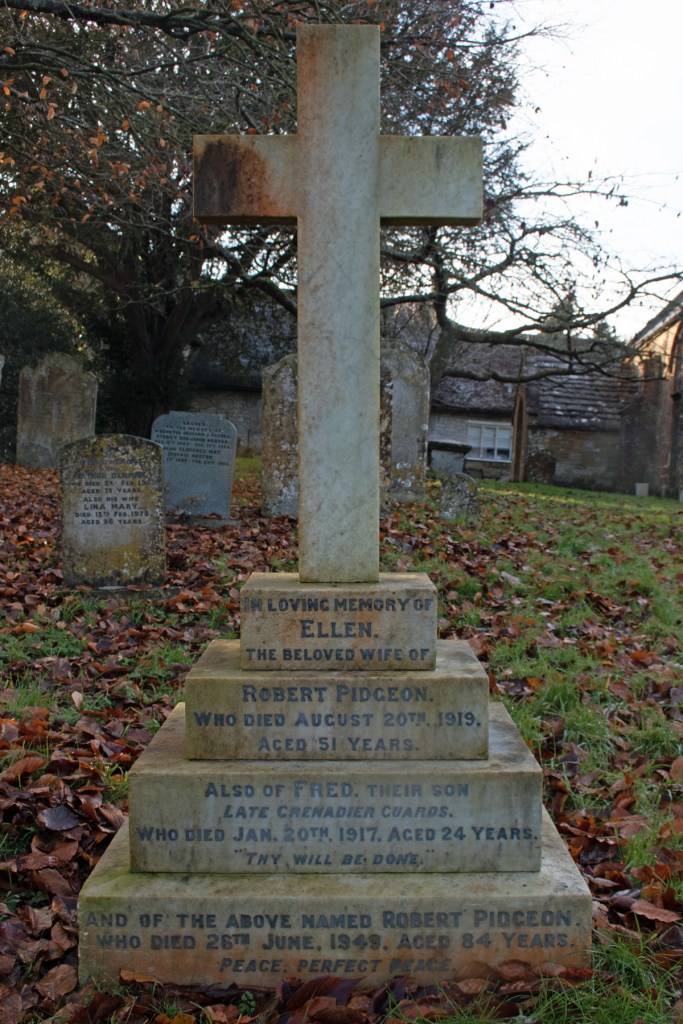
Frederick Pidgeon was born on 18th December 1892 in the Somerset village of Lopen. One of four children – and the only son – his parents were Robert and Ellen Pidgeon. Robert was a baker and, by the time of the 1911 census, only Linda – the youngest of Frederick’s siblings – was not helping in the business.

When war broke out, Frederick – who was better known as Fred – wanted to play his part. He enlisted on 7th December 1916, joining the 5th Battalion of the Grenadier Guards. As his was purely a territorial troop, Private Pidgeon was sent to the regimental barracks in Caterham, Surrey, for training.

At a time of tremendous upheaval, with men from all over the country suddenly thrust together in tightly packed barracks, it is no surprise that disease sometimes took hold. Tragically, Fred was not to be immune to this, and, on the 15th January 1917, he was admitted to the camp hospital, having contracted pneumonia.

The lung condition took a swift hold, and, tragically, Private Pidgeon was to succumb just a few days later. He breathed his last on 20th January 1917, at the age of just 24 years old. He had been in the army for just 44 days.

Fred Pidgeon was brought back to Somerset for burial. He was laid to rest in the family plot in the peaceful graveyard of All Saints’ Church, in his home village of Lopen.


Private Frederick Pidgeon

Ellen passed away in August 1919, aged just 54 years old, and was laid to rest alongside her son. Robert died some thirty years later, on 26th June 1949; he too was buried in the family plot, mother, father and son reunited once more.


Ordinary Seaman Walter Pearce

Ordinary Seaman Walter Pearce

Walter John Pearce was born on 15th June 1900 in Clapton, East London. One of ten children, his parents were James and Lily Pearce. Both were from Somerset, but cowman James went where the work was and they soon moved back to the South West, where he and Lily were from.

When he finished school, Walter found work as an errand boy for a grocer, but war was coming to Europe and, while he was too young when the conflict began, it was clear that he wanted to play his part as soon as he was able.

Walter enlisted in June 1918, joining the Royal Naval Volunteer Reserve. His service records show that he was 5ft 8ins (1.73m) tall, and had brown hair, hazel eyes and a fresh complexion. Ordinary Seaman Pearce was sent to HMS Crystal Palace in South London for training, arriving there on 17th June 1918.

Tragically, Walter’s service was to be short. Being billeted in close proximity to other men and boys from across the country, meant that disease was readily transmitted, and Walter contracted pneumonia. Admitted to the nearby Norwood Cottage Hospital, the lung condition was to prove fatal: Ordinary Seaman Pearce died on 19th July 1918. He was just 18 years of age, and had been in active service for just 33 days.

Walter John Pearce was brought back to Somerset – where his parents were now living – for burial. He was laid to rest in the peaceful graveyard of St Mary’s Church in Mudford.


Corporal John Cudby

Corporal John Cudby

Frederick John Cudby – who was known by his middle name – was born in the summer of 1884 in Farnham, Surrey. The fourth of six children, his parents were William and Caroline Cudby. William was a bricklayer from Essex, while his wife was from Ramsgate in Kent. The family went where his work was, and by the mid-1890s, they had moved to Blaenavon in Monmouthshire.

When he left school, John found employment as a mechanic, working as an engine oiler at a local works. William passed away in 1901, and by the time of the next census, in 1911, John was working as a mason’s labourer. The family were all still living in Blaenavon, helping Caroline by keeping money coming in .

When war came to Europe, John was quick to serve King and Country. He enlisted in the Monmouthshire Regiment and, as a Private, was assigned to the 2nd Battalion. His troop was soon sent to France and, by November 1914, he was entrenched at Ypres, near Ploegsteert Wood.

Promoted to Corporal, little of John’s service information survives. It is clear that he was wounded during a skirmish and that he was medically evacuated back to Britain. It seems likely that he was admitted to the Preston Hall Military Hospital in Aylesford, Kent, and that this is where he subsequently succumbed to his injuries.

Corporal Frederick John Cudby died on 6th June 1915, at the age of just 30 years old. He was laid to rest in the graveyard of St Peter and St Paul’s Church in Aylesford, Kent.


While buried in the churchyard, the location of John’s grave is not known. Instead, he is commemorated on a joint headstone in the First World War section of the graveyard.


Lieutenant Frederick Tugwell

Lieutenant Frederick Tugwell

Frederick William Tugwell was born in Cuckfield, West Sussex, in the autumn of 1888. The youngest of three children to John and Mary Tugwell, his father was a tailor in the village.

Little more is known about Frederick’s early life, but, when war broke out, he wad there to play his part. He enlisted in The Queen’s (Royal West Surrey Regiment) and, by July 1916 was in France. Frederick obviously made an impression in the army and rose through the ranks, reaching Lieutenant by the time the Armistice was declared in November 1918.

Lieutenant Tugwell remained overseas when the war ended and was based in Cologne. In March 1919, he returned home on leave, staying with his sister, Constance, who lived in Guildford, Surrey. It was here that he fell ill and here that he passed away, breathing his last on 2nd March 1919. He was just 30 years old.

Frederick William Tugwell was brought back to West Sussex for burial – he lies at rest in the cemetery of his home village, Cuckfield.


A mystery surrounds Frederick’s next of kin. His medal record suggests that it was his widow – Mrs FW Tugwell – who applied for that recognition. The address given for her is the same as for Constance. The newspaper report of his death gives no mention of a widow, only that he died at his sister’s home. There is also no clear evidence for Frederick getting married, although this may have been lost to the passage of time. His widow may, of course, have been living with her sister-in-law, but again, this cannot be confirmed either way.


Lieutenant Harry Street

Lieutenant Harry Street

Henry Street – known as Harry – was born on 22nd April 1875 in Oxted, Surrey and was one of thirteen children to Jacob and Emma. Jacob was an agricultural labourer, and this is work Harry initially went into when he left school.

However, it seems that Harry was after more of a career, and looks to have enlisted in the Royal Field Artillery by 1895. His trail goes cold for a while, and it can be assumed that he served abroad, although exact details of his career are lost to time.

By 1906, Harry was back in England, and, on 15th October he married Janette Street at St Peter’s Church in Tandridge, Surrey. The marriage record confirms that Harry was a soldier, while his new wife was the daughter of a labourer. Janette was three years Harry’s junior, and there does not seem to be any close family connection, in spite of their shared surname.

Again, information on Harry’s life at this point is sparse. When war was declared, he was either still serving with the Royal Field Artillery, or was called back in to duty. By December 1914, he had been promoted to Lieutenant: this was to be a rank he would continue to hold until the end of the conflict. He certainly served abroad, and was awarded the Long Service and Good Conduct Medals, in addition to the Victory and British Medals. He was also given the French Medaille Militaire, although reasons for this award are lost to time.

Lieutenant Street survived the war, and by the autumn of 1919, he was living at Bright Farm in Cuckfield, West Sussex. It was here, too, that he passed away, through causes unknown. He died on 5th October 1919, at the age of 44 years old.

Harry Street was laid to rest in Cuckfield Cemetery, in the shadow of the village’s Holy Trinity Church.


Sapper Walter Wigginton

Sapper Walter Wigginton

Walter Wigginton was born in the Leicestershire village of Illston-on-the-Hill in the summer of 1880. The second of seven children, his father John was a grazier, managing cows over a six-acre pasture. His mother, Rebecca, who was also born in Leicestershire, raised the family and managed the home.

Walter turned his hand to carpentry, and, by the time of the 1901 census, he was boarding with a widow in Frimley, Surrey, employed for his woodworking skills. By 1905, his journeyman life had taken him to the Somerset village of Trull. It was here that he met and married Annie Oaten, and here that the couple settled down to raise their family. They had two children, Dorothy, born in 1906, and Winifred, who was born two years later.

War was closing in on Europe and, by the summer of 1916, Walter had joined up to play his part. Initially assigned to the 65th Training Reserve Battalion, he had not long transferred across to the Royal Engineers as a Sapper when he fell ill.

Sapper Wigginton was admitted to the Kinmel Park Military Hospital near Abergele on the North Wales coast, suffering from bronchial pneumonia. Sadly, this lung condition was to get the better of him, and he passed away at the hospital on 29th December 1916, at the age of 36 years old.

Walter Wigginton’s body was brought back to Somerset for burial. He was laid to rest in the graveyard of All Saints’ Church in Trull, where his widow and children still lived.


Private Robert Creasey

Private Robert Creasey

Robert Thomas Creasey (also known as Thomas Robert Creasey) was born in the village of Ash, near Farnham in Surrey, on 3rd January 1896. He was the youngest of four children to Edwin and Elizabeth Creasey. Edwin was the landlord of the Standard of England public house in the village.

When he died in 1902, Elizabeth moved her family to Somerset, where she had been born and where she still had relatives living. With four young children to raise, she married again in April 1903, to local dairy farmer Frederick Gould.

Robert was working as a farmer when war was declared, but was one of the first to step forward and volunteer. He enlisted in the Somerset Light Infantry and in the autumn of 1915 was involved in the fighting in Gallipoli.

In July 1916 Private Creasey transferred to the Machine Gun Corps. Sadly, little further information about his military life is available, but he survived the war, and returned home to Somerset on furlough, before being demobbed.

This is where Robert’s trail ends. He passed away at home on 15th February 1919, presumably from one of the lung conditions running rampant across a war-torn continent. He was just 23 years of age.

Robert Thomas Creasey was laid to rest in the graveyard of St Michael and All Angel’s Church in Angersleigh, Somerset, not far from where his mother lived.