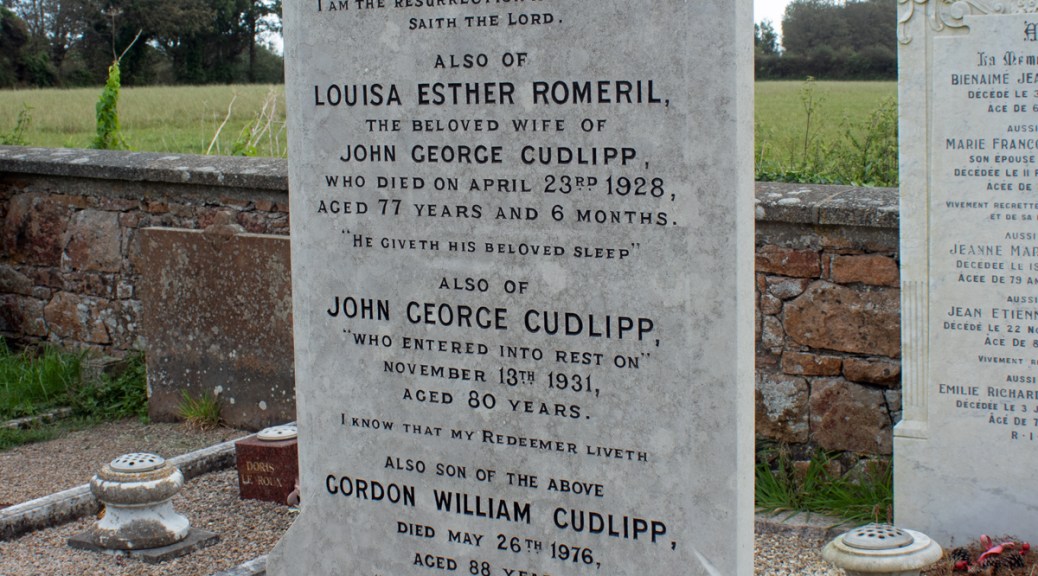
Herbert Henry Cudlipp was born in St Peters, Jersey, in around 1891. He was one of ten children to farmers John and Louisa Cudlipp. The family had moved to Mont à L’Abbé, on the outskirts of St Helier, by the time of the 1911 census, at which point the whole family were involved in the farm in one way or another.
Little information is available about Herbert’s military life. He enlisted in the Royal Garrison Artillery at some point during the war, and was attached to the 38th Siege Battery. The unit was based in Egypt from December 1915, and later moved to France. However, records are unclear as to when and where Gunner Cudlipp served.
Details of Herbert Henry Cudlipp’s later life are also lost to time. Herbert survived the war, but died on 4th June 1919, at the age of 28 years old. He was laid to rest in the family plot in Macpela Cemetery, St John’s, Jersey.
Frederick George China was born in Bath, Somerset, in the summer of 1885. He was the second of children to tailor George China and his wife, Gloucestershire-born Frances.
Frederick was working as a grocer’s assistant when his father died in 1906, at the age of 52. Determined to earn money for Frances and his three sisters, he left Somerset for work. The 1911 census recorded him as living in Worthing, West Sussex, boarding with the Vitler family. Percy was a baker’s assistant, and lived at 4, Tarring Road with his wife and two daughters. The census noted two visitors to the property, railway contractor Robert Puttock and his wife, Annie.
On 26th December 1912, Frederick married Lucy Hellier. Born in Midhurst, West Sussex, she was working as a confectioner’s shop assistant in Worthing’s Montague Street, boarding with the manager, Catherine Castle, her mother and her niece. The couple wed in Stanmer Parish Church, to the north of Brighton, which is where Lucy’s family were then living.
The newlyweds moved back to Bath, and Frederick took up a job as manager of the Widcombe branch of the Twerton Co-operative Society. Their only child, son Douglas, was born in February 1915.
By this point, war was raging across Europe, and Frederick stepped up to play his part. His full service details are no longer available, but he joined the Somerset Light Infantry in June 1916, and was assigned to the 7th Battalion.
He was in a battalion of the Somersets, who were heavily engaged at Langemarck, but he and his chum came safely through the severe fighting at that place. While returning, some time after, to the front trenches, he was knocked out by a shell, and received severe injuries. The spine was so badly hurt that, if he had survived, he would never have walked again.
[Bath Chronicle and Weekly Gazette – Saturday 29 September 1917]
Private China was medically evacuated to Britain for treatment, and he was admitted to King George’s Military Hospital in South London. Lucy and Frances travelled to Surrey to see him, and were with him when he passed, his wounds being too severe for him to survive. He passed away on 21st September 1917, at the age of 32 years of age.
The body of Frederick George China was aid to rest in Bath’s sweeping Locksbrook Cemetery, not far from where his father, George, was buried.
Private Frederick China (from britishnewspaperarchive.co.uk)
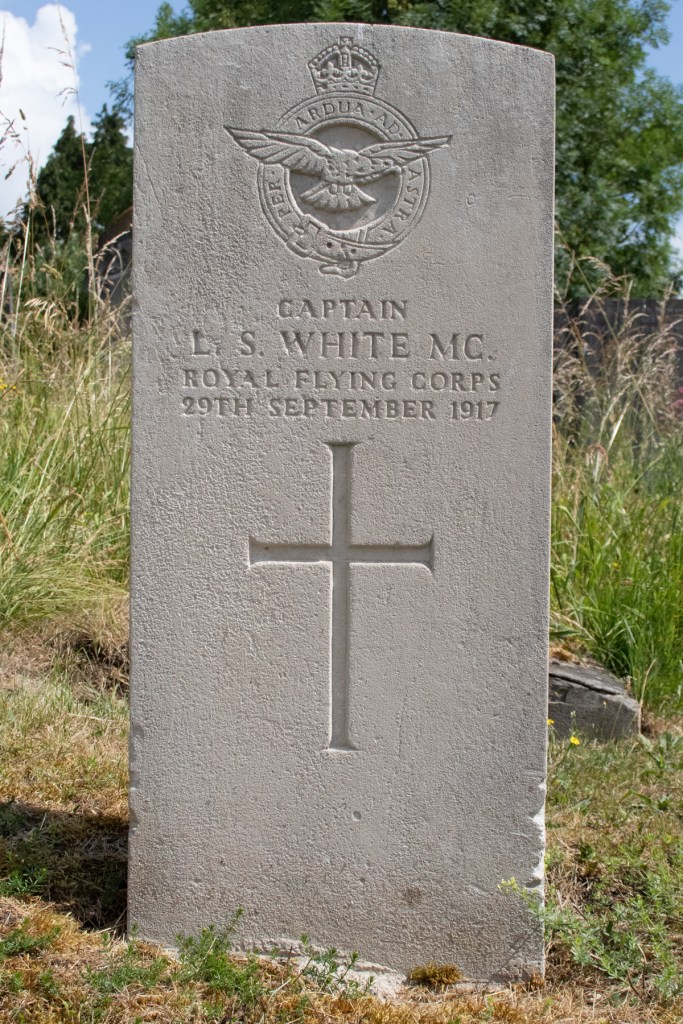
Lewis Scott White was born at the start of 1896 in Bath, Somerset. The youngest of four children, his parents were surgeon Edward White and his wife, Fanny. The 1911 census recorded the family living in a substantial property in Green Park: the now medical practitioner Edward, Fanny and Lewis sharing the 12-room house with a servant, Ellen Fry.
As befitting of his station in life, Lewis’ education was a well rounded one: “[he] was educated at Bath College and Kelly College, Tavistock, and was coached for his matriculation examination by Mr Samuel Edwards, of Grosvenor College. He exhibited a fondness for aeronautics when quite a lad. While at Victoria College he evinced much enthusiasm for the art of flying, and made models of flying machines. One of these miniature planes he flew successfully on Lansdown, and we believe showed at an exhibition in London. He was one of the leading spirits in the Bath Aerial Club, which used to meet at the Church Institute.” [Bath Chronicle and Weekly Gazette – Saturday 06 October 1917]
Lewis’s mechanical mind was put to good use in his working life as well. He found employment as a motor fitter, and this is what he was doing when war broke out in the summer of 1914. He felt duty bound to service his King and his Country, and, on 20th October, he enlisted in the Royal Flying Corps as an Air Mechanic. His service records confirm the man he had become: at 18 years of age, he was 5ft 4ins (1.63m) tall and weighed 117lbs (53kg). He had dark brown hair, brown eyes and a fresh complexion.
His skill and daring earned promotion, and he was given a commission… He accomplished many fine feats in actual aerial warfare on the Western Front, and for one of these some months ago he was awarded the Military Cross. He was acting as an observer when the flight occurred; the pilot in the same machine was given the DSO.
While wearing only one wing he came home to England to train as a pilot. He rapidly passed all the tests for this, and obtained the two wings, and was gazetted Captain of the RFC on May 5th last. It was only on Wednesday last week that Captain White attended an investiture at Buckingham Palace and was decorated by the King with the MC. So complete was his mastery of flying machines and so great his initiative that Captain White was appointed Flight Instructor, and for the last two months he had been Flight Commander quartered in Wiltshire.
[Bath Chronicle and Weekly Gazette – Saturday 06 October 1917]
On 29th September 1917, Captain White was piloting a Sopwith Camel from RAF Yatesbury, Wiltshire, when the aircraft failed to pull up from a dive. It crashed into the ground and Lewis was killed instantly. He was just 21 years of age.
It is no secret that the aeronaut whose intrepid feats in the air above Bath of late had caused much notice was Captain White. He would loop the loop with the greatest ease, and his nose-diving was most daring. When questioned why he performed these dangerous acts in the air Captain White would declare that there was no risk from engine trouble unless a man ‘lost his head,’ and apparently he had no idea that is was possible for him to get into difficulties from that cause. It is to be surmised therefore that in the accident which had cost his life, so especially valuable to the country now, something beyond engine trouble must have happened.
To stay-at-home and peacefully minded citizens some of the manoeuvring by aeroplanes in flight savours too much of the sensational, and they are apt to think that it is unnecessarily throwing away chances. But such an impression is as unjust as it is unkind. The strange evolutions described by machines in mid-air are just the kind that have to be executed in actual aerial warfare when seeking to gain an advantage over the foe, and unless this preliminary training were carefully and systematically gone through it would be hopeless to seek to acquire the necessary skill in the moment of crisis. Captain White was absolutely fearless, and his death will be deeply deplored by by many comrades who knew his worth.
[Bath Chronicle and Weekly Gazette – Saturday 06 October 1917]
A subsequent inquest found no immediate cause for the crash, but suggested that Captain White may have misjudged the distance whilst diving and flew into ground.
The body of Lewis Scott White was brought back to Somerset for burial He was laid to rest in the majestic Locksbook Cemetery in Bath, his funeral attracting a full page report in the city’s Chronicle and Weekly Gazette.
Leo Edwin Aldrich was born on 14th July 1897 in the Ohio city of Elyria, and was the only child to Hiram and Agnes Aldrich. Hiram was a machinist from New York and, by the time of the 1910 census, he had found work as a toolmaker for a motor company, and the family has moved to Detroit, Michigan, 150 miles (240km) along Lake Erie’s coastline.
When war came to Europe, Leo seemed keen to get involved. Full details of his military service are lost to time, but it seems that he enlisted in the Canadian Royal Engineers. By the summer of 1918, Leo was in Britain, and had transferred to the Royal Air Force. He had reached the rank of Second Lieutenant and was based at Yatesbury Airfield in Wiltshire.
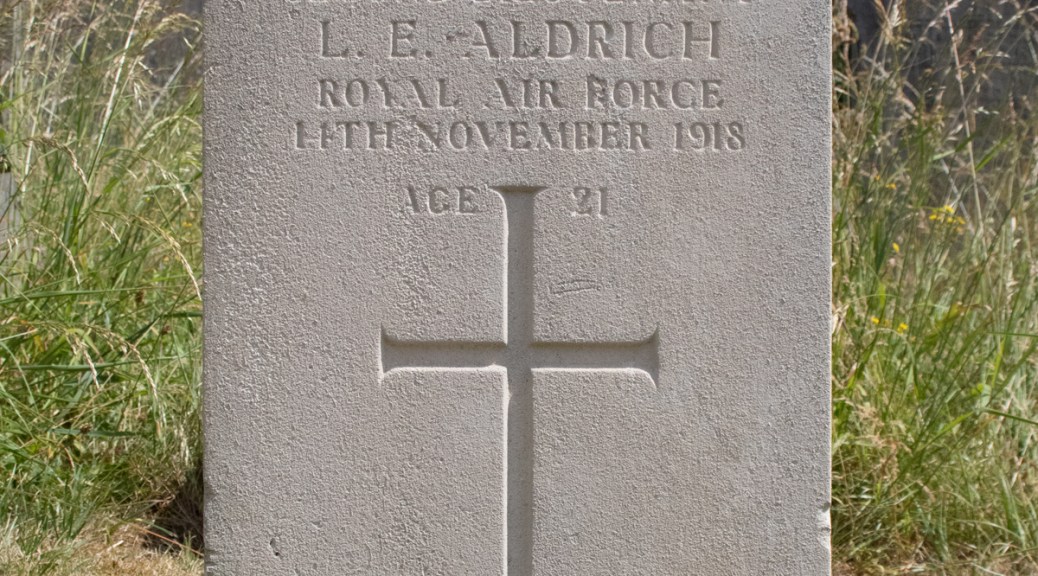
On 14th November 1918, just three days after the Armistice was signed, he was flying in a Bristol F2b fighter aircraft, when it nosedived into the ground. Both Second Lieutant Aldrich and his passenger Second Lieutenant McDougall were seriously injured, and were taken to Bath War Hospital for treatment.
Sadly, Leo’s injuries were to prove to be too severe. He passed away the same day: he was just 21 years of age.
Leo Edwin Aldrich was laid to rest in Locksbrook Cemetery, not far from the hospital in which he passed.
Leo’s service records suggest that his next of kin was his wife, Mrs Leo Aldrich of 480 East 112th Street, Cleveland, Ohio. There are no identifiable marriage records for him although, intriguingly another one does exist.
This confirms the wedding of a George L Aldrich to a Helen J Seymour on 6th August 1918 in Cuyahoga, Ohio. As the names do not match, the record would normally be dismissed, but the parents’ names – Hiram and Agnes – match Leo’s, as does the place of birth – Elyria – and his occupation – Second Lieutenant.
Further details for Helen Seymour, and why Leo may have given the name George, are lost to time.
Percy James Wall was born in the Somerset village of Kilmersden in the summer of 1880. The fifth of ten children, his parents were called Robert and Amelia. Robert was a cashier for a local colliery, but it seems that Percy did not follow into his father’s line of work.
The 1901 census found Percy working as a draper’s assistant for Jolly & Son’s in Bath. He was one of 27 boarders at the company’s lodgings on Milsom Street in the city centre. By 1911, he was still working for the same company, but as a draper’s clerk, and had moved to some new lodgings just to the north in Lansdown Road.
When war broke out, Percy stepped up to play his part. He enlisted in the Gloucestershire Regiment, although his full service records are no longer available. Private Wall was attached to the 1st/4th Battalion, and, by the autumn of 1916, he found himself caught up in fighting at the Ancre, part of the Battles of the Somme.
Percy was badly wounded, and evacuated to Britain for treatment. Full details are unclear, but his injuries were enough for him to medically discharged from the army. He was awarded the Silver War Badge – proof of his genuine discharge – but at this point his trail goes cold.
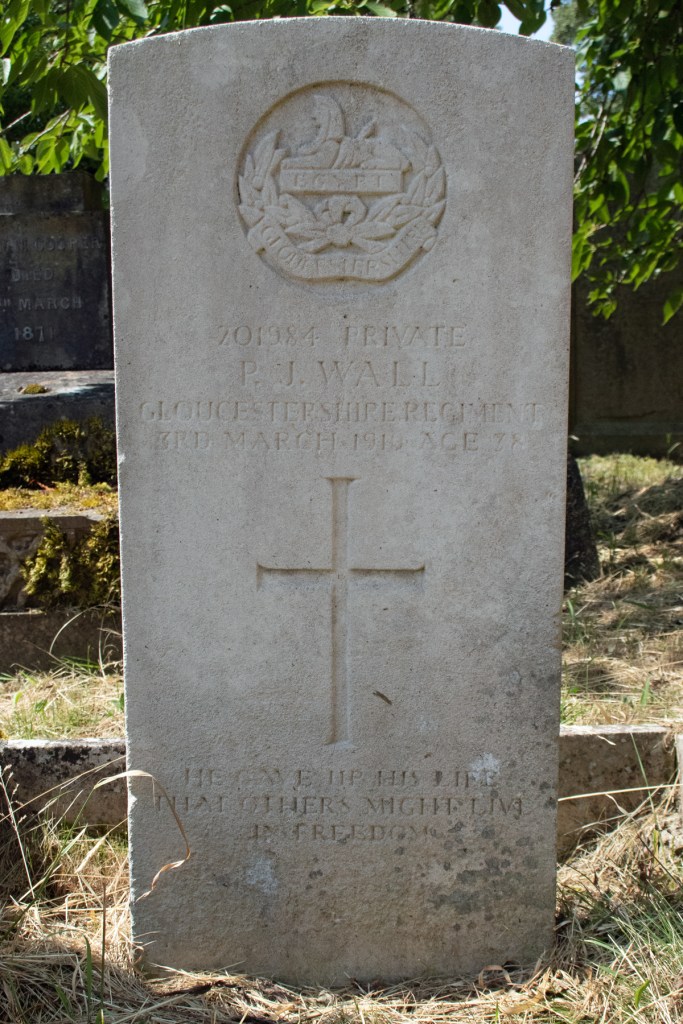
Percy struggled on with his injuries for a further two years. Hhe may have remained in hospital since his original injuries, but there are no records to corroborate this either way. At the start of 1919, he had been admitted to the Bath War Hospital, his family having also moved to the city by this point. He finally succumbed to his wounds, passing away on 3rd March 1919: he was 38 years of age.
Percy James Wall was laid to rest in the sprawling Locksbrook Cemetery, Bath, his pain finally eased.
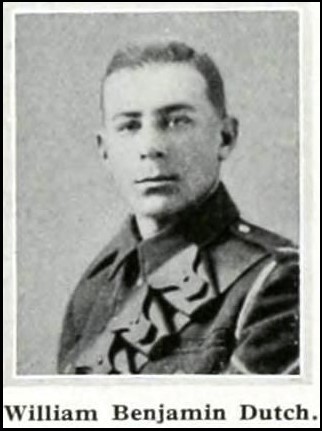
DUTCH, WILLIAM BENJAMIN, Sergt., No. 83812, 47th Brigade, Royal Field Artillery, [son] of William Dutch, of Bladud House, Bath, Accountant, by his wife, Alice, [daughter] of Alderman Alfred Taylor, of The Red House, Bath; b. Lower Weston, Bath, 21 April 1894; educ. Bathforum, and Bath City Secondary School 93 years’ Scholarship), and was employed in the engineering works of Stothert and Pitt Ltd., of Bath. He joined the Army, 17th Aug. 1914; was made Bombardier, 1 November 1914; Corpl., 14 November 1914; and Sergt., 1 January 1915; and died at the Thornhill Isolation Hospital, Aldershot, 11 April 1915, of septic scarlet fever; [unmarried]. He was buried at Locksbrook Cemetery, Bath, will full military honours. His Capt. wrote: “I cannot exaggerate the loss he is to me personally and to the whole battery, had picked up a wonderful knowledge of gunnery and his work in general was out and out the best sergeant I had, and would have gone far in the service.” He was a keen sportsman and a popular football player.
[De Ruvigny’s Roll of Honour, 1914-1919]
William Benjamin Dutch was the second of five children to William and Alice. His father initially worked as a grocer and wine and spirit shopkeeper, and the 1901 census found the family living above the shop on the corner of Chelsea Road and Park Road, Bath.
By the time of the 1911 census, however, things had changed. The Dutches had moved to Walcot, nearer the centre of Bath, and William was working as a tramway clerk. Alice was running the family home – 3 Bladud Buildings – as a boarding house, and employed a housemaid and kitchen maid to help look after the lodgings.
William’s dedication to his army role – and his rapid rise through the ranks – is outlined in the article above. He seems, however, to have spent his time on home soil, remaining at his Hampshire base from his enlistment to his passing. His service records give an insight into his physical nature: he stood 5ft 6.5ins (1.69m) tall, and weighed 153lbs (69.4kg). He had light brown hair, grey eyes and a fresh complexion.
Serjeant Dutch’s illness seems to have come on him quickly:
On Sunday a telegram reached [his parents] saying that their son… was seriously ill in hospital at Aldershot. Mr Dutch went thither at once, only to find that his son had passed away. He was attacked last week with bronchial pneumonia, and tracheotomy was performed in the hope of saving his life, but in vain. The deceased was… a young soldier of rare promise and fine physique.
[Bath Chronicle and Weekly Gazette – Saturday 17 April 1915]
William Benjamin Dutch was just 20 years old when he passed away. His body was taken back to Somerset for burial. He was laid to rest in the family plot in Bath’s sweeping Locksbrook Cemetery, within sight of William Sr’s former shop on Chelsea Road.
Ernest Roye Hewett was born on 18th April 1898 and was the third of twelve children to Alfred and Ada. Alfred was a coachman and groom and, while both he and Ada were born in Cornwall, it was in Budleigh Salterton, Devon, that the family were born and raised.
When he finished his schooling, Ernest found work as a butcher’s boy, but when sought bigger and better things. His oldest brother, Ralph, had enlisted in the army by the time of the 1911 census and, by that October, his next oldest brother, Leslie, had enlisted in the Royal Navy. Ernest felt a career in the military was his destiny and, on 12th September 1913, he also joined the navy.
As he was under age at this point, he was given the rank of Boy 2nd Class, and sent to HMS Impregnable, the training establishment in Devonport, for his induction. His service records show that he was 5ft 2.5ins (1.59m) tall, with brown hair, hazel eyes and a fresh complexion.
Ernest spent nine months training, moving from Impregnable to HMS Powerful, and gaining a promotion to Boy 1st Class in the process. In June 1914, he was assigned to the cruiser HMS Edgar, remaining on board for six months, by which point war had broken out.
On 18th December 1914, Lance Corporal Ralph Hewett was killed in action, aged just 20 years old. Attached to the 2nd Battalion of the Devonshire Regiment, he was caught in fighting in Northern France, and is commemorated on the Le Touret Memorial.
Ernest, by this point, had been assigned to another ship, the armed merchant cruiser HMS Viknor. Patrolling the seas off Scotland, towards the end of the month, she was tasked with locating and detaining the Norwegian ship Bergensfjord, on board which was a suspected German spy.
The vessel was located and escorted to Kirkwall in the Orkneys, and the suspect and a number of other prisoners, were taken on board the Viknor to be transported to Liverpool. The ship and crew were never to reach their destination. On 13th January 1915, she sank in heavy seas off the Irish Coast: no distress signal was made and all hands were lost.
BODY WASHED ASHORE – Another body has been washed ashore at Pallntoy Port, about six miles from Ballycastle. The body was that of a man of about 5ft 10in. in height. He was dressed in a blue jacket, and wore a service blue webbed belt, on which was the name E. F. Hewett. In the pocket of the trousers was a boatswain’s whistle.
Freeman’s Journal: 24th February 1915
Already in mourning for Ralph, Alfred and Ada were unable to bring 16-year-old Ernest Roye Hewett back home. Instead, he was laid to rest in Ballintoy parish church, County Antrim.
The heartbreak was to continue for the Hewett family. Leslie’s career had gone from strength to strength and, by the time of his older brother’s death, he had been promoted to Able Seaman. In the summer of 1915, he was assigned to the cruiser HMS Europa, remaining aboard for the next year as it patrolled the Mediterranean. In July 1916 he fell ill, having contracted malaria. This was to prove his undoing: he passed away from the condition on 21st July, at 20 years old.
Able Seaman Leslie Hewett was laid to rest in the Mikra British Cemetery in Greece. His parents had now lost their three oldest sons, and had no way to reach their final resting places.
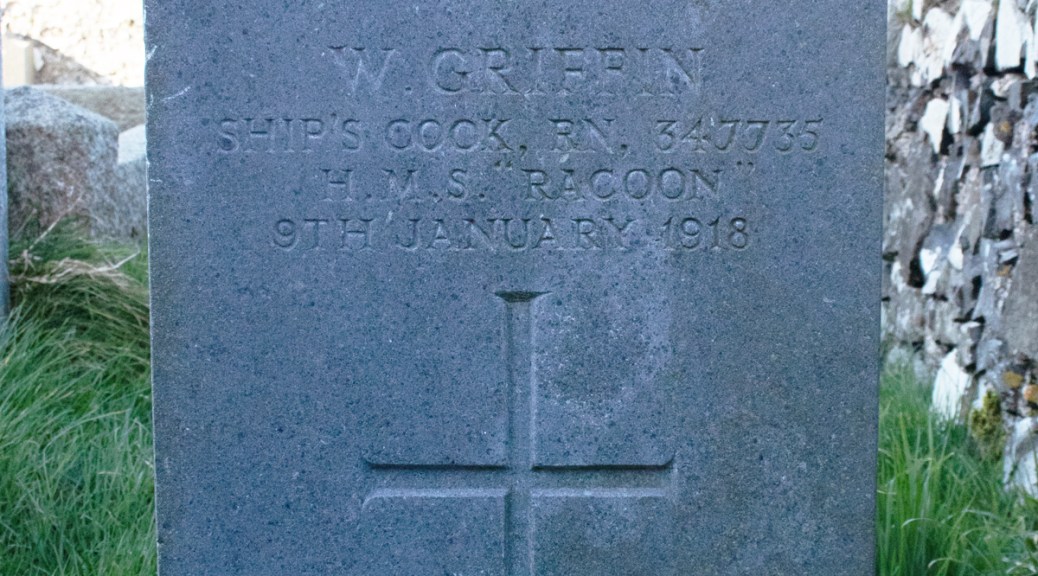
Walter Griffin was born on 15th December 1886 in Woolwich, Kent. Details of his early life are lost to time, but, by the time of the 1901 census, he was working as a cooper’s mate at a cement factory in Higham, Kent.
Walter sought bigger and better things for himself, and, on 19th June 1907, he enlisted in the Royal Navy as Cook’s Mate 2nd Class. His service records confirm that he was 5ft 4ins (1.62m) tall, with brown hair, grey eyes and a fresh complexion.
Walter was initially sent just down the coast to the Royal Naval Dockyard in Chatham, Kent, for his training. He remained there for nine months, and was promoted to Cook’s Mate 1st Class for his service.
In January 1908, he was given his first posting, on board HMS Wildfire, and, over the next nine years, he served on a further four ships, returning to Chatham in between postings. Walter was obviously dedicated to the work he was doing: in January 1910 he was promoted to Leading Cook’s Mate, and by 1917, he was promoted again, to the ran of Ship’s Cook.
This promotion coincided with a transfer to what would be his last assignment, on board HMS Racoon. This Beagle-class destroyer patrolled the waters between Scotland and Northern Ireland, and he spent the winter of 1917/18 on board.
On 9th January 1918, there were storm conditions off the Irish coast: high seas and blizzard limited limited vision. At 2am, the Racoon struck rocks, and foundered: in the treacherous conditions, all hands were lost. Shio’s Cook Griffin was 31 years of age.
Walter Griffin’s body washed ashore near the village of Ballintoy, Country Antrim, the following day. He was laid to rest in the parish church, next to two other crew members, Ordinary Seaman Frank Green and Stoker 2nd Class Frederick Sarell.
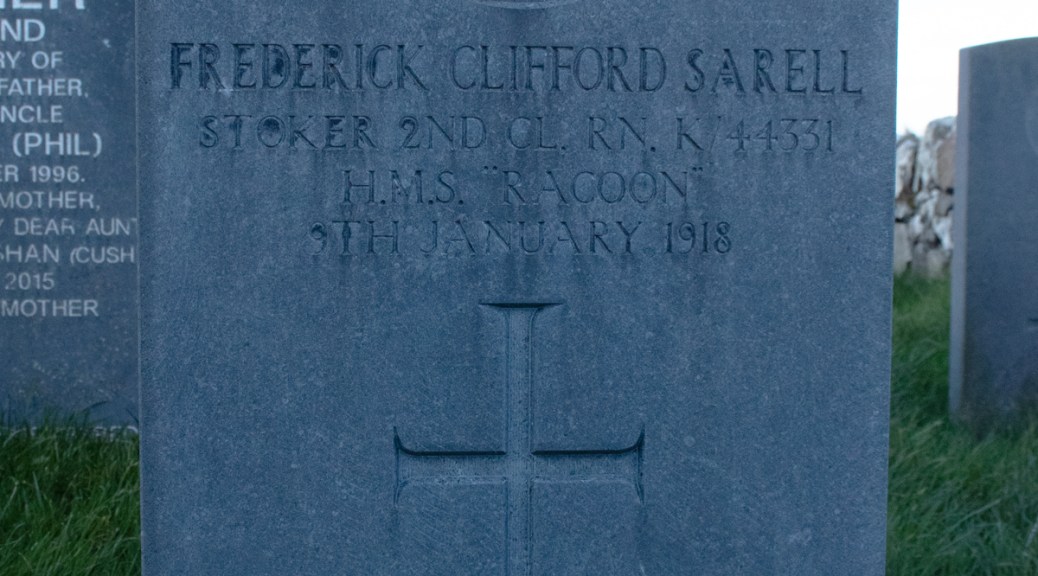
Frederick Clifford Sarell was born on 6th July 1899, one of six children to James and Theresa. James was a general labourer from East London, and the family were born and brought up in West Ham, Essex.
The Sarell family were beset by tragedy: Frederick’s oldest brother, James, died in 1903, at the age of 23, while James Sr passed away three years later. By the time of the 1911 census, Theresa was raising her five remaining children in a small house in Fife Road, Canning Town, with her oldest three children bringing in some money to support the family,
In 1913, another of Frederick’s brothers, George, passed away, and the following year his oldest sister, Theresa Jr, also died. By the summer of 1917, with war raging across Europe, Frederick stepped up to play his part. It is unclear whether his motives were to support his mother, or because he was conscripted, but either way he enlisted in the Royal Navy.
Frederick had been working as a dock labourer when he signed up. He Employed as a Stoker 2nd Class, his naval records show that he was 5ft 6.5ins (1.69m) tall, with brown hair, grey eyes and a fresh complexion. He was noted as having a scar on his right knee, a distinguishing mark that would tragically help to identify his body before the year was out.
Stoker Sarell was initially sent to HMS Pembroke, the Royal Naval Dockyard in Chatham, Kent, for his training. On 10th October 1917, he was given his first posting, on board the destroyer HMS Racoon, which patrolled the seas between Ireland and Scotland.
Frederick was on board when, on 9th January 1918, the Racoon struck rocks off the coast of Northern Ireland in heavy seas and blizzard conditions. All of the crew – more than 90 men – were lost. Stoker 2nd Class Sarell was just eighteen years old when he died: he had been in the Royal Navy for less than six months.
The body of Frederick Clifford Sarell washed ashore near Ballintoy, County Antrim. He was laid to rest in the graveyard of the village’s church next to two other crew members, Ordinary Seaman Frank Green and Ship’s Cook Walter Griffin.
Frank Ernest Green was born in Stratford, Essex on 14th November 1889. One of nine children, his parents were printer’s compositor John Green and his wife, Susan. The family were raised in Leytonstone and, by the time of the 1911 census, they were living in a house in Elsham Road.
Frank found work as a clerk for a financial company when he finished his schooling. On 31st August 1912, he married sailor’s daughter Charlotte Greenland, who was four years his senior. The couple settled in Gibbon Road, Peckham, Surrey, where Frank continued his work.
When war broke out, Frank was called upon to play his part. On 3rd January 1917, he enlisted in the Royal Navy for the duration of the war. His service records show that he was 5ft 6.5ins (1.69m) tall, with brown hair, blue eyes and a fresh complexion.
Ordinary Seaman Green was initially sent to HMS Pembroke, the Royal Naval Dockyard in Chatham, Kent, for training. He spent short periods of time on two ships before being assigned to HMS Racoon, a Beagle-class destroyer,
Initially patrolling the Mediterranean, by the time Frank joined the crew the Racoon she was part of the Second Destroyer Flotilla, based from Northern Ireland. In January 1918, she struck harsh weather:
HMS Racoon, Lieut. George LM Napier RN, in command, struck some rocks off the north coast of Ireland at about 2am on the 9th [January], and subsequently foundered with all hands.
Nine of the crew had been left behind at her last port of call, and these are the sole survivors.
Seventeen bodies have been picked up by patrol craft, and are being buried at Rath Mullan. Five more bodies have been washed ashore, and are being buried locally.
All the next of kin have been informed.
Exeter and Plymouth Gazette – Monday 14 January 1918
Ordinary Seaman Frank Ernest Green was one of those to be washed ashore. He was just 28 years of age. He was laid to rest in the peaceful and picturesque graveyard of Ballintoy Church, County Antrim, not far from where he had come to land. He was buried next to two other crew members, Ship’s Cook Walter Griffin and Stoker 2nd Class Frederick Sarell.













 Death and Service