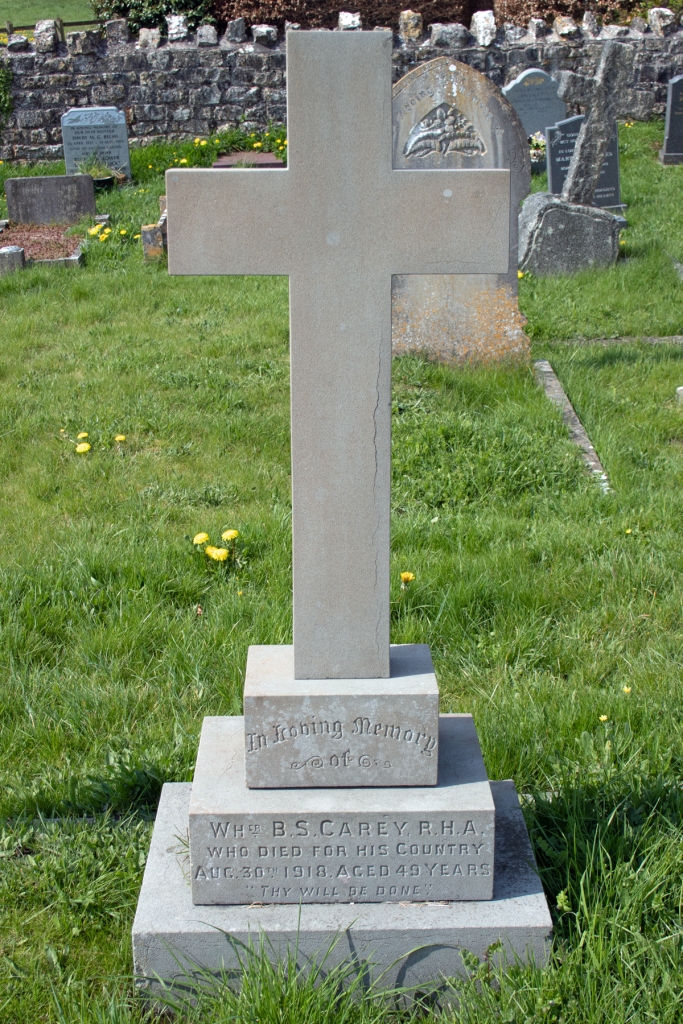
Banfield Sidney Carey – who was also known by his middle name – was born in 1868 in Farmborough, Somerset. His father, Abel, was a wheelwright, and both he and Sidney’s mother, Hannah, came from the village.
Sadly, little of Sidney’s life remains documented. He married Janet Morgan in Blackburn, Lancashire, in the autumn of 1912; they had had a daughter, Dorcas, five years before, and Janet had another daughter, Viola, from a previous relationship.
War came to Europe and Sidney enlisted in the Royal Horse Artillery as a Gunner (Wheeler), at some point before February 1918. By that year he was based at the regiment’s cadet school in St John’s Wood, London.
On 30th August Gunner Carey suffered a ruptured aneurysm and, despite being rushed to the nearby Hampstead Military Hospital, he died. He was 49 years old.
Sidney Carey was brought back to Somerset for burial in the family plot. He was laid to rest in the graveyard of All Saints’ Church in his home village of Farmborough.
Gilbert George Moxham was born in the spring of 1891 in the Somerset village of Timsbury. His father, Frederick, was the local blacksmith and both he and Gilbert’s mother, Julia, had been born and raised in the village.
When he left school, Gilbert helped his father and older brother, Albert (known as Ernest), in the blacksmith’s. War was coming to Europe, and things were going to change for the Moxham family.
In April 1914, Frederick died after a short illness. The Somerset Guardian and Radstock Observer reported that he had “been engaged in the business as a blacksmith for a considerable number of years” and was “well-known and highly respected“. [Friday 17th April 1917] Ernest now took over the family business and provided support for Julia, who was not in good health herself.
Gilbert, meanwhile, enlisted in the Machine Gun Corps. While full details of his service are not available, he joined up before October 1916. Private Moxham spent five months in France and was awarded the Victory and British Medals.
Ernest was still back in Somerset working. He had been exempt from enlisting, as the work he was doing was needed for the war effort. In February 1917, he applied for a further exemption. The local newspaper reported that:
He had one brother serving, and himself managed the blacksmith’s business for his mother. Much of his work was done for agriculturists. His mother was practically an invalid and had a trained nurse to look after her by day. He had a contract to make shoes for the Army, but there was no time specified as to the termination of the contract. In addition, he looked after between 60 and 70 horses for shoeing.
Somerset Guardian and Radstock Observer: Friday 2nd February 1917
Just over a month later, Julia passed away, after a long illness. She was 55 years of age.
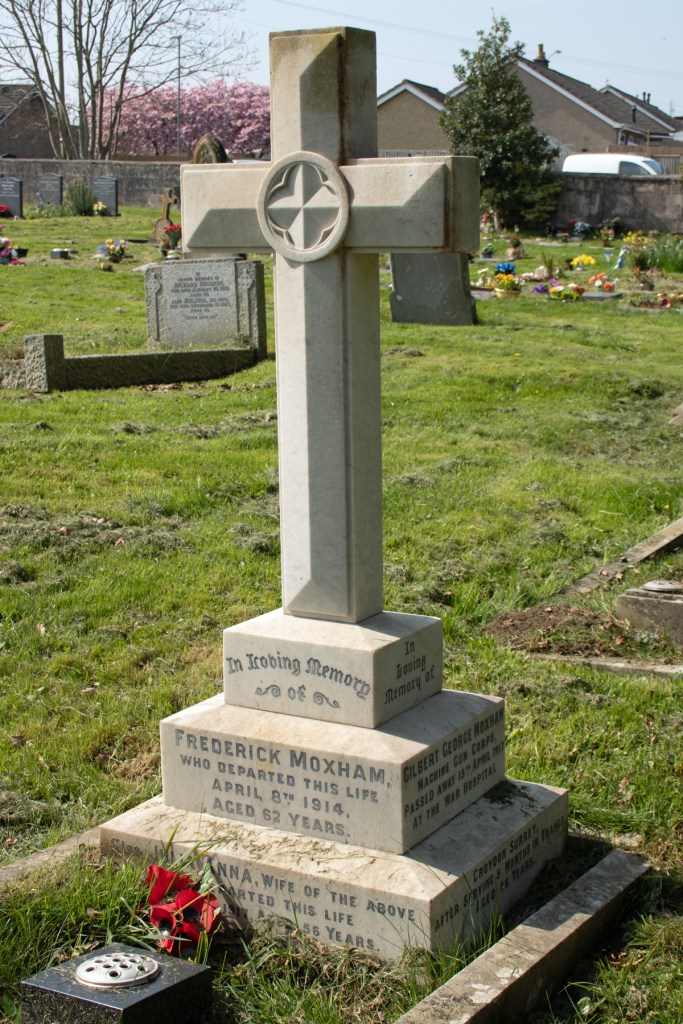
Meanwhile, Gilbert was also suffering with his health. He was admitted to the Croydon War Hospital in April 1917, having contracted pneumonia. Tragically, he was to succumb to the lung condition, passing away on 13th April 1917, aged just 26 years old.
Gilbert George Moxham was brought back to Somerset for burial. He was laid to rest with his parents in the family grave in the church cemetery of St Mary’s in his home village.
Private Gilbert Moxham
Ernest lived on for another three decades. He married a woman called Ada, and they had three children. The local newspaper – a constant for the Moxham family through the years, reported on his passing:
The death of Mr Albert Ernest Moxham, at the age of 67, has removed from Timsbury a very highly respected resident. In business as a blacksmith he had traded in this capacity all his working life.
Following the family trade, he was the fourth generation of blacksmiths, and will be missed by many farmers and other tradesmen for many miles around for his work and advice.
In addition to this, the family, for two generations, were recognised as the village dentists, and the late Mr Moxham could remember helping his father in this capacity in his early days…
Apart from his business, he was particularly interested in bell-ringing, and for many years rung in St Mary’s Church belfry, where, for a period of time, he was captain.
Somerset Guardian and Radstock Observer: Friday 23rd January 1953
Ernest, too, was laid to rest in the family plot. The church in which he rang was next door to the Forge, his home and business for many years.
Edward Short Mudford was born on 29th March 1898 in the Somerset village of Stratton-on-the-Fosse. He was one of nine children to Joseph and Mary Mudford.
Information about his early life is confusing: the 1901 census gives his name as Edwin, rather than Edward; his father appears to have died by this point, leaving Mary to raise the family alone. The 1911 census records Edward and a younger sister living in the Union Workhouse in Shepton Mallet, while Mary has apparently remarried and was living in Radstock with two of Edward’s siblings and a daughter from her second marriage, although her new husband is noticeable in his absence from the document.
From this shaky start, however, Edward sought a new life for himself. On 21st August 1913 he enlists in the Royal Navy. His service records show that he stood just 5ft 1ins (1.55m) tall, had fair hair, hazel eyes and a fresh complexion. Being under age at the time, he was given the rank of Boy 2nd Class.
Edward was initially sent to HMS Ganges, the naval training establishment outside Ipswich, Suffolk. Promoted to Boy 1st Class in February 1914, he was soon given his first posting, on the cruiser HMS Crescent.
After another short spell at HMS Vivid, the Naval Dockyard in Plymouth, Boy Mudford found himself on board HMS Thunderer. Edward spent nearly four years aboard the battleship, coming of age and gaining the rank of Ordinary Seaman, while also being promoted to Able Seaman in March 1916.
Edward returned to Plymouth in February 1918, and spent the next couple of years between there, Portsmouth and Woolwich Dockyards. He was again promoted, given the rank of Leading Seaman in September 1918.
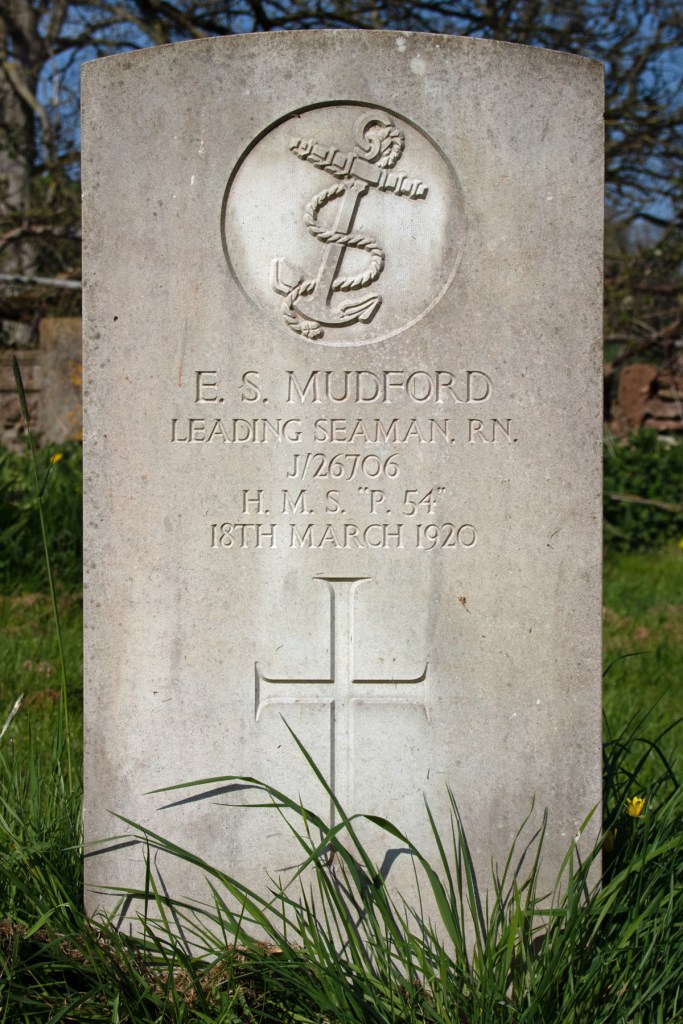
Life at sea and in barracks took its toll, however, and, in in the spring of 1920, Leading Seaman Mudford contracted influenza and pneumonia. Sadly the conditions proved too much to bear: he passed away on 20th March 1920, a week shy of his 22nd birthday.
Brought back to Somerset, where, presumably some of his family still lived, Edward Short Mudford was laid to rest in the graveyard of St John the Baptist Church in Chilcompton.
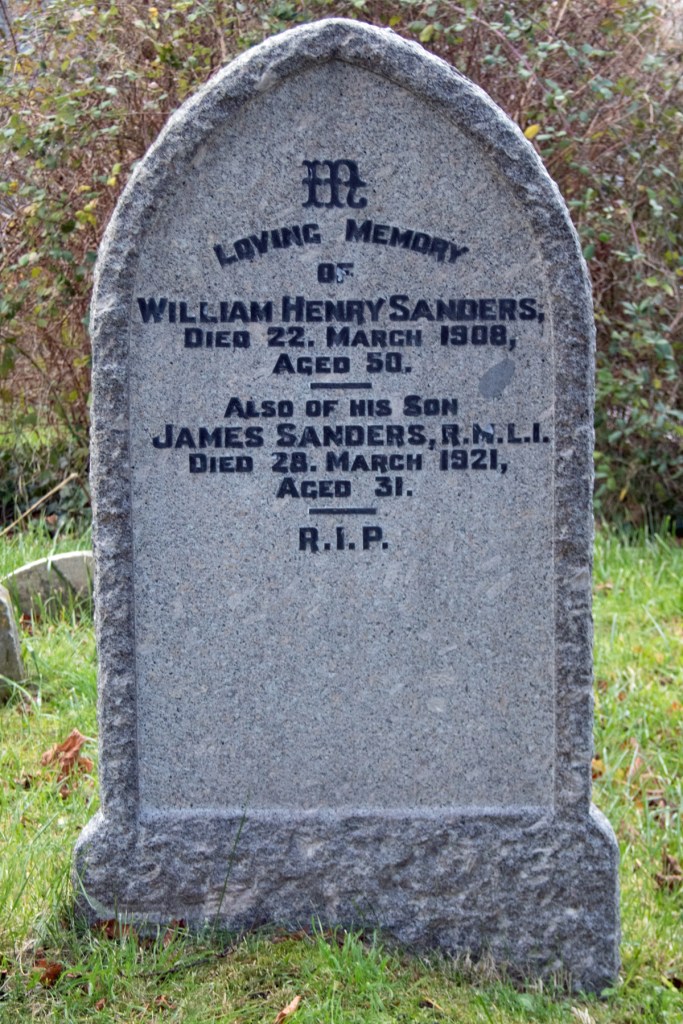
James Sanders was born on 17th April 1889. One of nine children, his parents were William and Emily Sanders. William worked for a clay company in his home town of Kingsteignton, Devon. He had various roles, including caretaker, inspector and messenger.
William’s son, however, was after bigger things in life and, on 17th July 1907, he enlisted in the Royal Marine Light Infantry. James’ service records show that he was 5ft 6ins (1.67m) tall, had light brown hair, grey eyes and a fresh complexion.
Based out of Plymouth, Private Sanders signed up for an initial period of twelve years. During this time, and throughout the war, he served on six vessels, including 30 months on HMS Argyll (where he was based for the 1911 census) and more than five years on HMS Colossus.
In April 1919, Private Saunders returned to land. When his initial contract was up, he re-enlisted, this time remaining at the Naval Dockyard in Plymouth.
James’ trail goes a little cold for the next couple of years, although he continued in his role with the Royal Marine Light Infantry. On the night of the 28th March 1921, however, he encountered some trouble. The local newspaper reported on the subsequent inquest.
Kingsteignton Man’s Mysterious Death
At an enquiry held at Teignmouth on Saturday afternoon into the circumstances attending the death of Private James Sanders, RMLI… who was found drowned in the river Teign on Friday, it was stated that deceased and seven other Kingsteignton men on Monday visited Teignmouth to attend a football match, at which Sanders acted as touch-judge.
After the match they went to a public house, where deceased had three or four pints of beer and some spirits, which made him unsteady.
They left to catch a bus, but at Station Road deceased turned back. One of his companions followed him, but could not persuade him to return, so he left deceased on his own to travel back home.
The man considered Sanders was in a condition to look after himself. An open verdict was returned.
Wester Times: Friday 8th April 1921
Private James Sanders died on 28th March 1921, aged 31 years old. He was laid to rest with his father, William, who had died in 1908, in the graveyard of St Michael’s Church in Kingsteignton.
Lawrence Arthur Scott was born in the spring of 1889 in the Devon town of Kingsteignton. He was one of nine children to George and Louisa Scott. George was a lighterman – transporting clay and other goods on a barge. When his father passed away in 1905, Lawrence found work as a clay cutter, bringing in money to help support his mother. By the time of the 1911 census, he was on the only one of Louisa’s children to still be living at home, and was the main breadwinner.
In the spring of 1915, Lawrence married Elizabeth Webber in Newton Abbot. The young couple settled in Kingsteignton, and went on to have a son, Frederick, who was born the following year.
By now war had descended upon Europe. Lawrence enlisted, joining the Royal Berkshire Regiment in the summer of 1916. His service records confirm that he was 5ft 7in (1.7m) tall, had dark hair, blue eyes and a fair complexion.
Private Scott arrived in France on 20th August 1916 and, over the next couple of years he served on the Western Front. In September 1917, he was transferred to the Labour Corps, but by now his health was suffering. On 22nd March 1918 he was admitted to a hospital in Rouen with bronchitis. He was transferred to a hospital back in England and, on 17th June 1918 he was formally discharged from the army, with arteriosclerosis.
Lawrence returned home, but his health was to get the better of him. He passed away from heart failure on 30th March 1919, aged just 30 years old.
Lawrence Arthur Scott was laid to rest in a family plot in the graveyard of St Michael’s Church, Kingsteignton. Elizabeth was finally reunited with her husband 67 years later and was buried with him.
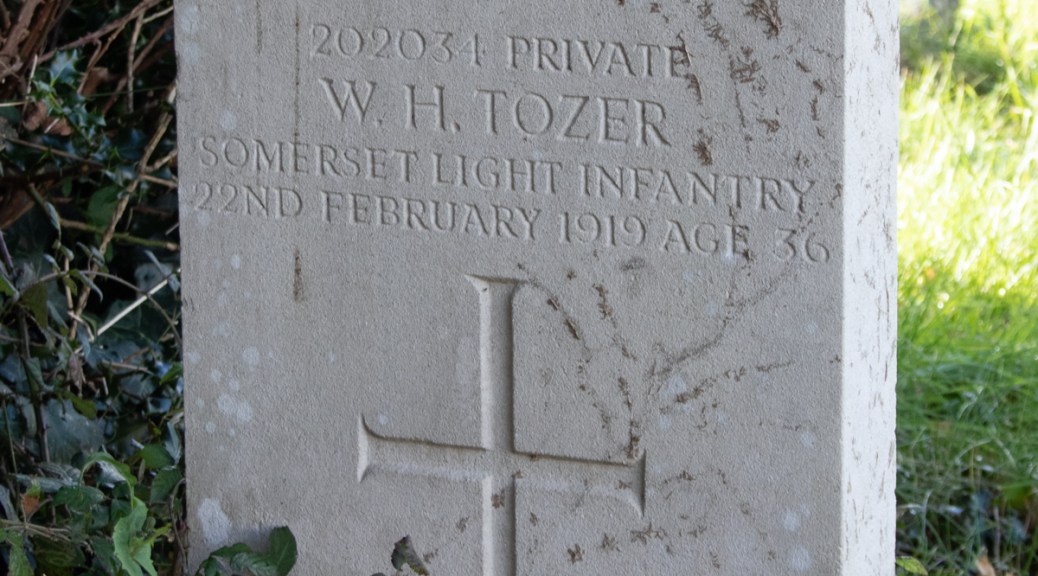
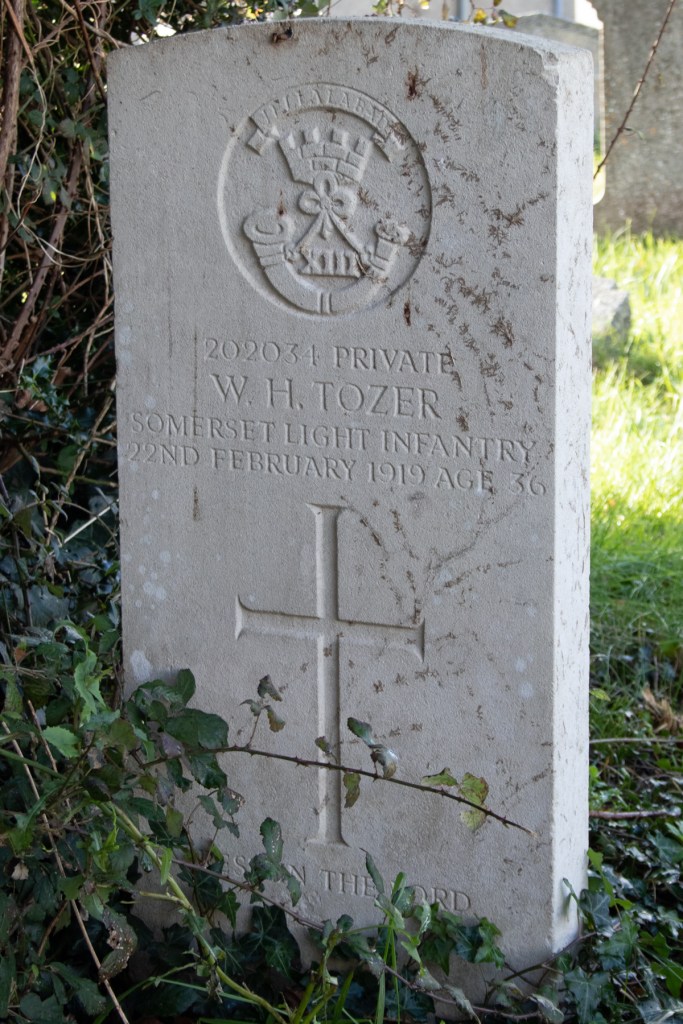
William Henry Tozer was born in the spring of 1882, and was one of four children to Elias and Thirza Tozer. Elias was a clay worker from Dawlish in Devon, and but the family were raised in nearby Kingsteignton.
William made his own way early on in life. By the time of the 1901 census he was working as a farm labourer and boarding with the family. Ten years later, he was employed as a porter at the Royal Hotel in Dawlish, and was again living on site.
At this point, William’s trail goes cold. War was approaching Europe, and it is documented that he enlisted in the Somerset Light Infantry at some point before the summer of 1918. Private Tozer was assigned to one of the regiment’s depots, but whether that was as part of the British Expeditionary Force, or on home soil is unclear.
William did survive the war, however, but was admitted to a military hospital at the start of 1919. Again, his condition is unclear, but the record of his passing confirms that he died of ‘disease’. He passed away on 22nd February 1919, at the age of 36 years old.
William Henry Tozer was brought back to Kingsteignton for burial. He was laid to rest in the graveyard of St Michael’s Church.
Frederick George Partridge was born on 26th May 1890 in Kingsteignton, Devon. He was one of ten children to clay cutter George Partridge and his wife, Anna. George passed away in 1903, but Frederick left school, and also found work as a cutter, helping to pay his way at home.
When was came to Europe, Frederick was keen to play his part. He enlisted on 18th November 1915, and was assigned to the King’s Royal Rifle Corps as a Rifleman. His service records show that he stood 5ft 9ins (1.75m) tall and weighed 145lbs (66kg). He was of good physical development, but had slightly flat feet.
After his initial training, Rifleman Partridge was sent to France, arriving in April 1916. His regiment soon found itself on the front line and, that summer, was firmly ensconced at the Somme. Sadly, Frederick was not to escape injury – he received a gun shot wound to his left thigh on 2nd September.
The wound was serious enough for him to be medically evacuated back to England for treatment. He was admitted to the Royal Victoria Hospital in Netley, near Southampton, but died of his injuries on 12th September 1916. He was just 26 years of age.
Frederick George Partridge was brought back to Devon for burial. He was laid to rest in the graveyard of St Michael’s Church in Kingsteignton.
Harold William Cornall was born on 16th August 1890 in Kingsteignton, Devon. He was the oldest of six children to William and Elizabeth Cornall. William worked as a carter and labourer for a tannery in the town, and, when he left school, this was where Harold also went for work.
In the autumn of 1912, Harold married Hilda Potter, from nearby Newton Abbot. The couple set up home and went on to have one child, a daughter called Winifred.
War broke out and, on 29th August 1914, Harold enlisted in the Royal Field Artillery. He was assigned to the A-Battery of the 90th (Howitzer) Brigade and was given the rank of Bombardier. He soon found himself in the thick of battle, as the brigade was sent to The Somme.
Bombardier Cornall was injured in the spine by some shrapnel, and medically evacuated to England in June 1916. Sadly, his injuries led to him becoming paralysed, and he passed away at the King George’s Hospital in London on 20th August 1916. He was just 26 years of age.
Harold William Cornall’s body was brought back to Devon; he was laid to rest in the graveyard of St Michael’s Church in his home town of Kingsteignton.
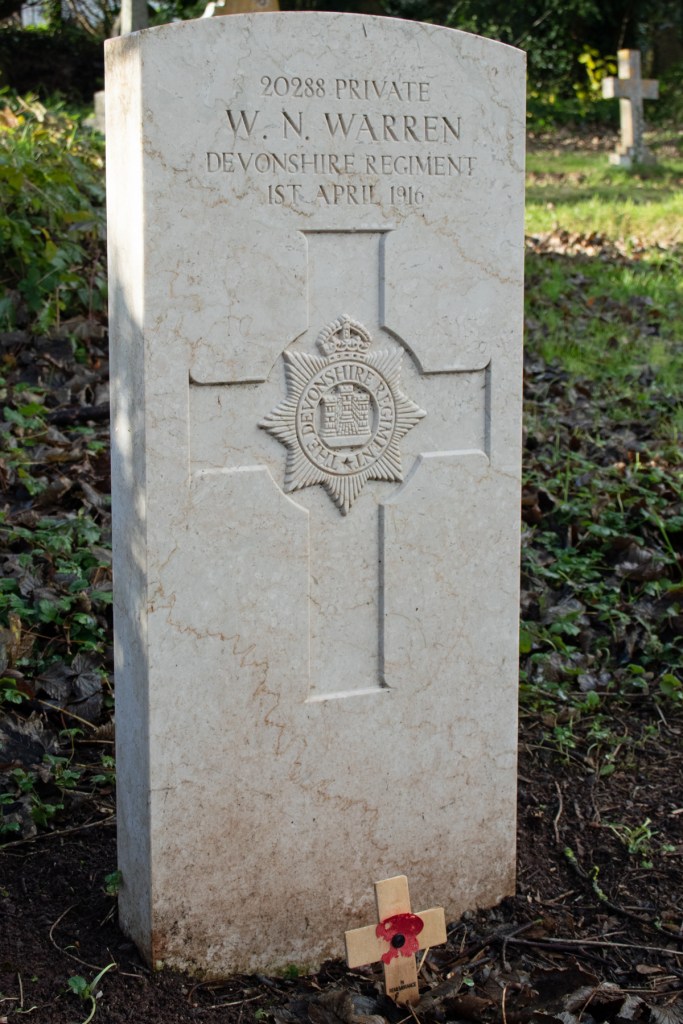
William Norrish Warren was born in Ashburton, Devon, on 24th April 1882, one of eight children to William and Irena Warren. William Sr worked as a woodsman and a farm labourer, and agriculture was a trade into which his son also went. There is a record that he found work as a railway porter, but this seems to have been only for a short while, and he soon resigned.
In the spring of 1915, William Jr married Olive Emmett, a carter’s daughter from the town. The couple went on to have a son, Alfred, who was born the following year.
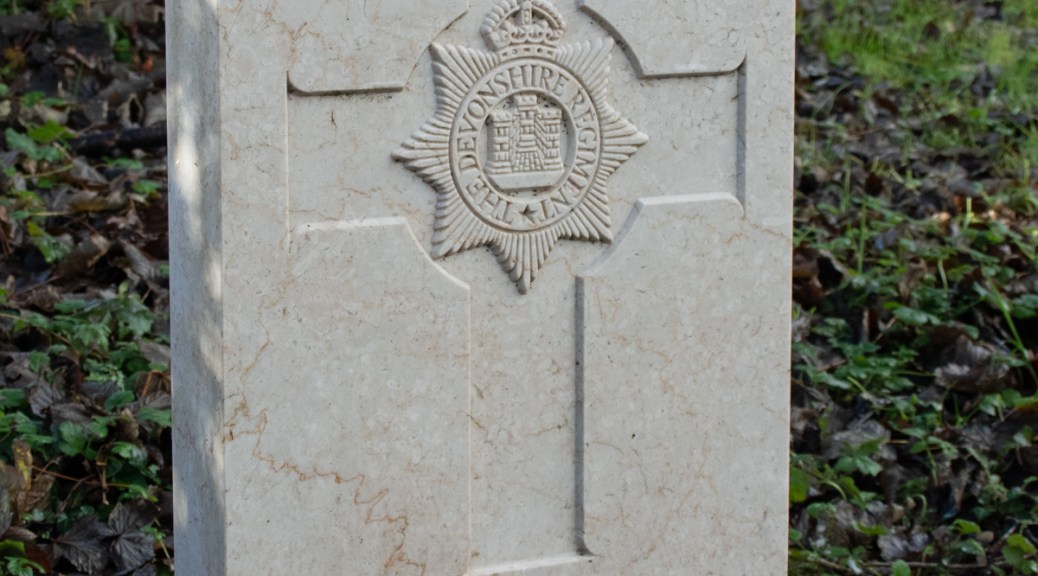
War was on the horizon, however, and William enlisted, joining the 9th Battalion of the Devonshire Regiment by October 1915. He was given the role of Private, and, while full service details are not available, he definitely spent time abroad.
Private Warren was fighting on the Front in the spring of 1916, when, on 10th March, he was badly injured. He was medically evacuated to England and admitted to the Netley Hospital near Southampton for treatment. Sadly, his internal wounds proved too severe and he passed away from his injuries on 1st April 1916. He was just 33 years old.
William Norrish Warren’s body was brought back to Ashburton for burial. He was laid to rest in the graveyard of the town’s St Andrew’s Church.
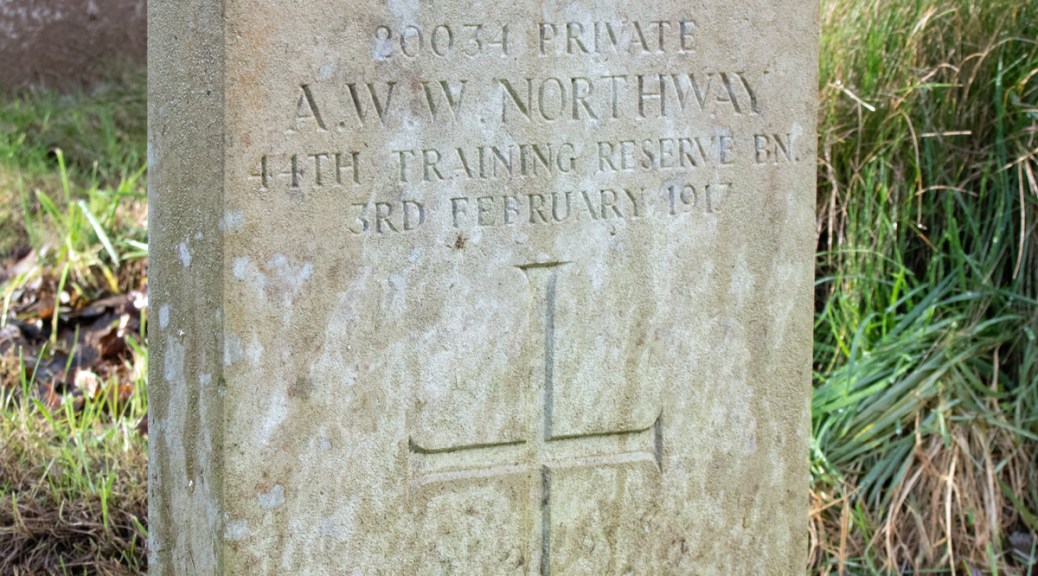
Alfred William Winsor Northway was born on 3rd December 1870 in Barnstaple, Devon. He was the only child to farm labourer John Northway and his wife Susan. By the time Alfred was a few months old, John had moved the young family to Ashburton.
On 2nd March 1890, Alfred married Susanna Raddon in Newton Abbot. The couple went on to have eleven children – Susanna already had two children when they married; there is no indication as to whether they were also Alfred’s.
By the time they married, Alfred was working as a farm labourer. This was a job he continued to do to support his rapidly growing family. War was coming to Europe, however, and the stability of life in Ashburton was soon to change. During this time, he volunteered for the 3rd Battalion of the Devonshire Regiment and this stood him in good stead moving forward.
At least two of Alfred and Susanna’s sons enlisted when the First World War broke out; not to be outdone, Alfred also joined up on 11th September 1914. Assigned to the 11th (Reserve) Battalion of the Devonshire Regiment as a Private, there is no indication that he saw any time abroad. Instead it seems that he served at the regiment’s depot in Wareham, Dorset, supporting the Training Reserve.
By the end of 1916, Private Northway had fallen ill. Admitted to the Sidney Hall Hospital in Weymouth with pneumonia, sadly the condition got the better of him. He passed away on 3rd February 1917, at the age of 46 years old.
Alfred William Winsor Northway was brought back to Ashburton for burial. He was laid to rest in the graveyard of St Andrew’s Church in the town.










 Death and Service