Category Archives: Ireland

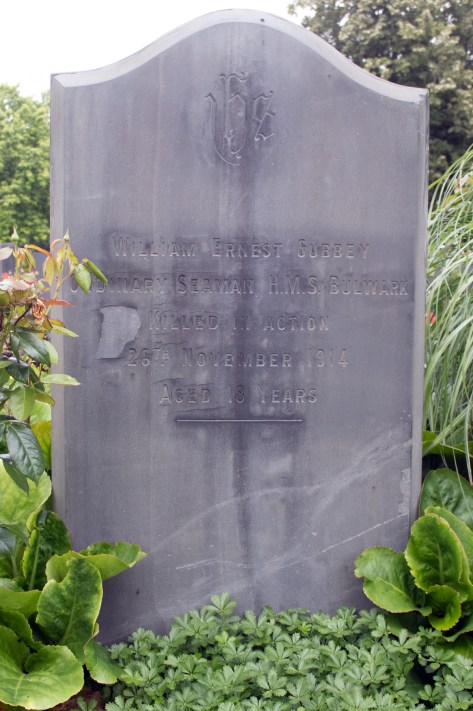
Ordinary Seaman William Gubbey

Ordinary Seaman William Gubbey

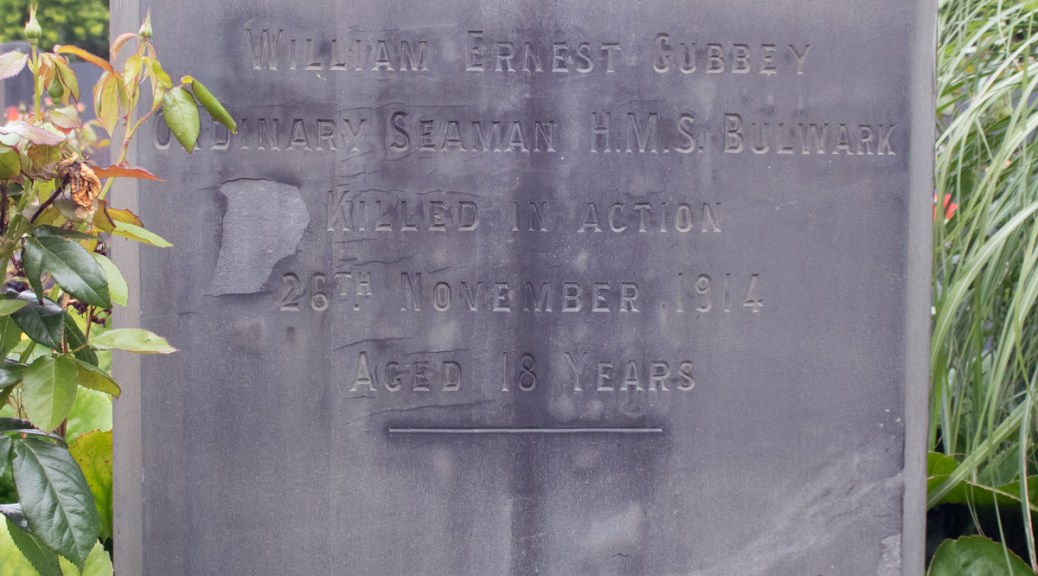
William Ernest Gubbey was born on 21st February 1896 in Portsmouth, Hampshire. He was the only child to William and Alice Gubbey. William Sr was a Petty Officer in the Coastguard, and the family travelled to where he was needed. The 1901 census found them in Malinmore, County Donegal, while ten years later, they were living in Tara, County Down.

It seemed natural for William Jr to follow in his father’s footsteps and, on 3rd August 1912, he joined the Royal Navy. He was too young to formally enlist, and was given the rank of Boy 2nd Class. Sent to HMS Impregnable, the school ship based in Devonport, she would remain his home for the next ten months while he was trained.

William was promoted to Boy 1st Class on 17th June 1913, and was assigned to the cruiser HMS Gibraltar the following day. After six months on board, and a short stopover at HMS Victory, the Royal Naval Dockyard in Portsmouth, Hampshire, he received his next posting, the battleship HMS Bulwark.

Boy Gubbey would spend the next year attached to Bulwark and, during this time, he came of age. Now formally inducted into the navy as an Ordinary Seaman, his service papers show the young man he had become. He was recorded as being 5ft 5.5ins (1.66m) tall, with brown hair, blue eyes and a dark complexion.

When was was declared in the summer of 1914, Bulwark was assigned to the Channel Fleet, patrolling and defending Britain’s southern coast. On 26th November 1914, she was moored in the River Medway, close to Sheerness, Kent, being reloaded with ammunition.

Some of the new cargo overheated and the resulting explosion ripped through the battleship. More than 740 crew were killed, including Ordinary Seaman Gubbey: he was just 18 years of age.

The bodes of the dead were laid to rest in Woodlands Cemetery, Gillingham, Kent. As his had been identified, William Ernest Gubbey was laid to rest in a marked grave.
Driver Walter Crabb

Driver Walter Crabb

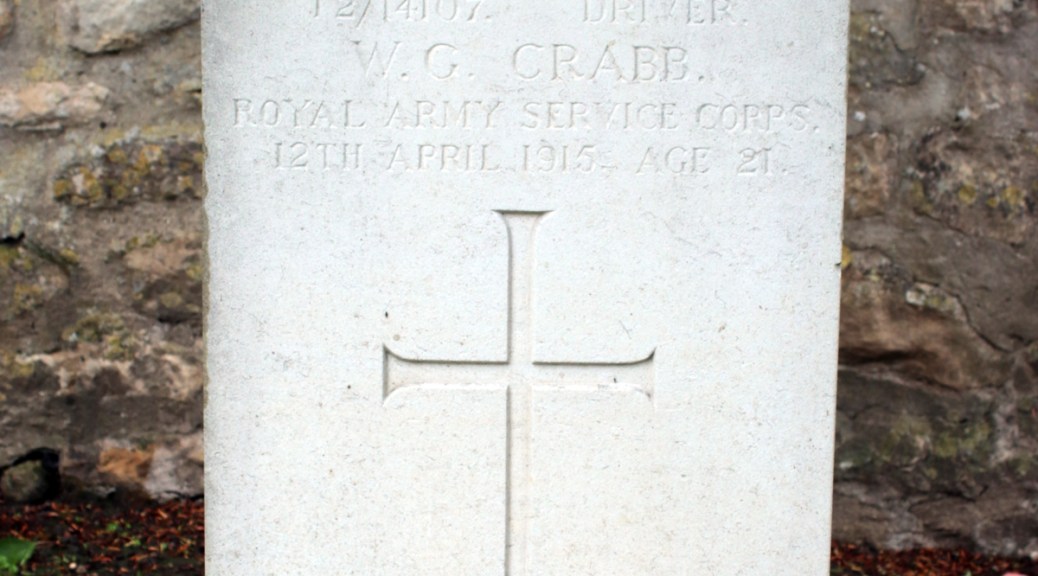
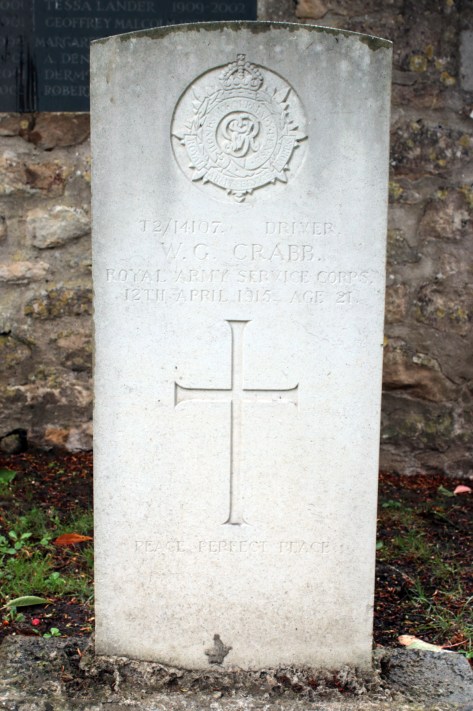
Walter George Crabb was born in the spring of 1893 in the Castleton area of Sherborne, Dorset. The oldest of ten children, his parents were Fred and Selina Crabb. Fred was a sawyer, but when Walter completed his schooling, he found employment as a bricklayer’s labourer. The 1911 census recorded the family as living in a 5-roomed cottage on Long Street.

When war came to Europe, Walter was quick to step up and play his part. His service records have been lost to time, but it is clear that he had enlisted by October 1914. As a Driver, he was attached to the 108th Horse Transport Company and, by the following spring, was barracked at Curragh Camp, to the south west of Dublin.

The next record for Driver Crabb is his entry in the British Army Register of Soldiers’ Effects. This confirms that he passed away in Curragh Hospital on 12th April 1915. The cause of his death is not recorded, but he was just 21 years of age.

The body of Walter George Crabb was taken back to Dorset for burial. He was laid to rest in the peaceful surroundings of St Mary Magdalene Churchyard, Castleton.


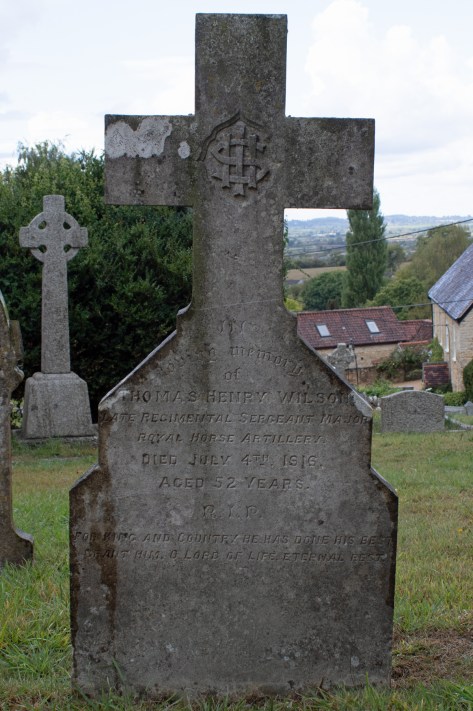
Regimental Serjeant Major Thomas Wilson

Regimental Serjeant Major Thomas Wilson

The life of Thomas Henry Wilson is challenge to piece together, and it is only through fragmented documents that the trail can be uncovered.

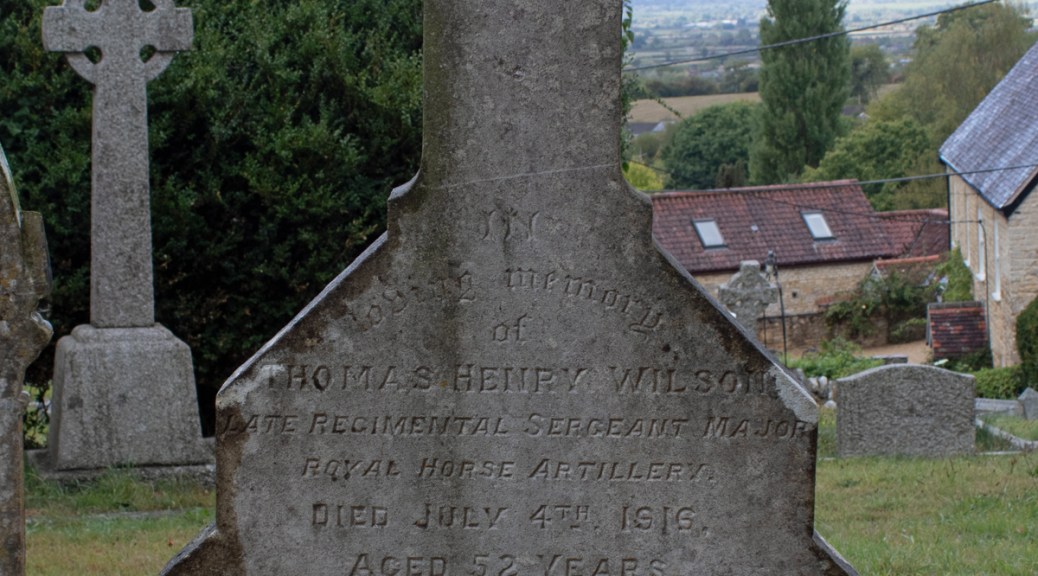
Thomas’ headstone confirms he was a Regimental Sergeant Major in the Royal Horse Artillery, and that he died on 4th July 1916, at the age of 52.

The Commonwealth War Graces Commission’s records confirm that he was married to Mary Ann Wilson (née Ralph), who lived in West Stour, Dorset. The couple’s wedding took place in Holy Trinity Church, Woolwich, Kent, on 14th February 1888. The marriage certificate gives their fathers’ names – farriers Charles Wilson and James Ralph. The document also confirms Thomas’ role as a a Sergeant in the RHA, and gives his age as 27, and Mary’s as 21.

The Wilsons’ appearance in the the census records is a little sporadic. They are not recorded on the 1891 census, but ten years later, they were living in Bilston, Staffordshire. They were listed as being caretakers of the town’s Conservative Club on Church Street. Their ages are given as 41 and 31, and Mary’s place of birth is given as Kington Magna, Dorset.

By 1911, Thomas and Mary had moved to London, and were boarding at the house of Joseph and Rosetta Johnson, at 5 Knivet Road in Fulham, Middlesex. Thomas was listed as being an army pensioner, while Mary was employed as a domestic cook.

At this point, Thomas’ trail goes cold. It is likely that he was called upon when war broke out, but there are no records to confirm where or how he served. He passed away in July 1916, and was laid to rest in All Saints’ Churchyard, Kington Magna, which would suggest that he and Mary had moved there to be closed to her family.


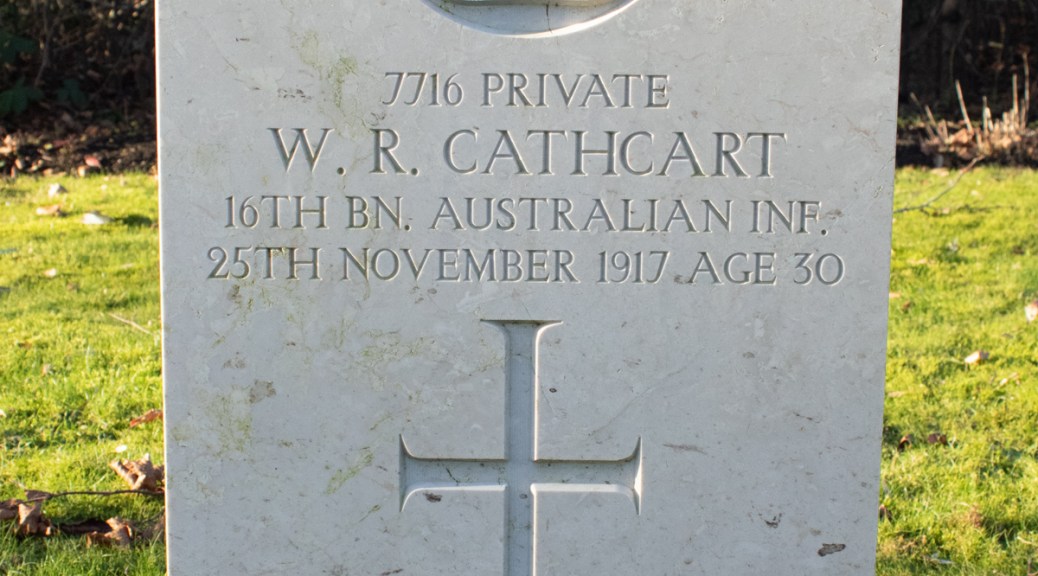
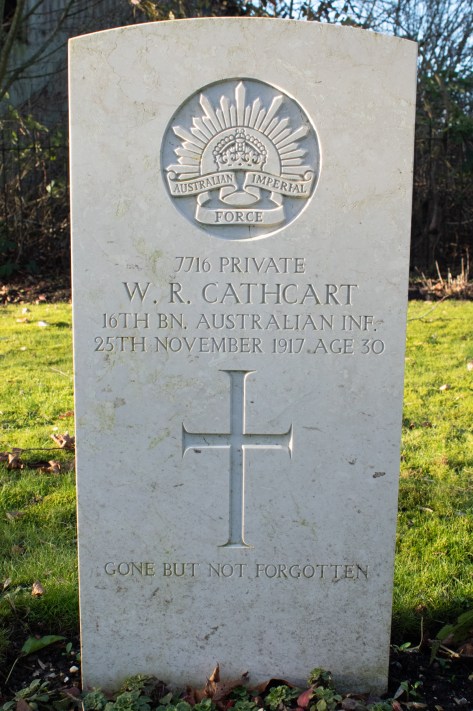
Private William Cathcart

Private William Cathcart

William Rea Cathcart was born in Ballymena, County Antrim, Northern Ireland, on 30th January 1887. The middle of five children, his parents were Thomas and Margaret Cathcart.

Little information is available about William’s early life, but he appears to have been a smart young man and, by his mid-20s was employed as a bookkeeper. Part of him sought a better life for himself and he took the decision to emigrate, arriving in Fremantle, Australia on board the SS Otranto on 14th November 1911.

William settled in Perth, but when war broke out, he was keen to step up and serve his King and Empire. He enlisted on 7th May 1915 but, for some reason, he wasn’t accepted for service at that time.

William did not give up, however, and he succeeded in enlisting on 30th May 1917. His service papers confirm that he was 5ft 8.75ins (1.74m) tall and weighed 150lbs (68kg). A Roman Catholic, he was noted as having brown eyes, brown hair and a fresh complexion.

Assigned to the 16th Battalion of the Australian Infantry, Private Cathcart’s unit set sail from Sydney on the troop ship A7 Medic, on the 1st August 1917. The voyage would take two months, and his unit arrived in Liverpool, Lancashire, at the start of October. It the then marched south to the ANZAC bases near Codford, Wiltshire.

It seems that the journey had exhausted William, and his health began to deteriorate. He was admitted to the camp hospital with diabetes, but moved to the No. 3 New Zealand General Hospital on 22nd November. He was emaciated and barely able to walk, constantly drinking, but eating very little.

Over the next few days, William’s condition worsened. He began getting pains in his arms and legs, was sluggish and restless. The treatment he was provided would ultimately prove too little, too late. Private Cathcart passed away at 1:05am on 25th November 1917: he was 30 years of age.

The body of William Rea Cathcart was laid to rest in the ANZAC extension to the graveyard of St Mary’s Church, Codford, not far from the hospital in which he had been treated.


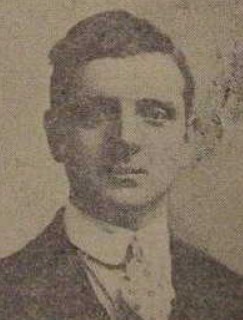
Private William Cathcart
(from ancestry.co.uk)

Private Seth Suter

Private Seth Suter

Seth Suter was born in the Dorset village of Silton on 8th March 1887. One of five children, he was the son of farm labourer Seth Suter and his wife, Mary. Seth Sr died in 1899, and, by the time of the next census, his son had taken a job as a stable boy at the Silton Farm, next to where the family lived on Waterloo Road.

The 1911 census recorded Seth living with his mother at Church Cottage in the village. Now employed as a domestic gardener, three of his siblings were also living there, and, while Mary was not working, there were four wages coming in to support the family.

At the start of 1916, Seth married Jane Sissons. There is little information about her but, while the couple married in Shaftesbury, she seems to have been born in Driffield, Yorkshire. The couple would not go on to have any children.

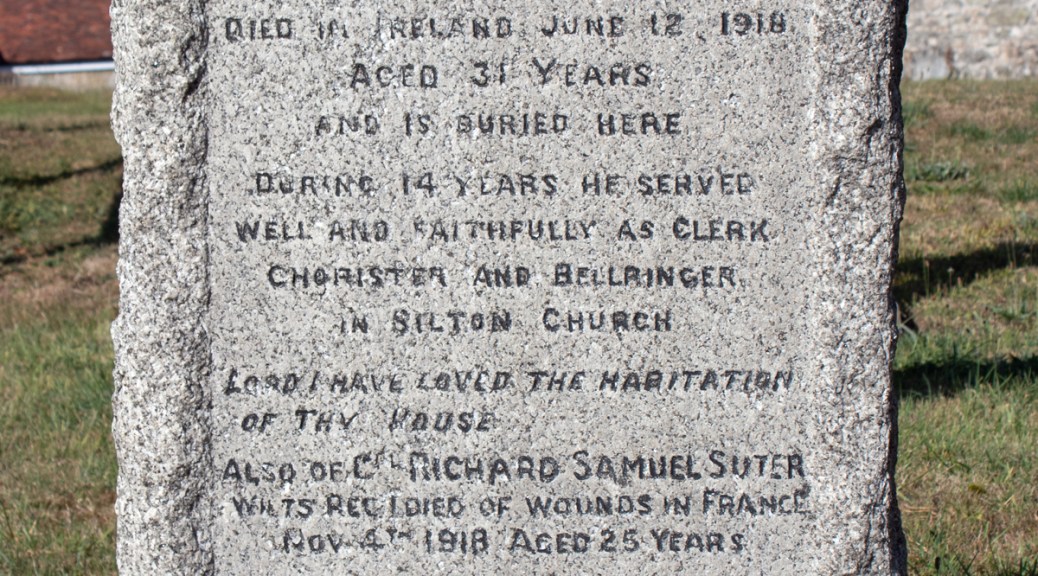
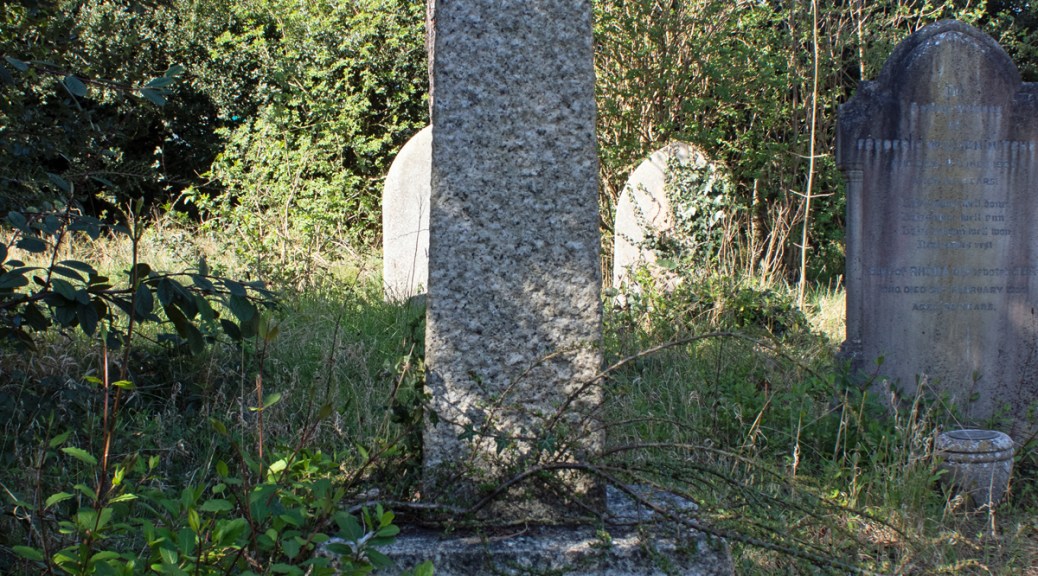
Details of Seth’s military life are sparse. With the war entering its final months, he enlisted in the Somerset Light Infantry on 13th May 1918. Assigned to the 3rd (Reserve) Battalion, he was sent to Ireland for training. Private Suter’s time there was not to be lengthy: he passed away through causes unknown just a month after joining up, on 12th June 1918. He was 31 years of age.

The body of Seth Suter was taken back to Dorset for burial. He was laid to rest in the quiet graveyard of St Nicholas’ Church in his home village of Silton.


Seth’s younger brother Richard also served in the First World War. He joined the 7th (Service) Battalion of the Duke of Edinburgh’s (Wiltshire Regiment), and rose to the rank of Lance Corporal.

He was injured during the fighting to the south of Valenciennes in France, dying of his wounds on 4th November 1918, one week before the end of the war. He was laid to rest in Busigny Communal Cemetery.


Serjeant Jack Hogan

Serjeant Jack Hogan

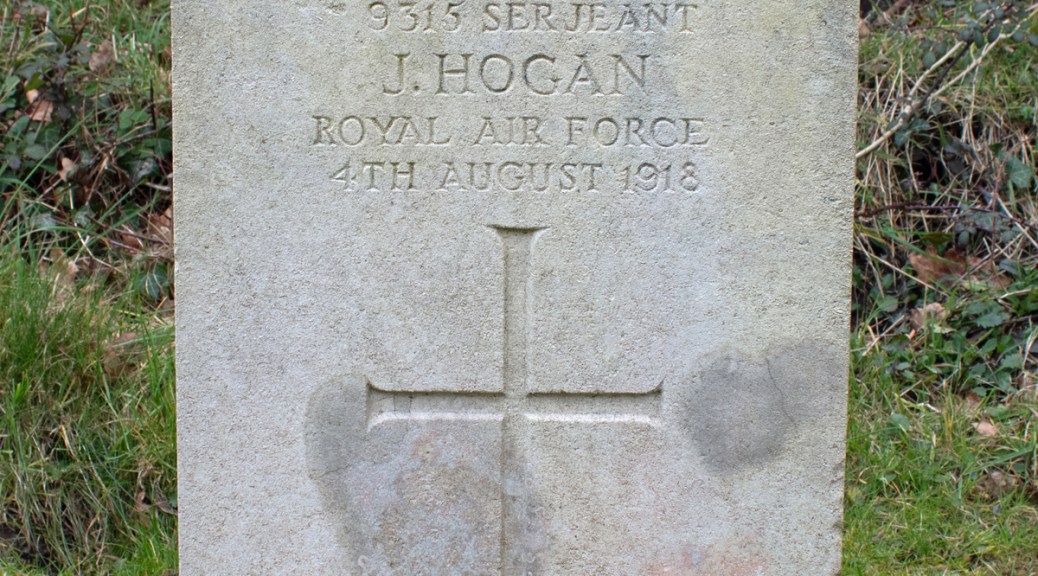
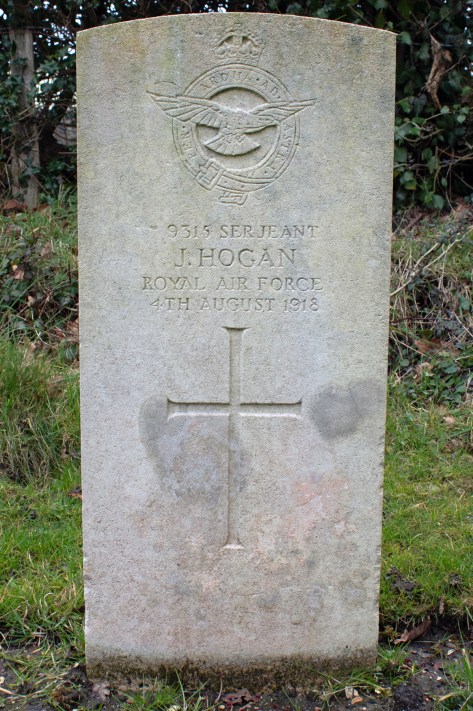
The personal life of Jack Hogan is a challenge to piece together, and much of the information is pulled from his service record. This confirms that he was born in 1890 in Cork, Ireland, and gives his next of kin as his mother, Annie Hogan, who was living in Southsea, Hampshire. He seems to have been born John Hogan, Jack being a common nickname, but there are too many census records with potential matches to narrow down a definite connection.

A Roman Catholic, Jack was 5ft 5.5ins (1.66m) tall. He had dark hair, brown eyes and a fresh complexion. He was also noted as having two small moles on his left cheek. He enlisted in the Royal Flying Corps as an Air Mechanic 2nd Class on 1st October 1915, leaving his job as a motor and cycle fitter to do so.

Jack seemed to have been proficient at what he was doing, and was promoted to Air Mechanic 1st Class less than a year after enlisting. On 5th February 1918 he rose again, taking the role of Acting Sergeant. When the Royal Air Force was formed in April that year, his rank was made permanent.

Sergeant Hogan was attached to the 29th Training Depot Station near East Boldre, Hampshire. On 4th August 1918, he was piloting an Avro 504, when it collided with another aircraft. There is little recorded about the incident, and his RAF Casualty Card does not give details of the other vehicle or its pilot. Jack’s biplane fell to the ground and he was killed. He was 28 years of age.

The body of Jack Hogan was laid to rest in the graveyard of St Paul’s Church in East Boldre, not far from the base that had become his home.


Lieutenant Allan Furlong

Lieutenant Allan Furlong

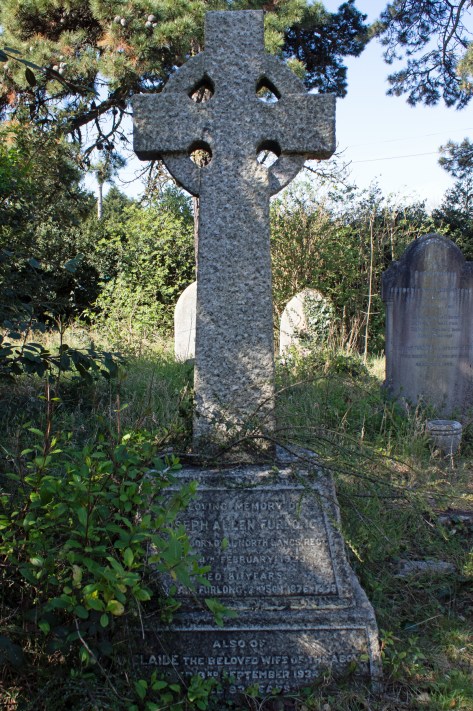
Allan Hyde Furlong was born the autumn of 1874, and was the oldest of seven children to Joseph and Adelaide Furlong. The place of his birth varies depending on which document you’re looking at, with census records suggesting he was born in Pembrokeshire, Wales, or Aldershot, Hampshire. His birth was registered in Eastry, Kent, however, so it is possible that this is where the family were based at the time.

Joseph was an officer in the North Lancashire Regiment, and his work meant the family moved time and time again. Allan’s younger siblings were born in Hampshire, Pembrokeshire and Athlone, Ireland. By the early 1880s, they had settled in Lancashire, the 1891 census recording them as living in the Fulwood Barracks in Preston.

Given his father’s military background, it is not surprising that Allan was drawn to follow suit. He took a different route, however, and enlisted in the Royal Naval Reserve. Midshipman Furlong took a commission on 27th August 1892, and would make a career out of the navy.

By the time war broke out, Allan was serving on board the SS Burma. In May 1915 he was promoted to Sub Lieutenant, and a further rise in rank – to full Lieutenant – followed in January 1918. He survived the war, and remained at sea through to the start of the new decade.

In March 1920, Lieutenant Furlong was admitted to the Royal Marine Infirmary in Deal, Kent, suffering from a combination of influenza and pneumonia. The conditions would get the better of Allan, and he passed away from them on 14th March 1920: he was 45 years of age.

Joseph and Adelaide were living in Worthing, West Sussex, by this point. Keen to bring their son home, the body of Allan Hyde Furlong was laid to rest in the town’s Broadwater Cemetery.


Private Lawrence Kinane

Private Lawrence Kinane

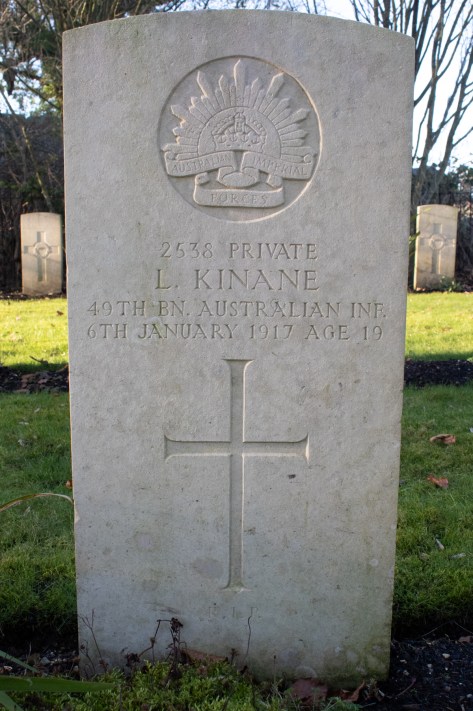
Lawrence Kinane was born in Tipperary, Ireland, in 1896. One of eight children, his parents were Daniel and Catherine Kinane. Daniel was a farmer and, when Catherine died when Lawrence was just 10 years old, he was left to raise the support the family on his own.

At this point, the family’s trail goes cold, and it later picked up in an unexpected way. Daniel and some of the children seem to have emigrated to the United States, and he died in Brooklyn in March 1914. Lawrence, meanwhile, seems to have gone further, seeking a new life in Australia. A cousin, Mary Mulcahey, was living with her husband in Warwick, Queensland, and, by the time war broke out, he had moved to Brisbane.

Lawrence was working as a labourer when, on 10th June 1916, he enlisted in the Australian Imperial Force. His service papers show that he was 5ft 11ins (1.8m) tall and weighed 147lbs (66.7kg). A Roman Catholic, he had dark brown hair, grey eyes and a medium complexion. Under Distinctive Marks, he was recorded as having a large patch of scars on his left side, about 7ins (18cm) above his buttock.

Private Kinane’s unit – the 49th Battalion of the Australian Infantry – set sail from Brisbane on the 19th September 1916. His ship – the SS Seang Choon – would take ten weeks to reach its destination – Devonport, Devon, and Lawrence finally arrived at the ANZAC base in Codford, Wiltshire in mid-December.

The lengthy sea voyage had taken its toll on a lot of the soldiers being transported, and Private Kinane was not to be immune. Within weeks of arriving, he came down with pneumonia, and was admitted to the No. 3 New Zealand General Hospital in nearby Sutton Veny on 31st December. Lawrence’s condition worsened, and he finally succumbed to it on 6th January 1917. He was just 20 years of age.

Thousands of miles from Australia, and with no family close by, the body of Lawrence Kinane was instead laid to rest in the graveyard of St Mary’s Church in Codford, not far from the base that had been his home for just a few short weeks.


Private Lawrence Kinane
(from findagrave.com)

Carpenter’s Mate George Land

Carpenter’s Mate George Land

George William Land was born early in 1891, and was the only child to George and Caroline Land. George Sr was a greengrocer from Dagenham, Essex, and the family were living in Ilford when his son was born.

Caroline seems to have died a few months after George Jr’s birth, and, by the time of the 1901 census, he was in the care of her parents. His father was still running the shop, and was supported by George Jr’s aunt.

The 1911 census found George Jr employed as a greengrocer, and it seems likely that he was working alongside his father by this point. He was living with his maternal and uncle, who was also employed in the same line of work.

When war was declared, it seems that George Jr wated to play his part. Full details of his service have been lost to time, but it seems that he joined the Merchant Navy and, by the summer of 1918, he was working as a Carpenter’s Mate on board the SS Mesaba. She was a cargo liner, requisitioned by the Admiralty for transport duties.

On 31st August 1918, the Mesaba left Liverpool, Lancashire, for Philadelphia. The following day, she was torpedoed by the German submarine U-118, and foundered. She sunk off the coast of County Wexford, with the loss of 20 souls, Carpenter’s Mate Land included. George Jr was 27 years of age.

The body of George William Land was laid to rest in St David’s Parish Cemetery, Pembrokeshire. It is unclear whether his body had been brought to Wales with the seventy survivors who had been rescued, or whether it had washed ashore there some time after the sinking.


Leading Boatman Peter Moran

Leading Boatman Peter Moran

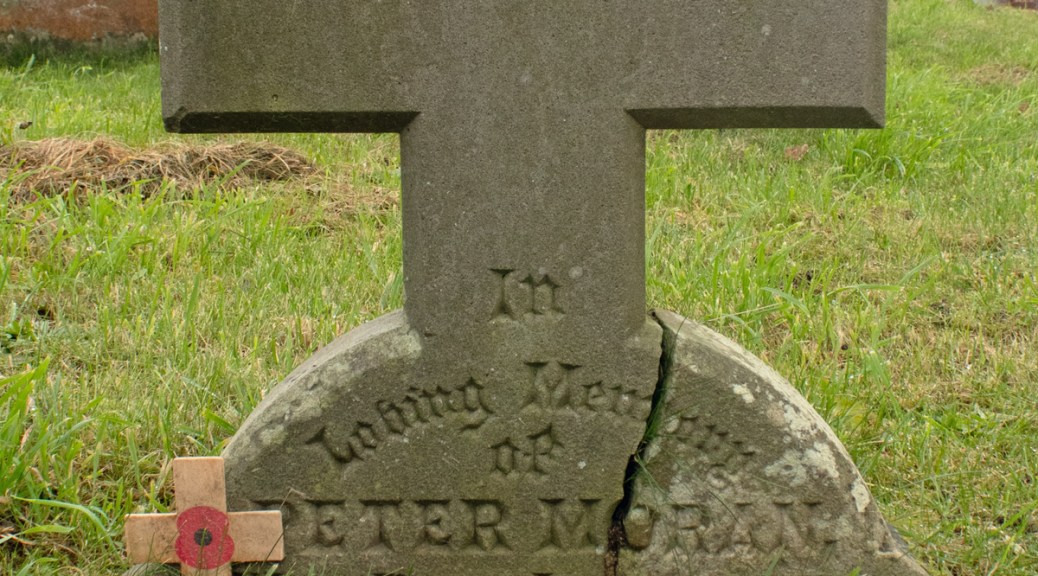
Peter Moran was born in Kilmeena, County Mayo, Ireland, on 29th January 1876. Details of his early life are hard to track down, but when he finished his schooling, he wound work as a fisherman.

By 19th August 1891, Peter sought to make a more permanent career of the sea. He signed up to the Royal Navy, and was sent to HMS Impregnable, the shore base in Devonport, Devon, for his training. Being just 15 years of age, he was too young to formally enlist, and was given the rank of Boy 2nd Class.

Over the next few years, Peter learnt the tools of his trade. On 2nd July 1892 he was promoted to Boy 1st Class, and the following February he was given his first sea-faring assignment, on board the battleship HMS Neptune. By March 1893 Boy Moran found himself serving on board HMS Daphne, a screw sloop which would become his home for the next three years.

During his time aboard Daphne, Peter came of age, and was given the rank of Ordinary Seaman. His service records show that he was 5ft 4ins (1.63m) tall, with light hair, grey-blue eyes and a fresh complexion. Within eighteen months he had proved his mettle, and was promoted to Able Seaman.

Over the next decade, Peter would serve on eight vessels. By the time the term of his contract came to an end in September 1903, he had been promoted twice – to Leading Seaman, then to Petty Officer 2nd Class.

Peter renewed his contract, but seems to have chosen a new career path. On 2nd October 1903 he moved to HM Coastguard and, as a Boatman, was assigned to Pendeen Cove, Cornwall.

Love blossomed for Peter, and he married a woman called Caroline in the next few years. There is little further information about her, but the couple would go on to have three children – Mary in 1908, Florence in 1911 and Thomas in 1913.

Boatman Moran would spend twelve years with the coastguard, moving to St Ives, Cornwall, in September 1908, and Fishguard, Pembrokeshire, in March 1914. By this point he had been promoted to Leading Boatman, and was set on a new life in Wales. Sadly, the new life was not to be: on 2nd June 1915 he passed away from pneumonia. He was 39 years of age.

The body of Peter Moran was laid to rest in Fishguard Cemetery: a life at sea, and forging homes in three countries at an end.