Category Archives: Middlesex

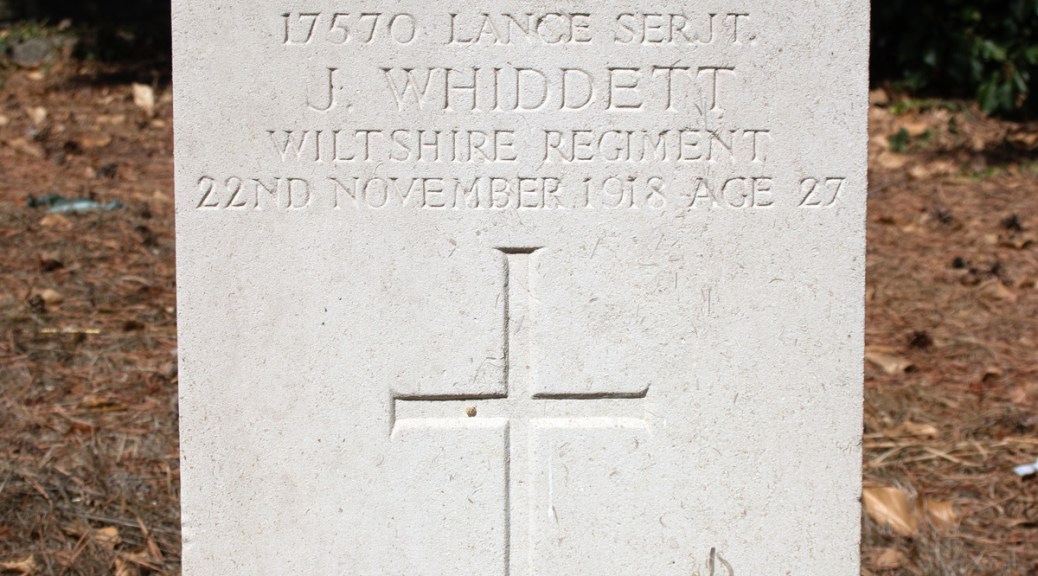
Lance Serjeant John Whiddett

Lance Serjeant John Whiddett

John Whiddett was born in Hammersmith, Middlesex, in 1892, and was one of thirteen children to Alfred and Mary Ann Whiddett. Alfred was a house painter while Mary Ann worked as a charwoman to bring in some additional money for the growing family.

John worked as a porter when he left school, but when war came to Europe, he stepped up to play his part. He enlisted in the Wiltshire Regiment in the summer of 1915, and was assigned to the 3rd (Reserve) Battalion.

While Private Whiddett served in France, he returned to Britain, and promoted to Corporal and then Lance Serjeant. His battalion eventually formed part of the Thames & Medway Garrison. Frederick found himself in Kent by the autumn of 1917 and served out the remainder of the war there.

At some point during the autumn of 1918, Lance Serjeant Whiddett fell ill. He was admitted to the Preston Hall Military Hospital in Aylesford, suffering from a combination of influenza and pneumonia. Sadly he was not to survive these lung conditions, and he succumbed to them on 22nd November 1918. He was just 26 years of age.

Finances may have restricted John’s family’s ability to bring his body back to Middlesex. Instead, he was laid to rest in the graveyard of St Peter and St Paul’s Church in Aylesford, Kent.


Lance Corporal Thomas Roberts

Lance Corporal Thomas Roberts

Thomas Roberts was born in Llangollen, Denbighshire, in 1895. One of seven children, his parents were William and Ellen Roberts. William was a butter merchant, and his wife helped in the business.

When Thomas left school, he found work as a greengrocer’s assistant, but when war was declared he saw an opportunity for glory. While full details of his military service are no longer available, it’s clear that he enlisted in the Royal Welch Fusiliers.

Private Roberts was assigned to the 13th (Service) Battalion (1st North Wales) and on 1st December 1915, found himself in France. For the next eighteen months, he was firmly ensconced on the Western Front, and rose to the rank of Lance Corporal for his service.

In April 1917, Thomas was injured in fighting and was medically evacuated to Britain for treatment to his bullet wounds. Admitted to the Edmonton Military Hospital in North London, his injuries were to prove too severe. Lance Corporal Roberts passed away on 22nd April 1917. He was just 21 years of age.

Brought back to Wales for burial, Thomas Roberts was laid to rest in the family plot in Llangollen’s Fron Cemetery.


Thomas was buried along with his brother David, who had passed away in 1912. They were joined by their father William, who died in 1919, and their sister Elizabeth, who passed away in 1945. The family were finally reunited with Ellen, when she died in 1947, at the age of 86.


Lieutenant Hugh Punchard

Lieutenant Hugh Punchard

Hugh Punchard was born in February 1895, the oldest of three children to William and Jane Punchard. William was a civil engineer from London, and Hugh was born in Surbiton.

The 1901 census recorded the family living in the 14-room house, Pope’s Garden, in Twickenham. Along with the family, there were four members of staff – a governess, housemaid, cook and a nurse. By the time of the next census, sixteen-year-old Hugh was away at school, boarding with more than 400 others at Haileybury College in Hertfordshire.

War was coming to Europe by this point, and Hugh was keen to play his part. He enlisted in the Royal Navy on 20th October 1914 and, while he was only there for a short period, his records shed some light onto the man he had become. He enlisted as a mechanic, and was noted as being 6ft 4ins (1.93m) tall, with dark brown hair, grey eyes and a fair complexion.

Hugh remained in the Royal Navy for only a month, and, while full details of his service are no longer available, it would seem that it was at this point that he transferred to the Royal Garrison Artillery. He appears to have performed his duties well, and achieved the rank of Lieutenant. He also made another transfer, when he was attached to the Tank Corps.

Lieutenant Punchard was based in Dorset by the last year of the war, and it was while he was serving there that he became unwell. He contracted pneumonia, and was admitted to Wareham Military Hospital. Sadly, the condition was to take his life, and he passed away on 31st October 1918, at the age of just 23 years old.

Hugh Punchard’s paternal grandparents lived in Devon, and, as William had passed away two years earlier, the decision was to lay him to rest in Totnes Cemetery.


Hugh’s will left his estate to his mother, Jane. When he passed, she became the beneficiary of his effects, totally some £3,600 7s 6d (around £250,000 in today’s money).

Jane stayed living in Twickenham: when she passed away on 29th July 1937, she was brought to Devon for burial, and was laid to rest with her son.


A number of documents relating to Hugh give his name as R Hugh Punchard. Sadly, I have not been able to unearth details of what his official first name might have been.


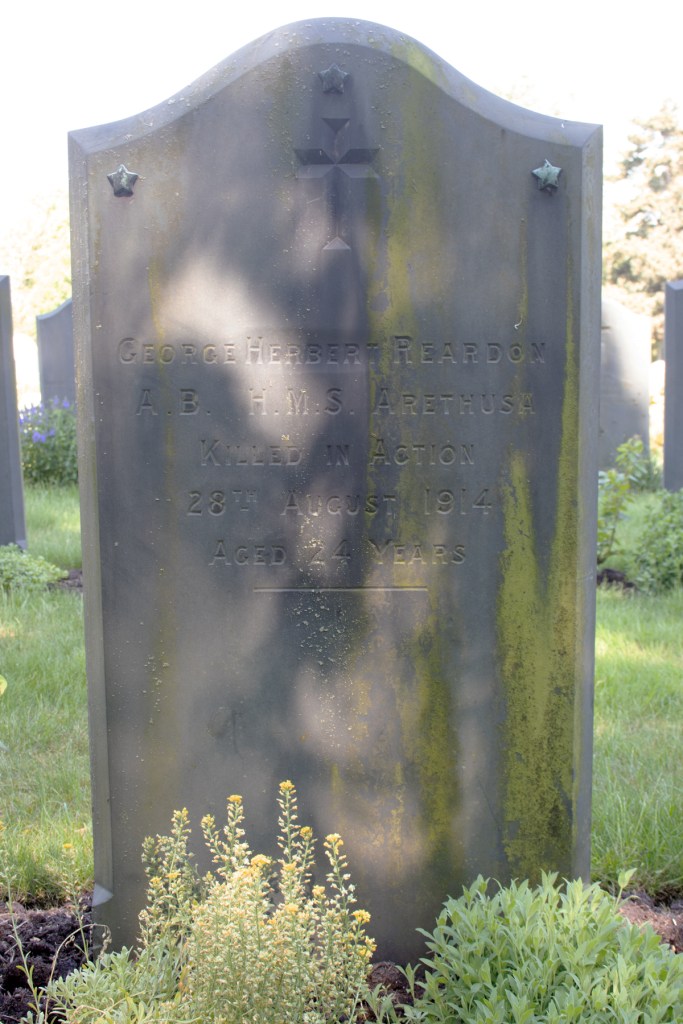
Able Seaman George Reardon

Able Seaman George Reardon

George Herbert Reardon was born on 29th March 1890 in St Pancras, Middlesex. The second of four children, his parents were tailor Thomas Reardon and his dressmaker wife, Mabel.

When he left school, George worked as an errand boy, presumably for his parents’ business. However, he wanted bigger and better things and, on 6th April 1906, he enlisted in the Royal Navy.

Initially underage, George was given the rank of Boy 2nd Class, and was sent to the training ship HMS Impregnable. After nearly a year there, he was promoted to Boy 1st Class and, on 5th March 1907, was given his first sea-going assignment. Over the following nine months, Boy 2nd Class Reardon served on five ships, the last being the battleship HMS Venerable.

It was while he was assigned to this ship that George came of age, and was formally inducted into the Royal Navy, on a twelve year contract. His service records show that he stood 5ft 5.5ins (1.66m) tall, had brown hair, brown eyes and a fresh complexion. He was also noted to have two moles, one on his right upper arm and another on the third finger of his left hand.

The now Ordinary Seaman Reardon remained on HMS Venerable until 1st February 1909, when he was transferred to another battleship, HMS Implacable. He was to spend the next eighteen months on board, and, while there, was promoted again, to Able Seaman.

In September 1910, George came on shore, and was assigned to HMS Pembroke, the Royal Naval Dockyard at Chatham, Kent. This was to be his base for the next few years, and he would return there in between voyages.

Over the next four years, he served on four more vessels – HMS St George, Vindictive, Forte and Ganges. Able Seaman Reardon’s last trip, however, was to be on HMS Arethusa, which he boarded on 11th August 1914, just a week after war had been declared.

The Arethusa was a light cruiser built at HMS Pembroke, and was the lead vessel of the Harwich Force, whose aim was to patrol the North Sea. On 28 August 1914, a fortnight after leaving port, she fought at the Battle of Heligoland Bight, and was seriously damaged by two German cruisers, SMS Frauenlob and Stettin.

Eleven souls were lost in the incident, Able Seaman Reardon among them. He was just 24 years of age.

The extent of the damage to HMS Arethusa meant she had to be towed back to England. Once on dry land, George Herbert Reardon was laid to rest in Woodlands Cemetery, Gillingham, not far from the dockyard at which he had been based.


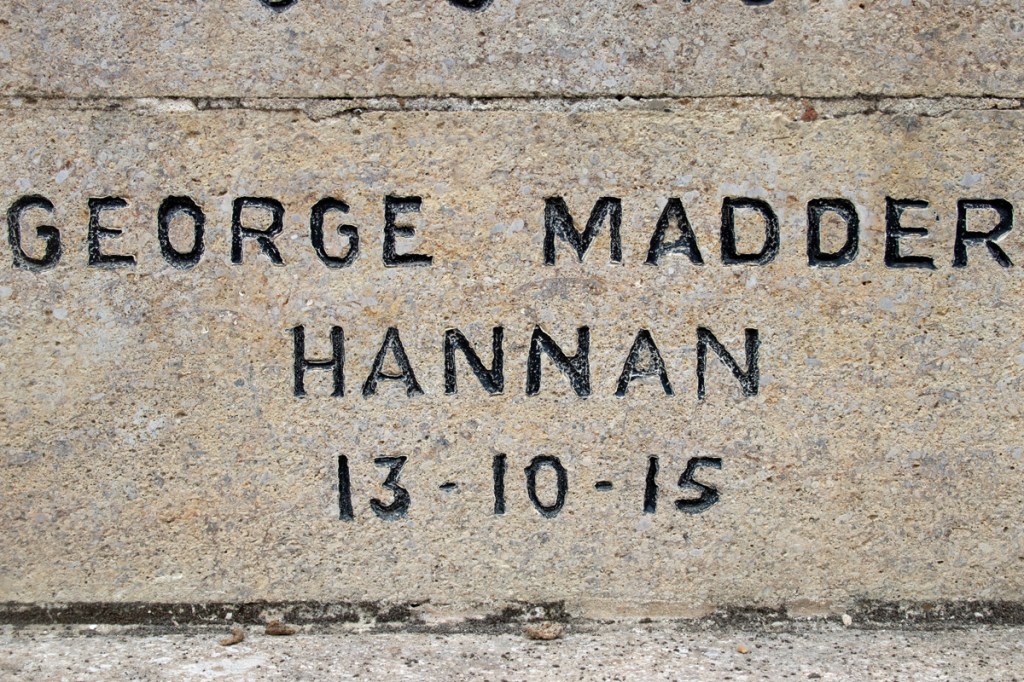
Major George Hannan

Major George Hannan

George Madder Hannan was born in Dublin in 1861, the son of banker Benjamin Hannan. There is little concrete information about his early life, but what can be pieced together produces the story of a well-travelled man.

On 22nd January 1896, George was initiated into the Lodge of Otago, a freemason’s collective in Dunedin, New Zealand. He is listed as being a Master Mariner.

George’s marriage certificate records that he wed Mary Carlisle on 27th October 1898. The wedding took place at St Jude’s Church in Kensington, London, and the groom was listed as a Gentleman. Mary was the daughter of a paper manufacturer, and had been born in Lancashire.

The next document for George is the 1911 census. This notes that he ad Mary were still living in Kensington, along with their only child – daughter Grace, who had been born in 1900 – and two servants. This time he is listed as being an army major, a special reserve officer.

Moving forward a few years, the next record for George is the notice of his funeral, in October 1915:

We regret to announce the death of Major Madder-Hannan, which occurred at May Bank on Wednesday morning. Major Madder-Hannan, who had only resided in the village [of Bearsted, Kent] for the past few months, held his commission in the 9th Service Battalion Cameronians. He had been an invalid since taking up his residence here.

Kent Messenger & Gravesend Telegraph: Saturday 16th October 1915

Sadly, no documentation remains about George’s time with the Cameronians. He passed away, presumably through illness, on 13th October 1915, at the age of 54 years of age.

Unusually, given the main family home was in Kensington, George Madder Hannan was buried in the village where he died. He was laid to rest in Holy Cross Churchyard, Bearsted.


Air Mechanic 1st Class Harold Weston

Air Mechanic 1st Class Harold Weston

Harold Stanley Weston’s early life is destined to remain a mystery. He was born, according to his Royal Air Force service records, in Southgate, Middlesex in 1887 and, before war broke our, was working as a waiter before enlisting.

On 3rd August 1915, he married a woman called Gertrude in Hastings, Eat Sussex, and it appears that this is where the couple set up home. Harold has initially enlisted in the army, but transferred across to the Royal Flying Corps on 28th October 1915. Air Mechanic 2nd Class Weston’s service records show that he stood just 5ft 2.5ins (1.59m) tall.

Over the next three years, Harold rose through the ranks to Air Mechanic 1st Class, and served in France for nine months during 1916. He then returned to England, and was based at an airfield near Detling, Kent. When the Royal Flying Corps and the Royal Naval Air Service merged in April 1918, he transferred across to the newly-formed Royal Air Force, and was attached to 27 Squadron.

In November that year, Harold was admitted to the Military Hospital in Maidstone, also in Kent, having contracted influenza and pneumonia. Sadly, the lung conditions were to get the better of him, and he passed away on 1st November 1918, at the age of just 31 years old.

Air Mechanic 1st Class Harold Stanley Weston’s body was laid to rest in the quiet graveyard of St Martin’s Church in Detling, not far from the base at which he served. Gertrude posted her thanks to “all [their] friends for their kindness and sympathy shown to her in her sad bereavement, more especially Captain Saunders, RAF, Major Chapman, KCC [Kent County Council?], Sergeant Fowle, KCC, and Sergeant Weller, RAMC [Royal Army Medical Corps]” [Maidstone Telegraph: Saturday 9th November 1918]


Lieutenant Noel Perris

Lieutenant Noel Perris

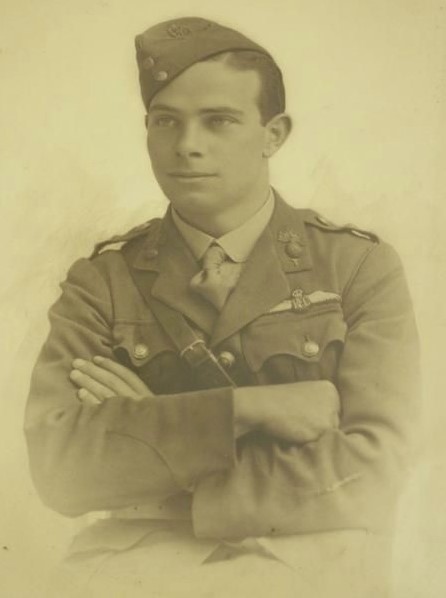
Noel Felix Perris was born early in 1894 in Chiswick, London and was the oldest of three children to George and Mary Perris. George was from Liverpool, and he and Yorkshire-born Mary made the move to south in the late 1880s.

Noel went on to study science at school, but when war broke out, he clearly felt a duty to play his part. George used his writing skills to become a war correspondent with the French army, while his son joined the 2nd London Regiment.

Quickly promoted to the rank of Lieutenant, Noel served in France and Egypt. In 1916, he was badly injured at Hébuterne, to the south of Arras, and returned to England to recuperate. When he had recovered, he transferred to the Royal Flying Corps, subsequently gaining his wings in the newly-formed Royal Air Force.

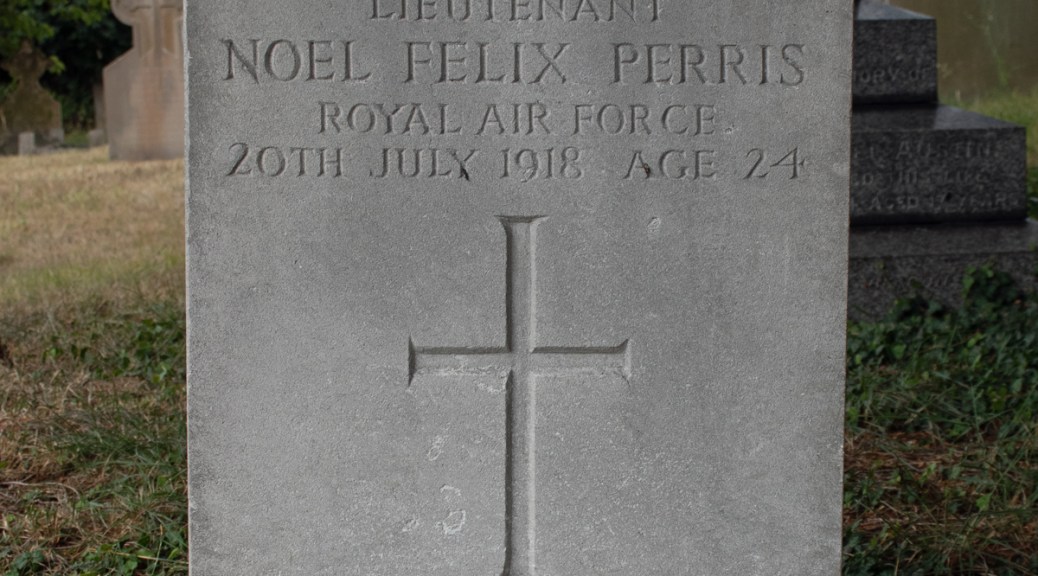
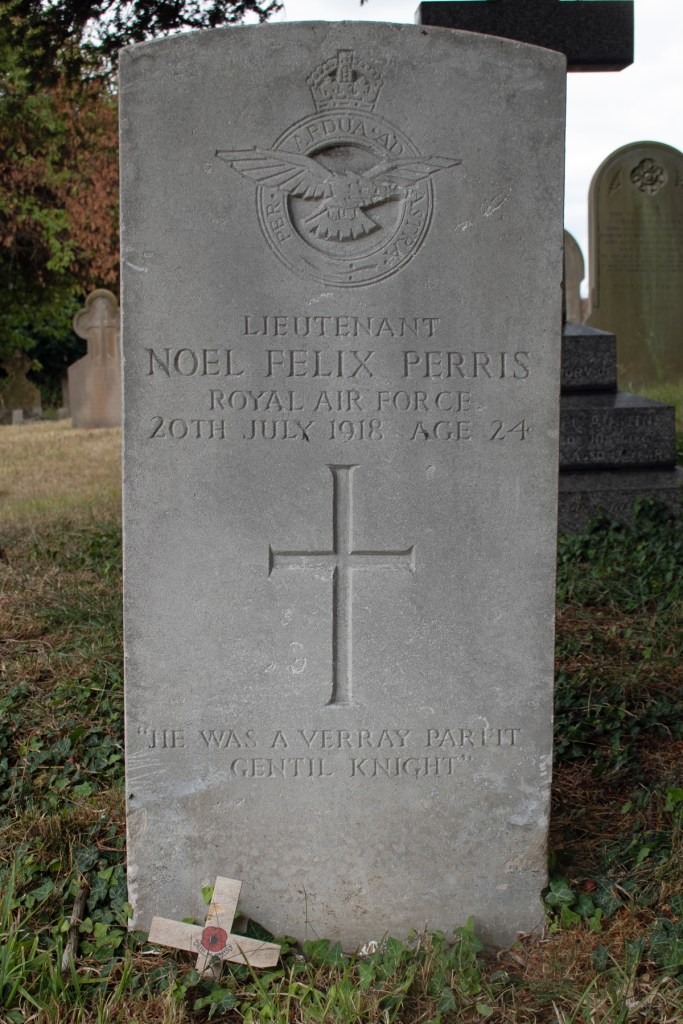
Lieutenant Perris was based in Kent as part of 143 Squadron. On the morning of 20th July 1918, he took off from Detling Airfield as part of a normal patrol flight. His aircraft – a single-seater RAF SE5a – collided with another plane, piloted by Lieutenant Thomas Wright, and both crashed to the ground in flames. Both piloted were killed on impact.

An inquest found that the cause of the pilots demise was accidental death. Lieutenant Perris was just 24 years old.

Thomas Wright’s body was taken home to Fleetwood, Lancashire, for burial. Noel Felix Perris was laid to rest in the quiet graveyard of St Martin’s Church in Detling, not far from the base.


Lieutenant Noel Perris
(from findagrave.com)

The epitaph on Noel’s headstone comes from Geoffrey Chaucer’s The Knight’s Tale.

He was a verray parfit gentil knight

A modern day translation might be “He was a true, perfect knight of noble character.”


Air Mechanic 1st Class Albert Young

Air Mechanic 1st Class Albert Young

Albert Franklin Young was born on 15th August 1899 in Marylebone, London. He was the older of two children – and the only son – to Kathleen (Kate) Young, and her photographer husband, Albert Antonio Young.

Albert Sr seemed to have made a successful of his photography business: Albert Jr attended St Hugh’s School in Chislehurst, Kent, before moving on to Margate College, also in Kent, and Watford Grammar School.

From leaving school, Albert Jr joined the Royal Flying Corps as a wireless operator on 28th September 1915. He was just sixteen years old, but within eight months he was serving with the British Expeditionary Force in France. He was involved in operations at the Somme and continued his flight training.

In November 1915, Albert was promoted to Air Mechanic 1st Class, and remained on the Western Front. On 28th March 1918, a German air raid hit No. 2 Air Depot, where Albert was working: he was badly wounded, and brought back to England for medical treatment.

Admitted to London Hospital in Chelsea, Air Mechanic Young was operated on a number of times, but was to finally succumb to his wounds on 9th June 1918. He was just 18 years of age.

As highlighted in de Ruvigny’s Roll of Honour, one colleague noted “I can assure you he was very greatly esteemed for his fine qualities by all with whom he came into contact, and the news of his death was received by all of us with most profound sorrow. He was a splendid boy.” Another said that the “great courage and coolness he always displayed at most critical moments were on many occasions an incentive to me. He was truly a gallant lad.”

Brought to West Sussex, where his parents were now living, Albert Franklin Young was laid to rest in Cuckfield Cemetery: “The scene… was very solemn and pathetic, yes beautiful and effective, and as all moved forward to the grave, and viewed the fair expanse of the Sussex Weald, the sweet melody of the Choir [was] ringing in our ears.” [Mid Sussex Tomes: Tuesday 18th June 1918]


Private Thomas Perrett

Private Thomas Perrett

Thomas William Perrett was born in October 1878, the seventh of eight children to Lewin and Ann Perrett. Lewin was an agricultural labourer from Wiltshire, and it was in Aldbourn, near Marlborough, that the family were raised.

Initially finding work as a farm labourer, Thomas was soon drawn to the bright lights and big city. By the early 1900s he had moved to London, and it was here that he met, and in 1909 married, Mary Sterry, a labourer’s daughter from Middlesex. The couple went on to have three children, Elsie, Rose and Alice.

Thomas, by this point, had found work on the railways: the 1911 census records him as a railway porter, presumably at Paddington Railway Station, which was within a few minutes’ walk of where the Perrett family were living.

War came to Europe, and Thomas was keen to play his part. Full details of his service are not available, but he enlisted in the East Surrey Regiment, where he was assigned to the 2nd/5th Battalion. This was a second line unit, and Private Perrett remained on home soil for the duration of the war.

This territorial role was reinforced when he transferred across to the 696th Agricultural Company of the Labour Corps. Details of his work are not available, but it seems likely that he was assigned to farm work in the mid-Sussex area.

This too is where Private Perrett remained after the war and where, on 24th February 1919, he was to pass away. Details of his death are vague and the cause is unknown, but he was 40 years of age.

Thomas William Perrett was laid to rest in the cemetery in Cuckfield, West Sussex.


Stoker 1st Class Sidney Seymour

Stoker 1st Class Sidney Seymour

Sidney Seymour was born on 5th April 1895 in Islington, London, the son of Elizabeth Seymour. Sadly, as his was a common name in the area, there is little concrete information about his early life, and is it not until his military service that anything specific can be confirmed.

Sidney was working as a clockmaker when he signed up. He enlisted on 29th April 1913, joining the Royal Navy as a Stoker 2nd Class on a twelve year contract.

Sidney was initially sent to HMS Pembroke, the Royal Naval Dockyard in Chatham, Kent. He trained for nine months at the dockyard, before being given his first posting on board the battleship HMS Dominion. Stoker Seymour spent more than three years on board: during this time he was promoted to Stoker 1st Class, but also spent two weeks in the cells for an unrecorded reason.

In July 1917 Sidney returned to HMS Pembroke; that summer was a busy time for the base, and Stoker 1st Class Seymour found himself billeted in overflow accommodation set up in the barracks’ Drill Hall.

On the night of 3rd September, Chatham came under attack from a German air raid, and the Drill Hall received a direct hit. Stoker Seymour was injured, and died of his injuries in hospital the following day. He was 22 years of age.

Sidney Seymour was laid to rest in the Woodlands Cemetery in Gillingham, Kent, alongside the other victims of the Chatham Air Raid.