The life of Thomas Harrison, buried in Holt Old Cemetery, Wiltshire, is a challenge to unpick. No service papers remain, but the Commonwealth War Graves Commission note that he was married to Annie Harrison, who lived in Trowbridge, Wiltshire.
The couple do not appear together in the 1911 census, so it is likely that they exchanged vows after this date. There is a Thomas Harrison recorded in the return: he was an Acting Bombardier in the Royal Horse Artillery, billeted in the barracks in Trowbridge. It is likely that he is the gentleman buried in Holt Cemetery, but it cannot be confirmed either way.
Acting Bombardier Harrison was born in Motherwell, Lanarkshire, in around 1889, but his name is not uncommon, so it is not possible to identify his parents or early life.
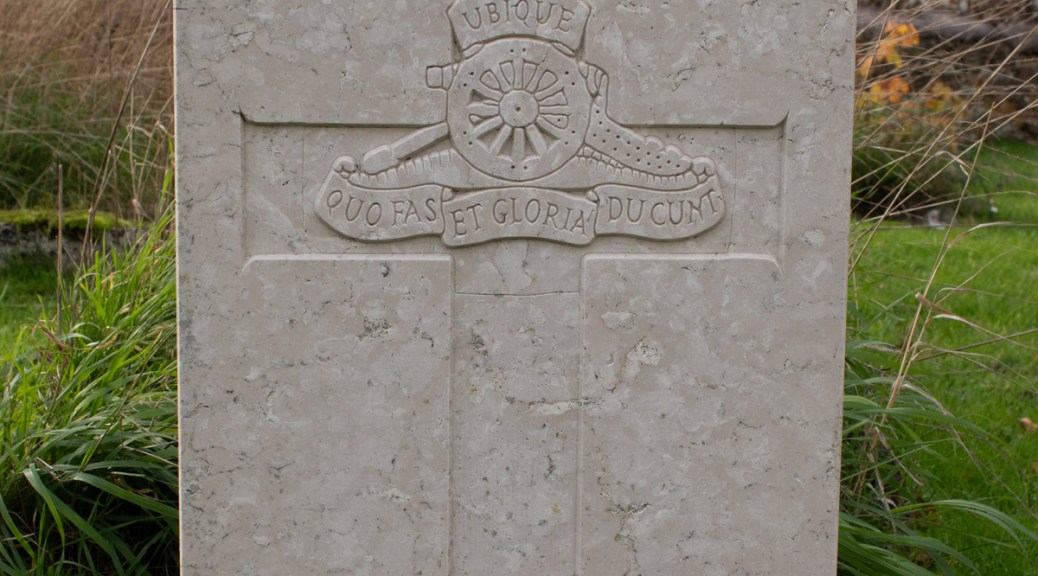
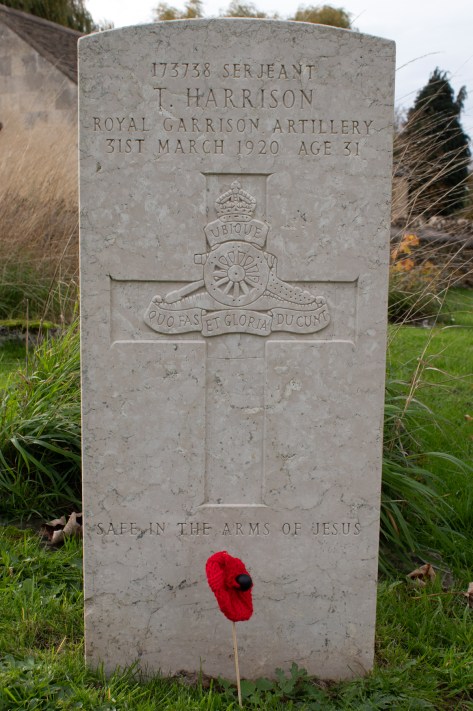
Thomas served during the First World War, rising to the rank of Serjeant in the Anti-Aircraft Depot of the Royal Garrison Artillery. He and Annie had two children: Vera, who was born in 1912, and Ivy, who was four years younger.
When the Armistice was declared, Serjeant Harrison returned home, but, in the spring of 1920, he suffered a bout of gastritis. The condition was to prove fatal, and he passed away on 31st March 1920. He was 31 years of age.
The body of Thomas Harrison was laid to rest in Holt Old Cemetery, not far from where Annie and the girls lived.
John MacDonald Ayre was born in Hemel Hempstead, Hertfordshire, in 1891. His father – also John MacDonald Ayre – had been born in Edinburgh, but had moved south to take up a job as a passenger clerk for the railways. He had met his wife, Rosa, there, and they had married in 1890. John Jr was their eldest child, and they would go on to have five more although, tragically, only three survived childhood.
John Jr also found employment with the railway company when he finished his schooling. The 1911 census found him working as a goods clerk, and he was living with his family at 16 Bridge Road in Hemel Hempstead town centre.
On 8th September 1915, John Jr married Mabel Langdon. She was a postman’s daughter from Westbury, Wiltshire, and, at the time of the 1911 census, she was working as an under-housemaid for Edward Innes, a barrister in her future husband’s home town. The couple married in Westbury Parish Church.
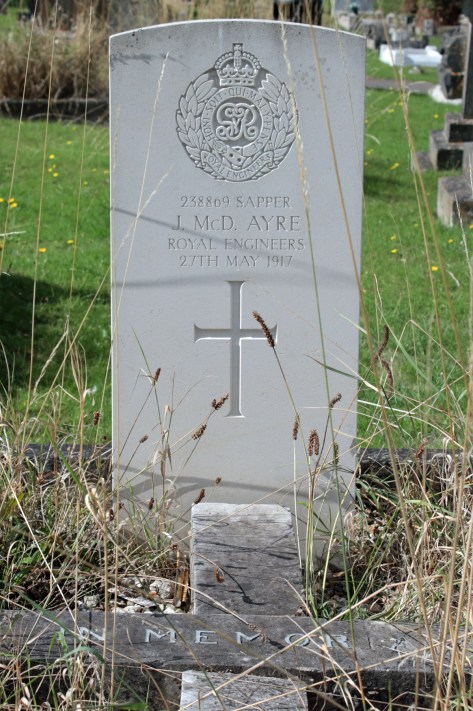
When war broke out, John Jr was called upon to play his part. Little information is available about his time in the army, but is it clear that he had enlisted by the end of 1916, and had joined the Royal Engineers as a Sapper. His background made him ideal for the regiment’s Railway Operating Division.
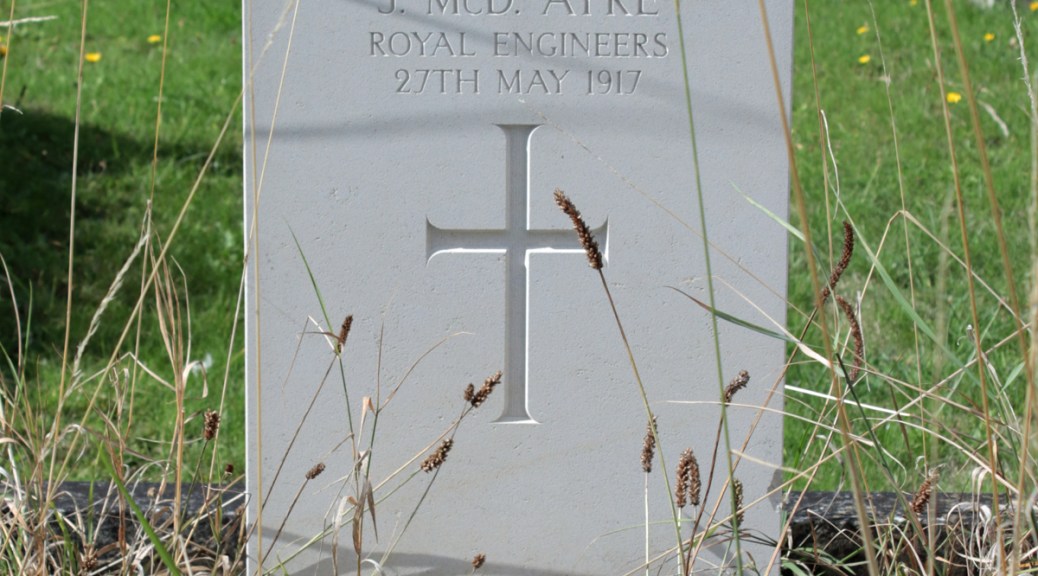
There is no evidence that Sapper Ayre spent any time overseas, and, by the spring of 1917, he was based in Shropshire. He had been unwell and was admitted to a military hospital in Shrewsbury, suffering from tuberculosis. The condition was to get the better of him, and he passed away on 27th May, at the age of 26 years old.
The body of John MacDonald Ayre was taken back to Wiltshire for burial. He was laid to rest in Westbury Cemetery.
Tragically, Mabel was pregnant when her husband died. She gave birth to their son, who she named John, on 14th July 1917.
Walter William Stead Pawson was born in South Shields, County Durham, on 7th October 1895. The second of six children, his parents were Albert and Louise Pawson. Albert was a joiner by trade, and his work took the family north for a while. The 1901 census found them living in Glasgow, but by the time Walter’s youngest sibling was born in 1905, they were back in County Durham once more.
Little further information is available about Walter’s early life, but in around 1912, he sought a new life for himself, and emigrated to California. When war broke out, however, he felt the need to serve his home country and enlisted on 5th June 1917. His US draft card show that he was working as a clerk at the Hotel de Luxe in Long Beach, California. He was noted as being tall and slender with blue eyes and light brown hair. The document also confirms two years’ voluntary service in the militia while in Scotland, during which time he reached the rank of Lance Corporal.
The next record for Walter is a second enlistment document, this time on 6th September 1917. Signing up in Toronto, Canada, he was now joining the country’s Royal Flying Corps. Whether he had been turned down for US service, of whether he felt joining the Canadian Expeditionary Force offered him better options is unclear.
Returning to Britain, he took a commission in the Royal Flying Corps, and was attached to the 70th Training Squadron based in Hampshire. His service papers do not give much detail of the man he had become, but do note his height as 6ft (1.83m).
Second Lieutenant Pawson spent the next few months training. On the 6th Mary 1918, he was piloting an Avro 504J biplane, when things went wrong. He was looping the aircraft, when it fell into a spin and he was unable to recover it. The aeroplane crashed to the ground and Walter was killed.
The RAF Casualty Card noted that: “The court having carefully considered the evidence and having viewed the wreckage are of the opinion that the accident… resulting the fatal injuries to the pilot… was due to an error of judgement on the part of the pilot who was under instruction at the time.”
Walter was 22 years of age when he died. An obituary stated that he was a “bright promising youth, and a splendid type of British manhood he us but one of the many precious lives lost through this terrible war.” [Jarrow Express: Friday 24th May 1918]
Walter William Stead Pawson was laid to rest in the graveyard of St Mary’s Church, East Boldre, Hampshire, not far from the airfield he had so recently called home.
Stanley Curtis was born on 31st October 1899, and was one of 21 children to Rowland and Sarah Curtis. Rowland was a gardener and labourer from Warminster, Wiltshire, and it was here, at 9 Marsh Street, that the family were raised.
There is little information available about Stanley’s early life: he was only two years old at the time of the 1901 census, and still at school for the next return in 1911. Later document, however, confirms that he worked as a farm labourer when he completed his schooling and that he was an active member of the Warminster Cadets.
Stanley was keen to play his part when war broke out. He enlisted in the Royal Navy as soon as he was able to, joining as a Stoker 2nd Class on 7th December 1917. His service records show that he was 5ft 4ins (1.62m) tall, with brown hair, brown eyes and a fresh complexion.
Stoker 2nd Class Curtis was sent to HMS Victory, the Royal Naval Dockyard in Portsmouth, Hampshire, for his training. After four months there he was given his first assignment, on board the protected cruiser HMS Amphitrite. Working as a minelayer, she served in the North Sea, and was positioned off Scotland when Stanley fell ill.
Stoker Curtis was disembarked in Edinburgh, and was admitted to the city’s Royal Naval Hospital with peritonitis. Sadly the condition was to prove fatal, and he passed away on 13th September 1918, a few weeks short of his 19th birthday.
The body of Stanley Curtis was brought back to Wiltshire for burial. He was laid to rest in the graveyard of Christ Church, Warminster, just a few minutes’ walk from where his grieving family lived.
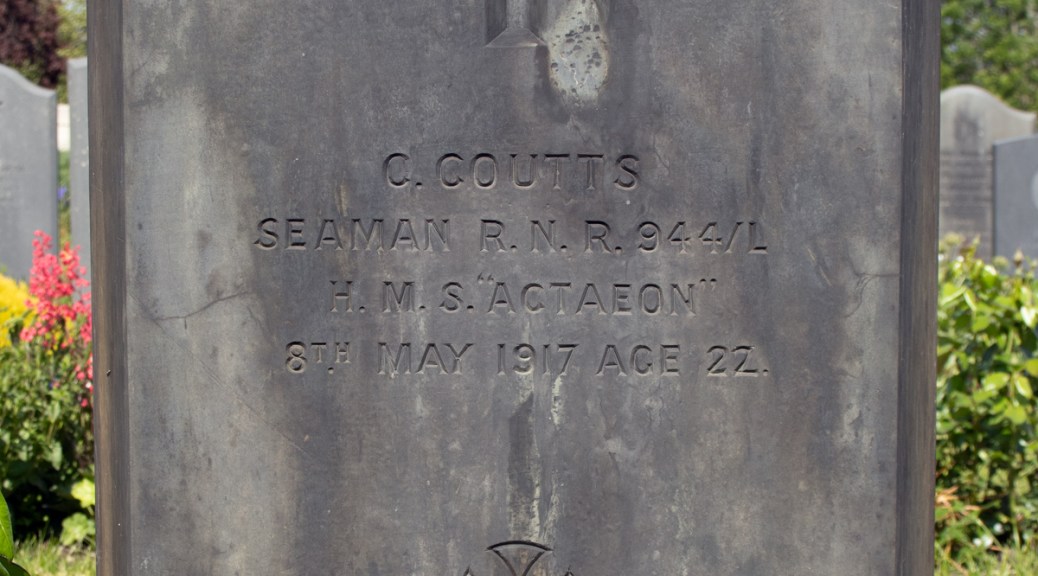
Christopher Coutts was born in Lerwick, Shetland, on 2nd August 1894, and was the only child to Robina Coutts. There is little information about his early life, but by the time war broke out, he was working as a shop assistant.
Given the location of his island home, it makes sense that Christopher also had a knowledge of the sea and seafaring. This was put to use during the war, and he was assigned to the Royal Naval Reserve as a Seaman. Initially based in Shetland, by the summer of 1916, he had been transferred to HMS Acteon, the torpedo school based in Sheerness, Kent.
Information has been received here that Christopher Coutts, RNR, has died in Hospital at Haslar. He had been in failing health for some time, and the end was not unexpected. Prior to the outbreak of war, deceased was employed as a shop assistant with Mr Brown, Freefield. After war broke out, he joined the RNR (Shetland Section), and after undergoing a period of training in Lerwick proceeded south to one of the naval depots, where he contracted the illness to which he has now succumbed. Deceased was a bright and promising young man, and much sympathy is extended to his sorrowing mother and other relatives.
Shetland Times: Saturday 12th May 1917
Given the location of HMS Acteon and the subsequent place of his burial, it is likely that Seaman Coutts died at the Royal Naval Hospital in Chatham, Kent, rather than Haslar Hospital, which is in Gosport, Hampshire. He died on 8th May 1917, at the age of 22 years old.
Christopher Coutts was laid to rest in the naval section of Woodlands Cemetery, Gillingham, Kent.
James Muir was born on 29th October 1889 in the hamlet of Burness on the remote Orkney island of Sanday. The youngest of three children, he was the only son to agricultural labourer Alexander Muir and his wife, Ann.
Little information remains about James’ early life. He seems to have found work at sea, as, when war broke out, he enlisted in the Royal Naval Reserve. His service records show that he was 5ft 8in (1.72m) tall, with brown eyes and a fresh complexion.
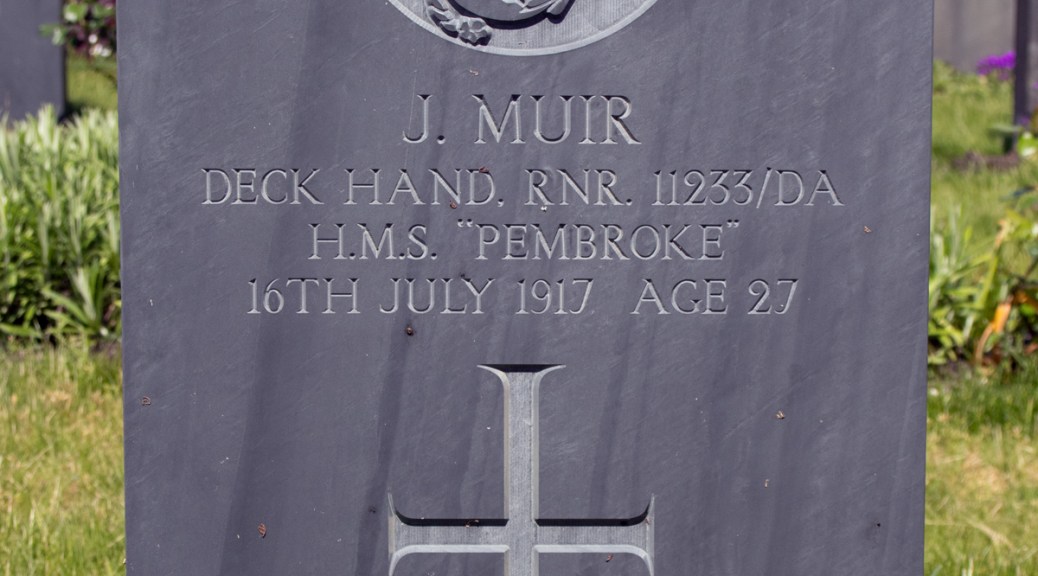
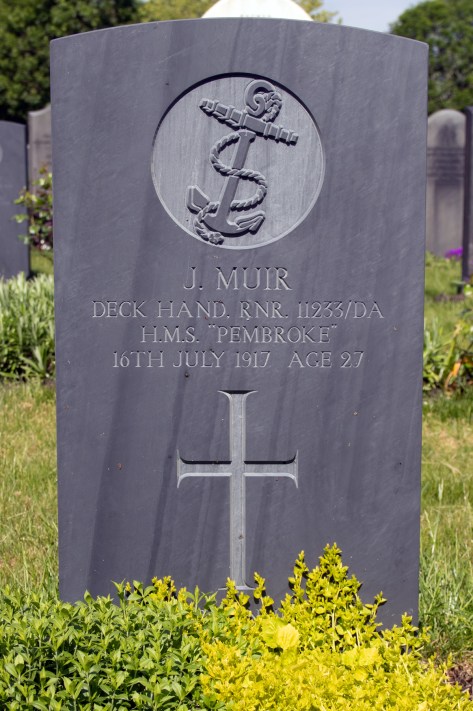
Deck Hand Muir initially served on the depot ship HMS Zaria, before bring transferred to the cruiser HMS Brilliant. By the spring of 1917, he was stationed at HMS Pembroke, the Royal Naval Dockyard in Chatham, Kent.
James was admitted to the town’s Royal Naval Hospital, suffering from fibroid phthisis, a wasting disease of the lungs. Formally discharged from the Royal Naval Reserve on medical grounds on 28th June 1917, his condition was to worsen, and he passed from the heart condition pericarditis on 16th July. He was 27 years of age.
James Muir passed away 560 miles (900km) from home: he was laid to rest in the naval section of Woodlands Cemetery, Gillingham, Kent, not far from the dockyard that had been his home.
Edwin Charles Hocking was born in Newton Abbot, Devon, on 28th January 1873. The youngest of four children, his parents were Richard and Harriet Hocking. Richard was an engine driver, and he was to die less than a year after his youngest boy’s birth:
Mr Deputy-Coroner Square and a jury of twenty-two to-day brought to a conclusion the inquest on the death of the engine driver Richard Hocking. The evidence of numerous witnesses went to show that the accident, which occurred on the morning of the 2nd inst., between Menheniot and St Germans stations occurred in consequence of the guards of two trains being called Dick. The morning was very dark, and at Menheniot there was standing at the station an up and a down goods, and a second down goods was on its way from St Germans, but this was unknown to the up goods. The porter Pratt at Menheniot gave the order to the guard (Wills) of the down train to start, saying “All right, Dick.” The driver of the up train (Scantlebury) was also called Dick, and when he heard the words he said “Is it right for me?” and Pratt, not seeing Scantlebury, and thinking Wills asked the question, repeated “It’s all right, Dick.” Scantlebury through it was meant for him, and gave the order to the deceased, “Right away.” Pratt, who had gone to let out the down train, hearing the starting whistle of the up train, rushed back to the platform waving his hand “danger” light. This attracted the attention of Scantlebury, the head guard, and he missed his van in consequence. Pratt said, “Wherever are you going?” Scantlebury replied, “Right away isn’t it?” Pratt said “God bless the man, who gave you ‘right’? The up goods is ten minutes off St Germans.” Scantlebury cried out “Oh! my God! Oh! my God!” Together they shouted and waved the danger light, but were unable to attract the drivers of either of the two engines attached to the train. The trains came into collision at full speed about two miles away. The deceased and the other driver were at great fault in leaving Menheniot, notwithstanding the order of the guard, for the signal was against them, and they did not observe the rules of the Company. They should not have gone on without hearing the second whistle of the guard, and after starting they should have satisfied themselves that they had the head guard in the train by seeing his lamp. Richard Scantlebury, the head guard, after being cautioned that he need not say anything to criminate himself, gave evidence that when Pratt said “All right Dick” he certainly thought it referred to him, especially as his train had nothing to do at Menheniot.
The jury deliberated for half-an-hour, and then returned a verdict of “Accidental death,” exonerating Pratt and Scantlebury from all blame. The appended a recommendation to the South Devon and Cornwall Railways to provide for a strict observance of their bye-laws for the use of some definite word for the up and down trains, and Christian names never to be used in such cases; that there be communication between the driver and guard on luggage trains as well as passenger trains, and that there be to men at least at each station on duty.
[Western Times: Wednesday 17th December 1873]
Harriet was just 28 years old when her husband died. With four children to raise, she married again – to John Staple – and went on to have four children with him too.
John also passed away in the spring of 1885, and the 1891 census found Harriet and six of her children living at 43 Richmond Terrace, to the west of the centre of Truro, Cornwall. Harriet was working as a washer woman, while Edwin, who was 18 by this point, was employed as a plumber’s assistant.
It is clear that Edwin wanted a better life for himself and in the spring of 1896, he took the skills that he learnt and signed up to the Royal Navy. His service papers show that he was 5ft 5ins (1.64m) tall with dark brown hair, grey eyes and a fresh complexion. He was also noted as having a tattoo on his left forearm.
Edwin took the rank of Plumber’s Mate, and spent the first two years split between two shore establishments – HMS Vivid and HMS Pembroke, the Royal Naval Dockyards in Devonport, Devon, and Chatham, Kent. He had enlisted for a twelve-year term and, over that time, he would serve on five ships, returning to Chatham in between assignments.
Plumber’s Mate Hocking consistently received very good reviews at his annual appraisals and, when his initial contract came to an end in May 1908, he immediately re-enlisted. He had a family to support by this point, having married Fanny Sears in Camberwell, Surrey, on 16th March 1902. A bricklayer’s daughter, she moved to Gillingham, Kent, to be close to Chatham Dockyard. The couple went on to have five children: Henry, Raymond, Doris, Elsie and Percival.
Back at sea, Edwin’s career continued with some consistency. His annual appraisals noted not on a character that was very good, but an excellent ability. Nevertheless, it would only be in the spring of 1916 that he would gain a promotion to full Plumber. Notwithstanding his general character, Edwin seems to have been a flawed character: in 1909 he applied for a discharge to the Royal Naval Reserve, but this was not approved as he had been found to be “carrying on a business as [a] bookmaker.” Instead, he was to be sent “to sea forthwith and warned that unless his betting practices [were] not stopped his discharge will have to be considered.”
By the summer of 1916, Plumber Hocking was eight years into his second term of service, and had served on five further ships. HMS Pembroke remained his shore base, and it was here that he attained his increased rank.
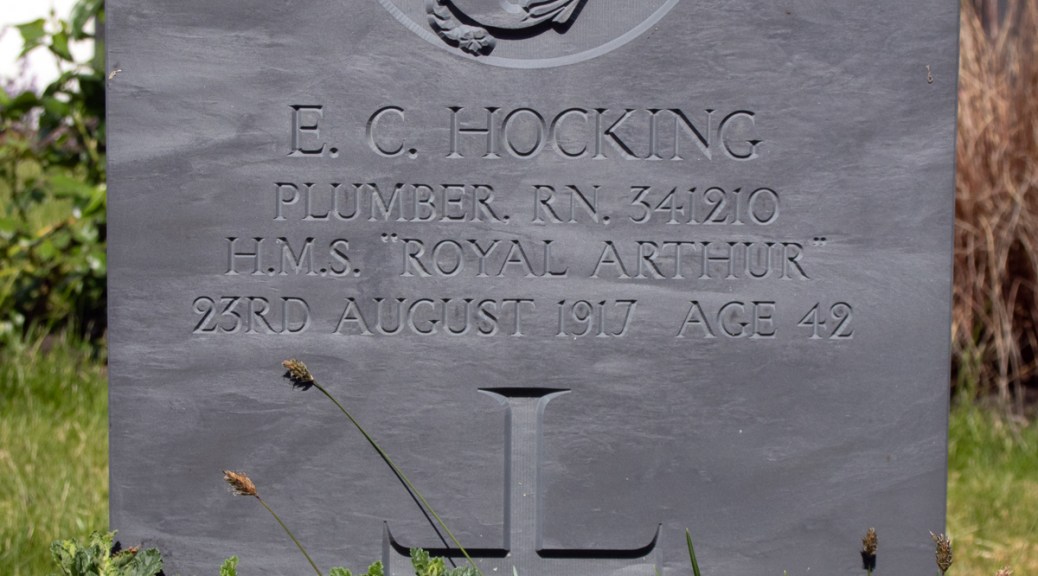
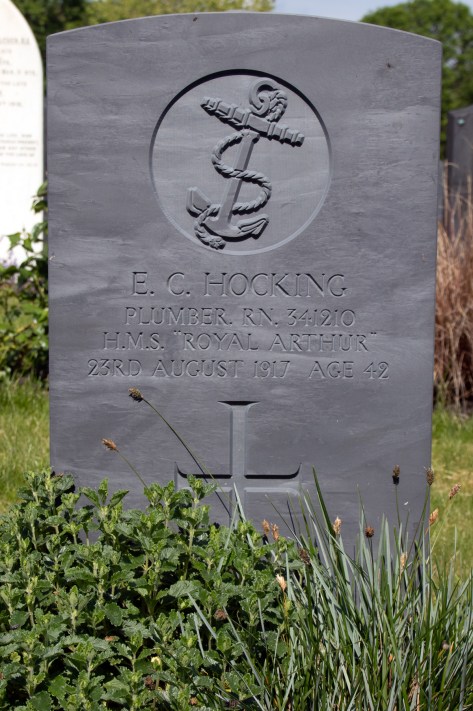
In October 1916, Edwin was given what would be his final assignment, on board the armoured cruiser HMS Royal Arthur. Based at Scapa Flow in the Orkneys, she was employed as a depot ship for submarines. Plumber Hocking spent ten months on board, before illness hit. Coming down with gastroenteritis following food poisoning, he was transferred back to Kent, and admitted to the Royal Naval Hospital in Chatham. The condition was to prove his undoing, and he passed away on 23rd August 1917: he was 44 years of age.
The body of Edwin Charles Hocking was laid to rest in the naval section of Woodlands Cemetery, Gillingham, a short distance from his grieving family’s home in King Edward Road.
Angus McLeod was born on 18th April 1881 in the hamlet of Deiraclete (or Diraclett) on the Isle of Harris, Scotland. Little information is available about his early life, but a later record suggests his parents were called Norman and Mary.
Given the remote location of his birth, it is unsurprising that Angus was to gain knowledge of a life a sea, whether for work, or as a mode of transport. When war broke out, his expertise was called upon, and he joined the Royal Naval Reserve as a Seaman. He enlisted on 31st October 1916, and his records show that he was 5ft 9.5ins (1.77m) tall, with grey eyes and a fresh complexion.
Over the next fifteen months, Seaman McLeod was based out of HMS Pembroke – the Royal Naval Dockyard in Chatham, Kent. His exact records are unclear, although it seems that he served mainly on merchant vessels and travelled as far as India.
By the end of 1917, Angus was becoming unwell. He was suffering from stomach cancer, and was medically discharged from naval service on 1st February 1918. He had been admitted to the Royal Naval Hospital in Chatham by this point, but his condition was to get the better of him. He passed away on 14th February, at the age of 36 years old.
More than 500 miles from his home – and his widow, Johanna – Angus McLeod was laid to rest in the naval section of Woodlands Cemetery, Gillingham, Kent.
Frederick Dennington was born in Wrentham, Suffolk, on 18th February 1877. The youngest of eleven children, his parents were William and Eliza Dennington. William was a house painter, and the family lived in a cottage on Southwold Road on the outskirts of the village.
Frederick was not to follow his father’s trade, and when he completed his schooling he found employment as a groom. Working with horses was one thing, but he wanted to make a bigger splash in the world, and so, on 28th April 1892, he joined the Royal Navy.
Too young to formally enlist, Frederick was given the rank of Boy 2nd Class, and was sent to HMS Impregnable, the training ship moored at Queensferry on the Firth of Forth, for his induction. Over the next three years, Boy Dennington would learn the tools of his trade, and spent time on another training vessel – HMS Lion – and at HMS Pembroke, the Royal Naval Dockyard in Chatham, Kent.
In June 1893, Frederick was promoted to Boy 1st Class, and the following January he was assigned to HMS Satellite. She was a composite screw corvette, and would remain his home for the next three years. During this time, he proved he came of age, and was formally inducted into the Royal Navy.
Give the rank of Ordinary Seaman, Frederick’s service papers give an insight into the man he was becoming. Short of stature – he was noted as being 5ft 1.5ins (1.56m) tall – he had dark brown hair, grey eyes and a fair complexion. He was also noted as having tattoos on both of his forearms, and rings tattooed on the fingers of his his right hand.
Ordinary Seaman Dennington seemed to impress his superiors and on 5th December 1895 – just ten months after coming of age – he was promoted to the rank of Able Seaman. His contract had tied him to the navy for twelve years, and during that time, Frederick would serve on five further ships. In between each of his assignments, he returned to Chatham, and this would become his longer-term base.
Frederick’s term of service came up for renewal in February 1907, and he immediately re-enlisted. His papers show that he was now 5ft 8ins (1.72m) tall, and his eyes were more grey-blue than grey. While he remained at the rank of Able Seaman, his character was always noted as being very good, and his ability as superior.
Able Seaman Dennington went on to serve on five ships over the next nine years, including three years of HMS Blenheim, and the same length of time on board HMS Duncan. By the autumn of 1916, with war raging across Europe, Frederick had clocked up 24 years in naval service.
By this point, Frederick was unwell. He was admitted to the Royal Naval Hospital in Chatham, Kent, with a stricture of the urethra. This was to be a condition that that he would succumb to, and he passed away on 9th December 1916, at the age of 39 years old.
The body of Frederick Dennington was laid to rest in Woodlands Cemetery in Gillingham, Kent, not far from the naval base that has become his second home.
Frederick never married. His probate record confirms that his effects – totalling £147 2s (worth £16,350 in today’s money) – was left to his father, William.
O’KEEFE Fireman Arthur. SS “Hartland.” 22nd Nov., 1917. Age 38. Son of John and Mary O’Keefe of Cork.
The search for information about Arthur O’Keefe has proved a challenging one. He does not appear with his parents on any census records, and there is precious little documentation about his life.
Arthur found work as a Fireman in the Mercantile Marine, and served on board at least four ships. In the autumn of 1917, he was based out of Glasgow, Scotland, and was attached to the SS Hartland. She had been requisitioned by the Admiralty, and was put to use transporting wheat from India.
On 22nd November the Hartland was travelling from Glasgow to Barry, South Wales, when she was hit by a torpedo from the submarine U-97, 21 miles south west of Bardsey Island. The ship was damaged, and two of the crew – Fireman O’Keefe and Fireman Thomas McGaw – were killed.
An American destroyer, the USS Conyngham, was at the head of the Hartland’s convoy, and managed to rescue the remaining 28 members of the crew, taking them to Holyhead. The Hartland was towed to Fishguard Harbour and refloated.
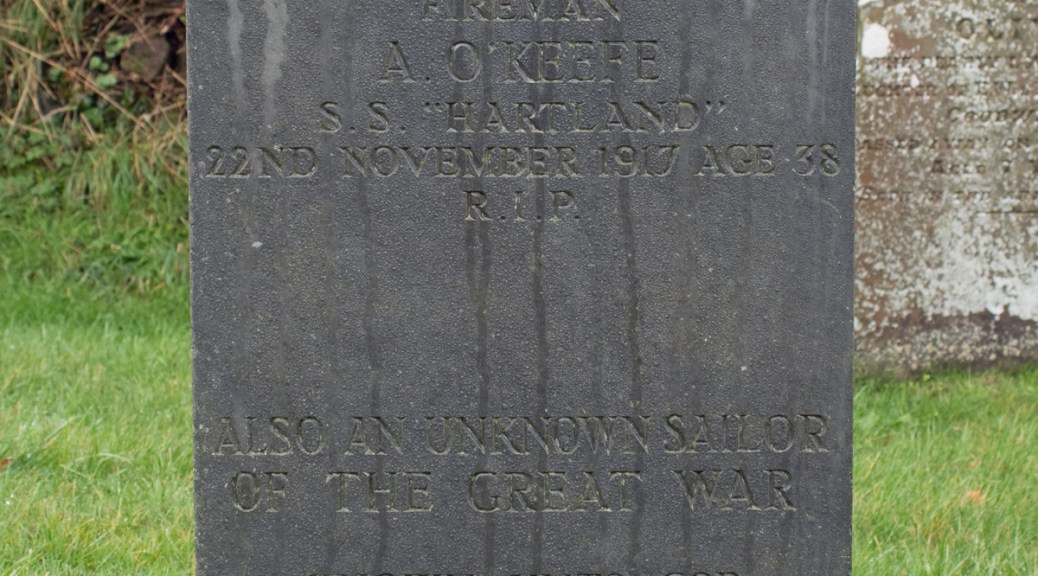
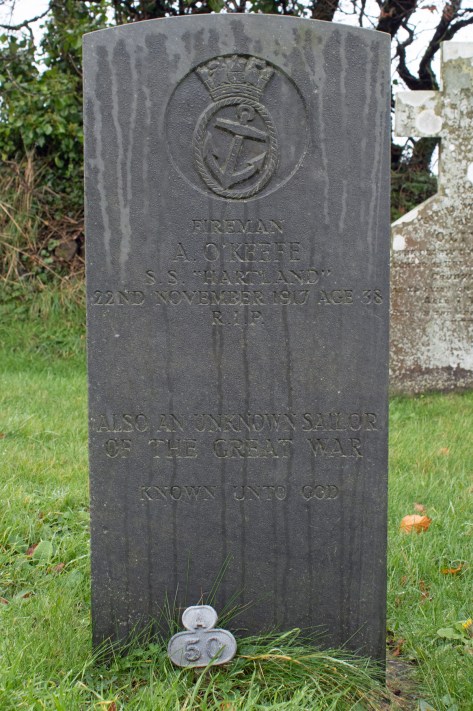
Arthur O’Keefe was 38 years of age when he was killed. He was laid to rest in Llanwnda Cemetery, not far from Fishguard, Pembrokeshire.
Arthur’s headstone notes that he was buried with an unknown sailor of the Great War. There is no indication who this might have been, but there are no records of his colleague Thomas McGaw being laid to rest. Given both men died in the same incident, and their bodies were transported to Fishguard with their ship, it seems possible that they may have been buried together.








 Death and Service