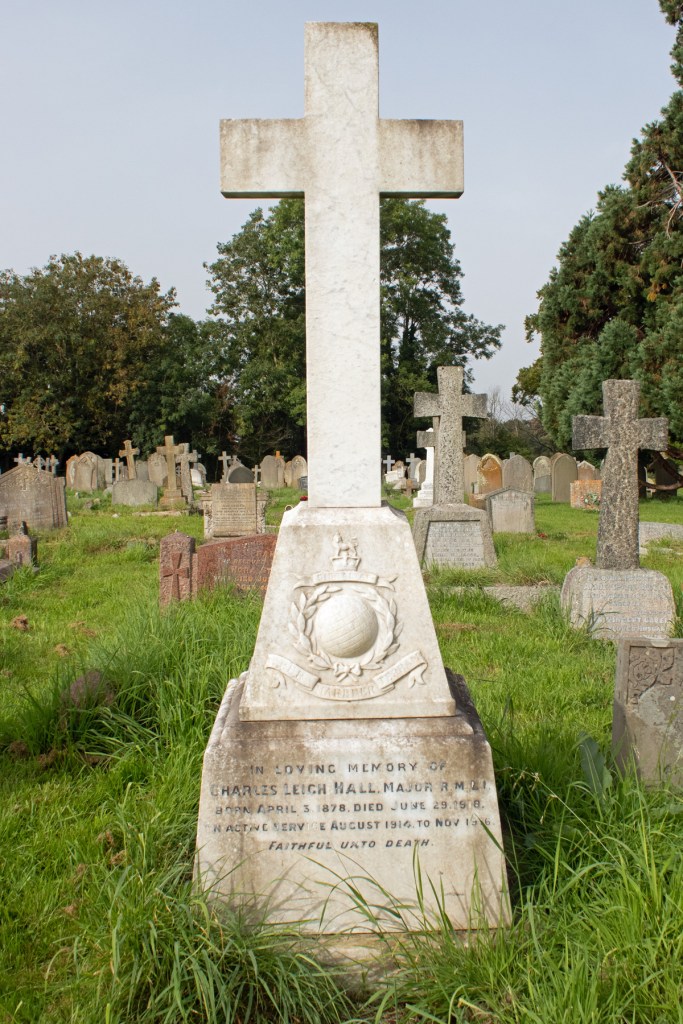
Charles Leigh Hall and his twin Maud, were born on 3rd April 1878 in Clifton, Gloucestershire. Two of eight children, their parents were Pedro and Anne Hall. Pedro, whose full name was Pedro Henrique Sinclair Hall, was better known as Henry, and was a mathematics tutor and Assistant Master at Clifton College, and it goes without saying that the Hall children had a educated upbringing.
Charles was always to be destined for great things. By the time of the 1901 census, when he was 22 years of age, he was a Lieutenant in the Royal Marines Light Infantry. Based on the cruiser HMS Amphion, he travelled the Pacific and, on the night the return was taken, was moored in Vancouver, Canada.
On 15th June 1910, Charles married Sophia Elinor Veale. Born in Caledon, South Africa, the couple wed in the village of Littleham, Devon. They set up home in Gosport, Hampshire – presumably as the now Captain Hall’s work was based from the docks there – and went on to have two children, Anthony and Nicholas.
By September 1915, Charles had been promoted again, this time to the rank of Major. His wartime service included a lot of work in Africa, including in Cameroon in 1914 – for which he was mentioned in Dispatches – German East Africa (Burundi, Rwanda and Tanzania today) in 1915 and Saadani (Tanzania) in 1916.
In October 1916, he was invalided out of the Royal Marine Light Infantry for reasons that are unclear, and returned to Britain from Simonstown, South Africa. While Charles seems not to have gone to sea any more, his experience was still respected, and, on 15th January 1917, he was promoted to Brigade Major.
The family settled back down in Portsmouth, Hampshire, and remained there for the next eighteen months. By the summer of 1918, Charles was in Bristol – either based at the docks there, or hospitalised in the city – and passed away on 29th July 1918. He was 40 years of age.
Sophia and her boys were still in Portsmouth, but Charles Leigh Hall was laid to rest in the graveyard of St George’s Church in Easton-in-Gordano, Somerset. The headstone incorrectly gives the month of death as June. Charles’ will divided his estate – £4467 (£318,000 in today’s money) – between his brother, Arthur, and Charles Garnett, a barrister, possibly as a trust for his sons.
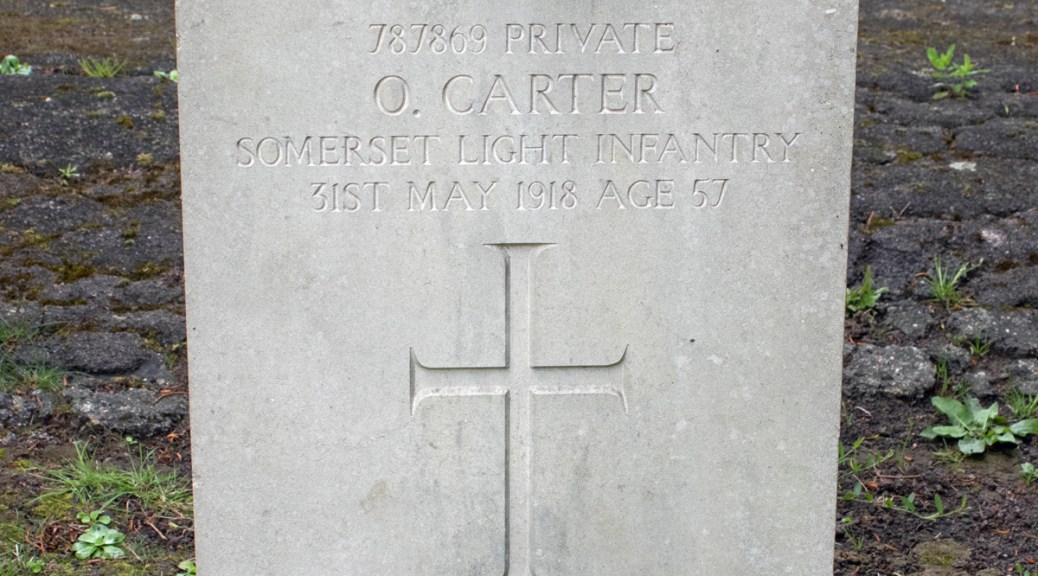
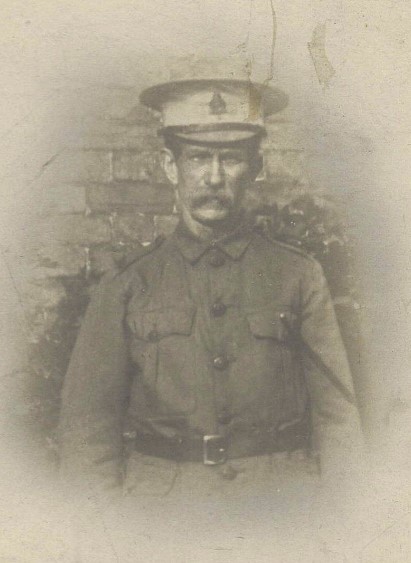
Oliver Carter was born in the spring of 1861 in East Budleigh, Devon. The youngest of four children, his parents were Ellis, who was a farm labourer, and Jane Carter.
As the years passed, Oliver’s older siblings left home and, by the 1881 census, he was the last of Ellis and Jane’s children to remain living with them. He was employed as a baker by this point, although he seemed to want more permanent employment.
On 9th February 1883, Oliver enlisted in the army. His service records show that he was 5ft 6.5ins (1.69m) tall and weighed 120lbs (54.4kg). He had a sallow complexion, with brown hair and grey eyes. The document confirmed no distinguishing marks (in the event that his body needed to be identified) and that his religious denomination was Church of England.
Private Carter was assigned the Commissariat and Transport Corps – a forerunner to the Royal Army Service Corps – for a period of twelve years. After eighteen months on home soil his unit was sent to South Africa, where he remained until December 1885. On returning to Britain, he spent the next nine years on reserve status, and was formally stood down from army service un February 1895.
The 1891 census return found Oliver back in Devon, where he working as a general labourer alongside his army commitments. Ellis, meanwhile, was employed as a miller’s waggoner, while Jane had also started taking in lacemaking jobs.
In the autumn of 1893, Oliver married Elizabeth Morrish. Eight years his senior, she was a widow with eight children of her own. The 1901 census recorded the couple living in a cottage near the King’s Arms Hotel in East Budleigh. They shared their home with three of Elizabeth’s children and their own daughter, Hilda. Oliver had changed jobs again, and was employed as a cowman on a farm.
Life continued on for the Carters. A chance of more regular employment as a labourer for the local council brought a move to Highbridge in Somerset. Elizabeth had her own account as a dressmaker, Hilda was keeping house and the family also had a boarder, Charles Smith, who was a butcher’s assistant. While they had made the move to a new county, they did not forget their roots: their house was called Budleigh.
When war broke out, Oliver seemed to be drawn to serve his country again. Full details of his second period of army service are lost to the mists of time, but some things can be gleaned from a contemporary newspaper report of his passing:
Death of a Volunteer
Much regret was expressed at Highbridge on Saturday when it became known that Mrs Carter, of Newtown Road, had received a telegram containing the news that her husband, Mr Oliver Carter, a member of the Somerset Volunteer Regiment, had died while undergoing training with his company under canvas.
Central Somerset Gazette: Friday 7th June 1918
Oliver had been assigned to the 1st (Volunteer) Battalion of the Somerset Light Infantry. His death was registered in Wiveliscombe, and the canvas reference would suggest that he was being trained on nearby Exmoor.
Given he was being trained at the time of his passing, Private Carter is likely to have been a new recruit to the Somersets. As he was 57 years of age when he passed, it is no surprise that he had volunteered for service. His age was to act against him, however: he passed away having contracted pneumonia.
Oliver Carter was brought back to Highbridge for burial. He was laid to rest in the town’s cemetery, a short walk from where his widow and daughter lived.
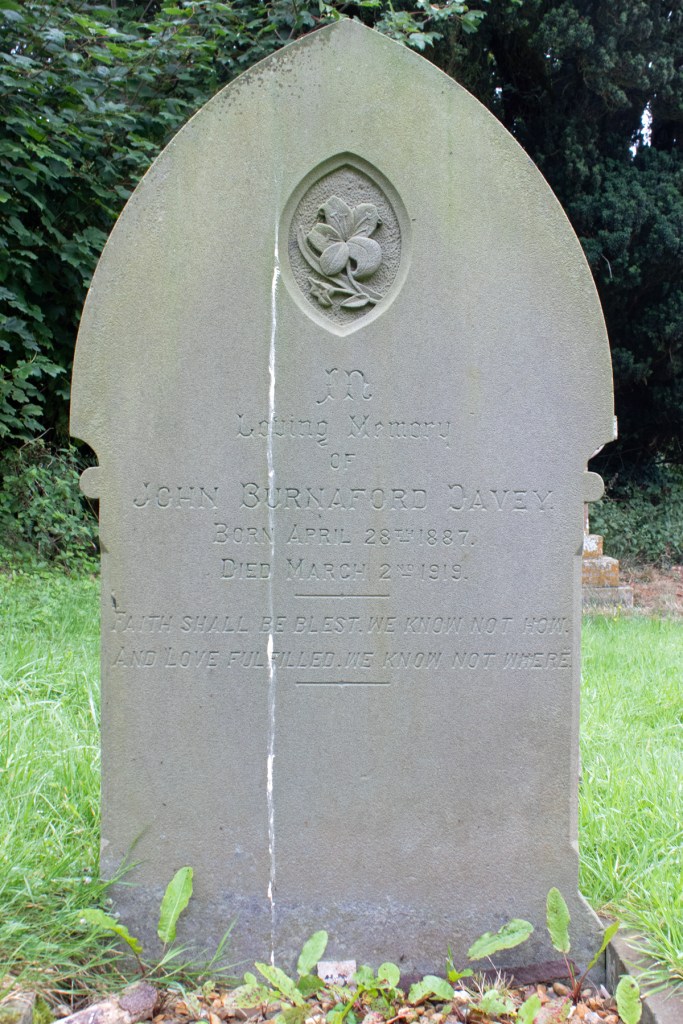
John Burnaford Davey was born on 28th April 1887 in Cannington, Somerset. The youngest of nine children, his parents were farmers Thomas and Emma Davey. Emma died in 1899, and the next census, two years later, found John and two of his siblings living with their father at Beere Manor Farm on the outskirts of the village.
John’s trail goes cold at this point, and it seems that he may have emigrated to South Africa. When war broke out, he enlisted in the Natal Light Horse, and was awarded the 1915 Star in Pretoria for his involvement in fighting in Africa. Private Davey’s troop later moved to England, and it was here that he transferred to the Royal Field Artillery.
The move, in September 1915, included a promotion to Second Lieutenant. Within a couple of years his dedication meant that he advanced to the rank of Lieutenant. By this point, John was based in London, and it was here, on 16th July 1917, that he married Katherine Trayler, a tanner’s daughter from Bridgwater, who had gone on to become a teacher of gymnastics. The couple went on to have a daughter, Jean, who was born in November 1918.
Illness caught up with John and, with the Armistice signed, he was invalided out of service on 8th February 1919. The family were now living in Bridgwater, and this is where John returned. His time back with family was to be tragically short, however, as he passed away just weeks after leaving the army, on 2nd March 1919. He was 31 years of age.
John Burnaford Davey was laid to rest in the peaceful graveyard of St Mary’s Church in Holford, Somerset.
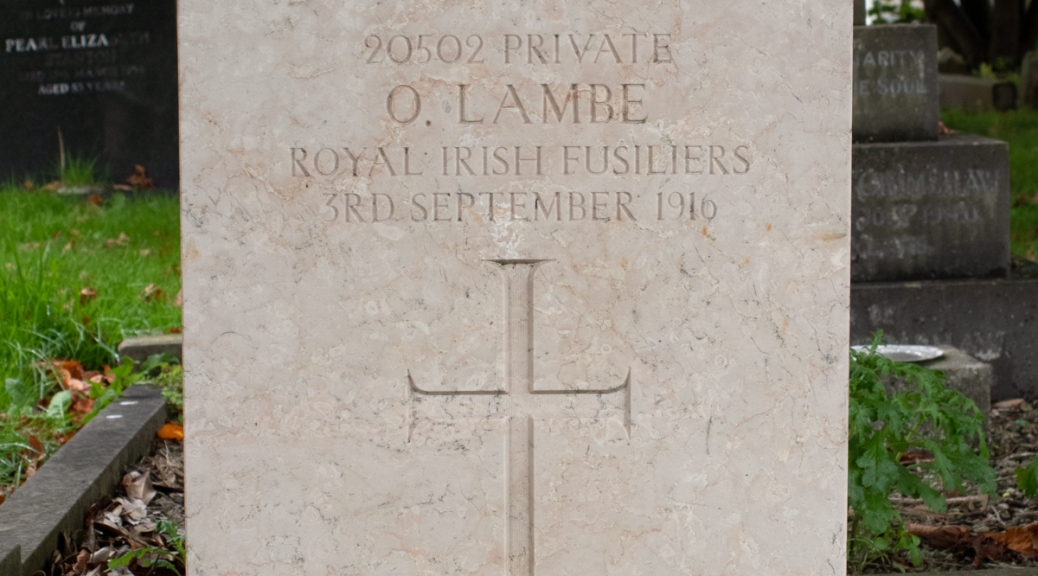
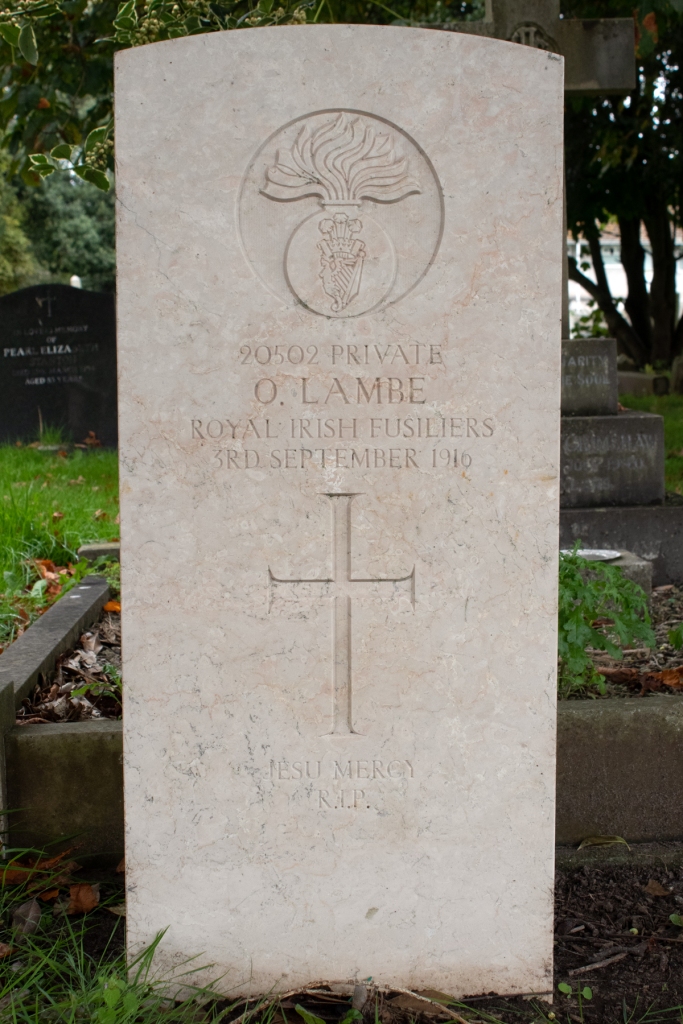
Owen Lambe was born in Drogheda, Co. Louth, Ireland, in November 1873. There is little information about his early life, but later documentation confirms that he was the son of John and Ellen Lambe, and that he had three brothers and one sister.
When Owen finished his schooling, he found work as a baker. He was also volunteering as a soldier in the 6th Battalion of the Royal Irish Rifles at the time, however, and this sparked a career move for him. On 7th May 1890, he formally enlisted: his medical report shows that he was 5ft 4ins (1.63m) tall, and weighed 128lbs (58kg). He was noted as having brown hair, grey eyes and a dark complexion.
Over the twelve years of his contract, Private Lambe saw a fair bit of the world. After eighteen months on home soil, he was sent to Malta, where he remained until November 1894. His battalion was then moved to India, where they remained for more than three years.
With seven years’ service under his belt, Owen returned to Britain. Put on reserve status, he was recalled to active duty in October 1899, as hostilities broke out in South Africa. He served in the Second Boer War for nearly three years, until, in July 1902, he returned home once more. By this point, he had completed his contract, and formally stepped down from the army on 31st August.
Owen’s trail goes cold at this point, and it is only possible to pick up details from later documents relating to his death. These confirm that he had re-enlisted by the spring of 1916, and that he joined the 8th (Service) Battalion of the Royal Irish Fusiliers. Based on his previous army experience, Private Lambe would have been sent to the Western Front fairly readily, and his battalion was certainly involved in the fighting at the Battle of the Somme.
It was here, on the front line, that Owen was injured. Again, details are sketchy, but he received gun shot wounds severe enough for him to me medically evacuated to Britain for treatment. He was taken to Somerset and admitted to the Volunteer Aid Detachment Hospital in Burnham-on-Sea for treatment. Private Lambe’s wounds were to prove too severe, however: he passed away from his injuries on 3rd September 1916, at the age of 42 years old.
Owen Lambe was laid to rest in the Roman Catholic section of Burnham Cemetery. His headstone was paid for by the local Catholic church.
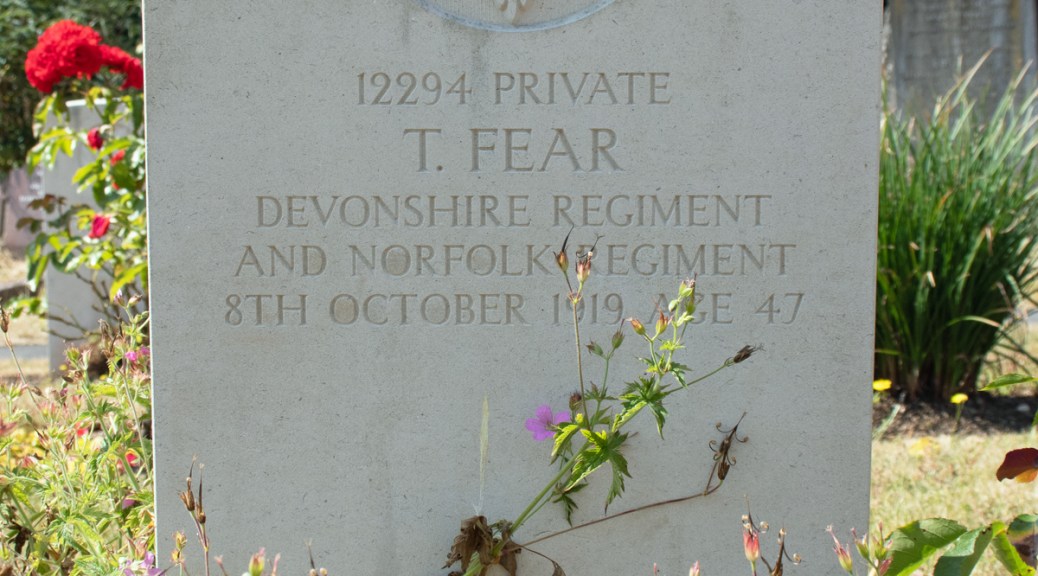
Thomas Fear was born in around 1872 in East Pennard, Somerset. The youngest of six children, his parents were Thomas and Harriet Fear. Thomas Sr was a general labourer, who had moved his family to Bath, where work was more plentiful, by the time of the 1881 census.
When Thomas Jr finished his schooling, he sought bigger and better things. He enlisted in the Devonshire Regiment, and while his service records no longer exist, other documents confirm that he fought in the Second Boer War in South Africa at the turn of the century.
On 5th August 1893, Thomas had married Bath-born Sarah Hughes, who was the daughter of a printer’s machinist. The couple went on to have three children: Albert, Nora and Rose. By the time of the 1911 census, the family were living in a four-roomed apartment near the centre of Bath. Thomas was employed as a stoker for a gas company, Albert was working as a tailor’s errand boy, and Nora had found employment at a lace factory.
When war broke out, Thomas felt the calling to serve his country once more. He enlisted on 1st September 1914, just weeks after conflict had broken out, joining the Somerset Light Infantry. His service records confirm that he was 5ft 5ins (1,65m) tall and weighed 136lbs (61.7kg). He was noted as having brown hair, blue eyes and a fair complexion.
Private Fear was transferred to his old regiment – the Devonshire – at the end of September, remaining on home soil until September 1915. At this point, his troop was sent to France, but he was not to remain on the Western Front for long. In November, his troop was sent to the Eastern Mediterranean, and for the next year, Thomas was based in Salonika.
While in Greece, Thomas contracted malaria, and this was to continue to affect his health in the months and years to come. By Christmas 1916, he had been sent back to Britain, and the following September, he was medically discharged from the army as he was no longer physically fit to continue.
At this point, Thomas’ trail goes cold. At the end of December 1917, “after much suffering patiently borne” [Bath Chronicle and Weekly Gazette: Saturday 5th January 1918], Sarah passed away, aged just 44 years of age. All of the children were of age by this point, and it can only be assumed that Rose, at least, was still residing in the family home.
The funeral took place at Locksbrook on Monday of the late Private Fear, whose death occurred at the [Bath] War Hospital. Private Fear, whose age was 45 [sic], was an old soldier, and had seen service in the South African and the late European Wars. In the latter he served with the 2nd/4th Battalion of the Norfolk Regiment, from which he was discharged in May, 1916. As an army pensioner, he was sent to the War Hospital by the Ministry of Pensions, but, unfortunately, his case proved fatal.
Bath Chronicle and Weekly Gazette: Saturday 18th October 1919
Thomas was actually 47 at the time of his passing, and it seems likely that he died of the condition that had resulted in his medical discharge from the army, malaria.
Thomas Fear was laid to rest in the military section of Locksbrook Cemetery, Bath, not far from where Sarah had also been buried.
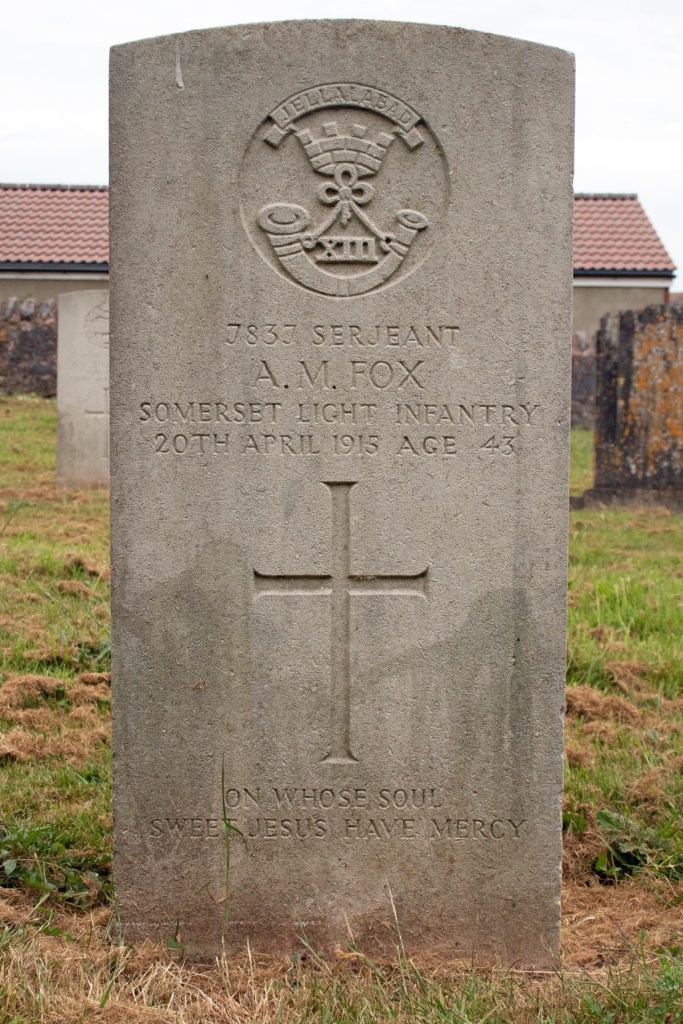
Andrew Michael Fox was born on 25th May 1871, the oldest of six children, to Michael and Eliza Fox. Michael was a Private in the 40th Regiment of Foot, and was based in Curragh Camp, Kildare, Ireland, when Andrew was born.
The family travelled where Michael’s work took him: Andrew’s oldest siblings were born in Uttar Pradesh, India, and the family were in England by the time of the 1881 census.
Given Michael’s military connections, it is no surprise that Andrew followed him into the army. He enlisted in August 1884, joining the South Lancashire Regiment. His service records give his age as 14 – he was, in fact, just 13 years old – and note his height as 4ft 9ins (1.44cm) and his weight as 73lbs (32.7kg). Andrew was recorded as having hazel eyes, brown hair and a fair complexion: his religion was also confirmed as Roman Catholic.
Andrew’s service records have become damaged over time, and a lot of his details are illegible. Because of his age when he enlisted, he was initially given the rank of Boy. In July 1887, he was formally mobilised, with the rank of Private. He remained on home soil for the next ten years, with the 1891 census listing him as being barracked in Fort Regent, Jersey.
It was in the Channel Islands that Andrew met Kathleen Dooling. The couple married on 7th January 1892, and went on to have ten children. Over the next couple of years, Andrew progressed through the ranks, achieving Lance Corporal in September 1892, Corporal in June 1894 and Lance Serjeant in August 1897.
In 1899, the Second Boer War led to the newly-promoted Serjeant Fox being posted overseas. He remained in South Africa for six months, while the conflict raged on. Andrew returned to Britain in April 1900, and was officially stood down from the army on 31st December that year, as he was deemed no longer fit for military service.
The 1901 census found Andrew and Kathleen still living in family barracks in Aldershot with their three eldest children, Andrew Margaret and Edith. Andrew was recorded as being an officer’s valet, likely now in a civilian role. The family remained in Aldershot until 1910, with five more of their children being born there.
Another change came at that point, however, as the following year’s census found the family living in Brighton Street, Warrington, Lancashire. Andrew was, by this point, working as a salesman for the Singer Sewing Machine Company, and the family were cramped into a four-roomed end-of-terrace house.
War came to Europe in the summer of 1914, and Andrew stepped up to play his part once more. Again, full details have been lost to time, but he took up the rank of Serjeant once more, and was attached to the Somerset Light Infantry. This necessitated another relocation for the family, and they moved to Cannington, near Taunton, Somerset.
Serjeant Fox was assigned to the 7th (Service) Battalion, but was not to remain in his role for long. He contracted phthisis, or tuberculosis, and passed away from the condition on 20th April 1915, just weeks before his regiment departed for the Western Front. He was 43 years of age.
Andrew Michael Fox was laid to rest in the peaceful Cannington Cemetery, not far from the family home.
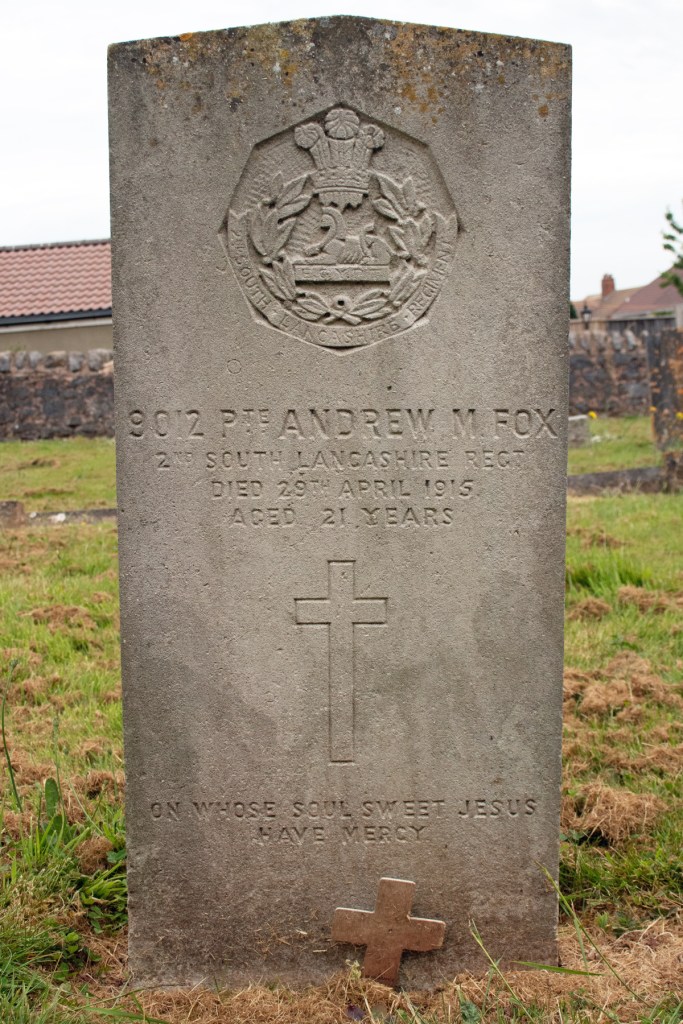
Private Andrew M Fox
In the plot next to Serjeant Andrew Fox is another, similar headstone. Not quite having the same form as the Commonwealth War Grave Commission headstone that Serjeant Fox has, this is dedicated to a Private Andrew M Fox, of the 2nd South Lancashire Regiment.
Andrew Moyse Fox was the eldest son of Andrew and Kathleen. Born on 31st March 1894 in Ireland, he wanted to follow his father and grandfather into the army.
Andrew Jr enlisted in the South Lancashire Regiment in August 1908. His service records confirmed that he was just 14 years of age, standing 5ft (1.52m) tall, and weighing 5st 2lbs (32.7kg). He was noted as having dark brown hair, hazel eyes and a fresh complexion, and that he has a scar on his right buttock.
As is the case with his father, there is limited information about Andrew Jr’s army career. He spent just under six years serving with the regiment, and was formally mobilised when he came of age in 1912. On 27th March 1914, however, Private Fox was discharged from the army on medical grounds, for reasons unclear. The next record available for him is that of his passing, just nine days after his father. He was 21 years of age.
Andrew Fox Jr was laid to rest next to his father in Cannington Cemetery. The heartbreak for Kathleen, to have lost husband and oldest boy within two weeks, must have been indescribable. While her son’s headstone is similar in design to her husband’s, he was not subsequently entitled to an official Commonwealth War Grave, as he had left the army before the outbreak of war: the Commission’s qualification dates (4th August 1914 to 31st August 1921).
News has been received at Bathpool, Taunton, that Lieutenant HB Redler, MC (RAF), was killed while flying at Turnberry, near Ayr. Lieutenant Redler, who was 21 years of age, was the eldest son of Mr and Mrs DB Redler, of Moorreesbury [sic], South Africa, and formerly of Bathpool, Taunton, and he sailed from South Africa with a schoolfellow at the end of 1915, at the age of 18, in order to join the Royal Flying Corps. On arrival in England they found no vacancies, and entered the Artists’ Rifles OTC, from which they joined the RFC. After obtaining his commission, Lieut. Redler spent a few months in France last year, and was then sent to Ayr as a fighting instructor. In March of this year he was sent to France for a six weeks’ course, during which he won the Military Cross, and it is believed that his record will show a total of nearly twenty enemy machines brought down.
Taunton Courier and Western Advertiser: Wednesday 3rd July 1918
Harold Bolton Redler was born in Worcester, Worcestershire, on 27th January 1897. The oldest of five children, his parents were Daniel and Annie. Daniel was a flour miller from Devon, and the family had moved to Worcester the year before Harold was born.
In 1903, the Redlers emigrated to South Africa. Initially settling in King William’s Town (now Qonce), they moved to Moorreesburg after the birth of Harold’s youngest sibling, Norman, in 1906.
Harold was educated at the Bishops Diocesan College in Rondebosch, Cape Town, and it was from here that he and his friend decided to step up and serve their King and Empire. Sadly, his service records have been consigned to history, and only the newspaper report remains to piece together his time in service.
Lieutenant Redler’s awarding of the Military Cross, however, is documented:
For conspicuous gallantry and devotion to duty. He encountered four enemy two-seater machines and attacking the lowest drove it to the ground with its engine damaged. Later he attacked one of five enemy two-seater machines and drove it down out of control. He has destroyed in all three enemy machines and driven three others down out of control. He continually attacked enemy troops and transport from a low altitude during operations and showed splendid qualities of courage and determination throughout.
London Gazette: 22nd June 1918
On the morning of 21st June 1918, Lieutenant Redler was flying a de Havilland DH9 aircraft, accompanied by Captain Ian Henderson. The plane was fitted with a Lewis gun, which the pair were testing. At 10am, the aircraft crashed, and both were killed. No immediate cause was identified, and their RAF cards record an open verdict. Harold was just 21 years of age.
With his parents and siblings in South Africa, Harold Bolton Redler’s body was taken to Somerset for burial. He was laid to rest with his paternal grandparents in the peaceful St Augustine’s Churchyard in West Monkton.
Frederick Chilcott was born in Bridgwater, Somerset, early in 1867. He was the fifth of thirteen children to labourer and kiln worker Henry Chilcott and his wife, Ellen.
When he finished his schooling, Frederick also found labouring work. He wanted bigger and better things, however, and the opportunity for a career in the army offered him just that. On 14th January 1888 he enlisted in the Royal Artillery. His service records confirm he was 5ft 6ins (1.68m) tall, and weighed 119lbs (54kg). He was noted as having dark brown hair, dark hazel eyes and a fresh complexion. He also had a scar on his forehead and a tattooed dot on his right forearm.
Frederick was initially given the rank of Driver and was assigned to the regiment’s 3rd Brigade Depot. He was sent to India in February 1889, and remained there until November the following year, when his troop returned to Britain.
Back on home soil Frederick’s role changed and he was given the rank of Gunner. On 1st January 1892, he was promoted to Acting Bombardier, but, on his own request, he reverted to his previous rank just three months later. On 15th January 1895, Gunner Chilcott was stood down to reserve status, having completed seven years’ service.
On 16th April 1895, Frederick married Eliza Stockham. She was a labourer’s daughter from the village of Puriton, to the north of Bridgwater, and it was here that the couple settled. Living in a small cottage, they went on to have six children between 1898 and 1911.
Frederick’s time in the army, however, wasn’t quite done. With the Second Boer War breaking out, he was recalled to the now Royal Field Artillery in January 1900. Sent to South Africa, Gunner Chilcott remained overseas for a year and was recognised for his commitment in the campaign.
Frederick returned to Britain on 3rd January 1901, and was finally stood down from the army in March that year, having fulfilled his twelve years’ contract. He returned home to Puriton, his service records noting that his character was ‘very good’.
The 1911 census found Frederick employed as a labourer in the local cement works. He and Eliza living in a small cottage in Puriton with four of the children (their oldest son was with Eliza’s parents, while she was pregnant with their youngest).
Conflict was knocking on England’s shore by this point, and when conflict broke out, Frederick appears to have stepped up to play his part once more. He was 47 years old when war was declared and, as such, would not have been required to enlist. Full details of his service are no longer available, but he had certainly joined the Army Veterinary Corps by the summer of 1917.
Private Chilcott is likely to have remained on home soil, but towards the end of his service was based in Curragh, County Kildare, Ireland. It was while here, on 23rd December 1917, that he suffered an aneurysm, passing away in the town’s military hospital as a result. He was 50 years of age.
Frederick Chilcott’s body was brought back to Somerset for burial. He was laid to rest in the quiet graveyard of St Michael’s Church in his home village, Puriton.
Frederick Murray Walker was born on 29th July 1862 in the village of Terregles, Kircudbrightshire, Scotland. The fifth of eleven children, his parents were Colonel Sir George Gustavus Walker, Member of Parliament for Dumfries & Galloway, and his wife, Anne. Sir George owned the Crawfordton Estate, and this is where Frederick was raised, with a retinue of fourteen staff to help the family.
Following his father’s military career, Frederick felt a draw to serve. On 15th July 1875, he entered the Royal Navy as a Midshipman. He set out to build a dedicated career, visiting most parts of the world in the process.
While Frederick’s initial service took him to the Mediterranean – where he received the Egyptian Medal and Alexandria Clasp – by 1883 he was out in China, but he also spent time in India and South Africa. In 1882 he was promoted to Sub Lieutenant, three years later he rose to the rank of Lieutenant. By 1899, Frederick had become a Commander.
By his own request, Frederick retired from the Royal Navy on 1st August 1909. He was now 47 years old, and had spent 34 years in service and was given the rank of Captain as a mark of his career.
On 19th June 1891, Frederick had married Lucy Scriven in St Saviour’s Church, Paddington, London. They would go on to have seven children, and to begin with, the life of a Naval Captain took Lucy around the coastal ports of Southern England. When Frederick retired, however, the family settled in a large house in Milford-on-Sea, Hampshire, where they were supported by a governess, cook, parlour maid and housemaid.
When war broke out in 1914, Captain Walker stepped up once more to serve his King and Country. He remained in territorial waters and was given successive command of the yachts James, Zaria and Albion III. By 1917, Frederick’s health was beginning to suffer, and he was placed on HMS Victory’s reserve books, ready should Portsmouth’s Royal Naval Dockyard need his service.
Frederick was not to be called to action again. By the time the Armistice was declared Frederick’s condition was worsening. He had developed cancer of the tongue, and it was having a real impact. He was admitted to the Haslar Hospital in Portsmouth, and passed away there on 7th February 1919, at the age of 46 years old.
By this point the family had relocated to Bath, Somerset, and this is where Frederick Murray Walker’s body was brought for burial. He was laid to rest in the prestigious Lansdown Cemetery, overlooking the city.
Charles Edward Ridley Holroyd-Smyth was born in Ballynatray, Co. Waterford, Ireland, on 16th August 1882. The seventh of nine children, his parents were John and Harriette Holroyd-Smyth. John was a colonel in the army and, while from a a renowned family, there is actually little documented about Charles’ early life.
Given his father’s military career, it seemed natural for Charles to follow suit. His service records are tantalisingly elusive, but he certainly served in South Africa during the Second Boer War at the turn of the century.
When war broke out, Charles took up the rank of Captain in the 3rd Dragoon Guards (Prince of Wales’ Own). He set sail for France on 1st November 1914, and he found himself in the very thick of the fighting, where his battalion fought at Ypres, Loos and Arras. His conduct during the war earned him both the Distinguished Service Order and a Military Cross.
On 29th October 1916, Charles married Norah Layard, the daughter of another army officer, who had been born in Ceylon. Charles was soon back in France, however, and was promoted to Lieutenant-Colonel, and given command of the 15th Battalion of the Durham Light Infantry.
Over the course of 1918, Lieutenant-Colonel Holroyd-Smyth led his troop in the Battles of Bapaume, Messines, Kemmel and Aisne. However, it was during the Battle of Epehy that he was badly wounded. Initially treated on sight, he was quickly evacuated back to Britain for further treatment.
Lieutenant-Colonel Holroyd-Smyth was admitted to the Royal Victoria Hospital in Netley, Southampton, but his wounds were to prove too severe. He passed away on 23rd September 1918, at the age of just 36 years of age.
The body of Charles Edward Ridley Holroyd-Smyth was brought back to Somerset, where Norah was living. His funeral, at St Stephen’s Church, in Bath, was marked with some ceremony, and he was laid to rest in Lansdown Cemetery, overlooking the city.
(from ancestry.co.uk)
Charles’ death came just nine days after the passing of his mother, back in Waterford. He and Norah didn’t have any children, although tragically a newspaper report from July 1918 did note a birth: “On the 3rd July, at East Hayes House, Bath, the wife of Lieutenant-Colonel CE Holroyd-Smyth MC, a son (stillborn).” [Bath Chronicle and Weekly Gazette: Saturday 13th July 1918]