Thomas George Bickley was born in Fremantle, Australia, in 1881, and was the second of six children to Absolom and Mary Bickley. May had been married and widowed twice before wedding Thomas’ father, and so he had eight half-siblings as well.
Thomas’ early life is a challenge to piece together, but his service records from the First World War fill in some of the detail. He confirms that he had served in the 1st Imperial Light Horse for eleven months, and that he fought in South Africa – presumably as part of the Boer War of 1899-1902.
At the time of enlisting on 13th September 1916, he was working as a carpenter, and had completed a five-year apprenticeship. He married Rose Buck in 1907, but they did not have any children.
Private Bickley was assigned to the 16th Battalion of the Australian Infantry, and his medical report confirms the man he had become. He was 5ft 10ins (1.77m) tall and weighed 170lbs (77.1kg). At 34 years of age, he had light brown hair, blue eyes and a fresh complexion.
Thomas’ unit left Fremantle on the Argyllshire. The troop ship arrived in Devonport, Devon, two months later, and his battalion was sent to their base near Codford in Wiltshire. The journey impacted a lot of soldiers, and Thomas was not to be immune from this.
On 12th February Private Bickley was sent to the camp hospital as he was suffering from bronchitis. The severity of his condition meant he was immediately transferred to an army hospital in nearby Sutton Veny, but it was to prove too late. Thomas died from the lung condition on 23rd February 1917: he was 35 years of age.
Thomas George Bickley was laid to rest in the ANZAC extension to St Mary’s Churchyard, Codford, not far from the based that had so briefly been his home.
Thomas Fidler was born on 15th May 1881 in Newbury, Berkshire and was the fourth of eight children to Charles and Sarah. Charles was a groom, who travelled where the work was, and, by the time of the 1901, the family has relocated to Whitchurch in Hampshire.
When he finished his schooling, Thomas found work as a dairyman. However, he had always had his sights on bigger and better things, and, having been a volunteer for the local militia, he was keen to become a full soldier. Things did not go immediately to plan though, and he was initially turned down because he was under height – he was just 5ft 3ins (1.6m) tall when he turned 18.
But Thomas was persistent, and, on 27th June 1898, he was formally enrolled in the Hampshire Regiment. Along with his height, his service records confirm other details about the young man he had become. The document show that he weighed 124lbs (56.2kg), and that he had brown hair, brown eyes and a fresh complexion. The records advise that he was considered fit for duty, but also note that he was given special authority to enlist, presumably to bypass the concerns about his height.
Private Thomas Fidler would go on to build up quite a military career for himself. He spent nearly two years on home soil, before his unit was shipped out to South Africa. During his time in the colony, he served in a number of the campaigns, and was awarded with the Queen’s South Africa medal, including clasps for Cape Colony, Orange Free State and Transvaal, and the King’s South Africa Medal 1901-1902.
After more than two years spent overseas, Thomas’ unit returned to Britain. He would remain on home soil until 1903, extending his service beyond the five compulsory years, and choosing to remain on active duty, rather than being stepped down to reserve status. In September of that year, his unit was on the move again, and he was transferred to Malta.
It would not be until September 1905 that Private Fidler saw home soil again. He was formally stood down from duty the following June and assigned to the Army Reserve. Interestingly, his transfer papers recorded that his conduct was indifferent, disobedient… inclined to drink.
Thomas’ attitude over the years was evidenced by his entries in the Regimental Defaulter Book. He was disciplined no fewer than twelve times during his military career. His offences included being absent from parade and using insubordinate language. While stationed in Malta, he was punished for being drunk four times. Over the years, Private Fidler spent 125 days confined to barracks, and was fined a total of £1 2s 6d for his crimes.
When he was not confined to barracks, Private Fidler would likely be found in a sick bay. Between January 1901 and September 1905, he spent 342 days in hospital with conditions ranging from fevers, psoriasis, scabies and gonorrhoea.
On 22nd March 1905, while serving in Malta, Thomas was admitted to hospital having suffered a fractured jaw following a scuffle. The cause of the injury is recorded in detail in an eleven-page report, which outlined that Private Fidler had been out in Valetta, and ended up quite drunk. He was approached by a couple of military police officers, and became abusive towards them. While trying to take off his boots, a private from another regiment, who was also drunk, came along and punched him in the face, fracturing his jaw. Both men were arrested and taken back to barracks. The investigation in to the incident found that, while Private Fidler was off duty at the time, he was to blame for the altercation.
In June 1906, Thomas returned to civvy street, and to his former job as a dairyman. On 5th February 1907, he married Tryphena Snook, who was the daughter of his employer. The couple had had a son the previous year, and would go on to have three more children in the next few years.
The 1911 census found the young family living in Sparsholt, Hampshire, the household being made up of Thomas, Tryphena and their older two children, Tryphena’s parents, William and Emma, and a boarder, William Clark, who was a carter on the farm.
By the summer of 1914, Thomas had been formally stood down from the army, his contract coming to an end on 26th June. A storm was brewing over the Channel, however, and he would soon be called upon to play his part once more.
Details of Thomas’ re-enlistment into the army have been lost to time. It is likely that he was called upon quite quickly. He was assigned to the South Wales Borderers, and, with the experience he had under his belt, was given the rank of Lance Corporal.
Thomas’ unit – the 4th (Service) Battalion – was initially sent to France, and he arrived there early in July 1915. Within a matter of weeks, however, the battalion moved on to the Eastern Mediterranean, ending up at Gallipoli.
Lance Corporal Fidler’s time in on the peninsula would have been fraught with danger. In the autumn of 1915, he was badly injured and was medically evacuated to Britain for treatment. Admitted to hospital in Devon, his wounds were to prove too severe, and he passed away on 5th November, at the age of 34.
The funeral rook place at Paignton… of Lance-Corpl. Thos. Fidler, of the 4th South Wales Borderers, who died at Oldway Hospital on Friday as a result of wounds sustained at Gallipoli. The widow and other mourners followed, and the Matron of the Hospital (Miss Blackmore) was among those present. Wounded convalescents from Oldway and a Company of the 7th Devons, under Capt. Brearley, attended, and the Devons provided a firing party.
[Exeter and Plymouth Gazette – Tuesday 09 November 1915]
Thomas Fidler was laid to rest in Paignton Cemetery.
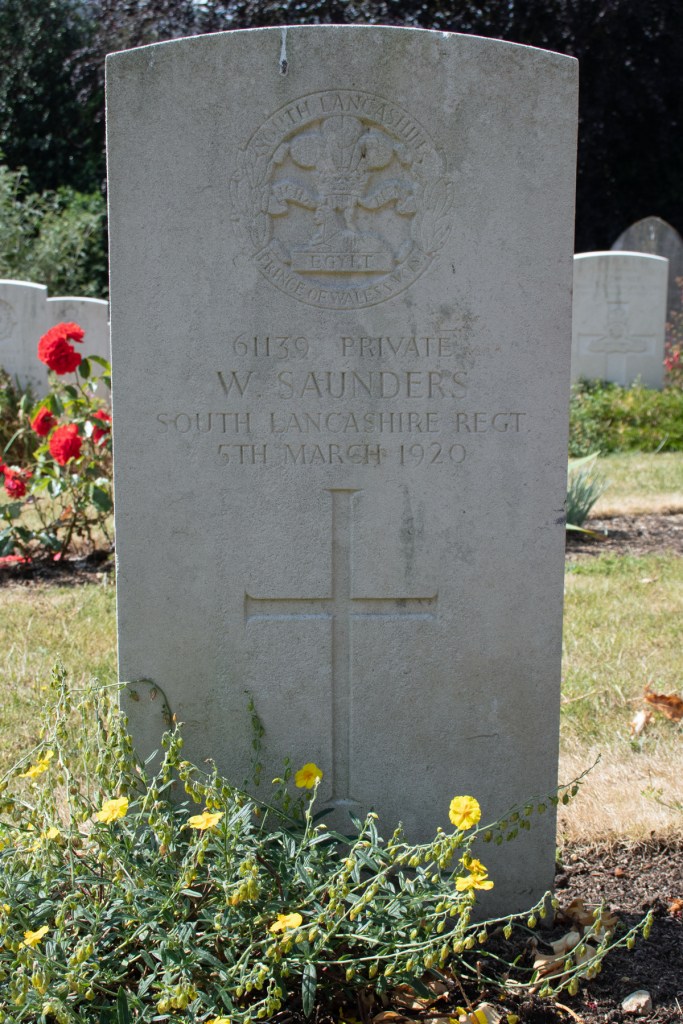
There is little concrete information about the life of Walter Saunders, and what details are available come from his limited military documents. These confirm that he was born in December 1862 in Widcombe, near Bath, Somerset.
Walter was unemployed labourer when enlisted in the army in January 1882. He joined the Somerset Light Infantry, and was attached to the 4th Battalion. His service records show that he was just under 5ft 5ins (1.64m) tall, with brown hair, hazel eyes and a fresh complexion. He was also notes as having a scar on his abdomen.
Private Saunders seems to have served in southern Asia, receiving the India medal and Burma 1885-1887 clasp. He then moved to South Africa, and was caught up in the Second Boer War. There is no further information about his initial time in the army.
When his contract came to an end, it would seem that Walter returned to the UK, finding work as a dock labourer in South Wales. When war came to Europe, though, he stepped up once more so serve his country, this time joining the South Lancashire Regiment. He was assigned to the 15th (Transport Workers’) Battalion, which served in the Mersey dockyards.
The next record for Private Saunders comes from June 1917, when he was sent to a medical board. He had been unwell for a while, it seems, and was suffering from arteriosclerosis, or hardened arteries. The medical report confirmed this was a permanent condition, and that he was no longer fit for military service.
At this point, Walter’s trail goes cold. It seems likely that he returned to Somerset, possibly still having family connections there. He passed away on 5th March 1920. He was 57 years of age.
Walter Saunders was was laid to rest in the military section of Bath’s sweeping Locksbrook Cemetery.
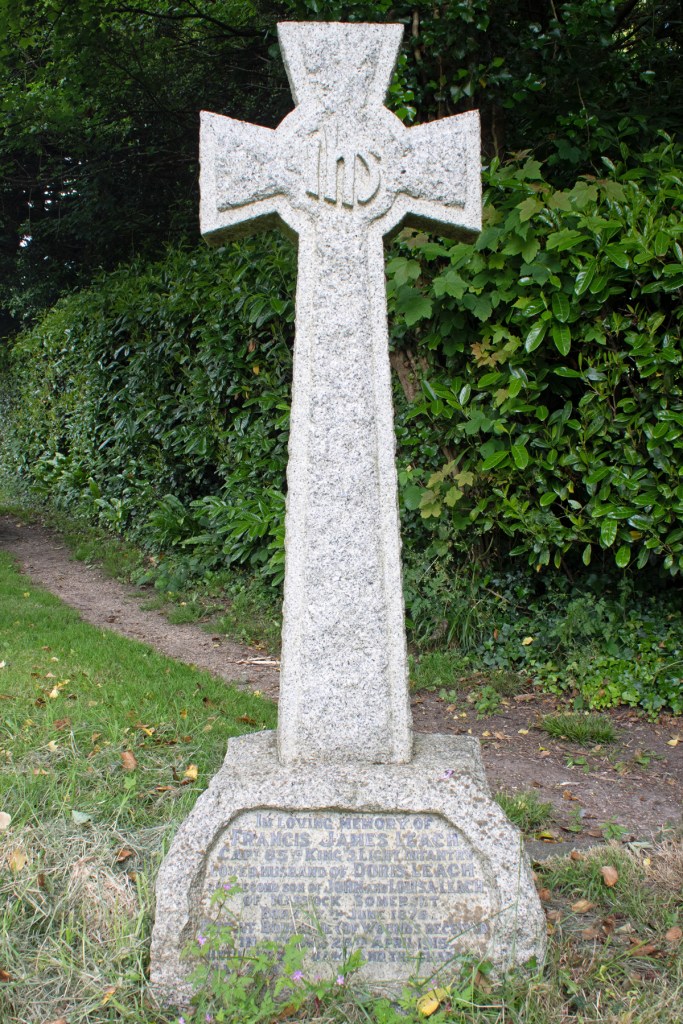
Francis James Leach was born on 27th June 1878 in the Somerset village of Martock. He was the middle of four children to John and Louisa Leach. John was a solicitor who was 17 years older than Louisa, who was his second wife, and by whom he had had two children. The 1881 census found the family living in a house called The Lawn on Church Street, supported by five servants: a nurse, an under-nurse, a cook, a housemaid and a footman.
The next census return, taken in 1891, recorded the family having moved to Seaton in Devon. Louisa was living at 7 West Cliff Terrace with five of the children and a domestic servant. John, however, is not noted on the document, although Louisa is still recorded as married, which would suggest that he had not passed away.
A later newspaper report helps build a picture of Francis’ life growing up:
…Leach was educated at Allhallows School, Honiton, was a thorough sportsman in every sense of the word, a good shot, a keen rider to hounds, a polo player, and cricketer.
[Exeter and Plymouth Gazette: Friday 7th May 1915]
When he finished his schooling, Francis felt drawn to an army career, and the newspaper confirmed his progress:
He served through the Boer War with the R Battery, Royal Horse Artillery, and was present at the relief of Kimberley and at the actions at Paardeberg, Poplar Grove, Zand River, Johannesburg, Pretoria, Diamond Hill and Wittebergen, and was awarded the Queen’s medal with six clasps and the King’s Medal with two. He was given his commission in the Shropshire Light Infantry in 1901, attained the rank of Captain last August and was appointed Adjutant of his Battalion February 2nd, 1914.
[Exeter and Plymouth Gazette: Friday 7th May 1915]
The 1911 census found Francis back with his mother. She was now living in the village of Hawkchurch, near Axminster, living in a 9-roomed house called The Vineyard. Louisa also had her daughter and two servants – a cook and a housemaid – supporting her. The census return also confirmed that Louisa was a widow, John having died some rears previously. Francis’ visit may have been a fleeting one, as his fiancée, Doris Maunsell-Smyth, was also visiting in preparation for a wedding.
Francis and Doris exchanged vows on 29th July 1911, the wedding taking place in Christ Church, Paddington, Middlesex. Their marriage certificate confirmed that the groom was an army officer, while the bride’s father, George Maunsell-Smyth, was noted simply as a gentleman.
When war broke out in the summer of 1914, Captain Leach and his unit was called up to play their part. Full details of his service have been lost to time, but he was sent to the the Western Front by December that year. Over the coming months, the battalion was involved in the Battle of Eloi and the Second Battle of Ypres.
The funeral of Captain Francis Leach of the 2nd Battalion Shropshire Light Infantry, as taken place in the village churchyard amid every token of respect and sympathy. The officer died at Boulogne of wounds received in action in Flanders.
[Exeter and Plymouth Gazette: Friday 7th May 1915]
Captain Leach died of his injuries on 26th April 1915. He was 36 years of age.
Interestingly, despite a decree that the conflict’s fallen would be buried overseas if that was where they died, it seems that Captain Leach’s family were able to circumvent that ruling. Whether that was because he died in a hospital ship in Boulogne’s harbour is unclear, but had he died in the town itself, he should have been laid to rest in France.
Either way, the body of Francis James Leach was brought back to Devon for burial. He was laid to rest in the graveyard of St John the Baptist Church, Hawkchurch, not far from where his mother still lived.
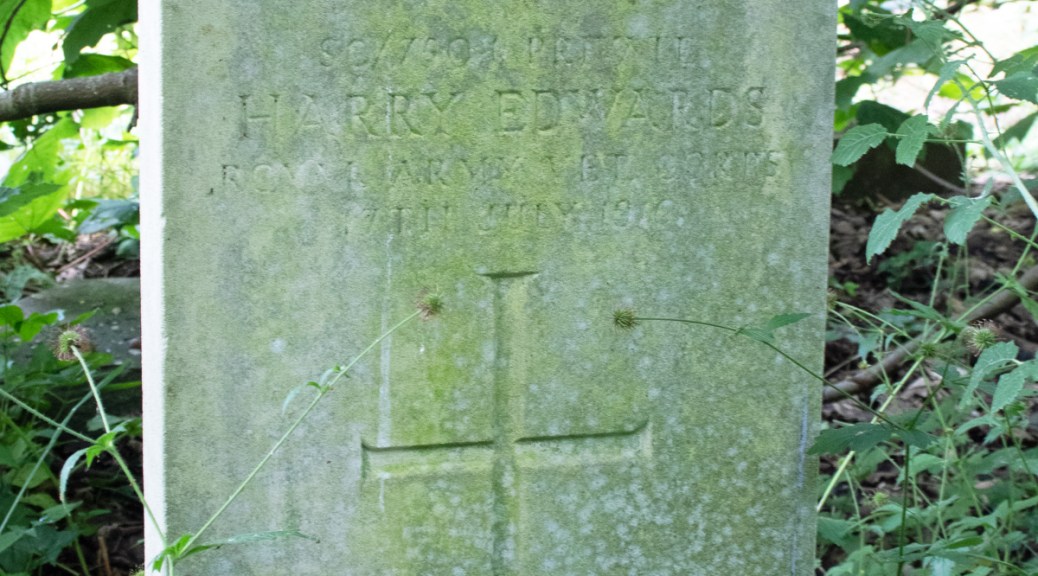
Harry Edwards was born early in 1855 in South London. One of eleven children, his parents were John and Sarah Edwards. John was a carpenter, and the family were raised in Bermondsey, first in a small terrace in Chapel Place, then sharing a slightly larger house in Grange Walk.
Much of Harry’s life is lost to time. He married Mary Ellerington on 27th July 1879: she was a tailor’s daughter from Southwark, and the couple set up home at 29 Newington Causeway. The marriage certificate confirmed that Harry was employed as a warehouseman at the time, and their daughter, Amelia, was born the following spring.
A later document suggests that Harry went on to join the army, fighting as part of the South Africa Campaign. Sadly, however, his service records are lost to time, and so it is not possible to confirm when and for how long he served. Certainly, there is no mention of the family in the census returns from 1881 to 1911, so he may well have been overseas.
The next records available for Harry are those relating to his military service during the First World War. He enlisted early in 1915, joining the Royal Army Veterinary Corps. He found himself in France by mid-April, and was awarded the British and Victory Medals and the 1915 Star for his service.
Private Edwards came down with bronchitis in the spring of 1916: he was medically evacuated to Britain for treatment, and was admitted to the Bath War Hospital in Somerset. It seems that Harry’s age was against him: he passed away from the condition on 17th July 1916, at the age of 61 years old.
Harry Edwards’ family may have been unable to afford the cost of bring him back to London for burial. Instead, he was laid to rest in the sweeping Locksbrook Cemetery, not far from the hospital in which he had breathed his last.
Edward Charles Brooke-Smith was born in Muizenberg, South Africa, on 2nd March 1892. The eighth of nine children, his parents were mariner Alfred Brooke-Smith and his wife, Louisa.
Little further information about Edward’s early life is available. The 1901 census recorded the family as having returned to Britain – where both Alfred and Louisa had been born. The family had set up home in a cottage in Woodbridge, Suffolk, but by the spring of 1911 Edward had moved again, emigrating to Canada to make a life as a farmer.
When war came to Europe, the empire was called upon to fight for peace. Edward, who was working as a merchant in Valcartier, Quebec, by this point quickly stepped up to play his part. He enlisted in the Canadian Expeditionary Force on 17th September 1914 as a Private.
Edward’s service record give an insight into the man he had become. He was noted as being 5ft 11ins (1.8m) tall, with dark brown hair, grey eyes and a dark complexion. Private Brooke-Smith was also noted as having vaccination scars on his left arm, a small scar on his right knee and two moles on the centre of his back.
Details of Edward’s travel back to Europe are lost to time, but he was attached to the 7th Battalion of the Canadian Infantry and, by the spring of 1915, he was in Northern France. In March he had a bout of bronchitis, which was quickly followed by influenza, and he was hospitalised in Rouen.
Private Brooke-Smith returned to his unit in May 1915, but he was dogged by flu for the next couple of months. Sadly, things were not to improve for him.
On 19th August 1915, Edward’s unit was fighting at Wimereux, France, when he was shot. The bullet shattered the top of his right thigh and pelvis, and, after treatment on site, he was evacuated to Britain for further medical support.
Edward was to spend the next sixteen months in hospital. He was initially admitted to the Cambridge Hospital in Aldershot, Hampshire, where his primary treatment took place. In November 1915, he was moved to the Duchess of Connaught Canadian Red Cross Hospital in Taplow, Buckinghamshire for ongoing recuperation.
On 13th March 1916, Private Brooke-Smith was moved to the Auxiliary Hospital in Torquay, Devon. Here further physiotherapy and recuperation took place, before an operation to correct the position of his thigh was undertaken 9th December. Despite the precautions that had been put in place, Edward did not come round from the procedure: he was 24 years of age.
Alfred and Louisa had settled in Paignton by this point – given the year their son had spent in the hospital, it seems likely that they had moved to be nearer to him. Edward Charles Brooke Smith was, therefore, laid to rest in the family plot in the town’s cemetery. When Alfred died nine months later, he was buried alongside his son.
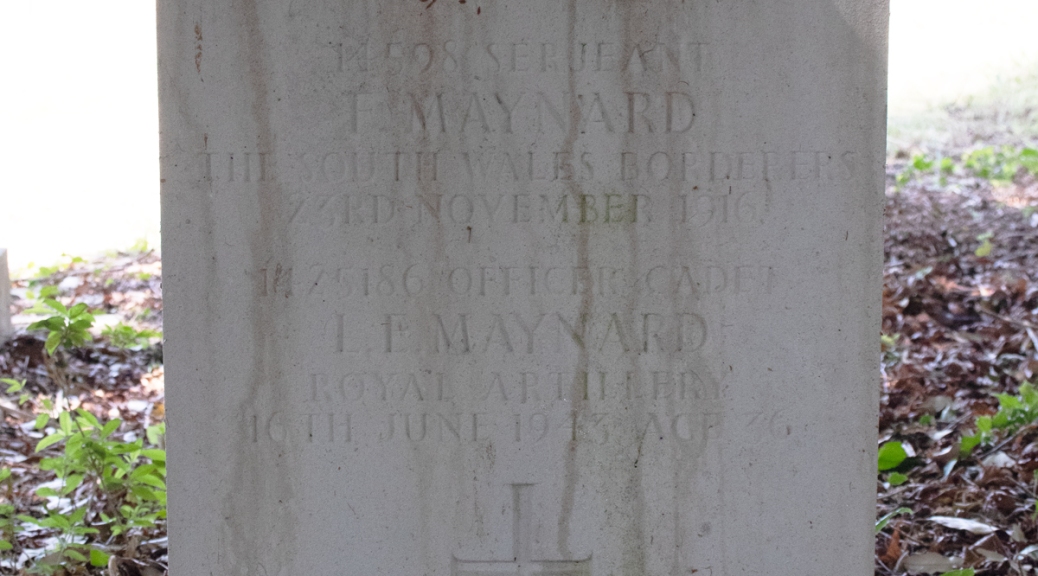
Details of Fred Maynard’s early life are a challenge to piece together. His First World War service records give his age as 44 years old when he enlisted in September 1914, and confirm his place of birth as Melksham, Wiltshire.
A newspaper report of his funeral gives the name of three brothers – Charles, Frank and Arthur – while only one census return, from 1881, provides a potential match for the family. This suggests Fred’s parents were iron fitter Alfred Maynard and his wife, Deborah, and gives the family’s address as Waterworks Road in Trowbridge.
Fred joined the army in the autumn of 1888. Initially assigned to the Gloucestershire Regiment, he had transferred to the Wiltshire Regiment by the following spring. Private Maynard showed a commitment to duty: in December 1890 he was promoted to Lance Corporal, rising to Corporal in the summer of 1893.
Fred was stood down to reserve status after his seven years’ active duty, but was recalled to the army in December 1899, when war broke out in South Africa. Promoted to Serjeant, he was sent to fight in the Boer War, and was mentioned in dispatches on 2nd April 1901 for special and meritorious service in South Africa. He was stood back down to reserve status in October 1901.
On 21st November 1895, Fred had married Louisa Card. The couple set up home in Trowbridge, but soon moved to London. They went on to have six children: Ernest, Nora and Leslie, who were all born in the London; and Arthur, Martha and Stuart, who were born in Cardiff, the family having moved to Wales by 1910.
The army was not finished with Fred, however, and, within weeks of war breaking out in the summer of 1914, he was called back into service. Given the rank of Serjeant again, he was attached to the South Wales Borderers. Fred was 44 years of age by this point, his service records confirming that he stood 5ft 8ins (1.73m) tall, weighed 164lbs (74.4kg) and had brown hair and hazel eyes.
Attached to one of the regiment’s depots, it seems unlikely that Fred saw service overseas this time around. He was discharged from the army on 1st September 1916 and this seems to have been on medical grounds. Later documents suggest that Serjeant Maynard had been diagnosed with carcinoma of the pylorus, or stomach cancer.
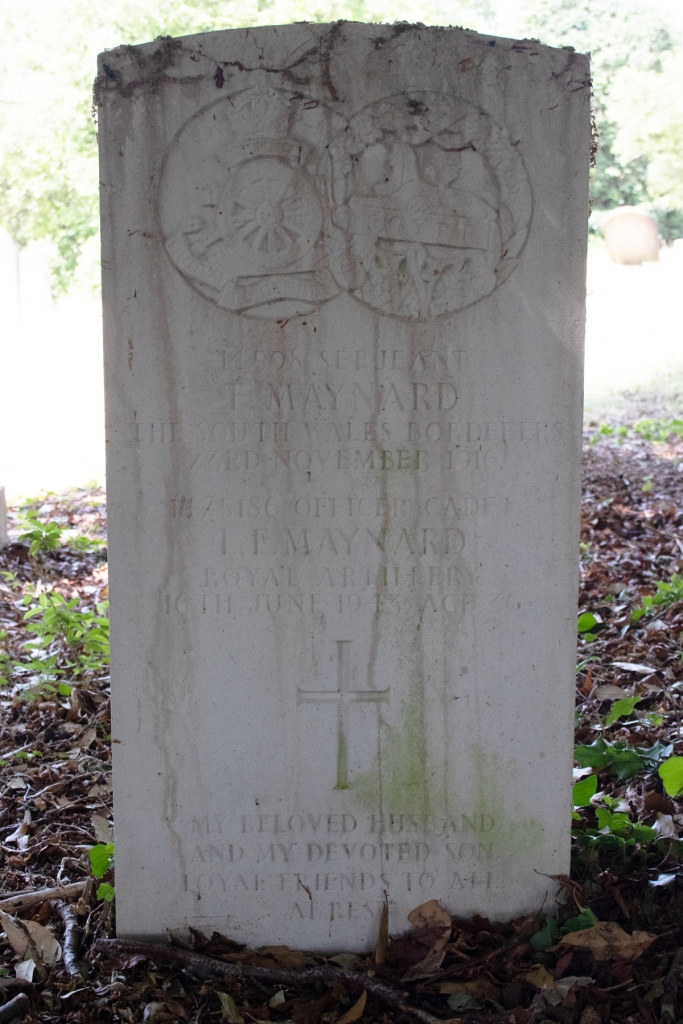
Fred returned to Cardiff, but his time back home was to be short. He was admitted to the Lansdown Road Military Hospital, and passed away on 23rd November 1916. He was 46 years of age.
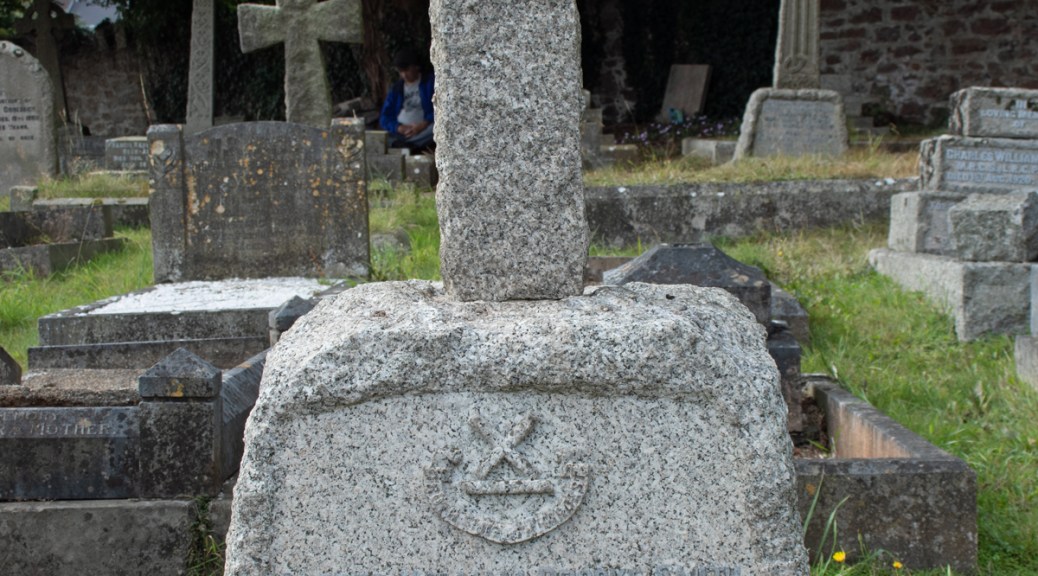
It seems that Fred’s brother’s had some sway in his funeral. Instead of being laid to rest in Cardiff, where Louisa and the children were living, he was, instead, buried in the Locksbrook Cemetery, Bath, Somerset. His sibling Charles, who was a sergeant in Bath City Police, lived in the city, as did another brother, Frank.
Fred’s headstone also commemorates his and Louisa’s son, Leslie. He had joined the army in the 1920s and, in the summer of 1943, was in Yorkshire, undergoing officer training.
The death of an officer cadet through the accidental discharge of a rifle whose bolt had jammed was described at an inquest…
Captain WH Price said he was in charge of an exercise on the moors which involved the used of small arms and the firing of live ammunition. A squad of cadets lay on the ground in front of a trench firing over a range. All finished firing except Cadet Frank Holroyd, who said his bolt had hammed while firing a second round. [Price] told him to release the bolt by knocking the cocking piece up and back.
This attempt failed, and he told Holroyd to get back into the trench, turn the rifle magazine upwards, place the butt on the side of the trench, and kick the bolt down with his foot. While Holroyd was doing this he noticed Maynard standing in the trench about 4ft away from Holroyd and on his right-hand side.
Captain Price said he saw the rifle was pointing down the range when Holroyd kicked the butt. The cartridge suddenly exploded and Maynard dropped into the trench, shot in the head, and was dead when they reached him.
[Bradford Observer: Saturday 19th June 1943]
Officer Cadet Leslie Maynard was 36 years of age when he was killed. His body was taken back to Somerset for burial: he was laid to rest in the same grave as Fred, father and son reunited after 27 years.
Louisa remained somewhat elusive as time wore on. Fred’s military records confirm that she had moved from Cardiff to the Isle of Wight by 1922. By the time of her son’s death, she was living in Sidcup, Kent.
The funeral of Mr Henry Hutchings, the Zulu war veteran, who died suddenly at Lower Weston on Tuesday, took place on Saturday afternoon…
The principal mourners were: Mrs Hutchings (widow), Sergt. Hutchings (son)(who wore the Mons ribbon and a Zulu war medal), Mr AE Adams (step-son), Mrs A Hutchings (daughter-in-law), Mr David Adams (step-son), and Mrs Emily Pickworth (step-daughter).
In order to attend the funeral Mr AE Adams had returned from France, where he has been carrying out work for a local firm.
Bath Chronicle and Weekly Gazette: Saturday 16th February 1918
Tracking down Henry Hutchings’ early life is a bit of a challenge, but working backwards through census records sheds some light onto his later years.
The Commonwealth War Graves Commission record states “Hutchings, Pte. Henry, 14475. Royal Defence Corps. 5th Feb., 1918. Age 59. Husband of Theresa Hutchings… Served in the Zulu War (1877-79) with Army Service Corps.”
The 1911 census recorded Henry and Theresa living in Shepherd’s Bush, Hammersmith. The document confirms they had been married for less than a year and, unusually, suggests both were twice married. Henry had been born in Notting Hill, and was employed as a smith’s hammerman. Theresa was born in Byfleet, Surrey, and the couple were living with Henry’s son, Henry Jr, and Theresa’s daughter, Alice.
Turn the clock back ten years, and the 1901 census tells a more confused story. Henry was living in Edmonton, Middlesex, where he was employed as a general labourer. Theresa is noted as being his wife – in contrast to the later census return – and the couple were living in Gilpin Crescent with Henry’s sons – Henry Jr, Edward and Sidney – and Theresa’s two children – Alice and Albert.
Going back a further ten years leads to a dead end. Neither Henry nor Theresa are readily identifiable on the 1891 census, even though both should have had their older children by that point.
An 1877 military record confirms Henry’s earlier time in the army. It was in July of that year that he enlisted, joining the Army Service Corps. At 18 years of age, he had been working as a carman, but a dedicated career is what he sought out. His record confirms he was 5ft 4ins (1.63m tall, with brown hair, blue eyes and a fresh complexion. Henry lists his next of kin as brother Robert Hutchings, although, again further family details are lost in the mists of time.
Private Hutchings spent twelve years in the army. After eighteen months on home soil, he was dispatched to South Africa, as the later newspaper report suggests, and spent a year overseas. He returned home in March 1880, and was stood down to reserve status until the end of his contract in July 1889.
The documentation uncovers details of Henry’s second period of time in the military. He enlisted in the Royal Defence Corps in September 1915, and was based at Alexandra Palace in London. His time there was limited, however, as he began to show signs of heart disease. By the following summer, Private Hutchings suffered from breathlessness and chest pains, to the point where he was medically discharged from service on 21st August 1916.
Henry and Theresa had moved to Somerset by January 1917, presumably for the cleaner air that their home in Bath would provide. This was not to be enough, however. Henry died a little over a year later, at the age of 59 years old.
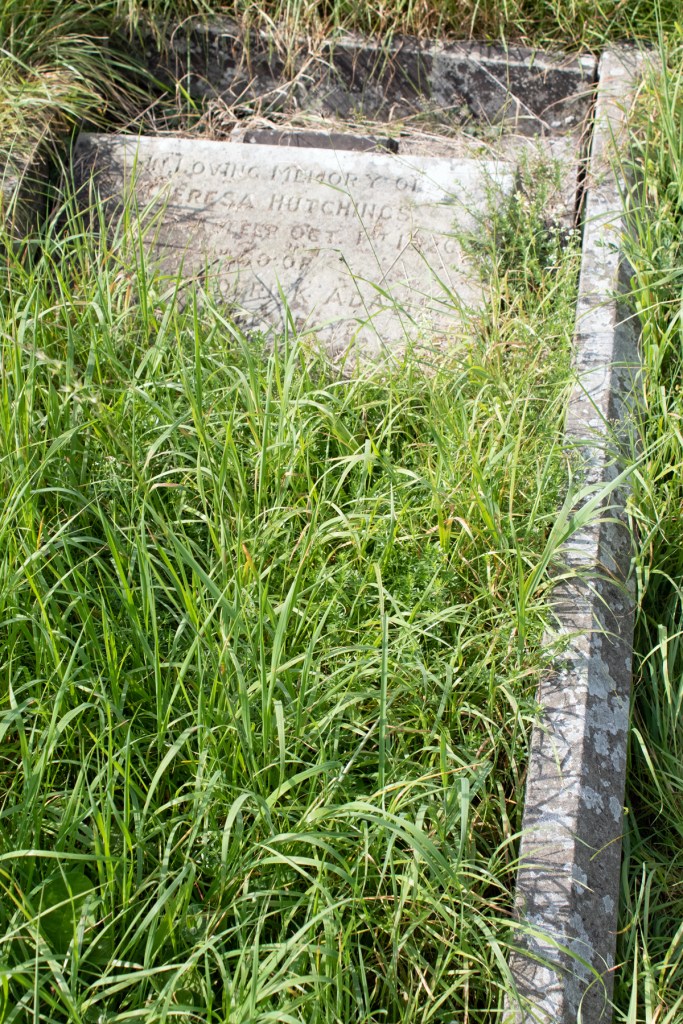
Henry Hutchings was laid to rest in the sweeping grounds of Locksbrook Cemetery, Bath. He was to be reunited with Theresa when she passed away in 1926.
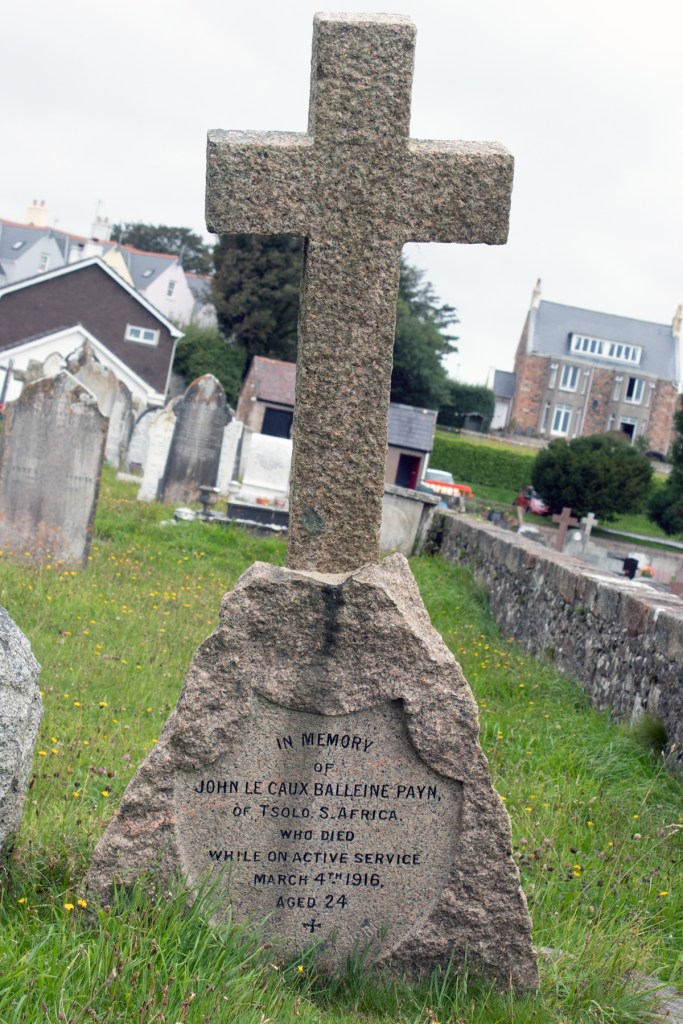
John le Caux Balleine Payn was born in South Africa in 1892. The sixth of seven children, his parents were Jersey-born Philip Payn and his wife, Mary, who came from the Eastern Cape.
There is tantalisingly little information available about John’s life. When war was declared in Europe, he answered the call from King and Empire, and enlisted in the South African Infantry. His regiment – the 1st – fought in North Africa and at the Somme, but it is not clear when and where he was based.
It is likely that Private Payn either had a base in the UK, or that he was hospitalised there following an illness or an injury. He passed away, through causes unconfirmed, on 4th March 1916. He was just 24 years of age.
It was impractical to repatriate John le Caux Balleine Payn’s body to South Africa for burial. Instead, he was laid to rest close to his father’s family, in St Martin’s, Jersey.
Keith Charles Beddy was born in Port Elizabeth, South Africa. His parents were Walter and Isabella Beddy, and he was the sixth of eight children.
Little additional information is available about Keith’s early life. When war broke out, he enlisted in the army, eventually becoming assigned to the 5th Battalion of the Hampshire Regiment. Rising through the ranks to the rank of Lieutenant, he eventually transferred to the Royal Flying Corps.
Lieutenant Beddy was based on Boscombe Down, near Amesbury, Wiltshire. On 6th February 1918, he was flying his RAF BE 2e aircraft when he attempted a turn at a low altitude. The plane nose-dived and crashed into the ground, and Keith was killed instantly. He was just 21 years of age.
With his family on the other side of the world, Keith Charles Beddy was laid to rest in Amesbury Cemetery, not far from the airfield where he had been based.