Category Archives: Wales

Lance Sergeant Henry Lewis

Lance Sergeant Henry Lewis

The early life of Henry Watkin Lewis is a challenge to piece together, and a lot of the detail comes from his later service records.

The document confirms that Henry was born in Pontypool, Monmouthshire, in December 1885. It gives his next of kin as his aunt, Ann Dunning, and there are no details about his parents.

Henry joined up in the days after war was declared. He was working as a plumber by this point, and enlisted in Preston, Lancashire, although it is not clear whether he was living in the area at this point. His records showing that he was 5ft (1.52m) tall and weighed 116lbs (52.6kg). With brown hair, blue eyes and a fresh complexion, he had a scar across the bridge of his nose and another on his lower lip.

Henry’s military career is an intriguing one. Assigned to the Loyal North Lancashire Regiment, he was initially given the rank of Private. He was promoted to Lance Corporal on 5th September 1914, just two weeks after enlisting. Four days later his rank was increased to Corporal, and by 14th October he had been promoted again, this time to Lance Sergeant. There is no evidence of any previous military background for him, and the cause of this rapid rise is unclear.

With any rapid rise, a rapid fall is often likely to follow, and Henry’s case was to be no different. He service records note that he was discharged from the army on 16th January 1915, as he was ‘not likely to become an efficient soldier’. Again, there is no further record as to why, although his papers do not suggest the cause was anything medical.

Lance Sergeant Lewis’ unit was based in Tidworth, Wiltshire, by this point, but he must have moved to Warminster following his discharge. It was here that he died on 23rd April 1915, the cause of his passing unknown. He was 29 years of age.

Henry Watkin Lewis was laid to rest in the graveyard of St Denys’ Church, Warminster.


Sapper William John

Sapper William John

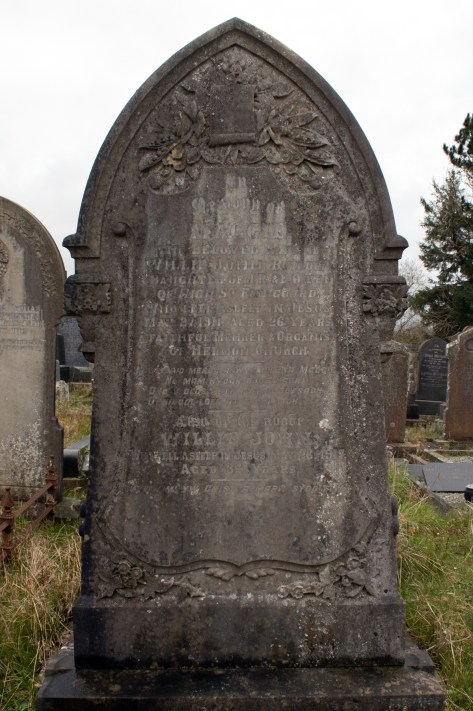
In the Hermon Baptist Burial Ground in Fishguard, Pembrokeshire is a headstone dedicated to Maggie and Willie John. The inscription reads: “In memory of Maggie, the beloved wife of Willie John, builder. Daughter of JR & E Owen of High Street Fishguard, who fell asleep in Jesus May 27, 1911, aged 26 years. A faithful member & organist of Hermon Church… Also of the above Willie John, who fell asleep in Jesus May 26, 1917, age 34 years.”

The early life of Willie – or William – John is a challenge to piece together. He and Maggie – Margaret – married in Hermon Chapel on 30th March 1907, and went on to have a son, Owen, who was born in May 1908.

Willie was employed as a builder and mason, and, after Maggie’s death, sought work wherever he could find it. When war broke out, he was living at 16 Bryn Bedw, Blaengarw, Glamorganshire, although it is unclear whether Owen was with him as well.

Willie’s trade made him an ideal candidate for the Royal Engineers, and he was assigned to the 38th Signal Company when he enlisted on 6th March 1915. Sapper John’s service records show that , he was 5ft 6ins (1.68m) tall, with black hair, dark eyes and a sallow complexion.

Sapper John was sent to Biggleswade, Bedfordshire, for his training, and it was while there that things took a downturn. On 17th September he had a standard inoculation against typhoid, and from there on in felt unwell. Over the following days and weeks he became anaemic and had bouts of giddiness and pains in the back. His medical report notes that he was breathless on waking, and when he walked more than a few hundred yards.

Over the next few months Willie’s condition was monitored, but his condition did not improve. Ultimately he was medically discharged from the army on 10th May 1916, as he was no longer fit enough to serve.

At this point, Willie John’s trail goes cold. He seems to have returned to Pembrokeshire, and it was here, on 26th May 1917, that he passed away. He was reunited with Maggie in the Fishguard burial ground.


Carpenter’s Mate George Land

Carpenter’s Mate George Land

George William Land was born early in 1891, and was the only child to George and Caroline Land. George Sr was a greengrocer from Dagenham, Essex, and the family were living in Ilford when his son was born.

Caroline seems to have died a few months after George Jr’s birth, and, by the time of the 1901 census, he was in the care of her parents. His father was still running the shop, and was supported by George Jr’s aunt.

The 1911 census found George Jr employed as a greengrocer, and it seems likely that he was working alongside his father by this point. He was living with his maternal and uncle, who was also employed in the same line of work.

When war was declared, it seems that George Jr wated to play his part. Full details of his service have been lost to time, but it seems that he joined the Merchant Navy and, by the summer of 1918, he was working as a Carpenter’s Mate on board the SS Mesaba. She was a cargo liner, requisitioned by the Admiralty for transport duties.

On 31st August 1918, the Mesaba left Liverpool, Lancashire, for Philadelphia. The following day, she was torpedoed by the German submarine U-118, and foundered. She sunk off the coast of County Wexford, with the loss of 20 souls, Carpenter’s Mate Land included. George Jr was 27 years of age.

The body of George William Land was laid to rest in St David’s Parish Cemetery, Pembrokeshire. It is unclear whether his body had been brought to Wales with the seventy survivors who had been rescued, or whether it had washed ashore there some time after the sinking.


Stoker 1st Class Edwin John

Stoker 1st Class Edwin John

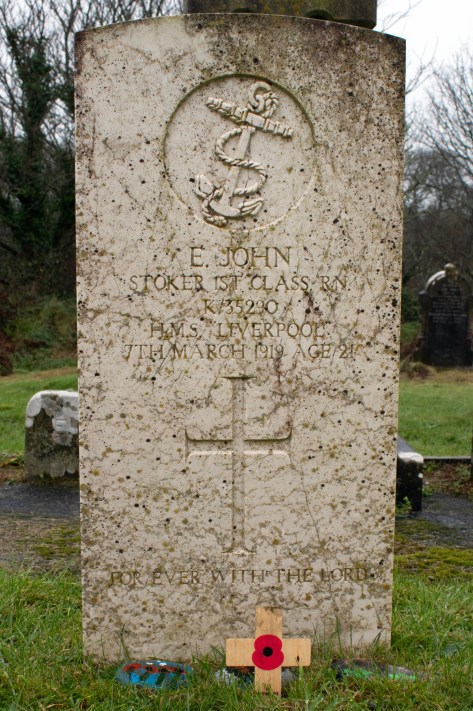
Edwin John was born in St David’s, Pembrokeshire, on 18th February 1898. The youngest of nine children, he was the son of farmer Henry John and his wife, Caroline. Edwin’s mum died when he was just five years old, and Henry was left to raise the family alone.

When he finished his schooling, Edwin found work on the farm. When war broke out, however, he was called upon to play his part and, on 19th July 1916, he enlisted in the Royal Navy. His service papers show that he was 5ft 4ins (1.63m) tall, with dark hair, grey eyes and a dark complexion.

Stoker 2nd Class John was sent to HMS Vivid, the Royal Naval Dockyard in Devonport, Devon, for his training. He remained there for three months, before being given his first assignment, the light cruiser HMS Liverpool. She spent the second half of the conflict patrolling the Mediterranean, and this is where Edwin would serve his time.

Edwin’s time in the navy was uneventful. He was promoted to Stoker 1st Class in March 1917, and, while he was consistently noted as being of very good character, his ability was recorded as being satisfactory.

On 28th April 1918, Stoker 1st Class John returned to shore to be demobbed. Given the war had another seven months to run, it is unclear why he was stood down, although it may have been on medical grounds. At this point his trail goes cold, but it is likely that he returned home.

Edwin’s health was certainly suffering by this point, and, on 7th March 1919 he passed away from bronchitis. He was just 21 years of age.

Edwin John’s body was laid to rest in St David’s Parish Cemetery, Pembrokeshire, not far from where his father and siblings still lived.


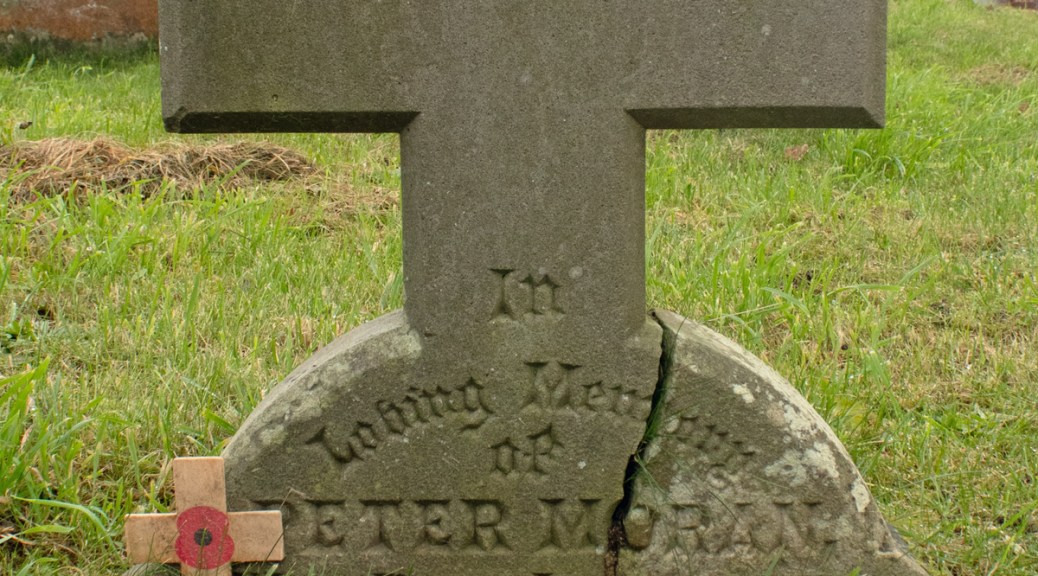
Leading Boatman Peter Moran

Leading Boatman Peter Moran

Peter Moran was born in Kilmeena, County Mayo, Ireland, on 29th January 1876. Details of his early life are hard to track down, but when he finished his schooling, he wound work as a fisherman.

By 19th August 1891, Peter sought to make a more permanent career of the sea. He signed up to the Royal Navy, and was sent to HMS Impregnable, the shore base in Devonport, Devon, for his training. Being just 15 years of age, he was too young to formally enlist, and was given the rank of Boy 2nd Class.

Over the next few years, Peter learnt the tools of his trade. On 2nd July 1892 he was promoted to Boy 1st Class, and the following February he was given his first sea-faring assignment, on board the battleship HMS Neptune. By March 1893 Boy Moran found himself serving on board HMS Daphne, a screw sloop which would become his home for the next three years.

During his time aboard Daphne, Peter came of age, and was given the rank of Ordinary Seaman. His service records show that he was 5ft 4ins (1.63m) tall, with light hair, grey-blue eyes and a fresh complexion. Within eighteen months he had proved his mettle, and was promoted to Able Seaman.

Over the next decade, Peter would serve on eight vessels. By the time the term of his contract came to an end in September 1903, he had been promoted twice – to Leading Seaman, then to Petty Officer 2nd Class.

Peter renewed his contract, but seems to have chosen a new career path. On 2nd October 1903 he moved to HM Coastguard and, as a Boatman, was assigned to Pendeen Cove, Cornwall.

Love blossomed for Peter, and he married a woman called Caroline in the next few years. There is little further information about her, but the couple would go on to have three children – Mary in 1908, Florence in 1911 and Thomas in 1913.

Boatman Moran would spend twelve years with the coastguard, moving to St Ives, Cornwall, in September 1908, and Fishguard, Pembrokeshire, in March 1914. By this point he had been promoted to Leading Boatman, and was set on a new life in Wales. Sadly, the new life was not to be: on 2nd June 1915 he passed away from pneumonia. He was 39 years of age.

The body of Peter Moran was laid to rest in Fishguard Cemetery: a life at sea, and forging homes in three countries at an end.


Fireman Arthur O’Keefe

Fireman Arthur O’Keefe

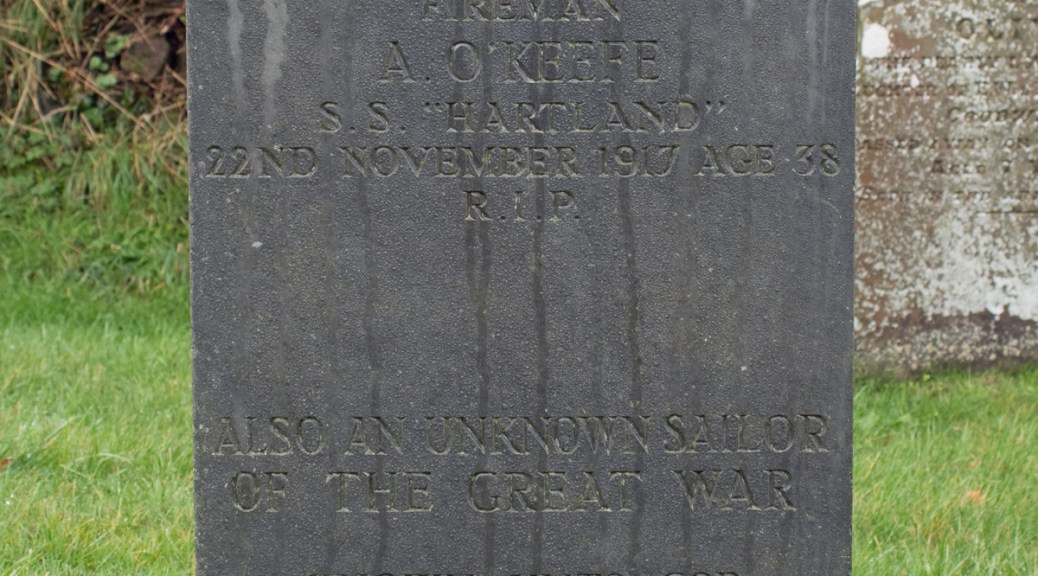
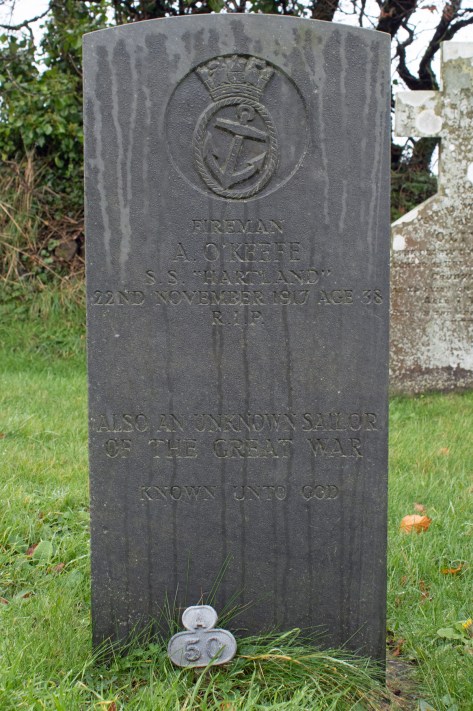
O’KEEFE Fireman Arthur. SS “Hartland.” 22nd Nov., 1917. Age 38. Son of John and Mary O’Keefe of Cork.

The search for information about Arthur O’Keefe has proved a challenging one. He does not appear with his parents on any census records, and there is precious little documentation about his life.

Arthur found work as a Fireman in the Mercantile Marine, and served on board at least four ships. In the autumn of 1917, he was based out of Glasgow, Scotland, and was attached to the SS Hartland. She had been requisitioned by the Admiralty, and was put to use transporting wheat from India.

On 22nd November the Hartland was travelling from Glasgow to Barry, South Wales, when she was hit by a torpedo from the submarine U-97, 21 miles south west of Bardsey Island. The ship was damaged, and two of the crew – Fireman O’Keefe and Fireman Thomas McGaw – were killed.

An American destroyer, the USS Conyngham, was at the head of the Hartland’s convoy, and managed to rescue the remaining 28 members of the crew, taking them to Holyhead. The Hartland was towed to Fishguard Harbour and refloated.

Arthur O’Keefe was 38 years of age when he was killed. He was laid to rest in Llanwnda Cemetery, not far from Fishguard, Pembrokeshire.


Arthur’s headstone notes that he was buried with an unknown sailor of the Great War. There is no indication who this might have been, but there are no records of his colleague Thomas McGaw being laid to rest. Given both men died in the same incident, and their bodies were transported to Fishguard with their ship, it seems possible that they may have been buried together.


Gunner Charles Walters

Gunner Charles Walters

Charles Archibald Walters was born in 1896, and was one of nine children to Arthur and Minnie. Arthur was a painter in the shipyards, and the 1901 census found the family living in a small cottage at 29 Cambrian Terrace in Neyland, Pembrokeshire.

By 1911, Charles had finished his schooling, and had found labouring work on a local farm. He was still living at home, however, and the family has moved to 46 Cambrian Road, overlooking the shipyard where Arthur still worked, and the Westward Pill and Cleddau Ddu rivers beyond.

When war came to Europe, Charles was called upon to play his part. Details of his military service are sketchy, but it is clear that he enlisted in the Royal Garrison Artillery, and was assigned to the Pembrokeshire Territorial Force.

Gunner Walters survived the war, but was suffering from nephritis. He was medically discharged from the army on 12th May 1919, and returned to the family home.

By this point Arthur had moved the family to Goodwick, near Fishguard, by this point, as he had taken up a job in the town as a painter for Great Western Railways.

Charles’ condition would ultimately get the better of him. He passed away on 4th April 1920: he was just 24 years of age.

Charles Archibald Walters was laid to rest in Llanwnda Cemetery, not far from where his family now lived.


The 1921 census found that two of Charles’ brother were also working for Great Western Railways, Frederick as a porter, and William as a boiler sealer in their engineering works (presumably the same place as Arthur).

Minnie died the following year, Arthur passing in 1924. Both were buried with their son, Charles, and they are remembered on his Commonwealth War Grave.


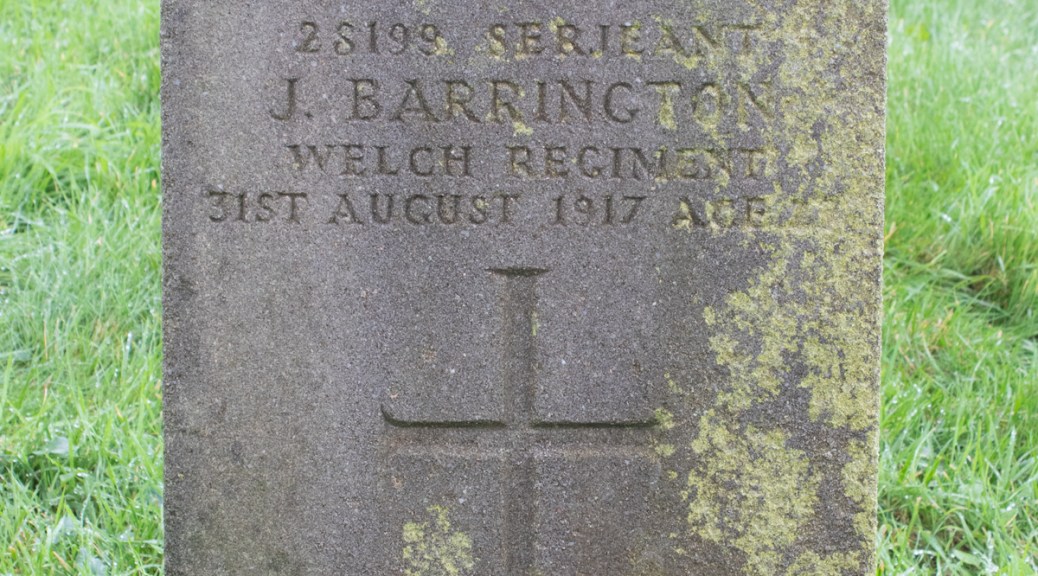
Serjeant James Barrington

Serjeant James Barrington

James Barrington was born in Westminster, Middlesex, on 1st June 1890. One of twelve children, his parents were Alfred and Hetty Barrington. Alfred worked in a soap factory, and the family seemed to move around: the 1891 census found them living in rooms at 3 Charles Buildings, St Martin-in-the Fields, while a decade later there were at 6 Lyric Place in Kennington, Surrey.

With so many mouths to feed, Alfred and Hetty were keen to get their children to work. The 1911 census found James working as a cowman on a farm in Mathry, Pembrokeshire, which must have come as a huge culture shock.

James soon settled in, however, and, on 9th November 1912, he married Elizabeth Thomas, the daughter of a labourer from nearby. The couple had a daughter, Hilda, who was born the following February.

When war broke out, James was called upon to play his part. There is little concrete information about his service, but he was assigned to the Welch Regiment, as was attached to the 18th (Service) Battalion (2nd Glamorgan). He had attained the rank of Sergeant by the summer of 1917.

Sergeant Barrington’s unit fought in some of the key battles of the early stages of the conflict, including the Battle of the Ancre in 1916, and the German retreat to the Hindenburg Line the following spring. It was during fighting on the Western Front that summer, though, that he was wounded, and medically evacuated to Britain for treatment.

James was admitted to a hospital in London, but his wounds would prove too severe: he passed away on 31st August 1917, at the age of 27 years old.

The body of James Barrington was taken back to Wales for burial. He was laid to rest in Mathry Church Cemetery, not far from where his widow still lived.


Private James Morse

Private James Morse

James Harries Morse was born in the autumn of 1895 in Llanwnda, Pembrokeshire. One of eleven children, his parents were agricultural labourer William Morse and his wife, Ann.

James’ schooling was completed early, and he was soon found work to keep him occupied. The 1911 census recorded him as being a cattle boy for the James family, living in on a farm not far from his family home.

When war broke out, James was keen to play his part. Details of his military service have been lost to time, but it is clear that he enlisted as a Private in the Welch Regiment, and was assigned to the 3rd (Reserve) Battalion. It’s not possible to identify where or for how long he served, and the only other documents available relate to his passing.

James Harries Morse died of disease on 12th February 1917: he was just 21 years of age. His body was taken back to Pembrokeshire for burial, and he was laid to rest in the family plot in Pencaer (Harmony) Baptist Burial Ground, not far from his parents’ home.


Private Arthur Charles

Private Arthur Charles

Arthur William Charles was born in Llanrhian, Pembrokeshire, in the summer of 1896. The middle of eleven children, his parents were Joseph and Phoebe Charles.

The 1901 census recorded Joseph as being a butcher and innkeeper in the village, but by the time of the next poll, the family were split. Joseph and Phoebe were now noted as being farmers, living with five of their children plus two servants at Henllys Farm. Arthur, meanwhile, was living with two of his sisters on his brother Thomas’ farm in Mathry. At 14 years of age, he was noted as being a farmer’s son, working on a farm.

When war broke out, Arthur was called upon to play his part. His service papers are long since lost, but he had enlisted in the Welch Regiment by the spring of 1916. Assigned to the 20th (3rd Rhondda) (Reserve) Battalion, he was sent to Bangor, Gwynedd, for training.

Tragically, however, Private Charles’ time there was not to be a lengthy one. He contracted cerebrospinal meningitis, and passed away on 6th August 1916: he was 20 years of age.

The body of Arthur William Charles was taken back to Pembrokeshire for burial. He was laid to rest in the Mathry Congregational Churchyard in Rehoboth.


Private Arthur Charles
(from ancestry.co.uk)