Herbert Henry Cleal was born on 6th November 1899, in the Somerset village of Hambridge. The tenth of twelve children, his parents were Daniel and Emily Cleal.
Daniel was a cowman on a farm, and it is likely that Herbert would have started in agricultural labouring, had war not intervened.
Full details of Herbert’s military service are not available, although it is clear that he had enlisted in the Worcestershire Regiment by the summer of 1918. By this point in the war, Private Cleal’s battalion – the 2nd/8th Battalion – was already in France, although, according to his records, it does not appear as if he saw any service overseas himself.
The only other record for Herbert is his entry in the Army Register of Soldiers’ Effects. This confirms that he passed away at Bradford War Hospital on 1st January 1919. The cause of his passing is not noted, but he had just turned 19 years of age.
Herbert Henry Cleal was brought back to Somerset for burial. He was laid to rest in the graveyard of St James-the-Less Church in his home village of Hambridge.
Anthony Eames was born on 29th October 1876 in the village of Newhall, Derbyshire. He was one of four children to James and Mary Eames, although Mary passed away in 1880, not long after Anthony’s younger brother was born. James remarried, and he and his new wife (and possibly his late wife’s sister), Theresa Barlow went on to have twelve children of their own.
James was a coal miner, and while Anthony initially followed in his father’s footsteps, he sought bigger and better things. In September 1896, just short of his twentieth birthday, he joined the Royal Navy as a Stoker 2nd Class. His service records show that he was 5ft 3.5ins (1.61m) tall, had brown hair, grey eyes and a fresh complexion. The document also noted that he had tattoos on both of his arms.
Stoker Eames’ initial posting was at HMS Victory, the Royal Naval Dockyard in Portsmouth, Hampshire. He spend a year there, honing his skill, before being assigned to HMS Powerful in September 1897. Three months later, he was transferred to the cruiser HMS Alacrity and, over the remainder of his twelve years’ service, he worked on eight further vessels, rising to the rank of Stoker 1st Class in the process.
It was during this time that Anthony met and married Frances Pelley, a young woman from Portsmouth. The couple went on to have three children and, when Stoker Eames was stood down from active service at the end of his contract in 1908, the family moved to Sheffield. Anthony found employment in the mines again and the family settled in to a small terraced house in the then village of Darnall.
The sea continued to call to Anthony, though, and, on 8th March 1912, he re-enlisted. For the next couple of years he was based at HMS Victory, but when war broke out he was transferred to the battleship HMS Bulwark.
Stoker Eames was on board Bulwark when, on the morning of 26th November 1914, an explosion ripped through the ship, tearing it apart and sinking it. In all 741 souls were lost, Anthony amongst them. He was 38 years of age.
The majority of those who died in the explosion aboard HMS Bulwark were buried in a mass grave in Woodland Cemetery, Gillingham, Kent. Anthony Eames’s body, however, had been identified, and so he was laid to rest in a marked grave in the cemetery.
James Roberts was born in 1885 in Llangollen, Denbighshire. The youngest of three children, he was the son of Elias and Winifred Roberts. Elias was a builder’s labourer and, while James initially went into this line of work when he left school, by the time of the 1911 census, he was listed as being employed as a gamekeeper.
War broke out across Europe, and James was there to play his part for King and Country. Full details of his military service are not available, but he enlisted in the Royal Field Artillery, and was assigned to C Battery of the 161st Brigade. This was a Howitzer unit, and, as a Driver, James would have been involved in leading the horses pulling the cannons to where they needed to be.
There is no actual confirmation that James served overseas. He was, however, awarded the Victory and British Medals for his service. Driver Roberts survived the war, but again, details of what actually happened to him are lost to time.
What can be confirmed is that, by 1919, James had been admitted to the Wharncliffe War Hospital in Sheffield, and this is where, on 27th November that year, he passed away. He was just 34 years of age.
James Roberts was brought back to Llangollen for burial. He was laid to rest in the town’s Fron Cemetery.
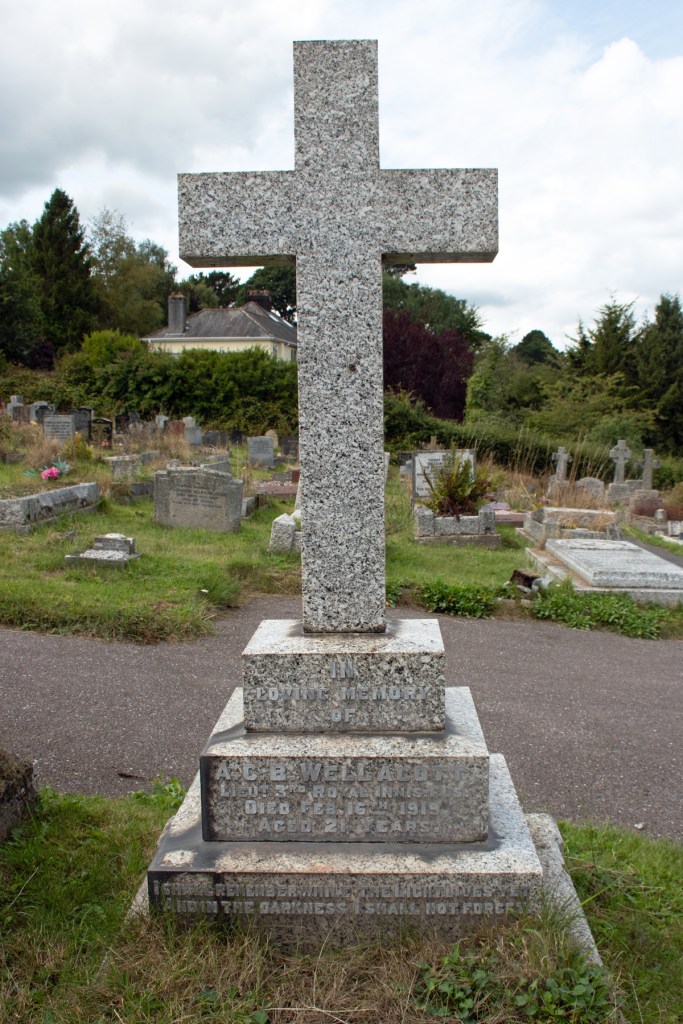
Arthur Cecil Baber Wellacott was born the summer of 1897, in the village of Bradworthy, North Devon. Ond of seven children, his parents were William and Ada Wellacott. William was the parish vicar and with his status came additional support for the family.
The 1901 census saw the vicarage employ three members of staff, and William was hosting two students as well as his and Ada’s own children. Ten years later, with Arthur and his younger brother William, boarding at a school in Bude, Cornwall, the Wellacott retinue remained in place.
On leaving boarding school, Arthur studied at Kelly College in Tavistock and, at around the same time his father took up a new post in Totnes. When Arthur left the college, he joined the 7th (Cyclist) Battalion of the Devonshire Regiment. He was subsequently given a commission in th 3rd Battalion of the Royal Inniskilling Fusiliers, and was based in Londonderry.
At Easter 1916, Lieutenant Wellacott took part in quelling the rebellion in Dublin, and was subsequently sent to France. In the battle for Contalmaison his platoon was gassed and buried, and Arthur was badly injured. Suffering from shell shock, the experience had a lasting impact on him “and from that time his health had given cause for anxiety…” [Western Morning News: Tuesday 18th February 1919]
Lieutenant Wellacott returned to England and he was billeted near Leeds. During the winter of 1918/1919, he contracted pneumonia, and was admitted to the Drax Hospital. Sadly, the condition was to prove too much for his already damaged lungs and he died on 16th February 1919. He was just 21 years of age.
Arthur Cecil Baber Wellacott was brought back to Devon for burial. He was laid to rest in the cemetery in Totnes, Devon.
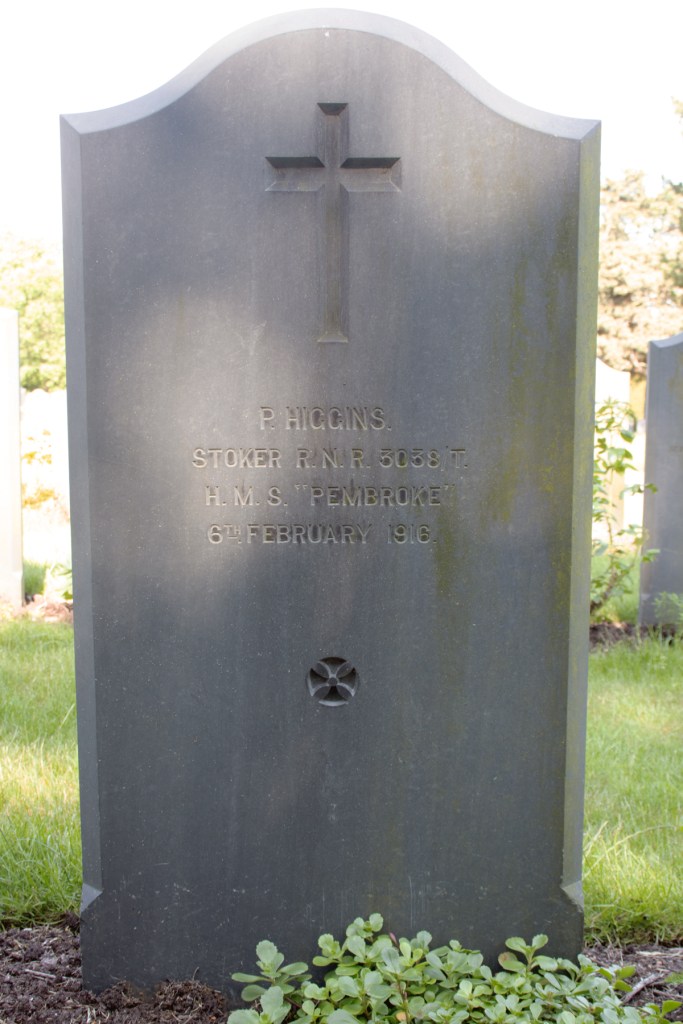
Peter Higgins was born in Thornaby, North Yorkshire, on 23rd January 1887. His parents were William and Catherine (Kate) Higgins, but of them there is very little information.
What seems likely that Peter would have had some experience with boats as, on 26th May 1909, he enlisted in the Royal Naval Reserve. His service records show that he was 5ft 7ins (1.70m) tall and was described as having blue eyes and a pale complexion. He was also noted as having a scar over his left eye and another on his left thigh.
When war broke out, Peter was officially called for duty and, over the next couple of years, he served as a Stoker on the battleship HMS St Vincent. The ship patrolled the North Sea, and would later be involved in the Battle of Jutland.
Stoker Higgins, however, was back on dry land by that point, having been assigned to HMS Pembroke, the Royal Naval Dockyard in Chatham, Kent. Peter had fallen ill with a gastric ulcer, and tragically, this was to prove fatal. He passed away on 16th February 1916, at the age of just 29 years old.
Peter Higgins was laid to rest in the naval section of Woodlands Cemetery in Gillingham, Kent, not far from the dockyard that was to prove his last posting.
Colin Lewis Clarke was born in the spring of 1879 in Cardiff, South Wales. He was one of seven children to Bernard and Elizabeth Clarke. Bernard was a carpenter, but after Elizabeth died in 1886, he took over the running of the Windsor Hotel in Penarth.
When he left school, Colin found work as a clerk. Bernard also died in 1908, and the 1911 census records Colin and his brother Thomas living with his sister, Beatrice. They were sharing the house with Beatrice’s second husband, Charles, and her six children from her first marriage in the Cheshire village of Poulton.
Colin’s trail goes tantalisingly cold at this point. When war broke out, he enlisted to play his part, joining the 16th (Transport Workers) Battalion of the York and Lancaster Regiment by the summer of 1916. This troop was a territorial force, and Private – and then Lance Corporal – Clarke was based in the Yorkshire Dales.
At some point during the autumn Colin fell ill, and was admitted to the Military Hospital in Middlesbrough. His condition is unclear, but he was to succumb to it, passing away on 5th November 1916, the age of 37 years old.
Colin Lewis Clarke’s body was brought back to Wales for burial. He was laid to rest in the graveyard of St Augustine’s Church in Penarth, Glamorganshire.
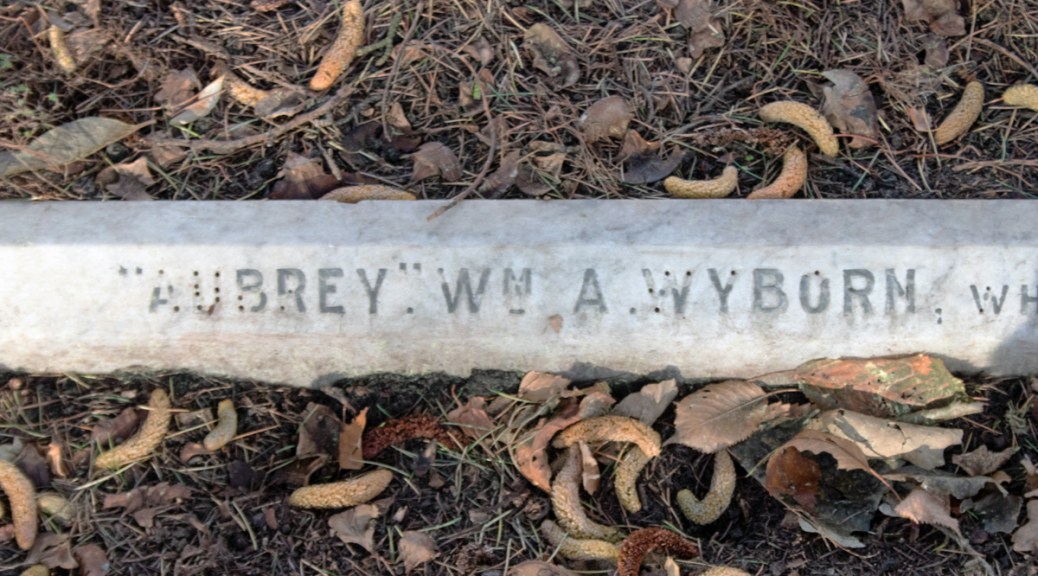
William Aubrey Wyborn was born on 15th November 1897, the middle of three children to farmer-cum-greengrocer-cum-butcher Henry Wyborn and his wife, Esther. The family lived in the Kent village of Tilmanstone, not far from Deal, but soon moved to Faversham in the north of the county.
William proved to be an astute student. After being a pupil at Faversham District Schools, he gained a scholarship to the towns Grammar School. He spent six years there, and proved to be a studious pupil, gaining a prize for maths. He was then granted a scholarship to the Sheffield School of Engineering, and, while studying for his degree there, war broke out.
William joined the West Lancashire Royal Field Artillery in June 1916 and was sent to Aldershot for training. sadly, Gunner Wyborn’s career was to be cut short – while training, he contracted diphtheria and pneumonia, passing away from a combination of the illnesses on 3rd November 1916. He was just short of his 19th birthday.
William Aubrey Wyborn was brought back to Kent for burial. He lies at rest in the family plot in the Faversham Borough Cemetery.
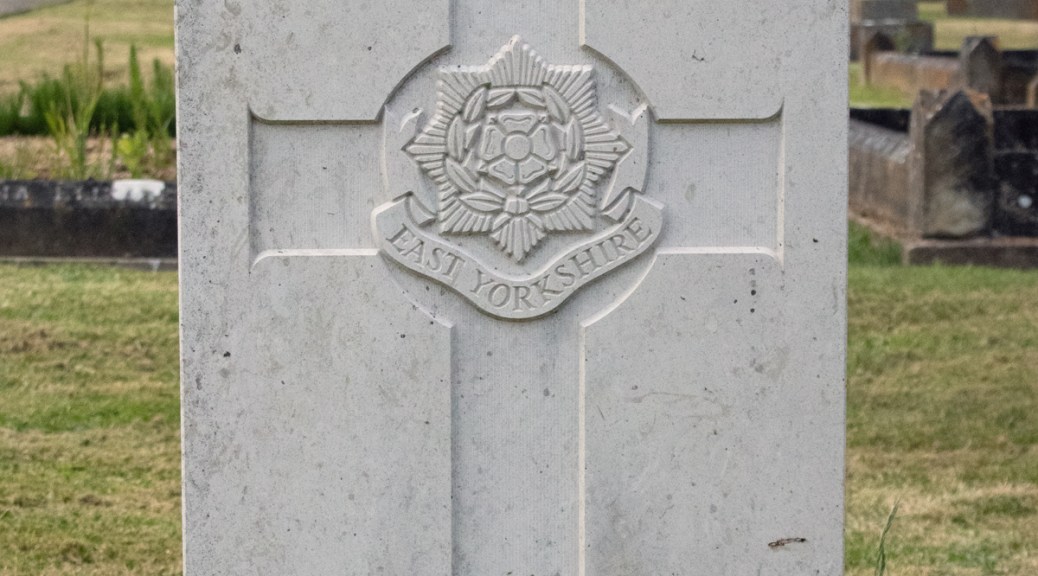
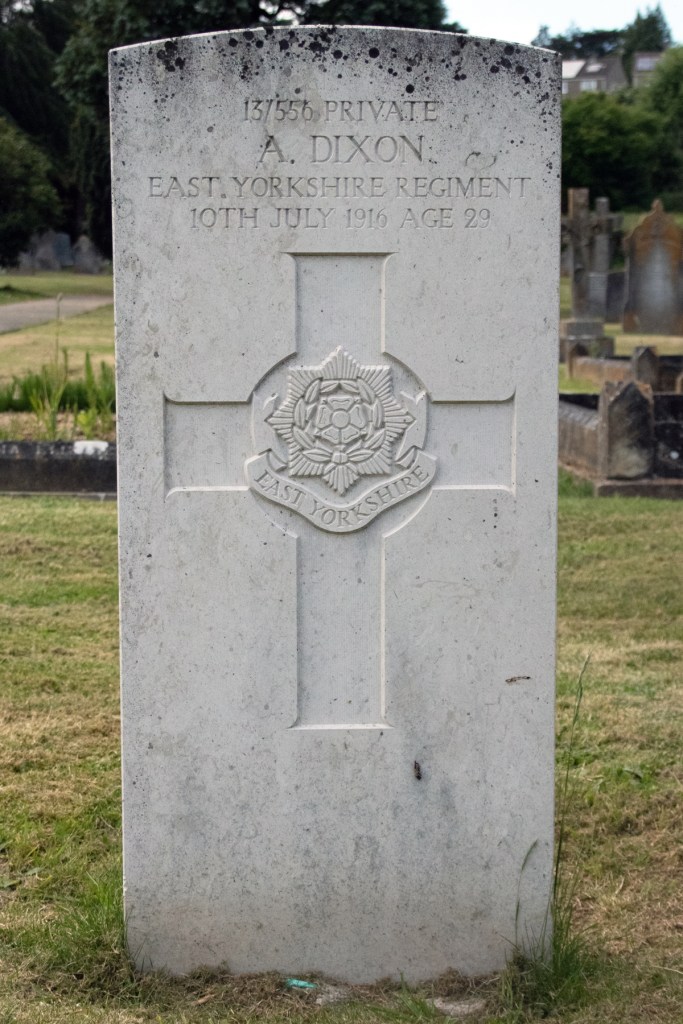
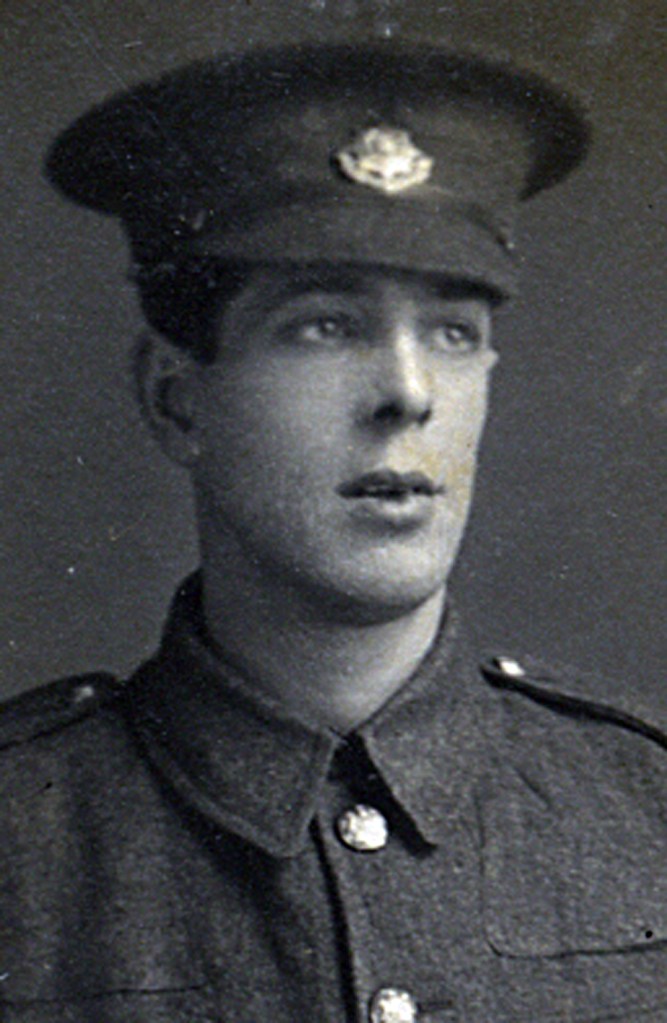
Alonsa Dixon was born in Kingston-upon-Hull, Yorkshire, in 1887, the oldest of seven children to Alonsa and Caroline Dixon. Alonsa Sr was a billiard marker, who raised his family in a small house near the city centre.
Alonsa Jr found work as an errand boy for a grocer when he left school, but went on to find work as a jobbing gardener. By the time of the 1911 census, he had moved out of home, and was boarding with cab driver George Gill and his family.
In April 1912, he married Edith Alice Gill. Trixie, as she was also known, was George’s daughter, and it seems likely that romance blossomed after Alonsa moved in. The couple went on to have a son, also called Alonsa, who was born the following year.
War was coming to Europe, and Alonsa was in one of the first waves of men to volunteer for King and Country. He enlisted in the East Yorkshire Regiment, and was assigned to the 13th Battalion. His service records show that he was 5ft 7.5ins (1.71m) tall, and weighed 144lbs (65.3kg). He was noted as being of good physical development.
Initially serving on home soil, Private Dixon was eventually dispatched overseas, arriving in Egypt in December 1915. Having spent just under three months in North Africa, he was moved to France in March the following year.
Alonsa had some health issues by this point, and was suffering from Bright’s Disease, or nephritis (inflammation of the kidneys). He was treated in a field hospital in Abbeville, but subsequently medically evacuated back to England for further care.
Private Dixon was admitted to the Monastery Hospital in Wincanton, Somerset in April 1916, but his condition proved too severe, and he passed away on 10th July 1916. He was just 29 years of age.
Alonsa Dixon was laid to rest in the cemetery of the town in which he passed away, Wincanton.
Michael Brown was born on 25th October 1891 in Kirkdale, Lancashire, one of four children to James and Julia Brown. James was a sailor who died when Michael was just a boy. While Julia tried to make ends meet by taking in washing, it must have worried her when her son then fell into a sea-going life when he left school.
Michael enlisted in the Royal Navy on 19th February 1910, by which time he was already a seaman in the merchant fleet. His service records show that he was 5ft 4.5ins (1.64m) tall, had bark brown hair, brown eyes and a dark complexion. He also had a number of tattoos on his forearms, including a shamrock and a cross.
Recruited as a Stoker 2nd Class, Michael served on a number of vessels in the lead up to the outbreak of war, including the scout ship HMS Patrol, which served from Harwich Harbour, Essex. It was here that he gained promotion to Stoker 1st Class in February 1911.
When not at sea, Stoker Brown was based at HMS Pembroke, the Royal Naval Dockyard in Chatham, Kent. When war broke out in 1914, however, he was in the middle of a three-year stint on board HMS St George, a cruiser that went on to guard the Humber Estuary on the east coast of Yorkshire and Lincolnshire.
By the spring of 1916, he was back in Chatham and from this point on, remained firmly on dry land, with assignments in Kent and at HMS Victory, the Royal Naval Dockyard in Portsmouth, Hampshire. By the summer of 1917, though, Stoker Brown returned to HMS Pembroke once again.
The naval base was particularly busy and cramped at that point in the war, and temporary overflow accommodation was set up in the barracks’ Drill Hall. This is where Michael came to be billeted.
On the night of the 3rd September, the German Air Force conducted the first night time raid on England. Chatham came in the firing line, and the Drill Hall received a direct hit. Stoker 1st Class Brown was among those to be killed. He was just 24 years of age.
Michael Brown was laid to rest in the Woodlands Cemetery in nearby Gillingham, along with the other victims of the Chatham Air Raid.
Wilfred Alson Follett was born in the spring of 1898, and was the second of eight children to Robert and Ellen (known as Nellie) Follett. Robert was a scavenger (or street cleaner) for Chard council, and it was in this Somerset town where his and Nellie’s young family were raised.
Lace making was the predominant industry in the area, and it was for local employer Boden & Co.’s Old Town Mills that Wilfred worked when he finished school. The 1911 census recorded him as being a threading boy in the factory.
War was coming to Europe, however, and Wilfred was keen to play a part. Sadly, full details of his military service are lost to time, but he had enlisted by the spring of 1917, initially joining the Somerset Light Infantry. He soon transferred across to the Welch Regiment, however, and was assigned to the 10th (Service) Battalion.
Private Follett was sent to the Western Front at the start of July 1917, and was soon caught up in the thick of the action at Ypres. He came through the Battle of Pilkem, but was injured at the fighting in Langemark. His wounds were severe enough for him to be evacuated to England for treatment, and he was admitted to a hospital in Bradford, Yorkshire.
Robert was sent for, but sadly did not arrive in time to see Wilfred before he passed away from his injuries. He died on 20th August 1917, at the tender age of just 19 years old.
Wilfred Alson Follett was brought back to his home town for burial. He was laid to rest in Chard Cemetery.









 Death and Service