Henry Edward Rowell was born on 22nd May 1898 in Southwark, Surrey. One of five siblings, of whom only three survived childhood, his parents were Henry and Jane Rowell. Henry Sr was a bricklayer’s labourer from Southwark, and the family were brought up in a small terraced house on Brandon Street, Walworth.
When he finished his schooling, Henry Jr found work as a turner’s improver but, when war came to Europe, he was called upon to play his part. He enlisted on 29th May 1915, and, as a Private, was attached to the 12th (Service) Battalion (Bermondsey) of the East Surrey Regiment. His service records tell a little of the man he was, confirming that he stood 5ft 3.5ins (1.61m) tall, and suggesting that he gave his age a 19 years old (he was just 16 at the time).
Henry seemed to have made an impression on his superiors as, in early October, he was promoted to Lance Corporal. His early service was based on home soil, primarily in Witney, Surrey.
In December 1915, Henry was temporarily released from military duty for munitions work. Sent to work for the engineering company Peter Hooker Ltd, in Walthamstow, Essex, Lance Corporal Rowell was to remain here for the next four months. On 25th March 1916, however, he was called back to service, as his battalion readied itself to move from its base, by that point in Aldershot, Hampshire, to Northern France.
Lance Corporal Rowell found himself in the thick of things very quickly. From 1st July, the 12th Battalion was caught up in the Battle of the Somme, and he remained entrenched there for the next couple of months.
On 15th September 1916, the British launched an attack on the German front line at Flers-Courcelette, mid-way between Albert and Bapaume. Lance Corporal Rowell was involved in the battle, which lasted until the end of the month, and was cut down on the very first day. He was just 18 years of age.
Henry Edward Rowell was laid to rest in the Bulls Road Cemetery in Flers, Picardie.
Henry Edward Rowell was my paternal grandmother’s first cousin.
Herbert Francis Wear was born in the summer of 1895, one of twelve children to Charles and Harriet Wear. Charles was a farmer from Congresbury, and when he died in 1907, aged just 51 years old, it fell to Harriet and her children to keep the farm running.
At this point, however, much of Herbert’s trail goes cold, and it is a challenge to piece together anything concrete. When war broke out, he stepped up to play his part, enlisting in January 1917. He was assigned to the Military Police Corps and initially served in the Military Foot Police.
However, at some point during the conflict, Corporal Wear transferred to the Labour Corps, where he was attached to the 449th Agricultural Company. This meant he remained relatively close to home, as he was based in the Taunton area of Somerset.
The next record for Herbert is the British Army Register of Soldiers’ Effects, which confirms that he passed away in Somerset. An entry in the Bristol Times and Mirror (Wednesday 4th December 1918) states that “The funeral of the late Lance-Corporal HF Wear, Stonewell Farm, Congresbury, will take place to-day… 2:30pm.”
Herbert’s death certificate confirmed that he died at home from a combination of influenza and pneumonia. He was 23 years of age when he breathed his last.
Herbert Francis Wear was laid to rest close to his father in the graveyard of St Andrew’s Church in Congresbury.
Frederick Reginald Channing was born in the autumn of 1869, in Bath, Somerset. He was one of five children to carpenter Allen Channing and his dressmaker wife, Sarah. When Frederick was just a toddler, Allen moved the family south to Chard, and this is where his younger siblings were born.
When Frederick left school, he found work as a lace machine operator and, in fact, all of Allen’s children found work with their hands: Frederick worked alongside one of his brothers, while his two other brothers built on their father’s woodworking skills, one as a coachbuilder, another as a cabinet maker.
By the autumn of 1905, Frederick had moved back to Bath. This is where he met Elizabeth Scammell, a farm labourer’s daughter from Wiltshire. The 1901 census appears to record her as being a servant to a surgeon’s family in Wincanton, and this may have prompted a further move to the larger city where the couple met.
The couple married in Bath towards the end of 1905, and had a son, Frederick Jr, who was born in November the following year. Frederick Sr was doing general labouring work by this point, and the family had moved to Wedmore by the time a second boy, William, was born in 1910. Frederick and Elizabeth had a daughter, Eva, in 1911, and another, Gwendoline, in 1913, tragically, the same year that Eva died.
When war came to Europe, Frederick stepped up to play his part. He enlisted in September 1914, joining the Somerset Light Infantry as a Private. His service records confirm that he was 5ft 6ins (1.67m) tall, and weighed 154lbs (69.9kg). The document also gives his age as 35, although he was actually ten years older than that by this point.
Private Channing spent a year on home soil, during which time Elizabeth gave birth to their fifth child, Percival, who was born in May 1915. Based at a camp in Aylesbury, Buckinghamshire, he was hospitalised twice in this time, suffering from a contusion of his left shoulder.
By September 1915, Frederick was in France, and he remained on the Western Front, apart from when on leave, for the next three-and-a-half years. At some point during this time, he was promoted to the rank of Lance Corporal, and transferred across to the Royal Engineers.
Back at home, Elizabeth was doing her best to raise the family. She didn’t always do the right thing, though, and this resulted in her being taken to court.
Elizabeth Mary Rose Channing, 30… was indicted for having been delivered of a certain female child, did unlawfully by a secret disposition of the deceased child, endeavour to conceal the birth thereof at Wedmore the same day in the month of September 1916.
Mr Wethered prosecuted, and said that the prisoner was a married woman. Her husband was a soldier now on active service. He was last home on leave in April or May, 1917. Previously to that he had not been home for 18 months or two years, so the child could not have been his. Some boys found a parcel in the well, and they discovered the body of the child. The boys communicated with the police, who searched the well and found some pieces of carpet which agreed with a similar carpet in the possession of the prisoner. When arrested she confessed to the crime.
Frederick Channing, husband of the prisoner, said he was home on leave five months ago – May 27th. He went back on June 4th. Previously he had not been home for twenty months. He pleaded for the prisoner in the interests of their four children. He was very sorry for her to think she had thrown herself away like that.
His Lordship, addressing the prisoner, said that while her husband was away doing his duty for her any everybody, she was not faithful to him, and the result was the birth of the child which had been concealed and not revealed till a year afterwards. His Lordship understood that prisoner was already legitimately in a certain condition, and he did not wish her child to be born in prison. She would be sent to prison therefore for three months.
Wells Journal: Friday 26th October 1917
Elizabeth was released in February 1918, and the couple’s last child, Kathleen, was born the following month.
Frederick, meanwhile, returned to the Western Front. He remained in France through to the end of the conflict and beyond, only returning to Britain in February 1919, having fallen ill. Admitted to the North Evington War Hospital in Leicester with influenza, he remained there for two months.
In April 1919, Lance Corporal Channing was transferred to the Bath War Hospital, back in Somerset. This was presumably so that he could be closer to his family, although there is no evidence of whether he was fully reconciled with Elizabeth. His condition did not improve, however, and by this point he was also suffering from myalgia.
Frederick remained in hospital for eighteen months. As time passed, carcinoma of the liver was identified, and this, eventually, was the condition that would take his life. Lance Corporal Canning passed away on 5th September 1920. He was 49 years of age.
Sarah and the children were still living in Wedmore, by this point. Frederick Reginald Channing’s last journey was not to be that far, however. He was moved only a short distance from the hospital, and was laid to rest in the sweeping grounds of the Locksbrook Cemetery in Bath.
Andrew Michael Fox was born on 25th May 1871, the oldest of six children, to Michael and Eliza Fox. Michael was a Private in the 40th Regiment of Foot, and was based in Curragh Camp, Kildare, Ireland, when Andrew was born.
The family travelled where Michael’s work took him: Andrew’s oldest siblings were born in Uttar Pradesh, India, and the family were in England by the time of the 1881 census.
Given Michael’s military connections, it is no surprise that Andrew followed him into the army. He enlisted in August 1884, joining the South Lancashire Regiment. His service records give his age as 14 – he was, in fact, just 13 years old – and note his height as 4ft 9ins (1.44cm) and his weight as 73lbs (32.7kg). Andrew was recorded as having hazel eyes, brown hair and a fair complexion: his religion was also confirmed as Roman Catholic.
Andrew’s service records have become damaged over time, and a lot of his details are illegible. Because of his age when he enlisted, he was initially given the rank of Boy. In July 1887, he was formally mobilised, with the rank of Private. He remained on home soil for the next ten years, with the 1891 census listing him as being barracked in Fort Regent, Jersey.
It was in the Channel Islands that Andrew met Kathleen Dooling. The couple married on 7th January 1892, and went on to have ten children. Over the next couple of years, Andrew progressed through the ranks, achieving Lance Corporal in September 1892, Corporal in June 1894 and Lance Serjeant in August 1897.
In 1899, the Second Boer War led to the newly-promoted Serjeant Fox being posted overseas. He remained in South Africa for six months, while the conflict raged on. Andrew returned to Britain in April 1900, and was officially stood down from the army on 31st December that year, as he was deemed no longer fit for military service.
The 1901 census found Andrew and Kathleen still living in family barracks in Aldershot with their three eldest children, Andrew Margaret and Edith. Andrew was recorded as being an officer’s valet, likely now in a civilian role. The family remained in Aldershot until 1910, with five more of their children being born there.
Another change came at that point, however, as the following year’s census found the family living in Brighton Street, Warrington, Lancashire. Andrew was, by this point, working as a salesman for the Singer Sewing Machine Company, and the family were cramped into a four-roomed end-of-terrace house.
War came to Europe in the summer of 1914, and Andrew stepped up to play his part once more. Again, full details have been lost to time, but he took up the rank of Serjeant once more, and was attached to the Somerset Light Infantry. This necessitated another relocation for the family, and they moved to Cannington, near Taunton, Somerset.
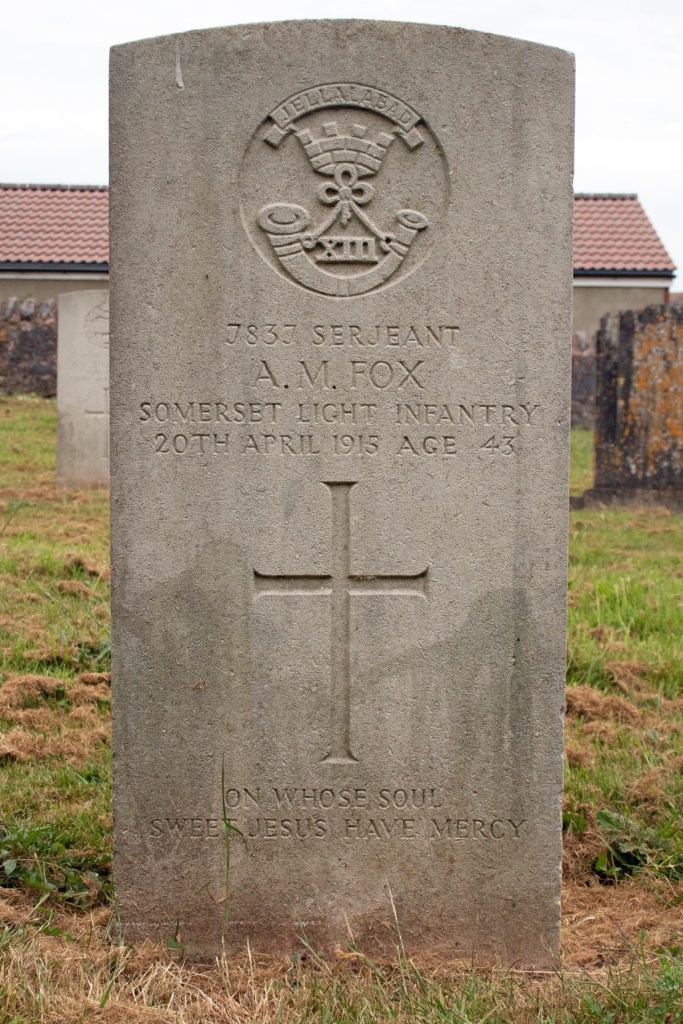
Serjeant Fox was assigned to the 7th (Service) Battalion, but was not to remain in his role for long. He contracted phthisis, or tuberculosis, and passed away from the condition on 20th April 1915, just weeks before his regiment departed for the Western Front. He was 43 years of age.
Andrew Michael Fox was laid to rest in the peaceful Cannington Cemetery, not far from the family home.
Private Andrew M Fox
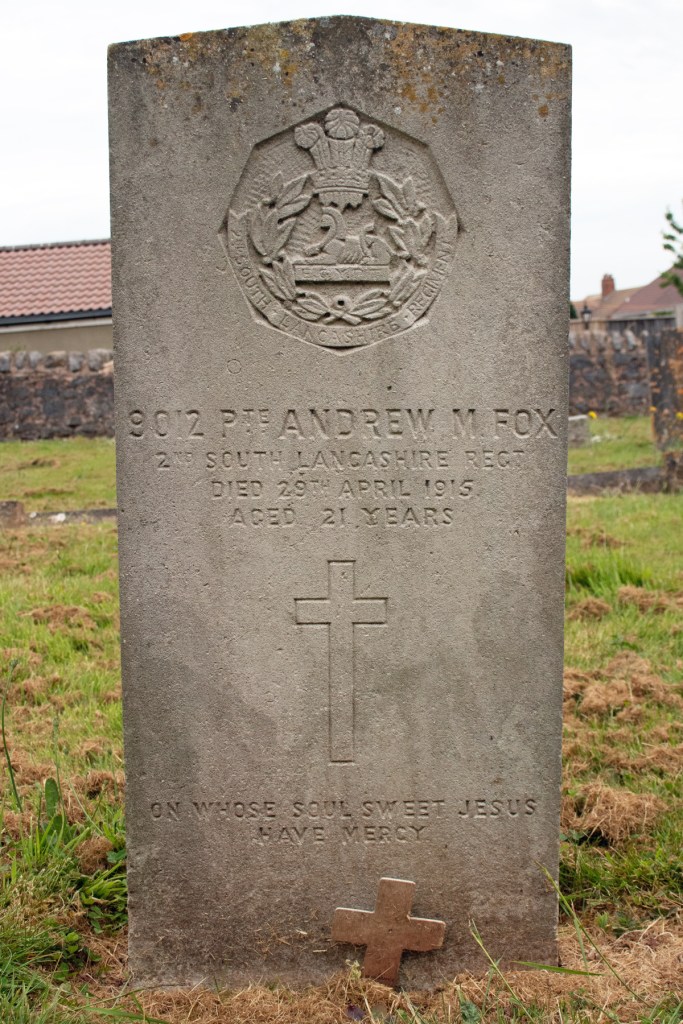
In the plot next to Serjeant Andrew Fox is another, similar headstone. Not quite having the same form as the Commonwealth War Grave Commission headstone that Serjeant Fox has, this is dedicated to a Private Andrew M Fox, of the 2nd South Lancashire Regiment.
Andrew Moyse Fox was the eldest son of Andrew and Kathleen. Born on 31st March 1894 in Ireland, he wanted to follow his father and grandfather into the army.
Andrew Jr enlisted in the South Lancashire Regiment in August 1908. His service records confirmed that he was just 14 years of age, standing 5ft (1.52m) tall, and weighing 5st 2lbs (32.7kg). He was noted as having dark brown hair, hazel eyes and a fresh complexion, and that he has a scar on his right buttock.
As is the case with his father, there is limited information about Andrew Jr’s army career. He spent just under six years serving with the regiment, and was formally mobilised when he came of age in 1912. On 27th March 1914, however, Private Fox was discharged from the army on medical grounds, for reasons unclear. The next record available for him is that of his passing, just nine days after his father. He was 21 years of age.
Andrew Fox Jr was laid to rest next to his father in Cannington Cemetery. The heartbreak for Kathleen, to have lost husband and oldest boy within two weeks, must have been indescribable. While her son’s headstone is similar in design to her husband’s, he was not subsequently entitled to an official Commonwealth War Grave, as he had left the army before the outbreak of war: the Commission’s qualification dates (4th August 1914 to 31st August 1921).
Ernest Harry Bennett was born in the summer of 1890, he third of ten children to Harry and Caroline – or Carrie – Bennett. Harry was a journeyman mason from the Devon village of Chagford, and this is where the Bennett family were raised.
When he finished his education, Ernest found work as a general labourer, and it this work that likely took him across the border to Somerset. He found work as a platelayer for the Great Western Railway in Taunton, and settled in Rowbarton, to the north west of the town.
On 28th September 1912, Ernest married Gertrude Alice Bennett in her local parish church, St George’s in Ruishton. A few months later, the couple had a son, Frederick, and almost exactly two years later, a daughter, Gladys, was born.
By this point, war was raging across Europe, and in July 1915, Ernest received the notice to enlist. Assigned to the Royal Engineers, he was attached to the 53rd Railway Company, probably to make use of his civilian trade. By the end of 1915, Ernest found himself in Egypt, and remained there for the rest of the war.
In July 1918, the now Lance Corporal Bennett was posted to the Railway Operating Division, but continued his service in North Africa. On 8th March 1919, he sailed from Port Said, heading back to Britain to be demobbed.
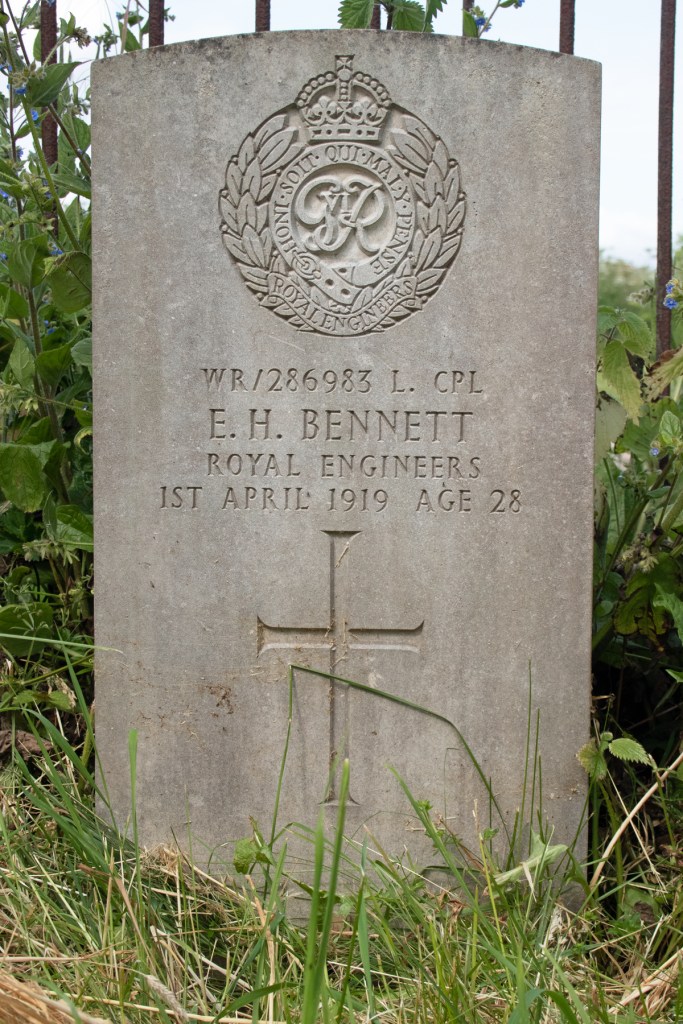
Returning to Somerset, Ernest fell ill, contracting pneumonia, probably on the journey home. He was admitted to the Taunton Military Hospital, but passed away from the condition just ten days after reaching England’s shores, on 1st April 1919. He was just 28 years of age.
The body of Ernest Harry Bennett was laid to rest in the graveyard extension to St George’s Church in Ruishton, not far from where his widow and children lived.
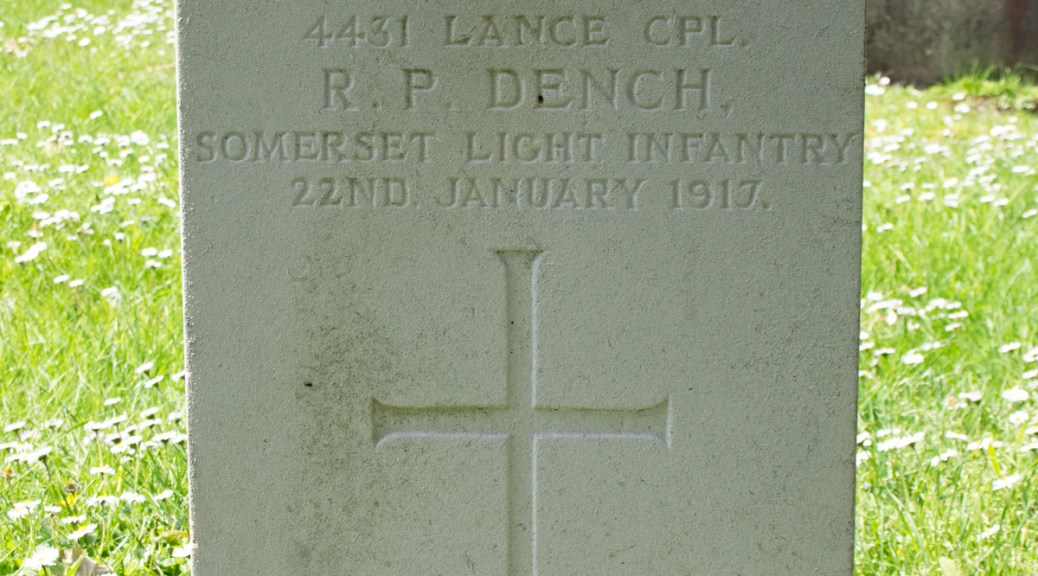
Reginald Percy Dench was born in the spring of 1884 in Twerton, Somerset. He was one of seven children to Henry and Jane – known as Lily – Dench. Henry was a shoe maker turned cloth dyer, but Reginald found work as a stone mason when he finished his schooling.
War came to Europe in 1914, and Reginald stepped up to play his part. His full service details are no longer available, but from what remains it is clear that he had enlisted in the Somerset Light Infantry by the summer of 1916. He was attached to the 5th Battalion, which spent of the conflict in India and Egypt, but there is nothing to confirm that Private Dench served overseas.
Reginald earned a promotion during his military career, and, by the end of 1916 was a Lance Corporal. By this point, however, he had fallen ill, contracting pleurisy. He was, by this point, back in Somerset, and it is likely that he was admitted to the Bath War Hospital. The condition was to get the better of him, and he passed away on 22nd January 1917. He was 32 years of age.
Reginald Percy Dench was laid to rest in Twerton Cemetery, a short walk from the family home in Mill Lane, and close to his two brothers, Edmund and Edward, who had died some twenty years before, while still children.
Tragedy was to strike again for the Dench family when, just six weeks after Reginald’s passing, Henry also died. He was laid in the same cemetery, not far from his sons. When Lily passed away in 1924, she was also buried in Twerton Cemetery, reunited with her family once more.
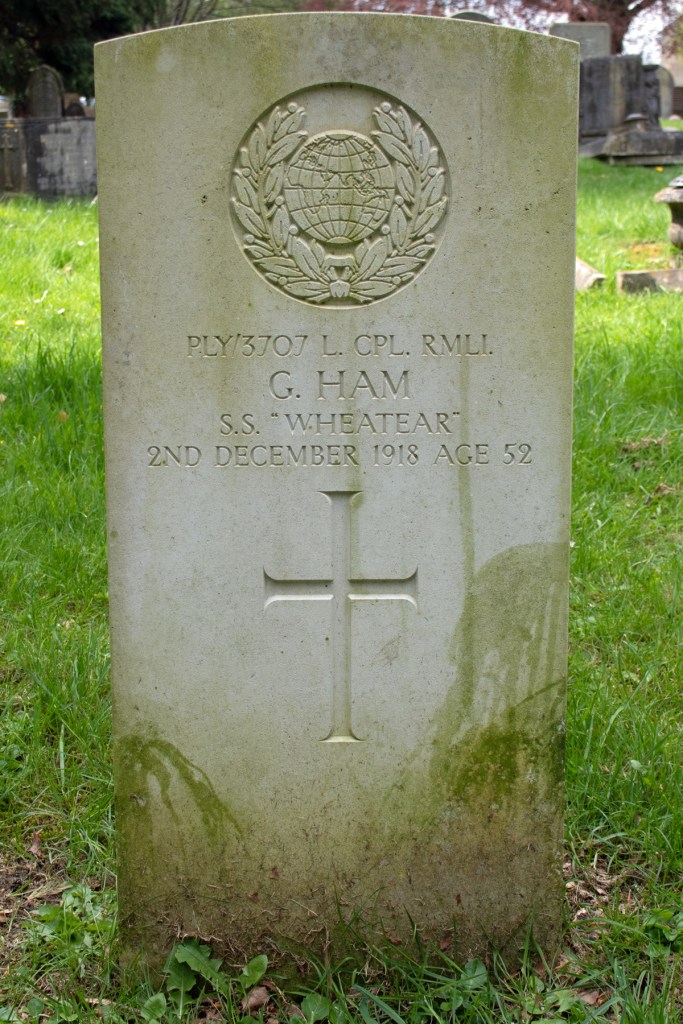
George Ham was born on 19th December 1867 in Twerton, Somerset. His parents were George and Emily Ham, and he was the oldest of their nine children. George Sr was a mason, and initially his first born followed suit, but he was pulled towards something bigger and better and, on 19th January 1886, he enlisted in the Royal Marine Light Infantry.
George’s service records note that he was 5ft 6ins (1.68m) tall, with brown hair, grey eyes and a fresh complexion. He was initially sent to the barracks at Walmer in Kent, and it was from here that Private Ham began a 21 year career in the Royal Marines. Over that time, he served on seven separate ships, and, between voyages, he was based in barracks in Plymouth, Devon. Both his character and ability were consistently noted as being very good.
Private Ham’s career took him around the world and, in 1887, he found himself on the gunboat HMS Banterer, on which he served for three years. His tour of duty included a period of time in Galway, Ireland, and it was here that he met Mary Ann Goode. On 5th July 1889, the couple married in city’s St Nicholas’ Church. The church’s records suggest that the couple went on to have four children – Frederick George; Emily, who died just after her first birthday; Albert; and Katherine.
George’s records from this point become a little disjointed. In October 1890, he returned to his Plymouth base, and the following year’s census recorded him as living in the East Stonehouse Barracks, although his marital status was noted as single.
The next census, in 1901, presents a different picture. George and Mary were, by this time, living in family barracks in East Stonehouse, with two children, (Frederick) George and Albert. Katherine, the couple’s youngest child, was born the following year.
In January 1907, after more than two decades’ service, George was stood down from active service in the Royal Marines. He was placed on reserve status, and took up work as a mason once more. At this point, however, the family seemed to have hit more troubled times, underlined by four separate 1911 census documents.
George, who was 44 by this point, was recorded as being an inmate in the Bath Union Workhouse and Infirmary in Lyncombe, Somerset. Mary and Katherine, meanwhile, were in two rooms in a house in Stonehouse, Devon. Frederick, who was now better known as George, had followed his father into military service, and was a Private in the Royal Marine Light Infantry, serving on HMS Colossus. Albert, who was 13 years old, was one of 946 students boarding at the Royal Hospital School for Sons of Seamen in Greenwich, London.
George spent nine years in the reserves, and, in 1914, was called up again for war service, this time as a Lance Corporal. According to a contemporary newspaper:
[He was] engaged on naval patrol work against submarines off the Canadian coast and elsewhere, and was in charge of a gun on an armed merchant ship. Once the boat he was on was torpedoed, and on another occasion he had a long running fight with a submarine in the Irish Channel. The ship, however, reached Portrush (Ireland), and the inhabitants gave Lance-Corporal Ham a testimonial, and he was also rewarded in other ways, the Cardiff owners of the vessel recognising his skill and gallantry.
Bath Chronicle and Weekly Gazette: Saturday 7th December 1918
Tragedy was to strike in the end, however, and George was to meet a sad end to a distinguished career.
While at Cork [George] fell, either from a boat or the dock, and sustained an injury to the side of his head. It did not appear very serious, and it is understood that he made a trip to Cardiff and back to Londonderry, [where] he became so seriously ill as to necessitate his going to a military hospital in Londonderry. Hemorrhage [sic] of the brain set in, and he died on Monday [2nd December 1918] before his brother, Mr Albert Ham, who had been telegraphed for, could reach him.
Bath Chronicle and Weekly Gazette: Saturday 7th December 1918
Lance Corporal George Ham was days short of his 51st birthday when he died. His body was brought back to Somerset for burial, and he was laid to rest in Twerton Cemetery. The newspaper report give no indication as to whether Mary or their children were in attendance and, in fact, does not mention his wife and family at all.
Ernest Algernon Phillips was born at the start of 1879 in the Somerset village of Winscombe. One of nine children, his parents were Arthur and Elizabeth Phillips. Arthur was a gardener, and Ernest followed suit when he finished his schooling.
By the time of the 1911 census, he was boarding with his younger sister Rose and her family – brother-in-law Leonard and nephew Leslie. Just a couple of weeks later, on 11th May 1911, Ernest married Winifred Carey. She was a coachman’s daughter from Winscombe, and the couple set up home in a cottage on the outskirts of the village.
When war broke out, Ernest felt a need to play his part. He enlisted in Bristol on 8th December 1915, but was not formally mobilised until the following June. Initially assigned to the Devonshire Regiment, he was transferred to the Worcestershire Regiment and attached to the 6th Battalion.
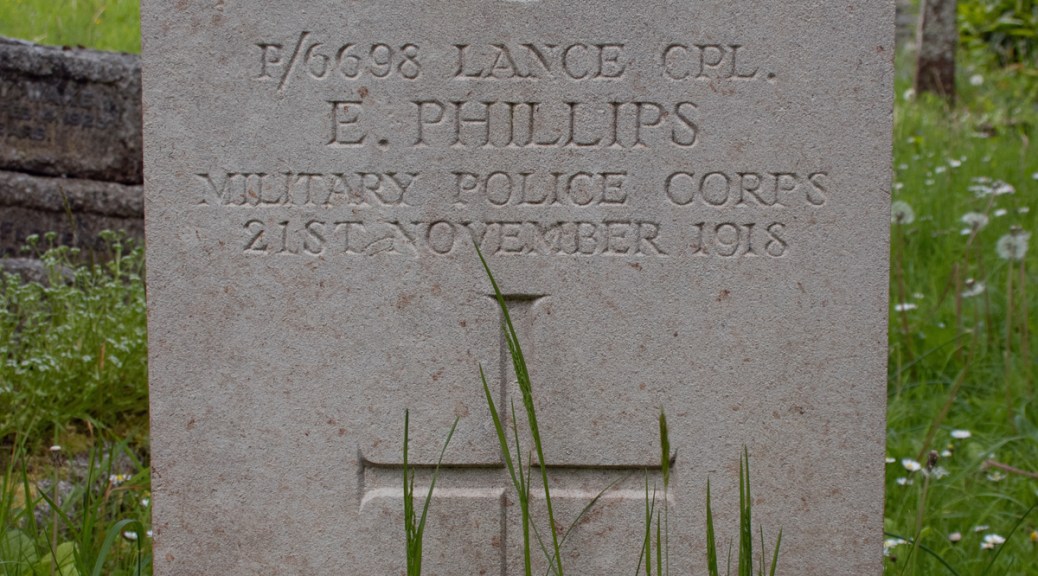
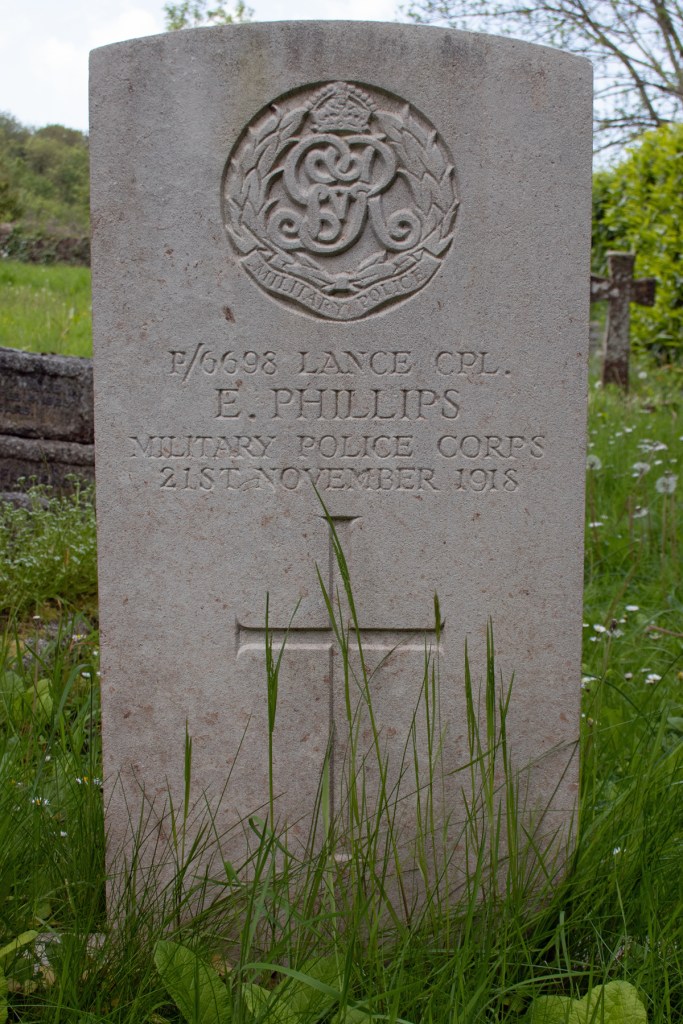
Private Phillips’ troop was based on home soil, and he was barracked in the garrison in Harwich, Essex, for the next six months. On 31st January 1917, he was transferred to the Military Police Corps, and given the rank of Acting Lance Corporal. Full details of his service from this point on are lost to time, but it is clear that he remained on home soil until the end of the war.
By November 1918, Ernest had fallen ill. He was admitted to the Queen Alexandra Military Hospital in London on 20th November, suffering from pneumonia. Within a matter of hours, while this seemed to have cleared, his pulse was ‘rapid, irregular and compressible.’ He was medicated, but did not respond to treatment, and passed away the following day. His death was noted as apparently being caused by clots of blood in the heart, but, at the request of his family, no postmortem examination was carried out. He was 39 years of age.
Ernest Algernon Phillips was brought back to Somerset for burial. He was laid to rest in the quiet graveyard of St James the Great Church in Winscombe.
John Burge Parker was born in the spring of 1887, the second of eight children to George and Ann Parker. The family were raised in Huntspill, Somerset, where George was employed as a labourer in the local railway works.
When he finished his schooling, John found work on a farm and this is how he was employed when, on 30th April 1907, he married Alice Jane Grove in the parish church in Pawlett. The sleepiness of the area is underlined by the fact that this was both the only wedding to take part in the church that year, and for more than a year. John and Alice went on to have three children, Audrey, who was born in 1907, Elsie, who came along two years later, and Clifford, born in 1915.
With a growing family to support, John sought out more of a career. Indeed, by the time of the 1911 census, he was employed as a police constable, and the Parkers had moved to Bristol. When war came to Europe, however, John stepped up to play his part.
John enlisted on 17th November 1915, joining the Railway Troops Depot of the Royal Engineers. His service records show the kind of figure he must have cut in the police, and he was noted as being 6ft 1in (1.85m) tall, weighing 176lbs (79.8kg). Initially give the rank of Private, he was promoted to Lance Corporal in May 1916, just four months after being officially mobilised.
In October 1916, Lance Corporal Parker’s troop set sail from Southampton, their final destination being Alexandria in Egypt. He spent more than two years in North Africa, wand was promoted to full Corporal during this time.
John returned to Britain early in 1919. In February, John was visiting his brother in Highbridge, Somerset, and, on the evening of the 6th, he left to visit his father in Huntspill. He set off to Highbridge Station first, with the intention of checking the train times to return to Bristol, but that was the last time he was seen alive.
A painful sensation was created in Highbridge and neighbourhood… when it became known than on the previous evening.. the mutilated body of a soldier was found on the Great Western Railway metals, about a quarter of a mile below the Highbridge Station… The body was subsequently identified as that of John Parker… a corporal in the Royal Engineers, whose home it at Bristol and who leaves a wife and three children.
Central Somerset Gazette: Friday 14th February 1919
Nothing untoward was confirmed in the accident that killed John on the night of the 6th February 1919, and at the inquest the jury reached the conclusion that he had died through a tragic accident. He was 32 years of age.
The newspaper report gave more insight into the character of Corporal Parker: “He was a splendid specimen of manhood, standing over 6ft, and of proportionately fine physique… [He] was of a most genial temperament [and] was held in the highest respect both in the Highbridge district and at Bristol.”
The body of John Burge Parker was laid to rest in the quiet graveyard of St Peter’s Church in his home village of Huntspill.
Frederick William Reid was born in January 1876 in Liverpool, Lancashire. Little information is available for his early life, and his trail only really becomes traceable when he joined the Royal Irish Regiment at the age of 16 years old.
Frederick’s service records confirm that his mother was called Elizabeth, who lived in Bedminster, near Bristol. He was already volunteering for the regiment when he enlisted, and was working as a musician when he joined up. His papers confirm that he was 5ft 4ins (1.63m) tall, and weighed 112lbs (60.8kg). He had brown hair, hazel eyes and a fresh complexion.
Frederick was given the rank of Drummer when he joined up and was attached to the Royal Irish Regiment’s 3rd Depot. He spent more than seven years on home soil, rising to the rank of Corporal in May 1898. The following January he reverted to the rank of Private at his own request, but his superiors obviously saw something in him, and he was supported in a new role – Lance Corporal – just a month later.
In October 1899, however, Frederick’s life was to take a new turn, when he was sent to India with his troop.
Corporal Reid was based in Lahore, and had found the life that he was seeking. Over the next forty months, he successfully took on a variety of clerical roles. He was promoted to Lance Sergeant in October 1901 and given oversight of the Officers’ Room.
In March 1903, Frederick returned to Britain. With the move came a further promotion, to the rank of full Sergeant, again, overseeing the Officer’s Room. He seems to have been based in Gloucestershire by this point, as, on 18th November 1903, he married Isabella Jane Parke at a Registry Office in Bristol. There is no further record for the young couple, however, so the new Mrs Reid is destined to remain a mystery.
Frederick was destined to return to India, and in January 1905, that is exactly what he did. His regiment returned to Lahore, and he was given the role of Clerk Steward at one of the Lawrence Memorial Asylum. The name is misleading, as the asylums were a series of four military-style boarding schools across India. Sergeant Reid’s records do not confirm which of the four he was attached to, but it would have been Sanawar, Mount Abu, Lovedale or Ghora Gali.
Given his military background, it seems that the role of clerk was something Frederick settled into quite happily. He was recalled back to army service in November 1909, and, within seven months, he requested a discharge from the army. This was granted, as he had, by this point, completed more than eighteen years’ service.
Frederick remained in India, however, and on 28th September 1913, he married Elizabeth Marshall in Lahore. They had two children, Florence, who was born in Quetta on 2nd September 1914, and Lily, who was born on 1st January 1916 in Lahore.
War had come to the world by this point, and in spite of his age – he was 39 by now – Frederick felt it only right to step up and play his part again. On 28th October 1914, he enlisted again, and was assigned to the 1st Battalion of the Duke of Wellington’s (West Riding Regiment). His new medical noted that he was 5ft 7ins (1.7m) tall, and weighed in at 9st (57.2kg). His complexion was recorded as pale, while he had a number of tattoos on his left forearm: the crossed swords, harp and crown of the Royal Irish Regiment, along with the initials VR.
While part of the West Riding Regiment, Sergeant Reid was attached to the 3rd Mule Corps of the Indian Supply & Transport Corps. He was involved in arranging provisions for the various battalions who needed them.
By March 1916, his battalion had been sent to Salonika, and it was here that Frederick contracted tuberculosis. Medically evacuated to Britain, he was admitted to the Southwark Military Hospital. He was confirmed as no longer being medically fit for army service and was discharged on 16th August 1916. His medical report noted that he “is anxious to have sanatorium treatment, but is not an insured man, owing to having been stationed in India.”
On his discharge, Frederick moved to Weston-super-Mare, Somerset, which is where his mother was by now living. His wife and children also came to live in England and, the family settled in Pawlett, near Bridgwater.
After leaving the army, Frederick’s trail goes cold. The next confirmation of his life is that of his passing. He died on 12th October 1919, presumably from his lung condition. He was 43 years of age.
Frederick William Reid, who had been born in Liverpool, who had had two separate careers in the army, and who had lived and married in India, was laid to rest in the peaceful graveyard of St John the Baptist’s Church in Pawlett, Somerset.









 Death and Service