Category Archives: Lance Corporal

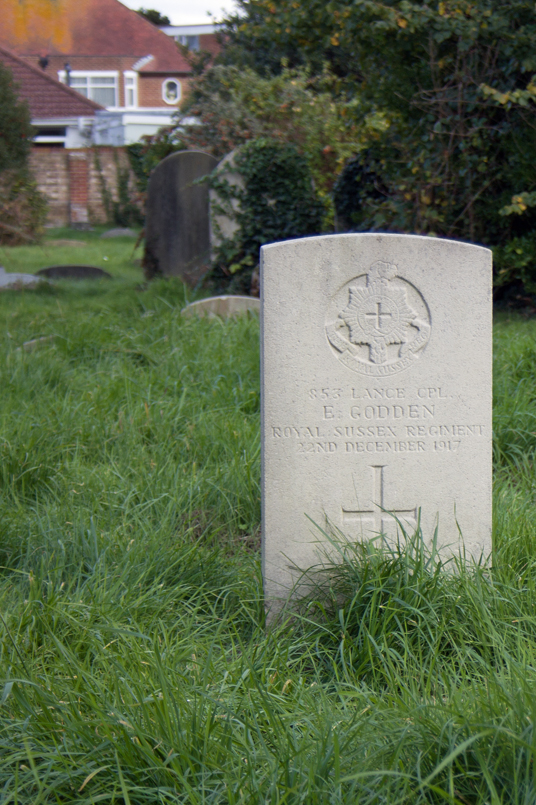
Lance Corporal Edgar Godden

Lance Corporal Edgar Godden

Edgar Godden was born in the summer of 1892, one of eight children to John and Alice Godden. John came from Littlehampton, and Alice from Worthing, and this is where they raised their family.

John was a bricklayer, and it was this trade that Edgar went into when he left school. War was coming to Europe, however, and, within weeks of the conflict breaking out, he had volunteered his services.

Edgar joined the Royal Sussex Regiment, and was assigned to the 7th (Service) Battalion. Details of his military service are a little sketchy, but a newspaper article, written after his death, gives a hint about what happened to him.

Mr Edgar Godden… who was twenty-five years of age and leave a widow and a little child, enlisted on the 1st September 1914, and was wounded in the arm in September of the following year. In October 1916 he was blown up and buried by an enemy mine. Last February he was taken out of the trenches and sent to a hospital in France, and last April he came home to England and had an arm amputated. Since his discharge from the Seventh Royal Sussex Regiment, he had been a member of the staff of the Post Office, and was known as “The One-armed Postman”.

Worthing Gazette: Wednesday 10th January 1918.

In the autumn of 1916, and recovering from his injuries Lance Corporal Godden married Emily Owers. They lived with John and Alice, but I have been unable to find details of the child mentioned in the newspaper report.

It seems that his injuries had left Edgar in a weakened state, and, after a ‘short and painful illness’ [Worthing Gazette: 2nd January 1918], he passed away on 22nd December 1917. He was just 25 years of age.

Edgar Godden was laid to rest, finally at peace, in the Broadwater Cemetery in his home town of Worthing, West Sussex.


The newspaper report above gave a little more information about a couple of Edgar’s siblings.

Mr & Mrs [John] Godden had one son killed in action in November 1916; and still another – the eldest – is now in France, as a member of the Royal Engineers.

Worthing Gazette: Wednesday 10th January 1918

Edgar’s oldest brother – also called John – survived the war, but it was his younger brother, Charles, who was killed in action.

A Corporal in the 11th Battalion of the Royal Sussex Regiment, Charles was caught up in the Battle of the Somme. It was while fighting in the Battle of the Ancre on 13th November 1916, that he was killed. He is remembered at the Thiepval Memorial in Northern France, and is also commemorated on Edgar’s own headstone.


One last aside to Edgar’s story is his address in the last few years of his life. John and Alice were living in Worthing, specifically at a house called “Chiswick” in Tarring Road, to the west of the town.

Coincidentally, when researching another soldier, Private Ernest Parsons, this turns out to be the address where he also died, just ten months later on 4th October 1918. There is no apparent other link between the two men.


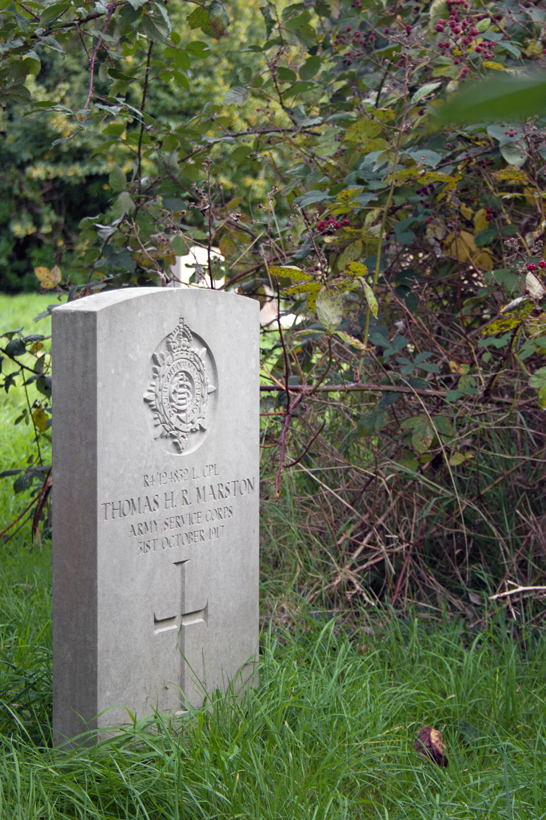
Lance Corporal Thomas Marston

Lance Corporal Thomas Marston

Thomas Henry Robert Marston was born on 12th February 1876, the son of Frederick and Elizabeth Marston. Frederick was a police constable who raised his family in the Paddington area of London.

Sadly, details of Thomas’ early life are tantalisingly scarce. He was not baptised until October 1881, on the same day as his brother, Frederick, who was four years younger.

Thomas seems to have had a sense of adventure; his Commonwealth War Graves Commission records confirm that he served in the South African Campaign – this would put him out of the country during the 1890s, and reinforce why documentation for that time is missing.

The next confirmed information for Thomas is his marriage record. He wed Bessie Ponder by banns in August 1909. The ceremony was at Christ Church in Marylebone, and the couple went on to have two children, Doris, born in 1911, and Hettie, born in 1912.

By the time of the 1911 census, with his military service by now complete, Thomas and Bessie were living on the Caledonian Road in Islington. Still childless at this point (although Bessie was undoubtedly pregnant), Thomas was working as a butcher.

The census gives their address as 54 Wallace Buildings, a Victorian tenement block, and the couple lived in two rooms. Their neighbours at No. 53 were fellow butcher Ralph Bonest, his wife Isabel and their three children, who also all lived in two rooms. On the other side newlywed cab driver William Barnes, lived with his wife Florence and her sister. The Barnes’ had the luxury of No. 55 being a three-roomed flat.

When the Great War broke out, it seems evident that the 38 year old Thomas was either re-mobilised or voluntarily re-enlisted. While the dates are not certain, he had joined the Army Service Corps by March 1917 and was assigned to the Remount Depot at Romsey in Hampshire. This section of the regiment was involved in the provision of horses and mules to other parts of the army.

No further details of Lance Corporal Marston’s military career remain. Sadly, the next record of his life confirm his death. He was admitted to the Hursley Camp Hospital with rupture of viscera (possibly an aneurysm), but died from his injury on 31st October 1917. He was 41 years old.

At some point after the 1911 census, the family had moved to Worthing in West Sussex. The body of Thomas Henry Robert Marston was brought back home, and he was laid to rest in the Broadwater Cemetery in the town.


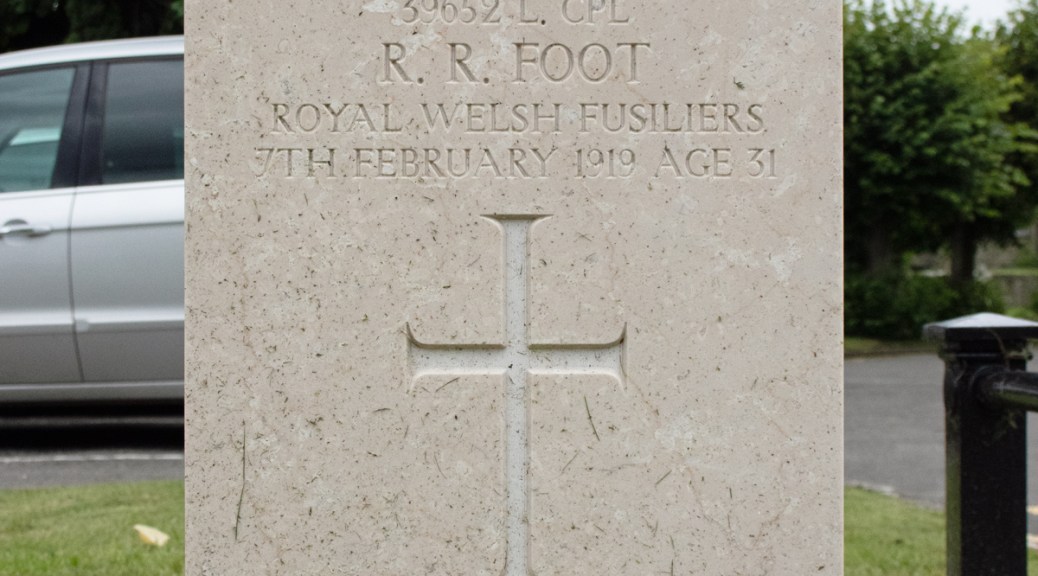
Lance Corporal Reginald Foot

Lance Corporal Reginald Foot

Reginald Robert Foot was born at the beginning of 1888 in Shaftesbury, Dorset, the oldest of three children to Robert and Annie Foot. Robert was a tailor from the town, who brought up his young family in the comfort of well-known surroundings.

When he left school, Reginald found work as a carpenter and joiner. He was a keen, if over-eager, sportsman, and played for Shaftesbury FC. In May 1906, he was reported for ‘cheeky’ behaviour towards the referee in one match.

In the lead up to the Great War, he also spent some of his his spare time in the Territorial Army and, when war broke out, he was keen to continue doing his bit. He joined the Royal Welch Fusiliers as a Private in December 1915 and, by the time he was shipped out to France in January 1917, he had been promoted to the rank of Lance Corporal.

After a year on the Western Front, Reginald returned to the United Kingdom and, once the Armistice had been declared, his unit was shipped to Ireland. He fell ill while he was out there, and, in January 1919 was admitted to a military hospital in Ireland.

Sadly, the lung conditions he had contracted – influenza and pneumonia – were to get the better of him, and he passed away on 7th February 1919. Lance Corporal Foot was 31 years old.

The body of Reginald Robert Foot was brought back to Dorset; he lies at rest in the Holy Trinity Churchyard in the town of his birth, Shaftesbury.


Lance Corporal William Neads

Lance Corporal William Neads

William John Neads was born on 16th December 1892, the middle of three children to cab driver and groom William Neads and his wife Ellen. Both William Sr and Ellen were from Somerset, although William Jr and his brother Charles – who was eleven months older – were both born in the Monmouthshire village of Cwmcarn.

William’s parents soon moved the family back to Clevedon in Somerset, and, when he left school, he found work as a farm labourer. He was eager to see more of the world, however and, in April 1913, he emigrated to Canada.

After working as a labourer there for a year or so, back in Europe war was declared. Keen to do his bit for King and Country, William enlisted in the 1st Battalion of the Canadian Infantry in January 1915. He soon found himself caught up on the Front Line.

In October 1916, he was involved in the Battle of the Somme – either at Le Transloy or The Battle of the Ancre Heights – and received a shrapnel wound to his left shoulder. Initially admitted to the Canadian General Hospital in Etaples, he was subsequently evacuated to England and the Northern General Hospital in Leeds. He spent three months recovering from his injuries, and was back on the Western Front in January 1917.

Later that year, William – now a Lance Corporal – was involved in the fighting at the Second Battle of Passchendaele (part of the Third Battle of Ypres). He was wounded again, this time receiving a rather unceremonious gunshot wound to the right buttock. Treated at the scene, he was evacuated back to England and admitted to the Fusehill War Hospital in Carlisle on 17th November.

Sadly, despite treatment, Lance Corporal Neads’ health deteriorated, and he passed away from his injuries on 16th December 1917, his 25th birthday.

William John Neads was brought back to his family’s home of Clevedon, and buried in the clifftop churchyard of St Andrew’s, overlooking the sea.


Tragically, William’s father had died in May 1917, at the age of 51. While no details of his passing are recorded, it meant that Ellen had, in just over a year, seen her son wounded, her husband die and her son wounded again and die as a result.


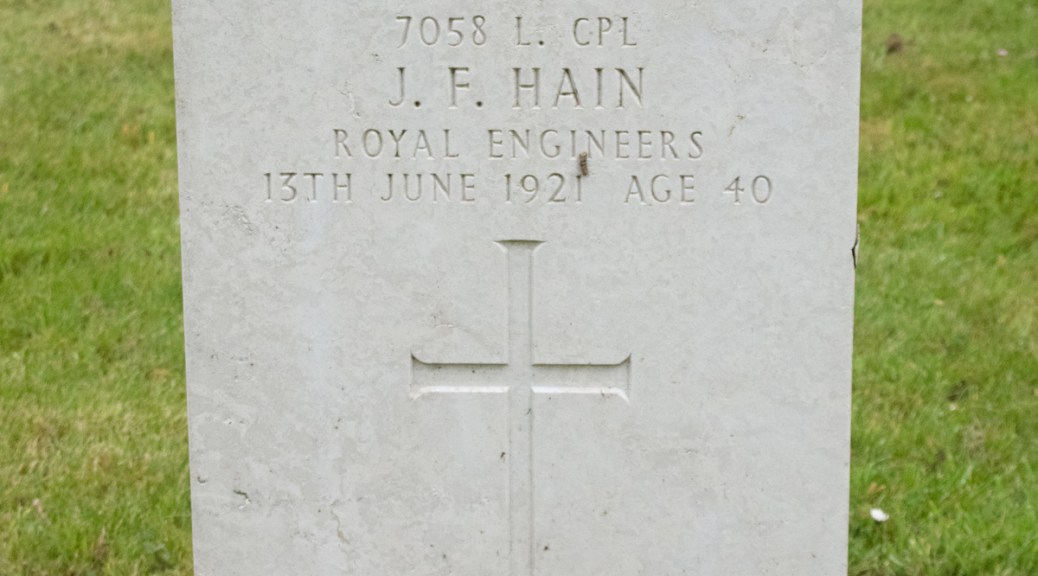
Lance Corporal James Hain

Lance Corporal James Hain

James Frederick Hain was born on 5th November 1881 in the village of Holmer in Herefordshire. He was one of seven children to James and Catherine Hain, and was more commonly known as Fred. On James Jr’s birth certificate, his father was listed as a manure agent, although by the time of the 1891 census, the family had moved to London, where James Sr was now running a coffee house.

When he left school, James Jr started work as a French polisher, but he had a taste for adventure and joined the army. He served in South Africa during the Boer War campaign of 1899-1900, attaining the Cape Colony, Orange Free State and Transvaal Clasps.

In 1900 James returned home, finding work as a French polisher. The military life was in his blood by now, though, and in September, he re-enlisted. Initially joining the Royal Berkshire Regiment, he was soon transferred over to the Royal Engineers as a Sapper.

James had signed up for a period of eight years and, as part of his role as a wireman (maintaining and fitting telegraph cables), he was stationed abroad. On one particular trip, when his battalion was travelling from Plymouth to Limerick early in 1908, he was injured. According to the accident report: “owing to bad weather on boat between Fishguard and Waterford he was thrown violently forward, striking his head against a girder.” Treated in Limerick, “the disability is of a slight nature, and in all probability will not interfere with his future efficiency as a soldier.”

Sapper Hain’s time with the service was nearly up, and he was put on reserve status in November 1908. By 1911, he was working as a linesman, and boarding in a house in Hayle, Cornwall.

War was on the horizon by now, and on 5th August 1914, James was called back into service. He saw action on the Western Front, adding the Victory and British Medals and the 1915 Star to his count. In October 1915, he was treated for shell shock, and evacuated back to England.

At the beginning of 1917, Lance Corporal Hain was transferred back to the Army Reserve, suffering from neuritis. His health was to suffer for the rest of his life.

In September 1917, having settled in Cornwall, James married Beatrice Opie, an innkeeper’s daughter from the village of Wendron, Cornwall. The couple would go on to have a son, who they called Frederick, two years later.

Discharged from the Army, James put his engineering experience to good use, joining the General Post Office to work with telegraphs.

By this time, James’ medical condition had been formally diagnosed as General Paralysis of the Insane. A degenerative disease, similar to Alzheimer’s disease, it was associated with brisk reflexes and tremors (usually most obvious of the lips, tongue, and outstretched hands) and characterised by failing memory and general deterioration.

By August 1920, James was admitted to the Somerset and Bath Asylum in Cotford, because of his worsening condition. He was not to come out again, and passed away ten months later, on 13th June 1921. He was just 39 years old.

James Frederick Hain was buried in the St James’ Cemetery in Taunton, Somerset.


James Frederick Hain
(from findagrave.com)

Lance Corporal Joscelin Currey

Lance Corporal Joscelin Currey

Joscelin William Currey was born in the summer of 1897, one of six children to Job Arthur Currey and his wife, Eliza Jane. Job was a shoesmith, and brought his young family up in his home town of Taunton, Somerset.

When Joscelin left school, he worked as an errand boy, before becoming an apprentice with local foundry of Messrs. Rudman, Lancey and Co. But with war on the horizon, things were about to change.

Along with his older brothers, Joscelin enlisted in the army, joining the 3/5th Reserve Battalion of the Somerset Light Infantry in August 1914. Initially based on Salisbury Plain, he was soon transferred to Bath, and attained the position of Lance Corporal.

It was in Bath that he fell ill, and was admitted to hospital with cerebrospinal meningitis. Sadly, Joscelin was to succumb to this condition, and he passed away on 28th June 1915. He was just 18 years of age.

Joscelin William Currey was laid to rest in the St James Cemetery of his home town of Taunton.


Joceslin Currey
(from britishnewspaperarchives.com)

The newspaper report of Lance Corporal Currey’s funeral confirmed that one of his brothers was a prisoner of war in Germany, while another was in the Royal Field Artillery. Joscelin was the only one of the three to die during the conflict.


Joscelin’s name is spelt variously as Jocelyn and Joslin across the documents relating to him, and his surname is also spelt Curry. For the purposes of this post, I have chosen to use the spelling cited on the Commonwealth War Graves Commission records.


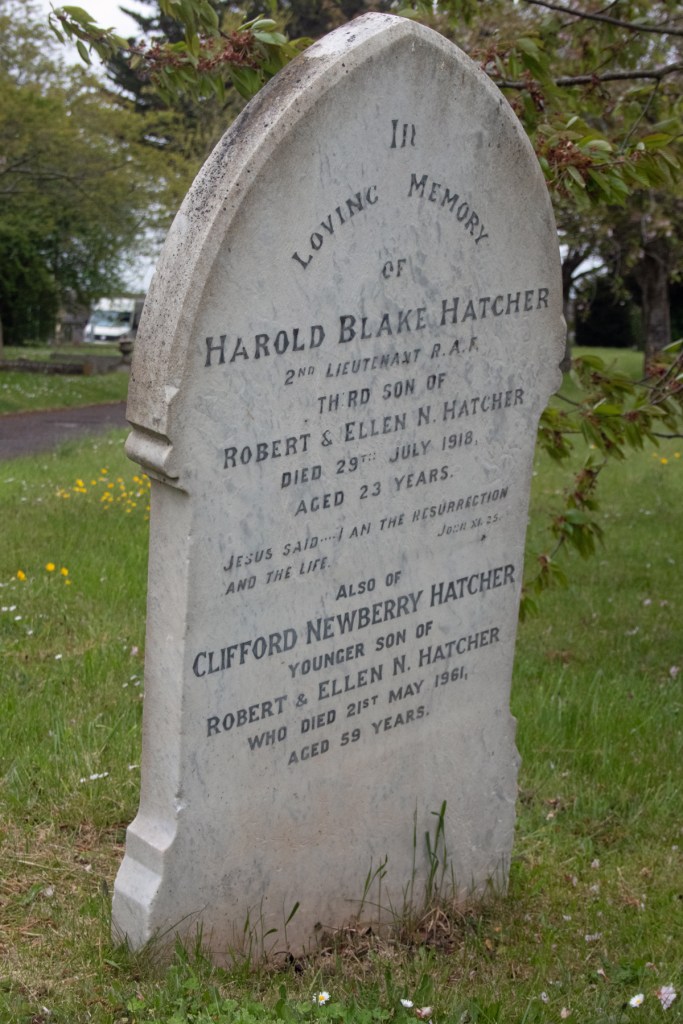
Second Lieutenant Harold Hatcher

Second Lieutenant Harold Hatcher

Harold Blake Hatcher was born on 11th February 1895, one of nine children to Robert Hatcher and his wife Ellen. Robert was a draper, and brought his family up in his home town of Taunton in Somerset. At least one of his children followed him into the cloth business, and, after he died in 1908, this seems to have fallen to Harold’s older brothers, Arthur and Ernest.

After leaving school, Harold became a dental student. Initially studying with Kendrick’s in his home town, he was about to begin training at Guy’s Hospital in London when war broke out.

Harold joined up in May 1915, and was initially assigned as a Lance Corporal to the 6th Battalion of the Somerset Light Infantry, before being transferred to the Middlesex Regiment.

In November 1917, he was badly injured in while fighting at Bourlon Woods, as part of the Battle of Cambrai. It was while he was recuperating that he transferred again, this time to the fledgling Royal Air Force.

Second Lieutenant Hatcher gained his wings in June 1918, and soon became a flying instructor. It was while he was working at RAF Fairlop in North West London, that an incident occurred. A local newspaper picked up the story.

Many in Taunton have learnt with sincere regret of the accidental death whilst flying of Lieutenant Harold Blake Hatcher of the Royal Air Force, third son of the late Mr Robert Hatcher of Taunton, and of Mrs Hatcher, now of Bristol.

The accident in which he met his death on Monday was a triple fatality, two other airmen being killed at the same time, Second Lieutenant Laurie Bell, of Bournemouth, and Flight Sergeant AR Bean, of Burslem.

At the inquest… it was stated in evidence that while Lieutenant Hatcher and Sergeant Bean were flying at a height of about 500ft, Second Lieutenant Bell, who w flying a single-seater, dived from a position some 700 feet higher, his machine striking and cutting clean through the double-seater, which folded its wings, hovered a few second, and then crashed to the earth. The three men were instantaneously killed.

A verdict of Accidental Death was returned.

Taunton Courier and Western Advertiser: Wednesday 7th August 1918

Further witness testimony described how the Sopwith Camel, piloted by Bell, cutting the AVRO airplane it in two. Hatcher fell out of the wrecked two-seater as the Camel’s wings slowly folded into a V and fluttered free following the fuselage to the ground. All three airmen lost their lives. Bean was found in a sitting position, still strapped in the front half of the AVRO’s fuselage, his instructor’s body was found unmarked thirty yards away in the grass where it had fallen. The wingless Camel crashed close by and Bell was found to have almost every bone in his body broken.

The accident took place on 30th July 1918. Second Lieutenant Hatcher was just 23 years old.

Harold Blake Hatcher lies at rest in St Mary’s Cemetery in his home town of Taunton, Somerset.


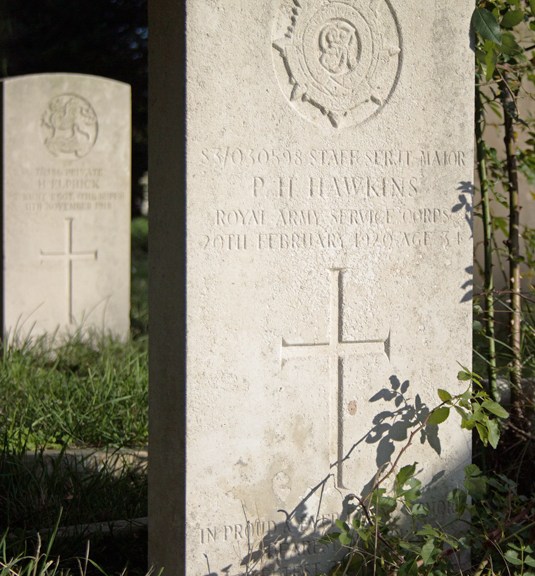
Lance Corporal Ernest Hawkins

Lance Corporal Ernest Hawkins

Ernest Frederick Hawkins was born in Street, Somerset, in 1884. He was the youngest of six children to Charles Hawkins and his wife Elizabeth. Both of Ernest’s parents were shoemakers in the Clark’s Factory in the town, and this was the trade Elizabeth continued in after her husband’s death in 1887.

Ernest’s life has some mysteries about it and there is a sense that he spent time trying to escape from something. In August 1904, he enlisted in the army, joining the Scottish Rifles (also known as the Cameronians). He did this under an assumed name, preferring to be called James Fisher.

“James” gave his next of kin as his parents, listing them as George and Annie in South Acton (even though these were not his actual parents’ names, and that his father had passed away 17 years previously).

His enlistment papers give an interesting insight into the young man. He was listed as 22 years old, 5ft 4ins (1.62m) tall, with brown eyes, black hair and a sallow complexion. His arms were adorned with a number of tattoos, including Buffalo Bill on his upper right arm and a ship surrounded by flags on his upper left.

Private Fisher served for a year on home soil, before being shipped out to India. He returned to the UK in October 1907, and transferred to the Army Reserve.

Ernest returned to Somerset, and it was here that he met Sarah Jane Manning. The couple married in a registry office in Bristol, and went on to have two children, Hubert and Iris.

War broke out, and Private Fisher was remobilised. By August 1914 he was promoted to Lance Corporal, and sent to France as part of the British Expeditionary Force. Here he became caught up in a number of the key battles of the conflict.

On 24th July 1916, during the British attacks on High Wood at the Somme, he was wounded in the right arm, and invalided back to England for treatment. Admitted to the War Hospital in Guildford, Surrey, it was confirmed that he had received a gun-shot wound to his right arm, which had resulted in a compound fracture of the humerus, radius and ulna. Sadly for Ernest, the only option was a full amputation of his right arm.

After some time to recover, Ernest was transferred to the Pavilion Military Hospital in Brighton where he was fitted for an artificial limb. He spent three months in the Brighton facility, before being moved to the Queen Mary’s Convalescent Home in Roehampton to recuperate. He was eventually discharged – from the hospital and the army – on 10th March 1917, and returned to his wife and family in Somerset.

There is little further documented information about Ernest. He and Sarah went on to have a further child – Leslie – in 1917. Sadly, where Ernest had been a toddler when his father had died, Leslie was consigned to be a babe-in-arms when Ernest passed away.

Ernest Frederick Hawkins – also known as James Fisher – died in Swindon on 2nd July 1918, at the age of 34. He lies at rest in St Mary’s Cemetery in his adopted home town of Taunton, Somerset.


Ernest’s gravestone also commemorates his brother Frank Hawkins. Frank was nine years older than Ernest, and, like his younger brother, had decided that the military life was for him.

Frank enlisted in the Royal Navy in November 1894 and was assigned a Boy 2nd Class on HMS Impregnable – the training ship based in Chatham, Kent. Over the period of his twelve years’ service, Frank rose through the ranks to Able Seaman. When his term was up, he joined the Royal Fleet Reserve for a further five years.

When war came, Able Seaman Hawkins was immediately called back into action. He was assigned to HMS Goliath, serving off German East Africa and the Dardanelles. On the night of the 12th May 1915, the ship was guarding the water off Gallipoli, when it was struck by three Ottoman torpedoes. The resulting explosions caused the ship to sink quickly, and 570 souls – out of a total complement of 750 crew – were lost.

Able Seaman Hawkins was one of those lost, and was subsequently commemorated on his brother’s gravestone.


Lance Corporal Francis Hawkins

Lance Corporal Francis Hawkins

Francis Moreton Hawkins was born in Cottingham, Northamptonshire on 15th July 1895. He was the eldest of eight children to Francis and Louisa Hawkins. Francis Sr was a butcher and, by 1905, he had moved the family to Taunton, where he set up a ship on the main shopping street in the town.

When Francis left school, he became a clerk for the business; he went on to take civil service exams, gaining employment in the General Post Office and then Customs & Excise. War was looming, however, taking him in a different direction.

Sadly, a lot of Francis’ military records no longer exist. What the records do tell us, though, is that he initially enrolled with the Somerset Territorials in October 1914, transferring first to the Civil Service Rifles and then the Rifle Brigade. He served his term in the army, rising to the rank of Lance Corporal.

When the war came to a close, Lance Corporal Hawkins was placed on furlough while he waited to be demobbed, and returned home on 19th November 1918. Feeling unwell, he took straight to his bed, and, three days later, was admitted to the Military Hospital in Taunton with influenza and pneumonia.

Tragically, these were to get the better of him; Francis passed away at the hospital on 23rd November 1918. He was just 23 years old.

Francis Moreton Hawkins lies at rest in St Mary’s Cemetery in his home town of Taunton.


Private Frederick Ashton

Private Frederick Ashton

Frederick John Ashton was born in Taunton, Somerset, in 1892. He was one of eight children to scavenger and labourer Thomas Ashton and his wife Susanna.

When he left school, Frederick found work as a carter, and this is the job he was doing in 1913, when he married local woman Ethel May Lock. The young couple went on to have two children, Olive and Phyllis.

War was on the horizon, and Frederick enlisted in June 1916. Initially assigned to the Royal Berkshire Regiment, Private Ashton was shipped off to France within a couple of months.

During his time there, he was promoted to Lance Corporal, but requested being reverted back to his previous rank a few months later. By this point, he had been transferred to the Labour Corps, the regiment in which he served for the rest of his time.

In March 1918, Frederick was badly wounded, and found himself invalided back to England. He was admitted to the Northumberland War Hospital in Newcastle-upon-Tyne, where his right leg was amputated. Sadly, it appears that the treatment came too late, and Private Ashton passed away on 27th August 1918. He was just 26 years old.

Frederick John Ashton lies at rest in St Mary’s Cemetery in his home town of Taunton.