Archibald Henry Mills was born in the summer of 1895, the oldest of six children to John and Edith. John was a commercial traveller, selling veterinary wares around the country; he was born in Derby, Edith was from Leicester and, for the for the first seven years of their married life they lived in Edith’s home town – this is where Archibald was born. By the turn of the century, however, they had relocated to Somerset, and set up home in Weston-super-Mare.
When he left school, Archibald found work as an errand boy for a local tailor, but change was on the horizon. By the summer of 1914, he had based himself in Nottingham – the reason is lost to time – and this is where he was when he volunteered for military service.
Archibald enlisted as a Private in the Notts and Derby Regiment – the Sherwood Foresters – and was assigned to the 7th Battalion. He was sent to France as part of the 46th Division and, over the next couple of years, he evidently served his regiment well.
In August 1915, Private Mills was promoted to Lance Corporal; three months later he was again promoted, to Corporal. By May the following year, he received another rise, this time to Serjeant. These promotions were against the backdrop of some fierce fighting – the Sherwood Foresters were involved at Hooge, Hohenzollern and Gommecourt, and were briefly sent to Egypt.
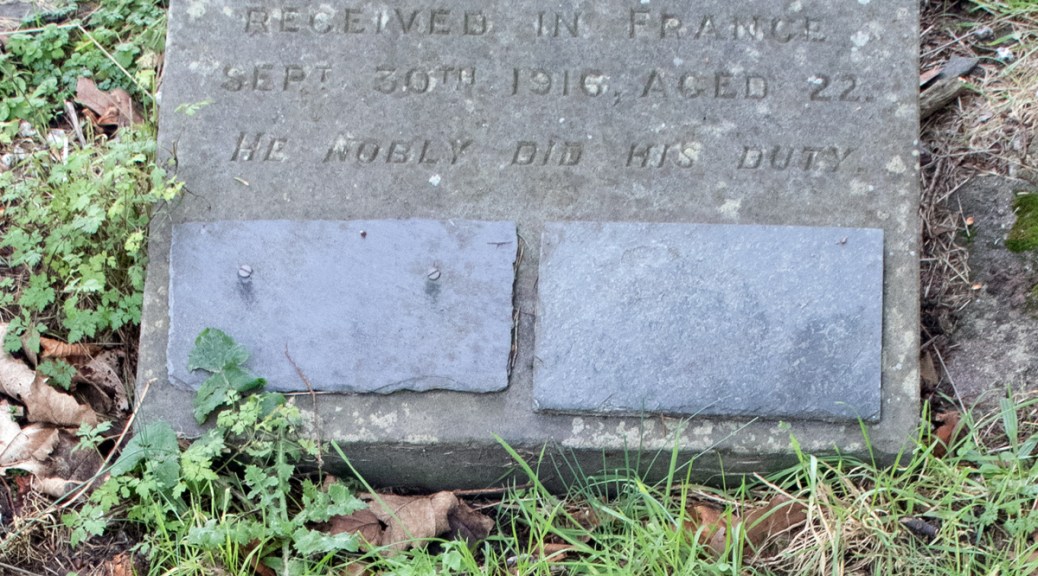
At some point during the summer of 1916 – possible at Gommecourt – Archibald was injured, and medically evacuated to the No.2 Western General Hospital in Manchester. Sadly, however, his wounds were to prove too much: Serjeant Mills passed away on the night of 30th September 1916. He was just 21 years old.
The body of Archibald Henry Mills was brought back to Somerset; he was laid to rest in the Milton Road Cemetery of his adopted home town of Weston-super-Mare.
Bruce Chapple was born in the autumn of 1893, the youngest of four children to Frederick and Elizabeth Chapple. Frederick was born in Newton Abbot and ran the managed a public house in the town (now the Locomotive Inn), although the 1901 census also listed him as a tobacco pipe manufacturer.
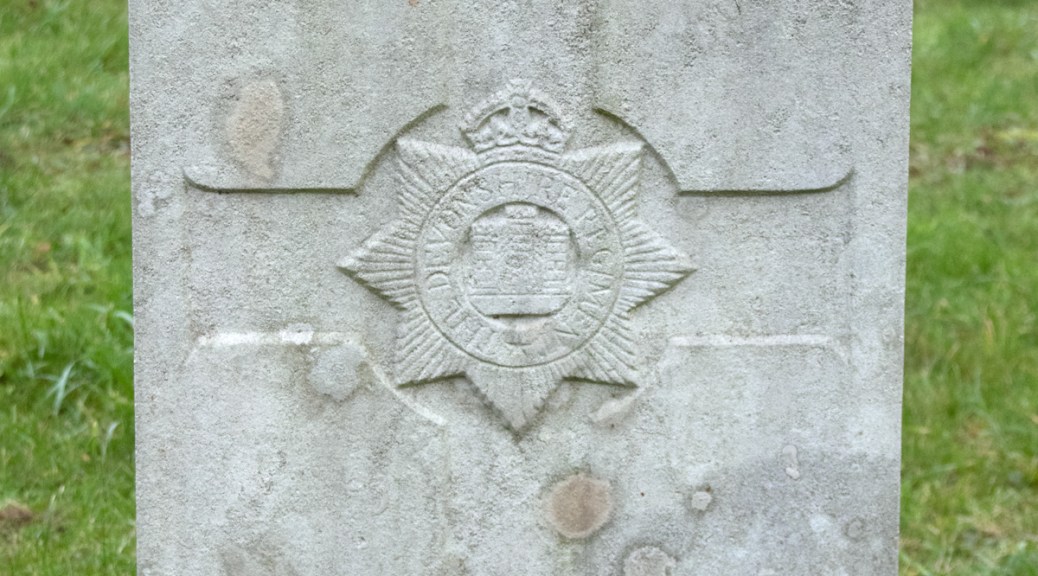
According to the next census – in 1911 – Bruce had taken over the pipe making, which meant that Frederick was devoting his time to being a publican. By this time, Bruce had another interest; military service. He had volunteered for the Devonshire Regiment in October 1909 and, over the next few years, the 5ft 3.5ins (1.61m) tall teenager received training in and around the county.
When war broke out in 1914, Private Chapple was formally enrolled and, as part of the 1st/5th Battalion, he set out for India that October. Initially based in Multan – in what is now Pakistan – he subsequently moved on to Lahore.
Bruce spent a total of two-and-a-half years in India, receiving a promotion to Lance Corporal in the process. In March 1917, his battalion transferred to Egypt, and the now Corporal Chapple went with them.
On 23rd November, Bruce was wounded in action, receiving a gun shot wound to his left thigh; he was not medically repatriated for treatment, but appears to have recovered from his injury and remained in Egypt until July 1918.
Back home in England, Corporal Chapple remained in the army for a further couple of months, before he was discharged as being no longer medically fit for service in September. Sadly, the cause for his discharge is lost to time.
It is at this point that Bruce’s trail goes cold. The next available record is of his death, on 16th November 1919; he was 26 years old.
Bruce Chapple was laid to rest in the family plot in Newton Abbot Cemetery.
James Allan Flood was born in Exeter, Devon, in 1879, and was the oldest of six children to James and Emily. James Sr was a bricklayer, and, according to the 1881 census, the family lived at 2 Stepcote Hill, sharing the house with two other families.
When he left school, James Jr also fell into labouring work. By this time he had met Amy Hobbs, a hotel worker’s daughter who had been born in London. Her father had moved from Devon to the city in the 1870s, but had brought his family back to his home county by 1885.
James and Amy married in the village of Wolborough in December 1899. They set up home in nearby Newton Abbot and went on to have five children.
The storm clouds of war were beginning to hover over Europe and, when the conflict broke out, James was keen to play his part. He enlisted within days of war being declared, joining the Devonshire Regiment as a Private. His service records show that he stood 5ft 6ins (1.68m) tall, and weighed 112lbs (51kg). He had a tattoo of a crown and heart on his right forearm.
Private Flood found himself in France by Christmas 1914 and stayed there for more than a year. During this time, he was promoted to Lance Corporal, although, as a result of missing a role call, he reverted back to Private again a couple of months later.
After a brief two months spent back on home soil, James returned to France again, spending a further ten months on the Western Front. In March 1917, he was transferred across to the Labour Corps, and came back to home soil again.
This transfer appears to have been connected to James’ health; he continued to work as part of 621st Agricultural Company for the next eighteen months, before being discharged from the army on medical grounds in September 1918. Sadly, the cause of his discharge is lost to time.
At this point, James Allen Flood’s trail goes cold. The next time he appears in documentation is nearly a year later: he passed away on 17th August 1919, aged 40. He was laid to rest at the Newton Abbot Cemetery.
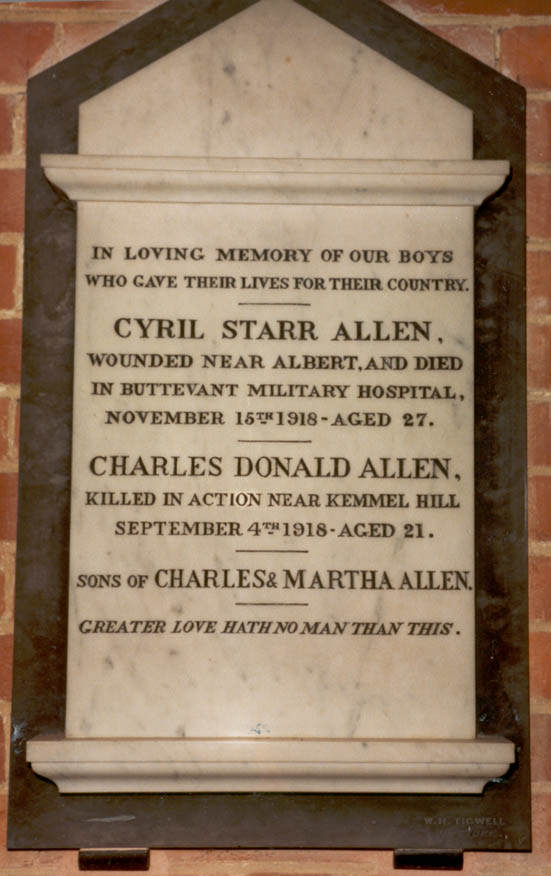
Cyril Starr Allen was born on 15th June 1891 in the village of Baughurst, near Tadley in Hampshire. He was the second youngest of five children to Charles and Martha Allen. Charles was a rate collector, and the family moved around the county during Cyril’s early years.
By the time Cyril left school, Charles had become an assistant bursar in Wootton, near Basingstoke. Cyril, meanwhile, had found similar administrative employment and was working as a clerk for a local land agent.
At the start of 1911, Cyril enlisted in the British Army. He joined the 4th Battalion of the Wiltshire Regiment as a Private and was soon based on Salisbury Plain. His service records confirm that he was 19 years and 7 months old, and stood at 5ft 5ins (1.65m) tall. Private Allen served for his initial term of four years, before being remobilised.
In November 1915, Cyril married Mabel Young. She was a printer’s daughter from Wiltshire, and the couple married in Salisbury, before settling down in Frome, Somerset. They went on to have a child, a daughter they called Kathleen.
Remobilised in the autumn of 1915 Private Allen received a series of promotions – to Lance Corporal, Corporal, Lance Sergeant and Sergeant, and, by June 1917, he found himself at the Front.
On 22nd April 1918, Cyril was injured, sustaining gunshot wounds to his shoulder and left arm. He was invalided back to England for treatment, and was hospitalised in the north of the country. He was then transferred to the Royal Welch Fusiliers with the rank of Corporal and sent to Ireland to continue his recovery and work light duties.
While in Ireland, Corporal Allen contracted influenza and was admitted to the Buttevant Hospital in County Cork. Sadly, in his weakened state, it was something he was to succumb to, and he passed away, with Mabel at his bedside, on 15th November 1918. He was just 27 years of age.
Cyril Starr Allen’s body was brought back to England; he was laid to rest in the graveyard of Christ Church in Frome, Somerset.
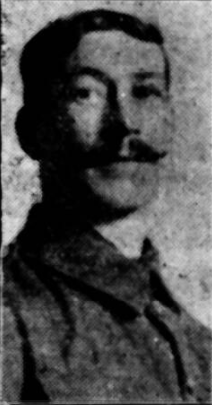
Corporal Cyril Allen (from ancestry.co.uk)
After the loss of her husband, Mabel went on to live her life. In 1923, she married James Burr, a draughtsman from Frome; they went on to have a child – a brother for Kathleen – called James.
Cyril’s two brothers, Winthrop and Charles, also fought in the First World War.
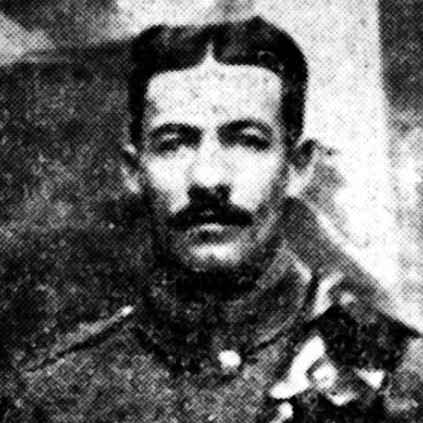
(from ancestry.co.uk)
Winthrop had emigrated to North America in 1911, but returned to Europe as part of the Canadian Expeditionary Force when war broke out.
Lance Corporal Charles Allen served with the 15th Battalion of the Hampshire Regiment. He fought on the Western Front and was killed near Kemmel Hill in Belgium on 4th September 1918. He was just 21 years old. Charles is commemorated at the Tyne Cot Memorial in Zonnebeke, Belgium.
Henry Thomas Preece was born in the summer of 1884, one of seven children to agricultural labourer Tom Preece and his wife, Sarah. Thomas had been born in the Somerset village of Nunney, and it was here that he raised his family.
When Henry left school, he chose not to follow in his father’s agricultural footsteps. By the time of the 1911 census, he was recorded as a baker and, as such, would have been at the heart of village life in Nunney.
Henry married local woman Ellen Stone in 1909, who was a dressmaker with her own account. The couple would go on to have four children between 1909 and 1916.
With war looming, Henry felt the need to play his part. He joined the King’s Royal Rifle Corps in January 1916 and, after training, was sent to France a couple of months later.
He was wounded on July 25th, when out with a wiring party erecting barbed wire obstacles. He received a gun-shot wound in the abdomen, which also injured the spinal cord and his back. He was first taken to the South African Hospital at the base, and after being there for several days he was removed to England and take to the Netley Hospital where he died…
Somerset Standard: Friday 8th September 1916
Lance Corporal Preece died on 3rd September 1916, at the age of 32 years old. His body was brought back to Nunney, where he was laid to rest in the family grave at All Saints’ Church.
Lance Corporal Henry Preece (from britishnewspaperarchive.com)
Henry’s brother Walter also served in the First World War:
Last weekend Mrs Preece, of the Market-place, Nunney, was officially informed of the death of her son, Pte. Walter Preece, of the 1st Wilts, and the sad news was confirmed in the following letter received by Miss Preece from Segt. Banning…
“Just a few lines to let you know how poor Walter was killed in action, as I know you are very anxious to learn. Well, he was killed by a bit of shell, which killed him almost instantly. The poor chap did not suffer any pain at all. You don’t know how I felt it when I saw him lying dead on the ground. It made me feel ill for days, and I am sure is must have broke you and your mother’s hearts when you heard of it, but cheer up and bear it well. I only wish I was coming home, as then I would tell you more about it. I received a parcel which you sent to him. As they won’t send back any parcels which were intended for any killed or wounded, I took it, and must thank you very much for it. I am sending back all Walter’s photos to you, as I thought you would like them. I am very sorry I cannot stop to say any more, so I will now close, with my deepest sympathy with you and your mother in the loss of your dear brother, Walter.”
Pte. Preece had served nine years with the Colours, and of these three were spent in India and three in South Africa. He had just started work at Hallatrow Station as a porter when the war broke out and he was called up to join his regiment. He went through the battle of Mons, in which the Wilts suffered badly. He was slightly wounded at Loos, and was in hospital at Rouen some months with bronchitis. Pte. Preece was one of five brothers serving with the Colours, and the greatest sympathy is felt for Mrs Preece and family in their loss.
[Somerset Standard: Friday 28th July 1916]
While he was obviously a military man, full details of his prior service have been lost to time. The 1911 census found him in South Africa, and based on the newspaper report, he would have enlisted in 1905, as soon as he turned 18 years of age.
When war broke out, Walter was called upon to play his part once more. Attached to the 1st Battalion of the Wiltshire Regiment again, he was sent out to France during the first weeks of the conflict.
Private Walter Preece , he was killed at the Battle of Albert on 6th July 1916: he was 29 years of age. He was buried at the Thiepval Memorial.
Private Walter Preece (from britishnewspaperarchives.com)
The Sergeant who had written to Walter and Henry’s sister was Frederick John Banning. Born in Stow-on-the-Wold, Gloucestershire, in 1893, he was one of five children to John and Caroline.
Frederick joined up in the early weeks of the war, and had reached the rank of Sergeant by that fateful summer of 1916. Medically discharged from the army on 3rd July 1917, Frederick survived the war, and returned to Gloucestershire.
The autumn of 1918 was a tragic one for the Banning family, with three of Frederick’s siblings dying over a matter of weeks. No details are available about their deaths, but, given the time period, it seems likely that they succumbed to the flu pandemic running rampant at the time. Frederick’s older sisters Polly and Dora were 30 and 29 when they passed, while his younger brother, George, was just 17 years of age.
After the war had ended, Frederick married Mary Ann Brennan (known as Annie). A dock labourer’s daughter from Liverpool, it is unclear how the couple met. They exchanged vows in June 1919, and would go on to have ten children.
The 1921 census recorded the family living on Well Lane in Stow-on-the-Wold, with Frederick now working as a cattle dealer with his father. This he continued to do through to the 1939 Register, and the outbreak of the Second World War.
During the conflict, Frederick and Annie’s son, Frederick Jr, joined the Royal Navy, rising to the rank of Able Seaman. HMS Manners, the ship he was serving on was sunk by the German submarine U-1051 on 26th January 1945. His parents were desperate for news of their son:
BANNING – Frederick Anthony Banning AB No. 62490, reported missing at sea January 1945. Can anyone help with information? If so, kindly reply to Mr FJ Banning, No. 1 King George’s Field, Stow-on-the-Wold.
[Gloucestershire Echo: Friday 2nd February 1945]
News later came that Frederick Jr had been killed in the attack.
Frederick John Banning lived on until 1964. He died in Warwick on 2nd September that year: he was 71 years of age.
Henry Preece’s brother-in-law, James Robert Parsons, also served his country.
James – who was known by his middle name – was born in Frome, Somerset, in the summer of 1873, and was the middle of nine children to Nunney farm labourer Henry Parsons, and his wife, Mary.
Robert sought out a career, and enlisted in the 1st Battalion of the Somerset Light Infantry. Details of his service have been lost, but a later report suggests he spent sixteen years in the army.
It seems that Robert had returned to Somerset by the spring of 1912 taking up a job as a farm labourer. On 27th April he married Henry’s older sister Bessie. They lived in Nunney, but did not go on to have any children.
In March [1915] he volunteered for active service and joined the 6th Somersets, and he had only been 17 days at the Front when he met his death.
[Somerset Standard: Friday 17th September 1915]
James Robert Parsons was 42 years of age when he died. He is commemorated at the Menin Gate in Ypres. His suprerior wrote to Bessie as soon as he was able.
“Dear Madam, Just a line as I think it my place to write to you on behalf of your beloved husband, who was in my section. I am sorry to inform you that he was killed on Friday morning, 3rd September, and I may say we put him to rest in peace respectfully. I was very sorry to lose him, and the other men were also, as he was respected by all here. It is very hard luck on your part and his, as he was the only one we lost while up in the firing line. I am also sending photo, which I took from his pocket. I knew it was there, as he showed it to me a few days before we went into the trenches, so I thought it was my place to send it to you, as very likely you will be pleased to receive it. I sympathise with you in your loss and hope you will bear it as best you can. I should have written before, but we have only just come out of the trenches, so this is my first chance of writing. I remain, yours respectfully, Corpl. E Jones, 1st Co. 6th Somts.”
[Somerset Standard: Friday 17th September 1915]
His brother-in-law, Henry, died a year to the day after him.
Three members of the same family – two brothers, and a brother-in-law – had died within exactly a year. The impact on the Preece and Parsons families, and on Nunney as a community, must have been immeasurable.
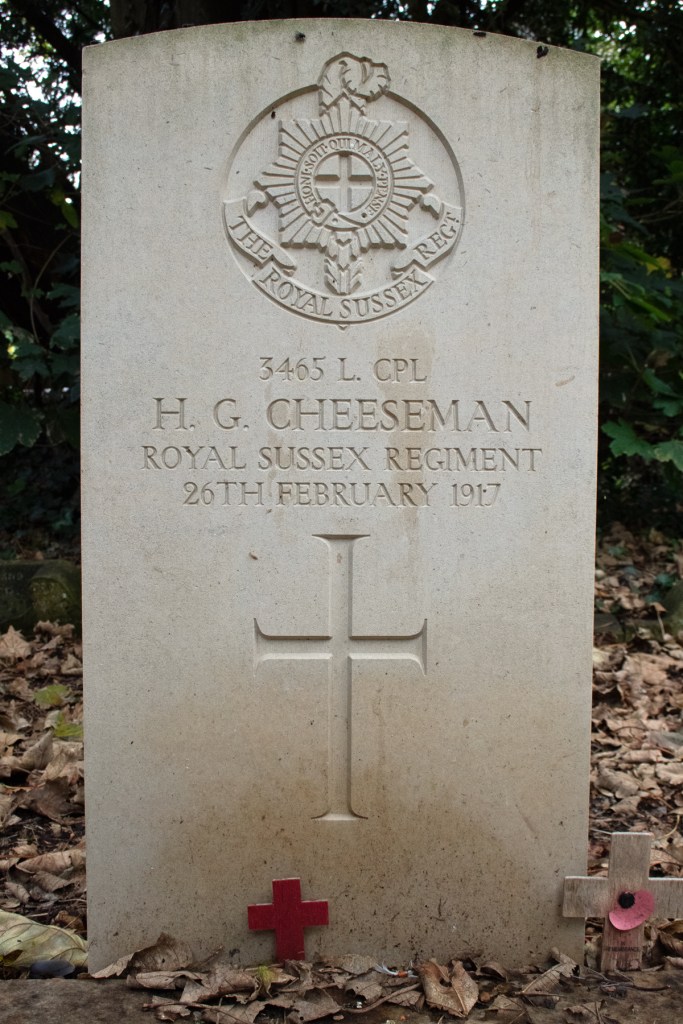
Harry George Cheeseman was born in the summer of 1893, one of eleven children to Charles and Sarah Cheeseman. Charles was an innkeeper, and ran the now-closed Red Lion Inn in Angmering, West Sussex for more than twenty years.
Harry did not follow in his father’s footsteps when he left school. Instead, he moved in with his older sister and her family in Horsham, where he worked as a roundsman on his brother-in-law’s dairy farm.
When war broke out, Harry was eager to enlist. He joined the Royal Sussex Regiment on 16th September 1914, and was assigned as a Private to the 9th (Service) Battalion.
Initially formed in Chichester, Private Cheeseman found himself moved to Portslade, then Shoreham, then Woking in Surrey, before eventually being sent to France at the beginning of September 1915. By this point, he had proved his worth and had been promoted to Lance Corporal.
Harry’s bravery shone through; in November 1915, while battle was raging, he brought an injured colleague into a field hospital and was about to rescue another when he himself was injured. His wound – a gun shot wound to the spine – was initially treated on site, but he was soon evacuated back to England.
Lance Corporal Cheeseman’s injuries proved to be life-changing. A later newspaper report stated that he had been “physically helpless” [Worthing Gazette: Wednesday 5th March 1917], so paralysis seems likely. Awarded the British and Victory Medals and the 1914 Star, he was medically discharged from the army in May 1916.
Harry returned home, but never really recovered from his injuries. He died on 26th February 1917, at the tender age of 23 years old. His funeral “which was of a most impressive character, was witnessed by five hundred people” [Worthing Gazette: Wednesday 5th March 1917], and he was laid to rest in the graveyard of St Margaret’s Church in his home town.
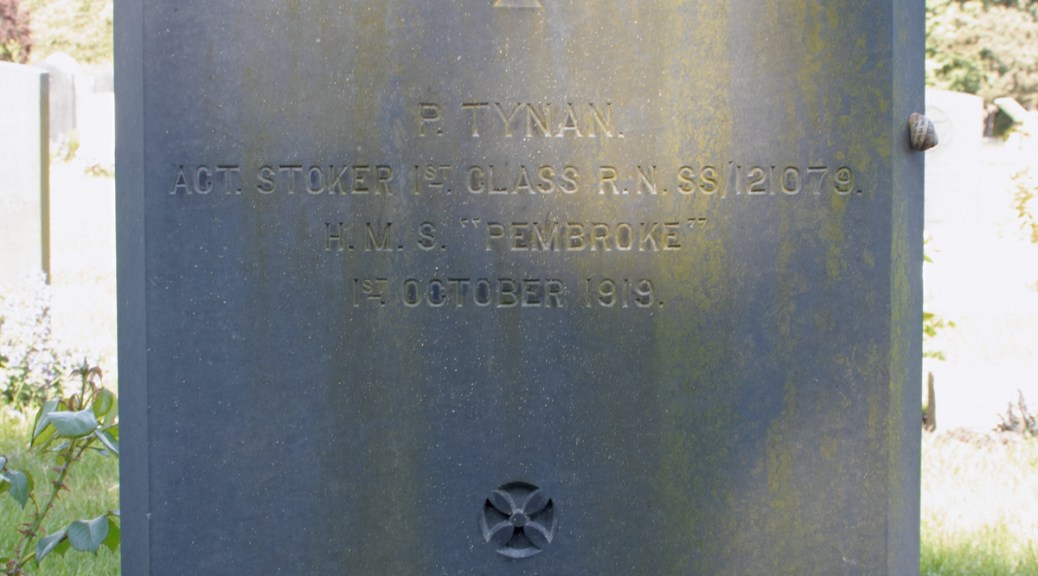
Patrick Tynan was born in Roscrea, Southern Ireland, on 9th June 1893. He was the eldest of four children to John and Anne Tynan, but sadly, there is no further information available for his early years.
Patrick’s story really picks up on 14th December 1915, when he joined the Royal Engineers as a Private. His service record states that he was living in Bangor, Gwynedd, and that he was a stall keeper at a fairground – a subsequent document noted his trade as a showman. He was noted to be 5ft 8ins (1.72m) tall, weighed 151lbs (68.5kg), and had numerous scars on his back.
Private Tynan did not stay in the UK for long. Assigned the new role of Driver, he was attached to the GHQ Signal Company and sailed from Devonport on 30th June 1916, bound for Mesopotamia. Arriving in Margil – the port connected to Basra – he was based here for more than a year, before moving north to Baghdad.
By this time, Patrick had risen to the rank of Lance Corporal, and was obviously a trustworthy member of the company. Towards the end of 1917, he had again been promoted, this time to Corporal.
During his time in modern day Iraq, Patrick was admitted to hospital a handful of times; there is little information on the conditions he suffered, but none appear to have been life threatening, as they were only for short periods. It’s also interesting to find that his service records confirm a month’s leave in May 1918, spent in India.
When the war came to a close, Corporal Tynan was still in the Middle East. Ready to be demobbed, his company moved to India and boarded the SS Chupra in Calcutta on 26th February 1919, bound for home.
Back in the UK, however, Patrick was not ready to give up the formal military life. Having returned to Gillingham in Kent, where the Royal Engineers were based, he initially found work as a tram conductor, but soon signed up for a five year term with the Royal Navy as a stoker.
He was based on HMS Pembroke II, the shore-based establishment at Chatham Dockyard, but sadly, his time in the navy was to be a short one. Admitted to the Royal Naval Hospital in the town with pneumonia, he passed away form the condition on 1st October 1919. He was just 26 years old.
Patrick Tynan was laid to rest in the Woodlands Cemetery in Gillingham. He had a short but full life, something his modest gravestone doesn’t begin to hint at.
Herbert George Rendell was born in the summer of 1886, the oldest of six children to George and Catherine Rendell. George was a twine maker from West Coker, near Yeovil in Somerset, and it was in this village that he and Catherine raised their young family.
While he initially found work as a labourer when he left school, the lure of a better life and career proved too much for Herbert and, in June 1905, he enlisted in the Royal Engineers as a Sapper. He spent three years spent on home soil, working hard and earning a Good Conduct medal for his service. During his tour of duty, he contracted pneumonia, spending five weeks in hospital in Chatham, Kent, over Christmas 1905, but fully recovering.
In September 1908, Herbert was sent to Singapore for a three-year tour of duty with the 21st Company. His body was not accustomed to the different environment, and he was hospitalised three times for malaria and myalgia, as well as two bouts of gonorrhoea in 1908 and 1910.
In December 1911, Sapper Rendell returned home, where he served for a further three years before war broke out in the summer of 1914. Having been promoted to Lance Corporal, and after a short bout in hospital following a reaction to his cowpox vaccination, he was sent to Egypt.
Assigned to the 359th Water Company, he would have been charged with constructing and maintaining the supply pipes to and from the Front Line and for his work was soon promoted to Corporal.
In the spring of 1918, the now Sergeant Rendell was transferred to the 357th Water Company, and found himself in Palestine, where he stayed until the end of the war. He came home on leave in April 1919, and it was here that, once again, he contracted pneumonia.
Sadly, Sergeant Rendell was not to recover from the lung condition for a second time; he passed away at his parents’ home on 9th April 1919, at the age of 32 years old.
Herbert George Rendell was laid to rest in Yeovil Cemetery, not far from the village where he was born.
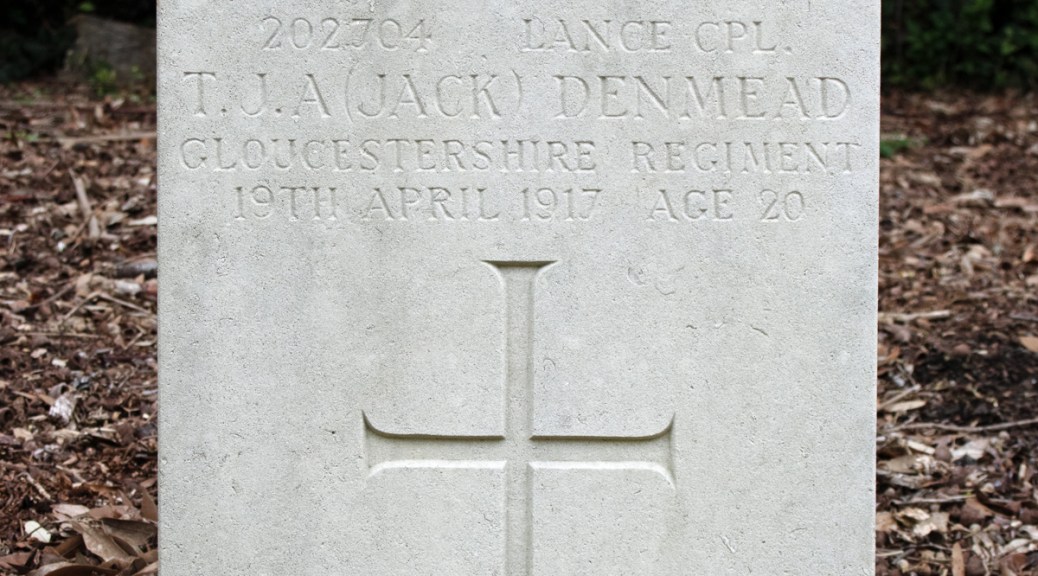
Thomas John Ambrose Denmead – better known as Jack – was born in Yeovil in the summer of 1896. The oldest of seven children, his parents were Thomas and Elizabeth Denmead. Thomas was a glover – the key industry in the Somerset town – who raised his young family in the middle of the town.
When he left school, Jack found work as a clerk at Petters’ Ltd, a local engine manufacturer and iron foundry. War was on the horizon, though, and he enlisted in the spring of 1916.
Jack joined the Gloucestershire Regiment, and was assigned to the 2nd/4th (City of Bristol) Battalion. He was sent to France in May 1916, and was involved in the Attack at Fromelles, part of the larger Somme offensive. He had started as a Private, but rose to the rank of Lance Corporal.
Towards the end of 1916, Jack fell ill. He was medically evacuated to the UK, and was admitted to the Royal General Infirmary in Paisley, Scotland. His condition was serious enough to need an operation, but the Lance Corporal sadly passed away not long after this treatment. He was just 20 years of age.
Jack’s body was brought back to Somerset for burial. He was laid to rest in the cemetery in his home town, Yeovil.
Albert William Romain was born in Gillingham, Kent, at the start of 1888, the middle of three children to Henry and Florence. Henry was a Sergeant in the Royal Engineers and is seemed inevitable that his son would follow suit.
Henry died in 1896, and was buried in the Grange Road Cemetery, Gillingham (now a public park). The 1901 census recorded Albert as a pupil at the Duke of York’s Royal Military Asylum in Chelsea. This was, in fact, a school for the children of soldiers, and it is likely that Albert was sent there to be educated when his father died.
The Royal Engineers obviously proved too great a lure for the young Albert. While full details of his service are not available, he had definitely enlisted early on, and was listed as a Lance Corporal in the Tempe barracks in Bloemfontein, South Africa in the 1911 census.
When war broke out, he was called back to Europe, as was on the Western Front by November 1914. Little further information on Albert is available – during the conflict he was assigned to D Company of the Royal Engineers, but the end of the war, he had become a Sergeant in the 1st Reserve Battalion.
In November 1918, back on UK soil, he was admitted to the Fort Pitt Military Hospital in Chatham, Kent. His condition is unclear, but sadly it was to be one to which he would succumb. Sergeant Romain died on 8th November 1918; he was just 30 years old.
Albert William Romain was laid to rest with his father in the Grange Road Cemetery. He is commemorated in the Woodlands Cemetery in his home town of Gillingham, Kent.