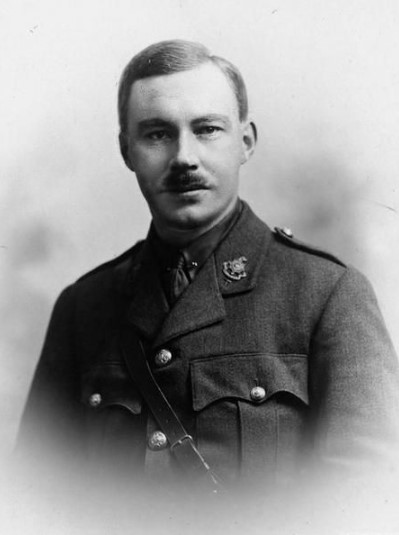
Frederick Charles Evelyn Liardet was born in Brighton, now a suburb of Melbourne, Australia, in 1888, and the eldest son of Wilbraham and Eleanor Liardet.
There is little further information about Frederick’s early life, but, when war broke out, he wanted to play his part for King and Country, and enlisted in the Devonshire Regiment.
He had an adventurous career… Having been twice wounded while on active service in France, he was appointed an instructor in the Balloon Section of the Royal Flying Corps.
Exeter and Plymouth Gazette: Tuesday 18th December 1917
On 23rd October 1915, Frederick married Kathleen Norah Liardet in Highweek, Newton Abbot, Devon. She was the daughter of a retired Lieutenant Colonel in the Royal Marine Light Infantry, and may have been a cousin (while their surname is unusual enough for there to be a connection, I have been unable to identify a specific connection). The couple went on to have a daughter, Barbara, who was born in 1917.
In 1916, while on a night flight with the Royal Flying Corps, the now Lieutenant Liardet was involved in an accident and badly injured. He returned to England to recover, he and Kathleen living with her family. While his health initially improved, he relapsed and passed away on 13th December 1917, aged just 29 years old.
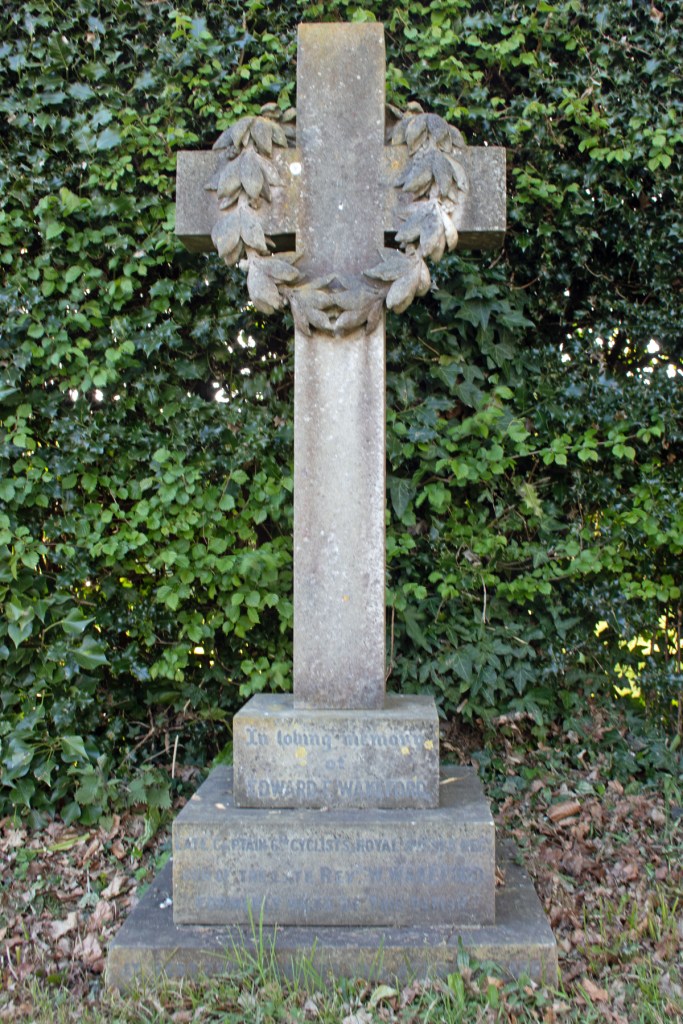
Frederick Charles Evelyn Liardet was laid to rest in the graveyard of All Saints Church in his adopted home of Highweek, Devon.
Alan Edward Lloyd was born in around 1899, the second of five children – all boys – to William and Edith Lloyd. Both of his parents were Welsh, and his older brother was born in Cardiff. Railway clerk William moved around the country with work, however, and Alan was born in Lydney, Gloucestershire, his younger brother in Paddington, London, and his two youngest siblings were born in Windsor, Berkshire.
There is little information about Alan’s early life; what is clear is that, by the autumn of 1918, he had been in the army, reaching the rank of Lieutenant. He transferred across to the newly formed Royal Air Force and, in December that year was training as a Flight Cadet at Shotwick Airfield near Chester.
On the 4th December, Alan was flying his Sopwith Camel, when he got into a flat spin; the aircraft crashed and Alan was killed. He was just 19 years old.
Alan Edward Lloyd was brought to Devon – where his family were now living – for burial. He was laid to rest in the graveyard of All Saints Church in Highweek, near Newton Abbot.
Cecil George Lunell Pearse was born in the spring of 1883, one of seven children to George and Elizabeth Pearse. George was a schoolmaster from Devon, who moved the family to Weston-super-Mare in Somerset in the the 1870s to take up a post at the National School in the centre of the town.
Cecil and at least two of his siblings also went on to become teachers. By the time of the 1911 census, he was living in Plumstead, South East London, with his brother and sister-in-law, and teaching locally.
War was about to descend on Europe, and it is at this point that Cecil’s trail begins to go cold. He enlisted in the Royal Field Artillery, serving as part of the 8th London Howitzer Brigade. During his time, he rose to the rank of Lieutenant, and it seems that he remained part of the Territorial Force, but there is little more information available about his time in the army.
Nor is there much detail around Lieutenant Pearse’s death. He passed away on 20th October 1918, at the age of 35 years old, through causes unrecorded.
Cecil George Lunell Pearse was laid to rest in the Milton Road Cemetery in Weston-super-Mare, the town of his birth.
Stafford Edmund Douglas was born on 4th January 1863, the second of four children to Stephen and Mary Douglas. Stafford came from a military family, his father having been a Captain in the Royal Navy. This led to a lot of travelling and, having been born in Donaghadee, County Down, he then moved to South Wales.
By the 1880s, when Stephen and Mary had set up home in Portsmouth, Stafford had started to carve out a career for himself, and was a Lieutenant in the Argyll and Sutherland Highlanders, based at Edinburgh Castle.
Over the coming years, Lieutenant Douglas, who stood 5ft 8.5ins (1.74m) tall and also spoke French, travelled the world, serving in South Africa, Ceylon (Sri Lanka) and Hong Kong. By 1894 he had made Captain, and he finally retired in 1903, after nineteen years’ service.
On 29th April that year, at the age of 40, Stafford married Mary Louisa Harris. She was the daughter of an army colonel, and the couple wed in St George’s Church, Hanover Square, London. The couple set up home in Exeter, Devon, and went on to have two children – Violet and Stafford Jr.
At this point, Stafford’s trail goes cold. When war broke out in 1914, he was called back into duty, working as a Railway Transport Officer in Norwich. He continued in this role until 1919, before being stood down and returning home.
Stafford Edmund Douglas passed away on 15th February 1920, at the age of 57 years old, although no cause of death is immediately apparent. He was laid to rest in the Milton Road Cemetery in Weston-super-Mare, presumably where his family were, by this time, residing.
Herbert William Hare Marshall was born in Ambala, India, on 19th August 1890. His father – Herbert Seymour Marshall – was a Colonel in the army, and was serving in India with his wife, Charlotte, when their children – Charlotte (known as Jessie) and Herbert Jr – were born.
The family were back in England by 1898, and had set up home in the Somerset seaside town of Weston-super-Mare. When Herbert Sr passed away that year, Charlotte was set up on a widow’s pension, and this allowed her to send her son to St Peter’s, a private boarding school in the town.
When her son’s schooling was complete, Charlotte took the family off to Canada. They settled in British Colombia, in Revelstoke, a mountain town halfway between Calgary and Vancouver. Here, Herbert found work as a bank clerk, but war came to Europe, and he felt a need to do his bit for King and Country.
Herbert enlisted in the Canadian Expeditionary Force (CEF) in November 1914; his service papers record him as being 5ft 8ins (1.73m) tall, 148lbs (67kg) in weight. He had black eyes, brown hair and a dark complexion – something that he may well have inherited through his mother’s genes.
Shipped to England, by August 1915, Private Marshall had been discharged from the CEF as part of a transfer to the New Army – also known as Kitchener’s Army, the volunteer British Army raised as a direct result of the outbreak of war.
Detailed information about Herbert’s military service is lacking, although it seems that he joined the 17th Battalion of the West Yorkshire Regiment, one of the regiments heavily involved during the Battle of the Somme.
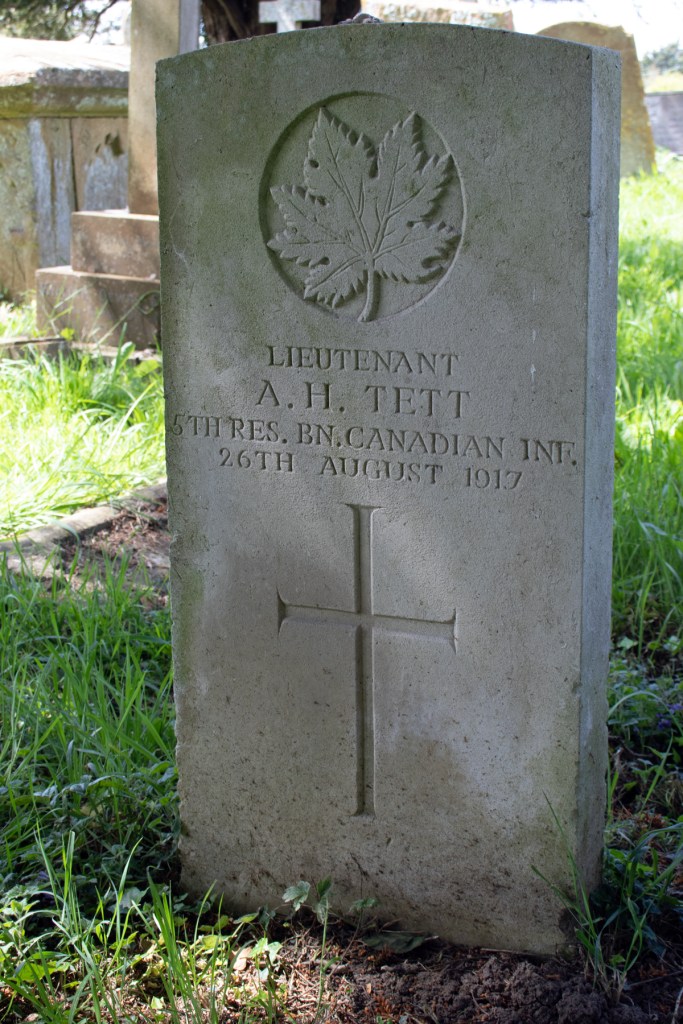
By October 1916, however, the now Lieutenant Marshall had made another move, this time joining the Royal Flying Corps. On the afternoon of 26th August 1917, he was an observer on a flight at Marham, in Norfolk. The pilot, a Lieutenant Challington, was banking the aircraft, when it dived and crashed, killing both men. Lieutenant Marshall had turned 27 years old the week before.
Herbert William Hare Marshall’s body was brought back to his adopted home of Weston-super-Mare. He lies at rest alongside his father in the town’s Milton Road Cemetery.
Basil Scott-Holmes was born on 2nd February 1884 in the Somerset village of Wookey. The oldest of two children, his father was Liverpool-born Thomas Scott-Holmes and his wife, Katherine. When Basil was born, Thomas was the vicar of St Matthew’s Church, Wookey, but by 1901, he had risen to the role of clergyman – and subsequently Chancellor – at Wells Cathedral.
Basil’s pedigree stood him in good stead. Initially educated in Llandaff, South Wales, he subsequently attended Sherborne School in Dorset. Sent up to Cambridge, he studied history at Sidney Sussex College.
After leaving university, Basil spent time in Europe learning German and French. He was then assigned the role of Assistant Commissioner in North Nigeria but, after a year there he was invalided home taking up a teaching role at the Bristol Grammar School in 1912.
In July 1913, Basil married Barbara Willey, a surgeon’s daughter from Reigate, Surrey. The marriage record shows that Basil was registrar for an architectural association by this point; the couple went on to have two children, daughters Annette and Prudence.
When the war broke out, he was obviously keen to do his bit. In September 1914 he enlisted in the Royal Army Service Corps, before gaining a commission in the King’s Royal Rifle Corps a couple of months later. In the spring of 1916, Lieutenant Scott-Holmes had been seconded to the Machine Gun Corps, although it is unclear whether he served abroad during any of his time in the army.
On the evening of 24th October 1916, Lieutenant Scott-Holmes was riding in a motorcycle sidecar through central London, on the way back to camp. A local newspaper picked up the story:
…they stopped when going through Wandsworth to re-light the near light, and in the dark a motor omnibus ran into them, and Lieutenant [Scott-Holmes], who was strapped in the side-car, was, with the car, flung across the road. He died as he was being taken to Wandsworth Hospital. At the subsequent inquest, a verdict of “accidental death” was returned.
Central Somerset Gazette: Friday 3rd November 1916
Basil Scott-Holmes was just 32 years old. His body was brought back to Somerset; he was laid to rest in the cemetery at Wells Cathedral.
John Scrace was born on 31st July 1892 in Chatham, Kent, the oldest of five children to John and Adelaide Scrace. John Sr was a relieving officer for the Medway Board of Guardians, a role which involved “taking charge of poor or insane persons not otherwise cared for” [census1891.com]. Adelaide worked in a similar role, as an infant protection visitor.
It is fair to say, therefore, that John Jr had a very supportive childhood. He attended King’s School in Rochester, where he obtained a scholarship to Peterhouse College, Cambridge.
When war broke out, John was keen to do his part. Initially joining The Buffs (the East Kent Regiment), he transferred across to the newly-formed Royal Air Force in June 1918. By this point he had risen to the rank of Lieutenant, and, as part of his new RAF role, was based at Driffield in Yorkshire.
On 24th August 1918, the aircraft John was flying at the base, spun into the ground, and John was killed instantly. A subsequent inquest identified that “the cause of the accident was due to the fact that, for reasons unknown, part of the top of the left-hand plane of the machine crumpled up in the air and thereby [caused] the pilot to lose control of his machine.” [rafmuseumstoryvault.org.uk] Lieutenant Scrace was just 26 years of age.
John Scrace was buried in Christ Church Churchyard in Luton, Kent; he is commemorated in Woodlands Cemetery in nearby Gillingham.
William Thomas Cole was born in the spring of 1897, the youngest of three children to John and Caroline Cole. John was a bank cashier from Gillingham in Dorset, while Caroline was born in Battersea, London. By the time of William’s birth, however, the young family had settled in the Dorset town of Blandford.
John was a man with ambitions for himself and his family. The 1911 census records him and Caroline living in Axbridge in Somerset, where he was now a bank manager. William, meanwhile, was a student in Wareham, Dorset, and was lodging at a boarding house in the town.
There is little documented about William’s military service. His gravestone confirms that he had originally enlisted in the Dorsetshire Regiment, but had subsequently joined the Royal Air Force, when it was formed in April 1918. By the time of his death, he had reached the rank of Lieutenant, so it would seem that his John’s ambitious nature had rubbed off on his only son.
William’s death was reported in a number of contemporary newspapers:
Lieutenant WT Cole and First Air Mechanic H Keates were killed while flying in South Essex last night. They were both in the same machine, which nose-dived and crashed into the ground. Cole’s home is at Shaftesbury, Dorset, and Keates’ at West Wood Grove, Leek, Staffordshire.
Dundee Evening Telegraph: Thursday 24th October 1918
Lieutenant Cole was flying in Hornchurch, Essex, and was in an Avro 504K bi-plane. He was just 21 years old when he died on 23rd October 1918. There is little further information about the accident, but highlighting the real danger in aviation at the time, this was one of eight fatal plane crashes across the UK that day alone.
The body of William Thomas Cole was brought back to Shaftesbury, where his parents were by then living. He was laid to rest in the Holy Trinity Churchyard in the town.
Ernest Henry Hutchinson was born in January 1878, one of four children to Dorothy Hutchinson, from Blyth, Northumberland. Details of Ernest’s father are sketchy and, by the time of the 1891 census, Dorothy seems to have been widowed and remarried, as her surname was now Alexander.
By this time Ernest was at school, and boarding with his aunt and uncle, but his siblings were all living with Dorothy and listed as ‘step-children’. Dorothy gave her employment as ‘housewife; husband at sea’, and it seems that this was likely her first husband’s job and, in fact, it would turn out to be her eldest son’s as well.
Ernest disappears from the census records for a while, but had readily taken to a life at sea. Over the next few years, he became certified as a Second Mate of a Foreign-Going Ship (1897), First Mate of a Foreign-Going Ship (1899) and Master of a Foreign-Going Ship (1904).
When war broke out, Ernest was seconded into the Merchant Navy. Sadly, his military records no longer exist, but during his time he attained the rank of Lieutenant. Ernest survived the war, and was retained as part of the Royal Naval Reserve, while continuing with his own sailing work.
At some point, Ernest married a woman called Emma Jane; documentation on the couple is scarce, so the date of the marriage is lost to time. The couple settled, however, in Weston-super-Mare, Somerset, but do not appear to have had any children.
Ernest’s maritime career continued after the war. One of his commissions was as First Mate aboard the SS Treveal. This was a new vessel in 1919, making its maiden voyage from Glasgow to the Middle East. It then sailed on to Calcutta, and was on its way back to Dundee by the beginning of 1920.
A local Cornish newspaper took up the story.
The terrible toll of 36 lives were levied by the wreck of the St Ives steamer Treveal, off the Dorset Coast on Saturday morning. The crew totalled 43, only seven surviving.
The Treveal, 5,200 tons, one of the Hain fleet of steamers, was caught by a fierce gale during Friday night and was firmly wedged on the Kimmeridge Ledge, near St Alban’s Head.
A Portland tug and Swanage lifeboat came to her assistance, but were unable to lend any practical aid, and on Saturday morning the Treveal was abandoned in favour of the ship’s boats. The latter were soon capsized and only seven of the crew succeeded in reaching the shore.
West Briton and Cornwall Advertiser: Monday 12th January 1920.
The report went into much more detail about the tragedy, including “a warm tribute to the vicar of a parish nearby, the Revd. Pearce, who stood up to his neck helping to pull the men in. The vicar tried for an hour to resuscitate the First Mate [Ernest Hutchinson], but without success.“
Another newspaper gave further information about Ernest’s funeral, and the impact of the shipwreck on his widow.
There was a simple but affecting scene in Weston-super-Mare Cemetery on Saturday afternoon, when the body of Chief Officer EH Hutchinson, one of the 35 victims in the wreck of the SS Treveal… was laid to rest.
It will be recollected that… the first tidings of his tragic fate reached the widow… through the columns of a Sunday newspaper. Only on the previous morning she had received a letter notifying the date on which the Treveal was due to reach Dundee – whither the major portion of her cargo has been consigned from Calcutta – asking him to meet her there.
Western Daily Press: Monday 19th January 1920
Ernest Henry Hutchinson drowned at the age of 42 years old. He was buried in the Milton Cemetery in his adopted home town of Weston-super-Mare in Somerset.
Alfred William Betty was born early in 1869, one of ten children to John Betty and his wife Hannah. John was a blacksmith, and the family lived in the Somerset town of Taunton.
After leaving school, Alfred found work as a silk throwster, twisting silk into thread or yarn. Thus was not the long term career that he sought, however, and in 1887 he enlisted in the Rifle Brigade. During a period of service that lasted 21 years, he fought in India and South Africa, rising to the rank of Quartermaster-Sergeant by the end of his tenure in 1908.
In 1896, Alfred had married Elizabeth Johnson, also from Taunton, who was herself the daughter of a soldier. The couple went on to have three children, two of whom survived – daughters Ella and Hazel.
By the time of the 1911 census, the family had set up home in Taunton. Alfred, now back on civvy street, was working as a clerk and had become involved in the town’s Holy Trinity Men’s Club.
War was on the horizon, however, and when hostilities broke out, Alfred quickly re-enlisted. Within a month of re-joining the Rifle Brigade, he was given a commission in the 13th Battalion. After initially being based in Winchester, by the summer of 1915 Lieutenant Betty found himself on the Front Line. He was involved in some of the fiercest fighting, and was caught up in the Battle of the Somme.
It was here that Alfred fell ill. While full details of his condition are not readily available, he contracted a prolonged illness, as a result of “hardship and exposure” [Western Daily Press, Saturday 24th March 1917].
Whatever the condition, it was serious enough for Lieutenant Betty to be invalided back to England and out of the army, and he returned to his family home in Taunton.
Sadly, Alfred’s condition was to take its toll on him, and he finally succumbed to it on 23rd March 1917. He was 48 years old.
Alfred William Betty lies at peace in St Mary’s Churchyard in his home town of Taunton in Somerset.