Tag Archives: brothers

Lieutenant Alexander Spurway

Lieutenant Alexander Spurway

Alexander Popham Spurway was born on 8th April 1891 in Newbury, Berkshire. He was the second of six children to Edward and Gertrude Spurway. Edward was a clergyman, and the family moved to Heathfield in Somerset when Alexander was a small boy. Education was key to Edward and, the 1901 census records show Alexander as being a boarder at the Portmore School in Weymouth, Dorset.

Reverend Spurway set the family up well in Heathfield: by the time of the next census in 1911, the family were living in the village rectory, with five members of staff.

Alexander, meanwhile, had taken a different route, entering the Royal Naval College at Osborne on the Isle of Wight in January 1904. He was a keen sportsman and, while there, he represented the college at both cricket and football.

In September 1908, he passed out from the college as a Midshipman, and served on HMS Canopus in the Mediterranean. His career continued, and he was made Sub-Lieutenant in December 1911, and Lieutenant two years later.

Reverend Spurway died at home in February 1914 and, by the time war broke out, Lieutenant Spurway was assigned to HMS Achilles. He remained on board the cruiser for the next two years and it was during this time that he developed diabetes: something that was to prove an ongoing issue for him.

Returning home in the autumn of 1915, the condition was to prove too much, and he passed away on 29th November 1915, at the age of 24 years old.

Alexander Popham Spurway was laid to rest in the graveyard of his late father’s church, St John the Baptist in Heathfield.


Lieutenant Spurway (from findagrave.com)

Sadly, Alexander was not the only member of the Spurway family to lose their life as a result of the war.

Richard Popham Spurway, Alexander’s older brother, was a 2nd Lieutenant in the Somerset Light Infantry, and was attached to the Hampshire Regiment, when it was moved to Gallipoli in 1915. He was killed on 13th August 1915, and is commemorated on the Helles Memorial at Canakkale, Turkey.

Alexander’s younger brother, George Vyvyan Spurway, joined the Royal Fusiliers, before transferring to the Machine Gun Corps. He had arrived in France in September 1916, and was killed while fighting on the Western Front on 28th March 1918. He was laid to rest at Arras and is commemorated on the memorial there.

Flight Lieutenant Lewis Morgan

Flight Lieutenant Lewis Morgan

Lewis Morgan was born on 22nd May 1892 in Plymouth, Devon. He was one of six children to former army officer and rector Lewis Harold Gilbert Morgan and his wife, Mary.

Growing up in Plymouth, it seems inevitable that the sea life would take hold in Lewis Jr. He first took up a post in the Merchant Navy, rising to Second Mate in December 1911.

By this point, however, he had set his sights on something more formal and soon enlisted in the Royal Navy. He served on a number of vessels over the years, and was re-engaged when war broke out. By the summer of 1915, he transferred to the Royal Naval Air Service, earning his wings on 5th August that year.

The now Flight Lieutenant Morgan’s service grew as the war continued. The life of air crew at this point in the era of flight was notoriously dangerous, and Lewis was to meet his own fate. On 11th May 1917, he was flying with Probationer Flight Officer Randolph Seed around Edmonton, Middlesex, when an accident occurred. The local newspaper reported on the incident and the subsequent inquest:

Flight-Lieutenant Mitchell gave a graphic account of the accident. He said that about eight o’clock in the evening he was flying at a height of 1,000 feet, and the machine containing the deceased officers was just ahead, but 500 feet higher. The flying conditions were good, and at the time both machines were going steadily. Glancing upwards he notices that the other machine suddenly appeared to collapse, the front extension of the main plane crumpling up. The machine nose-dived, and a black object fell out of it. The machine continued its descent and fell into the Edmonton Sewage Farm… The machine was so entirely broken up that it was impossible to theorise upon the cause of the accident. Morgan was said to have fallen on a concrete path. The deaths were instantaneous.

Taunton Courier and Western Advertiser: Wednesday 23rd May 1917

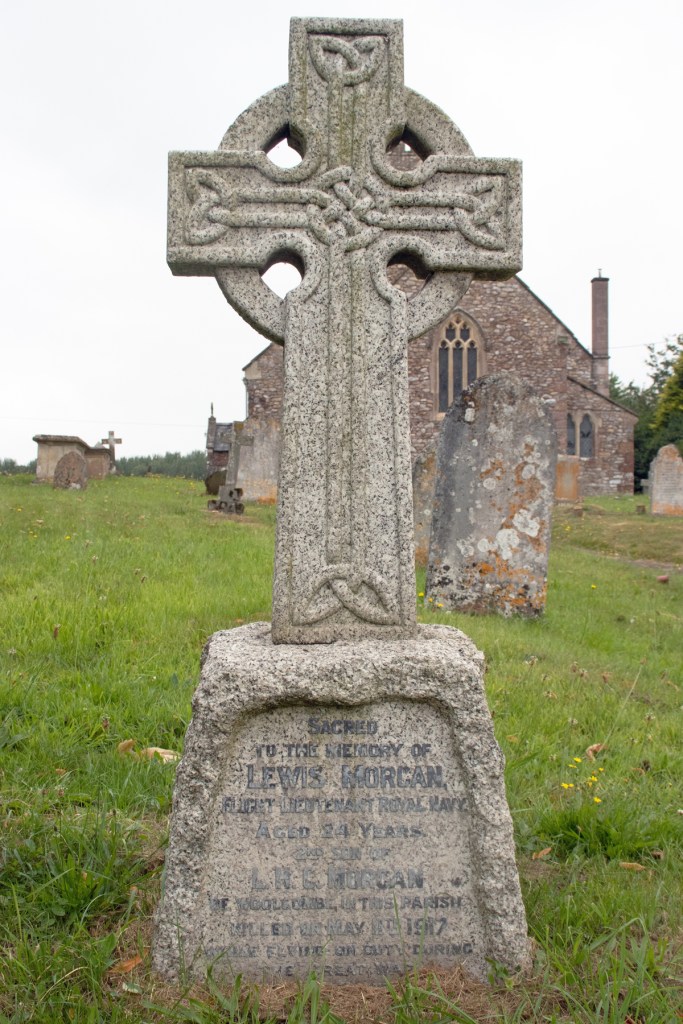
Lewis Morgan was just 24 years old, and days away from his 25th birthday. His body was brought back to Somerset, and laid to rest in the graveyard of Holy Cross Church in Sampford Arundel. By this point, his parents were living in the nearby Woolcombe House, so their son was, in a way, brought home.


The newspaper article went on to report that Flight Lieutenant Morgan was the third and last son to Lewis and Mary.

Francis Morgan – five years Lewis’ senior – enlisted in the Royal Field Artillery when war broke out. He rose to the rank of Captain, and was mentioned in Despatches for his actions. He was killed in the Dardanelles – potentially at Gallipoli – on 2nd May 1915, at the age of 28 years old.

Walter Morgan was a year younger than Lewis. He also played his part in the First World War, joining the South Lancashire Regiment, and rising to the rank of Second Lieutenant. Walter was also sent to fight in Gallipoli, and this is where he also lost his life. He was killed just three months after Francis, on 9th August 1915. He was just 22 years of age.

The loss of three sons in two years was to take a further toll on the Morgan family. Mary had suffered from poor health for a while, and the deaths of Francis, Walter and Lewis was to prove too much. She passed away at home on 15th July 1917, aged just 56 years old.


Flight Lieutenant Lewis Morgan

Reverend George Sweet

Reverend George Sweet

George Charles Walrond Sweet was born on 4th December 1889, the oldest of three children to Reverend Charles Sweet and his wife Maud. A Church of England vicar, Charles moved around with his work, and, when George was born, he was based in Winterborne Kingston in Devon.

George was sent away to school, and, by the time of the 1901 census, Charles and the family had moved to Milton Lilbourne in Wiltshire, to tend the local flock.

After school, George studied at Oxford, then followed in his father’s footsteps by taking holy orders, and was soon appointed rector of Symondsbury, Dorset.

When war broke out, his calling was to serve in the Royal Army Chaplain’s Department. Details of his time during the conflict are unclear, although by the spring of 1919, he was attached to the headquarters of the Army of the Rhine.

It was here that he met Phyllis Squire Hickson, who was serving as a Nurse in the Queen Mary’s Auxiliary Army Corps. The couple fell in love and, in June 1919 they returned to England to marry. The wedding occurred on 6th August 1919, and the newlyweds set off on honeymoon the following day.

On his honeymoon tour, the Revd. George C Walrond Sweet… was drowned on Thursday evening in the Cherwell at Oxford, in the presence of his wife.

Mr and Mrs Sweet engaged a punt at Tims’s boathouse and went for a trip on the river. On returning about seven o’clock, when within 300 yards of the boathouse, the punt pole was embedded in the mud and, in attempting to dislodge it the pole broke.

Mr Sweet fell on the side of the boat and then over-balanced into the river. His wife tried to reach him, but without success, and then jumped into a second punt and from that into another boat, but failed to reach him, and he disappeared. The body was not recovered until a quarter of an hour had elapsed, and life was then extinct.

Mr Sweet, who was an MA of Keble College, was only married on Wednesday at St James’s Church, West Hampstead…

[Phyllis’ father] Mr William Hickson… said his daughter became engaged to Mr Sweet in France. He did not meet him until last Tuesday. They came to England to be married. Mr Sweet met with a bicycle accident some years ago and [he] understood from his daughter that her husband was unable to swim or take any active exercise, but while he had been in France his health had much improved.

It was stated [at the inquest] that Mr and Mrs Sweet had been married only one day when the accident occurred and Dr Brooks, a university coroner, said that the tragedy was one of the saddest that had ever come under his notice.

Taunton Courier and Western Advertiser: Wednesday 13th August 1919

The inquest confirmed that the punt pole had broken about 2.5ft (0.76m) from the top. When George was dragged from the river, artificial respiration was carried out for around 50 minutes, but proved unsuccessful. The inquest returned a verdict of accidental death. George was just 29 years of age.

Reverend George Charles Walrond Sweet’s body was brought to Somerset for burial. He was laid to rest in the graveyard of Holy Cross Church in Sampford Arundel, more than likely because he or his father had been vicars there.


This was the second tragedy to befall the Sweet family. George’s younger brother, Leonard, had been schooled in Sherborne, then at the Military College in Sandhurst. He joined the 1st Battalion of the Hampshire Regiment as Second Lieutenant on 5th February 1913, and was promoted to full Lieutenant in September 1914, and Captain in October 1915.

Captain Sweet was then attached to the 29th Squadron of the Royal Flying Corps, and gained his wings at the British Flying School in Le Crotoy, France, in August 1915. On 22nd June 1916, he was on patrol duty over the British lines, when he was involved in a skirmish, and his plane crashed, killing him instantly. He was just 23 years of age.

Captain Leonard Sweet was laid to rest at the Lijssenthoek Military Cemetery in Poperinge, near Ypres.

Captain Leonard Sweet
(from findagrave.com)

Phyllis Sweet never remarried. By the time of the 1939 England and Wales Register, she was living in Bridport, Dorset, and working as a political organiser and speaker. She passed away in August 1944 in Cannock, Staffordshire, at the age of 63 years old.


Private Tom Simmons

Private Tom Simmons

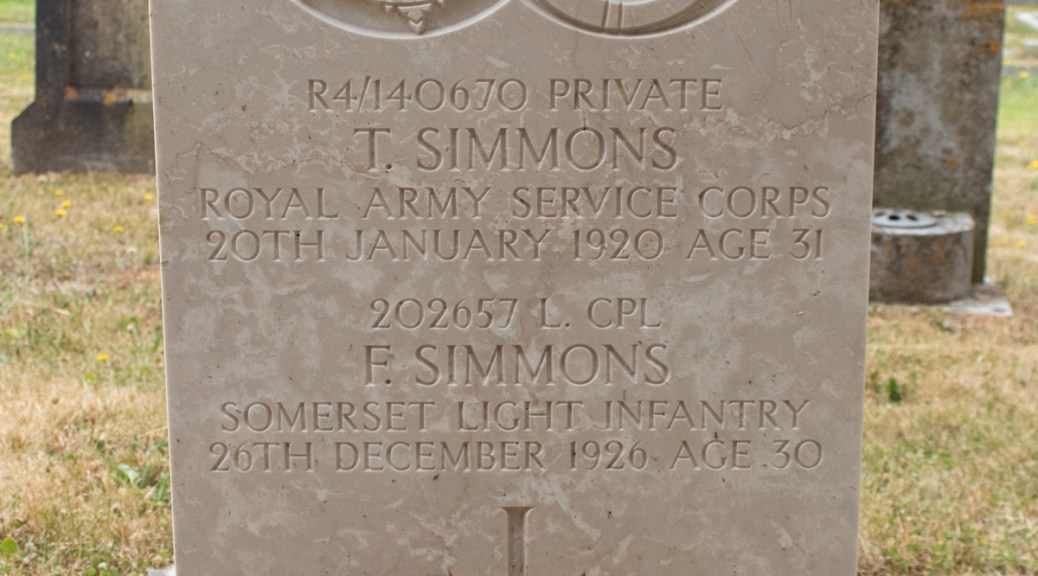
Tom Simmons was born early in 1889, one of fourteen children to William and Elizabeth Simmons. William was a farm labourer from Devon, who had moved to Runnington, near Wellington in Somerset, with Elizabeth in the late 1880s. This was where their growing family was born and raised.

Tom found work away from Somerset when he left school and, by the time of the 1911 census, he was lodging in a house in Llanwonno, Glamorgan. He was employed as an assistant machine repairer at the local colliery.

War was beginning to encroach on England’s shores, and Tom was to play his part. Full service details are not available, but he enlisted in the Royal Army Service Corps and served as part of a territorial force. For the part he played, he was awarded the Victory and British Medals and the Silver War Badge.

It would seem that Private Simmons survived the war and was demobbed, returning to Somerset at some point by the end of 1919. Sadly, his trail goes cold: the next record available is of his death – through causes unspecified – at home on 20th January 1920, at the age of 31 years old.

Tom was buried in Wellington Cemetery, not far from his family home.


Tom’s headstone also includes a dedication to a Lance Corporal F Simmons.

Frederick Simmons was seven years younger than his brother. When he left school, he worked as a wool spinner in the local wool mill. When war came to Europe, he too played his part. Again, full details of his service are sketchy, but he enlisted in the Somerset Light Infantry.

Like Tom, Frederick served as part of the territorial force, and worked his way to the rank of Lance Corporal. After the war he returned home, but his life there was not set to be a long one. He passed away, through causes not noted, on 26th December 1926. He was just 30 years of age.

Frederick was laid to rest in the same grave as his brother. Technically not entitled to an official Commonwealth War Grave (the rules are laid out here), his service was remembered alongside that of Tom’s.


Private Ernest Board

Private Ernest Board

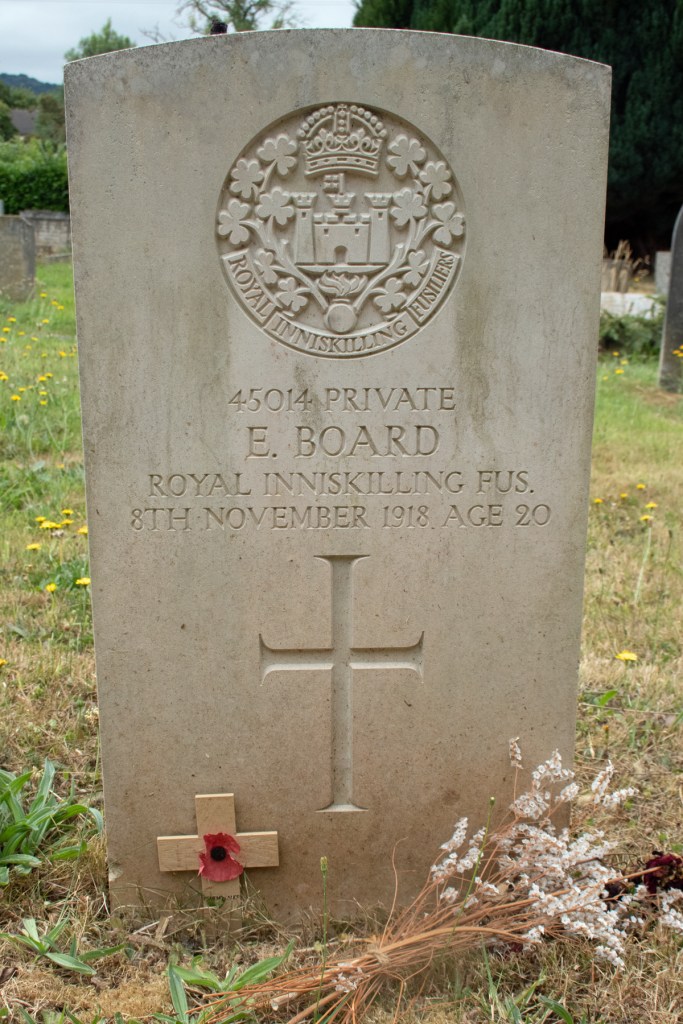
Ernest Board was born in Taunton, Somerset, on 20th September 1898 and was one of at least six children to Walter and Mary Board. Walter was a carter for the town’s gasworks, but, when Mary passed away in 1910, things changed dramatically for the family.

The 1911 census found Walter working as a cowman on a farm in Milverton, Somerset. All but two of his children are missing from that year’s national record, but Ernest and his older brother Arthur are noted as being ‘inmates’ at the National Nautical School in Portishead, near Bristol.

This was an establishment set up in 1869 for the destitute and neglected boys of the area. Ernest and Arthur were two of more than 320 students at the school which, at that time, was under the control of Commander Willoughby Still. School life was very strongly based on the running of a ship, with hammocks instead of beds, and a parade ground in front of the building.

There is no information about how long the brothers remained at the school, but, when war came to Europe, it would seem that they were keen to play their part. Sadly little detail remains of Ernest’s military life.

What can be determined, however, is that he enlisted in the Royal Inniskilling Fusiliers, and was assigned to the 1st Battalion as a Private. His battalion fought at, and were evacuated from, Gallipoli, before moving to France. There is no record where Private Board was involved, sadly, although his Medal Roll Card shows that he was assigned the Victory and British Medals, although may not have actually seen time overseas.

Private Board’s passing is also lost to time. All that can be confirmed is that he died on 8th November 1918, and was just 20 years of age.

Ernest Board was laid to rest in Wellington Cemetery, Somerset: as this is not far from where his father was recorded on the census seven years earlier, it is likely that his place of burial was due to family connections in the area.


Serjeant-Trumpeter Alexander de Vere

Serjeant-Trumpeter Alexander de Vere

Alexander Johnstone de Vere was born on 10th August 1889 in Murree, India (now Pakistan). He was one of five children to Norfolk-born Alexander Johnstone (also known as John Ralph de Vere), and his wife Dorothea who had been born in Sangor, India. Alexander Sr was a Sergeant Major in the 12th Lancers, and the family returned to England not long after his son was born, settling first in Aldershot, then in Sandhurst.

Alexander’s youngest sibling, George, was born in Cairo, Egypt, so the family was on the move again. Sadly, Alexander Sr died in a nursing home in the city just two years later and, after returning to England, Dorothea passed away in a Holborn infirmary just two years later.

Documents for the de Vere children – Ellen, Alexander, Dorothea, William and George – are few and far between. The 1911 census places Dorothea boarding with a family in Kingston-upon-Thames, where she was employed as a dress maker. The same document records William as a Bandsman in the 1st Battalion of the Seaforth Highlanders, based at Chanpatia, in Northern India. George, meanwhile, was a schoolboy at the Duke of York’s Royal Military School on the outskirts of Dover. Of the two eldest siblings, however, there is no record.

In the autumn of 1912, Alexander married Emily Louise Collins. Born in Norfolk in 1884, she was working as a servant in a house in Surrey when she and Alexander met. The couple married in Faversham, Kent, and settle down there, their daughter, Dora, being born in the town in January 1915.

Given his family’s military background, it is not unsurprising that Alexander enlisted in the army almost as soon as war was declared. He may have already seen military service, as he enlisted in the 11th Hussars as a Lance Corporal. By 15th August 1914, Alexander was in France.

Lance Corporal de Vere was quickly caught up in the fighting. He saw action at Mons and Nery in 1914, and at Ypres the following year. By this point, he had been promoted to the rank of Sergeant Trumpeter, reflecting the musical connection he shared with his younger brother, William.

Alexander remained in France until January 1916, when he was invalided home. He was admitted to Dorchester County Hospital in Dorset, suffering from a cerebral abscess. Despite treatment, he succumbed to the condition, passing away on 17th March 1916, at the age of just 26 years old.

Alexander Johnstone de Vere was brought back to Kent for burial. He was laid to rest in Faversham Borough Cemetery.


Private Herbert Macklin

Private Herbert Macklin

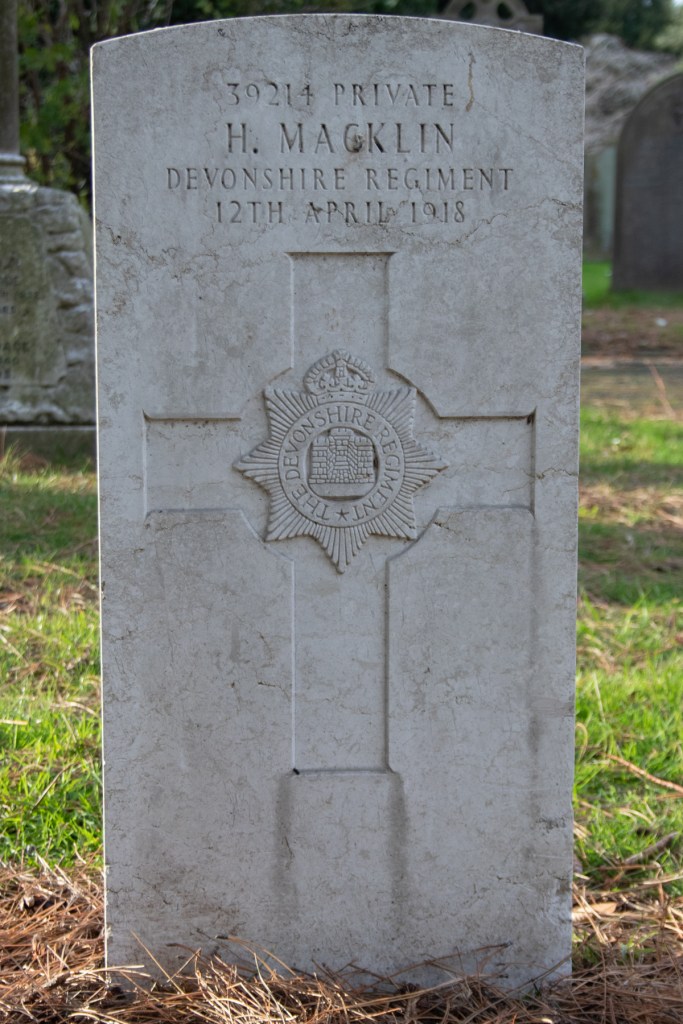
Herbert Macklin was born in Lambeth, Surrey, on 14th August 1897, the youngest of six children to Enos and Sarah Macklin. Enos was a general labourer and, after his mother died in 1909, Herbert worked around his school as a baker’s errand boy, to bring in a little more money for his family.

After Enos passed away in 1912, and with his older sisters all having families of their own, Herbert and his older brother William did what they could to survive, getting some support from the local poor school.

The outbreak of war gave the brothers a sense of purpose, and both enlisted. William joined the Royal Field Artillery, and was sent to France in September 1915.

Herbert, being six years younger than his brother, enlisted later than his sibling. He joined the Middlesex Regiment, on 10th May 1916, and his service records show that he was 5ft 4.5ins (1.64m) tall, 126lbs (57.2kg) in weight and had a fair physical development. While Herbert had a fair physical development, he was also recorded as having flat feet, which somewhat limited his army service.

Private Macklin transferred across to the Devonshire Regiment a few months after enlisting. He was then assigned to the regiment’s Labour Corps in the summer of 1917, and remained with them for the rest of his service.

While William was serving abroad, Herbert remained on home soil for the duration. By the spring of 1918, he was working in Kent, but was admitted to hospital in Faversham, suffering from acute tonsillitis. Sadly, this was to prove too much for Private Macklin’s body to take: he suffered cardiac failure, and died on 12th April 1918. He was 21 years of age.

Herbert Macklin was laid to rest in the Borough Cemetery of the town in which he passed, Faversham.


Tragedy was to strike again for the Macklin brothers: as the war moved into its closing months, Driver William Macklin was based in Salonika, Greece. He was not to see England’s shores again, sadly: he passed away on 23rd November 1918, aged just 27 years old.


Rifleman Frederick Burstow

Rifleman Frederick Burstow

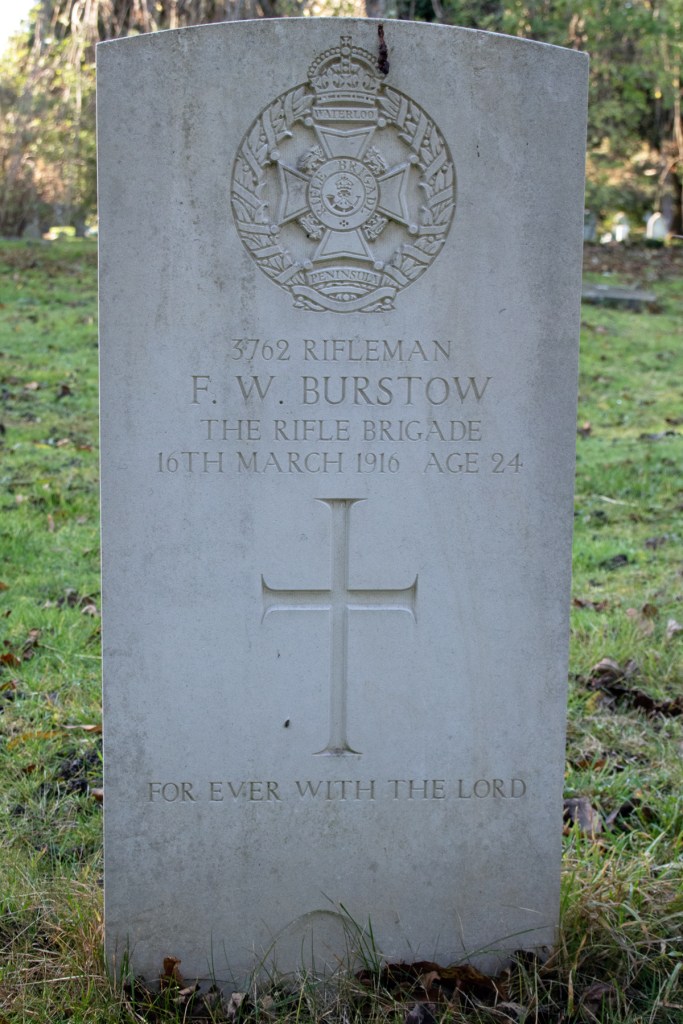
Frederick William Burstow was born in the summer of 1893, and was one of thirteen children. His parents were plasterer Alfred Burstow and his wife, Lydia. Both came from Sussex, and it was in Bexhill-on-Sea where they raised their family.

There is little documented about Frederick’s early life, but he sought a life outside of Sussex and, in around 1900, he enlisted in the 2nd Battalion of the Rifle Brigade, serving in India for a time.

Rifleman Burstow was still serving when, in August 1914, war was declared. His battalion was sent to France that November, and he ended up serving two terms on the Western Front.

In the summer of 1915, Frederick married Priscilla Epps. She was from Faversham, Kent, and this is where the couple set up home together.

It was while on his second term in France that Rifleman Burstow became ill. He had contracted enteric fever – also known as typhoid – and, at the beginning of 1916, he was sent home to recuperate. While here, Priscilla gave birth to a child, Alice.

Sadly, however, Frederick’s condition was to get the better of him: he passed away at home on 16th March 1916, at the age of just 24 years old.

Frederick William Burstow was laid to rest in the Borough Cemetery in his adopted home town of Faversham.


Rifleman Frederick Burstow
(from ancestry.co.uk)

Frederick was not the only Burstow family member to die during the war. His older brother, Arthur Edward James Burstow, fought on the Western Front with the 2nd Battalion of the London Regiment.

Private Burstow was caught up in the fighting in Arras in the spring of 1918, and was killed in action on 13th April. He was 38 years of age, and left behind a widow and six children.

Arthur Edward James Burstow is commemorated on the Ploegsteert Memorial in Belgium.


Stoker 1st Class William Banfield

Stoker 1st Class William Banfield

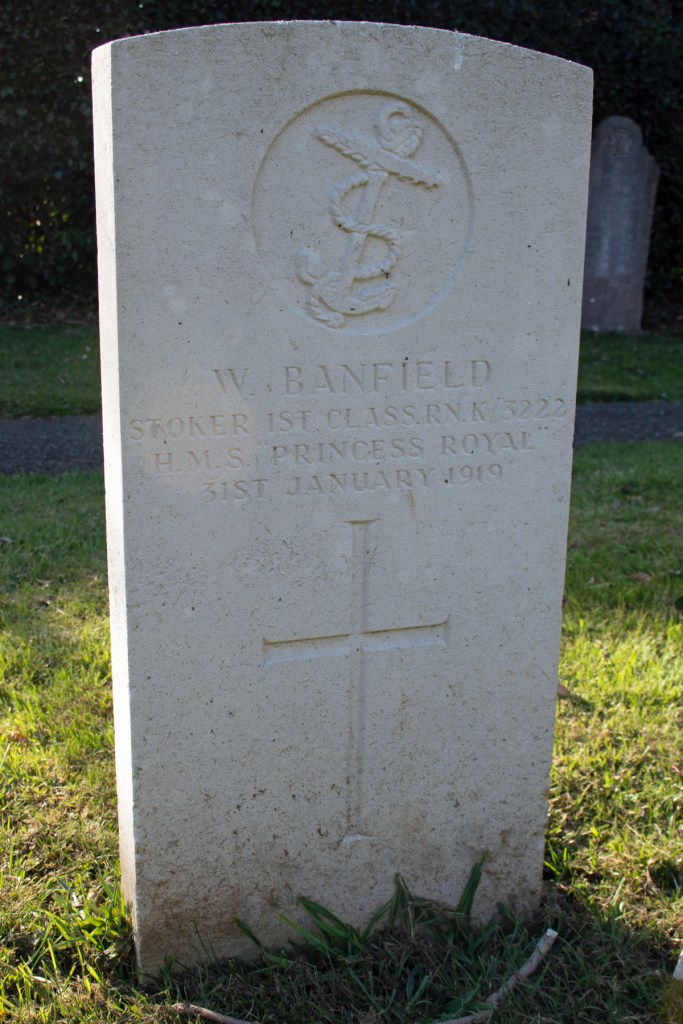
William Banfield was born on 7th November 1890, in Henfield, near Horsham, West Sussex. He was the second youngest of seven children to George and Ellen Benfield. George was a carpenter, and this was a trade his two sons – William and his older brother, George – were initially both to follow as well.

William had a longing for the sea, however, and, on 11th June 1909, he enlisted in the Royal Navy as a Stoker 2nd Class. His service records show that he was 5ft 7.5ins (1.71m) tall, had brown hair, blue eyes and a fair complexion.

Stoker Banfield was based out of HMS Victory, the Royal Naval Dockyard in Portsmouth, Hampshire, but, over the eventual decade of his service, he spent no more than seven months ashore. Instead, he served on a total of nine ships. This included the battleship HMS Exmouth where, during the eighteen months he spent on board, he was promoted to Stoker 1st Class, and also spent 14 days in the brig, for reasons undisclosed.

On 27th September 1915, William was assigned to HMS Princess Royal. He served aboard for nearly three and a half years, patrolling the North Sea, coming under fire during the Battle of Jutland, and providing support during the Second Battle of Heligoland Bight.

Towards the end of January, Stoker 1st Class Benfield fell ill, and was admitted to the Edinburgh City Hospital. Suffering from encephalitis, sadly the condition proved too much for his system to bear and he passed away at the hospital on 31st January 1919. He was 28 years of age.

William Banfield was brought back to Sussex for burial. He was laid to rest in the cemetery of his home town, Henfield.


William’s older brother, George, was also to fall victim to the First World War. He had enlisted in the Royal Navy three years before his younger sibling, and also served as a Stoker 2nd Class (subsequently being promoted to Stoker 1st Class in 1907).

George was also based out of HMS Victory, and, in April 1911, was stood down to the Royal Naval Reserve, having completed an initial five years’ service.

When war broke out, George was called back into service, and was assigned to HMS Good Hope, travelling from English shores to Nova Scotia, before heading to South America and into the Pacific.

Caught up in the Battle of Coronel on 1st November 1914, the Good Hope was sunk by the German cruiser SMS Scharnhost. All souls on board – all 926 of them – were lost; this included Stoker 1st Class George Banfield. He was only 27 years of age.


Private Albert Stockley

Private Albert Stockley

Albert William Stockley was born in the spring of 1897, the youngest of twelve children to Frank and Mary Ann Stockley. Frank was a clay cutter from Dorset, and he and his wife raised their family in the picturesque village of Corfe Castle.

Sadly, much of Albert’s life is lost to time. He would have been 17 years old when war broke out, so it seems likely that he would not have been in the first wave of men to enlist.

Albert joined the Dorsetshire Regiment and, as a Private, was assigned to the 1st/4th Battalion. His troop was based in India for the first part of the war, before moving to Mesopotamia in 1916. There is nothing to confirm, however, whether Private Stockley served abroad, or if he remained as part of a territorial force.

Private Stockley was demobbed on 22nd May 1919, and awarded the Victory and British Medals for his service. He returned to Dorset, but is it at this point that his trail goes cold.

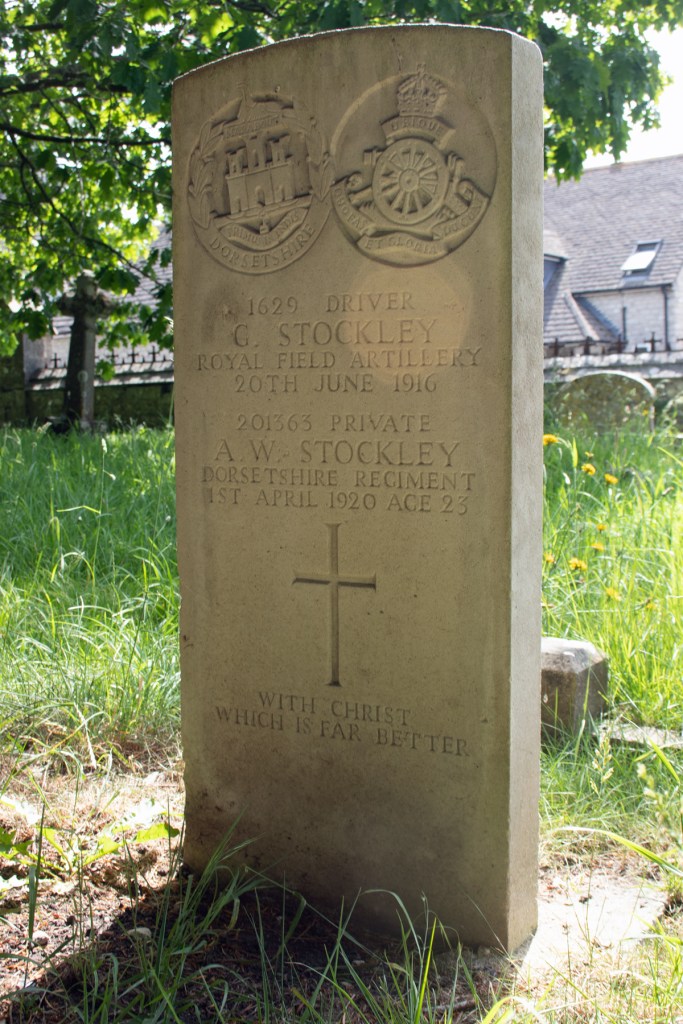
All that is evident is that Albert William Stockley passed away on 1st April 1920, ages just 23 years old. was laid to rest in the Old Church Cemetery in his home town of Corfe Castle.


Albert shares his grave with his older sibling, George Stockley, who died in June 1916. The brothers are commemorated on the same headstone.