Tag Archives: Devon

Captain William Mence

Captain William Mence

William Charles Mence was born in Blackheath, Kent in the spring of 1877. He was the oldest of five children to William Cookes Mence and his wife, Susanna.

William Sr was a chemist-turned-dentist, and by the time of the 1881 census, the family had moved to prestigious lodgings on the corner of Claremont and Victoria Roads in Kingston-upon-Thames, Surrey. William had set up practice in the building, and employed two servants to assist him with the practice, and two more to help Susanna with the family.

Dentistry would keep William Sr occupied for at least the next thirty years, a move to nearby Surbiton in the late 1890s being the only change tot he business.

William Jr, meanwhile, was making his own way in the medical world. The 1901 census recorded the 24-year-old Mr Mence visiting a possible mentor, physician and surgeon Charles Gallie, in Camberwell. William was also noted as being a physician and surgeon, and this was to become the career in which he forged his way.

On 9th August 1906, William married Dorothy Mytton in the Saint Aelhaiarn’s Church in Guilsfield, Powys, Wales. Dorothy was the daughter of a retired army captain, Devereaux Mytton. She had been born in Guilsfield and, at the time of the 1901 census, was living with her family and ten servants at Garth Hall, close to the village.

The young couple’s marriage certificate also sheds some light on William’s career. It confirms that he was working as a medical practitioner, and was living in the village of Perranzabuloe in Cornwall.

William and Dorothy went on to have five children, and named them to reflect their combined family histories. Daughter Evaline Dorothy Cookes Mytton Mence was born first, in 1907, followed by sons John Herbert Myttone Cookes Mence, Devereaux Mervyn Mytton Cookes Mence and Godfrey Powis Mytton Cookes Mence. Their fifth child, daughter Myfanwy Susan Mence, was born in 1914.

When war broke out in Europe, William was drawn to play his part. While full details about his service are not available, his public standing meant that he took a commission as Captain in the Royal Army Medical Corps. His Medal Roll Index Card confirms that he was awarded the 1914-1915 star, so he joined early in the conflict. It also outlines that he served in Mesopotamia from 4th February 1916, in France in 1917 and in Salonika from 1917 to 1919.

Ill health seemed to have dogged him in later years, and by the summer of 1919, Captain Mence had returned to British shores, and to Devon, where his practice had moved to shortly before the conflict.

Dr William Charles Mence, of Axminster, who died in Axminster Cottage Hospital on Friday night, recently returned from active service… He was a medical officer under Axminster Board of Guardians…

Western Morning News: Monday 28th July 1919

William Charles Mence died on 25th July 1919 as a result of an ongoing illness: he was 42 years of age. He was laid to rest in Axminster Cemetery, not far from the family home.

Private John Richards

Private John Richards

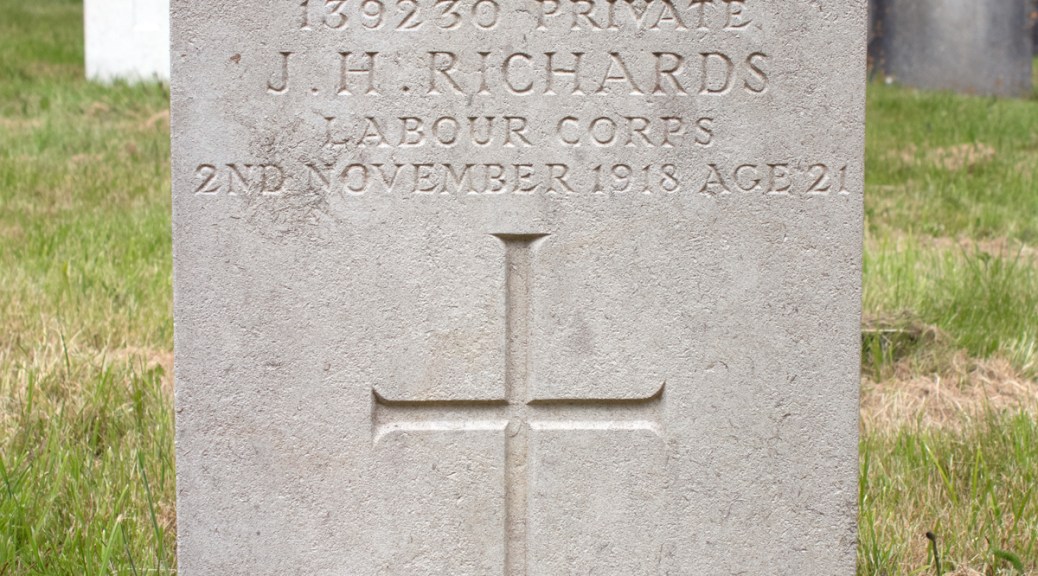
John Henry Richards was born in Sutton, Surrey, on 3rd June 1896. The third of four children, his parents were John and Harriet Richards. John Sr was an engine driver and stoker, while his son found employment as a greengrocer’s assistant when he finished his schooling.

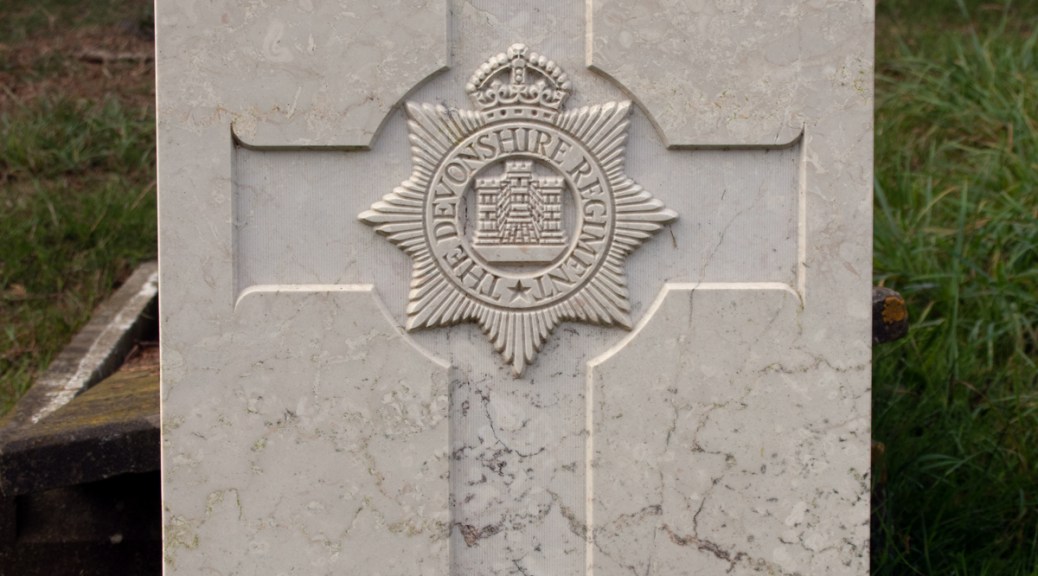
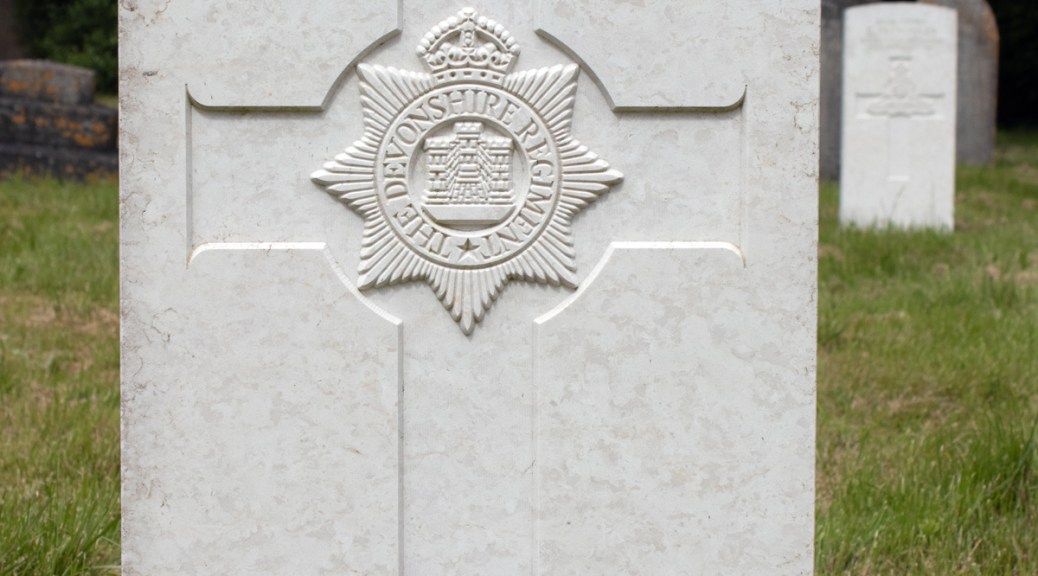
When war came to Europe, John Jr stepped up to serve his King. Full details of his military service have been lost to the annals of time, but he had certainly enlisted by the end of 1917. Initially joining the Devonshire Regiment, he subsequently transferred to the Labour Corps, and was assigned to the 385th Coy.

Private Richards seems to have been based in Kennington near Lambeth, Surrey. He married Dorothy Ford on 23rd December 1917, at which point, both bride and groom were living at 47 Hartington Road.

The family’s geographical locations become a bit confused at this point: Dorothy had been born in Bristol, Gloucestershire, but the 1911 census found her living in Ottery St Mary, Devon, with her paternal grandparents. John seems to have served some time in Devon as well, but it is unclear whether the couple met in the South West or London.

By the autumn of 1918, Private Richards’ unit was certainly in Devon: it was here that he contracted pneumonia, and he was admitted to the No. 1 Section Hospital in Devonport for treatment. This was to prove ineffectual, however, and he passed away on 2nd November 1918. He was 22 years of age.

Dorothy’s family appears to have been living in Axminster by this point, and it is certainly somewhere he would return to in later years. The town’s cemetery is where she would bury her late husband: John Henry Richards at peace again.


Lance Corporal John Channing

Lance Corporal John Channing

John Samuel Channing was born in Axminster, Devon, in 1884, the oldest of four children to John and Elizabeth. John Sr was a bricklayer’s labourer, and, when Elizabeth died in the late 1890s, he struggled to look after the whole family.

The 1901 census found John Sr and his two youngest children living with his widowed mother, while John Jr and his sister Sarah were sent to live with their maternal grandmother, widow Mary Telford. Both were of age to leave school, and both were employed: Sarah as a lace mender, John Jr as a nail brush finisher.

John Jr married a woman called Elizabeth in 1910. There is little additional information available about her, but by the time of the following year’s census, the young couple were boarding with an Eliza Banks in Silver Street, close to the centre of the town. John was employed as a toilet brush maker, adding that they were bone nailbrushes. Within the year, Elizabeth gave birth to their only child, son Leslie.

In addition to his brushwork, John had also enlisted in the local militia. He joined the Devonshire Regiment on 1st April 1908, although his service details are lost to time. Private Channing’s unit – the 4th Battalion – were based around Exeter, but, when war was declared, they moved to India. There is no evidence, however, that John went with them: promoted to the rank of Lance Corporal, it is likely that his experience was better used on the Home Front, training new recruits.

John’s wartime experience was not to be a lengthy one, however. By 1st April 1915, he had been medically discharged from service, having contracted tuberculosis. At this point, Lance Corporal Channing’s trail goes cold, but it is likely that he returned home to Elizabeth and Leslie.

The next record for John is that of his passing. He died from tuberculosis at home on 29th December 1918: he was 34 years of age.

John Samuel Channing was laid to rest in Axminster Cemetery, a short walk from where his widow and son still lived.


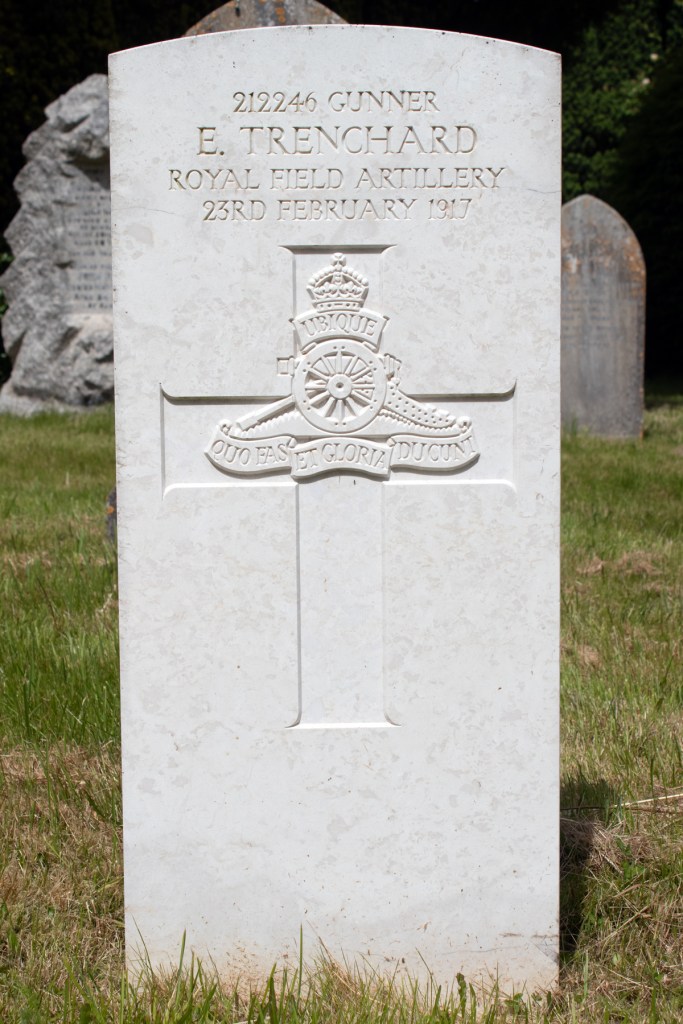
Gunner Eli Trenchard

Gunner Eli Trenchard

Eli Trenchard and his twin Reuben were born on 29th December 1889 in Axminster, Devon. Two of nine children, their parents were George and Mary Trenchard. George was a gamekeeper turned farmer, and the family were brought up at Uphay Farm on the outskirts of the town.

The whole family helped out on the farm and, by the time of the 1911 census, when the twins were 20, seven of the Trenchards – George, Mary, Eli, Reuben and three of their siblings – were all living in the farmhouse and employed in the business.

On 25th March 1913, Eli married Lily Gillingham. Born in Dorset, she was the daughter of the landlord of the Lamb Inn in Axminster, and working as a dressmaker in her own right. The couple moved to the village of Chardstock in Devon, and went on to have a daughter, Lilian, who was born later that year.

In 1915, Eli found himself brought to the Petty Sessions in Axminster, charged with “moving pigs from Dorset to Devon without the necessary license” [Western Times: Wednesday 27th October 1915]. Eli stated that he had purchased the pigs from his brother, Reuben, at Uphay Farm. Despite Reuben confirming this, it was subsequently determined that they had, in fact, been bought from a Mr Wells of Penn in Dorset. Eli have been convicted of a similar offence before, and was fined £10.

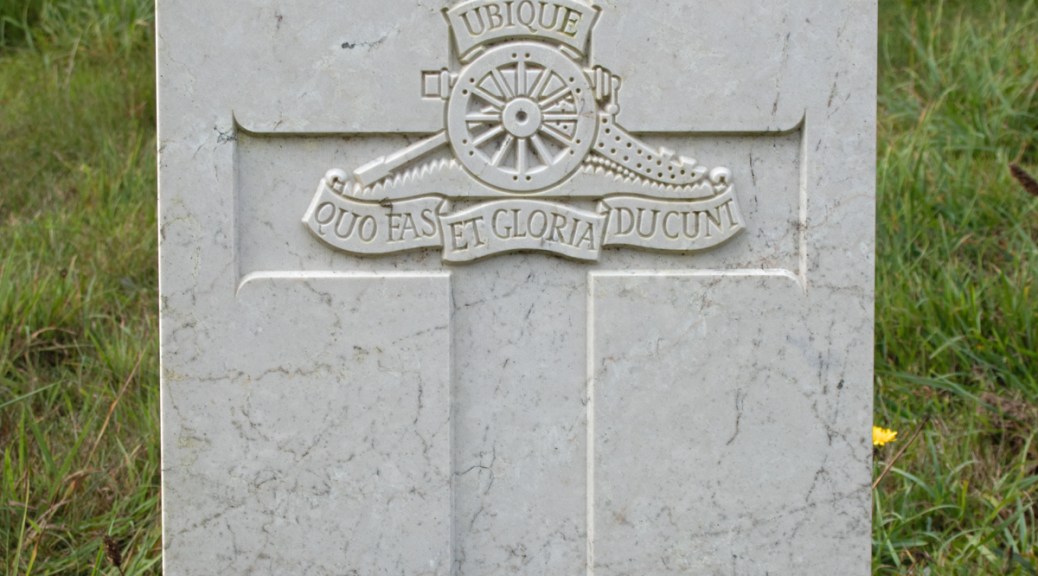
War was raging across Europe by this point, and Eli was called upon to play his part. He enlisted in the Royal Field Artillery in January 1917. Assigned to the 23rd Reserve Battery, Gunner Trenchard was sent to a camp near Sutton Veny in Wiltshire.

Eli’s time in the army was not to be a long one, however, and he was soon admitted to the camp hospital, suffering from pneumonia. The lung condition was to get the better of him, and Eli passed away on 23rd February 1917. He was 27 years of age.

The body of Eli Trenchard was taken back to Devon for burial. He was laid to rest in Axminster Cemetery, not far from where his widow and family still lived.


The Trenchard family were soon back in the court, however, with Lily bringing a lawsuit against her father-in-law, George, in December 1917. The widow said that Eli and his father had agreed her late husband’s immediate tenancy of two fields the month before Eli had been called up for to serve.

However, the month after his death, when she had gone to the fields to sow them for the coming season, the gates had been locked and her entrance barred. George responded by saying that he had agreed to pass the fields to his son, but only on the event of his own death. He subsequently sold the land to another farmer.

The judge in the case found that Lily had “failed to prove that an agreement had been made between [George] and his son” [Western Times: Thursday 6th December 1917] and found in the defendant’s favour.


Gunner Victor Evans

Gunner Victor Evans

Victor George Evans was born in the autumn of 1882, one of eleven children to George and Charlotte Evans. George was a woodsman from Aldworth in Berkshire, and it was here that he and Charlotte raised their growing family.

There is little concrete information about Victor’s early life. While his family were living on Bethesda Street in Basildon, Berkshire, at the time of the 1901 census, Victor is noticeable by his absence.

On 29th January 1910, Victor married Edith Rains in Kensington, Middlesex. She appears to have been a dressmaker’s apprentice, and had been born in Moulton, Lincolnshire. The next year’s census recorded Victor employed as a butler for the Clutton family. His boss, Ralph Clutton, was a lawyer, and the family resided at 5 Vicarage Gate, not far from Kensington Palace. This time, however, it is Edith who is missing from the census record and, given that she had given birth to their one and only child, Phyllis, the year before, it is likely that she was recuperating elsewhere, possibly with the support of her family.

When war broke out, Victor was called upon to serve his country. On 22nd December 1916, he enlisted, joining the Royal Garrison Artillery as a Gunner. His service records show that 34 years of age and stood 5ft 7.5ins (1.71m) tall.

Victor was recorded as being a messenger, and he and Edith were living with his older sister, Rachel, at 17 Adeney Road in Hammersmith, Middlesex. The document suggests, however, that Phyllis was in the care of Edith’s parents in Lincolnshire, possible to enable both her and Victor to work.

Gunner Evans was assigned to the 270th Siege Battery, and he was soon sent to France. While based near Rouen in April 1918, he was badly injured through a number of shrapnel wounds, and medically evacuated to Britain for treatment. Admitted to a hospital in Paignton, Devon, there was little that could be done, other than being made comfortable. Victor succumbed to his wounds on 28th April 1918: he was 35 years of age.

It is likely that Edith would not have been able to afford for her husband to be brought back to Middlesex for burial. Instead, Victor George Evans was laid to rest in the ground of Paignton Cemetery.


Private Robert Kelway

Private Robert Kelway

Robert Jenkins Kelway was born in the autumn of 1897 in the Devon town of Torquay. The oldest of four children, his parents were Robert and Rosina Kelway. Robert Sr had been born in Paignton and, when a job working as a carter for Hollicombe Gas Works came up in around 1900, he moved the family back down the coast.

By the time of the 1911 census, the Kelways were living at 3 Hollicombe Terrace, on Torquay Road: their home was one of a row of terraced houses build specifically for the gas works employees, and all of their neighbours were employed there in one form or another.

Robert Jr was 13 years old at this point, and seemed to have completed his schooling: his entry on the census confirms he was employed as a telegraph messenger for the Post Office.

Everything was to change when war was declared and, on 22nd April 1915, Robert Jr voluntarily stepped up to play his part. Lying about his age – he said he was 19, when he was, in fact, two years younger – he was nonetheless taken on his word. His service records show that he was 5ft 5ins (1.65m) tall and weighed 141lbs (64kg). He was noted as having brown hair, blue eyes and a fresh complexion.

Assigned to the Devonshire Regiment, Private Kelway was initially attached to the 3rd Battalion. At the end of October 1915, however, he was transferred to the 8th (Service) Battalion, and dispatched to France. His unit was caught up in the Battle of Loos, but it was at the Somme the following year that Robert would really have cut his teeth in fighting.

Private Kelway saw out the Somme relatively unscathed, but, on 27th December 1916 his luck was to run out. He was shot in the back, damaging one of his lower vertebra, and was medically evacuated to Britain for treatment.

Robert was admitted to King George’s Hospital in South London, and it was quickly ascertained that the damage to his spine was permanent. Paralysed from the waist down, he was, not surprisingly, no longer able to continue in the army in any capacity. His discharge papers noted that he was a ‘steady, sober and honest’ person.

From this point, details of Robert’s life are sketchy. It is unclear whether he was able to return home, although he was definitely back in Devon by the spring of 1919, as this is where he died. Admitted to the Royal Devon & Exeter Hospital, he passed away from pneumonia on 18th April, aged just 21 years old.

Robert Jenkins Kelway was laid to rest in Paignton Cemetery, a short distance from where his family lived, in the Preston area of the town.


Private Melbourne Mumford

Private Melbourne Mumford

Melbourne Linas Mumford was born on 13th June 1898, and was one of seven children to William and Fanny. William was a Gunner in the Royal Artillery, and while Melbourne and his siblings were born in the Kent village of Cliffe, the family soon moved to rented rooms in Stafford Street, not far from his new barracks in Gillingham, Kent.

It seems that William’s term of service came to an end, and he moved the family to Devon, where he had been born. Fanny died in 1909, at the age of just 33, and he was suddenly left to raise the family alone. The1911 census found William and his three sons – including Melbourne – living in a cottage in Paignton. William was by now working as a nurseryman, while Melbourne’s older brother, also called William, was bringing in some money as a paperboy for Smith & Sons.

When war came to European shores, Melbourne stepped up to play his part. Full service details have been lost to time, but later documents confirm that he had enlisted in the Devonshire Regiment on 9th August 1915. Attached to the 9th (Service) Battalion, papers confirm that he was 5ft 3.5ins (1.61m) tall, and weighed 99lbs (44.9kg).

Private Mumford’s unit fought as Loos in 1915, and at the Somme in 1916, but it was at Ypres, on 7th October 1917, that he was badly injured. Melbourne was shot in the left thigh, which caused a compound fracture in his femur. Medically evacuated to Britain for treatment, he spent time hospitalised in Manchester.

Recuperation was ongoing, but was not to prove successful, and Private Mumford was eventually discharged from the army on 22nd January 1919.

Melbourne’s treatment would continue, however, and he had a further operation on his leg that summer. Tragically, however, his body had been weakened, and he passed away following the procedure, on 27th August 1919. He was just 21 years of age.

The body of Melbourne Linus Mumford was laid to rest in Paignton Cemetery, not far from the family home in Corsham Road.


Private Mumford’s Dependant’s Pension was assigned to Mrs Kate Mumford, who was recorded as his mother. This would suggest that William had remarried after the 1911 census, although there are no records to confirm this.


Lance Corporal Thomas Fidler

Lance Corporal Thomas Fidler

Thomas Fidler was born on 15th May 1881 in Newbury, Berkshire and was the fourth of eight children to Charles and Sarah. Charles was a groom, who travelled where the work was, and, by the time of the 1901, the family has relocated to Whitchurch in Hampshire.

When he finished his schooling, Thomas found work as a dairyman. However, he had always had his sights on bigger and better things, and, having been a volunteer for the local militia, he was keen to become a full soldier. Things did not go immediately to plan though, and he was initially turned down because he was under height – he was just 5ft 3ins (1.6m) tall when he turned 18.

But Thomas was persistent, and, on 27th June 1898, he was formally enrolled in the Hampshire Regiment. Along with his height, his service records confirm other details about the young man he had become. The document show that he weighed 124lbs (56.2kg), and that he had brown hair, brown eyes and a fresh complexion. The records advise that he was considered fit for duty, but also note that he was given special authority to enlist, presumably to bypass the concerns about his height.

Private Thomas Fidler would go on to build up quite a military career for himself. He spent nearly two years on home soil, before his unit was shipped out to South Africa. During his time in the colony, he served in a number of the campaigns, and was awarded with the Queen’s South Africa medal, including clasps for Cape Colony, Orange Free State and Transvaal, and the King’s South Africa Medal 1901-1902.

After more than two years spent overseas, Thomas’ unit returned to Britain. He would remain on home soil until 1903, extending his service beyond the five compulsory years, and choosing to remain on active duty, rather than being stepped down to reserve status. In September of that year, his unit was on the move again, and he was transferred to Malta.

It would not be until September 1905 that Private Fidler saw home soil again. He was formally stood down from duty the following June and assigned to the Army Reserve. Interestingly, his transfer papers recorded that his conduct was indifferent, disobedient… inclined to drink.

Thomas’ attitude over the years was evidenced by his entries in the Regimental Defaulter Book. He was disciplined no fewer than twelve times during his military career. His offences included being absent from parade and using insubordinate language. While stationed in Malta, he was punished for being drunk four times. Over the years, Private Fidler spent 125 days confined to barracks, and was fined a total of £1 2s 6d for his crimes.

When he was not confined to barracks, Private Fidler would likely be found in a sick bay. Between January 1901 and September 1905, he spent 342 days in hospital with conditions ranging from fevers, psoriasis, scabies and gonorrhoea.

On 22nd March 1905, while serving in Malta, Thomas was admitted to hospital having suffered a fractured jaw following a scuffle. The cause of the injury is recorded in detail in an eleven-page report, which outlined that Private Fidler had been out in Valetta, and ended up quite drunk. He was approached by a couple of military police officers, and became abusive towards them. While trying to take off his boots, a private from another regiment, who was also drunk, came along and punched him in the face, fracturing his jaw. Both men were arrested and taken back to barracks. The investigation in to the incident found that, while Private Fidler was off duty at the time, he was to blame for the altercation.

In June 1906, Thomas returned to civvy street, and to his former job as a dairyman. On 5th February 1907, he married Tryphena Snook, who was the daughter of his employer. The couple had had a son the previous year, and would go on to have three more children in the next few years.

The 1911 census found the young family living in Sparsholt, Hampshire, the household being made up of Thomas, Tryphena and their older two children, Tryphena’s parents, William and Emma, and a boarder, William Clark, who was a carter on the farm.

By the summer of 1914, Thomas had been formally stood down from the army, his contract coming to an end on 26th June. A storm was brewing over the Channel, however, and he would soon be called upon to play his part once more.

Details of Thomas’ re-enlistment into the army have been lost to time. It is likely that he was called upon quite quickly. He was assigned to the South Wales Borderers, and, with the experience he had under his belt, was given the rank of Lance Corporal.

Thomas’ unit – the 4th (Service) Battalion – was initially sent to France, and he arrived there early in July 1915. Within a matter of weeks, however, the battalion moved on to the Eastern Mediterranean, ending up at Gallipoli.

Lance Corporal Fidler’s time in on the peninsula would have been fraught with danger. In the autumn of 1915, he was badly injured and was medically evacuated to Britain for treatment. Admitted to hospital in Devon, his wounds were to prove too severe, and he passed away on 5th November, at the age of 34.

The funeral rook place at Paignton… of Lance-Corpl. Thos. Fidler, of the 4th South Wales Borderers, who died at Oldway Hospital on Friday as a result of wounds sustained at Gallipoli. The widow and other mourners followed, and the Matron of the Hospital (Miss Blackmore) was among those present. Wounded convalescents from Oldway and a Company of the 7th Devons, under Capt. Brearley, attended, and the Devons provided a firing party.

[Exeter and Plymouth Gazette – Tuesday 09 November 1915]

Thomas Fidler was laid to rest in Paignton Cemetery.


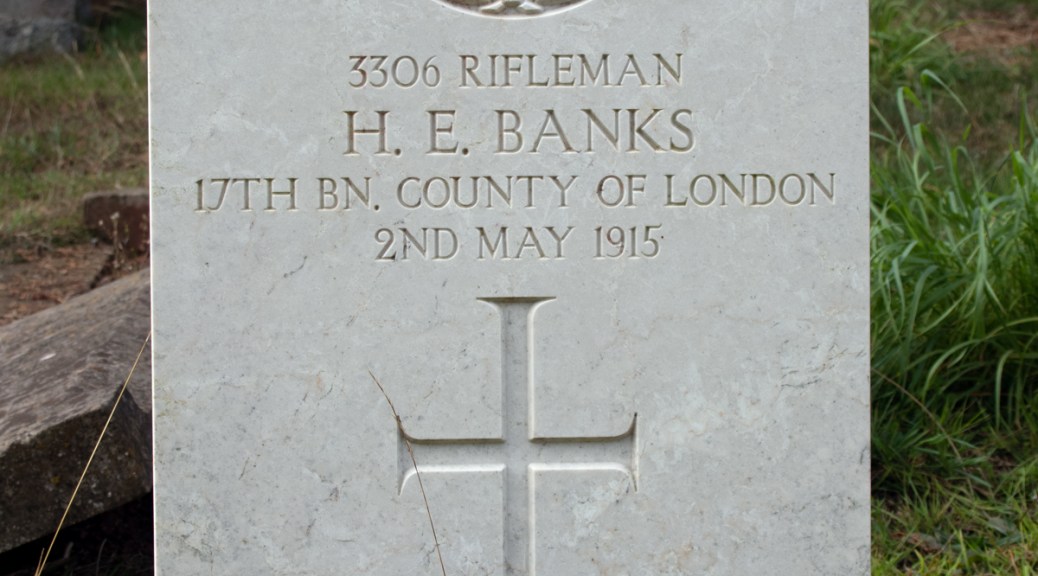
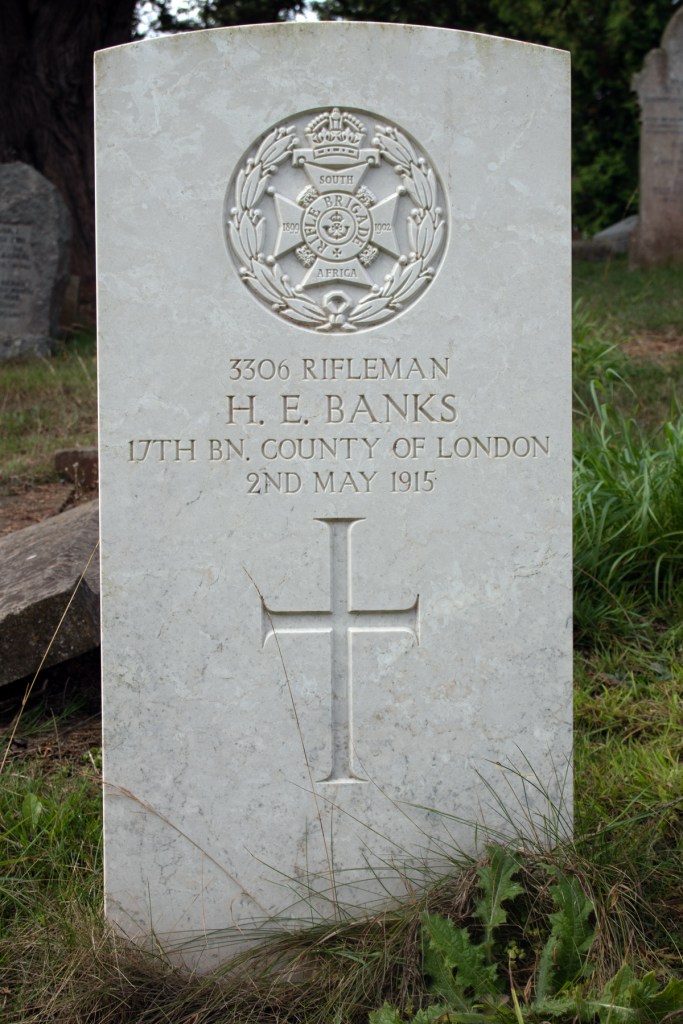
Rifleman Henry Banks

Rifleman Henry Banks

The early life of Henry Ernest Banks is destined to remain lost to time as there is little documentation available to corroborate details. The first concrete documentation for him is his marriage certificate, and this sheds lights onto the man he had become.

The wedding took place on 7th August 1905, and confirms that Henry was 19 years of age. His father was recorded as being James Banks who, by this point was deceased. He had been a chairmaker, and his son had followed in a similar type of work, being employed as a French polisher.

Henry’s bride was 19-year-old Blanche Hearnden, who was noted as being the daughter of deceased traveller William Hearnden. At the time of their marriage, the newlyweds were living at 13 Busby Street, Bethnal Green, London. Now long since gone, the road led directly to St Matthew’s Church, which is where their nuptials took place.

By the time of the 1911 census, Henry and Blanche were living with her mother in Whitechapel. They had had a child, son Ernest, the previous year, and the mixed household included Blanche’s three sisters and their children. Money must have been tight, but four members of the household were bringing in some money, Henry working as a French polisher, with two of his sisters-in-law working as a cigarette packer and a printer’s assistant. Blanche and her other sister were listed as housewives, while her mother, who was also called Blanche, was noted as being a charwoman.

When war broke out, Henry was called upon to play his part. Details of his military service are sketchy, but it is clear that he enlisted in the London Regiment, and was attached to the 17th (County of London) Battalion, which was also known as the Poplar and Stepney Rifles.

Rifleman Banks’ unit was sent to France on 9th March 1915. Within a matter of weeks, however, he was back in the UK, and appears to have been admitted to a hospital in Paignton, Devon.

Henry died on 2nd May 1915, and one record – his entry on the Grave Registration Form – that sheds a little light on Henry’s passing. It is noted being as a result of a strangulated hernia, although this is the only document that gives any details about his death. Henry was 28 or 29 years of age.

Henry Ernest Banks was laid to rest in Paignton Cemetery, Devon.


Leading Signalman Alexander Daisley

Leading Seaman Alexander Daisley

Alexander William Arthur Daisley was born on 13th November 1886, and was the second of four children to William and Judith Daisley. William was a Private in the Royal Marines and, as the time his son was born, the family were based in Dartmouth, Devon. By the time of the 1891 census, however, they had moved to Kent, and were billeted in family accommodation in the Milton Barracks, near Gravesend.

Ten years on, and the 1901 census confirms that the Daisleys had relocated again. William had left his military service behind him, and had taken up work as a publican at the Seven Stars Inn in Litlington, Cambridgeshire. Alexander is noticeable in his absence from the record, however. The following year, he surfaces again, however, and seems that he was destined to follow his father’s naval career.

On 10th April 1902, Alexander enlisted in the Royal Navy. At just 15 years of age, he was assigned the rank of Boy 2nd Class, and was sent to HMS St Vincent, a training ship based in Haslar, Hampshire, for his induction. He remained there for the next fifteen months, gaining promotion to Boy 1st Class in February 1903.

Alexander spent the second half of that year at HMS Victory, the Royal Naval Dockyard in Portsmouth, Hampshire, before being given his first posting in November. His assignment was on board the armoured cruiser HMS Good Hope: she was to become his home for the next year and a half, during which he came of age, and was formally inducted into the Royal Navy.

At this point, Alexander’s service records give an insight into the man he was becoming. He was noted as being just 5ft 1in (1.55m) tall, with hazel eyes and light brown hair. He had a fair complexion and three scars on the back of his head. It seems that he had some aptitude, as he was given the rank of Signalman, rather than being directed to the role of seaman.

Over the next twelve years – the term of his contract – Signalman Daisley would serve on eight ships: in between assignments he would return to his Portsmouth base. His time in the Royal Navy was not without incident, and he spent three separate periods in the cells – 14 days in 1907, 17 days in 1908 and 10 days in 1909. Despite this, he was promoted to the rank of Leading Seaman in January 1913, while serving on board HMS Egmont, an armoured frigate.

On 9th March 1915, Leading Signalman Daisley was assigned to HMS Princess Irene, an ocean liner that had been converted to a minelayer at the start of the war.

On 27th May 1915, while Irene was moored off Sheerness, Kent, a series of explosions ripped through the ship, killing more than 350 crew. Leading Signalman Daisley was among those who perished: he was 29 years of age.

The body of Alexander William Arthur Daisley was buried in Woodlands Cemetery, Gillingham, Kent, alongside the other victims of the disaster.