George Fawcett was born on 3rd February 1873, one of ten children to John and Maria (or Mary). John was a stonemason who raised his family in Essex, and it was in Stratford that George and most of his siblings were born.
When George left school, he was drawn to a life of adventure. He joined the Royal Navy on 5th May 1888, and was first assigned the role of Boy, as he was under age. He was formally enlisted on 3rd February 1891 – his 18th birthday. He had, by this point, been serving on HMS Hotspur for nine months, and was given the rank of Ordinary Seaman. His hard work must have held him in good stead, because he was promoted to Able Seamen just two months later.
Over the course of his initial twelve years’ service, Able Seaman Fawcett served on eight different ships, and continued to rise through the ranks. He mad made Leading Seaman by 1894 and Petty Officer 2nd Class five years later. By the time his first term of service had ended, he had been promoted again, this time to Petty Officer 1st Class.
George voluntarily renewed his service in 1903, and over the next few years, he served on a number of other vessels. His shore base was always HMS Pembroke, though, and his time at sea was interspersed with periods at the Naval Dockyard in Chatham.
Petty Officer Fawcett had been in the Royal Navy for 23 years by the time war was declared. He was still at sea in August 1914, but was transferred to a permanent shore role at the beginning of the following year. He spent three years fulfilling his duties at HMS Pembroke, but fell ill in the spring of 1918.
He was admitted to the Naval Hospital in Chatham with liver disease, and this was a condition he was not to recover from. Petty Officer Fawcett passed away on 12th April 1918, at the age of 45.
George Fawcett’s body was laid to rest in the Woodlands Cemetery, Gillingham, not far from the naval base at which he was based.
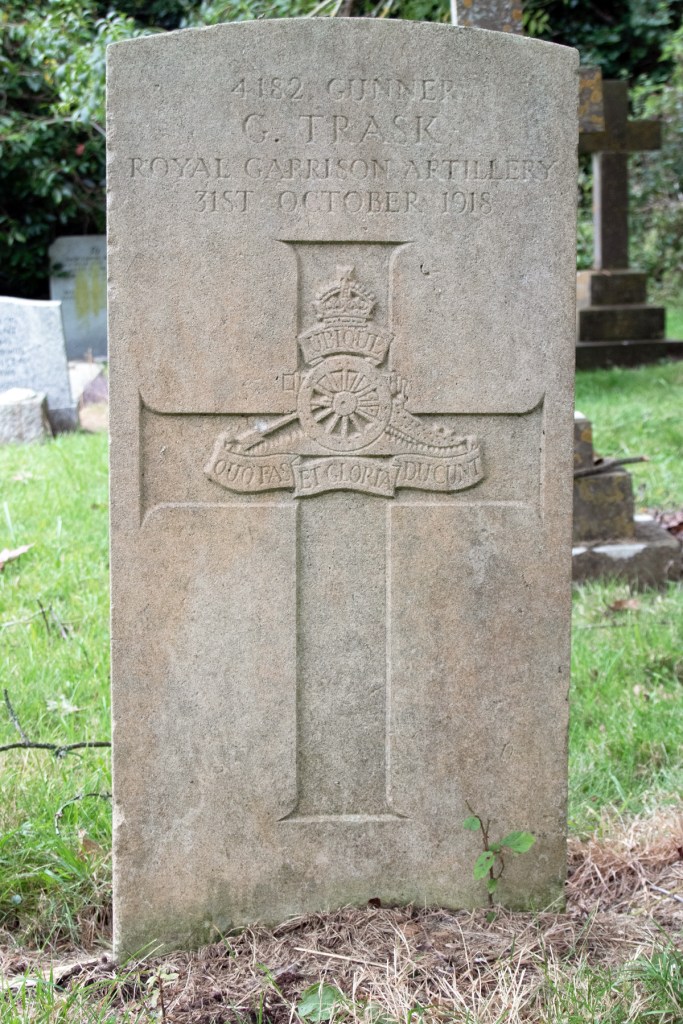
George Trask was born on 22nd December 1875 and was the oldest of nine children. His parents were Absolam and Sarah Jane Trask, although it seems that the couple did not actually marry until after their first three children had been born. Absolam was an agricultural labourer and the family lived in his and Sarah’s home village of East Coker, near Yeovil in Somerset.
George was destined for a life of adventure; in May 1894, aged just 18, he enlisted in the army, joining the Royal Artillery as a Gunner. His medical examination sheds some light on his physique. He stood 5ft 7ins (1.70m) tall and weighed in at 144lbs (65.3kg). He had a fair complexion, hazel eyes and light brown hair.
Oddly, in the section on distinguishing marks – recorded to help identification should the soldier be killed – the medic only highlighted a ‘small mole midway between pubes and umbilicus’: it seems unlikely that this was the only distinguishing mark that could have been highlighted.
Gunner Trask’s initial service was spent in England. He served four-and-a-half years on the home front, before being shipped to Malta. After six months on the island, he was moved to Crete for a few months, before returning to Malta in September 1899.
George completed his initial term of seven years’ service, and elected to remain to complete a full twelve years of enlistment. As part of this, he was transferred to the Caribbean, spending two years stationed in Bermuda, before moving on to St Lucia for a further two years. By December 1905, Gunner Trask was back home in England, and it was on home soil that he remained.
Back in Somerset, George extended his term of service for another four years. Settled in his home village, he married Elizabeth Garrett on 27th December 1908; the couple would go on to have three children: Ethel (born in 1910), Lilian (1911) and George Jr (1916).
Gunner Trask’s military service continued apace. Reassigned to the Royal Garrison Artillery, he was posted in Portsmouth up until the outbreak of the war. He was awarded a third Good Conduct Medal in addition to the ones he had received in 1900 and 1904.
At this point, details of George’s military service become a little hazy. He achieved 21 years’ military service on 29th May 1915 and was awarded a further Good Conduct Medal. At this point, with the war raging, his period of duty was extended again, until the end of the conflict.
At some point during this time, he was assigned to the Royal Artillery’s School of Experimental Gunnery in Shoeburyness Essex. Sadly, there is nothing to confirm his exact role there, although, given that he was in his 40s by this point, it is likely that he acted as more of a mentor.
And it is here that the story comes to an end. Gunner Trask is noted as passing away in the Military Hospital in Shoeburyness on 31st October 1918, though there is nothing to confirm the cause of his death. He was 43 years of age.
George Trask’s body was brought back to Somerset for burial. Having travelled the world with the army, he was laid to rest in the graveyard of St Mary’s Church in his home village of East Chinnock.
George’s son George was to follow his father into military service.
Working as a press operator for a plastics company, he married Gwendoline Harper in Southend, Essex in April 1940. There is no record of whether he had enlisted at this point, but is seems likely that he had.
When the Second World War broke out, he joined the 4th Battalion of the Suffolk Regiment. After initially helping in the defence of England following the British Army’s evacuation from Dunkirk, late in 1941, he was sent first to Egypt, then to Singapore to help strengthen the garrison there.
Early the following year, the 4th and 5th Battalions fought in the defence of Singapore, before the island surrendered to the Japanese Army. At this point, Lance Corporal Trask found himself a prisoner of war.
The prisoners were put to work building the Burma railway, and suffered great hardship at the hands of their captors. Many succumbed to illness, and George was amongst them, dying from beriberi on 18th December 1943. He was just 27 years old.
George Reginald Trask was laid to rest in the Chungkai Cemetery in Thailand, 100km west of Bangkok.
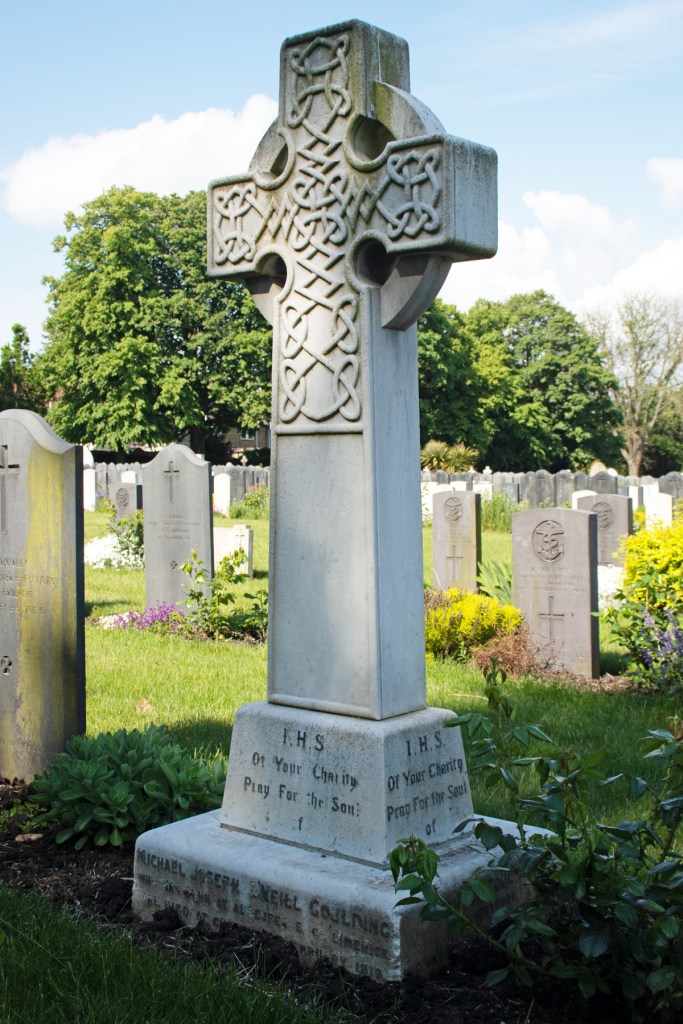
Michael Joseph O’Neill Goulding was born on 5th May 1884, the oldest of six children to Michael and Ellen Goulding (née O’Neill). Michael Sr worked for the inland revenue and his job took him around most parts of the British Isles.
Michael Jr had been born in Limerick – both of his parents came from Ireland – but his subsequent three siblings (Patrick, Margaret and William) had all been born in Scotland. His second youngest sibling, Lily, was born in County Durham, the youngest back in Scotland, while, by the time of the 1901 census, the whole family were living in Forest Gate, East London.
The census also shows that Michael Jr, having left school, was working at Customs House (presumably where his father was employed), as a boy copyist on tea accounts. The inland revenue at that time was a career for life; by the next census in 1911, the family had moved to Hertford, where Michael Sr was a customs and excise supervisor, and Michael Jr was an assistant clerk at the same place of employment.
War was on its way, but Michael seems not to have enlisted immediately. While specific dates for his joining up are not available, it appears that he was still working for the Inland Revenue when he got married in Shoreditch, in April 1917. His wife was called Bridget Mary Gough (known as Bryde), and she had also been born in Ireland. The couple went on to have a daughter, Ellen (or Eileen), the following year.
By this time, Michael had definitely enlisted. He joined the Royal Naval Volunteer Reserve, and was based at HMS Pembroke, the shore-based establishment in Chatham, Kent. This was the location for the Navy’s main accounting base, so it is likely that he was employed for financial, rather than his military, skills.
Able Seaman Goulding served through to the end of the war and beyond, and it was while he was based in Kent that he became unwell. Admitted to the Royal Naval Hospital in Chatham, he succumbed to a combination of bronchitis and pneumonia on 22nd February 1919. He was 34 years of age.
Michael Joseph O’Neill Goulding was laid to rest in the Woodlands Cemetery in nearby Gillingham. His family were still in Hertford, while his widow and daughter moved back to Ireland.
Michael Joseph O’Neill Goulding (courtesy of ancestry.co.uk)
Frederick John Shiplee was born on 15th November 1895 in the Essex town of Harwich. The oldest of eight children, his parents were Frederick and Matilda. Frederick Sr worked as a carter for the local railway, while his son found employment as a butcher’s errand boy when he left school.
In November 1913, having just turned 18, Frederick Jr enlisted in the Royal Navy as an Officer’s Steward, and spent three years training and serving on board HMS Ganges, the shore establishment at Shotley, near Ipswich.
From Suffolk, Frederick moved to Kent, and was based at the HMS Pembroke in Chatham. From here, he was involved in trips on HMS Spey, an old river gunboat that had been converted for use as a diving tender. It was during one of these trips that tragedy struck.
STORY OF A COLLISION IN THE THAMES
Mr CB Sewell resumed the inquest at Chatham, on Monday, on the 13 naval men who lost their lives after a collision between the London County Council steam hopper Belvedere and an old naval vessel in the Thames on March 7th [1917]…
The collision occurred shortly before four o’clock in the afternoon, the weather being bitterly cold and boisterous, and the sea extremely rough. The men, who had taken to a raft, were drifting about till 9pm before the raft was driven ashore. On the raft, when discovered, were a pile of dead men, who had been rendered unconscious by the cold and subsequently drowned through the raft being partly submerged. Lieutenant Humphreys, Royal Naval Reserve, and the other officers were all drowned. In all, 30 of the 37 members of the ship’s company lost their lived, and several bodies have not been recovered. Thirteen of the ship’s crew managed to get ashore at Sheerness in the cutter and three reached the shore at the Isle of Grain in the gig, while one was saved by the hopper.
Arthur George Chick, able seaman, said he was at the wheel of the naval vessel, which was steaming up river at six knots an hour to secure shelter from the weather. Lieutenant Humphreys and a warrant officer were on the bridge, and there were two look-out men. All were now missing. He saw the hopper coming down the river when she was two miles away. When the vessels were nearing each other, the hopper suddenly altered her course to starboard. The witness then altered his course to port by his officer’s orders, but the hopper crashed into his ship, stroking it a glancing blow in line with the forepart of the bridge on the starboard side. The ship sank in three minutes.
Alfred Rawlings, leading signalman, stated that the hopper changed her course when almost abreast of the naval vessel. The hopper’s alteration of course was, he considered, the cause of the collision.
Henry Davies, second officer, and Joseph Beard Hasdell, master of the hopper, gave evidence that they considered the collision was caused through the naval vessel’s error of judgment in starboarding, instead of going to port. The hopper, they stated, ported its helm in accordance with the ‘rule of the road’.
South Eastern Gazette: Tuesday 27th March 1917
While not mentioned in the newspaper report for security reasons, the ‘old naval vessel’ was, in fact HMS Spey. Annoyingly, I can trace no further report of the inquest, other than the conclusion that the deaths were due to drowning following a collision at sea.
Officer’s Steward Shiplee was one of the twenty men who died that day. He was just 21 years of age.
Frederick John Shiplee’s body was laid to rest in the Woodlands Cemetery in Gillingham, not far from the Naval Dockyard in Chatham, where he had been based.
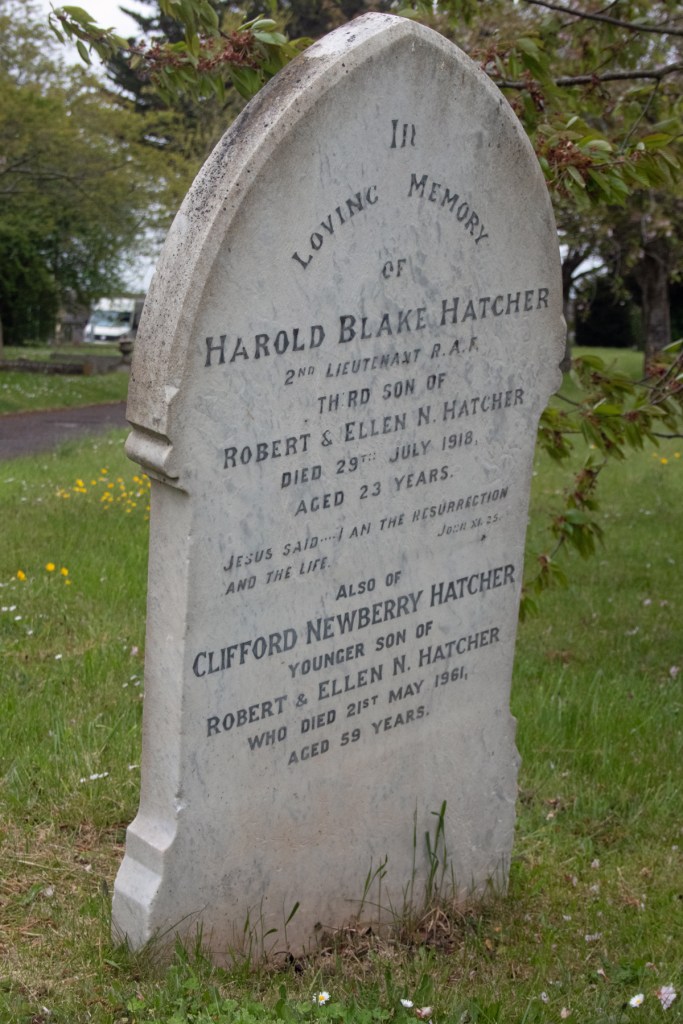
Harold Blake Hatcher was born on 11th February 1895, one of nine children to Robert Hatcher and his wife Ellen. Robert was a draper, and brought his family up in his home town of Taunton in Somerset. At least one of his children followed him into the cloth business, and, after he died in 1908, this seems to have fallen to Harold’s older brothers, Arthur and Ernest.
After leaving school, Harold became a dental student. Initially studying with Kendrick’s in his home town, he was about to begin training at Guy’s Hospital in London when war broke out.
Harold joined up in May 1915, and was initially assigned as a Lance Corporal to the 6th Battalion of the Somerset Light Infantry, before being transferred to the Middlesex Regiment.
In November 1917, he was badly injured in while fighting at Bourlon Woods, as part of the Battle of Cambrai. It was while he was recuperating that he transferred again, this time to the fledgling Royal Air Force.
Second Lieutenant Hatcher gained his wings in June 1918, and soon became a flying instructor. It was while he was working at RAF Fairlop in North West London, that an incident occurred. A local newspaper picked up the story.
Many in Taunton have learnt with sincere regret of the accidental death whilst flying of Lieutenant Harold Blake Hatcher of the Royal Air Force, third son of the late Mr Robert Hatcher of Taunton, and of Mrs Hatcher, now of Bristol.
The accident in which he met his death on Monday was a triple fatality, two other airmen being killed at the same time, Second Lieutenant Laurie Bell, of Bournemouth, and Flight Sergeant AR Bean, of Burslem.
At the inquest… it was stated in evidence that while Lieutenant Hatcher and Sergeant Bean were flying at a height of about 500ft, Second Lieutenant Bell, who w flying a single-seater, dived from a position some 700 feet higher, his machine striking and cutting clean through the double-seater, which folded its wings, hovered a few second, and then crashed to the earth. The three men were instantaneously killed.
A verdict of Accidental Death was returned.
Taunton Courier and Western Advertiser: Wednesday 7th August 1918
Further witness testimony described how the Sopwith Camel, piloted by Bell, cutting the AVRO airplane it in two. Hatcher fell out of the wrecked two-seater as the Camel’s wings slowly folded into a V and fluttered free following the fuselage to the ground. All three airmen lost their lives. Bean was found in a sitting position, still strapped in the front half of the AVRO’s fuselage, his instructor’s body was found unmarked thirty yards away in the grass where it had fallen. The wingless Camel crashed close by and Bell was found to have almost every bone in his body broken.
The accident took place on 30th July 1918. Second Lieutenant Hatcher was just 23 years old.
Harold Blake Hatcher lies at rest in St Mary’s Cemetery in his home town of Taunton, Somerset.
Albert Rudolph Percy was born in April 1889 in Taunton, Somerset. His parents were William Percy, a draper, and his wife, Elise, who had been born in Baden Baden, Germany. Elise’s background certainly influenced the naming of the couple’s five children, all sons with middle names ranging from Rudolph and Frederick, to Leopold and Felix.
All but the eldest of William and Elise’s children followed their father into the drapery business; after initially doing so when he left school, Albert’s older brother Frederick took holy orders, a following he continued for the rest of his days.
On the outbreak of war 1914, Albert volunteered for military service, leaving his father’s business behind him. Enlisting in the West Somerset Yeomanry, he was shipped off to to Colchester in Essex for training.
While taking two days’ leave in September that year, Private Percy returned home, and, on the first evening complained of feeling unwell. A doctor was summoned and diagnosed spinal meningitis. Albert was swift to succumb to the illness, passing away on 4th October 1914. He was just 25 years old and likely one of the first from Taunton to die whilst on active service.
Albert Rudolph Percy lies at rest in St Mary’s Cemetery in his home town of Taunton, Somerset.
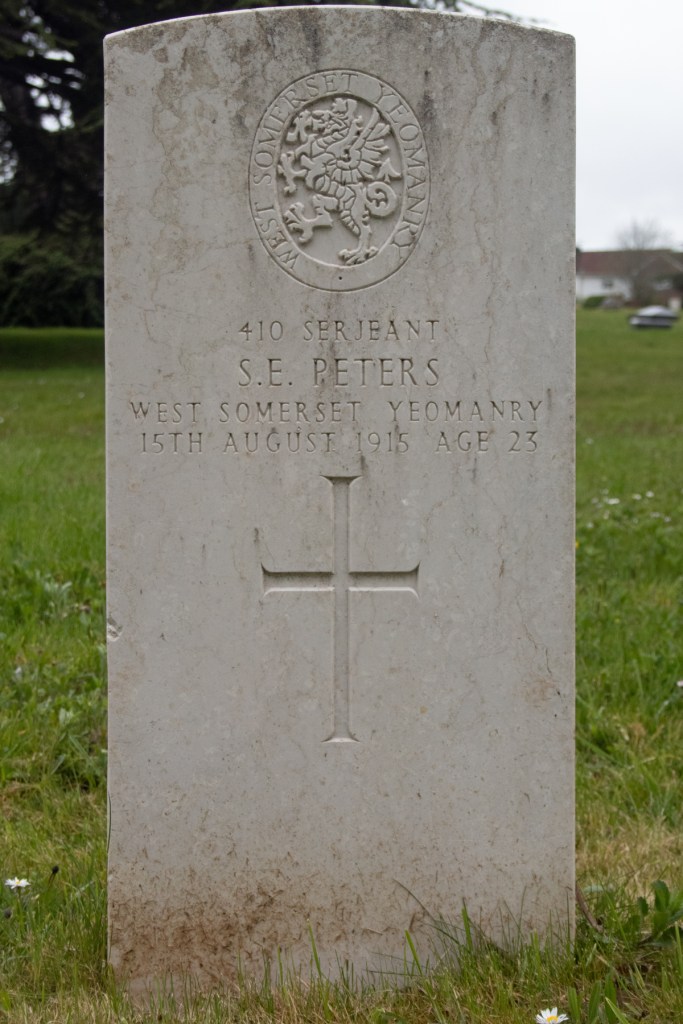
Sydney Edward Peters was born at the end of 1891, the only child to farmers Edward and Annie Peters. The family lived in Bishop’s Hull, near Taunton, where Edward also employed two members of staff to help with the household and his dairy herd.
Sydney went on to manage the neighbouring farm to his father, and looked to be making a living with this. Keen on sport, he went on to captain the village cricket team, and took an interest in physical fitness.
War broke out and Sydney was quick to enlist. Joining the West Somerset Yeomanry, he was assigned to the 1st Battalion. Initially the regiment were based on home turf, and he spent a lot of that time in East Anglia. He must have made a positive commitment to the troop, and was soon promoted to Serjeant.
In the early summer of 1915, he returned to Taunton, to help drill recruits at the Territorial Depot there. A short while after returning to his Essex he fell ill, and before the battalion were due to be shipped overseas, Serjeant Peters went back to Somerset on leave.
By the time he reached home, however, he was severely ill, and very quickly died from what turned out to be blood poisoning. Serjeant Peters was just 23 years old.
Sydney Edward Peters was buried in St Mary’s Cemetery in his home town of Taunton.
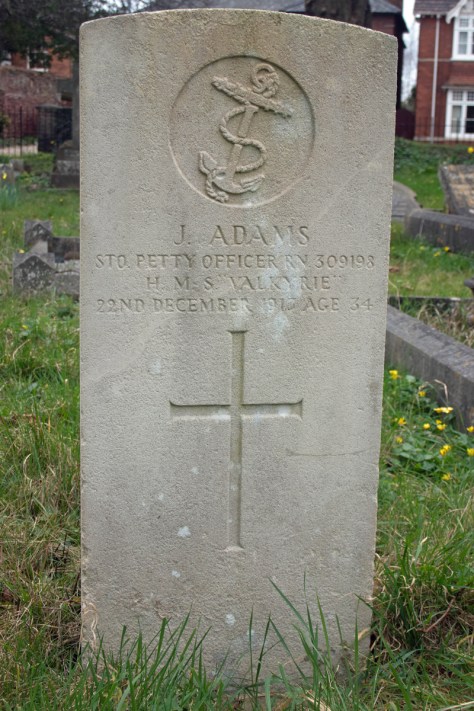
James Adams was born in June 1883, son of Robert and Eliza Adams from Bridgwater in Somerset. Robert was an agricultural labourer; James was one of seven children.
James was keen to get out and see the world. In November 1905 – aged just 12 years old – he enlisted in the Royal Navy as a stoker. After training in Devonport, Plymouth, Stoker Adams served on a number of different vessels, including HMS Victorious, Ramillies, Amphitrite, Monmouth, Andromeda and Halcyon.
By the time war broke out, James has been promoted to Leading Stoker, and was assigned to HMS Cornwall. This was an armoured cruiser that was involved in the Battle of the Falklands in December 1914.
Promoted to Stoker Petty Officer in October 1915, James continued to serve on HMS Cornwall until he was transferred to the brand new ship, HMS Valkyrie. The vessel was involved in offensive sweeps and convoy escorts based out of Harwich.
On 22nd December 1917, the Valkyrie was part of the escort for a convoy travelling to the Netherlands, when she struck a mine. In total, nineteen men were killed, twelve instantly; this included Stoker Petty Officer Adams. He was 34 years old.
James Adams lies at rest in the Wembdon Road Cemetery in his home town of Bridgwater.
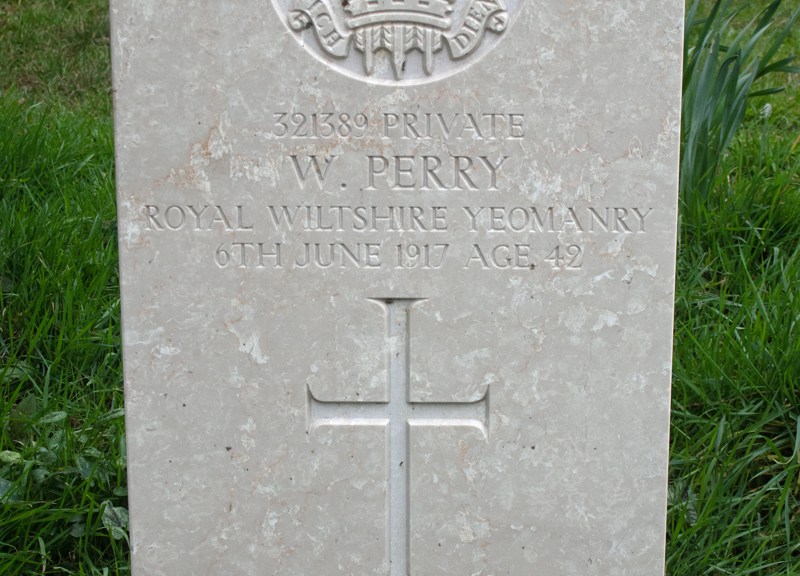
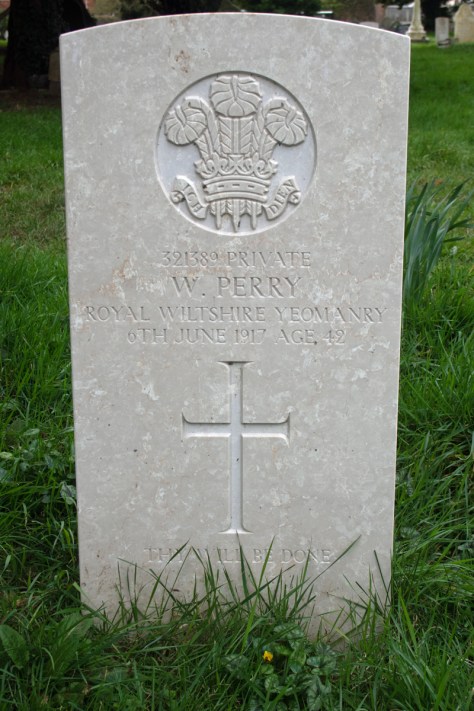
Walter Perry was born in Bridgwater, Somerset, in 1874. He was one of ten children to James Perry, a general dealer, and his wife Hannah. After he had left school, Walter became a labourer; his older siblings had all become labourers or factory workers in the area.
In November 1899, Walter married Rebecca Cavill; their first child, Hilda, was born at the end of March the following year. By this time, Walter was working for a brewery, while his new wife was working at a shirt collar factory. The young couple went on to have two further children – Walter and Beatrice – before Rebecca tragically passed away in June 1906.
Walter married again in November 1908, this time to a Mary Ann Reed also from Somerset. The couple went on to have two children, Joseph and Edna, and the family lived together in the centre of Bridgwater.
The Great War was on the horizon. While details of Walter’s military service are not readily available, it is unlikely that he was called up as soon as hostilities broke out – he turned 40 in 1914, and so was too old to qualify immediately.
Walter enlisted in the 2/1st Royal Wiltshire Yeomanry; he was based primarily in England, where his battalion acted as a training/reserve for the 1st Battalion, who were serving on the Western Front. It was while Private Perry was based in Essex, that he contracted appendicitis; he was admitted to the General Military Hospital in Colchester, but passed away on 6th June 1917. He was 43 years old.
Walter Perry lies at peace in the Wembdon Road Cemetery in his home town of Bridgwater.
Charles Cornell was born in July 1885, the youngest of six children to Philip and Martha Cornell, from Ashdon in Essex. Philip was an agricultural labourer, and Charles and his older brother Daniel followed their father into the trade.
Charles was keen to further himself, however, and enlisted in the army. The 1911 census records him as a Private soldier at the Salamanca Barracks in Aldershot.
Private Cornell married Elizabeth Fanny Hoare in Strood, Kent, in October 1913. Beyond this there is little information on either Charles or Elizabeth.
Charles was assigned to the 3rd Battalion of the East Yorkshire Regiment and was promoted to Corporal. This reserve battalion was initially based in the town of Beverley, before moving to Hull and then nearby Withernsea. It seems unlikely, therefore, that Corporal Cornell saw active service on the Western Front.
His passing seems to have been sudden; his pension record shows that he had been admitted to the Military Hospital at Wharncliffe with nephritis (inflamed kidneys). He passed away on 27th January 1918, aged 32 years old.
Corporal Charles Cornell is buried in the graveyard of St Helen’s Church in Cliffe, Kent, the village his widow’s family were from. He is also commemorated in his own family’s village of Ashdon in Essex (where the memorial states he had attained the rank of Sergeant).
The majority of the the Commonwealth War Graves Commission headstones in the UK are made from Portland stone, although, in face, over 50 different natural stones have been used.
Corporal Cornell’s headstone is one of two in St Helen’s Churchyard that have been fashioned from dark grey slate.