Tag Archives: family

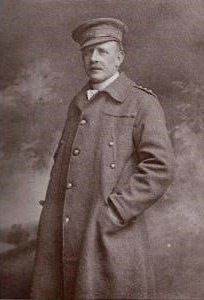
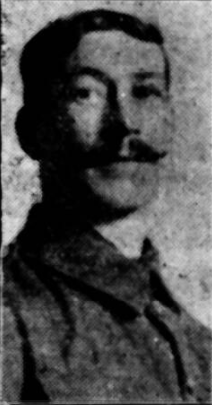
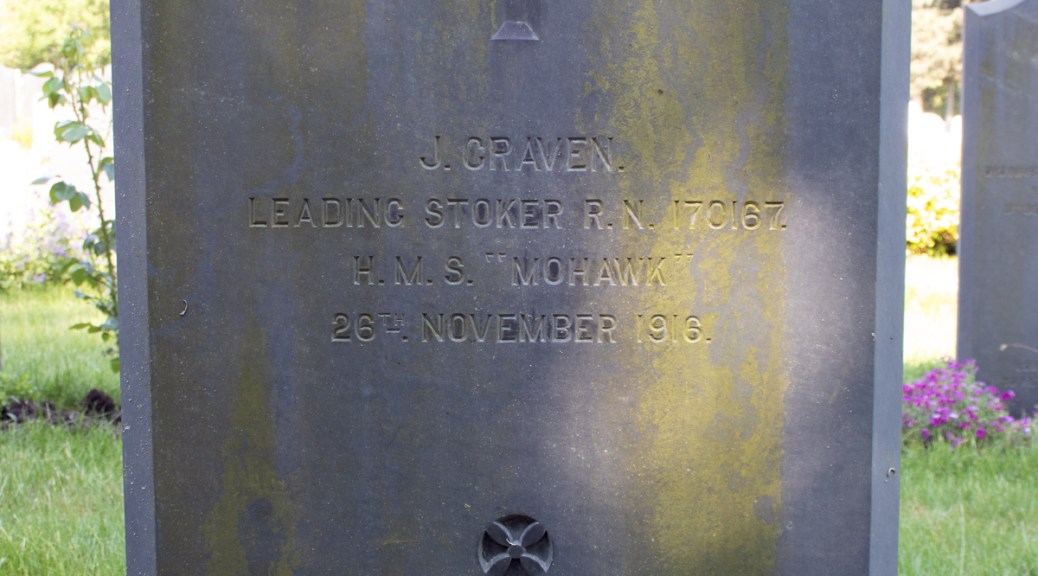
Leading Stoker Joseph Craven

Leading Stoker Joseph Craven

Joseph Craven was born in Liverpool on 6th January 1870. There is little information available about his early life, but by the time of the 1891 census, he was boarding with a blacksmith and his family in Bootle, Lancashire. By this point he was working as a fireman – probably a stoker-type role, rather than for the fire service.

The following year, Joseph found an opportunity to broaden his horizons and, on 21st October 1892, he enlisted in the Royal Navy as a Stoker 2nd Class. His papers show that, at the time of joining up, he was 5ft 4ins (1.62m) in height, had dark brown hair, blue eyes and a fresh complexion. No distinguishing marks were noted.

Joseph’s previous employment seemed to have stood him in good stead. After initial assessments at HMS Pembroke – the shore-based establishment at the Royal Naval Dockyard in Chatham, Kent – he was quickly moved on to HMS Wildfire, based in Sheerness. His first sea posting was aboard the battlecruiser HMS Howe, and, within a couple of months, he had been promoted to Stoker 1st Class.

By the time Joseph’s initial twelve-year contract came to an end, he had served on board nine ships and travelled the world. When the time came, he voluntarily renewed his contract and continued his life at sea.

When back in port, he developed a private life. He met a young widow called Sarah Baker in Portsmouth, and the couple married in 1908. The census three years later found Joseph as the head of the household, living in a seven-room house with Sarah, her 13-year-old daughter, 80-year-old widowed mother and two boarders.

Stoker Craven’s naval service was, by this point, continuing apace. By the time hostilities were declared in August 1914, he had served on twelve further ships, and been promoted again, this time to the role of Leading Stoker. In between his voyages, he was based primarily at HMS Victory, Portsmouth Dockyard’s shore-base.

By the end of the following year, Joseph was almost entirely shore-based, moving from HMS Victory in Portsmouth to HMS Pembroke in Chatham and HMS Attentive in Dover. On 26th November 1916, he was serving in Chatham. A local newspaper picks up on what happened to him next:

Joseph Craven… belonging to Portsmouth, met his death under shocking circumstances at Chatham Dockyard on Sunday. When walking by the side of his ship, which was in dry dock, he tripped over some hose and fell headlong into the dock, turning two or three somersaults in his descent, and falling upon his head at the bottom, 80ft [24.3m] below. He was killed instantly.

Kent Messenger and Gravesend Telegraph: 2nd December 1916

An inquest on the 46-year-old’s death was held, and a result of accidental death was returned.

Joseph Craven was laid to rest in the Woodlands Cemetery, Gillingham, walking distance from the dockyard in which he lost his life.

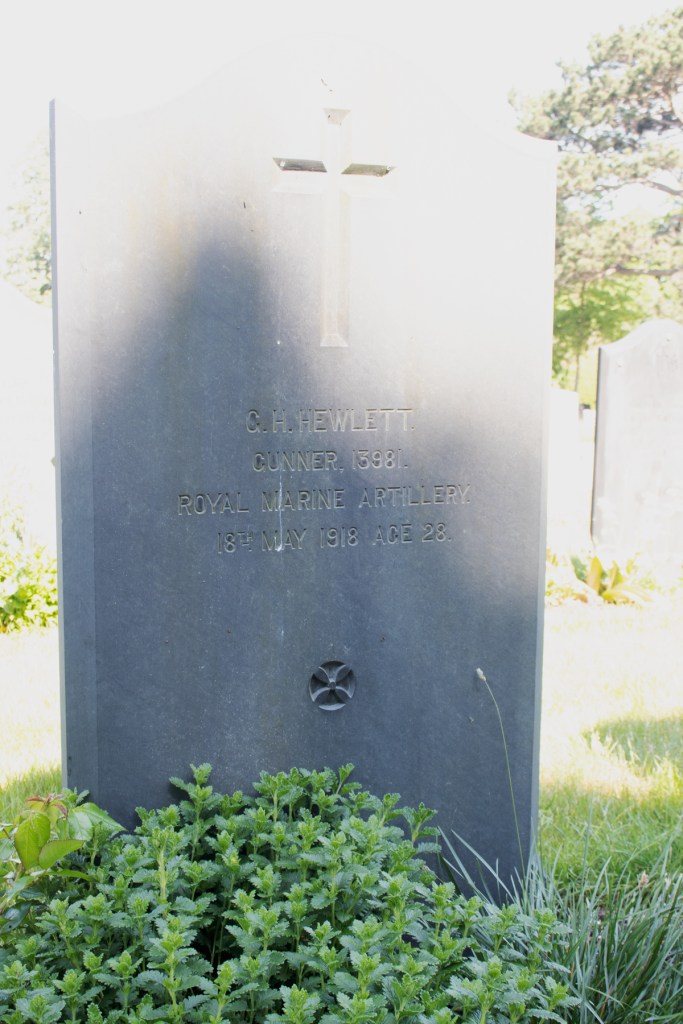
Gunner George Hewlett

Gunner George Hewlett

George Henry Hewlett was born on 11th July 1892, the oldest of four children to Henry and Louisa Hewlett. Henry was a painter from Hampshire, who travelled for work. George and his youngest sibling were born in Romsey, while his two brothers were born in Swindon, Wiltshire. By the time of the 1901 census, when George was eight years old, the family had settled in Hammersmith, London.

The next census, in 1911, recorded the family as living in Caterham, Surrey. By this time, George and his father were working as gardeners, while his brothers were working as grocers. Louisa, meanwhile, was employed as a live-in housekeeper for a spinster and her mother just around the corner.

War was coming and George was determined to do his bit. Full details are not available, but he enlisted in the Royal Marine Light Infantry, taking on the role of Gunner. In May 1918 he was on board HMS Iris, a Mersey ferry requisitioned by the Royal Navy for support in the planned raid on Zeebrugge.

On 23 April 1918, HMS Iris was towed across the English Channel to Zeebrugge by HMS Vindictive; she was carrying a couple of platoons of the 4th Battalion of the Royal Marines as a raiding party. When the Vindictive neared the Zeebrugge she cast the ferry aside. Iris tried to pull up to the breakwater under heavy fire in order to off-load the raiding parties which were on board. She sustained heavy fire and a shell burst through the deck into an area where the marines were preparing to land. Forty-nine men were killed, including Gunner Hewlett. George was 28 years of age.

George Henry Hewett’s body was brought back to England. He was laid to rest in the Woodlands Cemetery in Gillingham, Kent, not far from the dockyard at which he was based.


George’s two brothers also fought in the First World War.

John William Hewlett, who was two years younger than George, joined the 1st Royal Marine Battalion of the Royal Naval Division as a Private. He fought on the Western Front, and was killed in fighting on 22nd October 1916. He was 21 years of age. John was laid to rest at the Mesnil-Matinsart Cemetery near the town of Albert in Northern France.

Joseph Herbert Hewlett was born three years after George. When war was declared, he enlisted in the Buffs (East Kent Regiment), joining the 4th Battalion as a Private. Dispatched to India, he was initially based in Bombay, but was injured in fighting. He was sent back to England, and treated at the Military Hospital at Netley, near Southampton. Sadly, his wounds proved too severe – he passed away on 4th April 1915, aged just 20 years old.

In the space of three years, Henry and Louisa Hewlett had lost all three of their sons to the war. After George’s death, a local newspaper reported this was their “sad and proud record”. [Dover Express: Friday 31st May 1918]


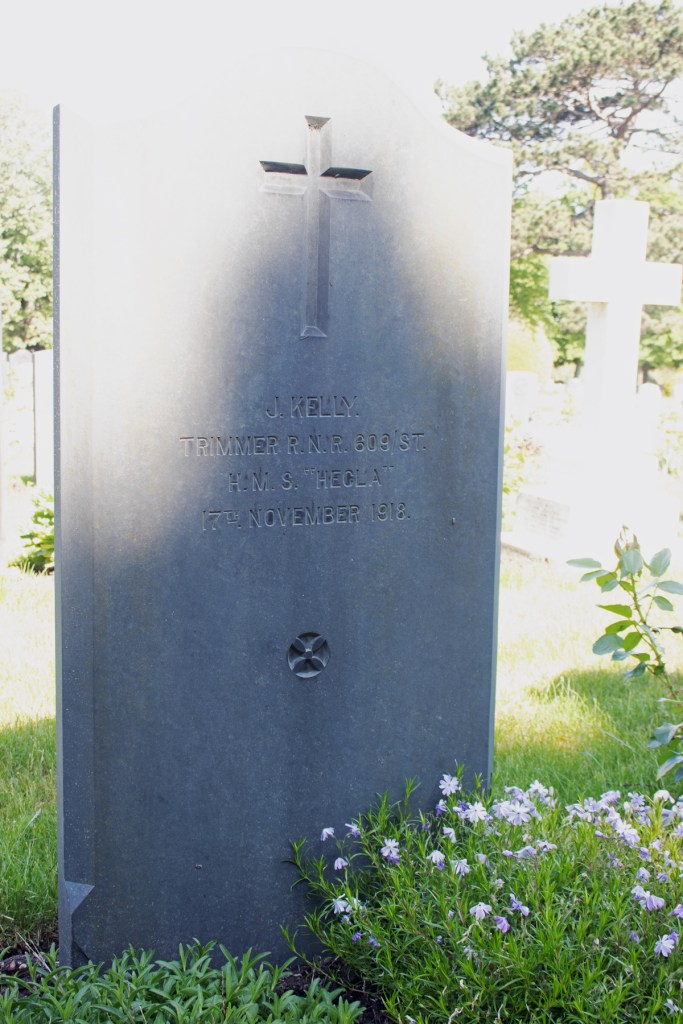
Trimmer John Kelly

Trimmer John Kelly

John Kelly was born in East London on 11th January 1871, the son of Charles and Jane. There is not a lot of concrete information about his early life, but he seems to have married an Isabella Coles in the late 1890s, and the couple went on to have at least one child – a daughter they called Lizzie.

On 13th May 1915, with the First World War raging, John enlisted. He joined the Royal Navy for the duration of the war as a Trimmer (or Stoker), His enlistment papers show that he stood at 5ft 6ins (1.67m tall), had a fair complexion and blue eyes. He is also noted as having a scar on his chin.

During his time at sea, Trimmer Kelly served on board a number of vessels; his primary base, however, remained HMS Pembroke, the shore-based establishment at the Royal Naval Dockyard in Chatham, Kent.

It was while he was on board HMS Hecla, a depot ship, that John fell ill with stomach problems. Returned to Chatham, he was admitted to the Naval Hospital in the town, but died of a carcinoma of the stomach on 17th November 1918. He was 47 years old.

John Kelly was laid to rest in the Woodlands Cemetery, Gillingham, a short distance from the dockyard where he had been based.


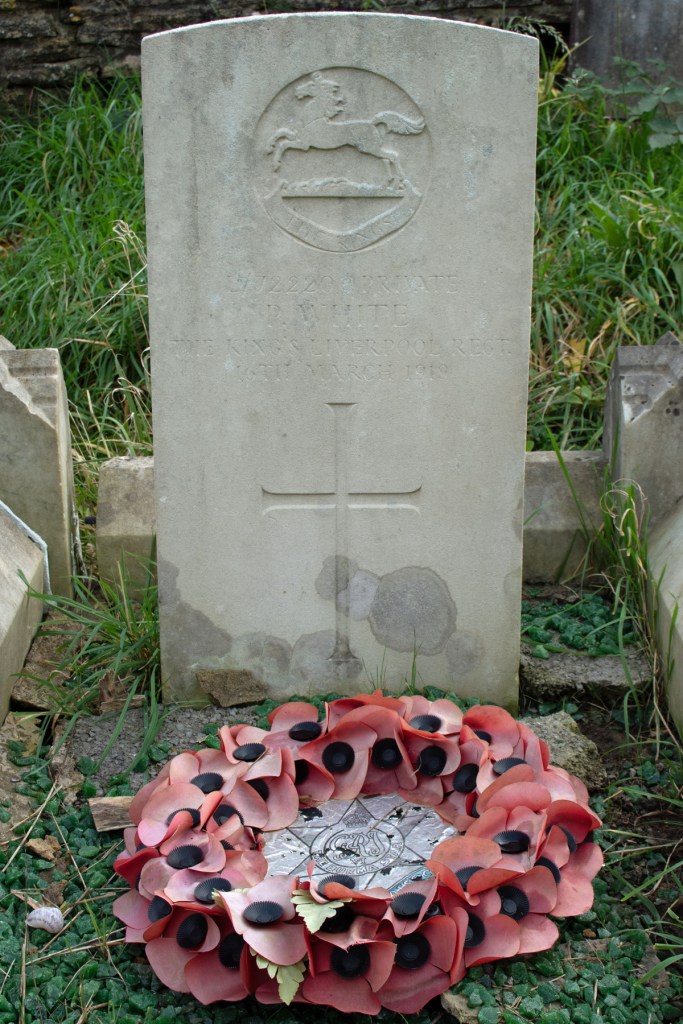
Private Percy White

Private Percy White

Percy White was born in the spring of 1890, the youngest of four children to Frank and Fanny White. Frank was a tailor from Frome, Somerset, and this is where the family were raised and settled for most of Percy’s life.

By the time of the 1911 census, Frank and Fanny had been married for 30 years. Frank was still working as a tailor, while Percy’s three older siblings – all girls – were working as silk weavers and packers. Percy had moved away from the family’s clothing heritage, and had found work as a hairdresser.

War was on the horizon, however, and Percy was called upon to do his duty for King and Country. He was initially assigned as a Private to the King’s (Liverpool Regiment) when he joined up in the autumn of 1914. Full details of his military service are not readily available, but it seems that he served on the Front Line in France, but was invalided out late in 1917.

By that point, he had met Bessie Cundick, who had been born in Wiltshire. They married in Andover in the spring of 1916, when they were both 26 years old.

Back in England, and discharged from the King’s (Liverpool Regiment), Percy was transferred to the Labour Corps and, for the last year of the war had done agricultural work in Cambridgeshire. After the armistice was signed, Frank fell ill and died on 4th February 1919.

Private White attended the funeral at the Vallis Road Cemetery in Frome with his family, before returning to his unit. By this point, however, he had himself fallen ill with influenza, and was admitted to the East General Hospital in Cambridge. The condition was to prove too much, however, and he passed away on 16th March, less than six weeks after his father’s death. He was just 29 years of age.

Percy’s body was brought back to Frome; he too was laid to rest in the Dissenters’ Cemetery in Vallis Road, Frome.


Bombardier Daniel Mcauley

Bombardier Daniel McAuley

Daniel Mcauley was born in Belfast in around 1883, one of six children to John and Margaret Mcauley. John was a farmer, and when Daniel – who was named after his uncle – left school, he found labouring work to help the family bring in an income.

In January 1909, Daniel married Annie Fittis, the daughter of a linen tenter (stretching cloth on a loom while it was drying and maintaining the machines). The couple had had a son, John, eighteen months before, and would have another child, Sarah, later that year.

The 1911 census for Northern Ireland found the young family living with Annie’s mother and two sisters in Dayton Street, near the middle of Belfast. Annie and her sisters were working as flax spinners, while Daniel was a labourer. Tellingly, the document lists inhabitants’ religion – Daniel is the sole Roman Catholic amongst a family of Presbyterians.

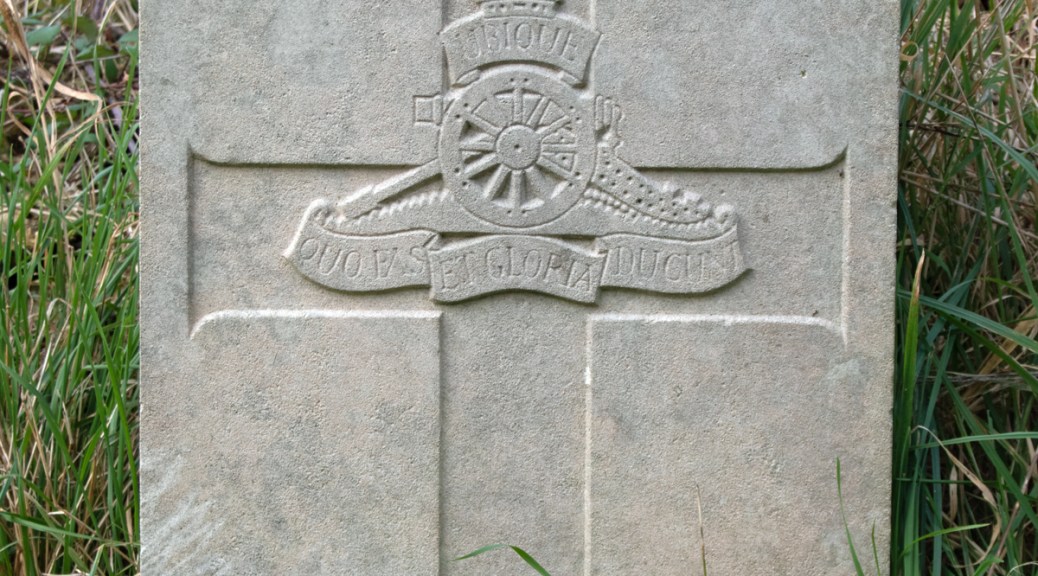
War was coming to Europe, and Daniel was called on to do his bit. Sadly, full details of his military service are not available, but what is clear is that he enlisted as a Bombardier in the Royal Field Artillery towards the end of 1914. He was shipped to England, and barracked in Somerset, near Frome.

Sadly, the next evidence of Daniel’s life comes in a wealth of newspaper articles that report on the accident that led to his death.

One soldier was killed and another seriously injured as the result of a horse attached to a Royal Field Artillery wagon bolting at Frome Saturday morning. The wagon was on its way to the stables when the horse got out of control and ran along Christ Church Street West.

One man, who was riding in the wagon, in jumping clear was seriously cut about the head and body, and was taken to the hospital. The other, Bombardier Daniel MacAulay, belonging to Glasgow [sic], remained in the wagon trying to pull up the horses, but the vehicle swerved across the road and he was thrown out, his head coming into contact with a street lamp.

He was taken to the hospital on the police ambulance, but died before admission. He was a married man, about 34 years of age, and was to have gone on leave Saturday in order to visit his sick child. In the morning he received a letter from his wife saying that the child had been seriously ill and had gone blind.

Mr Douglas Mackay, deputy coroner, held an inquest at Frome on Tuesday on the body of the deceased. The verdict was “Accidental death.”

Shepton Mallet Journal: Friday 19th March 1915

Other newspapers reported similarly, a couple stating that Daniel was father to three children. There is no evidence that this was the case and, given that all of the reports state that he came from Scotland, when he was Irish, it is likely that this too was an error. Each newspaper give variations of the spelling of his surname too, evidence that spelling was often at the mercy of the person documenting it, even in the media.

Daniel was buried in Somerset and Annie travelled to England to attend the funeral. Again, newspaper reports suggest that Daniel’s brothers also attended, although he had only one male sibling.

Bombardier Daniel Mcauley died on 13th March 1915, aged around 33 years old. He was laid to rest in the Vallis Road Burial Ground in Frome, also known as the Dissenters’ Cemetery (for those who did not follow the English Protestant faiths.


McAuley (McCauley), Daniel, Bombardier, Royal Field Artillery, 7 Wall Street Belfast, Died, March 1915

Private Frederick White

Private Frederick White

Frederick James White was born in the autumn of 1898, one of four children to Frederick and Emma White. Frederick Sr was a gas fitter from Frome, and the Somerset town was where the family were raised.

As a youngster, Frederick Jr attended the Primitive Methodist Sunday School in the town. He also acted as treasurer for the local YMCA. He was only 15 when war broke out, so was not able to enlist immediately.

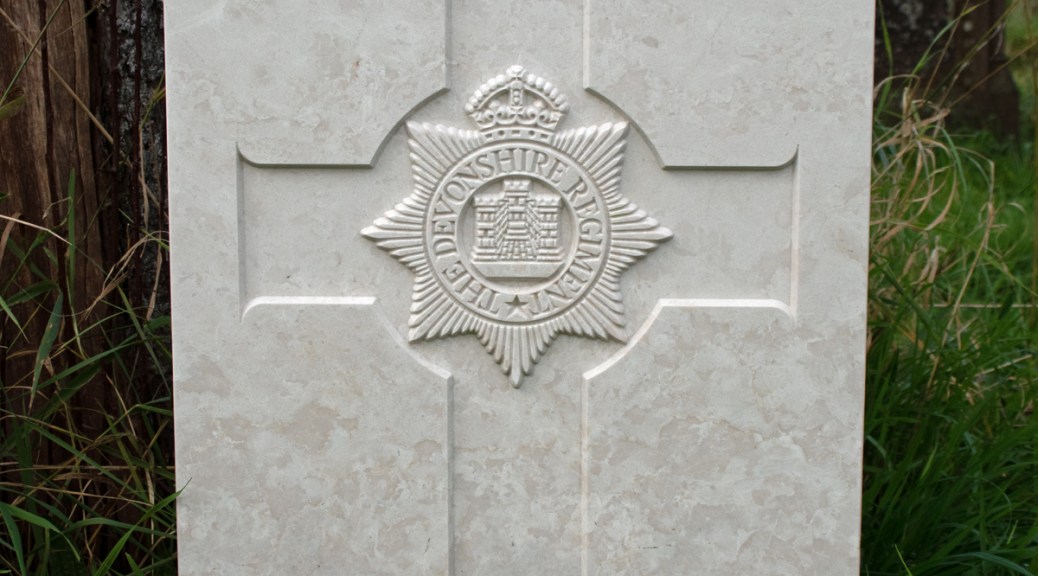
However, by 1916 he had joined the 1st Battalion of the Devonshire Regiment as a Private and, at some point, was assigned to the Royal North Devon Hussars.

Either way, in whichever regiment he served, Frederick saw fighting in France, and was wounded in the autumn of 1917. Medically evacuated back to England, he was admitted to the temporary military hospital at Collegiate Hall in Sheffield.

The local newspaper shed a little more light into Frederick’s life:

Deceased, who was in the North Devon Hussars, died on November 22nd, at Sheffield, of wounds he received on November 5th. He was brought back to England three weeks to the day from the time he sailed for France.

Somerset Standard: Friday 30th November 1917

Private White’s wounds were too much; he passed away at the age of just 19 years old.

Frederick James White’s body was brought back to his home town. He was laid to rest in the Dissenters’ Cemetery in Vallis Road, Frome.


Frederick Sr and Emma White would have been understandably saddened by their son’s passing. They had four children; their eldest, Florence, had passed away before reaching her first birthday. Their youngest, Reginald, had died in childbirth. Frederick had died as a result of the First World War.

Sadly, the tragedy wasn’t yet over. Their only surviving child, Frederick’s younger brother William, passed away in August 1919, aged just 17 years old.

Frederick Sr and Emma had outlived all of their children, none of whom had reached or survived their teenage years.


Captain Hugh Brooking

Captain Hugh Brooking

Hugh Cyril Arthur Brooking was born on 15th September 1870 and was one of six children (although he also had three further half-siblings through his father’s first marriage). His father, Arthur Brooking, was the vicar of the Hertfordshire village of Bovingdon, and it was in the vicarage that he and his wife Marian raised their family (with the help of seven servants).

Hugh led a life befitting of a reverend’s son; he was educated at St Mark’s School in Windsor, Lancing College and Down College, both in Sussex. He continued his studies at the Mining College in London (now part of Imperial College London), and went out to South Africa to further that work.

The local newspaper reporting on his funeral takes up the story:

When the Boer War broke out he joined the Imperial Light Horse, and was engaged in the battles of Elandslaagte, Wagon Hill and others, was in Ladysmith during the siege, and the relief of Mafeking. He was several times mentioned in despatches, and obtained the Queen’s medal and six clasps, and the King’s medal with two clasps. He then joined the South African Constabulary, under General Baden Powell.

He had previously held a commission in the North Somerset Yeomanry, and after leaving it for a short time he re-joined a soon as the [First World War] was declared, and was in France with his regiment when it made its famous stand against the Prussian Guards. All his superior officers were killed or wounded, and he was temporarily in command of the regiment.

He received the ribbon of the 1914 Star of Mons, but did not live to get the star. He served with the regiment 20 years. He was latterly attached to the Labour Corps at West Ham.

Captain Brooking came to Frome with his parents as a boy. In his youth he was a thorough sportsman, well known in the hunting field, genial and kindly, ready with a pleasant word, and courteous to all, he won friendly appreciation from all classes of townsfolk.

He had seen a great deal of fighting, though from exposure and other causes his health suffered, and he was employed on home service.

He was in command of the 371st Labour Company, and second in command of his battalion, when he met with the slight accident which led to his death. He grazed his knuckles, causing bleeding, but of so slight a character that no notice was taken of it. A few hours later he again struck his hand, and fresh paint appears to have affected the wound, and blood poisoning supervened.

Somerset Standard: Friday 7th June 1918

In his personal life, Hugh had met and married Florence Day, a farmer’s daughter seventeen years his junior from Somerset. The wedding was in the autumn of 1912, and they would go on to have two children, Granville and Hugh Jr. The boys would both go on to lead distinguished lives, Granville in the armed forces and Hugh as a ‘King’s Messenger’ in South America.

Following Captain Brooking’s injury, he was admitted to the Military Hospital in Purfleet but the treatment he received there was to do no good. Three months after the accident, on 31st May 1918, he passed away; he was 47 years of age.

Hugh Cyril Arthur Brooking’s body was taken back to Frome; he was laid to rest in the graveyard of St John the Baptist Church in the town.


Larger memorial image loading...
Captain Hugh Brooking
(from findagrave.com)

Lance Corporal Henry Preece

Lance Corporal Henry Preece

Henry Thomas Preece was born in the summer of 1884, one of seven children to agricultural labourer Tom Preece and his wife, Sarah. Thomas had been born in the Somerset village of Nunney, and it was here that he raised his family.

When Henry left school, he chose not to follow in his father’s agricultural footsteps. By the time of the 1911 census, he was recorded as a baker and, as such, would have been at the heart of village life in Nunney.

Henry married local woman Ellen Stone in 1909, who was a dressmaker with her own account. The couple would go on to have four children between 1909 and 1916.

With war looming, Henry felt the need to play his part. He joined the King’s Royal Rifle Corps in January 1916 and, after training, was sent to France a couple of months later.

He was wounded on July 25th, when out with a wiring party erecting barbed wire obstacles. He received a gun-shot wound in the abdomen, which also injured the spinal cord and his back. He was first taken to the South African Hospital at the base, and after being there for several days he was removed to England and take to the Netley Hospital where he died…

Somerset Standard: Friday 8th September 1916

Lance Corporal Preece died on 3rd September 1916, at the age of 32 years old. His body was brought back to Nunney, where he was laid to rest in the family grave at All Saints’ Church.


Lance Corporal Henry Preece
(from britishnewspaperarchive.com)

Private Henry Teahen

Private Henry Teahen

Henry Teahen (or Teahan) was born in around 1898 in Castlegregory, County Kerry, Ireland. One of twelve children – eight of whom survived infancy – his parents were John and Catherine Teahan.

John was a wayman (or road surveyor), who was born in Kerry. Catherine was born in Wandsworth and it was in London that the couple met and married. By the time Henry was born, the family had moved back to Ireland, although Catherine had made the journey back to England in the early 1900s, after John passed away.

The 1911 census found the family living in Forest Gate in the east of the capital; Henry’s oldest brother, Joseph, was head of the household and, at 24, was working as a police constable. Schoolboy Henry was there, as was his mother, two more of his brothers, one of his sisters and his niece and nephew.

War was imminent, though, and, within a week of hostilities breaking out, Henry – who had been working as a waiter – enlisted in the Royal Marine Light Infantry. Private Teahen’s service records show that he was 5ft 8ins (1.72m) tall, had a fair complexion, grey eyes and brown hair. They also give his date of birth as 22nd June 1896, although he may have adapted this, as he would have been underage at the point he joined up.

Over the next few years, he served on a number of ships, switching between the Plymouth and Chatham divisions of the regiment. Full details of his duties are not immediately apparent, although is seems that he was injured while on board HMS Valiant in February 1916 – six months before her involvement in the Battle of Jutland – receiving a contusion to his right knee.

By the closing months of the war, Private Teahen had transferred back to the Naval Dockyard in Chatham, Kent. It was while here, early in 1919, that he fell ill. Details of his condition are lost to time, but it is known that he succumbed to them, passing away on 1st March 1919; he was 21 years old when he died.

Henry Teahen was laid to rest in the Woodlands Cemetery in Gillingham, within walking distance of the dockyard at which he was based.


Henry’s older brother James, also fought in the First World War. Full details are not clear, but documents show that he enlisted in the 6th City of London Regiment (also known as the City of London Rifles).

James’ regiment fought in many of the fiercest battles on the Western Front, including Loos, Vimy, High Wood and Messines, but it was at Ypres in the late summer of 1917, that he was injured. He died of his wounds on 30th September, aged just 23 years old.

Private James Teahan was laid to rest at the Mendinghem Military Cemetery in Poperinghe, Belgium.


Stoker 1st Class Henry Wate

Stoker Henry Wate

Henry Wate was born on 15th June 1897, the youngest of seven children (four of whom survived) to Henry and Norah Wate. Henry Sr was from the East End of London. He raised his family in a three-room tenement in White Horse Alley, just off Cowcross Street, next to the busy Farringdon Station.

By the time of the 1911 census, Henry Sr and Norah had been married for thirty years. The head of the household, Henry was working as a rad dealer, while Norah was a housewife. Of their children, William (the eldest) worked as a labourer for a bike dealer, Annie was a packer in a chocolate factory, Nellie was a waitress and Henry Jr was still at school, though only just. Henry’s niece Julia was also staying with them, and was employed as a fancy leather worker.

When war broke out, Henry Jr was working as a carman, carting goods to and from the nearby railway. When the call came, however, he joined up, enlisting in the Royal Navy as a Stoker 2nd Class. After a couple of months training at HMS Pembroke – the shore establishment at the Naval Dockyard in Chatham – he was assigned to HMS Wallington. This was a trawler, requisitioned by the Royal Navy to act as a boom/balloon vessel, presumably to tether barrage balloons.

In January 1917, Henry received a promotion to Stoker 1st Class. He returned to Chatham six months later. That summer, HMS Pembroke was becoming crowded and he was billeted at the Chatham Drill Hall.

On 3rd September 1917, the building took a direct hit from a German bomber. Stoker Wate, along with 97 others, was killed instantly. He was just 20 years old.

Henry Wate was laid to rest – along with the others who perished that night – in a mass funeral on 6th September 1917 at the nearby Woodlands Cemetery in Gillingham.


Full details of the night raid on Chatham Drill Hall can be found here.


Henry’s older brother William also served in the Great War. Twelve years older than his brother, William joined the Royal West Surrey Regiment in January 1915 as a Private. He was posted to France in July, and ended up serving on the Front Line for nearly four months.

In September 1915, Private Wate fell ill with heart palpitations. Shipped back to England for treatment, he was admitted to the Brook War Hospital in Greenwich, South London. The medical report confirmed that William had had rheumatic fever as a child, and had had an attack of ‘sycope’ (low blood pressure and a loss of consciousness) in 1911. The report concluded that he had heart disease and he was discharged from military service in 1916, as a result of this.

Little is known about Williams post-army life. All that can be confirmed is that he passed away from his heart condition on 23rd November 1918 aged 33. He was buried in St Mary’s Roman Catholic Cemetery in Kensal Green, North London.