Pte. Arthur Candey, of the Devon (Cyclists) Territorials, was found shot at Rotterdam, Talland, near Polperro, early on Friday morning. About six weeks ago Candey was drafted to Polperro from Looe and had been engaged in watching the coast, and the deceased and Pts. C Harris went on patrol duty. At Rotterdam Cottage, Candey complained of feeling tired and unwell. so Harris told him to remain in a hut close by while he went on alone and met the other patrol. While on the return journey Harris heard the report of a gun, and deceased was found dead with a bullet wound in the head. Death must have been instantaneous. Pte. Harris was away from the deceased for fifty minutes altogether…
At the inquest at Talland… the jury… returned a verdict that Candey took his life while temporarily insane.
[West Briton and Cornwall Advertiser: Monday 21st June 1915]
Arthur Candey was born in the spring of 1897 in Tiverton, Devon. One of thirteen children, and the youngest surviving son, his parents were Richard and Ellen Candey. Richard was a lace maker, and the family lived in a small terraced house in John Street, to the west of the town.
There is little information available about Arthur’s life. The 1911 census showed that he was still in school, and his army service records have been lost to time. It is clear that he enlisted in the 2nd/7th (Cyclist) Battalion of the Devonshire Regiment, and the newspaper report confirms that he served in Cornwall.
Private Arthur Candey was just 18 years of age, when he died on 18th June 1915. His body was taken back to Devon for burial. He was laid to rest in Tiverton Cemetery, a short walk from where his grieving family still lived.
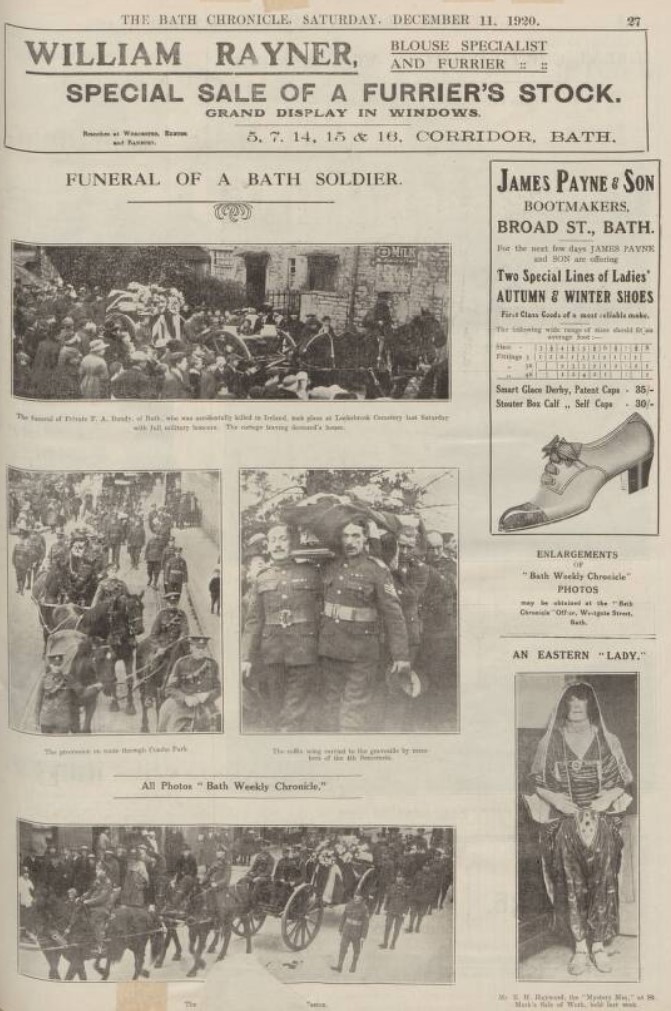
Private Frederick Arthur Bundy, of the 1st Somerset Light Infantry is to be buried in Locksbrook Cemetery tomorrow (Saturday) afternoon with full military honours. He met with a fatal accident in Belfast on Sunday last. In the afternoon when in quarters he was passing from one room to another when a rifle which was bring cleaned by a comrade in the room which he was entering went off. The bullet passed through Private Bundy’s wrist and entered the stomach. He was at once removed to the military hospital, but passed away at midnight, from internal haemorrhage. Deceased, was the son of Mr FA Bundy, of 93 High Street, Upper Weston, and enlisted at the Drill Hall, Bath, in August 1919, when only 15 years of age, being accepted as he was a youth of exceptionally fine stature. At the time of his death he was 16 years and 10 months of age. After a short period of training at Taunton he went with a draft of Somersets to Ireland and was stationed for some time at Carrickfergus Castle, being moved into Belfast when the riots occurred there.
[Bath Chronicle and Weekly Gazette: Saturday 4th December 1920]
Frederick Arthur Bundy was born early in 1904, and was the middle of three children to Frederick and Mary Ann Bundy. Frederick Sr was a labourer from Bath, Somerset, and it was in the Weston area of the city that the family were born and raised.
The 1911 census – the only one Frederick Jr would be recorded on – noted the family as living at 45 High Street, Weston. The household consisted of Frederick Sr, Mary Ann, Frederick Jr, his older sister Sarah, younger brother William and Mary Ann’s daughter from a previous marriage, Annie.
Sadly, due to his young age, there is little additional documentation to build a picture of Frederick Jr’s life. He passed away on 28th November 1920, and was laid to rest in Bath’s Locksbrook Cemetery, not far from the family home.
Frederick Arthur Bundy’s funeral was shown in a photo-spread in the Bath Chronicle of 11th December 1920.
Editor’s Note: While Frederick enlisted nine months after the end of the First World War, his acceptance for a Commonwealth War Grave is because his passing being between the qualifying dates and the cause being as a result of his military service.
William James Profitt was born on 20th August 1894 in Collingwood, Victoria, Australia. The oldest of ten children, his parents were Cornish-born Francis Profit and his Australian wife Mary.
Little information is available about William’s early life. When he finished his schooling, he found work as a salesman, and this is the work he was doing when war was declared in Europe.
William felt duty bound to serve his King and Empire, and, on 5th July 1915, he enlisted in the Australian Imperial Force. His service records confirm that he was just 5ft 2.5ins (1.59m) tall, weighing 8st 4lbs (52.6kg). He was noted as having cark brown hair, blue eyes and a fresh complexion: he had a scar on his left cheek.
After initial training, Private Profitt arrived in Alexandria, Egypt. He was assigned to the 23rd Battalion of the Australian Infantry and, by 30th March 1916, he was in France. William’s unit was one of the many to become entrenched at the Somme, having been evacuated from Gallipoli just weeks before he had arrived in Europe.
On 2nd August Private Profitt was admitted to a camp hospital in Boulogne with a sprained ankle. The medical report noted the injury as trivial, having occurred when, on ‘being relieved from trenches [he] slipped and fell into an old German dugout.’ By 21st August he was back with his unit, now based in Etaples.
Just a week later, William was sent to a casualty clearing station in Rouen, having been shot in his right elbow. Less trivial an injury this time round, he was medically evacuated to Britain for treatment, and was admitted to the Cambridge Military Hospital in Aldershot, Hampshire.
Private Profitt’s injury should not have been a life-threatening one, but septicaemia set in. His condition worsened, and he passed away on 25th October 1916. He was just 22 years of age.
With William James Profitt’s family more than 10,000 miles (17,000km) away, it was not possible to him to be buried at home. Instead, his body was taken to the peaceful and picturesque graveyard of St Michael’s Church in Rock, Cornwall, close to where his father’s family still lived.
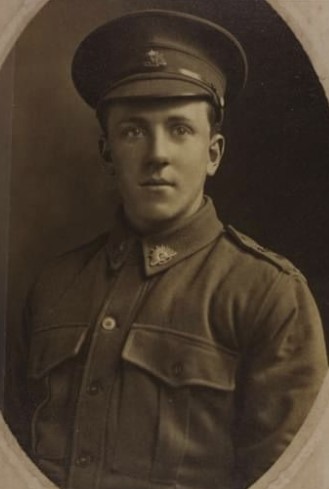
Private William Profitt (from findagrave.com)
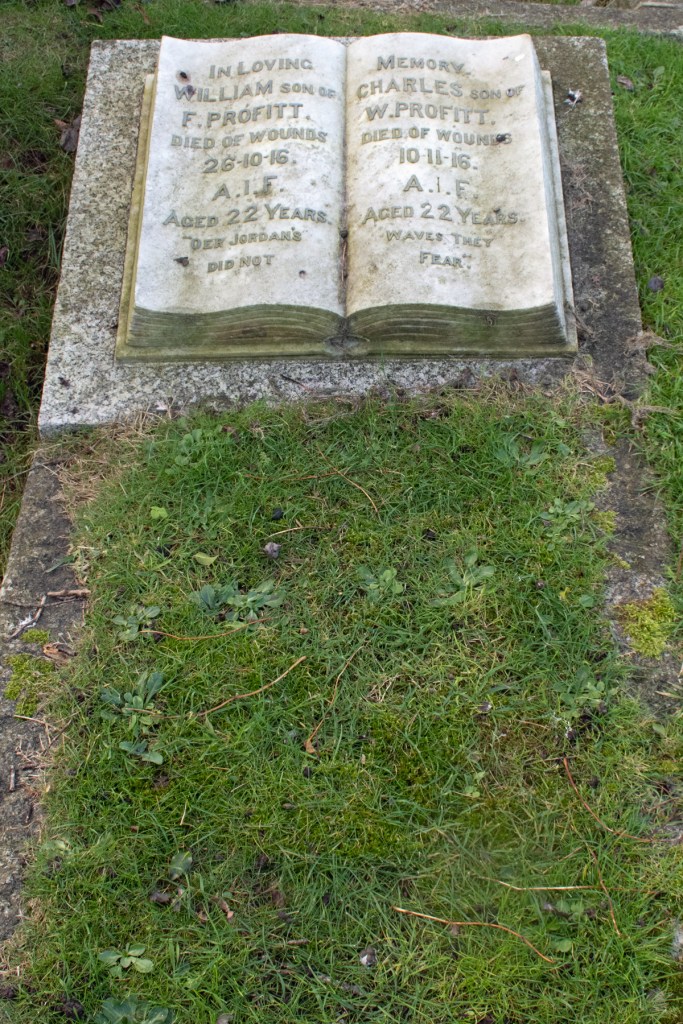
William’s grave shares a dedication with Charles Profitt, who died just a fortnight after him.
John Walter Charles Profitt – better known as Charles – was born in the summer of 1894 Geelong, Victoria, Australia. The oldest of three sons to William and Harriet Profitt, it is likely that his father was William’s uncle, and that the two siblings had both travelled to Australia to earn their fortunes.
Working as a teacher at the time, Charles enlisted just days after his cousin, joining the 6th Field Ambulance unit. His service records show that he had dark brown hair, grey eyes and a fresh complexion, no dissimilar to William. Standing 5ft 8ins (1.73m) tall and weighing 10st 6lbs (66.2kg), it is clear that his side of the family had markedly different genes.
Private Profitt arrived in France on 27th March 1916, and his dedication to the role showed when he was promoted to the rank of Lance Corporal in August.
On 9th November he was badly wounded while carrying out his duties, receiving a severe gun shot wound to his abdomen. He was admitted to the 1st Anzac Medical Station, but died of his injuries just two days later. He was just 22 years of age.
Lance Corporal Charles Profitt was laid to rest in Heilly Station Cemetery to the south of Méricourt-l’Abbé. He is commemorated with his cousin, William, in St Michael’s Church, Rock.
Lance Corporal Charles Profitt (from findagrave.com)
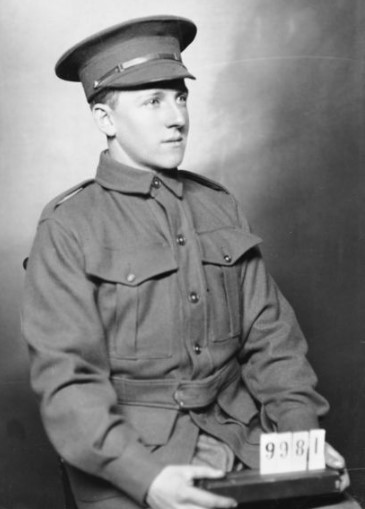
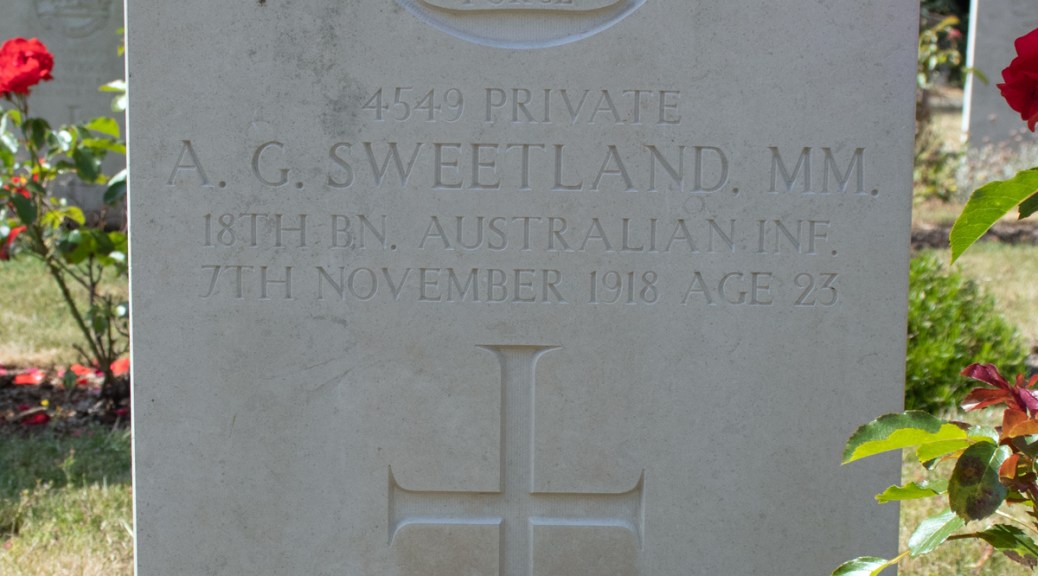
Albert Graham Sweetland was born on 6th January 1895 in Kensington, Middlesex. The oldest of seven children, his parents were mechanical engineer Albert Sweetland and his wife, Edith.
A work ethic was instilled into Albert Jr from an early age. By the time of the 1911 census, he had been sent to Truro, Cornwall, where he worked as a servant to the Faull family, tending to their poultry.
Albert was set on developing a life for himself and, in the next few years, he emigrated to Australia. He settled in the town of Liverpool, now a suburb of Sydney, and found work as a station hand. War was on the horizon, however, and people of the empire were called upon to serve their King.
Albert enlisted on 22nd January 1916, joining the 18th Battalion of the Australian Infantry. His service records tell a little about the man he was becoming. He was 5ft 7ins (1.7m) tall, and weighed 143lbs (64.9kg), with fair hair, blue eyes and a fair complexion. The document also notes that he was a Methodist, and that he had tried to enlist in the British army before emigrating, but that a slight defect in his right eye had prevented him.
Private Sweetland set sail for Europe on 9th April 1916. His unit sailed via Suez, reaching Folkestone, Kent, that November. His time back in Britain was to be brief, however: within a matter of days he was in Etaples, France.
Albert was thrown into the thick of things. On 5th May 1917, he was wounded while fighting at Arras. He was shot in the legs, and medically evacuated to Britain for treatment and recuperation. He was to remain on home soil for the next year, before returning to his unit in June 1918.
On 3rd October 1918, Private Sweetland was injured during the Battle of the Beaurevoir Line. His unit’s push forward was initially successful, but ultimately failed to capture the the village. The German forces attacked with gas, and Albert was caught up in it, receiving a gun shot wound to his back.
By the time Beaurevoir was in Australian hands three days later, more than 430 Allied soldiers had been killed. Albert was awarded the Military Medal for his bravery during the battle.
Private Sweetland was medically evacuated to Britain once more, and was admitted to Bath War Hospital for treatment. This time, however, he was not to be as luck as he had been eighteen months previously. He died on 7th November 1918, from a combination of appendicitis, pneumonia and heart failure. He was just 23 years of age.
Albert Graham Sweetland was laid to rest in the military section of Bath’s Locksbrook Cemetery, not far from the facility where he had passed. His parents and his sister Winifred attended the funeral.
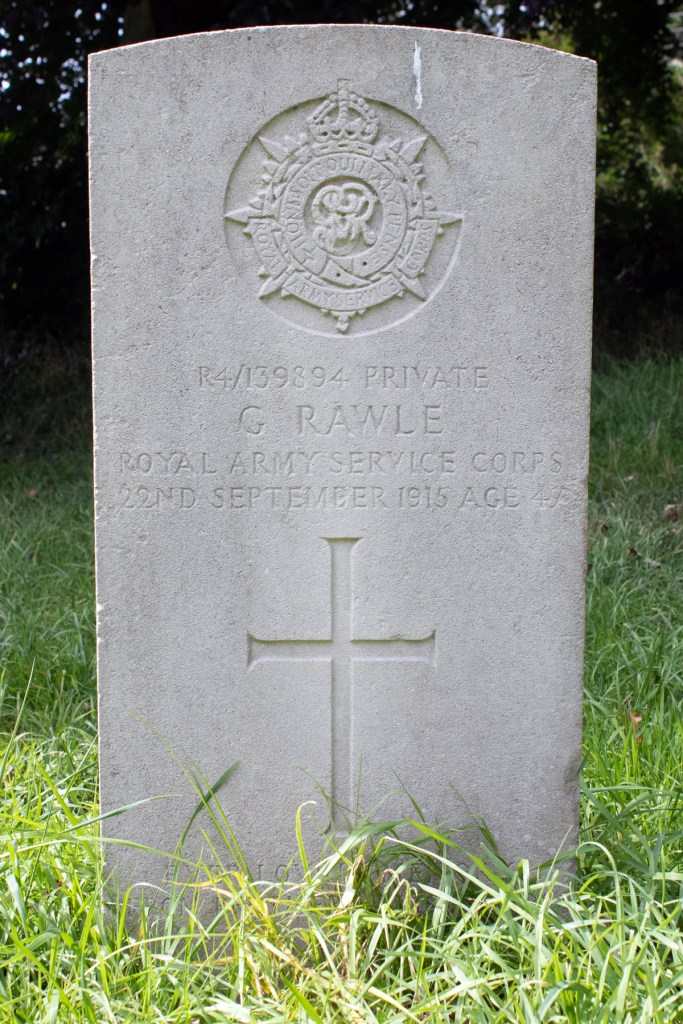
George Rawle was born on 26th April 1867 in the Somerset village of Milverton. One of nine children, his parents were William and Ann. William was a shepherd turned general labourer and, when he first finished his schooling, George was sent north to Nether Stowey, where he worked as a stable boy at Castle Hill House.
The 1891 census found George back living with his parents, who had moved to Milverton, presumably following William’s work. George, by this time, was employed as a domestic groom, although the next census found both him and William – now 74 years of age – working as general labourers.
William died in 1902, and Ann passed away seven years later. By 1911, George had moved just up the road to Wiveliscombe. He was living in a four-roomed cottage and employed as a jobbing gardener. He shared his home with two of his sisters: Jane was 46 years old and working as a housemaid; Alice, 33 years of age, was a housekeeper.
When war came to European shores, George felt the need to step up and play his part. He joined up at an enlistment drive at the brewery in Wiveliscombe, and was assigned to the Royal Army Service Corps as a Private. While waiting for his medical he returned to the home he shared with his sisters. It was here, just five days later, that he ended his life.
A painful sensation was caused in Wiveliscombe on Wednesday morning, through the action of Priv. George Rawle, of the E Squadron, Somerset Mule Depot, who took his own life under distressing circumstances at his residence at Higher Nunnington.
Deceased… had been restless through the night, and about five o’clock in the morning he told his sister he was going to get up to write a letter. The sister begged him to put his clothes on, but he would not do so, and went downstairs. She followed him in her nightdress. He picked up a gun in the hall, and she tried to take it away from him, but failed. Rawle went out to the path in front of the door of the house. His sister took hold of his arm, but he wrenched himself away, put the muzzle of the gun in his mouth, pulled the trigger, and fell down beside her, having blown out his brains.
Dr WH Randolph was in attendance shortly after, but could only pronounce life extinct.
The inquest took place on Friday, before Mr Foster Barham, coroner for West Somerset.
Jane Rawle, deceased’s sister, said her brother had suffered from nervous depression for many years, and seventeen years ago was a patient at Cotford Asylum. Lately he had been worried about the house in which he lived.
Taunton Courier and Western Advertiser: Wednesday 29th September 1915
The jury at the inquest returned a verdict of suicide while of unsound mind. George was 48 years of age.
George Rawle was laid to rest in the quiet graveyard of St Andrew’s Church, Wiveliscombe. His estate was shared between two of his sisters, Jane and Hannah.
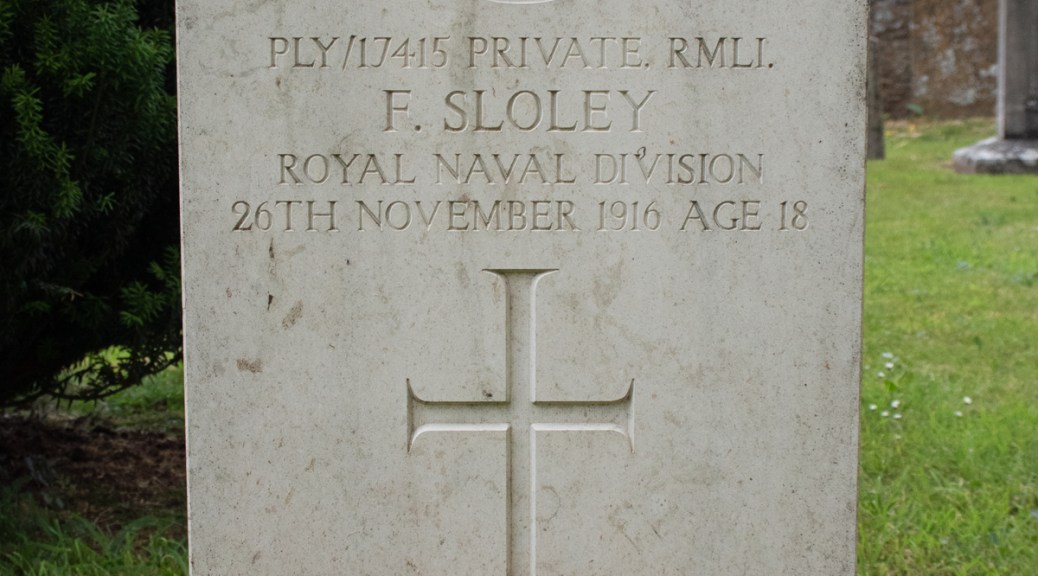
Frederick Sloley was born on 7th April 1897 in Kingston St Mary, Somerset, and was the fourth of nine children to Walter and Mary Jane Sloley. The family were farm workers and were living with Walter’s parents – also agricultural labourers – in the 1901 census.
After he finished his schooling, Frederick found began working with the horses on the farm. When war broke out, however, he saw an opportunity to serve his King and Empire, and enlisted in the Royal Marine Light Infantry. He joined up on 5th October 1914, and his service records show that he was 5ft 4ins (1.63m) tall, with black hair, grey eyes and a fresh complexion.
Private Sloley was initially sent to the Reserve Depot in Deal, Kent, for training, before moving to the Plymouth Division in Devon in March 1915. He records do not make it clear where he served specifically, but by 1916 he has fought in the Dardanelles and Mesopotamia.
It was while he was in the Eastern Mediterranean that Frederick was injured. Wounded in the spine by enemy gunfire, he was medically evacuated to Britain for treatment. Admitted to King George’s Hospital in London, surgery proved too late. Private Sloley passed away on 26th November 1916, at the age of just 19 years old. His mother, Mary, had managed to see him before he died.
The body of Frederick Sloley was brought back to Somerset for burial. He was laid to rest in the peaceful graveyard of St Mary’s Church in his home village of Kingston.
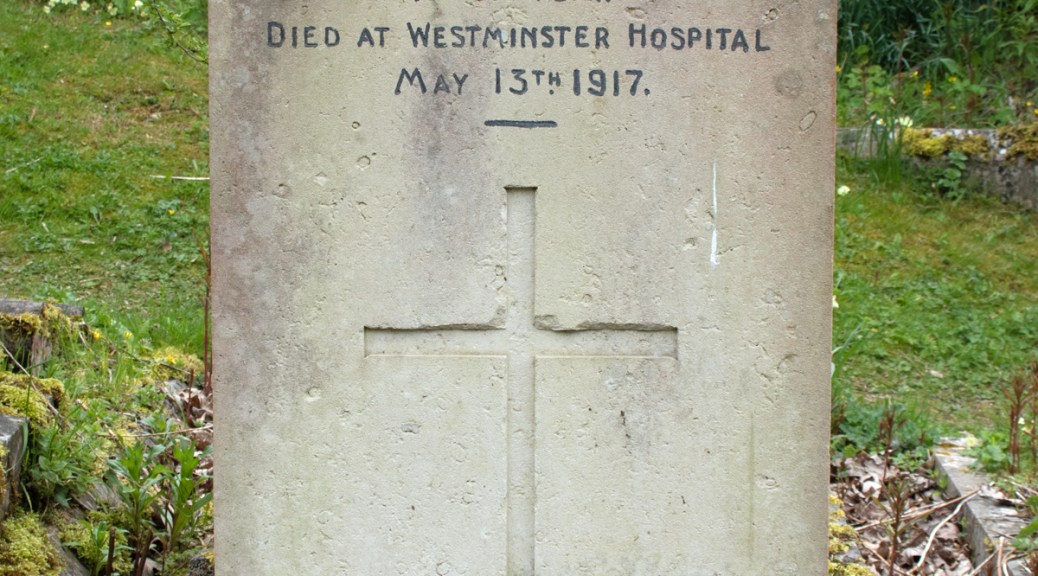
Much public interest was manifested in the funeral, on Thursday, of Private John St Clair Cotterell eldest son of Mr T Sturge Cotterell, JP, of Bath. Deceased, who was 26 years of age, was educated at Bath College, and left England to take up the life of a rancher in Canada. Here he joined the Alberta Rifles and saw service on the Western Front, where he was dangerously wounded in an attack on the Arras front on April 28th. He was, however, brought back to this country, only to succumb to his severe wounds in Westminster Hospital on Saturday. He leaves a widow and one child.
Bath Chronicle and Weekly Gazette: Saturday 19th May 1917
John St John Cotterell was born in Bristol, Gloucestershire, on 17th September 1891. One of six children, his parents were wallpaper manufacturer turned quarry manager Thomas Sturge Cotterell, and his wife, Edith. John remains noticeably absent from both the 1901 and 1911 censuses in which his parents and sibling – and servants – are recorded, so his early life is hard to piece together.
By 1908 John had emigrated to Canada to become a farmer. It was here that he met and married Gladys Nettleton. The couple settled in Alberta and had a daughter, Nellie, who was born in 1915.
When war came to Europe, John stepped up to play his part for King and Empire. He enlisted in the Canadian Expeditionary Force on 8th March 1916, and was assigned to the 192nd Overseas Battalion. Private Cotterell’s service records confirm that he was 5ft 5ins (1.65m) tall, weighed 117lbs (53kg) and had fair hair, grey eyes and a fair complexion.
Private Cotterell left Canada for Britain on 1st November 1916, arriving in Liverpool ten days later. He was transferred to the 9th (Service) Battalion of the Canadian Infantry, and barracked at St Martin’s Plain, near Folkestone in Kent. Early in 1917, he was moved to the 10th Battalion and, on 4th March was shipped off across the English Channel.
John’s arrival in France was not an auspicious one. Tightly packed barracks were a breeding ground for disease, and, by the time he had arrived in Le Havre, John had contracted mumps. He was laid up in a camp hospital for just over a month before returned to his battalion and heading to Arras.
Private Cotterell’s was severely injured in the fighting, and he received a gunshot wound to his spine. Medically evacuated to Britain, he was admitted to the Westminster Hospital in London. His medical report noted that his ‘1st lumbar vertebra [was] shattered and [spinal] cord [was] cut through‘. He had complete paralysis below the groin and that he was in a ‘hopeless condition‘. His injuries proved too severe, and he passed away on 13th May 1917, three days after being admitted. John was just 25 years of age.
John St Clair Cotterell’s body was brought back to Somerset for burial. He was laid to rest in Bath’s Abbey Cemetery.
Joseph Smith was born at the beginning of 1879 in Bath, Somerset. The fifth of six children – all boys – his parents were William and Sarah Smith. William was a carpenter and, while he did not follow in his father’s trade, Joseph found employment as a house painter when he left school.
Joseph married Alice May Martin in 1896: the couple were young, the groom being a year older than the bride, and they went on to have a daughter, Dorothy, who was born the following year. The newlyweds moved into a small, terraced house in Bath with Alice’s mother and sister, both of whom were widowed, and Alice’s nephew.
The 1911 census found the extended family living in larger home away from the centre of the city. Joseph was still employed as a house painter, Dorothy had left school and was apprenticed to a dressmaker. Alice looks to have been looking after the household, while her mother and sister were both living on their own means.
In his spare time, Joseph was also a member of staff at Bath’s Theatre Royal. He was sporty, with a keen interest in football and partial to a game of cricket. He was also very connected to St Stephen’s Church in the city, and was involved in parish life.
War was coming to Europe, and Joseph stepped up to play his part. Full details of his military service are lost to time, but from his gravestone and linked records, it is clear that he enlisted in the 6th Battalion of the Somerset Light Infantry. Further details are outlined in a contemporary newspaper report:
Though married, he was anxious to enlist practically as soon as the war began: and on January 16th, 1915, he offered himself for service, and was at once accepted. He did not leave England till 16th August [1916]. He had been selected for inclusion in 32 drafts on various occasions prior to that date; but had been obliged to remain behind from illness or some other cause. When he actually sailed, it was not as a member of a draft, but as one of five sergeants who had volunteered for special service.
Bath Chronicle and Weekly Gazette: Saturday 28th October 1916
Sergeant Smith made it to the Western Front, and was entrenched at the Somme. The newspaper report picks up on what happened next:
He was wounded in September, being struck by a bullet while leaving the trench preparatory to advancing. The bullet struck him in the thigh, and severed an artery… After doing what he could with his first-aid dressing, Sergt. Smith crawled some three miles from the firing line amid bursting shells. After five hours of this painful progress he was picked up by a stretcher party.
Bath Chronicle and Weekly Gazette: Saturday 28th October 1916
Sergeant Smith was medically evacuated to Britain for treatment, and was admitted to the 3rd Western General Hospital in Cardiff. Alice and Dorothy were a constant presence as his bedside, but the wound was to prove too severe, and he passed away at the hospital on 25th October 1916. He was 38 years of age.
Joseph Smith was brought back to Bath for burial. He was laid to rest in the Lansdown Cemetery, overlooking the city he called home.
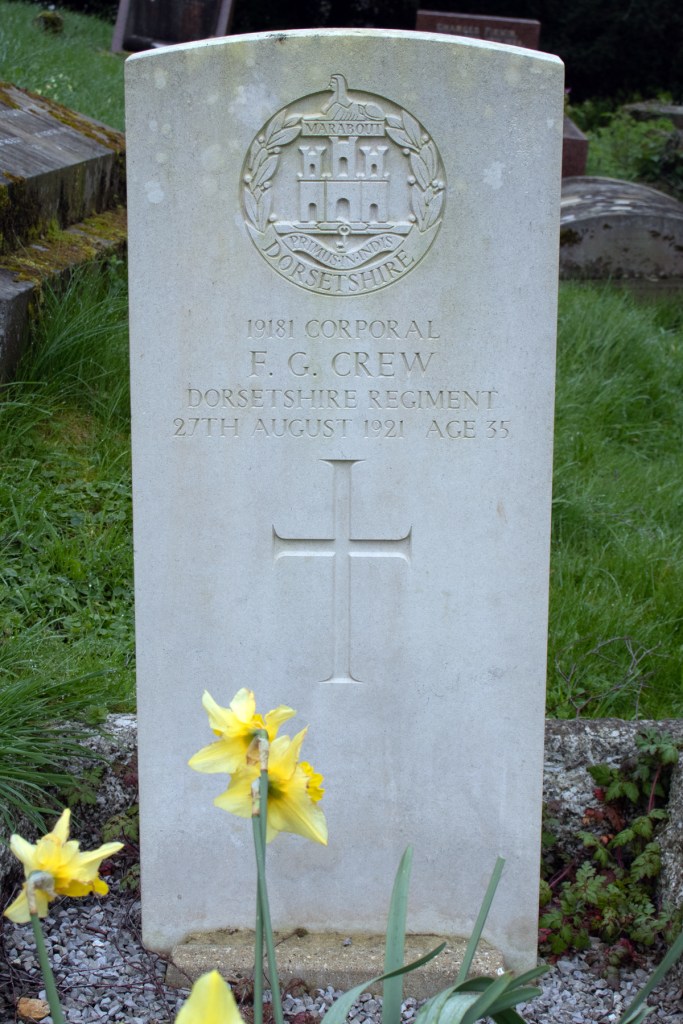
Frank George Crew was born in Twerton, Somerset, on 25th January 1886. The fourth of five children, his parents were nurseryman and market gardener William Crew and his laundress wife, Fanny.
When Frank finished his schooling, he followed his father into the nursery trade, and this is how he was employed when war was declared. He enlisted in the Dorsetshire Regiment on 19th July 1915, and was assigned to the 3rd (Reserve) Battalion. Private Crew’s service records are limited, but his medical report shows that he was 5ft 9ins (1.75m) tall, weighing around 10st (63.5kg).
On 6th October 1918, Frank, who had been promoted to Corporal by this point, was admitted to the Military Hospital in York with a bullet wound to his right forearm. Given that his battalion remained on home soil for the duration of the conflict, it is unclear whether this was an accidental injury at camp, or if he transferred to another troop when he recovered.
Little additional information for Frank remains. He remained in hospital until 8th November 1918 and it is unclear if he continued with his army service once he recovered – although given the Armistice was declared three days later, it is unlikely that he did.
On 11th November itself, Frank married Kate May, a mason’s daughter from Limpley Stoke, to the west of Bath. By this point he recorded his profession as gardener, so it seems his army career was indeed behind him. The couple went on to have a daughter, Peggy, who was born a year later.
William died in 1920, and by the time of the following year’s census, Frank, Kate and Peggy were living with Frank’s now-widowed mother. The extended family had a home on Padleigh Hill, to the south west of Bath city centre, and Frank seemed to be the main breadwinner, working as a labourer for Stothert & Pitts Ltd, a crane company on the River Avon.
Sadly, Frank was only to survive the census by a couple of months. He passed away on 21st August 1921, dying from a combination of influenza and epilepsy. He was 35 years of age.
Frank George Crew was laid to rest in the quiet Englishcombe Churchyard, close to the family home.
Charles James Anderson Newbery was born in Misterton, a stone’s throw from Crewkerne, Somerset, in the spring of 1895. The oldest of eight children, his parents were Benjamin and Edith Newbery. Benjamin was a farmer, who passed away in 1908, when his son was just 13 years of age.
Charles seems not to have spent a great deal of time in the family home, however: the 1901 census found him living with his paternal grandmother, while the 1911 census, taken three years after his father’s death, recorded him as living with his paternal aunt, and working on their farm.
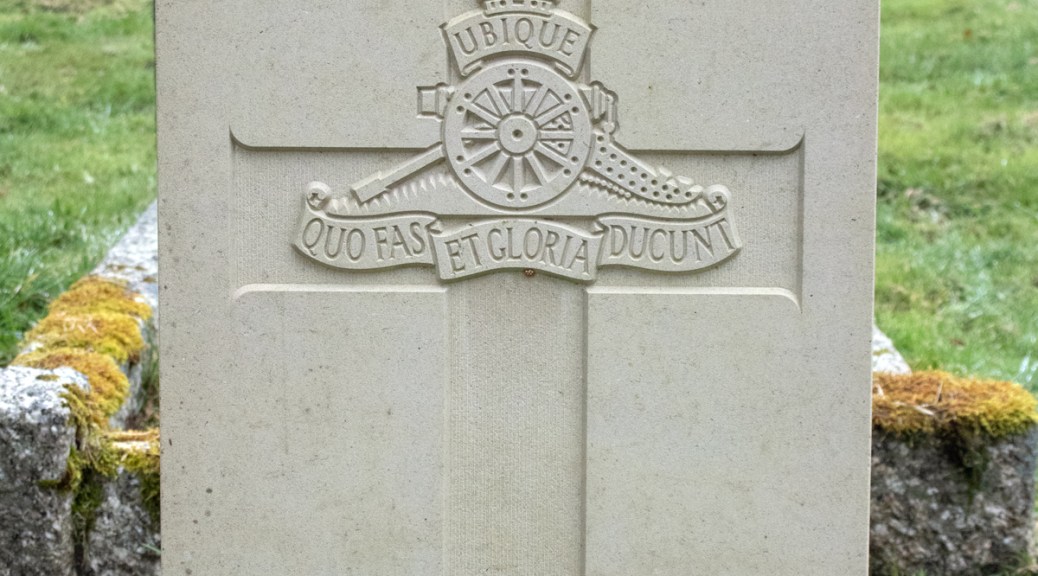
The farming life seemed to suit Charles: indeed he emigrated to Australia to pursue the life. When war broke out in Europe, however, he returned to England’s shores to better serve King and Country. He enlisted in the Royal Garrison Artillery on 18th October 1915, and was given the rank of Gunner.
Charles’ service records confirm that he was 5ft 5ins (1.65m) tall and weighed 140lbs (63.5kg). He was noted as having a mole on his left shoulder and an upper denture.
Private Newbery was sent to France in April 1916 and, a little over a year later, was promoted to Bombardier. He was attached to the 137th Heavy Battery and all seemed to be going reasonably well for him. He had ten days’ in England in July 1917, and a further two weeks’ in March 1918.
On 13th August 1918, possible during the Battle of Amiens, Charles was injured by a gun shot wound to his right leg. He was initially treated at the 47th General Hospital at Le Treport on the French coast, but was medically evacuated to Britain for further treatment.
Charles was moved to the 4th Northern General Hospital in Lincoln. To complicate matters, he had contracted bronchitis and, while his injury was being managed, it was a combination of the lung condition and cardiac failure to which he succumbed. Private Newbery passed away on 2nd September 1918, his mother and sisters by his side. He was just 23 years of age.
Charles James Anderson Newbery was taken back to Somerset for burial. He was laid to rest in Crewkerne’s Townsend Cemetery, not far from the family home.
Bombardier Charles Newbery (from ancestry.co.uk)
Edith had to write to the regimental office three times to get her late son’s belongings back, and in the end it took more than six months to do so. She received the items he had on him in Lincoln in April 1919: they included and “upper row [of] teeth, cigarette case, wallet containing letters, hair brush [and] comb, disc, letter, wristlet watch, note paper and envelopes.”










 Death and Service