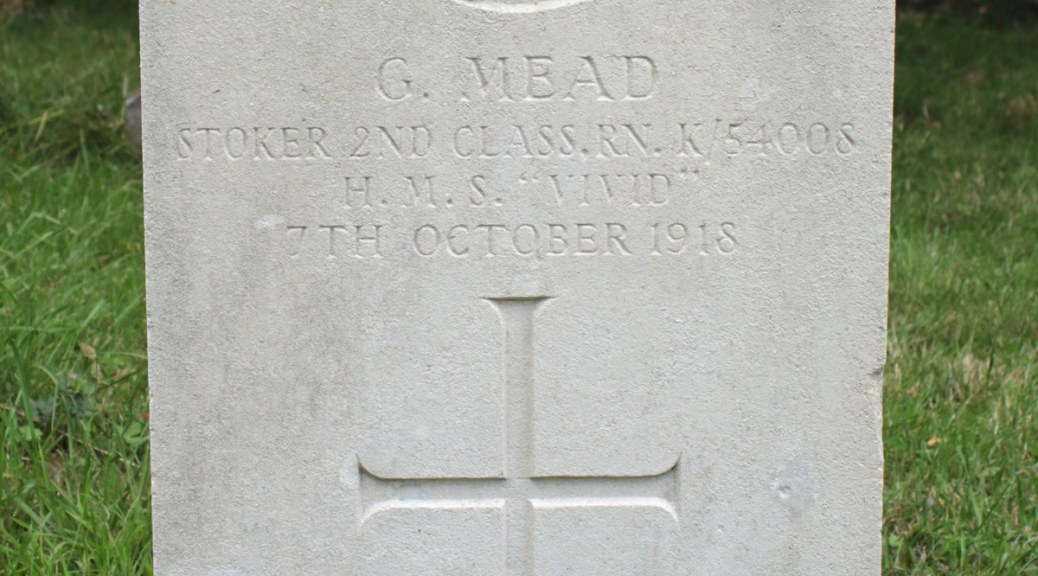
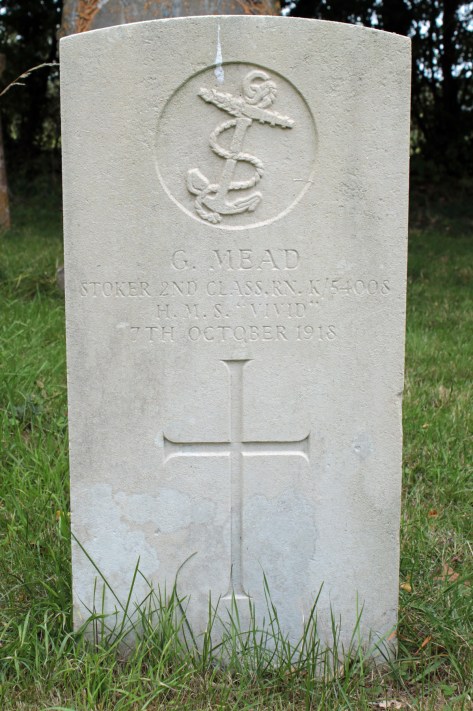
George Mead was born on 18th September 1900 in the Wiltshire village of Semley. The youngest of eleven children, his parents were police sergeant George Mead and his wife, Rebecca.
The 1911 census recorded the Mead family as having moved to Chapmanslade, near Westbury. George Sr and Rebecca were set up in a five-room cottage, Forest View, with George Jr and two of his older sisters – Edith and Margaret – also living there.
Rebecca passed away when her youngest was just sixteen years of age and, on 12th March 1917, George Jr’s older brother Charlie, a Private in the Worcestershire Regiment, was killed in action while fighting in France. It seems that his younger sibling was keen to prove his mettle before peace was declared and, on the day after his eighteenth birthday, he gave up his job as a carter and enlisted in the Royal Navy.
Stoker 2nd Class Mead’s service records show that he was 5ft 10.5ins (1.79m) tall, with brown hair, blue eyes and a fresh complexion. He was sent off to HMS Vivid – the Royal Naval Dockyard in Devonport, Devon – for his training.
Tragically, George Jr’s time in the navy was to be short. He contracted pneumonia and as admitted to the naval hospital in Plymouth. The illness was to prove too severe, and he passed away on 7th October 1918: he was eighteen years of age, and had been in the Royal Navy for just 18 days.
The body of George Mead Jr was taken back to Wiltshire for burial. He was laid to rest in the extension to St Margaret’s Church, Corsley, not far from where his grieving father still lived.
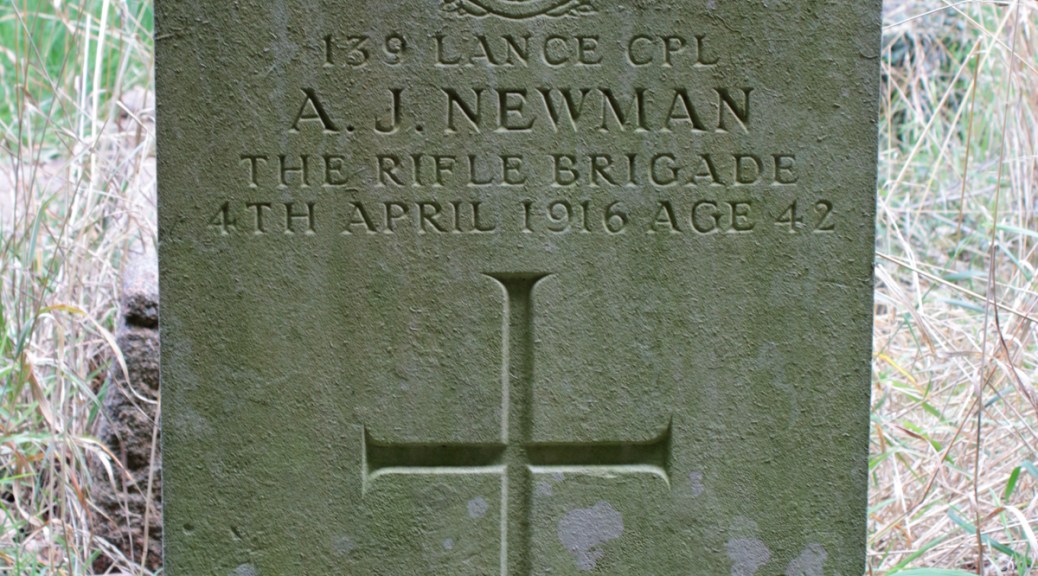
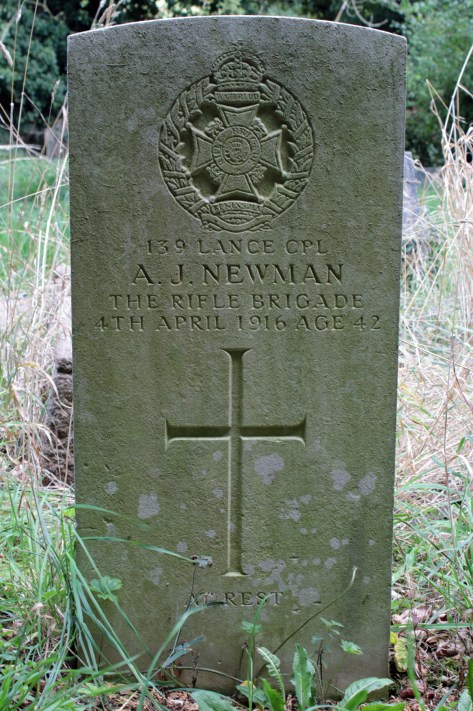
Alfred James Newman was born in around 1874 in Westbury, Wiltshire. One of six children, his parents were coke burner and agricultural labourer James Newman and his wife, Virtue.
Alfred followed his father into farm work, and would remain living with his parents until they were in their seventies. The 1911 census found the family living in Westbury Leigh, to the south of Westbury itself, James and Virtue as pensioners and Alfred as a general farm labourer. Also living with them was adopted child James Ellery, although it isn’t clear who had adopted him, and whether he had any other familial connection to them to the Newmans.
When war broke out, Alfred stepped up to play his part. Full details of his military service have been lost to time, but it is clear that he joined the Wiltshire Regiment, and was attached to the 4th Battalion. He was then transferred to the 22nd (Wessex and Welsh) Battalion of the Rifle Brigade. It is unclear whether he spent time overseas, but, by the spring of 1916, he had been promoted to the rank of Lance Corporal.
On Tuesday last week, Mr James Newman… received a telegram from the military authorities stating that his son, Lance-Corporal Alfred James Newman had died the same day in the 2nd Southern General Hospital at Bristol… He, having obtained leave, went to Bristol to pay a visit to some friends and evidently caught a chill. His death took place on Tuesday morning. He was conveyed to his home on Friday, and the funeral took place on Saturday afternoon.
[Wiltshire News: Friday 14th April 1916]
Alfred’s Pension Ledger Index Card suggests that, rather than a chill, he had, in fact, died following the rupture of an aortic aneurysm. He passed away on 4th April 1916, and was 47 years of age.
The body of Alfred James Newman was laid to rest in the peaceful setting of the Provident Baptist Chapelyard in Penknap, to the south west of Westbury.
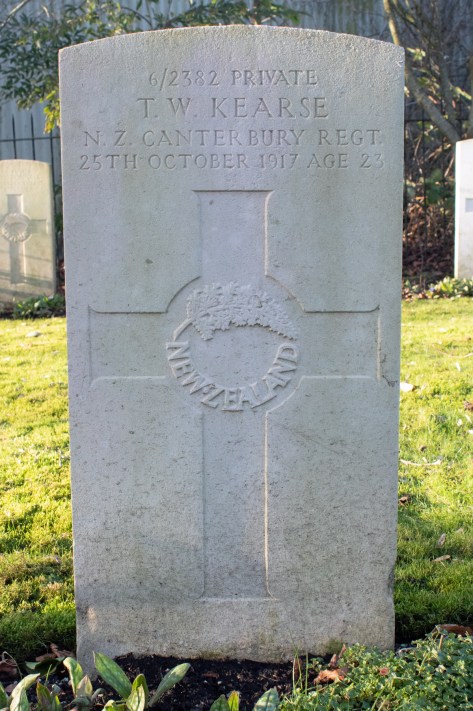
Thomas Walker Kearse was born in Westport, New Zealand, on 15th December 1891. One of seven children, his parents were British emigrant Thomas Kearse and his local-born wife, Rosanna.
There is little information available about Thomas’ early life. He found work as a general labourer when he finished his schooling, by which time his mother had passed away. By his mid-20s, he had relocated to Kaikohe, on North Island.
When war broke out, Thomas stepped up to play his part. He enlisted in Trentham on 16th February 1915, and was assigned to the New Zealand Canterbury Regiment. Private Kearse’s medical examination noted that he was just over 5ft 6ins (1.68m) tall, and weighed 139lbs (63kg). He had light hair, blue-grey eyes and a fair complexion. He was also noted as having a scar on his right shin.
Private Kearse would be in the army for two-and-a-half years, but would experience enough warfare for a lifetime. On leaving New Zealand his unit made for the Dardanelles, arriving there on 16th August 1915. He was wounded early on, and medically evacuated to Malta. His injuries would need further treatment, however, and he was shipped to Britain, and sent to hospital in Birmingham.
Thomas spent time recuperating at a base in Hornchurch, Essex, and it would seem that, while here, he met Catherine Goodwin. A romance started, but Thomas was sent to re-join his unit, who were barracked in Egypt. Within a month, however, he was on the move again, arriving in France in April 1916. While there, he went absent without leave for two days, and forfeited a month’s pay as a result.
In October, Private Kearse was wounded in the head and arm by gunfire, and, after initial treatment in Rouen, he was medically evacuated to Britain. Admitted to the 3rd Southern General Hospital in Oxford, he would remain here for the next month. He was then sent to the ANZAC base in Codford, Wiltshire, again to recuperate, but, while there, he was admitted to the camp’s venereal unit for a fortnight.
Discharged again, his condition had not cleared up: Thomas was back in hospital on 5th December 1916, and he spent a further two weeks admitted.
On his latest discharge, Private Kearse was marched to Sling Camp, near Bulford, where he took up a role as cook. He would remain there for the next four months and, during this time, he and Catherine exchanged vows. She had given birth to a daughter, Ivy, the previous October, and this helped formalise their family unit.
Over the next few months, Thomas’ life repeated itself. He was admitted to hospital in Codford again in June 1917, and went AWOL for 26 hours on 27th/28th July (for which he was docked four days’ pay). Discharged from hospital on 4th September, he was marched back to the Sling Camp.
Within six weeks, however, he was sent back to hospital in Codford, this time suffering from pneumonia. This time, Thomas would not be as fortunate. The lung condition got the better of his, and he passed away on 25th October 1917, at the age of 25 years old.
The body of Thomas Walker Kearse was laid to rest in the ANZAC extension to St Mary’s Churchyard in Codford, not far from the hospital he had visited so many times.
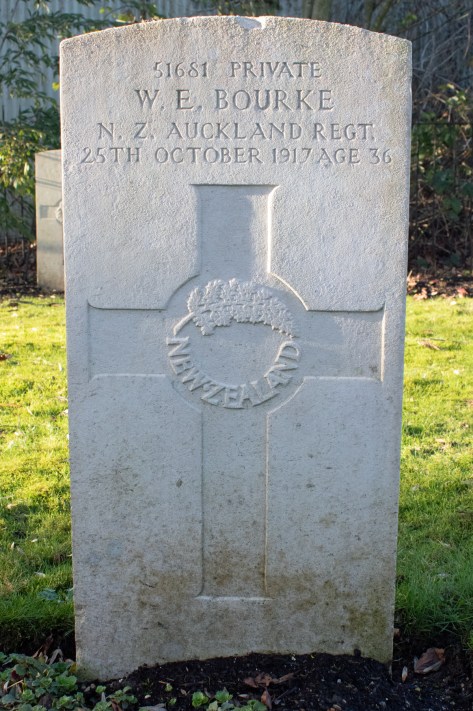
Walter Edward Bourke was born in Whangarei, New Zealand, on 6th May 1885. The fifth of six children, his parents were Patrick and Elizabeth Bourke, who had emigrated from Ireland in the 1870s.
Patrick died in 1911, at the age of 65. Walter, by this point, was working as a chamber hand in a freezing works. When war broke out, however, he was compelled to step up and serve his country. He enlisted on 22nd January 1917, and was assigned to the New Zealand Auckland Regiment.
Trained at Trentham, Private Bourke’s unit set sail for Europe on 12th June 1917. The voyage from Wellington to Devonport would take two months and, from there Walter was marched into a camp in Sling, near Bulford, Wiltshire.
Within a matter of weeks, Walter fell ill. He was sent to the No. 3 New Zealand Hospital near Codford, Wiltshire, but his condition worsened significantly over the next month. His treatment would prove fruitless, and Private Bourke passed away on 25th October 1917: he was 32 years of age.
Thousands of miles from family, Walter Edward Bourke was laid to rest in the extension to St Mary’s Church graveyard, not far from the hospital in which he had passed.
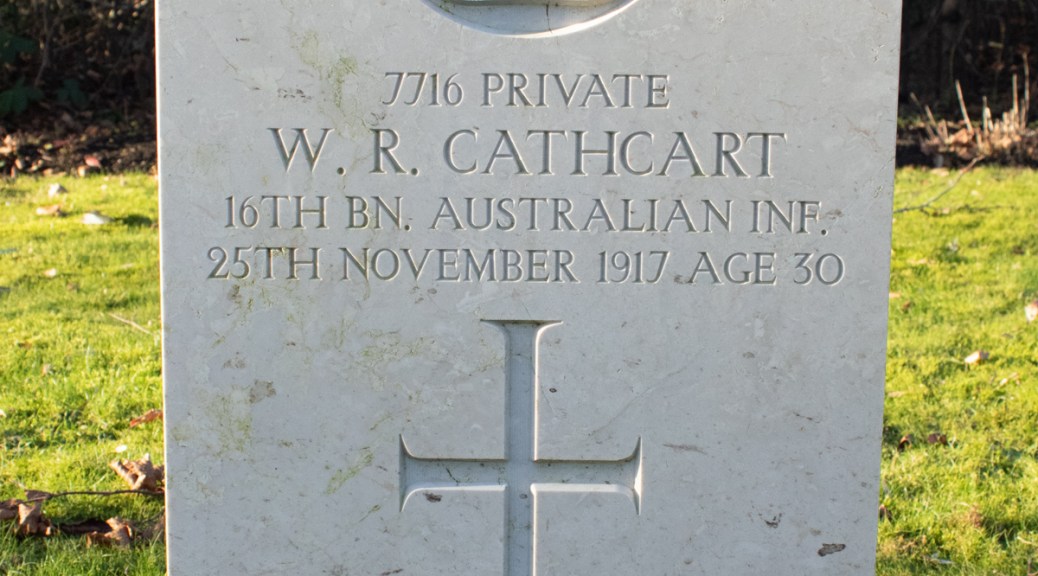
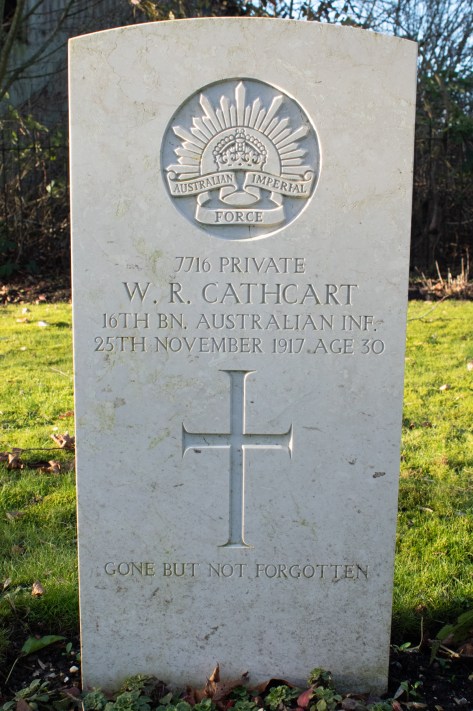
William Rea Cathcart was born in Ballymena, County Antrim, Northern Ireland, on 30th January 1887. The middle of five children, his parents were Thomas and Margaret Cathcart.
Little information is available about William’s early life, but he appears to have been a smart young man and, by his mid-20s was employed as a bookkeeper. Part of him sought a better life for himself and he took the decision to emigrate, arriving in Fremantle, Australia on board the SS Otranto on 14th November 1911.
William settled in Perth, but when war broke out, he was keen to step up and serve his King and Empire. He enlisted on 7th May 1915 but, for some reason, he wasn’t accepted for service at that time.
William did not give up, however, and he succeeded in enlisting on 30th May 1917. His service papers confirm that he was 5ft 8.75ins (1.74m) tall and weighed 150lbs (68kg). A Roman Catholic, he was noted as having brown eyes, brown hair and a fresh complexion.
Assigned to the 16th Battalion of the Australian Infantry, Private Cathcart’s unit set sail from Sydney on the troop ship A7 Medic, on the 1st August 1917. The voyage would take two months, and his unit arrived in Liverpool, Lancashire, at the start of October. It the then marched south to the ANZAC bases near Codford, Wiltshire.
It seems that the journey had exhausted William, and his health began to deteriorate. He was admitted to the camp hospital with diabetes, but moved to the No. 3 New Zealand General Hospital on 22nd November. He was emaciated and barely able to walk, constantly drinking, but eating very little.
Over the next few days, William’s condition worsened. He began getting pains in his arms and legs, was sluggish and restless. The treatment he was provided would ultimately prove too little, too late. Private Cathcart passed away at 1:05am on 25th November 1917: he was 30 years of age.
The body of William Rea Cathcart was laid to rest in the ANZAC extension to the graveyard of St Mary’s Church, Codford, not far from the hospital in which he had been treated.
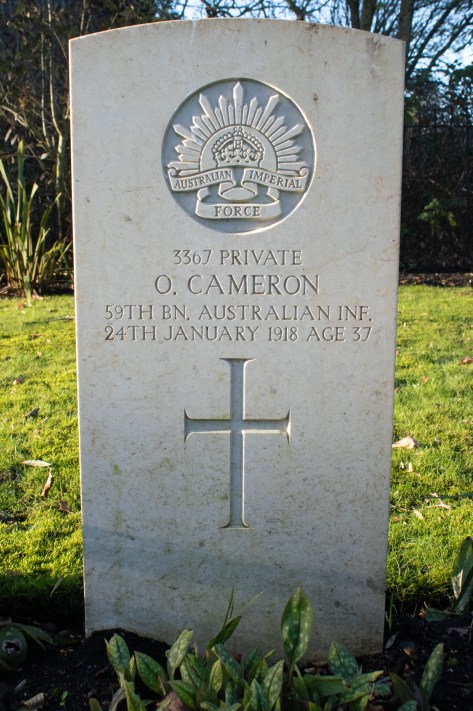
Born in Shelburne, Nova Scotia, in around 1876, the early life of Oscar Cameron is a challenge to piece together. He was one of four children to ship’s carpenter Christopher Cameron and his wife Alice.
Oscar appears to have followed his father in a sea-faring life, and his later army service records confirm that, by 1917, he was a ship’s officer. When the call came to serve the Empire, he took a discharge from his ship in Australia, and joined up.
Enlisting on 20th February 1917, Oscar’s service records show that he was 5ft 6.5ins (1.69m) tall, and weighed 128lbs (50.1kg). He had fair hair, blue eyes and a fresh complexion, with a tattoo on his right forearm and a vaccination scar on his left upper arm. His age was given as 36 years and 6 months, although he was, in fact 41 by this point.
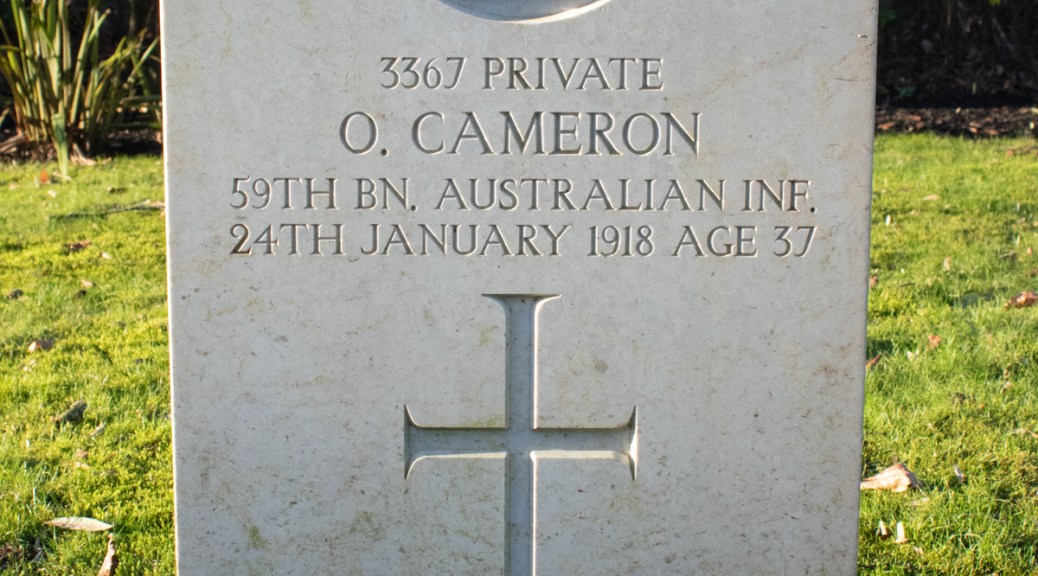
Assigned to the 59th Battalion of the Australian Infantry, Private Cameron’s unit left from Sydney on board the HMAT A16. The two-month voyage was not uneventful: Oscar spent three days in hospital with an undeclared ailment, and also forfeited two days’ pay for being absent without leave for 34hrs during the ship’s layover in Cape Town, South Africa.
The 59th Battalion disembarked in Liverpool, Lancashire, on 16th September 1917. From there it made the journey to the ANZAC camps in Wiltshire, and this is where Oscar would have continued his training.
At the start of 1918, Private Cameron’s health was suffering again. He was admitted to the No. 3 New Zealand General Hospital in Codford, Wiltshire, suffering from nephritis. Ultimately, the condition was to prove fatal: Oscar passed away at 4:45pm on 24th January 1918, aged 40.
Thousands of miles from home, it wasn’t possible for the remains of Oscar Cameron to be taken back to Canada. Instead, he was laid to rest in the ANZAC extension to St Mary’s Churchyard in Codford, not far from the base where he had received treatment.
George Twiselton was born in Milton Malsor, Northamptonshire, in the spring of 1878. The third of nine children, he was the second of two sons to Reuben and Eliza Twiselton. Reuben was a general labourer, working for the local railway and brewer, and his son was to follow suit, taking up employment as a drayman.
In 1903, George married Annie Branson. She was a cooper’s daughter from Northampton, and it seems likely that George and his future father-in-law knew each other through their combined work. By the time the young couple married, Annie was working as a domestic servant for the Burnham family, and was living at 50 Middle Street, Bradwell, Buckinghamshire (now part of Milton Keynes).
The 1911 census found George and Annie living in Milton Malsor. They had four children by this point: Edith, Doris, Reuben and Clara. George was still employed as a brewer’s drayman, and this would stand him in good stead when war broke out a few years later.
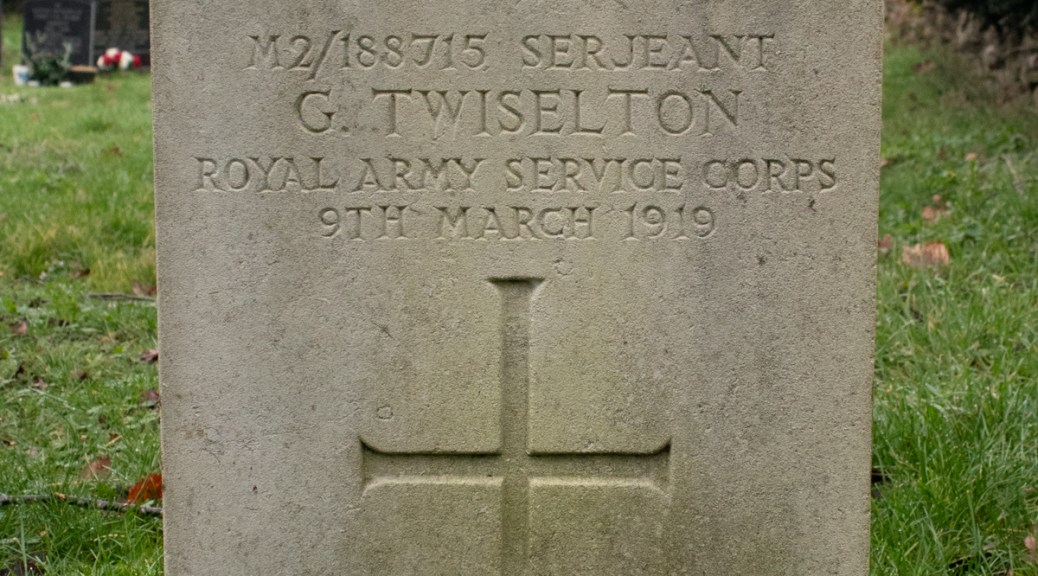
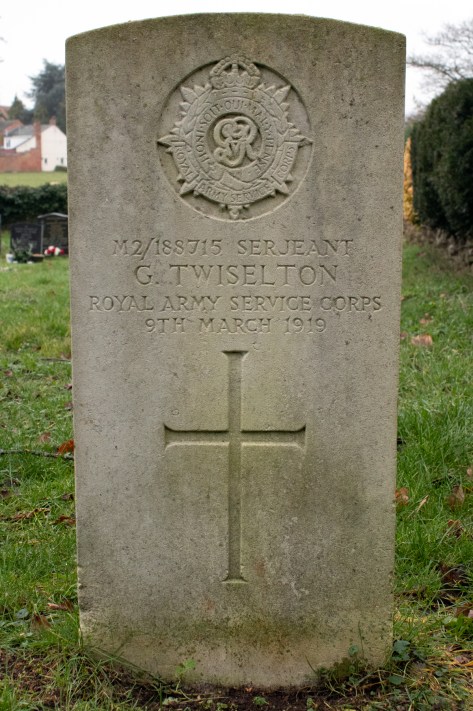
Details George’s time in the army have been lost to time, but it is clear that he had enlisted by 1916, and was assigned to the Royal Army Service Corps. His previous time with horses led him to be attached to the 381st Mechanical Transport Company, and he spent time in France, eventually rising to the rank of Serjeant.
George survived the war, and returned home after the Armistice. However, he contracted influenza early in 1919, and would succumb to the condition on 9th March: he was 40 years of age.
The body of George Twiselton was laid to rest with full military honours in the graveyard of Holy Cross Church, in his home village of Milton Malsor.
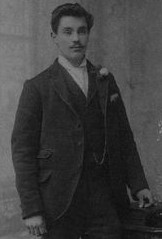
Serjeant George Twiselton (from miltonmalsorhistory.org.uk)
With her husband dead, and six children to raise, Annie had to find the strength to continue. The 1921 census found her living with her four youngest – including her only son, Reuben. She was employed on home duties, while her 13-year-old boy was working as a farm servant.
Reuben’s story is a testament to his father’s determination:
At the outbreak of WW2 Reuben, the only son of George, joined his father’s old RASC regiment and went to France as an ambulance driver with the British Expeditionary Force. Along with many others, he withdrew to the Dunkirk beaches but turned down evacuation back to the UK, choosing instead to stay behind and give assistance to the many wounded. He was later taken prisoner and held a Prisoner of War for 5 years until released by American soldiers in 1945. He died in 1988 aged 81 years.
Thomas White was born on 17th October 1889, and was the fourth of nine children to William and Minnie White. William was an agricultural labourer for Hartwell, Northamptonshire, but the family were raised in the village of Hardingstone, to the south of Northampton.
When they finished their schooling, Thomas’ older siblings also found work on local farms, and Thomas was to do the same. By the time of the 1911 census, the white family had moved to Wootton, and were living in a four-roomed cottage on the village’s high street.
On 25th July 1914, Thomas married Nellie Westbury. The daughter of a groom from Wootton, she was employed as a cook at The Hermitage in the village when they couple exchanged vows. They would go on to have a daughter, Phyllis, the following year.
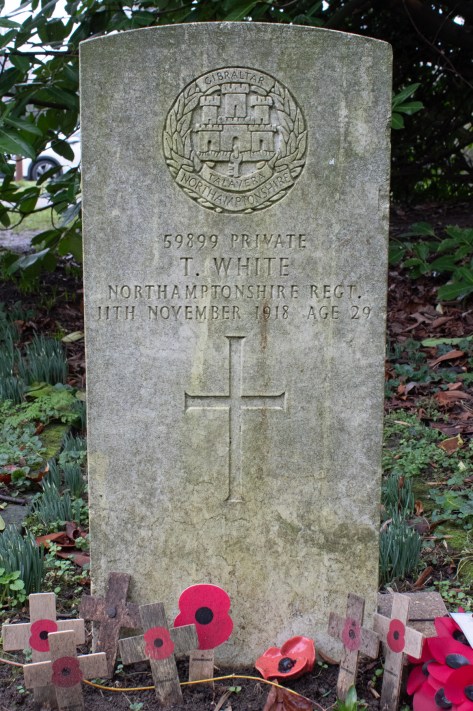
Details of Thomas’ military service are a challenge to pull together. His entry on the Army Register of Soldiers’ Effects confirm that he enlisted on 20th July 1918, joining the 3rd Battalion of the Northamptonshire Regiment. This was a training and depot unit, and, by the time Private White signed up, they were based in Sheerness on the Isle of Sheppey, Kent.
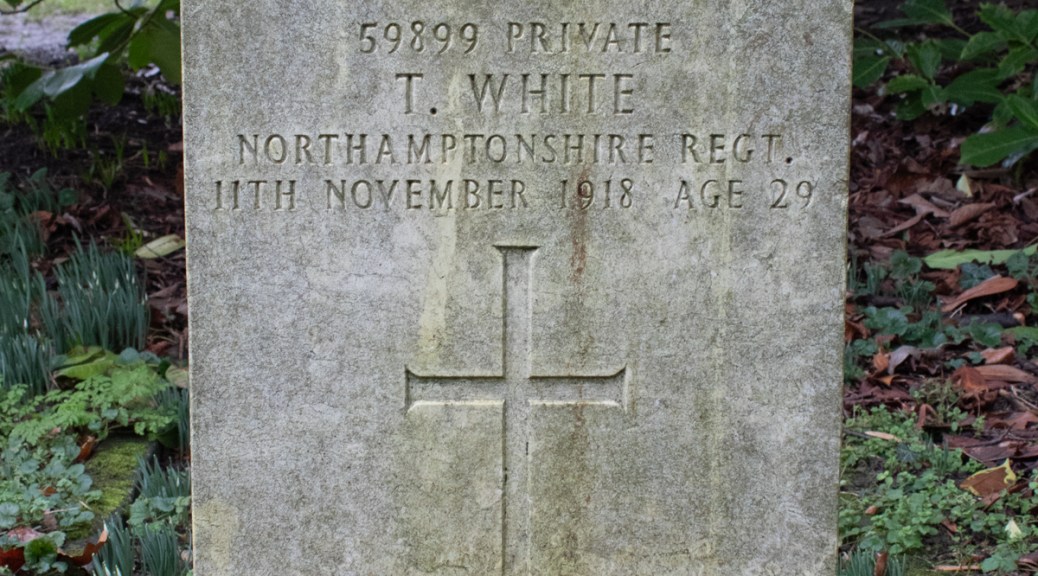
Thomas’ time in Kent was to be brief. While training, he came down with a combination of influenza and pneumonia, conditions to which he would succumb. Private White passed away on 11th November 1918, the day that Armistice was signed: he was 29 years of age.
The body of Thomas White was taken back to Northamptonshire for burial. He was laid to rest in the peaceful surroundings of St George’s Churchyard in Wootton.
Nellie went on to make a life for herself and her daughter. The 1921 census found them living at 28 Alton Street, Far Cotton, Hardingstone, Nellie working as an office cleaner for the Midland Railway.
Charles Albert Frost was born in Daventry, Northamptonshire, at during the winter of 1882/3. The third of eight children, his parents were William and Louisa Frost. William was a foreman at a shoe factory in Northampton and, at the time of the 1891 census, the family were living at what looks to be 47 Ardington Road or Abington Road (the return is not clearly legible).
Charles also found work in the shoe trade when he completed his schooling, but his is not a career he wanted to make for himself. Instead he was drawn to the army and, on 26th January 1900, he joined up. The now Driver Frost’s service records show that, at 18 years of age, he was 5ft 4.5ins (1.63m) tall and weighed 127lbs (57.6kg). He had brown hair, blue eyes and a fresh complexion.
Assigned to the Army Service Corps, Charles spent the next few years on home soil. Attached to the 17th Company, he would work hard and that dedication would pay off. He was promoted to Lance Corporal in April 1902, and 2nd Corporal just six months later. By January 1903 he had risen to Corporal, extending his term of service the same month.
Interestingly, in March 1904, Charles reverted to the role of Driver at his own request. He would remain at that rank until for the next four years, when he was stood down to reserve status.
The 1911 census found Charles living back home with his parents and siblings. By this point there were six adults and three children living at 74 Hood Street, Northampton, a seven-roomed terraced house on the east of the town centre. Charles had found work as a blouse cutter in a local factory, and with his father and older siblings all involved in factory work in some way.
Life on civvy street seemed not to appeal, however, and in November 1911 Charles was re-engaged with the Army Service Corps. This was initially planned to be for four years, but he would remain in the army for nearly twice that long.
In August 1914, Driver Frost was shipped out to France. and, barring leave, he would remain there for the next three years. In the summer of 1915, he returned home briefly, marrying Daisy Harris at St Edmund’s Church in Hardingstone, Northamptonshire, when he did so. He was soon sent back out to France, however, and remained on the other side of the Channel until April 1917.
Back on home soil, Charles’ career had taken a surprising turn. In January 1915 he was promoted to Acting Corporal, rising to Acting Sergeant just four months later. By November 1916 he had been promoted to Acting Quartermaster Sergeant, a role that was formalised just four months later.
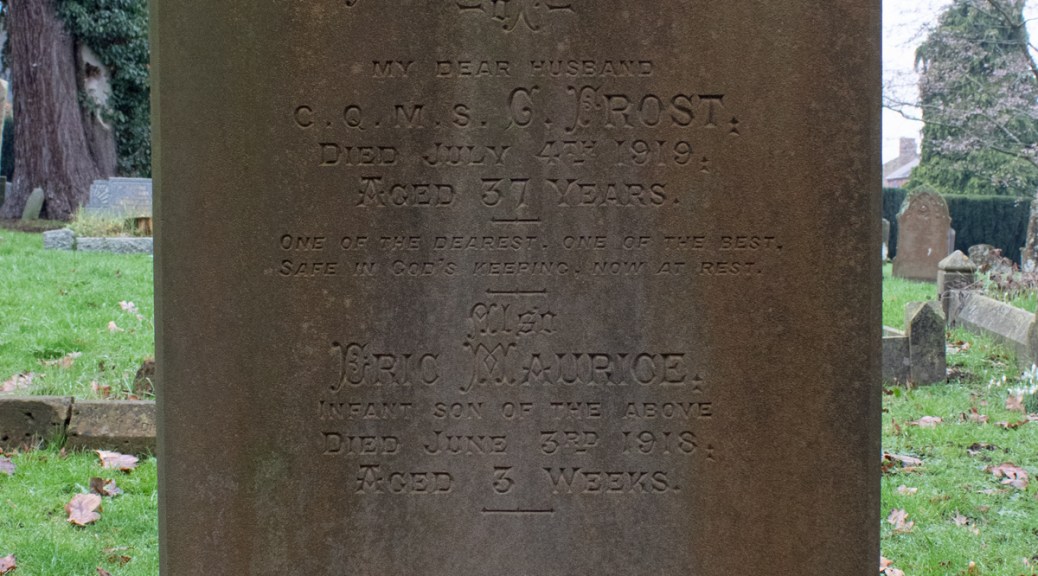
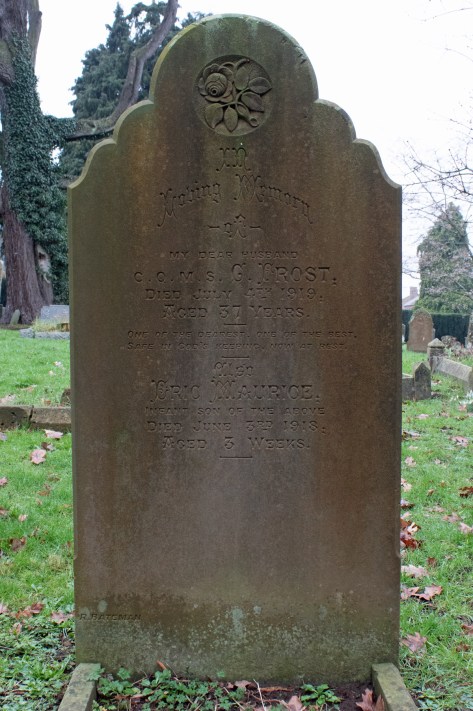
In May 1918, Daisy gave birth to their first – and only – child, a boy they called Eric. Tragically, he passed away just three weeks later, from a combination of pemphigus and asthma: with Charles away, Daisy had to register the death.
Quartermaster Sergeant Frost survived the war, but was admitted to the Mill Road Hospital in Liverpool, Lancashire, on 28th June 1919. He was suffering from a cerebral tumour, but his treatment would prove ineffectual. He died at 3:20am on 4th July 1919: he was 37 years of age.
The body of Charles Albert Frost was taken back to Northamptonshire for burial. He was laid to rest in the graveyard of St Edmund’s Church, Hardingstone, alongside Eric: a father and son reunited.
Daisy had not lost her son and husband in just over a year. The 1921 census found her back living with her father and sister, carrying out home duties while they worked.
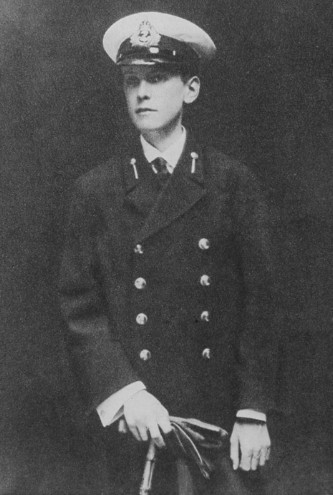
Gervase Anthony David Herewyt de Bless was born on 20th October 1897 in Westminster, Middlesex. One of two children, he was the surviving son of barrister Alfred de Bless and his wife Maud, born Maud Cary-Elwes. Both were renowned families – Maud’s brother going on to become the Bishop of Northampton. The family do not appear in the 1901 census, but by 1911 Gervase’s parents were living at 156 St James’ Court, with French lady’s maid Henriette Forestier.
Alfred died not long after the census was taken. Gervase, meanwhile, was installed as a boarder at Downside College, Somerset. One of 168 students, he was taught by twelve schoolmasters and a handful of Roman Catholic priests from the local abbey.
An exceptionally clever boy of very active minds and many interests, during his time in the School he distinguished himself in all branches of study, winning the Gregorian Medal in 1912. He passed the Higher Certificate three times, twice gaining distinction in French and twice in Roman History. For three years he played in the Junior Cricket Eleven, which he captained in 1912. From 1908 to 1912 he sang in the choir as a treble, and he took a leading part with much success in “The Gondoliers,” and in “HMS Pinafore.” In 1914 he was Editor of The Raven, and he was on the committee of the Petre Library. In this year also he was awarded the Higher Certificate Latin Prose Prize given by St Gregory’s Society. On leaving Downside he spent two terms at Cambridge under the tuition of Mgr Barnes. Sensitive and somewhat retiring, and with health far from robust, he faced the situation created by the war with splendid courage, and obtained a cadetship in the Royal Navy. A skilful angler, fishing had ever been his favourite recreation, and on this pleasant pastime he wrote some charming verses which were afterwards collected in a little booklet.
[Baliol College War Memorial Book]
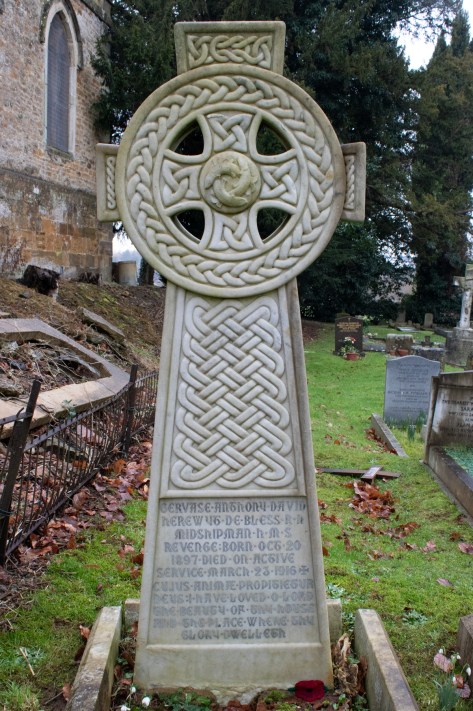
Gervase was given the rank of Midshipman in February 1916, and was assigned to the battleship HMS Revenge the following month. Before his posting he had suffered a bout of influenza, and had a relapse within days of boarding. He died from a combination of influenza and diabetes on 23rd March 1916, just two days after joining Revenge. He was just 18 years of age.
…rites of the Church… were administered to him by Dom Jerome Tunnicliffe, of St Mary’s, Liverpool, a monk of Downside.
[Baliol College War Memorial Book]
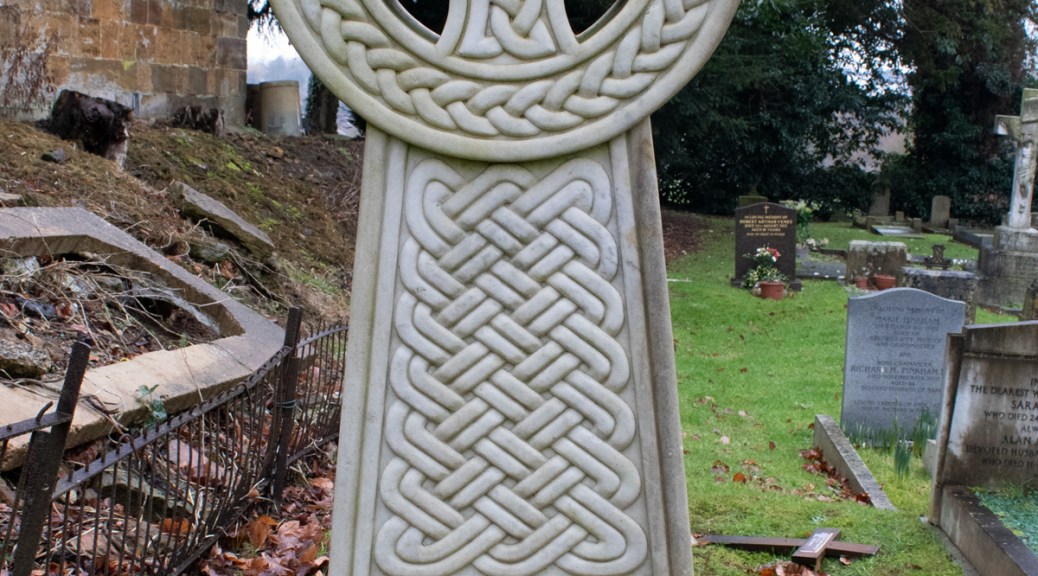
The body of Gervase Anthony David Herewyt de Bless was taken to Northamptonshire for burial. He was laid to rest in the ground of St Andrew’s Church, Great Billing, the last resting place of the Cary-Elwes family and de Bless families.

 Death and Service