Tag Archives: Kent

Private John Merritt

Private John Merritt

John Merritt was born on 17th August 1880 in Shoreditch, London, and was the youngest of three children to James and Emily Merritt. James was a dock labourer, who passed away when his son was just four years old. Emily remarried the following year, having a child with her new husband, George Wise, in 1888.

When he completed his schooling, John found work as a stoker. However, he sought bigger and better things and, on 21st February 1898, he enlisted in the Royal Marine Light Infantry. Not yet eighteen years old, his service records show that he was 5ft 5.5ins (1.64m) tall, with grey eyes, brown hair and a fresh complexion. His service records also record a couple of tattoos: an anchor on his left forearm, and a crossed heart on his right.

Over the next two decades, Private Merritt sailed and saw the world. Primarily based out of the Royal Naval Dockyard in Chatham, Kent, he served on ten ships in all. His superiors obviously thought highly of him, as his records note his character and ability as very good throughout his service.

On 3rd July 1909, John married Harriett Wise. She was a lighterman’s daughter from East London, who was working as a cork cutter when the couple exchanged their vows. They went on to have two children: Florence, who was born in 1910, and Reginald, who came along six years later.

By the time war was declared in the summer of 1914, John seems to have been mainly shore-based, his time being split between Chatham and Portsmouth, Hampshire.

On 7th March 1917, Private Merritt was on board the gunboat HMS Spey, which was carrying out diving operations in the Thames Estuary. At 4 o’clock in the afternoon, in “bitterly cold and boisterous conditions” [Whitstable Times and Herne Bay Herald: Saturday 24th March 1917], the ship lost an anchor, and the decision was made to return to base at Sheerness, Kent. Another vessel, the HMS Belvedere, was close by and turned towards the Spey, and, despite trying to avoid a collision, the smaller ship was struck a glancing blow.

The Spey was 40 years old, and the impact sheered numerous rivets from the side. Water gushed in, and the gunboat sunk beneath the Thames within a matter of minutes. Some of the crew had managed to escape on a life raft, but it was not fitted with lights or flags. The boat drifted and was not found until five hours later, partially submerged: all on board had died.

In total, twenty of the thirty-seven crew perished on that March afternoon, including Private Merritt. He was 36 years of age.

It would seem that Harriett was unable to cover the cost of bringing her late husband’s body back to London for burial. Instead, John Merritt was laid to rest in Woodlands Cemetery in Gillingham, Kent, not far from the naval base in Chatham which he had called home for so long.

Able Seaman Horace Freeman

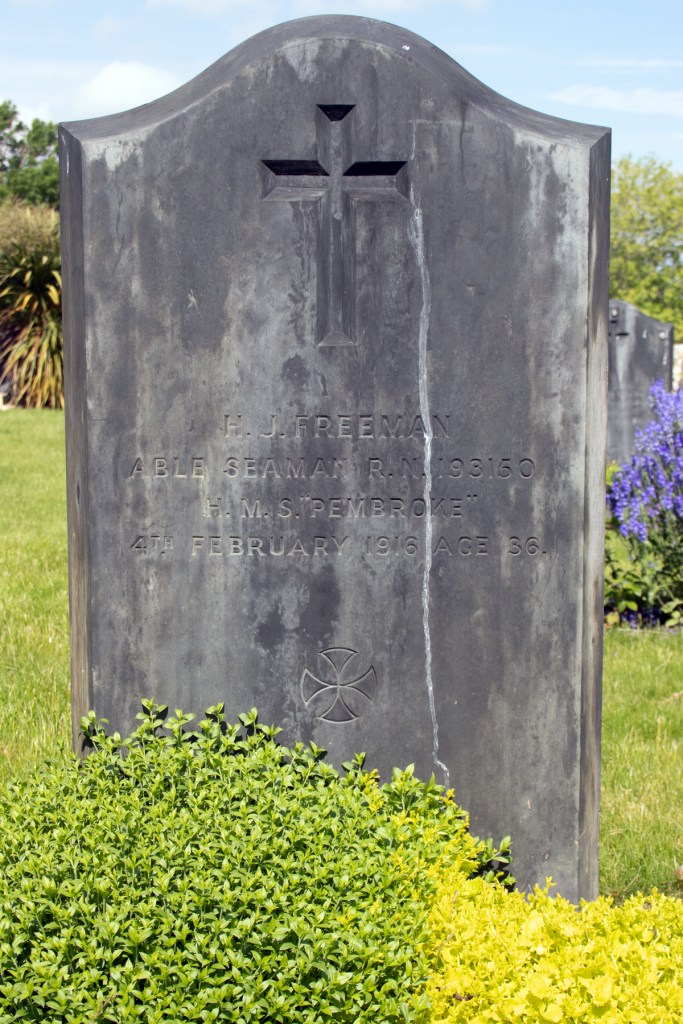
Able Seaman Horace Freeman

Horace James Freeman was born in Hackney, East London, on 16th September 1879. The second of five children, his parents were Archibald and Mary Freeman. According to the 1891 census, Archibald was employed as a carman, but the next document had him listed simply as a ‘traveller’.

When he completed his schooling, Horace found work as a baker’s assistant. He sought bigger and better things, however, and, on 13th February 1897, he enlisted in the Royal Navy. His service records show that he was 5ft 5.5ins (1.66m) tall, with brown hair, hazel eyes and a fresh complexion.

A few months under full age, Horace was initially given the rank of Boy 2nd Class. He was sent to the training ship HMS Northampton, and seemingly impressed his superiors, rising to Boy 1st Class within a couple of months. He moved to another training vessel, HMS Calliope, in July 1897, and was serving on board when he came of age that September.

Now formally inducted into the Royal Navy, Ordinary Seaman Freeman began what was to be an eighteen year career at sea. He would become based at HMS Pembroke, the Royal Naval Dockyard in Chatham, Kent, and went on to serve aboard nine ships during his time.

Promoted to the rank of Able Seaman in October 1899, Horace’s time in the navy was not to be without incident. He spent eight separate periods of time in the cells, 158 days in total. Full details of his misdemeanours are lost to time, but at least on at least one occasion he was placed in the brig for refusing orders.

On Christmas Day 1911, Horace married Sarah Byatt. She was a bricklayer’s daughter from Tottenham, and the couple went on to have two children: Clifford, born in 1913, and Leslie, born two years later.

While Sarah was looking after their young family, Horace spent a lot of his time at sea. As time moved on, however, he was based at HMS Pembroke for longer spells, and it was while he was in Chatham early in 1916 that fate befell him.

The body of Horace J Freeman, an able seaman of the RFR, who had been missing from his ship since February 25th, was found floating in South Lock at Chatham Dockyard on Saturday.

[South Eastern Gazette: Tuesday 11th April 1916]

Little additional information is available about Horace’s death, and it is unclear how he had fallen into the lock. He was 36 years of age.

The body of Able Seaman Horace James Freeman was laid to rest in Gillingham’s Woodlands Cemetery, not far from the naval base he had called home for so long.


Stoker James Clark

Stoker James Clark

In the regimented Woodlands Cemetery in Gillingham, Kent, stands the headstone dedicated to Stoker James Clark of the Royal Naval Reserve. The grave marker, and associated documents, confirm James’ age at the time of his passing as 48 years, but gives no details of next of kin or any relatives.

Stoker Clark’s service records are sparse, but confirm a date and place of of birth – 13th December 1867 in Glasgow, Scotland – and his parents’ names, William and Catherine. Sadly, while the document also gives the names of two of James’ siblings – Mary and William – it has not been possible to match these with any census documents from the Glasgow area.

James’ service records state that he joined the Royal Naval Reserve on 1st October 1897. He was 5ft 8.5ins (1.74m) tall, with grey eyes and a fresh complexion. He was also noted as having a number of tattoos on his right arm, including a sunrise and a heart.

Stoker Clark’s time in the Royal Naval Reserve are a bit patchy, but it seems that he was called into full duty in 1914. Over the next couple of years he served on three different ships, each time returning to HMS Pembroke, the Royal Naval Dockyard in Chatham, Kent.

While his overall service seems to have gone well, in July 1915, he deserted. Full details are not evident, but he was captured, and seems to have returned to duty by the end of the month.

The next record for Stoker Clark is that of his passing. His service records state that he “died suddenly at [Royal Naval Barracks] Chatham on 2nd May 1916 (cause of death at present unknown)”. There is no other information about his death, and, while his siblings were informed of his death, it appears they were unable – or unwilling – to bring his body back to Scotland for burial.

Instead, James Clark was laid to rest in Woodlands Cemetery, Gillingham, not far from the dockyard he had called his home.


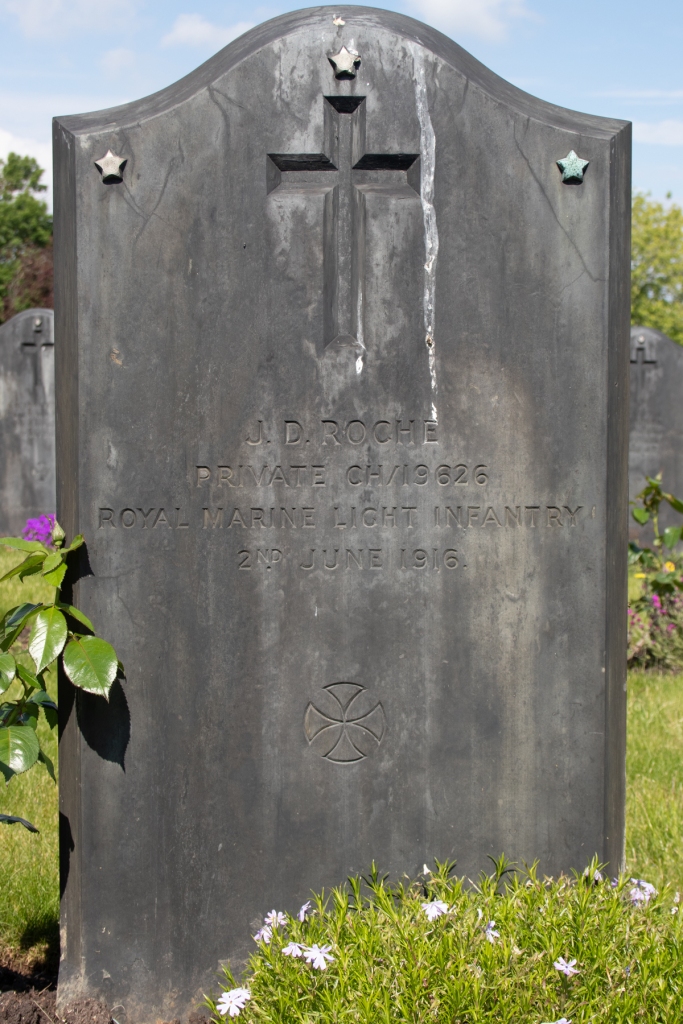
Private John Roche

Private John Roche

In the middle of the military section of the Woodlands Cemetery in Gillingham, Kent, is a headstone commemorating the life of John David Roche.

Details of John’s life are a challenge to piece together, although a later document gives his next-of-kin as Mrs E Roche of 108 Osnaburgh Street, Regent’s Park, London. There is a baptism record from 1897 for John David Roche, whose mother’s name was given as Lizzie. John’s father is listed as David, and the christening took place in Chelsea. There are no other records or census returns to give any further family background.

John’s time in military service is also hard to determine. That he joined the Royal Marine Light Infantry is clear, although when he enlisted and where he served are sadly lost to time.

Details of Private Roche’s passing are also unclear. He is noted as having died of disease, although the specific cause is not detailed. Given the location of his burial, it seems likely that he passed either at the Royal Naval Dockyard in Chatham, Kent, or at the hospital in the town connected to it.

John David Roche passed away on 2nd June 1916. If the baptism was correct, he was a day short of his 19th birthday.


Able Seaman Charles Dorman

Able Seaman Charles Dorman

Charles Columbus Dorman was born on 21st October 1892, and was the middle of three children to James and Margaret Dorman. Charles’ parents both hailed from Belfast, Country Antrim, but the 1901 census records his and his older sister’s birthplace as America. No baptism documents are available and no later information supports this, so, while his unusual middle name may suggest the place of his birth, it seems destined to remain unclear.

When he left school, Charles found work as a printer’s apprentice. He sought more, however, and was drawn to a life at sea. On 29th November 1910, he enlisted in the Royal Navy as an Ordinary Seaman. His service records confirm that he was 5ft 3.5ins (1.61m) tall, with brown hair, hazel eyes and a fresh complexion.

Charles was sent to HMS Pembroke – the Royal Naval Dockyard in Chatham, Kent – for his training. In January 1911, he was assigned to the ill-fated HMS Bulwark, before moving to the battleship HMS Implacable three months later. He would remain on board until the summer of 1914, gaining a promotion to Able Seaman during his three year stint there.

Charles was serving on Implacable when war was declared. At the beginning of September, after a week back in Chatham, was assigned to the sloop HMS Cormorant. After six months aboard, the cruiser HMS Blenheim became his home, and he spent the next month supporting troops who were being sent to Gallipoli.

By this point, Able Seaman Dorman had become unwell. He had contracted the autoimmune disease pemphigus, resulting in blistering to his skin and body. He returned to HMS Pembroke, and was stood down from the service on medical grounds 9th July 1916.

It is unclear whether or not Charles was admitted to hospital for his condition. Either way, he succumbed to the illness on 31st August 1916. He was just 23 years of age.

Charles Columbus Dorman’s family appear to have been unable to bring their boy back to Ireland for burial. Instead, he was laid to rest in Woodlands Cemetery, Gillingham, not far from the Kent naval base he had come to call home.

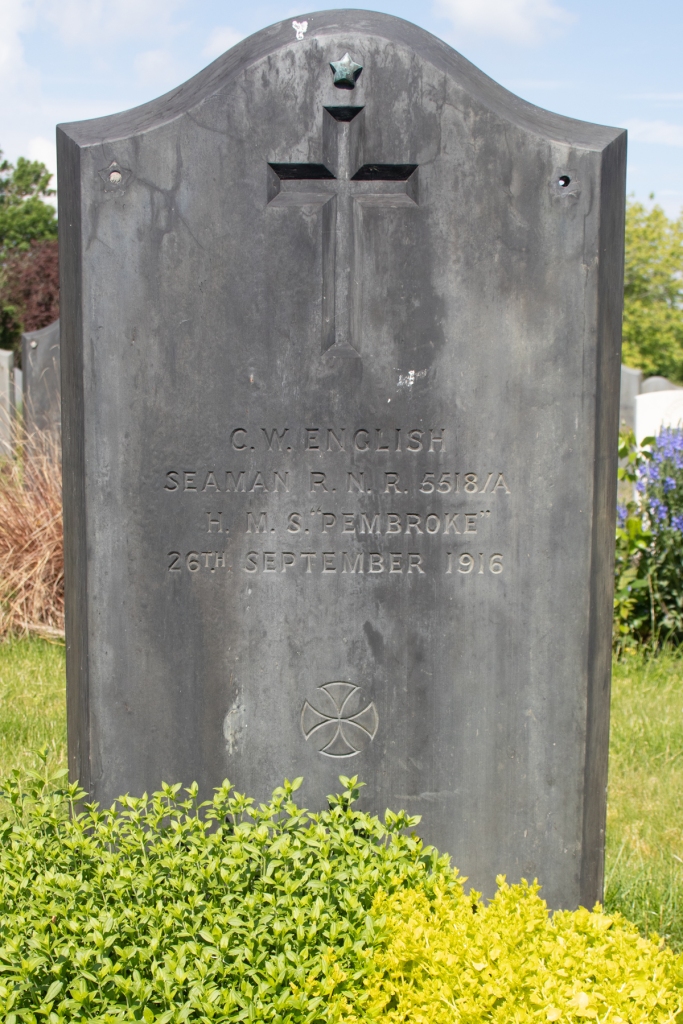
Seaman Charles English

Seaman Charles English

Charles William English was born on 30th August 1895 in the Suffolk town of Southwold. According to his later naval service records, his parents were Ellis and Sarah English, although there is little other information available to back this up.

Charles evidently had a draw to the sea and, when he enlisted in the Royal Naval Reserve on 10th January 1914, he was working as a fisherman. His service records confirm that he was 5ft 9ins (1.75m) tall, with grey eyes and a fresh complexion.

Over the next few years, Seaman English served off the east coast, and was attached to HMS Mantua, a former cruise ship taken over by the Royal Navy to patrol the North Sea. In between trips, Charles made HMS Pembroke, the Royal Naval Dockyard in Chatham, Kent, his home and it was to here that he returned in the autumn of 1916 when he fell ill.

Charles was admitted to the Royal Naval Hospital in the town, tests showing that he was suffering from lymphatic leukaemia. This was to prove fatal, and Seaman English passed away on 26th September 1916, aged just 21 years of age.

It seems likely that Charles William English’s family were unable to foot the bill for bringing their son back to Suffolk. Instead, he was laid to rest in Woodlands Cemetery, Gillingham, not far from the base he had come to call home.


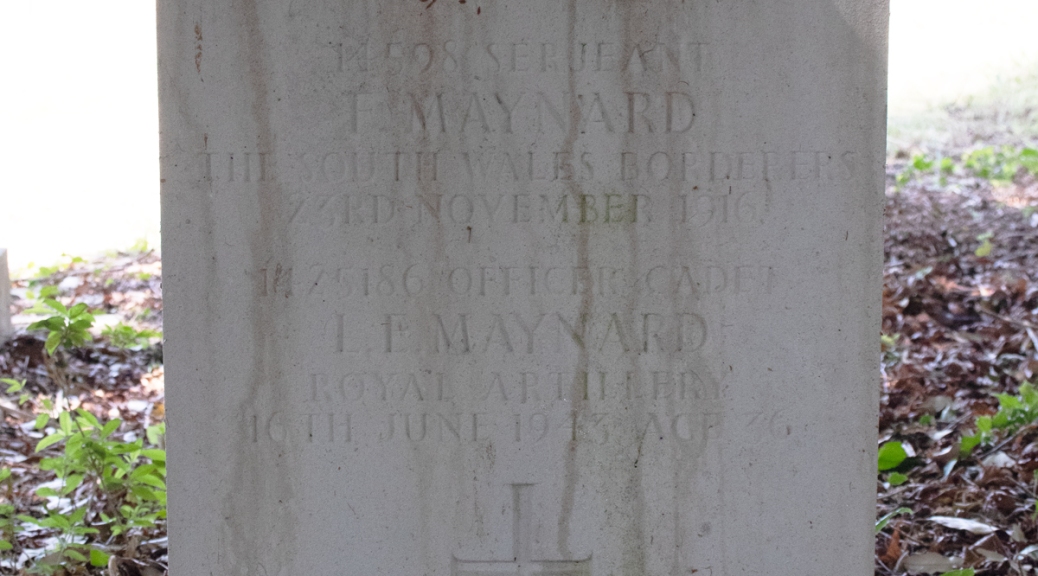
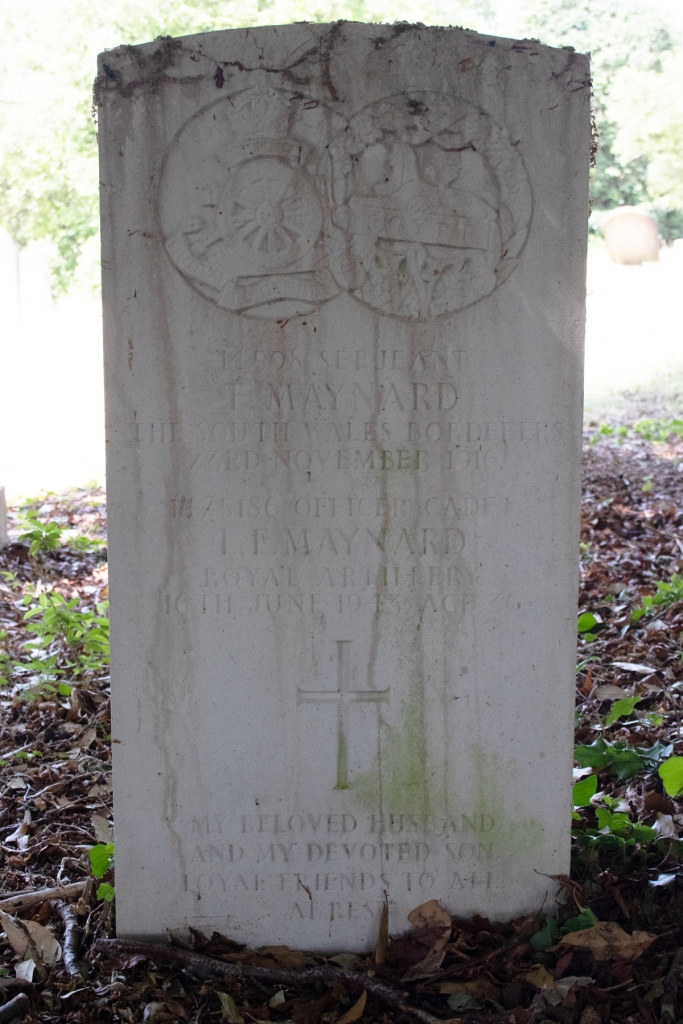
Serjeant Fred Maynard

Serjeant Fred Maynard

Details of Fred Maynard’s early life are a challenge to piece together. His First World War service records give his age as 44 years old when he enlisted in September 1914, and confirm his place of birth as Melksham, Wiltshire.

A newspaper report of his funeral gives the name of three brothers – Charles, Frank and Arthur – while only one census return, from 1881, provides a potential match for the family. This suggests Fred’s parents were iron fitter Alfred Maynard and his wife, Deborah, and gives the family’s address as Waterworks Road in Trowbridge.

Fred joined the army in the autumn of 1888. Initially assigned to the Gloucestershire Regiment, he had transferred to the Wiltshire Regiment by the following spring. Private Maynard showed a commitment to duty: in December 1890 he was promoted to Lance Corporal, rising to Corporal in the summer of 1893.

Fred was stood down to reserve status after his seven years’ active duty, but was recalled to the army in December 1899, when war broke out in South Africa. Promoted to Serjeant, he was sent to fight in the Boer War, and was mentioned in dispatches on 2nd April 1901 for special and meritorious service in South Africa. He was stood back down to reserve status in October 1901.

On 21st November 1895, Fred had married Louisa Card. The couple set up home in Trowbridge, but soon moved to London. They went on to have six children: Ernest, Nora and Leslie, who were all born in the London; and Arthur, Martha and Stuart, who were born in Cardiff, the family having moved to Wales by 1910.

The army was not finished with Fred, however, and, within weeks of war breaking out in the summer of 1914, he was called back into service. Given the rank of Serjeant again, he was attached to the South Wales Borderers. Fred was 44 years of age by this point, his service records confirming that he stood 5ft 8ins (1.73m) tall, weighed 164lbs (74.4kg) and had brown hair and hazel eyes.

Attached to one of the regiment’s depots, it seems unlikely that Fred saw service overseas this time around. He was discharged from the army on 1st September 1916 and this seems to have been on medical grounds. Later documents suggest that Serjeant Maynard had been diagnosed with carcinoma of the pylorus, or stomach cancer.

Fred returned to Cardiff, but his time back home was to be short. He was admitted to the Lansdown Road Military Hospital, and passed away on 23rd November 1916. He was 46 years of age.

It seems that Fred’s brother’s had some sway in his funeral. Instead of being laid to rest in Cardiff, where Louisa and the children were living, he was, instead, buried in the Locksbrook Cemetery, Bath, Somerset. His sibling Charles, who was a sergeant in Bath City Police, lived in the city, as did another brother, Frank.


Fred’s headstone also commemorates his and Louisa’s son, Leslie. He had joined the army in the 1920s and, in the summer of 1943, was in Yorkshire, undergoing officer training.

The death of an officer cadet through the accidental discharge of a rifle whose bolt had jammed was described at an inquest…

Captain WH Price said he was in charge of an exercise on the moors which involved the used of small arms and the firing of live ammunition. A squad of cadets lay on the ground in front of a trench firing over a range. All finished firing except Cadet Frank Holroyd, who said his bolt had hammed while firing a second round. [Price] told him to release the bolt by knocking the cocking piece up and back.

This attempt failed, and he told Holroyd to get back into the trench, turn the rifle magazine upwards, place the butt on the side of the trench, and kick the bolt down with his foot. While Holroyd was doing this he noticed Maynard standing in the trench about 4ft away from Holroyd and on his right-hand side.

Captain Price said he saw the rifle was pointing down the range when Holroyd kicked the butt. The cartridge suddenly exploded and Maynard dropped into the trench, shot in the head, and was dead when they reached him.

[Bradford Observer: Saturday 19th June 1943]

Officer Cadet Leslie Maynard was 36 years of age when he was killed. His body was taken back to Somerset for burial: he was laid to rest in the same grave as Fred, father and son reunited after 27 years.


Louisa remained somewhat elusive as time wore on. Fred’s military records confirm that she had moved from Cardiff to the Isle of Wight by 1922. By the time of her son’s death, she was living in Sidcup, Kent.


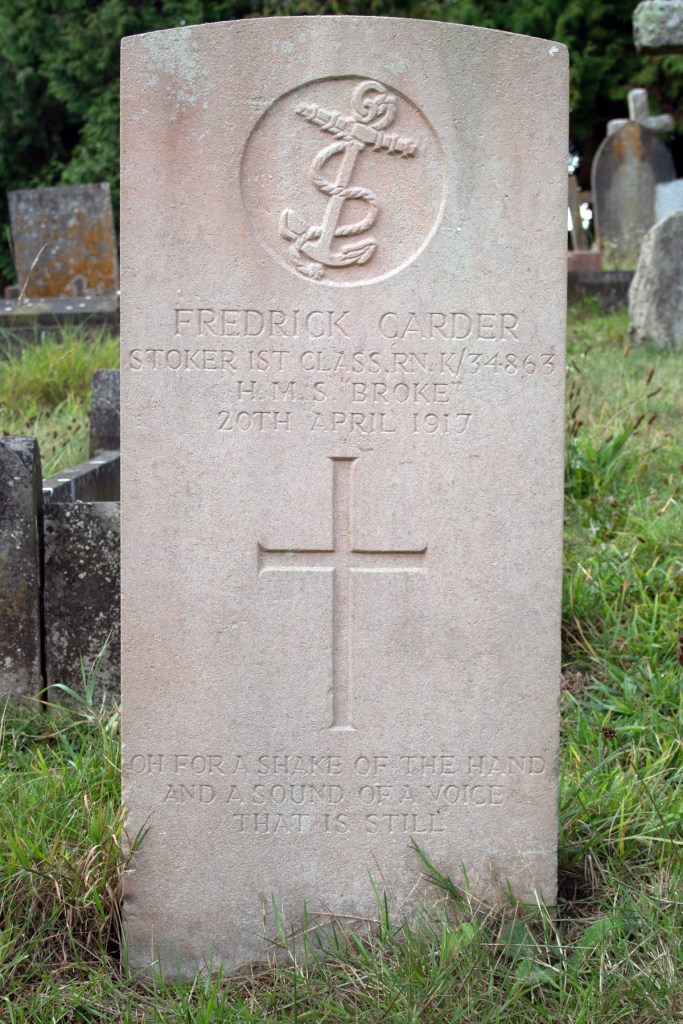
Stoker 1st Class Frederick Carder

Stoker 1st Class Frederick Carder

Frederick Albert Carder was born on 2nd March 1893 in Dartmouth, Devon. The youngest of ten children, his parents were shipwright Samuel Carder and his wife, Julia. Frederick lost both of his parents in 1909, when he was just 14 years of age. He was taken in by his older brother, Ernest – who was better known as James – and his family and, by the time of the 1911 census was working as a porter for the local Co-operative Stores.

War came to Europe in the summer of 1914, and, two years later, Frederick stepped up to play his part. He enlisted in the Royal Navy on 4th July 1916, and was given the rank of Stoker 2nd Class. He was sent to HMS Victory – the Royal Naval Dockyard in Portsmouth, Hampshire – for his initial training.

By the end of August, Stoker Carder was assigned to HMS Broke, a destroyer that formed part of the Dover Patrol, monitoring the waters off the Kent coast. He remained attached to the patrol and was promoted to Stoker 1st Class in January 1917.

On 20th April 1917, the Broke and another ship, HMS Swift, took on six German torpedo boats who were attacking the Dover Barrage – a network of nets and mines in the English Channel, designed to stop U-boats. The Broke rammed the torpedo boat SMS G42, and the two ships became locked together. Enemy sailors boarded the Broke, and hand-to-hand combat ensued. Eventually Broke managed to break free, and the G42 sank.

HMS Broke was towed back to shore, but 21 of her crew had died in the Battle of Dover Strait, including Stoker 1st Class Carder. He was 23 years of age.

The body of Frederick Albert Carder was taken back to Devon for burial. He was laid to rest in Paignton Cemetery, close to his brother, James, who had died in the summer of 1916. Read more about him by clicking here.


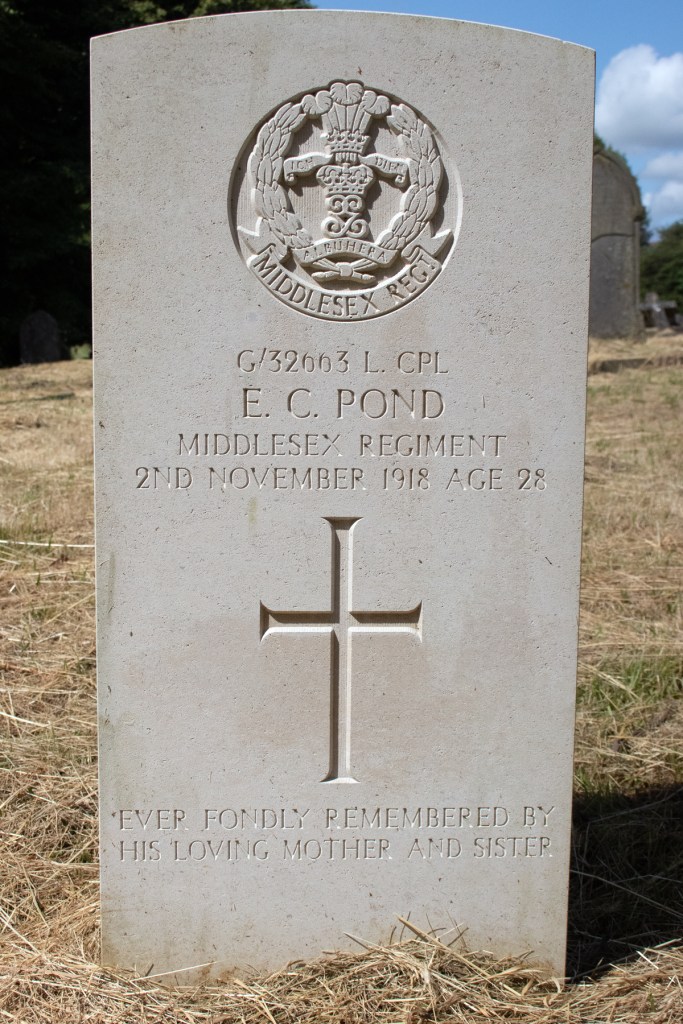
Lance Corporal Ernest Pond

Lance Corporal Ernest Pond

Ernest Charles Pond was born in the autumn of 1889 in Bath, Somerset, and was the younger of two children. His father, Charles, who worked as a wheelchairman, died in 1904, leaving his mother, Eliza, to raise the Ernest and his older sister, Daisy, on her own.

The 1911 census shows the determination the Pond family had in the wake of Charles’ death. Eliza had opened up a tea room in River Street Place, and was living above the business with Daisy and two servants. Daisy, meanwhile, was employed as a school teacher, something she had been doing for at least ten years. Ernest had left Bath, and headed for London: he had taken a room in a house in Tufnell Park, and was working as a furniture designer.

When war came to Europe, Ernest was called upon to play his part. Sadly, full details of his service have been lost to time, but it is clear that he had enlisted by the summer of 1918. He joined the Middlesex Regiment, and was assigned to the 6th (Reserve) Battalion. His unit formed part of the Thames and Medway Garrison, and there is no evidence that Ernest spent any time overseas.

By the autumn of 1918, Ernest had risen to the rank of Lance Corporal. With the war coming to an end, he fell ill, however, and was admitted to a military hospital in Chatham, Kent. Details of his illness are unclear, but it was severe enough that he succumbed to it: he passed away on 2nd November 1918, at the age of 28 years old.

The body of Ernest Charles Pond was taken back to Somerset for burial. He was laid to rest in Bath’s sweeping Locksbrook Cemetery, not far from where his father was buried.


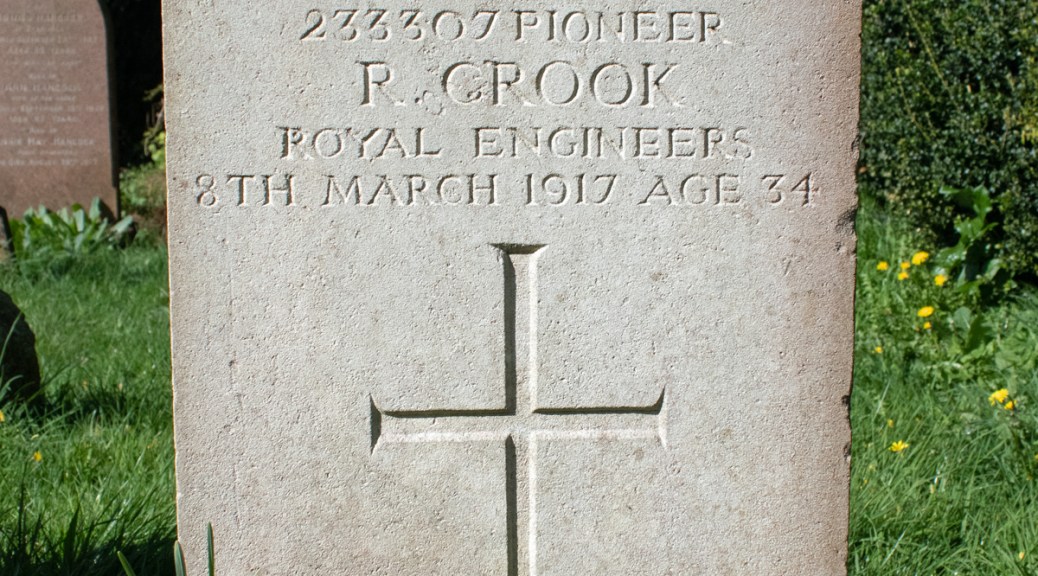
Pioneer Richard Crook

Pioneer Richard Crook

Richard Crook was born in the spring of 1883 in the Devon village of Locksbeare. The youngest of three children, his parents were Richard and Ann Crook. Richard Sr was a general labourer, and his son followed suit when he completed his schooling.

On 5th November 1904, Richard married farmer’s daughter Elizabeth May. The couple went on to have four children, and moved around Devon to wherever his farm work took them. Ann died in 1910, and by the time of the following year’s census, they had settled in Burlescombe, near Sampford Peverell.

By the start of 1917, Richard was called upon to serve his King and Country. He enlisted on 30th January and joined the Royal Engineers. His service records show that he was attached to the Inland Water Transport Corps, and given the rank of Pioneer.

Richard was sent to Kent for training, but within a matter of weeks he was admitted to a military hospital in Canterbury. He had contracted German measles, and it was so severe that he quickly succumbed to it. He passed away on 8th March 1917, at the age of 34 years old. He had been in the army for less than five weeks.

Richard Crook’s body was brought back to Somerset for burial. He was laid to rest in the graveyard of St Peter’s Church, Uplowman, Devon, not far from where his widow and children were living.