Tag Archives: Kent

Shoeing Smith Samuel Treeby

Shoeing Smith Samuel Treeby

Samuel Treeby was born in December 1865 in Taunton, Somerset. The third of seven children, his parents were cordwainer Thomas Treeby and his wife, Anna (or Hannah).

When he finished his schooling, Samuel found work as a blacksmith at a collar factory in Taunton. His trade stood him in good stead away from the forge: he volunteered for the Royal Horse Artillery, becoming adept at shoeing the animals.

In 1906, Samuel married Sarah Parker. She was from Enmore, between Bridgwater and Taunton, although the couple married in Cardiff, Glamorgan. The couple settled back in Enmore, where Samuel continued his smithing trade.

War came to Europe in 1914 and, although he was 49 years old, Samuel stepped up to play his part. He was attached to the Royal Army Service Corps and given a rank that echoed his civilian profession, that of Shoeing Smith. His service records show that he was of average height – 5ft 6ins (1.68m) tall – but that he was illiterate: he signed his declaration with a cross.

Samuel spent several months on home soil, before being sent out to France in March 1916. He spent six months overseas, before being shipped back to Britain, suffering from rheumatism. Shoeing Smith Treeby was admitted to the East Leeds War Hospital before being discharged to the regiment’s Remount Depot in Woolwich, Kent.

Samuel returned home to Somerset, but his poor health still dogged him during the winter of 1916/17. He contracted bronchitis, and died of the condition on 27th February 1917, while still based in London. He was 51 years of age.

Samuel’s body was taken back to Somerset for burial. He was laid to rest in the peaceful graveyard of St Michael’s Church in Enmore, not far from where his widow still lived.


Corporal Francis Rich

Corporal Francis Rich

Francis Frederick Herbert Rich was born in Sherborne, Dorset, in the spring of 1896. The youngest of three children, his parents were Frederick and Alice Rich. Frederick was a grocer’s assistant, who had left Sherborne by the time of the 1901 census for Weston-super-Mare, Somerset, to find work. Alice remained with their children, but, by 1911, the family were back together and living in Bridgwater.

Frederick was now working as a grocer, and his two daughters were employed as pressers in a local blouse factory. Frederick, meanwhile, was apprenticed to an outfitter’s in the town.

War came to Europe, and Francis stepped up to service his King and Country. Full details of his time in the army are lost to time, but it is clear that he joined the Royal Engineers, and was attached to the 20th Territorial Force Depot. This was based in Pier Road, Gillingham, Kent, but it seems likely that he spent at least some time overseas.

A contemporary newspaper suggested that he worked as a dispatch rider for his battalion. The location of his passing – the Royal Victoria Hospital in Netley, near Southampton – would intimate that he had been brought there from the Western Front, having been wounded there.

Corporal Rich had been awarded the Military Medal before he passed, although again, the reason for this award is lost to the ages. He died, through causes unknown, on 16th May 1918, at the age of just 22 years old.

The body of Francis Frederick Herbert Rich was brought back to Somerset for burial. He was laid to rest in North Petherton Cemetery, not far from where his family still lived, on Taunton Road, Bridgwater.


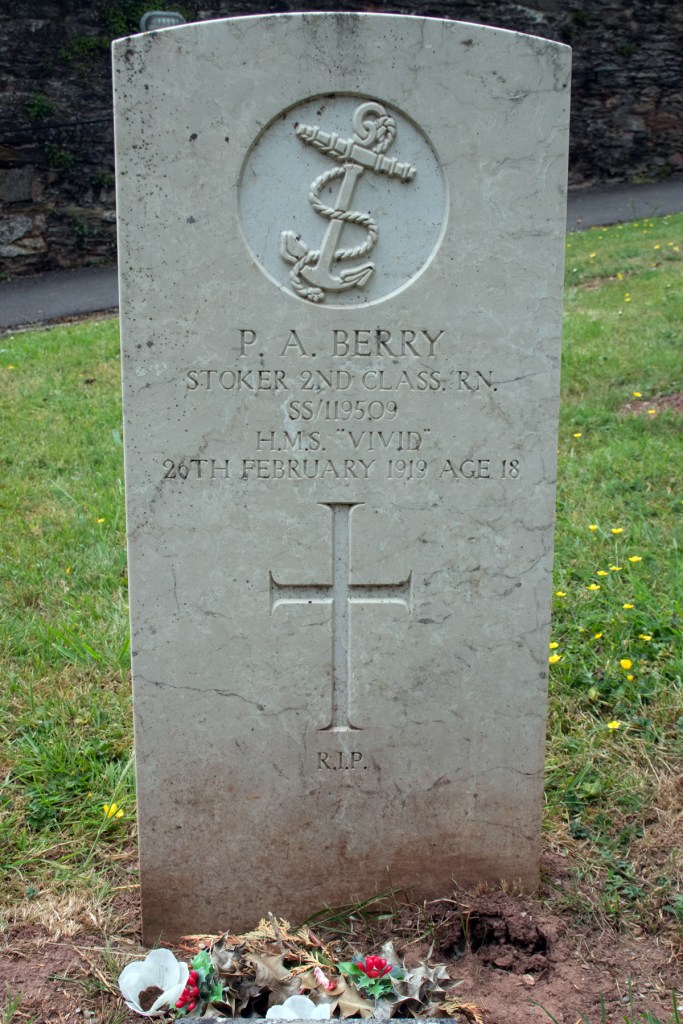
Stoker 2nd Class Percival Berry

Stoker 2nd Class Percival Berry

Percival Arthur Berry was born in January 1902, one of five children to Henry and Elizabeth Berry. Henry was a bricklayer from West Monkton in Somerset, and this is where the family were born and raised.

Percival seems to have had a roaming soul, or itchy feet. When he finished his schooling, he worked as a farm labourer, but in January 1918, he found employment as an engine cleaner for Great Western Railways in Taunton. This was not to last, however, and hi employment ended on 15th March, his work records stating that he just left.

Percival went back to farm labouring, but still sought a way out of that life. In January 1919, he enlisted in the Royal Navy. So keen was he to escape Somerset, he added a year to his age, to ensure that they allowed him to enlist. His records show that he was 5ft 6ins (1.68m) tall, with brown hair, blue eyes and a fresh complexion.

Assigned the rank of Stoker 2nd Class, Percival was sent to HMS Vivid, the Royal Naval Dockyard in Devonport. Within a matter of weeks, however, Stoker Berry had fallen ill. The details are a little confusing at this point – he was stationed at HMS Vivid, but admitted to the Dreadnought Seaman’s Hospital in Greenwich, Kent, his admission records stating that he had come from HMS Harlech. It is likely, therefore, that he was on a voyage from Devon, on board the converted trawler Harlech, when he fell ill. Docking in London, he was then admitted to the Greenwich hospital.

Stoker 2nd Class Berry had contracted influenza, and this was to take his life. He died on 26th February 1919, aged just 17 years old. He had served in the Royal Navy for just 47 days.

Percival Arthur Berry was brought back to Somerset for burial. He was laid to rest in the peaceful graveyard of St Mary’s Church in Kingston St Mary, a few miles from his old family home.


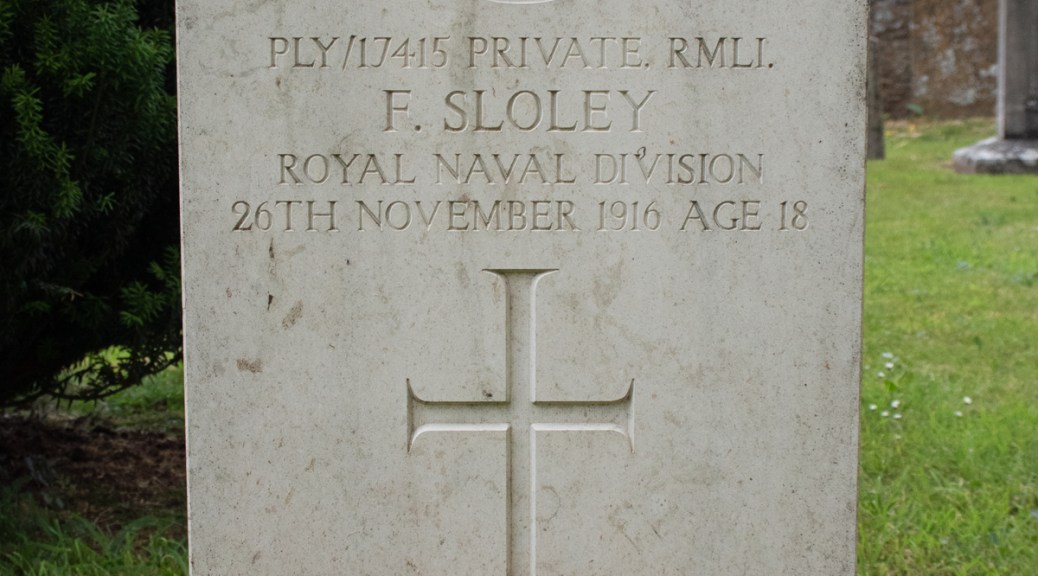
Private Frederick Sloley

Private Frederick Sloley

Frederick Sloley was born on 7th April 1897 in Kingston St Mary, Somerset, and was the fourth of nine children to Walter and Mary Jane Sloley. The family were farm workers and were living with Walter’s parents – also agricultural labourers – in the 1901 census.

After he finished his schooling, Frederick found began working with the horses on the farm. When war broke out, however, he saw an opportunity to serve his King and Empire, and enlisted in the Royal Marine Light Infantry. He joined up on 5th October 1914, and his service records show that he was 5ft 4ins (1.63m) tall, with black hair, grey eyes and a fresh complexion.

Private Sloley was initially sent to the Reserve Depot in Deal, Kent, for training, before moving to the Plymouth Division in Devon in March 1915. He records do not make it clear where he served specifically, but by 1916 he has fought in the Dardanelles and Mesopotamia.

It was while he was in the Eastern Mediterranean that Frederick was injured. Wounded in the spine by enemy gunfire, he was medically evacuated to Britain for treatment. Admitted to King George’s Hospital in London, surgery proved too late. Private Sloley passed away on 26th November 1916, at the age of just 19 years old. His mother, Mary, had managed to see him before he died.

The body of Frederick Sloley was brought back to Somerset for burial. He was laid to rest in the peaceful graveyard of St Mary’s Church in his home village of Kingston.


Serjeant Robert Priddle

Serjeant Robert Priddle

Zebulon Priddle was born in the autumn of 1876 in Curry Mallet, Somerset. One of ten children, who included Meliam, Cornelius, Absalom, Ebenezer, Lancelot and Jabez, his parents were Robert and Mary Priddle.

Robert was a farm labourer, and his son followed suit at first, but a career away from home beckoned and, on 16th January 1894, he enlisted in the Royal Artillery. Aged just 18 years and 2 months, Zebulon had volunteered in the Somerset Light Infantry, a militia group at that point. His service records confirm that he was 5ft 5ins (1.65m) tall and weighed 122lbs (55.3kg).

Driver Priddle was based on home soil for eighteen months before his wish for a life of adventure was realised. On 16th September 1894, his battalion set sail for India, and he was to remain there for more than six years. Zebulon returned to Britain in February 1902, where he was placed on reserve status. He completed his twelve years’ service in January 1906, and stepped down from the army.

Britain’s shores could not contain Zebulon, however, and at some point he emigrated to Canada. Little information of his life in North America is available, other than that the move seemed to have provided him with an opportunity to change his name, as in documents from this point on he is known as Robert Priddle.

The next record for Robert is that of his re-enlistment when war broke out. He was living in Winnipeg by this point, and, as he gives his mother, Mary, as his next-of-kin, it seems that he did not marry or have children.

Robert joined up again on 16th December 1914, and was attached to the 9th Battalion of the Canadian Infantry. Promoted to the rank of Sergeant, he arrived back in England in March the following year. His time there was to be brief, however, and within a matter of weeks, Robert arrived on the Western Front.

Over the next six months, Sergeant Priddle’s health suffered significantly, and he had several periods in hospital. Initially suffering from bronchitis, in July 1915 he was medically evacuated to Britain with cardiac angina. He remained in England and, when rheumatism set in in October, he was transferred to reserve status.

Sadly, this was not to be the last time Sergeant Priddle’s health suffered: he was admitted to hospital in Shorncliffe, Kent, with a ruptured aortic aneurysm. He succumbed quickly, passing away on 25th January 1916, at the age of 39 years old.

The body of Robert Priddle was brought back to Somerset for burial. He was laid to rest under his assumed name, in the peaceful graveyard of St James’ Church in his home village of Curry Mallet.


Private John Cotterell

Private John Cotterell

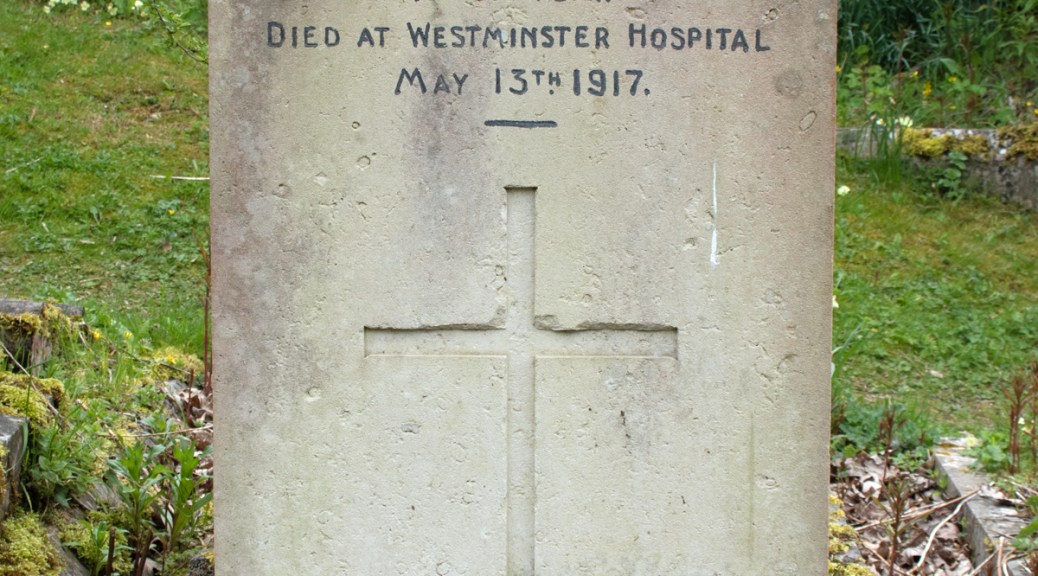
Much public interest was manifested in the funeral, on Thursday, of Private John St Clair Cotterell eldest son of Mr T Sturge Cotterell, JP, of Bath. Deceased, who was 26 years of age, was educated at Bath College, and left England to take up the life of a rancher in Canada. Here he joined the Alberta Rifles and saw service on the Western Front, where he was dangerously wounded in an attack on the Arras front on April 28th. He was, however, brought back to this country, only to succumb to his severe wounds in Westminster Hospital on Saturday. He leaves a widow and one child.

Bath Chronicle and Weekly Gazette: Saturday 19th May 1917

John St John Cotterell was born in Bristol, Gloucestershire, on 17th September 1891. One of six children, his parents were wallpaper manufacturer turned quarry manager Thomas Sturge Cotterell, and his wife, Edith. John remains noticeably absent from both the 1901 and 1911 censuses in which his parents and sibling – and servants – are recorded, so his early life is hard to piece together.

By 1908 John had emigrated to Canada to become a farmer. It was here that he met and married Gladys Nettleton. The couple settled in Alberta and had a daughter, Nellie, who was born in 1915.

When war came to Europe, John stepped up to play his part for King and Empire. He enlisted in the Canadian Expeditionary Force on 8th March 1916, and was assigned to the 192nd Overseas Battalion. Private Cotterell’s service records confirm that he was 5ft 5ins (1.65m) tall, weighed 117lbs (53kg) and had fair hair, grey eyes and a fair complexion.

Private Cotterell left Canada for Britain on 1st November 1916, arriving in Liverpool ten days later. He was transferred to the 9th (Service) Battalion of the Canadian Infantry, and barracked at St Martin’s Plain, near Folkestone in Kent. Early in 1917, he was moved to the 10th Battalion and, on 4th March was shipped off across the English Channel.

John’s arrival in France was not an auspicious one. Tightly packed barracks were a breeding ground for disease, and, by the time he had arrived in Le Havre, John had contracted mumps. He was laid up in a camp hospital for just over a month before returned to his battalion and heading to Arras.

Private Cotterell’s was severely injured in the fighting, and he received a gunshot wound to his spine. Medically evacuated to Britain, he was admitted to the Westminster Hospital in London. His medical report noted that his ‘1st lumbar vertebra [was] shattered and [spinal] cord [was] cut through‘. He had complete paralysis below the groin and that he was in a ‘hopeless condition‘. His injuries proved too severe, and he passed away on 13th May 1917, three days after being admitted. John was just 25 years of age.

John St Clair Cotterell’s body was brought back to Somerset for burial. He was laid to rest in Bath’s Abbey Cemetery.


Officer’s Steward Sidney Gordon

Officer’s Steward Sidney Gordon

Hidden away above the busy A371 to the north of Axbridge, Somerset is an unassuming graveyard. Overgrown and haunting, with headstones lining the boundary of the copse, this is the cemetery for the former St Michael’s Sanatorium, now the St Michael’s Cheshire Home. In the middle of the plot, next to the central memorial, is a headstone dedicated to Sidney Gordon, notably buried somewhere else in the grounds.

Sidney Vincent Gordon was born in Upton Park, Essex, on 7th May 1897. There is little information about his early life, other than his mother’s name, May.

The 1911 census recorded Sidney as being an inmate at the Scattered Home for the West Ham Union, the workhouse that covered the area. At 13 years of age, he was one of the older of the thirteen students boarding in the home, which was overseen by Emma Caroline Simpson, the House Mother.

When Sidney completed his schooling, he managed to find employment as an undertaker’s boy. But he sought out bigger things and, on 8th June 1914, he enlisted in the Royal Navy. His service records note that he was 5ft 6ins (1.68m) tall, with brown hair, blue eyes and a fresh complexion.

Being under-age when he enlisted, Sidney was given the rank of Boy. He was first sent to HMS Pembroke, the Royal Naval Dockyard in Chatham, for training, and remained there for a couple of months. In August 1914, Boy Gordon was moved down the coast to HMS Actaeon, a torpedo school based in Sheerness, Kent.

After five months, he moved to HMS Wildfire, another part of the Sheerness base, and it was while there he turned 18, and could formally join the Royal Navy. He was given the rank of Officer’s Steward 3rd Class and remained at Wildfire until the end of 1915. After a short stint back in Chatham, Sidney was given a new posting on board the supply ship HMS Tyne, where he remained until the following May.

Officer’s Steward Gordon returned to HMS Pembroke once more, and was assigned to his final sea-going ship, the newly launched monitor, HMS Erebus. She was to be his home until June 1917, when, having become unwell, he was posted back to HMS Pembroke.

Sidney had contracted pulmonary tuberculosis, which led to him being invalided out of the Navy on 1st August 1917. At this point his trail goes cold once more, but it is likely that, by the start of 1919, his condition had led to his admission to St Michael’s.

When he died there, on 5th March 1919, Sidney was just 21 years old. Given his background, it seems probable that his mother, if she was still alive, would not have been able to afford for his remains to be brought back to Essex. Sidney Vincent Gordon was laid to rest in the sanatorium’s cemetery, in the foothills of the Mendips, finally at peace.


Corporal Charles Fernley

Corporal Charles Fernley

Charles Edward Fernley was born on 28th November 1874 in Stepney, East London. One of thirteen children, his parents were Richard and Eliza Fernley. Richard was a sluice keeper, who worked his way up to be an inspector of sewers and drains for London County Council. By 1888, he had been able to move his family out of the East End, to suburban Bromley, south of the river in Kent.

By the time of the 1891 census, Charles had finished his schooling, and had found work as a printer’s labourer. Ten years later, however, he was employed as a packer for a millinery warehouse. There seems to have been more need for this back in the East End, however, as he was living in Bow in the summer of 1901.

On 21st August 1901, Charles married Hannah Weston in St Faith’s Church, Stepney. She was three years younger than her husband, and was the daughter of a boatbuilder. The couple settled in a small terraced house in East Ham and had a son, Leonard, who was born in 1908.

When war came to Europe, Charles was keen to play his part. He enlisted in the Essex Regiment, and was assigned to the 1st/4th Battalion. Sent to the Balkans in August 1915, it is likely that he was caught up at Gallipoli and, in December 1915, evacuated with his battalion to Mudros on the Greek island of Lemnos.

By this point, the now Corporal Fernley had contracted dysentery, and was repatriated to Britain for treatment. He was admitted to the Newton Park VAD Hospital on the outskirts of Bath, but was to succumb to the condition on 31st December 1915. He was 41 years of age.

Charles Edward Fernley was laid to rest in the quiet Holy Trinity Churchyard in Newton St Loe, Somerset.


While Charles’ headstone is dedicated to Sergeant Fernley, all other documentation suggests that he held the rank of Corporal when he died.


Private Walter Lane

Private Walter Lane

Walter Frederick Lane was born in Sidcup, Kent, in the early part of 1893. The younger of two children, his parents were Frederick and Caroline Lane. Frederick was a carman and the transient nature of his work meant that the family moved on a regular basis.

The 1901 census found them in Eltham, Kent, while ten years later the family of three – Walter’s older sister having moved on – were boarding in Harton Street, Deptford. By this point, Walter was 17 years of age, and he was also working as a carman. (It is interesting to note that the earlier census recorded Walter’s parents by their first names, while the 1911 document used their middle names – Walter and Kate: transient work allowing for reinvention, perhaps?)

Walter sought a more permanent career, and, on 17th March 1913, he enlisted in the army. Full details of his military career have been lost to time and, in fact, most of his service details come from his discharge papers.

Walter enlisted in the Queen’s Own (Royal West Kent Regiment), although, as Private Lane, he was not formally mobilised until March 1914. When war broke out, his battalion, the 1st/5th, was sent to India, and he remained there for the duration of the war.

Private Lane’s time in the army was not without incident. He contracted malaria in 1915, and while he initially recovered, the condition was to continue to dog him over the following years.

By 1917 Walter’s troop was based in Jabalpur, Madhya Pradesh, but in December that year, the battalion set sail from Bombay for Basra, Mesopotamia.

While in Iraq, he had a couple of run-ins with his superiors. On 22nd December 1917 he was stopped a week’s pay for ‘disobeying an order: putting his equipment on a transport waggon’ and ‘losing by neglect his equipment.’ On 18th February 1918, a further 28 days’ pay was deducted for ‘making away with regimental necessaries (1 towel)’ and ‘neglecting to obey an order.’

During this time, though, Walter’s health was regularly impacted when malaria caught up with him. His discharge documents recorded that he had an attack about once a month, which lasted four or five days each time. In the end, he was released from active service, and left the army on 19th February 1919.

Walter had been discharged while admitted to the Dispersal Hospital in Brighton. His health did not improve, however, and he was soon moved to Somerset for respite care. It was here that he passed away on 7th August 1919. He was 26 years of age.

Walter Frederick Lane was laid to rest in the Holy Trinity Churchyard, Newton St Loe, Somerset.


My thanks go to Liz at the local parish office for her help in unpicking the details of Walter’s passing.

Thanks also go to Tim Hill, who has been researching the graves in the Newton St Loe churchyard.


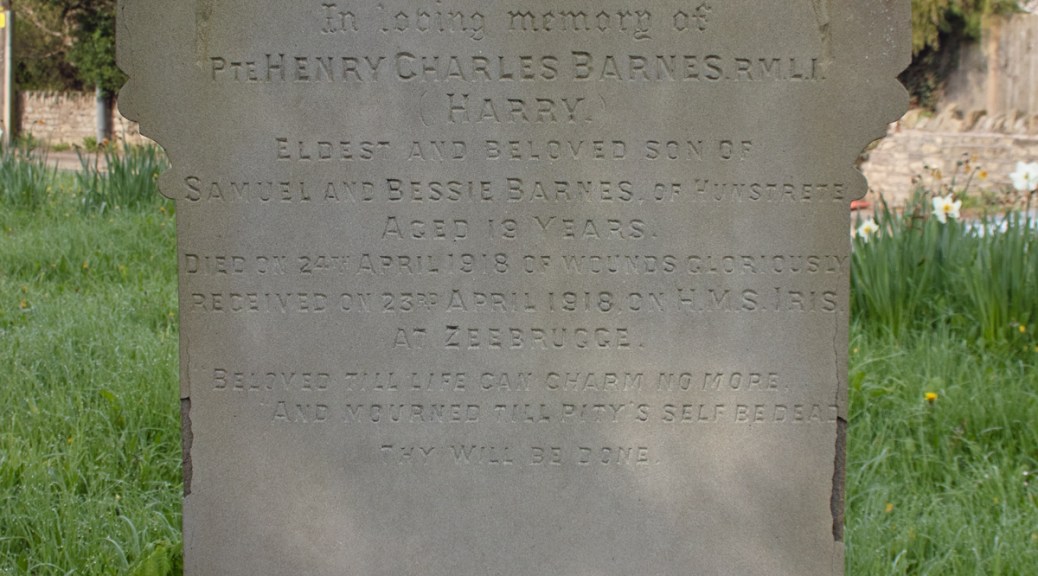
Private Henry Barnes

Private Henry Barnes

Hunstrete, Pensford was plunged into sorrow, not unmixed with pride, when is became known that one of its lads Pte. HC Barnes, RMLI… had played a hero’s part in the now famous Zebrugge raid, where he was severely wounded in the head and shoulder, from which wounds he subsequently succumbed in Chatham Naval Hospital. Before joining up at the age of 17 years and two months he was employed to look after the famous poultry of Mr HLF Popham, of Hunstrete House, taking all the honours at the Crystal Palace during one show. He was first sent to Salonika but was invalided home with malaria and was on board the Iris during the raid. The deceased lad, who was 19, was brought home and his body laid to rest at St Peter’s, Marksbury.

Somerset Guardian and Radstock Observer: Friday 10th May 1918

Henry Charles Barnes was born on 5th December 1898 in the Somerset village of Hunstrete. Also known as Harry, he was the oldest of six children to coal hewer Samuel Barnes and his wife Elizabeth, who was better known as Bessie.

After his recovery from malaria, Private Barnes was assigned to HMS Iris, a Mersey ferry requisitioned by the Royal Navy for support in the planned raid on Zeebrugge.

On 23 April 1918, Iris was towed across the English Channel to Zeebrugge by HMS Vindictive; she was carrying a couple of platoons of the 4th Battalion of the Royal Marines as a raiding party. When the Vindictive neared Zeebrugge she cast the ferry aside. Iris tried to pull up to the breakwater under heavy fire in order to off-load the raiding parties which were on board. She sustained heavy fire and a shell burst through the deck into an area where the marines were preparing to land. Forty-nine men were killed, while others, including Harry, were badly injured.

Medically evacuated to Britain, Private Barnes was admitted to the Royal Naval Hospital in Chatham, Kent, but his injuries were too severe, and he died on the day after the raid.

Henry Charles Barnes was laid to rest in the graveyard of St Peter’s church in Marksbury, the parish church for the family’s home in neighbouring Hunstrete.