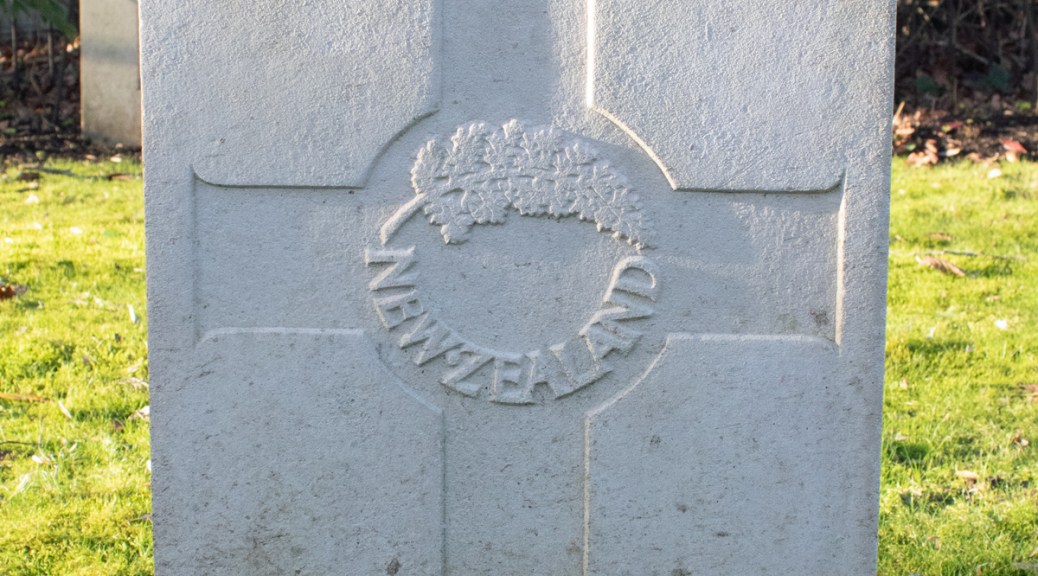
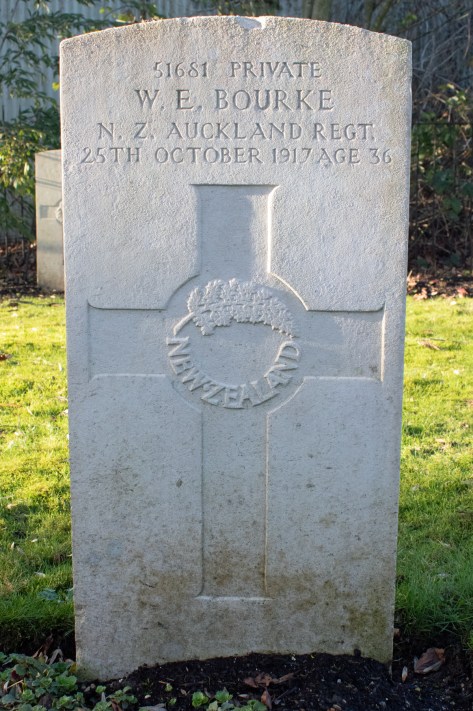
Walter Edward Bourke was born in Whangarei, New Zealand, on 6th May 1885. The fifth of six children, his parents were Patrick and Elizabeth Bourke, who had emigrated from Ireland in the 1870s.
Patrick died in 1911, at the age of 65. Walter, by this point, was working as a chamber hand in a freezing works. When war broke out, however, he was compelled to step up and serve his country. He enlisted on 22nd January 1917, and was assigned to the New Zealand Auckland Regiment.
Trained at Trentham, Private Bourke’s unit set sail for Europe on 12th June 1917. The voyage from Wellington to Devonport would take two months and, from there Walter was marched into a camp in Sling, near Bulford, Wiltshire.
Within a matter of weeks, Walter fell ill. He was sent to the No. 3 New Zealand Hospital near Codford, Wiltshire, but his condition worsened significantly over the next month. His treatment would prove fruitless, and Private Bourke passed away on 25th October 1917: he was 32 years of age.
Thousands of miles from family, Walter Edward Bourke was laid to rest in the extension to St Mary’s Church graveyard, not far from the hospital in which he had passed.
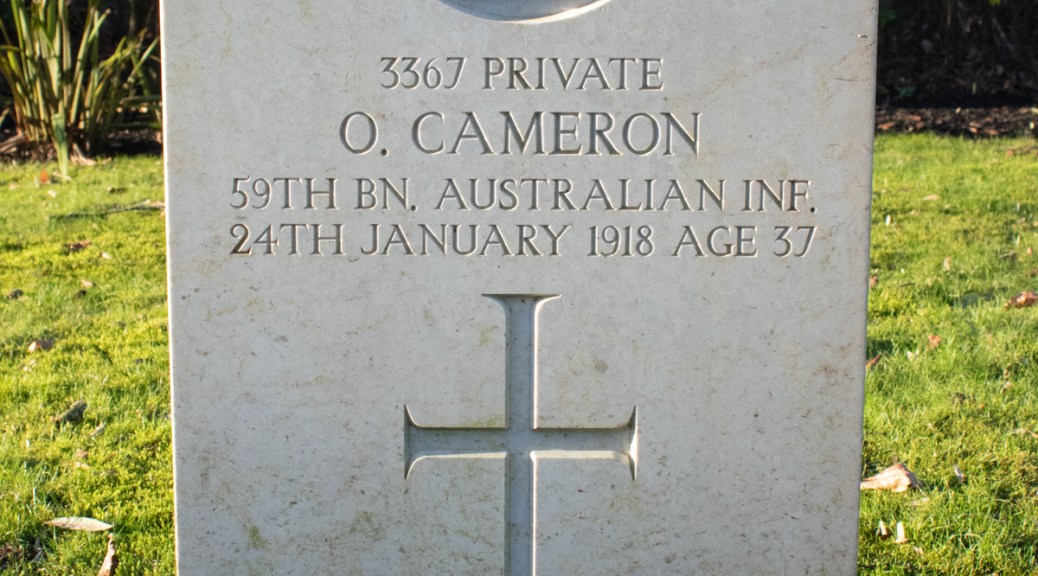
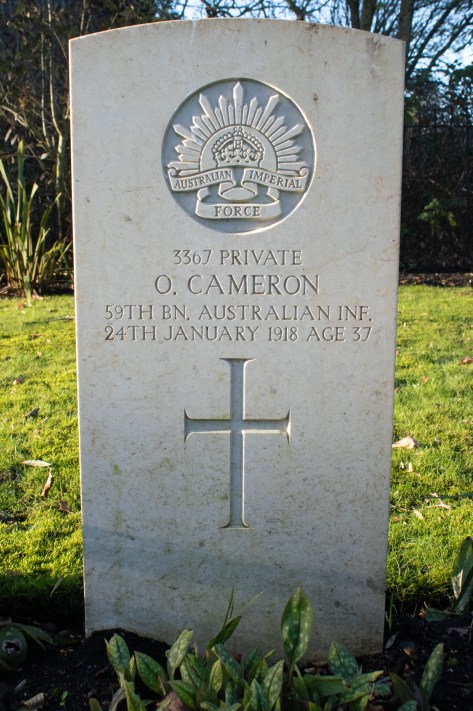
Born in Shelburne, Nova Scotia, in around 1876, the early life of Oscar Cameron is a challenge to piece together. He was one of four children to ship’s carpenter Christopher Cameron and his wife Alice.
Oscar appears to have followed his father in a sea-faring life, and his later army service records confirm that, by 1917, he was a ship’s officer. When the call came to serve the Empire, he took a discharge from his ship in Australia, and joined up.
Enlisting on 20th February 1917, Oscar’s service records show that he was 5ft 6.5ins (1.69m) tall, and weighed 128lbs (50.1kg). He had fair hair, blue eyes and a fresh complexion, with a tattoo on his right forearm and a vaccination scar on his left upper arm. His age was given as 36 years and 6 months, although he was, in fact 41 by this point.
Assigned to the 59th Battalion of the Australian Infantry, Private Cameron’s unit left from Sydney on board the HMAT A16. The two-month voyage was not uneventful: Oscar spent three days in hospital with an undeclared ailment, and also forfeited two days’ pay for being absent without leave for 34hrs during the ship’s layover in Cape Town, South Africa.
The 59th Battalion disembarked in Liverpool, Lancashire, on 16th September 1917. From there it made the journey to the ANZAC camps in Wiltshire, and this is where Oscar would have continued his training.
At the start of 1918, Private Cameron’s health was suffering again. He was admitted to the No. 3 New Zealand General Hospital in Codford, Wiltshire, suffering from nephritis. Ultimately, the condition was to prove fatal: Oscar passed away at 4:45pm on 24th January 1918, aged 40.
Thousands of miles from home, it wasn’t possible for the remains of Oscar Cameron to be taken back to Canada. Instead, he was laid to rest in the ANZAC extension to St Mary’s Churchyard in Codford, not far from the base where he had received treatment.
Charles Archibald Walters was born in 1896, and was one of nine children to Arthur and Minnie. Arthur was a painter in the shipyards, and the 1901 census found the family living in a small cottage at 29 Cambrian Terrace in Neyland, Pembrokeshire.
By 1911, Charles had finished his schooling, and had found labouring work on a local farm. He was still living at home, however, and the family has moved to 46 Cambrian Road, overlooking the shipyard where Arthur still worked, and the Westward Pill and Cleddau Ddu rivers beyond.
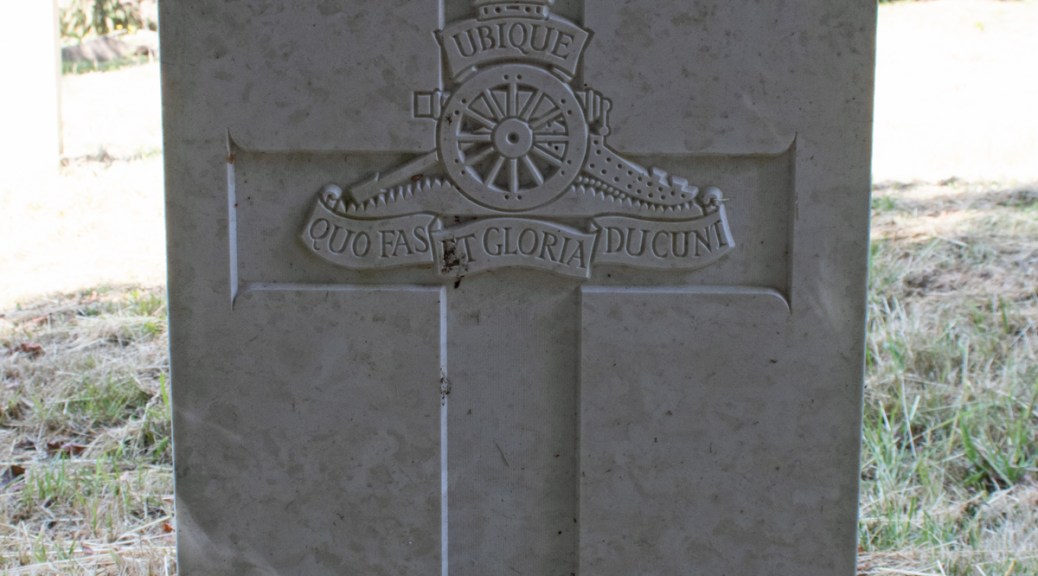
When war came to Europe, Charles was called upon to play his part. Details of his military service are sketchy, but it is clear that he enlisted in the Royal Garrison Artillery, and was assigned to the Pembrokeshire Territorial Force.
Gunner Walters survived the war, but was suffering from nephritis. He was medically discharged from the army on 12th May 1919, and returned to the family home.
By this point Arthur had moved the family to Goodwick, near Fishguard, by this point, as he had taken up a job in the town as a painter for Great Western Railways.
Charles’ condition would ultimately get the better of him. He passed away on 4th April 1920: he was just 24 years of age.
Charles Archibald Walters was laid to rest in Llanwnda Cemetery, not far from where his family now lived.
The 1921 census found that two of Charles’ brother were also working for Great Western Railways, Frederick as a porter, and William as a boiler sealer in their engineering works (presumably the same place as Arthur).
Minnie died the following year, Arthur passing in 1924. Both were buried with their son, Charles, and they are remembered on his Commonwealth War Grave.
Alexander Albert Sturrock was born in the autumn of 1877. The second of two children, he was the only son of Alexander and Elizabeth Sturrock. Alexander Sr was a plasterer from Scotland, while his wife had been born in Bristol. It was in the Pimlico area of Middlesex, however, that the couple would raise their two children: Alexander and his older sister Eleanor.
The 1891 census found the family living at 253 Wellington Buildings, on Ebury Bridge Road. According to the next census, however, they had taken rooms at 52 Warriner Gardens, south of the Thames in Battersea.
By 1901, the Sturrocks had moved north again, and were living at 7 Fulham Place in Paddington. One of three families in the house, Alexander Sr and Elizabeth shared the rooms with their son and Eleanor’s son, Leslie. Alexander Sr was still working as a plasterer, while his son was now employed as a clerk.
Alexander Jr married Edith Concanen in 1910. A widow, she had a son, Douglas, and the three of them lived in her family home on Camden Road, Sutton, Surrey. Alexander was working as a commercial accountant, and at some point in the next five years, the family moved to Paignton, Devon.
When war came to Europe, Alexander stepped up to play his part. He enlisted in Exeter on 17th November 1915, and joined the Devonshire Regiment. His service records note that he was 5ft 11ins (1.8m) tall and weighed 185lbs (83.9kg). He was also recorded as having Edith’s name tattooed on his left forearm.
Private Sturrock was mobilised the following June, and was attached the 3rd (Reserve) Battalion. He was promoted to Lance Corporal in August 1916, and transferred to the 8th (Service) Battalion. Shipped to France in December, he would spend the next eighteen months overseas.
Alexander had ongoing issues with his health, however, and was hospitalised at least three times with diarrhoea. In July 1918, he was transferred to the Labour Corps, and reassigned to home soil. Promoted to Corporal by this point, he was attached to the 114th unit, although it is unclear where he served.
Corporal Sturrock’s health continued to dog him. The Armistice signed, he was medically discharged with nephritis on 14th June 1919, and returned home. Sadly, his reunion with Edith was not to be a lengthy one. Alexander passed away on 25th July 1919: he was 41 years of age.
Alexander Albert Sturrock was laid to rest in Paignton Cemetery, overlooking the town he had most recently called home.
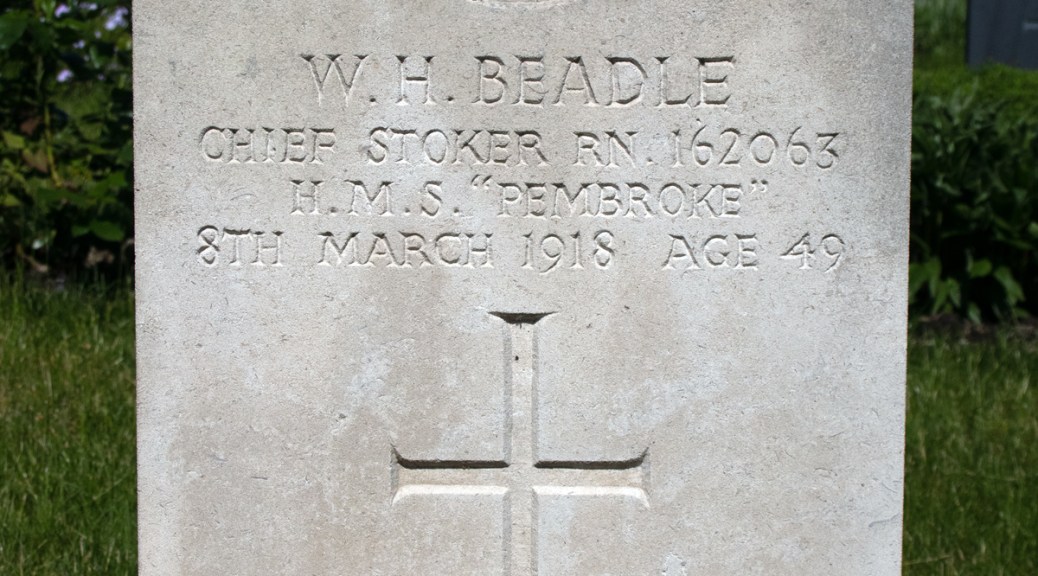
William Henry Beadle was born in Heybridge, Essex, on 23rd April 1870. The youngest of three children his parents were William and Sophia Beadle. William Sr was a waterman-turned-labourer, and the young family lived with Sophia’s parents.
When Sophia died in 1875, her widow and their children remained with his in-laws. William Sr died in 1887, and by the time of the 1891 census, his son was living with his now widowed grandmother. The document notes that she was a pauper, but he was a moulder in the local iron works.
William sought bigger and better things and, on 13th August 1891, he enlisted in the Royal Navy as a Stoker 2nd Class. His service records show that, as 21 years of age, he was 5ft 8ins (1.72m) tall, with brown hair, grey eyes and a fresh complexion.
Stoker Beadle was initially sent to HMS Pembroke, the Royal Naval Dockyard in Chatham, Kent, for his training. He would spend the next six months split between there and HMS Wildfire, a shore establishment downriver at Sheerness.
In 1892, William spent six months on board the troop ship HMS Tyne. He returned to Chatham in July of that year, and was promoted to Stoker 1st Class. Over the course of the next eleven years, he would go on to serve on four ships, each time returning to his base port, HMS Pembroke.
William’s service record is pretty much mark free. He was confined to cells for seven days in October 1895, although his offence s unclear. In April 1896 he was promoted to Leading Stoker 2nd Class, and made Leading Stoker 1st Class three years later. In December 1902, while on board the cruiser HMS Diana, William was promoted again, to Acting Chief Stoker, and the following August, his initial contract of service came to an end.
By this point William was a married man. He married Clara Walford in Rochford, Essex, and, while the couple did not go on to have children, there is little additional information about her.
William re-enlisted as soon as his initial twelve-year contract came to an end. In December 1903 he was promoted to Chief Stoker, and he remained at this rank until he war formally retired on 16th August 1913. He had spent more than two decades in the Royal Navy ,and travelled the world: the 1911 census recorded him as one of the crew of HMS Lancaster, moored in Malta.
Chief Stoker Beadle’s time away from the Royal Navy was not to be lengthy and, when war broke out less than a year later, he was called upon once more. He spent nine months back at HMS Pembroke, before being assigned to the new cruiser HMS Calliope. She would be William’s home for the nearly three years, and it was not until March 1918 that he came back to shore.
William’s return to Chatham seemed to coincide with a downturn in his health. He was admitted to the town’s Royal Naval Hospital with nephritis, and this is what would take his life. He died on 8th March 1918: he was 47 years of age.
William Henry Beadle was laid to rest in the military section of Woodlands Cemetery, Gillingham, not far from the naval base he had called home for so long.
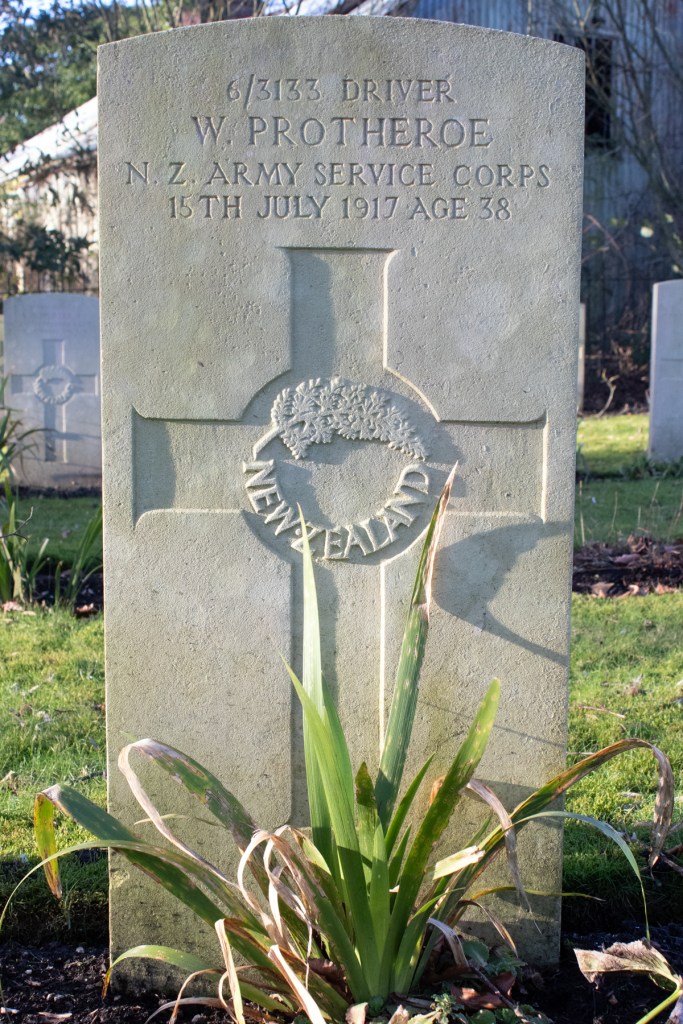
William Protheroe was born in Rangiora, New Zealand, on 3rd January 1878. One of eleven children, his parents were Welsh-born Alexander Protheroe and his English wife, Mary.
There is little concrete information about William’s early life, but later documentation gives his trade as ‘traveller’, and confirms his marriage to Elizabeth Marshall in 1906, although she had passed away by the summer of 1915.
When the Empire was called upon to support Britain in the First World War, William stepped up to play his part. He enlisted on 14th June 1915, and was initially assigned to the Canterbury Infantry Regiment. His service records confirm that at 36 years of age, he was 5ft 9.5ins (1.77m) tall, and weighed 156lbs (70.8kg). William had brown hair, grey eyes and a fair complexion.
After his initial training, William was sent to Europe. On 18th November 1915, he arrived in Suez, and it was here that he transferred to the New Zealand Army Service Corps as a Driver. By the following spring he was on the move again, and he arrived in France in May 1916.
Driver Protheroe was dispatched to a field hospital, as he had contracted influenza, but was well enough to re-join his unit after a few weeks. December 1916 proved eventful for William. He was admitted to hospital in Wimereux, France, the records for the time confirming that he was suffering from rheumatism. Intriguingly, a corresponding entry advises that ‘Soldier was on duty at time of accident and in no way to blame.’
Medically evacuated to Britain, William was admitted to the No. 1 New Zealand General Hospital in Brockenhurst, Hampshire. He spent the month of January 1917 there, before moving to the ANZAC camp near Codford, Wiltshire.
Driver Protheroe would remain in Codford for the next few months. His health was still causing some concern, however, and he was admitted to the camp hospital on 30th June. William was suffering from nephritis, and this was the condition to which he would ultimately succumb. He passed away on 15th July 1917, at the age of 39 years old.
William Protheroe was laid to rest in the graveyard extension of St Mary’s Church, Codford, Wiltshire, alongside fallen colleagues from his regiment.
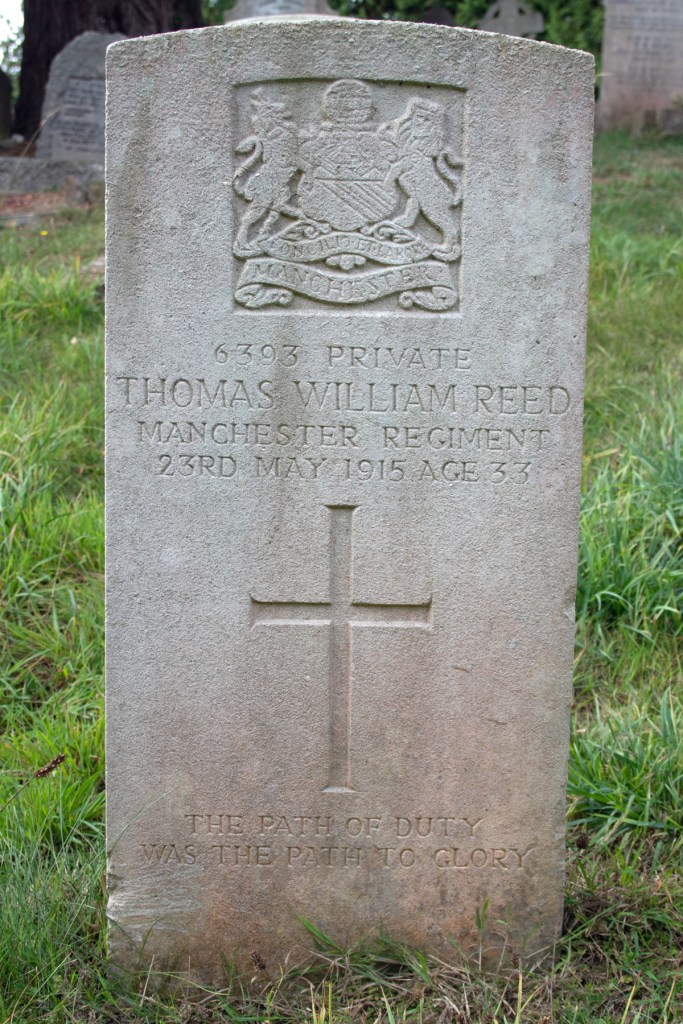
Thomas William Reed was born in 1883 and was one of nine children to George and Catherine. George was a general labour and he and his wife were born in Alton, Hampshire. It was in South London, however, that they raised their family.
Thomas found work as a house painter when he completed his schooling. The 1911 census recorded him as being the only one of his siblings still living in the family home, 16 Valentine Row in Blackfriars.
When war came to Europe, Thomas stepped up to play his part. Full service records have been lost to time, but from what remains it is clear that he had enlisted in the army in the opening months of the conflict. Private Reed was assigned to the Manchester Regiment and, as part of the 2nd Battalion, would have quickly found himself on the Western Front.
Thomas’ time in the army was to be tragically brief. By the spring of 1915 he was back in Britain, hospitalised in Devon with nephritis, or inflamed kidneys. His condition worsened, and he passed away on 23rd May: he was 32 years of age.
Thomas William Reed was laid to rest in Paignton Cemetery, not far from the Devon hospital in which he had breathed his last.
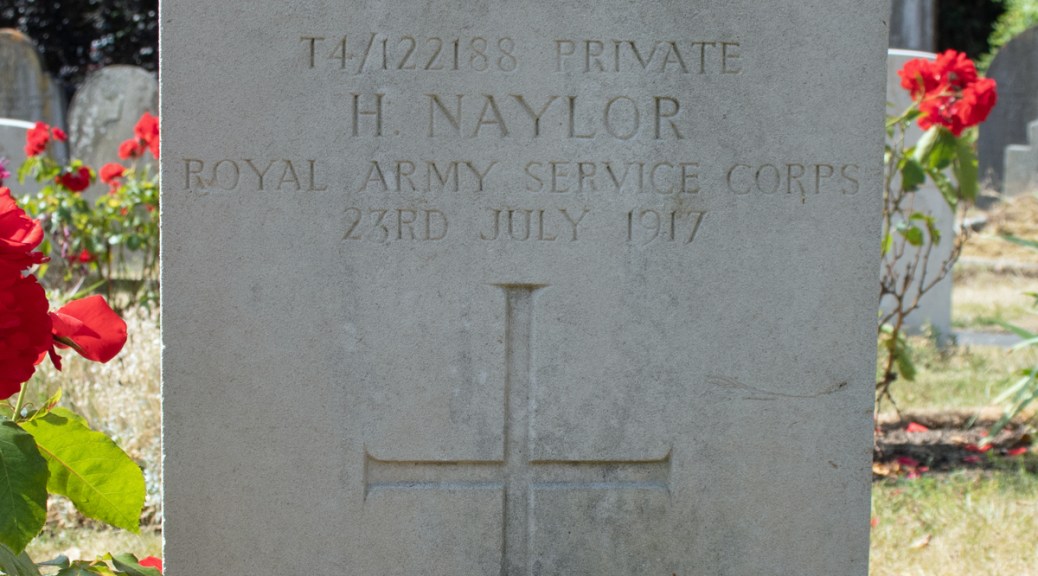
The early life of Hubert Naylor is a challenge to piece together. Later documents suggest he was born in Elsley (possibly Ilsley), Berkshire in around 1874.
The first census Hubert appears on dates from 1911. By this time he was living in Bath, Somerset and was employed as a general labourer. The document confirms that he was married to Mary, and had been for some eight years. The couple had four children – Isabella, Hubert Jr, Henry and Catherine – and the family were living at 1 Dover Court, in the Walcot area of the city.
When war broke out, despite his age, Hubert stepped up to play his part. He enlisted in the Royal Army Service Corps on 27th June 1915. Mary may not have been happy with this turn of events, as she had had two further children – Bertha and Doris – by this point.
Hubert was given the rank of Driver, and was initially posted to the 12th Labour Battalion. Within a year, his unit was in France. He spent the next year overseas, transferring to the Reserve Supply Personnel Depot as a Private in the process.
By the summer of 1917, Hubert’s health was failing. He was medically evacuated to Britain for treatment, and was admitted to the Bath War Hospital. He passed away from nephritis on 23rd July 1917: he was 42 years of age.
Hubert Naylor was laid to rest in the sweeping Locksbrook Cemetery in Bath, not far from the family home.
The early life of Henry Morris is difficult to pin down although later records suggest that his parents were William and Elizabeth from Bath, Somerset. A baptism record from December 1882 shows Henry Morris, with a mother called Elizabeth, but no father is noted, so there is no way to confirm any connection.
The first concrete information for Henry is the 1911 census: this records Henry Morris living with his wife, Eliza, their son, Henry Jr, and Eliza’s mother, Emma Derrick. He was working as a poulterer, employed by a fishmonger’s, with Eliza also working as a fish hawker. Henry and Eliza – who had married in 1905 – would go on to have a second child, Emma, who was born in November 1911.
When war broke out, Henry stepped up to serve his King and Country. Full service records are lost to time, but it is clear that he had enlisted by the spring of 1916, joining the Royal Field Artillery as a Gunner. Documents suggest two different units in which he served: the 26th Division Ammunition Column and the 5th (Reserve) Brigade.
By the autumn of 1916, Henry was suffering from nephritis. He was admitted to the military hospital on Endell Street, London, but his condition was to prove fatal. He passed away on 24th November 1916: he was 32 years of age. With a few discrepancies, a newspaper article gave a little more information about his life:
Henry Morris, RFA, 67 Avon Street, died this morning… He was invalided home from Salonika, and arrived in London nine weeks ago, He was married, and leaves a widow and two children… For eleven years Driver Brooks worked for Mr Broadhurst, fishmonger, York Buildings, Bath, and joined the army sixteen months ago.
[Bath Chronicle and Weekly Gazette: Saturday 25th November 1916]
Henry Morris was taken back to Somerset for burial. He was laid to rest in Bath’s sweeping Locksbrook Cemetery.
The life of Russell Engleback seems destined to remain lost in the mists of time and the only concrete information for him relate to his military service.
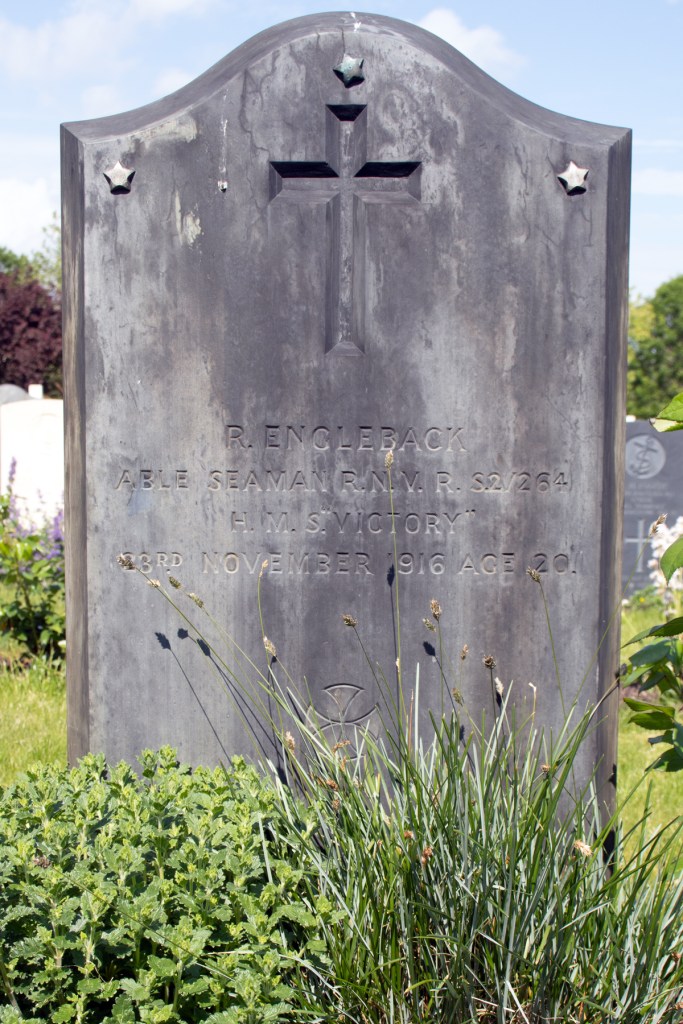
Ordinary Seaman Engleback joined the Royal Naval Volunteer Service on 3rd July 1914, just weeks before the declaration of war. His records confirm his date of birth – 11th August 1896 – and his occupation, which was a printer. He was 5ft 5ins (1.64m) tall, and had dark brown hair, brown eyes and a dark complexion.
Russell was sent to HMS Victory – the Royal Naval Dockyard in Portsmouth, Hampshire – for training, before being assigned to the battleship HMS Commonwealth in October. He remained on board for the next two years, rising to the rank of Able Seaman during this time.
Able Seaman Engleback returned to HMS Victory in August 1916, but may have moved to another naval base, HMS Pembroke in Chatham soon afterwards. Certainly he was at the Kent dockyard when he fell ill in November, as he was admitted to the Royal Naval Hospital around this time.
Russell was suffering from nephritis – kidney disease – by this point, and it was a condition that was to ultimately kill him. He passed away on 23rd November 1916, while still admitted in hospital: he was just 20 years of age.
Russell Engleback was laid to rest in Woodlands Cemetery, Gillingham, not far from the Chatham dockyard. His pension records give Fred and Amelia Tiffin – Russell’s Sussex-based mother and stepfather – as his next-of-kin.









 Death and Service