Tag Archives: pleurisy

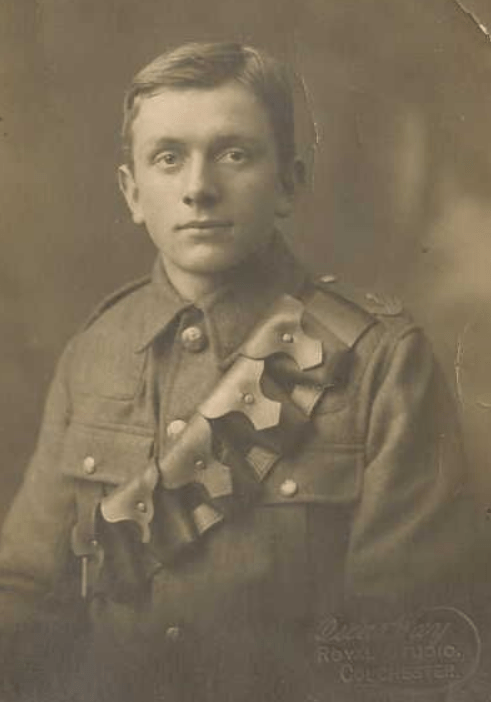
Sergeant Charles Chown

Sergeant Charles Chown

Charles Allen Chown was born in the Sussex village of Lyminster, at the start of 1882. The tenth of eleven children, his parents were Samuel and Mary Chown. Samuel was a general labourer, and when he passed away in 1898, Charles and his siblings rallied to support his now widowed mother.

The 1901 census found Mary, Charles and his brother Jesse living at 32 Lennox Road, Worthing, West Sussex. Jesse was employed as a brickmaker, while Charles had found work as a solicitor’s clerk. The family had two boarders, Helen and Rosie Bulbeck, and Charles’ niece, Minnie, was also staying with them.

Away from work, Charles was a music lover, and joined the local operatic society. In 1904 he appeared in a local version of Iolanthe, his “piece of portraiture being described as one of the successes of the occasion, for his facial play was good, and the drolleries of the character were displayed in an each and natural manner.” [Worthing Gazette: Wednesday 12th September 1917] In the following year’s Mikado, he took the role of the Lord High Executioner, and he was noted as being a “born comedian, with the most mobile countenance and a singularly dry form of humour…” [Worthing Gazette: Wednesday 12th September 1917]

By the time of the 1911 census, Charles had moved on with work, and moved out of home. Taking a room at 7 Tarring Road, Worthing, his landlords were Harold and Rose Ward. Still employed as a clerk, he was now employed by one of the estate agents in the town, although it is clear that his passion was elsewhere. When he joined up in the autumn of 1914, he gave his trade as musician.

Charles enlisted on 7th October 1914 in Ashton-under-Lyme, Lancashire. What took him north is unclear, although a theatre tour is a possibility. His service records note that he was 5ft 8.5ins (1.74m) tall and weighed 138lbs (62.6kg). He had dark brown hair, brown eyes and a sallow complexion.

Initially assigned to the Manchester Regiment, Private Chown was soon transferred to the 8th (Service) Battalion of the East Lancashire Regiment. He was obviously dedicated to his job: by the end of October 1914 he had been promoted to Lance Corporal, and within six weeks he rose to Sergeant.

In July 1915, Charles’ unit was dispatched to France. That autumn, they remained based near Tilques, in Northern France, but Sergeant Chown’s health was beginning to suffer. After just three months overseas, he was medically evacuated to Britain to receive treatment for pleurisy, and was hospitalised in Chatham, Kent.

When he recovered, Sergeant Chown was reassigned to the 10th Battalion of the East Lancashire Regiment, before being transferred to the 47th Training Reserve Battalion in September 1916. That winter, however, his health received a setback, and he contracted tuberculosis. He would spend the first half of the following year in hospitals in Aldershot in Hampshire, Sutton Veny in Wiltshire and, from May 1917, the 3rd Southern General Hospital in Oxford.

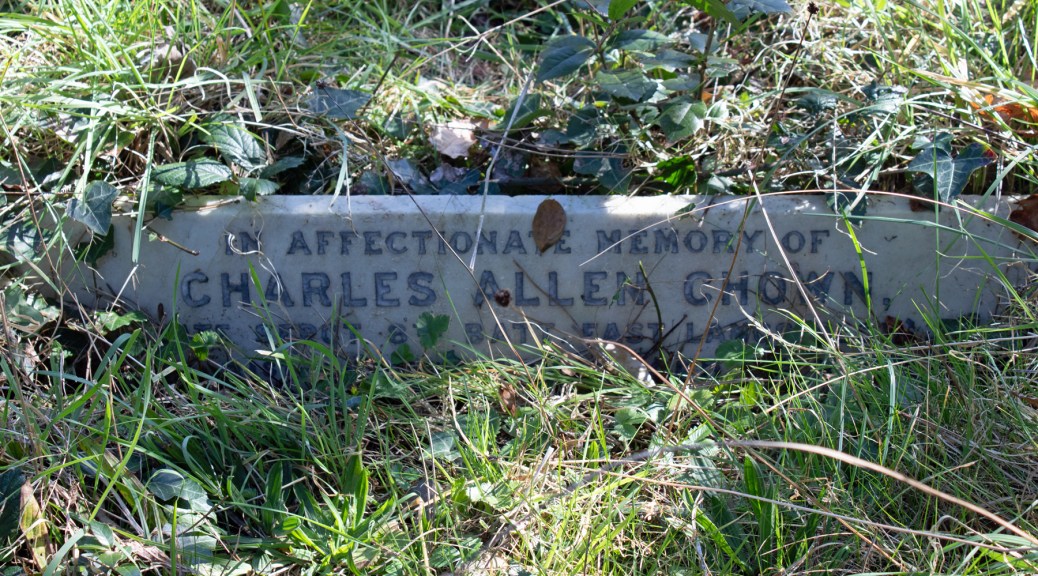
Sergeant Chown’s health would continue to deteriorate, and he was formally discharged from the army on 6th July 1917. He returned to Worthing, and his mother’s home, 2 Montague Place. Charles would eventually succumb to his medical condition, and he passed away on 31st August 1917, at the age of 35 years old.

The body of Charles Allen Chown was laid to rest in the family plot in Broadwater Cemetery, Worthing.

Stoker 1st Class Henry Tregillis

Stoker 1st Class Henry Tregillis

Henry Johnson Tregillis was born on Christmas Day 1890 and was one of six children to Edward and Emma. Edward was a journeyman baker from Westminster, Middlesex, but the family were raised in Woolwich, Kent.

When Henry finished his schooling, he found work as a general labourer, but as he got older, he sought a more reliable trade. On 15th September 1909 he enlisted in the Royal Navy as a Stoker 2nd Class. His service papers show that he was 5ft 9ins (1.65m) tall, with light brown hair, blue eyes and a fresh complexion. He was also noted as having a number of tattoos: a soldier and rifle on his left forearm, a girl on his left upper arm, Buffalo Bill on his right upper arm, the words In loving memory of my dear father and his mother’s name, Emma, on his right forearm.

Stoker Tregillis was sent to HMS Pembroke, the Royal Naval Dockyard in Chatham, Kent, for his induction. In March 1910 he was assigned to the battleship HMS Lord Nelson. He would spend the next five years attached to Lord Nelson and, while he was promoted to Stoker 1st Class, his time on board was not without incident. He spent two separate periods in the cells – totally 21 days – for unrecorded demeanours.

Henry left HMS Lord Nelson in July 1915, and over the next couple of years he served on two more ships, before becoming shore based – first at HMS Victory, the Royal Naval Dockyard in Portsmouth, Hampshire, then back at HMS Pembroke again. His annual review were mediocre, ranging from fair to very good, and he spend three more periods of time in the brig: 7 days in October 1915, 28 days in April/May 1916 and 14 days in June 1916.

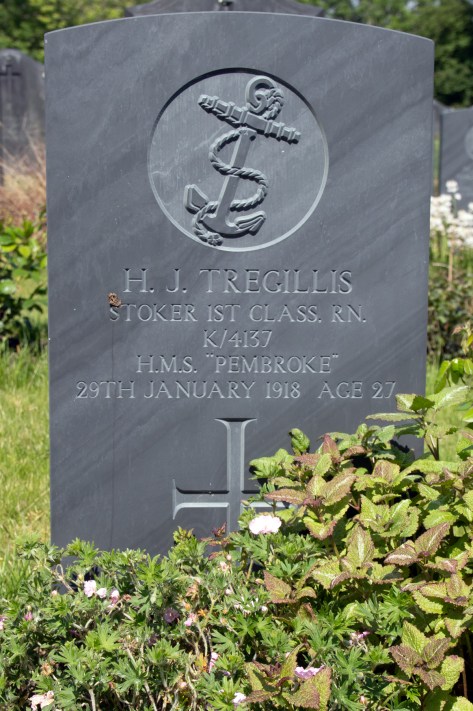
By the start of 1918, Stoker 1st Class Tregillis had been at Chatham Dockyard for six months. That winter he came down with pleurisy, and was admitted to the town’s Royal Naval Hospital. The condition would prove fatal, and he breathed his last on 29th January 1918: he was 27 years of age.

The body of Henry Johnson Tregillis was laid to rest in the naval section of Woodlands Cemetery, Gillingham, walking distance from the dockyard that had become home.


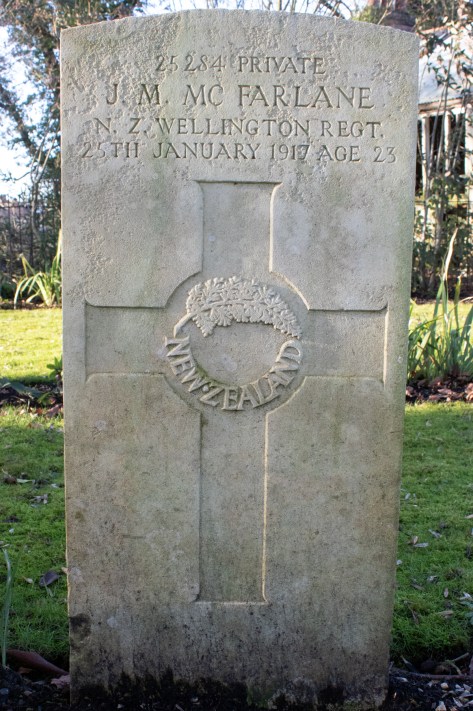
Private James McFarlane

Private James McFarlane

James Malcolm McFarlane was born in Christchurch, New Zealand, on 24th April 1893. Little is known about his early life, although his parents are recorded as Peter and Helen.

When he completed his schooling, James found work on a farm. By the time war broke out, he was employed as a shepherd for Patrick Burke of Woodgrove, in the country’s Canterbury region.

James gave up his work to join the army, enlisting on 24th March 1916. He would have cut a striking figure, standing 6ft 3.5ins (1.92m) tall, and weighing 184lbs (83.5kg). He had dark brown hair, grey eyes and a fresh complexion. His records note that he had a small scar on his right shin, from an old pellet wound.

Assigned to the New Zealand Wellington Regiment, Private McFarlane spend three months in Trentham, on the North Island, for his training. His unit boarded the SS Maunganui and left Wellington for Europe on 26th June 1916. The troop ship arrived in Devonport, Devon, in late August, and James and his colleagues were sent to their camp in Sling, near Bulford, Wiltshire, arriving after a 4-day march.

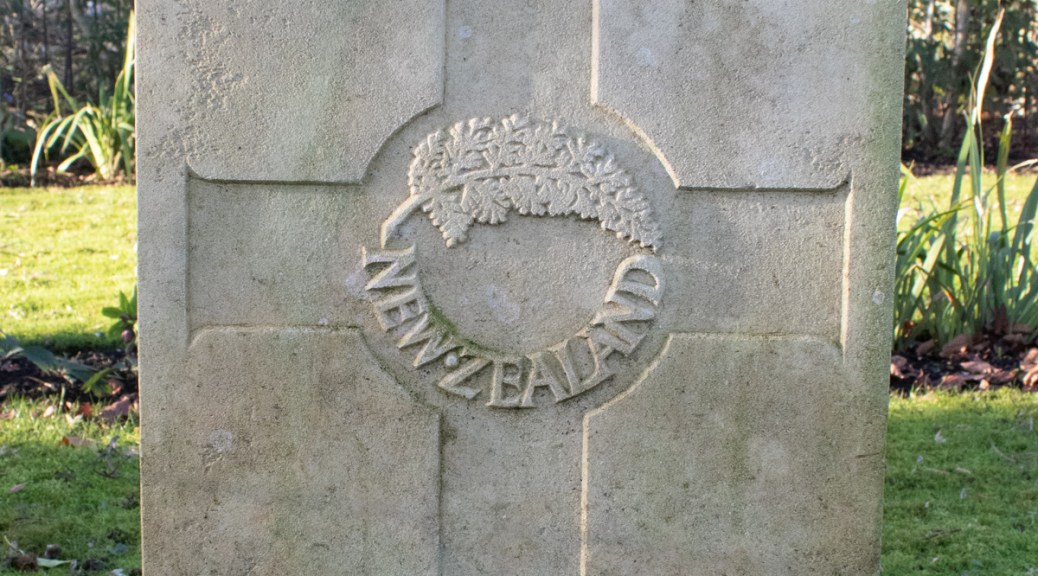
Private McFarlane would not see any enemy action. In November 1916 he was moved to the ANZAC base near Codford, Wiltshire, and he was admitted to the No 3 New Zealand General Hospital located there. Suffering from pleurisy, he would remain there for the next two months. James passed away from pneumonia on 25th January 1917: he was just 23 years of age.

James Malcolm McFarlane was buried alongside his comrades in the newly extended graveyard attached to St Mary’s Church, Codford.


Private James McFarlane
(from findagrave.com)

Private James McLeod

Private James McLeod

James McLeod was born on 15th April 1893 in Dunedin, New Zealand. There is little further information about his early life, although the Commonwealth War Graves Commission give his father’s name as Samuel, and his service records note his next-of-kin as his brother, George McLeod.

James was employed by A&T Watt as a French polisher. However, he gave that up on 25th January 1915, when he enlisted in the New Zealand Expeditionary Force. His service records show that he was 5ft 8.5ins (1.74m) tall, and weighed 166lbs (75.3kg). He was recorded a having fair hair, blue eyes and a fair complexion.

Private McLeod was assigned to the New Zealand Otago Regiment, and undertook his initial training on home soil. He evidently showed some promise as, on 1st May, he was promoted to Lance Corporal. Six weeks later his unit was heading for Europe, and by the summer James was in Egypt.

On 20th August 1915, Private McLeod was admitted to the New Zealand and Australian Convalescent Hospital in Mena with a gun shot wound to his finger. He remained there for three weeks, returning to his unit in time for them to leave for the Dardanelles on 7th November 1915.

What happened to James over the next couple of months is uncertain. Certainly he was on the Greek island of Moudros by 18th November and in the Dardanelles on 7th December 1915. Just 20 days later he was back in Alexandria, and he would remain there for the next few months. There is, however, nothing in his medical record to suggest that his return to Egypt was on health reasons.

On 6th April 1916, Private McLeod was on the move again, this time to France. He was wounded again on 14th July 1916, and medically evacuated to Britain for treatment. Details of this injury are not clear, but he was admitted to the 2nd London General Hospital in Chelsea, Middlesex. After a month recuperating, James was released from hospital and sent to camp in Hornchurch, Essex. At this point he was also demoted to Private, although, again, the reason is unclear: it may have been a personal choice, or the reversion may have been connected to his injuries.

In September 1916, Private McLeod was transferred to the ANZAC Camp on the outskirts of Codford, Wiltshire. That winter he contracted pleurisy, and he was admitted to the No. 3 New Zealand Hospital, which was connected to the camp, on Christmas Day. His condition worsened, and James passed away from pneumonia on 28th December 1916. He was just 23 years of age.

Thousands of miles from home, James McLeod was laid to rest alongside his fellow soldiers in the extension to the graveyard of St Mary’s Church, Codford.


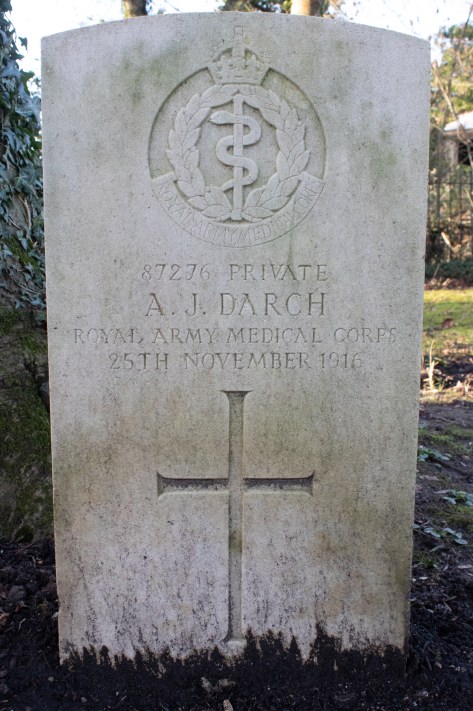
Private Alfred Darch

Private Alfred Darch

Alfred James Darch was born early in 1884, the second of seven children to James and Emily Darch. James was a postman and labourer from Somerset, but the family were brought up in Devon village of Clayhidon.

By the time of the 1901 census, the family had moved over the border to Wellington. Alfred had completed his schooling, and was working as a showmaker’s assistant. He committed himself to the role, and by 1911 was a shoemaker in his own right. By this point he was one of two of the Darch children to still be living with his parents: the family were settled at 22 Eight Acres Lane in Wellington.

When war broke out, Alfred stepped up to play his part. On 19th October 1916 he enlisted, joining the Army Medical Corps. His service records show that he was 5ft 4ins (1.63m) tall. They also suggested that his right leg was slightly shorter than his left, following an old dislocation. Private Darch had also had an operation for appendicitis five years previously.

Alfred was sent to Codford, Wiltshire, where the No. 3 New Zealand General Hospital was located. His time there was to be tragically short, however. On 17th November he was admitted himself, suffering with some breathing complications. The medical report noted that he was “vaccinated a fortnight ago. Bad, sore, inflamed arm. Reported sick eight days later with general malaise, slightly sore throat, slight headache – some cough. He had one anti-typhoid inoculation 2 or 3 days before vaccination… Has had no [previous] chest trouble… Face flushed. Temp 104.8. Pulse 100. Tongue white in centre, red at sides. Breath extremely foul. Voice hoarse. Breathing quiet. Not distressed.”

Over the nest week, Private Darch’s health deteriorated. Pleurisy was suggested, but when he passed away, at 5:45am on 24th November 1916, the diagnosis was pneumonia. He was 32 years of age.

Alfred James Darch was laid to rest in the extension to St Marys Church, Codford, not far from the base to which he had been sent just weeks before.


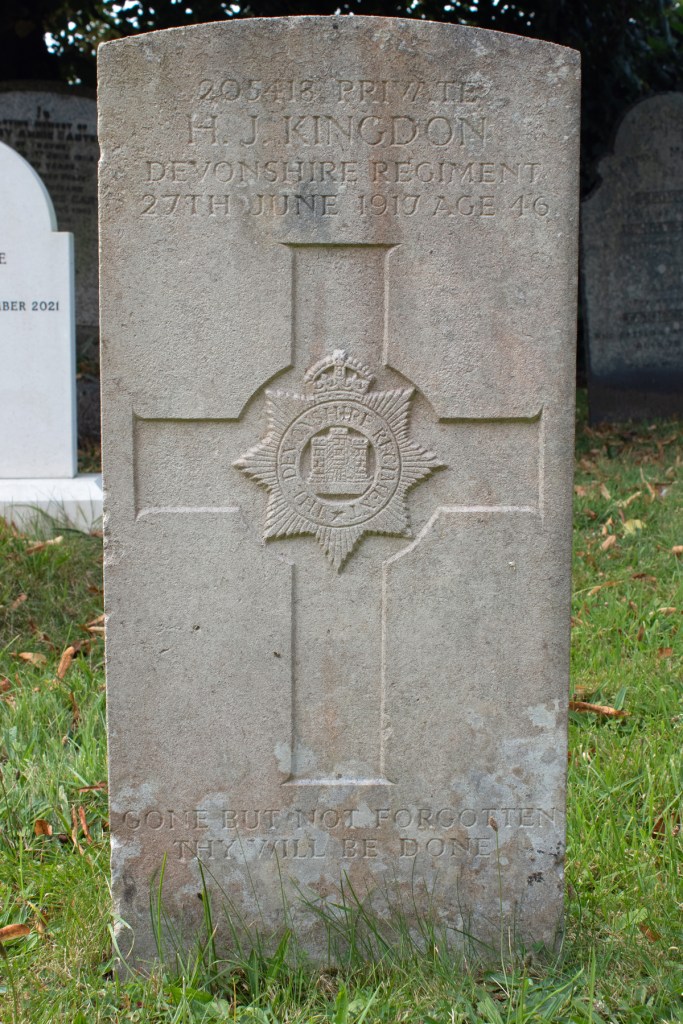
Private Herbert Kingdon

Private Herbert Kingdon

Born in the spring of 1872, Herbert James Kingdon was the ninth of ten children to George and Elizabeth. George was an agricultural labourer from the Devon village of George Nympton, it was here that the family was born and raised.

George died in 1900, at the age of 72, from this point on, Elizabeth also disappears from the records. In the spring of 1900, Herbert, now also a farm labourer, married Elizabeth – or Bessie – Speed. She was a farmworker’s daughter from South Molton, just two miles to the north. The couple set up home close to where Herbert had been living, and would go on to have five children by the time war was declared: Frederick, Florence, Frank, Annie and Herbert Jr.

George Nympton was a small village, and most of Herbert’s siblings remained close. The 1911 census found Herbert and Bessie living in the village, next door to Bessie’s parents who appear to have moved closer to support their daughter’s family. Three of their four children now old enough to attend the local school, while Herbert was still doing farm work, alongside his father-in-law, George Speed, and his brother-in-law, Fred.

When war broke out, Herbert stepped up to play his part. His full service records are no longer available, but the documents that do still exist suggest that he had enlisted by the start of 1917. Joining the Devonshire Regiment, he was assigned to the No. 4 Agricultural Company, and remained on home soil. By this point, Bessie had had a sixth child, Edward, and it is likely that she needed all the help she could get. With her husband remaining close by, and with her parents still living next door, she seems to have been supported.

By the summer of 1917, Private Kingdon had become unwell, and was suffering from a combination of pneumonia and pleurisy. Convalescing at home, the conditions were to get the better of him: he passed away on 27th June 1917, at the age of 45 years old.

Herbert James Kingdon was laid to rest in the graveyard of St George’s Church, George Nympton, in sight of his former home.


Bessie was pregnant when her husband passed: she gave birth on 13th January 1918, to a baby girl, Mary.

Bessie would only outlive her husband by five years. The last record for her is the 1921 census, when she was living in the family home with five of her children, and her parents, now in their mid-60s, living next door.


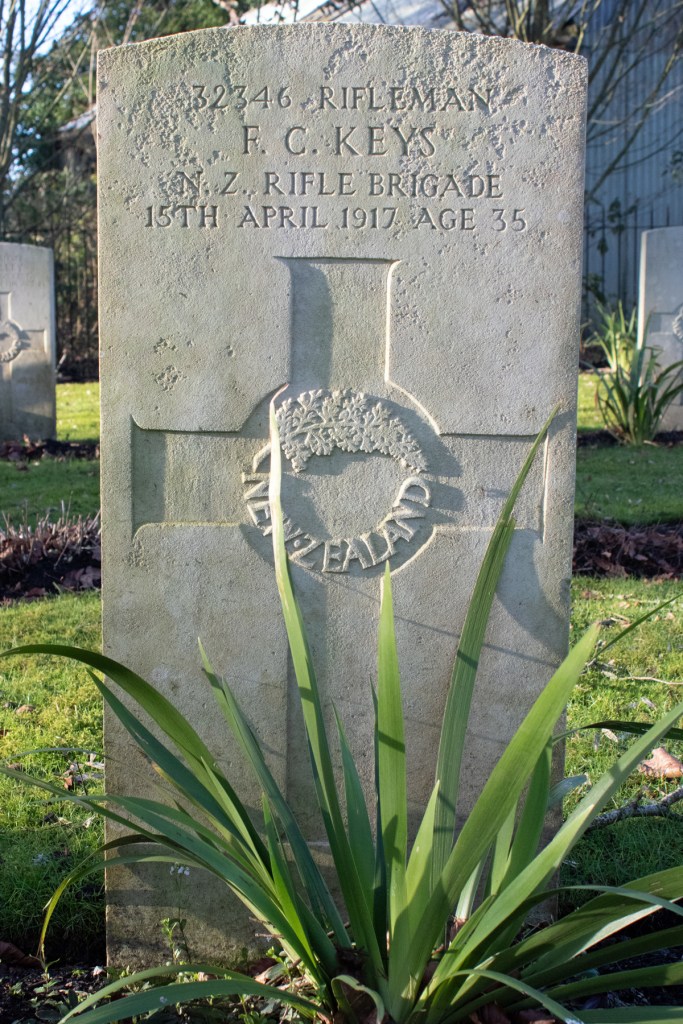
Rifleman Frederick Keys

Rifleman Frederick Keys

Frederick Charles Keys was born in Dunedin, New Zealand on 15th January 1882. The third of eight children, his parents were Benjamin and Annie Keys.

There is little information about Frederick’s early life. When he finished his schooling, it is likely that he found work as an agricultural labourer, and this is the job he was doing when war broke out.

As so many of his countrymen were to be, Frederick was called upon to serve his empire. He signed up in Christchurch on the country’s South Island, enlisting on 27th July 1916. He have his job as a farm hand, and his address as Silver Grid, a boarding house and billiard saloon on the city’s Manchester Street.

Frederick’s medical report confirms that he was 5ft 6ins (1.68m) tall and weighed 136lbs (61.7kg). He had fair hair, blue eyes, and a fair complexion. He was noted as being a very suitable man for the army.

Assigned to the New Zealand Rifle Brigade, Rifleman Keys embarked for Europe from Wellington on 15th November 1916. Two-and-a-half months later, his ship – the Tahiti – arrived in Devonport, Devon, and the New Zealand troops marched on to their final destination, the ANZAC camps just outside Codford, Wiltshire.

Frederick would spend the next few months training in the camp, although his time there was not without incident. On 31st March 1917, he was docked two days’ pay for ‘being in a crowd some members of which were gambling’. It is not clear whether Frederick himself was gambling, but given his last residence in New Zealand, it is unlikely that he wasn’t immune to chancing the odds.

Two weeks later, Rifleman Keys was admitted to the 3rd New Zealand General Hospital near the camp. He was suffering from pleurisy, but any treatment was to prove too late. He passed away from the condition on 15th April 1917: he was 35 years of age.

Frederick Charles Keys was laid to rest in St Mary’s Churchyard, Codford, in a new extension added for the fallen ANZAC troops.


Private Arthur Harcourt

Private Arthur Harcourt

Arthur Wellesley Harcourt was born on 18th June 1895 in Brentford, Middlesex. He was the youngest of five children to Charles and Eliza Harcourt.

The son of a Baptist minister, Charles was a banker’s clerk, but “practically the whole of [his] leisure in a busy life [was] spent in mission work, mainly in Middlesex…” [Middlesex & Surrey Express – Saturday 13 October 1900] When he died in 1900, at the age of 57, Eliza was left to raise her younger children alone.

Arthur’s young life was to be one of travel. The 1901 census, taken just six months after his father’s death, found him living in Walton le Soken (now Walton-on-the-Naze), Essex. Eliza had taken rooms for the family in a lodging house at 9 New Pier Street, yards from the town’s stony beach.

The next record for Arthur is from 1908. Surprisingly, for the grandson of a Baptist minister and the son of a missionary, he seems not to have been baptised when he was born. The document shows that he was christened on 26th April, at St Mary’s Church in the village of Sporle with Palgrave in Norfolk. There is nothing to confirm why he was in Norfolk, or why he chose to be baptised there: the 1911 census found Eliza and his siblings living back in Middlesex.

By this point, Arthur was on the move again. Now fifteen years of age, the same census found him visiting George and Amelia Kerswill at their home in Exeter, Devon. George was a retired nurseryman and florist from Hendon, and it seems likely that the couple were friends of the family.

By the time war broke out, the Harcourts had moved once again, this time setting up home in Reculver, Kent. Arthur was working as a surveyor’s assistant, but felt drawn to play his part. On 8th March 1917, he enlisted, joining the Army Service Corps as a Private. His records show that he was 5ft 4.5ins (1.61m) tall, and weighed 96lbs (43.5kg). He was of fair physical development, but it was noted that he had an understandard chest, but was deemed fit for military service.

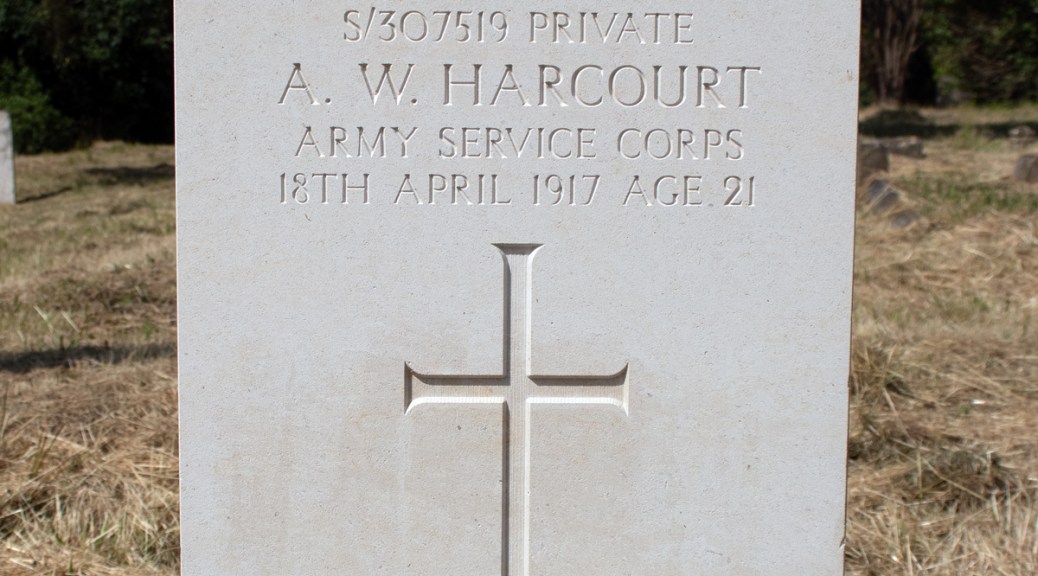
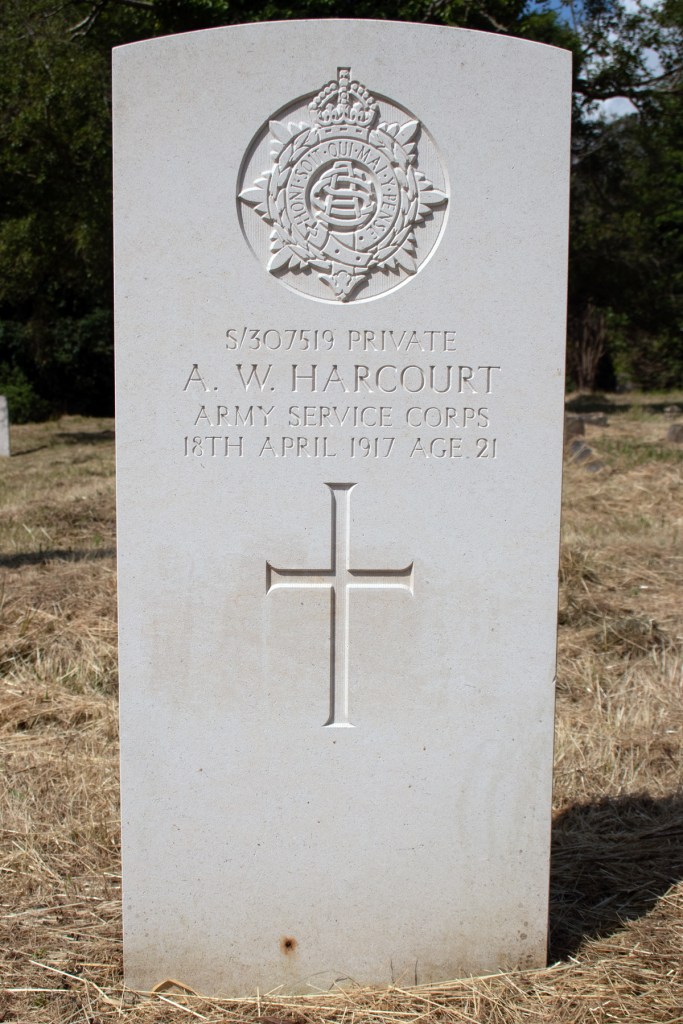
Private Harcourt was sent to Somerset for training. Tragically, however, his health was to take a dramatic downturn. Admitted to the Bath War Hospital on 1st April with influenza, this quickly developed into double pneumonia and pleurisy. The strain was to be too much for his young body to bear: Arthur passed away on 18th April 1917, at the age of just 21 years old.

Surprisingly, Eliza, whilst able to live on her own means, did not chose to lay her son to rest close to home. Instead, Arthur Wellesley Harcourt was buried in Locksbrook Cemetery, Bath, not far from the hospital in which he had breathed his last.


Private John Turner

Private John Turner

John Francis Turner was born on 24th March 1899 in the St Ouen region of the Channel Island of Jersey. He was the only surviving child of Francis and Eugenie Turner, his older brother, Francis Jr, having passed away before John was born.

Francis was a farm labourer, but when John finished his schooling, he found work as a carpenter. When war broke out across Europe, he was conscripted to play his part and, on 31st March 1917, he enlisted in the army.

Private Turner was noted as being 5ft 5ins (1.65m) tall and weighing 115lbs (52kg). His medical records show that his vision was defective, but not so bad as to exclude him from service, but he was also found to have flat feet.

John was assigned to the Royal Army Medical Corps, and was sent to Blackpool, Lancashire, where he was attached to the local depot. He spent the next two years in the army, although his time was not without incident.

In December 1917, he was confined to barracks for five days for overstaying his pass by more than eight hours. This seems to have been Private Turner’s only misdemeanour, however, and there is nothing to suggest anything other than good service.

John’s time in the army does not seem to have been limited to home soil, and, in the spring of 1919, he was attached to one of the Russian convoys ferrying aid and supplies overseas. On his return, however, he fell ill, and on 2nd February, he was admitted to hospital in Edinburgh, suffering from pleurisy.

Private Turner was to remain in hospital for the next few months. He slowly recovered, but then contracted meningitis, and, with his body already weakened by illness, this was to prove his undoing. He passed away on 23rd June 1919, aged just 20 years of age.

John Francis Turner’s body was taken back to Jersey for burial. He was laid to rest in the peaceful churchyard of St Ouen’s.


Private Richard Gale

Private Richard Gale

Richard William Gale was born in the autumn of 1897 in the Devon village of Sidbury. The third of six children, he was the son of George and Emma Gale. George was a bricklayer and labourer, and the family had moved to Burnham-on-Sea, Somerset, by the time Richard was ten, as this is where he had found work.

When Richard finished his schooling, he found employment as an errand boy for a school outfitters. By the time oft he 1911 census, there were four wages coming into the Gale household. Besides Richard and his father, his older brother, Frederick was working as a grocer’s apprentice, and his sister, Laura, was a dressmaker.

War was declared in the summer of 1914, and Richard was called upon to play his part. His service records no longer exist, so it is not possible to fully track his time in the army. However, he initially joined the 2nd/1st Battalion of the West Somerset Yeomanry and was sent for training in East Anglia.

As some point, Private Gale transferred to the Labour Corps, and became attached to the 949th Employment Company. Based in the London area, Richard’s duties are unclear, and his troop would have taken on any of a wide range of roles, from cooking and store work, to salvage, traffic control and telephone operating. Whether his previous work at the outfitters came into play is unclear, although Employment Companies were also involved in tailoring, shoemaking and laundry work.

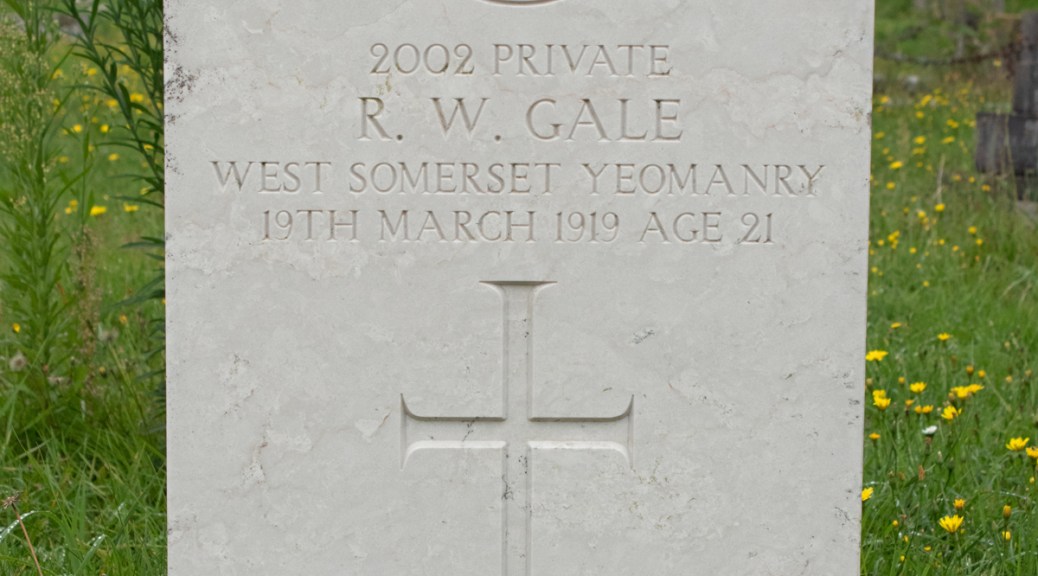
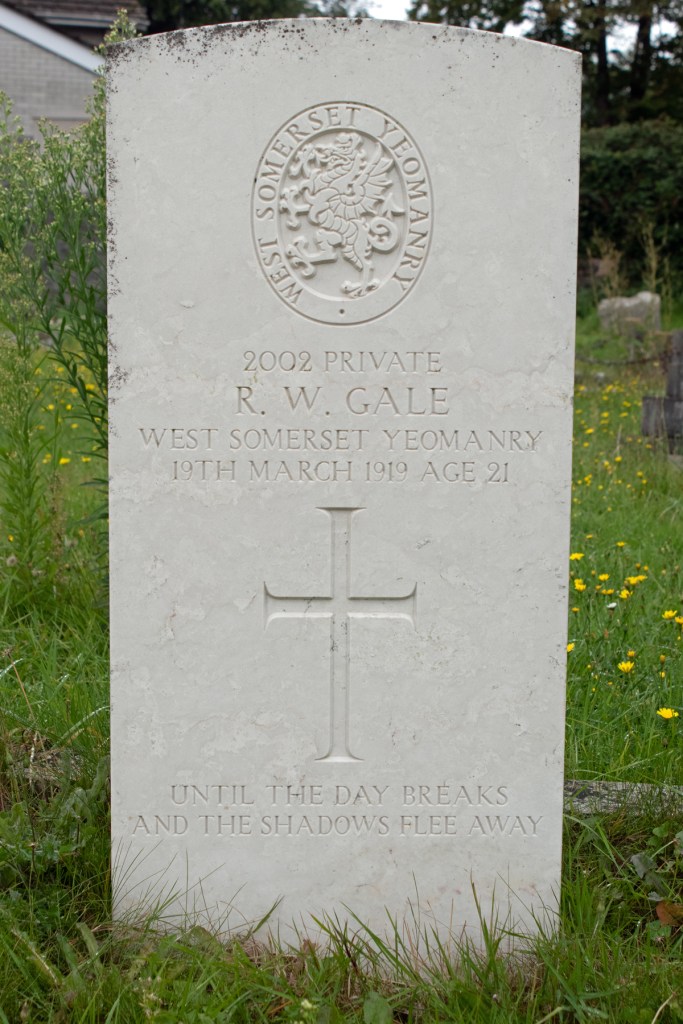
Private Gale survived the conflict, and seems to have been based in the the Nottingham area after the Armistice. By March 1919, he had become unwell and, having contracted pleurisy, he was admitted to the Berridge Road Military Hospital. The condition took its toll on Richard, sadly, and he passed away on 19th March 1919. He was just 21 years of age.

Richard William Gale’s body was taken back to Somerset for burial. He was laid to rest in the cemetery of Burnham-on-Sea, a short walk from where his family lived.


Private Richard Gale
(from findagrave.com)