Tag Archives: pneumonia

Private Joseph Dodge

Private Joseph Dodge

Joseph Dodge was born in the summer of 1883, and was one of twelve children, including eleven boys. His parents were David and Eliza Dodge, who raised their growing family in Stoke-sub-Hamdon, a few miles to the east of Yeovil, Somerset.

David was a mason and stone sawyer, but his children went into other roles when they left school; Joseph found work as an agricultural labourer.

In October 1903, Joseph married Elizabeth Ann Case – better known as Annie – who came from just over the Dorset border in the village of Corscombe. Setting up home in Yeovil itself, the couple went on to have two children – both boys – Walter and Norman.

War was coming to Europe, and Joseph was intent on doing his bit. Full service details are not available, but the documents that exist confirm that he enlisted as a Private in the Wiltshire Regiment. Initially assigned to the 1/4th Battalion (which served in Egypt), he transferred to the 2/4th Battalion (which served in India).

Sadly, there is no documentation to give service dates, it is impossible to establish when or if Joseph actually served in these locations. India seems likely, however, as he later transferred to the 1st Garrison Battalion of the East Yorkshire Regiment, which was based in Lucknow.

Private Dodge survived the war and came back to England, but seems to have contracted pneumonia on the journey home. Admitted to hospital in Liverpool, the condition sadly got the better of him. He passed away on 16th February 1919, at the age of 35 years old.

Joseph’s body was brought back to the county of his birth; he was laid to rest in Yeovil Cemetery.


Joseph came from a very patriotic family, and local newspapers early in the war highlighted that many of the Stoke-sub-Hamdon brothers had enlisted to serve King and Country.

At the time of the article, six had enlisted – Thomas, Arthur and Percy (all in the Somerset Light Infantry), Albert (West Somerset Yeomanry), Evan (Royal Navy) and David (Canadian Infantry).

Corporal David Dodge seems definitely to have distinguished himself. Having emigrated to Canada before the war, he returned to Europe when conflict broke out. An article in the Western Chronicle reported that he had “been awarded the Military Medal for conspicuous bravery on the field under heavy fire.[Western Chronicle: Friday 15th November 1918]

Amazingly, of the seven brothers who fought in the conflict, only Joseph perished.


An earlier series of articles tells the tragic story of another of Joseph’s siblings. Henry Dodge (known as William) had moved to Senghenydd, to the north of Cardiff, in 1910; mining work was plentiful there and he and a number of his fellow villagers had sought money from the black gold.

On the 14th October 1913, and explosion happened in the mine and together with the resulting fire and subsequent poisonous gas outpouring killed more than 430 miners. Initially reported missing, William was later confirmed dead; he was just twenty years old and left a widow and child.


Chief Stoker John Seager

Chief Stoker John Seager

John Edward Seager was born in Gillingham, Kent, in March 1869. One of eight children, his parents were labourer William Seager and his wife Maria (who was known by her middle name, Elizabeth).

John was keen to have adventure in his life, and the local Naval Dockyard in Chatham gave him that opportunity. on 23rd April 1887, he enlisted in the Royal Navy for the standard twelve years’ service. During that time, he served on six different ships, begging his career as a Stoker and rising through the ranks to become a Leading Stoker at the end of his time.

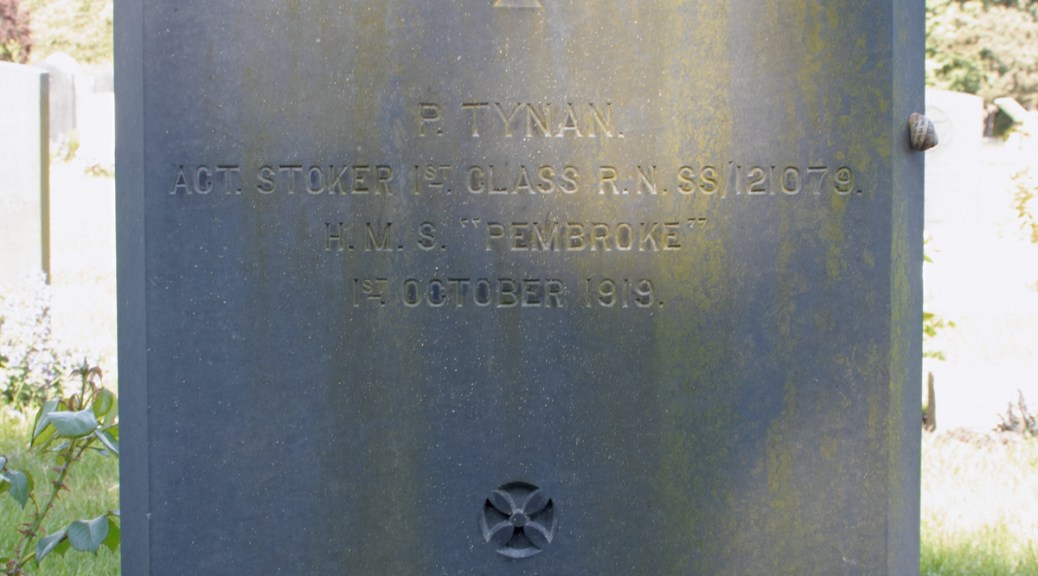
In April 1899, John re-enlisted and was given the rank of Chief Stoker. After completing his initial training at the on-shore establishment HMS Pembroke, he was assigned to HMS Cossack. Over the next ten years, he served on five more ships, before being moved over the Royal Naval Reserve in 1909.

During this time, John had gotten married. Emmeline Ada Driver was also born in Gillingham, and had found work as a nurse in the Surrey County Asylum. The couple married on 8th August 1903 in New Brompton, and set up home in a cottage close to the centre of Gillingham, close to their families and within walking distance of the dockyard.

When war broke out, John was called back into active service. He spent a year on board HMS Wildfire and five months on HMS Attentive. Most of his time, however, was spent at HMS Pembroke in Chatham. It was while he was here in January 1918 that he was admitted to hospital with pneumonia and tuberculosis. Sadly, Chief Stoker Seager was to succumb to these conditions; he died on 1st February 1918 at the age of 49 years old.

John Edward Seager was laid to rest in the Grange Road Cemetery in Gillingham, Kent. He is commemorated in the Woodlands Cemetery, which replaced this now park.


Private William Osborne

Private William Osborne

William Osborne is sadly one of those names that seems destined to be lost to time.

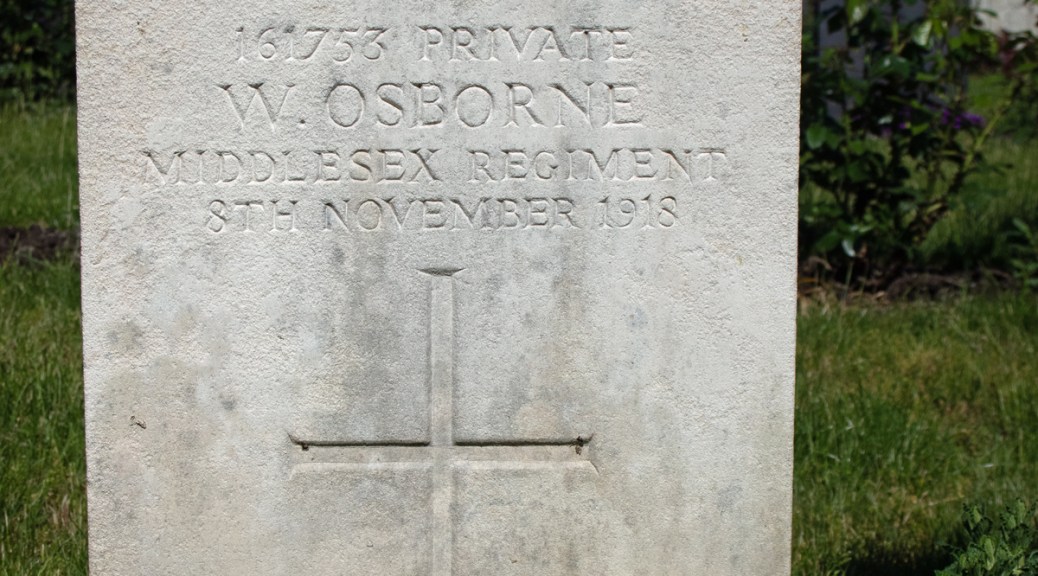
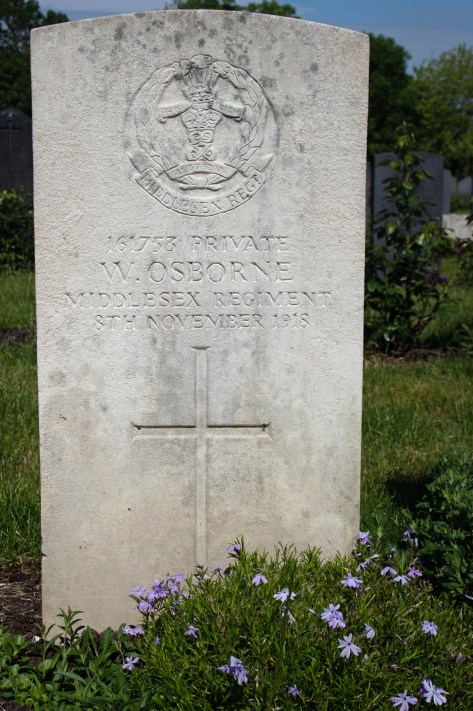
The starting point for any research is always going to be the gravestone; this is situated in the Woodlands Cemetery in Gillingham, Kent and confirms his service number, rank and regiment and the date of his death.

The service number helps confirm his first name, and that his widow was called Eliza, but without his age and confirmation of when he was married, there are too many potential Williams and Elizas/Elizabeths to confirm a definite identity.

The only thing that can be confirmed, therefore, is that William enlisted in the Middlesex Regiment at some point before April 1918, and subsequently transferred across to the Labour Corps. He passed away on 8th November 1918 at the Second Eastern General Hospital in Brighton, Sussex, having contracted pneumonia.

William Osborne lies at rest in that Gillingham Cemetery, not far from where his widow was living.


Gunner William Morgan

Gunner William Morgan

William Francis Morgan was born on 22nd January 1884 in Bengal, India. The youngest of three children, he was the son of James Morgan and his wife Mary. Both came from Ireland, marrying in 1876. They moved to London, before James was posted to India as part of his role in the Royal Horse Artillery.

Sadly James died when William was just a toddler; this prompted Mary to move the family back to England. She married again in 1887, to Edward Curling, who was a carpenter in the Royal Artillery, and the family settled on the Isle of Grain in Kent, living in the fort where Edward worked.

Surrounded by those in military service and with an army heritage himself, is it no surprise that William felt drawn to the life. In September 1898 he enlisted in the Royal Garrison Artillery. Though not yet fifteen years old, he stood 5ft 11ins (1.69m) tall and weighed in at 101lbs (46kg). He had a fresh complexion, grey eyes and light brown hair and four distinctive marks were noted – three scars on his head and one on his right knee.

Trumpeter Morgan certainly got to see a lot of the world during his time in the army. After a period on home soil, he was sent to Egypt on Christmas Eve 1901, staying there for just over a year. He moved on to India, returning to England five years later, by which time he had achieved the rank of Gunner.

War was imminent, and in September 1914 he was sent to France as part of the British Expeditionary Force. Barring a short period at home, Gunner Morgan remained on the Western Front for the remainder of the war, finally returning to the UK in January 1919.

William’s time in the army was one of two halves. He had several bouts of illness during his service, coming down with phimosis in 1901, scarlet fever and gonorrhoea in 1902, a fractured clavicle in 1903, pneumonia in 1904, rheumatism in 1906, ague in 1908, pleurisy in 1909, and had to return from France to England for an operation to remove a carbuncle between his shoulder blades in the summer of 1915.

Gunner Morgan was also pulled up for his conduct a few times too. He was punished for neglect of duty in August 1908, disobeyed orders in May 1909, was pulled up for being improperly dressed while in Portsmouth’s Highbury Arms Pub in November 1909 and went AWOL for ten hours on 31st July 1913.

There were positives to William’s service too, however. He was awarded the British and Victory Medals as well as the 1914 Star during the First World War. He was mentioned in dispatches and received the Military Medal in 1917 an the Long Service and Good Conduct Medal two years later.

Sadly, though, after Gunner Morgan’s positive and lengthy military service, his time out of the army was to be brief. Returning to England on 13th January 1919, he contracted influenza and pneumonia and succumbed to the lung conditions within weeks. He passed away on 27th February 1919, at the age of just 35 years of age.

William Francis Morgan was laid to rest in the Woodlands Cemetery, Gillingham, Kent, just minutes’ walk from where his mother now lived.


Boy 2nd Class George Sandell

Boy George Sandell

George William Sandell was born on 13th August 1902, the oldest of five children to William and Mary Sandell. While George was born in Chichester, William raised the family in Worthing; he was a carpenter and joiner by trade, and came from a local building family.

When George left school, he found work as a porter on the railways. Too young to be directly involved in the 1914-1918 conflict, he was definitely for adventure, and, on 5th February 1919, he enlisted in the Royal Navy.

Assigned the rank of Boy – because of his age – he was sent to HMS Ganges II, a training establishment in Suffolk. His decision to enlist was set to be young George’s undoing; within weeks he had contracted pneumonia, and he passed away on 10th March 1919. Tragically, he was just 16 years old.

William and Mary brought their boy back to Worthing; he was buried in the Broadwater Cemetery there, within walking distance of their home.


For me, a huge coincidence to this story is that I lived in the house George was brought up in. He was raised at 27 Southfield Road, in Worthing, up until he was sent for training in 1919. I lived at the same address for a number of years in the early 2000s.


Leading Seaman Albert Heasman

Leading Seaman Albert Heasman

Albert Andrew Heasman was born in 1890 or 1891, and, like his date of birth, much of his life remains a mystery. He was one of five children to William and Kate Heasman, who brought their family up in the West Sussex town of Worthing.

Documentation on Albert is scarce. He does not appear on census records until 1911, by which time he is working as a mate on a fishing boat, based out of Ramsgate, Kent.

Naval records are also patchy; he certainly enlisted during the war, and, by 1918 had joined the Royal Naval Reserve. He was assigned to HMS President III, a training ship based at the Royal India Dock in London.

The only other concrete information available on Leading Seaman Heasman is that he passed away from pneumonia on 21st October 1918. He was just 28 years old. His pension record confirms that his sister, Ethel, was listed as a dependent.

Albert Andrew Heasman’s body was brought back to Worthing, where he lies buried in the Broadwater Cemetery, to the north of the town.


Private Bertie Bridger

Private Bertie Bridger

Bertie Charles Bridger was born in the summer of 1876, one of nine children to William and Anne. William was a carman for the railway, and the family lived close to the central station in Worthing.

When Bertie left school, he followed in his father’s trade and, by the time of the 1901 census, was working as a groom and carman alongside his father and older brother, Arthur.

Bertie came to the notice of the local court when, in February 1900 he was called up to the Petty Sessions. He was fined for ‘cruelly ill-treating a horse by working it into an unfit state’ [Sussex Agricultural Express: Friday 9th February 1900], and ordered to pay a total of 18 shillings.

In the spring of 1904, Bertie married Ethel Gray, a carpenter’s daughter from Essex, who had found employment as a parlour maid for a Worthing solicitor. The couple would go on to have two children, Bertie Jr, who as born in 1905, and Leonard, born seven years later.

By the time of the 1911 census, the young Bridger family were living near the main railway station in a two-up, two-down property, where Bertie Sr was still plying his trade as a carman at the station.

War was coming, however, and in the summer of 1915, Bertie enlisted in the Royal Defence Corps. He was assigned as a Private to the 452nd Protection Company and, while his exact duties remain unclear, it is likely that he would have been involved with horses at some level, given his experience.

Private Bridger’s service appears to have mainly been spent on home soil, although, towards the end of the conflict he was sent to Ireland. It was while he was there, that he came down with influenza, which then turned into pneumonia. He was admitted to the Military Hospital in Curragh, but he died of the conditions on 14th November 1918, three days after the Armistice was signed. He was 42 years old.

The body of Bertie Charles Bridger was brought back to Sussex, and he was laid to rest in the Broadwater Cemetery to the north of Worthing. The local newspaper commented that:

Previous to his enlistment the deceased soldier was an outside porter at the Railway Station for nearly thirty years, and the sympathy of a wide circle of friends will be extended to his widow and two children.

Worthing Gazette: Wednesday 27th November 1918

Private Bertie Bridger (from Ancestry.com)

Private Henry Greenfield

Private Henry Greenfield

Henry Gordon Greenfield was born in Worthing, West Sussex, in 1890. The fourth of nine children, his parents were Edmund and Caroline. Edmund was a carter from the town, who raised his family in a small terraced house near the station.

By the early 1900s, Edmund had changed profession, becoming a plasterer, and this was employment that his son followed him into. This seems to have been more lucrative for the family, and they moved to a larger property to the north of the town.

In August 1911, Henry married Edith Tombs. Edith was a gardener’s daughter from London, who had moved to Worthing for work. When the couple married, she was employed as a domestic servant for a solicitor and his wife. The young couple would go on to have three sons.

When war broke out, Henry was quick to enlist. He initially joined the Royal Sussex Regiment, serving his time as part of the 10th Battalion. This was a reserve company, that was based on home soil. When hostilities came to an end, Henry was transferred to the Labour Corps, and was billeted in Belfast.

Little further information about Henry’s service can be confirmed; he was admitted to the Military Hospital in Belfast with pneumonia, but sadly died of the condition on 27th February 1919. He was just 28 years old.

Brought back to Worthing, Henry Gordon Greenfield lies at rest in the Broadwater Cemetery there, not far from his parents and widow.


Henry’s younger brother Frederick also served during the Great War. Joining the Royal West Kent Regiment as a horse driver, he fought on the Western Front. He was killed on 17th August 1917, and is buried at the Duisans Cemetery in northern France. He was just 21 years of age.


Deck Hand Charles Bashford

Deck Hand Charles Bashford

Charles Bashford was born on 10th August 1890, one of fifteen children to James and Mary Ann Bashford. James was a fisherman, and the family lived in Field Row, a narrow lane in the centre of Worthing, West Sussex.

The seaside town was a centre of fishing activity, so it is no surprise that most of James and Mary Ann’s children went into it in some way, and Charles was no exception. The 1911 census list him as the youngest of four siblings still living at home, and three of those gave their trade as fisherman, as well as James. Charles’ older brother William was the only sibling not to, and he was working as a printer.

War was coming to Europe, and, given his seafaring experience, it is no surprise that Charles sought to enlist in the Royal Navy. He joined up on 12th August 1916 and, after six weeks’ training, was assigned to the Royal Navy Reserve (Trawler Section). During his service he would have been involved in minesweeping and anti-submarine activities, using his own boat – or his family’s one – to do so.

Little further information is available for Deck Hand Bashford. He survived the war, but passed away on 11th August 1919 at the Royal Haslar Hospital, where he had been admitted, suffering from pneumonia. He was 28 years old.

Charles Bashford was brought back to his home town of Worthing; he was laid to rest in the Broadwater Cemetery there.


Corporal Henry Forrest

Corporal Henry Forrest

Henry Charles Forrest was born in Bromley, Kent, in the summer of 1893. The youngest of eight children to William and Wilhelmina Forrest, Henry’s father was a police sergeant, who retired not long after his youngest son’s birth, moving his family to Worthing in West Sussex.

Henry was obviously a bright lad; the 1911 census records him as a student teacher. The only one of William and Wilhelmina’s children still living at home, he was, by this point, still just 17 years old. His career continued over the next few years, and he taught at the Ham Road Schools in Worthing.

In the spring of 1916, Henry married Constance Robertson. The young couple had a lot in common and seemed like a perfect match. Constance was the daughter of a retired police constable, and was also a student teacher.

War, by this time, had come to Europe. Full details of Henry’s military service are not available, but it seems that he initially joined the Oxfordshire and Buckinghamshire Light Infantry. Private Forrest was promoted to the rank of Corporal, and subsequently transferred to the Army Cycling Corps, serving in France.

As the war moved on, Corporal Forrest was released to resume his teaching back in Worthing but, in the autumn of 1918, he contracted influenza and pneumonia. The conditions got the better of him, and he passed away on 5th December 1918, at the age of just 25 years old.

Henry Charles Forrest was laid to rest in the Broadwater Cemetery in Worthing; sadly, it seems that Constance was unable to attend – she was represented at the ceremony by her mother.