Ernest James Dean was born in the autumn of 1898 in St Pancras, Middlesex. The older of two children, he was the only son to Ernest and Caroline Dean. Ernest Sr was a bootmaker, and the family lived at 51 Lismore Road.
Ernest Jr found work as a clerk when he completed his schooling. However, when war broke out, he was keen to play his part. He enlisted on 6th February 1917, joining the Royal Flying Corps as an Air Mechanic 3rd Class. His service record shows that he was 5ft 6ins (1.67m) tall, and he must have proven to be a keen student: within four months he had been promoted to Air Mechanic 2nd Class and was being trained as a wireless operator.
When the Royal Air Force was formed on 1st April 1918, Ernest’s transfer was automatic. It is unclear exactly where Air Mechanic Dean served, but he seems to have been based in Kent by that autumn.
In October, Ernest was admitted to the Lees Court Hospital in Faversham, Kent, having come down with pneumonia. The condition, sadly, was to prove fatal: he passed away on 29th October 1918, at the age of just 20 years old.
The body of Ernest James Dean was taken back to Middlesex for burial, and he was laid to rest in the majestic grounds of Highgate Cemetery.
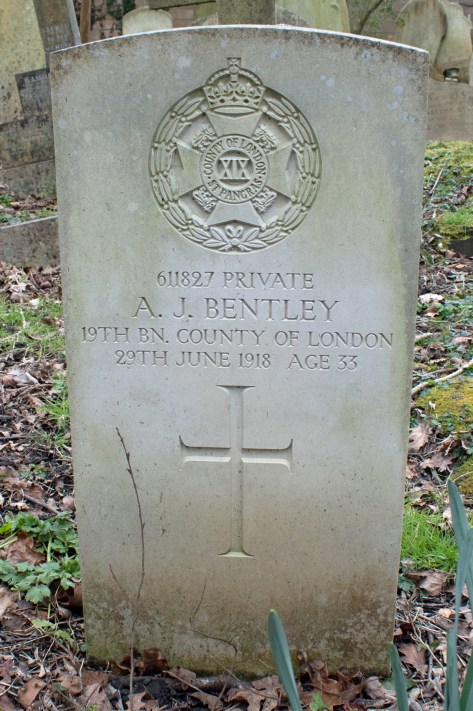
Albert John Bentley was born in St Pancras, Middlesex, in the spring of 1885. The second of six children, his parents were John and Eleanor (also known as Elizabeth) Bentley. John was a piano maker, and the family lived at 27 Hampshire Street in St Pancras.
When his father died in 1910, Albert had already started to follow in his footsteps. The following year’s census recorded him living with his mother and three younger siblings. Employed as an organ builder, his was one of three wages being brought into the household.
Albert stepped up to play his part when war broke out. Full details of his military service have been lost to time, but it is clear that he enlisted in the London Regiment, and was assigned to the 1st/19th (County of London) Battalion (St Pancras).
It is unclear whether or not Private Bentley spent any time overseas. By the summer of 1918, however, he had fallen ill, and was admitted to a military hospital in Shoreham-by-Sea, Sussex. He succumbed to a combination of influenza and pneumonia on 28th June 1918: he was 33 years of age.
The body of Albert John Bentley was taken back to Middlesex for burial. He was laid to rest in the sweeping grounds of Highgate Cemetery.
Richard Oscar Ford was born in Williamstown, Australia, in July 1891. The oldest of four children – and the only son – his parents were Anthony and Mary Ford. Anthony was a soldier, but Richard chose a different route and took work as a labourer when he completed his schooling.
There is little information available about Richard’s early life, but when war broke out, he stepped up to play his part. He enlisted in the Australian Imperial Force on 9th November 1914.
By this point he was working as a bushman, and his service papers reveal something of the man he had become. Standing 5ft 7ins (1.7m) tall, he weighed 140lbs (63.5kg), Private Ford had auburn hair, blue eyes and a fair complexion.
Assigned to the Light Horse Regiment, Richard left Australia for Europe on in March 1915. His unit arrived on the Gallipoli Peninsula on 15th July, and he would remain there for the next five months.
In December 1915, Richard came down with a bout of influenza, and was medically evacuated to the island of Mudros, then on to Alexandria, Egypt. In January 1916, he was admitted to hospital again, this time suffering from gonorrhoea and, after treatment, he re-joined his unit on 2nd February.
Private Ford’s unit spent that spring training in Egypt, but on 29th May, they set sail for the Western Front. Within a week they had disembarked in the French port of Marseilles and headed north to Etaples.
The next couple of years would prove a little disjointed. Richard switched units in August 1916, and given the rank of Gunner, but within two months his role had changed to Driver. His service records suggest that he managed to avoid injury during the fighting he was involved in, but that did not mean that he avoided hospital completely.
In January 1917 Driver Ford was admitted to the 51st General Hospital with a heart murmur, returning to his unit on 16th March. He had a second spell in hospital in February 1918, having come down with laryngitis.
In July 1918, having spent some time at the 4th Army Corporal School, Richard was reassigned to the 3rd Australian Field Artillery. This move seemed to have been the focus he needed. Initially promoted to Bombardier, within a month he rose to Lance Corporal, and by December 1918 he was a full Sergeant.
After the Armistice was signed, Richard was given three weeks’ leave, which he spent in Britain. By January 1919, however, his health was becoming an issue again, and he was admitted to the military hospital in Fovant, Wiltshire, suffering from influenza. The condition worsened, and Sergeant Ford passed away from bronchopneumonia on 4th February 1919. He was 27 years of age.
Richard Oscar Ford was laid to rest in Highgate Cemetery, Middlesex. While there seems to be no direct connection between the location and the man, his father, Anthony, had been born in Hackney, so it can be assumed that there was a family link to the area.
William McMullan was born in Okaihau, on New Zealand’s North Island, on 10th May 1896. One of three children, his parents were James and Rose McMullan.
There is little concrete information about William’s early life. By the beginning of 1916, he was working as a bushman and volunteering for the local militia. The First World War provided an opportunity to put his skills to use, and he enlisted in the New Zealand Rifle Brigade on 15th January 1916.
Rifleman McMullan’s service records show that, at 19 years and 8 months of age, he was 6ft (1.83m) tall and weighed 12st 6lbs (79kg). A Roman Catholic, he had brown hair, blue-grey eyes and a medium-dark complexion.
William left New Zealand in May 1916, bound for Britain. The journey took ten weeks and, after disembarking in Devonport, Devon, his unit marched to Sling Camp, near Bulford, Wiltshire, arriving there on 29th July. Just a few weeks later, however, Rifleman McMullan was on the move again, and he found himself on the Western Front towards the end of September.
On 16th November 1916, while fighting at the Somme, Rifleman McMullan received a gunshot wound to his thigh. A blighty wound, it saw him medically evacuated to Britain for treatment, and he was admitted to the No. 1 New Zealand General Hospital in Brockenhurst, Hampshire. A few weeks later, he was moved to Codford, Wiltshire, for recuperation at the No. 3 NZ General Hospital.
William would spend the next few weeks in Wiltshire, but after initially being discharged from hospital, he was re-admitted on 25th January 1917. He had contracted broncho-pneumonia, and this would be the condition to which he would succumb. Private McMullan passed away on 13th February, at the age of just 20 years old.
Thousands of miles away from home, William McMullan was laid to rest in the ANZAC extension to St Mary’s Churchyard in Codford, close to the camp he had most recently called home.
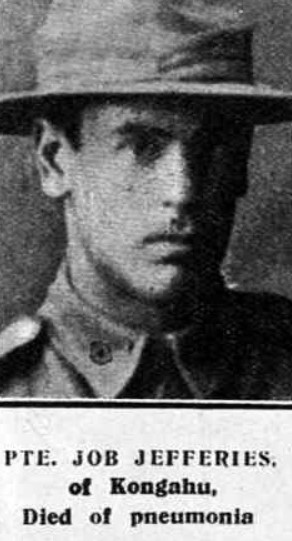
Job Jefferies was born on 12th October 1889 in the city of Timaru, on New Zealand’s South Island. The sixth of ten children, his parents were William and Ada Jefferies.
There is little information available about Job’s early life, but by the time war broke out, he had moved to Kongahu, at the northern tip of South Island. He was working as a labourer, and was employed by the Public Works Department.
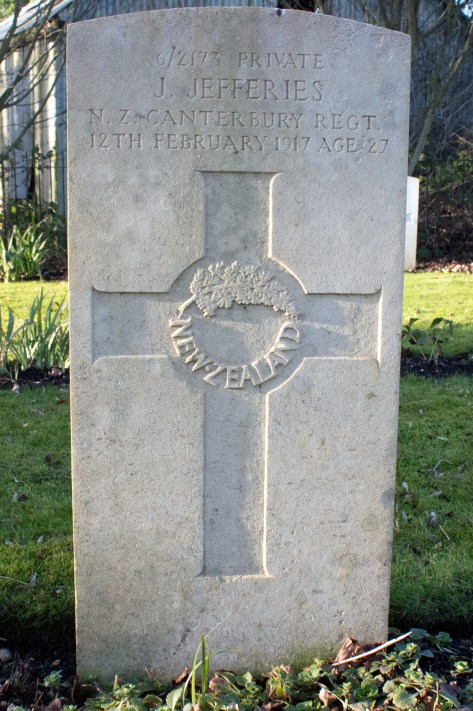
Job was quick to step up and serve his country. He enlisted in the New Zealand Infantry on 12th February 1915, and was assigned to the Canterbury Regiment. His service records confirm that he was 5ft 10.75ins (1.79m) tall, and weighed 170lbs (77.1kg).
Private Jefferies left New Zealand in the summer of 1915, and his service record makes for grim reading.
On 9th August 1915, Job’s unit arrived in the Dardanelles, and he was firmly entrenched in the fighting at Gallipoli. Wounded on 5th September, he was initially treated at a casualty clearing station, before being medically evacuated first to Malta, then to Britain. He was admitted to the No. 2 Western General Hospital in Manchester, Lancashire, and would spend the next seven months there.
On 12th May 1916, Private Jefferies was on the move, leaving his base in Hornchurch, Essex, for the Western Front. He re-joined his unit on 7th July, but just nine days later was wounded at the Somme. Medically evacuated to Britain again, he spent the next couple of months being moved between hospitals. Discharged back to base in Hornchurch, Essex at the end of September, he would spend the next four months recuperating once more.
By February 1917, it would seem that Private Jefferies had been moved to Sling Camp near Bulford, Wiltshire. While there, he fell ill, and was admitted to the No. 3 New Zealand General Hospital in nearby Codford. He was suffering from pneumonia, and this time his body could take no more. Job passed away on 7th February 1917: he was 27 years of age.
Job Jefferies was laid to rest alongside his fellow soldiers in the ANZAC extension to St Mary’s Churchyard, Codford.
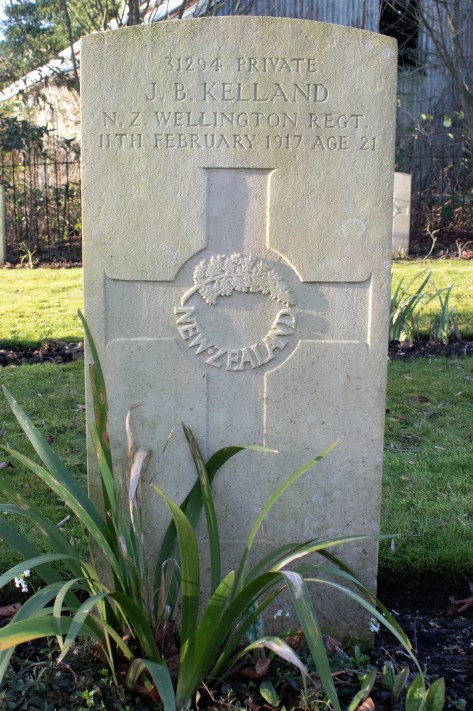
John Bodley Kelland was born on 4th June 1895 in Otakeho, on New Zealand’s North Island. The fifth of eight children, his parents were George and Mary Kelland. George died in 1902, and John’s mother married again: she and new husband Albert Bowers would have two further children.
There is little additional information available about John’s early life. He found work as a carrier when he left school, and by the time war broke out he was living in the town of Taumarunui. In his spare time, he seems to have volunteered for a local army brigade.
John formally enlisted on 24th July 1916. He joined up in Trentham, and was assigned to the New Zealand Wellington Regiment. His service records show that he was 5ft 9ins (1.75cm) tall and weighed 152lbs (68.9kg). A Roman Catholic, he had brown hair, grey eyes and a dark complexion.
Attached to B Company of the 19th Reinforcements, Private Kelland left his home country on 15th November 1916. He spent the next ten weeks on board the troop ship Tahiti, finally disembarking in Devonport, Devon, on 29th January 1917. From there his unit marched to Sling Camp near Bulford, Wiltshire, where many of the ANZAC troops were billeted.
Private Kelland’s time there was to be limited. His health had been impacted during the sea voyage, and he was admitted to the No. 3 New Zealand General Hospital in Codford, Wiltshire, on 8th February. Suffering from pneumonia, his condition worsened: he passed away on 8th February 1917, at the age of just 21 years old.
John Bodley Kelland was thousands of miles from home. He was laid to rest alongside his comrades in the newly-extended graveyard to St Mary’s Church in Codford.
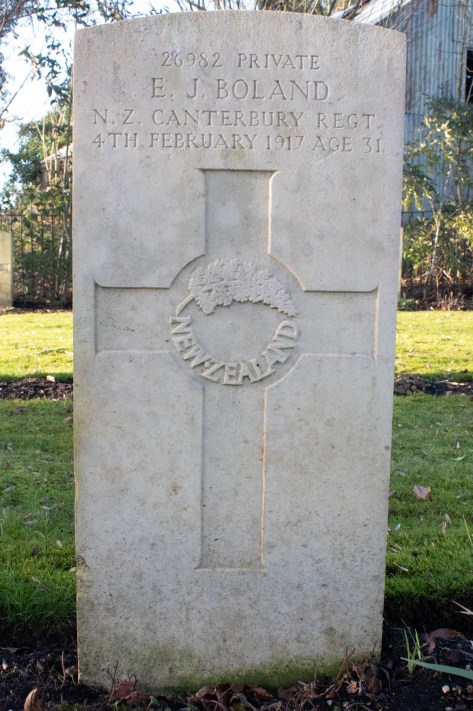
Edward James Boland was born on 14th August 1885 in the town of Darfield, on New Zealand’s South Island. Details of his early life are sketchy, but he was the fourth of nine children to Francis and Annie Boland.
When he finished his schooling, Edward found work as a farm labourer. In 1906, he married Ellen – or Nellie – Shea: their first child, son Raymond, was born the same year, and they would go on to have three more children by the time war was declared.
On 18th June 1916, Edward answered the call to serve the Empire. Enlisting in Trentham, he joined the New Zealand Canterbury Regiment as a Private. His service record notes that he was 5ft 8.5ins (1.74m) tall and weighed 144lbs (65.3kg). A Catholic, he had light brown hair, blue eyes and a fair complexion. A scar on his right thigh was also recorded as a distinguishing mark.
On 16th October 1916, Private Boland left from Wellington on board the steam ship Willochra. His unit – the 18th Reinforcements – arrived in Devonport, Devon, ten weeks later. They were then marched to their base at Sling Camp near Bulford, Wiltshire.
The journey from New Zealand, impacted Edward’s health. At the end of January 1917, he was admitted to the 3rd NZ General Hospital in Codford, Wiltshire, suffering from broncho-pneumonia. His condition deteriorated and would take his life. Private Boland died on 4th February 1917: he was 31 years of age.
As he was thousands of miles from his home, Edward James Boland was instead laid to rest in the newly extended graveyard attached to St Mary’s Church in Codford.
George Leslie Lewis Carter was born at the start of 1891 in New Cross, Kent. The oldest of three children, his parents were laundry managers William and Isabel Carter.
The Carters’ work seemed to take them across South London and the 1891 census found them living in Hammersmith. George’s two siblings had been born by this point, one in Gravesend, Kent, the other in Richmond, Surrey.
By 1911, William and Isabel had moved the family to Kingston-upon-Thames, Surrey. That year’s census recorded them as living at 142 London Road, which was noted as being a 12-roomed property. The couple were managing a laundry – possibly living in at the laundry itself. George was recorded as being a university student, while his younger brother Lionel was at school. The family also had a housekeeper, Frances Stoke, living with them.
When George finished his studies, he found employment as an Assistant Paymaster with the Royal Naval Reserve. On 15th February 1916, he married Ada Ritchie. She was a merchant’s daughter from Long Ditton, Surrey, and the couple exchanged vows in her local parish church.
At this point, George’s trail goes cold. He became attached to the Royal Naval College in Dartmouth, Devon – also known as HMS Pomone – and took on the role of Naval Instructor. It is unclear what type of instructing he was doing, but it seems likely to have been connected with the administration or financial part of the Royal Navy.
The funeral of Naval Instructor George Leslie Lewis Carter, Royal Naval College, Dartmouth, who died on Monday from pneumonia following an attack of influenza, took place on Wednesday morning…
The mourners were Mrs Carter (widow), Mrs Carter, Surbiton (mother), Mr Carter (brother), and Mr Jamieson Ritchie, London (brother-in-law)…
[Dartmouth & South Hams Chronicle: Friday 2nd August 1918]
Naval Instructor Carter was 27 years of age when he died on 29th July 1918. The newspaper article’s distinction between Ada and Isabel would suggest that Ada may have been living in Dartmouth at the time as well.
George Leslie Lewis Carter was laid to rest in the graveyard of St Clement’s Church in Dartmouth, Devon.
Thomas Fleet was born on 3rd February 1879 in Kingswear, Devon, and was the sixth of nine children to Thomas and Emma. Thomas Sr was a fish dealer, and the family lived on Lower Street over the river in Dartmouth. Most of the family were involved in the fish industry, and by the time of the 1901 census, Thomas Jr was also working as a fisherman.
On Christmas Day 1901, Thomas Jr married Hannah Jury. She was a farm labourer’s daughter from Torquay, Devon. The couple married in Hannah’s home town, but settled back in Dartmouth. They had five children – Reginald, Elspeth, Edith, Florence and Thomas – and set up home in a five-roomed house on Victoria Road.
By the time of the 1911 census, Thomas had changed jobs, and was working as a yachtsman. The following year, Reginald died, at the age of just 9 years old. It is unclear how he died, but he passed in August 1912, and was buried on 2nd September, in St Clement’s Churchyard, Dartmouth.
When war broke out, Thomas would be called upon to serve. Unsurprisingly, given his job, he joined the Royal Navy, enlisting on 30th March 1917 as an Ordinary Seaman. His service records show that, at 5ft 2ins (1.57m) tall, he had brown hair, blue eyes and a fresh complexion.
Ordinary Seaman Fleet was sent to HMS Vivid, the Royal Naval Dockyard in Devonport, Devon, for his formal training. Tragically, however, his time in the service was to be a brief one. He contracted lobar pneumonia and was admitted to the barracks’ sick quarters. He passed away from heart failure on 13th May 1917, at the age of 38 years old.
The body of Thomas Fleet was taken back to Dartmouth for burial. He was laid to rest in the family plot in St Clement’s Churchyard, reunited with his oldest son, Reginald.
Jack Wallis Gauntlett was born in Burbage, Wiltshire, in the spring of 1898. The oldest of four children, his parents were George and Florence Gauntlett. On Jack’s baptism record, George gives his trade as a yeoman, while later census records confirm he was a farmer.
Jack was baptised in St Mary’s Church in Stapleford, near Salisbury, some distance south of Burbage, and, given that his parents had no connection to that area, it seems that his father’s work took the family around the county. The 1901 census record found them Gauntletts back in Burbage, but by the time of the 1911 return, they had moved to Middleton Farm in Norton Bavant.
When war broke out, Jack stepped up to serve his country. He enlisted in the Royal Flying Corps in January 1917 and, as an Air Mechanic 2nd Class, was sent to Farnborough, Hampshire, for training.
Much sympathy is felt with Mr and Mrs FG Gauntlett, of Middleton Farm, in the loss they have sustained by the death of their eldest son, JW Gauntlett… He came home three weeks ago on leave before proceeding to France, and was then sickening for measles and had bronchitis. He was taken to Sutton Veny military hospital and died there on Friday from an attack of pneumonia.
[Wiltshire Times and Trowbridge Advertiser: Saturday 19th May 1917]
Jack Wallis Gauntlett was just 19 years of age when he died on 11th May 1917. He was buried in the family plot in All Saints’ Churchyard, Norton Bavant.