Tag Archives: Scotland

Major Stafford Douglas

Major Stafford Douglas

Stafford Edmund Douglas was born on 4th January 1863, the second of four children to Stephen and Mary Douglas. Stafford came from a military family, his father having been a Captain in the Royal Navy. This led to a lot of travelling and, having been born in Donaghadee, County Down, he then moved to South Wales.

By the 1880s, when Stephen and Mary had set up home in Portsmouth, Stafford had started to carve out a career for himself, and was a Lieutenant in the Argyll and Sutherland Highlanders, based at Edinburgh Castle.

Over the coming years, Lieutenant Douglas, who stood 5ft 8.5ins (1.74m) tall and also spoke French, travelled the world, serving in South Africa, Ceylon (Sri Lanka) and Hong Kong. By 1894 he had made Captain, and he finally retired in 1903, after nineteen years’ service.

On 29th April that year, at the age of 40, Stafford married Mary Louisa Harris. She was the daughter of an army colonel, and the couple wed in St George’s Church, Hanover Square, London. The couple set up home in Exeter, Devon, and went on to have two children – Violet and Stafford Jr.

At this point, Stafford’s trail goes cold. When war broke out in 1914, he was called back into duty, working as a Railway Transport Officer in Norwich. He continued in this role until 1919, before being stood down and returning home.

Stafford Edmund Douglas passed away on 15th February 1920, at the age of 57 years old, although no cause of death is immediately apparent. He was laid to rest in the Milton Road Cemetery in Weston-super-Mare, presumably where his family were, by this time, residing.


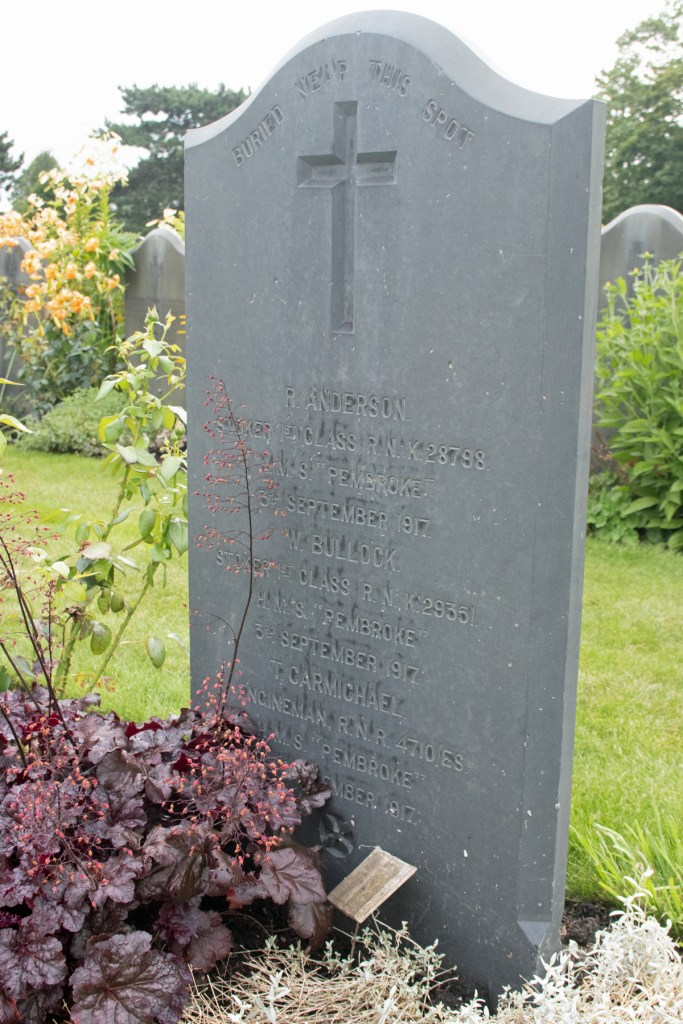
Engineman Thomas Carmichael

Engineman Thomas Carmichael

Thomas Carmichael was born on 19th December 1888, the older of two children to George and Elizabeth – Lizzie – Carmichael. George was an engine fitter from Hull, Yorkshire, and this is where he and Lizzie raised their young family.

Little further information is available for Thomas’ early life. He married a woman called Annie, but no documents remain to confirm when their wedding was. The couple settled in Hull, and went on to have two children, a girl and a boy.

War had his Europe by this point, and Thomas enlisted in the Royal Naval Reserve. He joined the Royal Naval Reserve as an Engineman on 16th May 1916, serving primarily at the shore-based establishments of HMS Pembroke (the Royal Naval Dockyard in Chatham, Kent), HMS Gunner (the Granton Naval Base in Edinburgh) and HMS Vivid (the Naval Dockyard in Devonport).

Engineman Carmichael arrived in Chatham in August 1917. The Dockyard was particularly busy that summer, and the large number of extra servicemen meant that Thomas was billeted in temporary accommodation in Chatham Drill Hall.

On the 3rd September 1917, the first night air raid carried out by the German Air Force bombarded the town, and scored a direct hit on the Drill Hall; Engineman Carmichael was among those killed. He was just 28 years of age.

Thomas Carmichael was laid to rest, along with the other victims of the Chatham Air Raid, in the Woodlands Cemetery, Gillingham. Tragically, the Navy Death Records state that he was Buried as unidentified in one of the following graves: 516, 522, 642, 735, 935, 937 or 948.


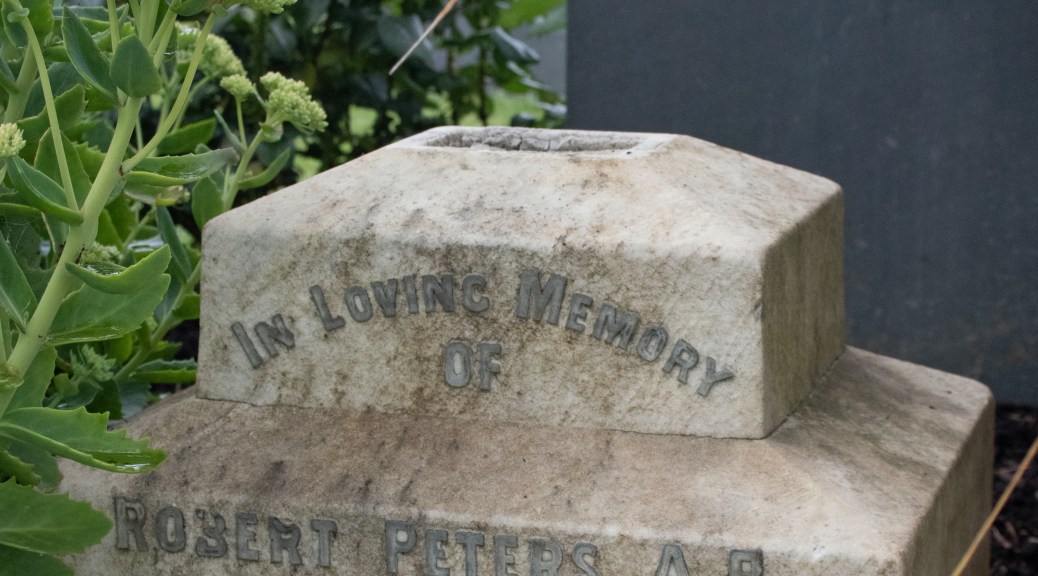
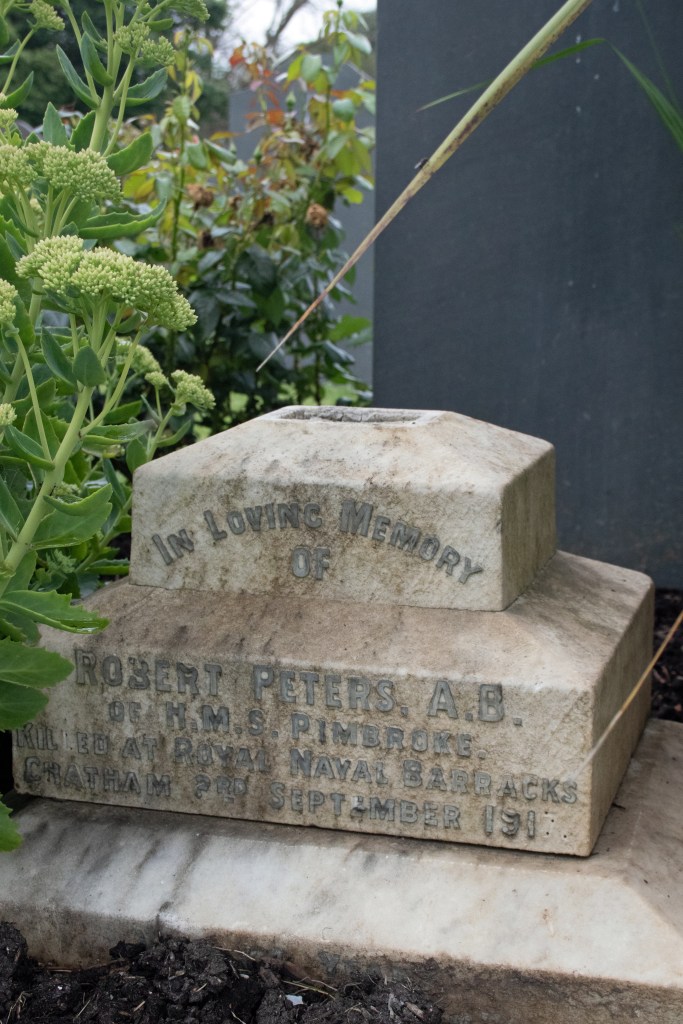
Able Seaman Robert Peters

Robert Peters was born on 27th May 1893 in Dundee. Little information remains documented about his early life, but he was one of at least four children to John and Agnes Peters, and had two sisters, one called Mary, and an older brother. The family lived in towards the west of the city centre, in the now-spartan Annfield Road.

The bulk of the information about Robert comes from one document – his Royal Navy Service Records. He enlisted as an Ordinary Seaman on 4th April 1912, but, because of his work as an iron turner, he seems to have been put on reserve until hostilities broke out two years later.

While on reserve, he received the training that all reservists would have done, which meant that, when he was formally called into action in June 1916, he did so at the rank of Able Seaman. Robert’s service records also show that he was 5ft 5ins (1.65m) tall, had dark hair and brown eyes.

Able Seaman Peters first posting was at HMS Victory – the Naval Dockyard in Portsmouth. After a couple of months’ additional training, he was assigned to HMS Wallington, a depot ship based on the Humber Estuary.

After a year on board, Robert transferred to HMS Pembroke, the Royal Naval Dockyard in Chatham, Kent. The base was a busy place that summer, and temporary accommodation was set up at the Dockyard’s Drill Hall. This is where Robert found himself billeted.

On the 3rd September 1917, the German Air Force carried out its first night air raid: Chatham was heavily bombed and the Drill Hall received a direct hit; Able Seaman Peters was among those killed instantly. He was just 24 years of age.

Robert Peters was laid to rest, along with the other victims of the Chatham Air Raid, in the Woodlands Cemetery, Gillingham. His parents had passed away before the war, and so his sister Mary was confirmed as his next of kin.


Able Seaman Robert Peters (from findagrave.com)

Stoker 1st Class John McGregor

Stoker 1st Class John McGregor

John McGregor was born Aberdeen in 1898, the son of James McGregor. Little specific information is available about John’s early life, but it is clear that James remarried at some point, Jane McGregor becoming John’s stepmother. The family moved south to Airdrie, living on one of the main thoroughfares, South Bridge Street.

At some point after the outbreak of war, John joined up, taking on the role of Stoker 2nd Class in the Royal Navy. During his time in the service, he was promoted to Stoker 1st Class. By 1917, he was assigned to the HMS Prince George, a battleship that patrolled the English Channel, and acted as support for the Dardanelles campaign in the Eastern Mediterranean.

In the summer of 1917, Stoker McGregor was transferred to HMS Pembroke, the Royal Naval Dockyard in Chatham, Kent. That point in the war was particularly busy for the base, and temporary accommodation was set up in the Drill Hall; this is where John found himself billeted.

By this point in the war, the German Air Force had suffered huge losses during the daylight bombing raids it had been undertaking. It was imperative for them to minimise these losses, and so a new tactic – night time raids – was employed.

The first trial of this approach was on the night of 3rd September 1917, and Chatham suddenly found itself in the firing line, startlingly unready and fundamentally unprotected. One of the German bombers landed a direct hit on the Drill Hall, and Stoker McGregor was amongst those to be instantly killed. He was just 19 years old.

Ninety-eight servicemen perished during the Chatham Air Raid that night. They were buried in a mass funeral at the Woodlands Cemetery in nearby Gillingham. This, too, is where John McGregor was laid to rest.

Stoker 1st Class Arthur Charlton

Stoker 1st Class Arthur Charlton

Arthur Charlton was born in St Pancras, London, on 21st November 1891. His parents were Arthur and Bridget Charlton, but little further information on Arthur Jr’s early life remains.

When he left school, he found work as a butcher, but it seems he was after a life of adventure and travel. On 6th November 1913, he enlisted in the Royal Navy, initially for a period of twelve years as a Stoker 2nd Class. Arthur’s service records show that he stood 5ft 6.5ins (1.69m) tall, had brown hair, blue eyes and a fair complexion.

Stoker Charlton was initially posted to HMS Pembroke – the Royal Naval Dockyard in Chatham, Kent – and this is where he did his training. He was then sent to the battleship HMS Vanguard, on board which he served for nearly three-and-a-half years. Arthur was assigned to Vanguard in the summer of 1917, when the vessel was sunk following a series of internal explosions in Scapa Flow, Scotland, with the loss of more than 800 souls. It seems, however, that he was not on board at the time, which likely saved his life.

Brought back to HMS Pembroke that summer, and with the Vanguard destroyed, Arthur found himself in an overly packed dockyard. He was billeted in the Chatham Drill Hall, which was being used as temporary accommodation.

On the 3rd September 1917, the first night air raid carried out by the German Air Force scored a direct hit on the barracks and Drill Hall; Stoker 1st Class Charlton was killed instantly. He was just 25 years old.

Arthur Charlton was laid to rest, alongside the other victims of the Chatham Air Raid, in the Woodlands Cemetery, Gillingham.


Arthur’s pension record gives a Mrs Amelia Ward as his next of kin. No details of a marriage between them are evident, and, as there is no record of his early life, it is not possible to identify whether Amelia was his sister. A mystery left unsolved.


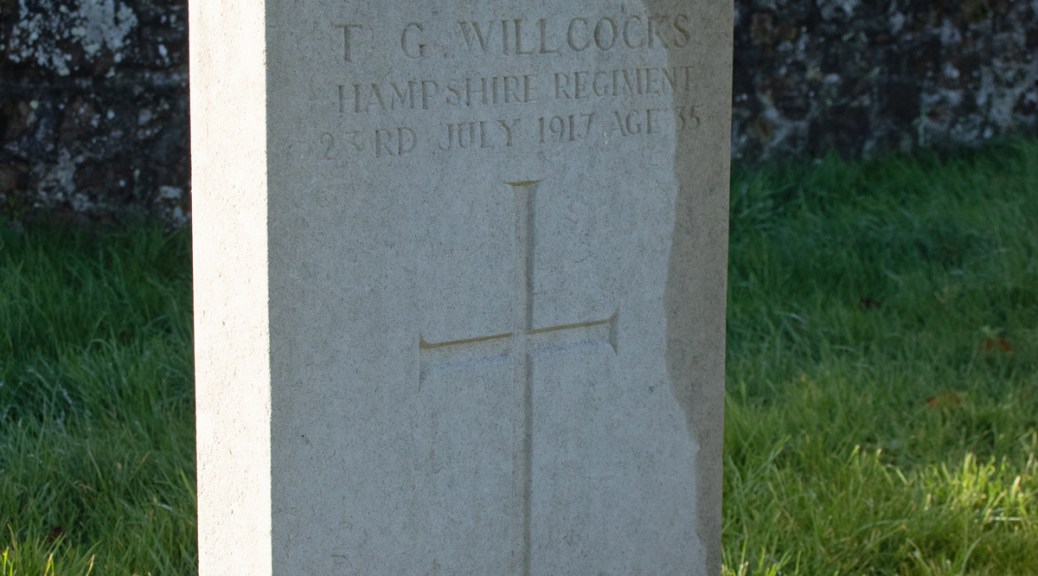
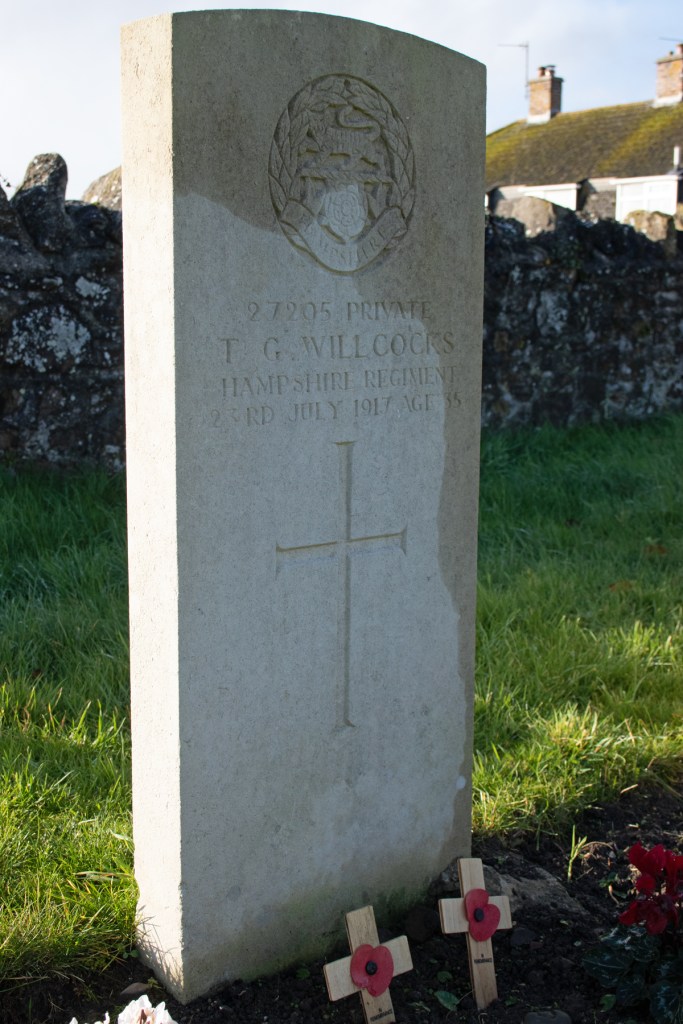
Private Thomas Willcocks

Private Thomas Willcocks

Thomas George Willcocks was born on 18th April 1882, in the Devon village of Chudleigh Knighton. The oldest of five children, his parents were William Willcocks and his wife Emma. William worked as a clay cutter, and this was a trade Thomas followed when he left school.

By 1899, Thomas had met Sophy Gale, a clay cutter’s daughter from nearby Hennock; the couple married and had a daughter, Violet. Thomas was also working as a cutter, and moved into his in-laws house to start raising his young family.

Life can be cruel: the 1911 census shows that Thomas and Sophy had moved to Chudleigh Knighton – where Sophy was originally from. Violet had, by this point, sadly passed away; Thomas’ brother-in-law, Albert, had moved in with the couple to help pay their way.

War was coming to Europe and, although full details of Thomas’ service no longer remain, it is possible to piece together some of his time in the army.

Private Willcocks enlisted in the Duke of Cornwall’s Light Infantry at some point before January 1917, although he soon transferred across to the Hampshire Regiment. His battalion – the 15th – were moved to France in the summer of 1916, and it seems that Thomas was caught up in a gas attack, while in the trenches of the Western Front.

Private Willcocks’ health deteriorated and he was medically evacuated back to the UK for treatment. He was admitted to the Red Cross Hospital in Glasgow, but reports are confused – some identify the impact of the gas on his lungs, while others suggest he was suffering from rheumatism and trench fever. Regardless of the cause, he passed away on 23rd July 1917 at the age of 35 years old.

The body of Thomas George Willcocks was brought back to Devon for burial. He was laid to rest in the graveyard of St Paul’s Church in Chudleigh Knighton.


Thomas’ brother in law, Albert, also died as a result of the First World War; he lies in the grave next to Thomas. His story can be found here.

Thomas’ neighbour was Alfred Moist. He also lies in the same churchyard and his story can be found here.


Thomas George Willcocks
(from findagrave.com)

Trimmer Cuthbert Kean

Trimmer Cuthbert Kean

Cuthbert Kean was born on 2nd October 1862, the eldest of four children to John and Jane Kean. John was a tailor from Manchester, who brought his young family up in the town of Crook, County Durham.

Cuthbert followed in his father’s footsteps and, by the time of the 1891 census – when he was 26 years old – was lodging in central Edinburgh, and was working as a tailor.

There is little more information available on Cuthbert’s early years. When war broke out, he enlisted in the Royal Navy, joining up on 26th October 1914. His papers show that he stood 5ft 2ins (1.57m) tall, had a fair complexion and grey eyes.

By 1917, having turned 55, he was transferred to the Royal Naval Reserve, and worked as a Trimmer – an alternative title for a Stoker. He had served on a number of vessels, joining HMS Firefly towards the end of the war.

Early in 1919, Trimmer Kean was admitted to the Royal Naval Hospital in Chatham, Kent, suffering from a sarcoma of the neck. Sadly, he was to succumb to this, and he passed away on 4th March 1919. He was 58 years old. His records give his next of kin as his sister Mary, who was living in Durham.

Cuthbert Kean was laid to rest in the Woodlands Cemetery in Gillingham, Kent.


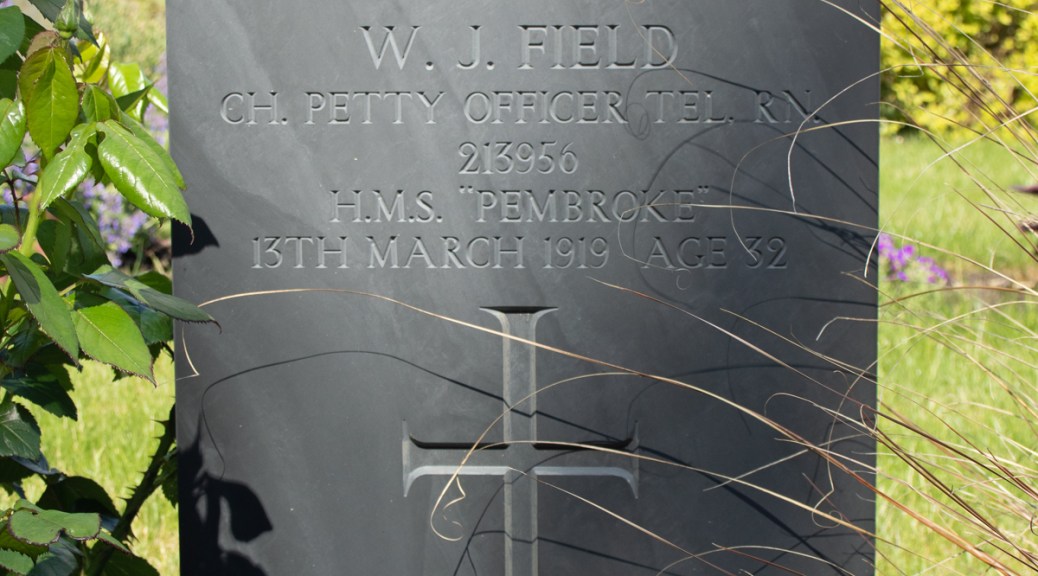
Chief Petty Officer Telegraphist William Field

Chief Petty Officer Telegraphist William Field

William John Field was born on 8th October 1885 in Boston, Lincolnshire. The eldest of four children, his parents were Charles and Ellen. Charles was a boatman for the coastguard; his job, by the time of the 1891 census, had taken the family to the village of Dawdon on the County Durham coastline.

Given his father’s job, it is not unsurprising that William was destined for a life at sea. As soon as he left school in the spring of 1901, he joined the Royal Navy and was sent to HMS Ganges, the shore-based training establishment in Suffolk. Being underage, he was initially assigned the role of Boy, moving, after a year, to HMS Pembroke, also known as the Naval Dockyard in Chatham, Kent.

By November 1902 Boy Field was moved to HMS Venerable, a ship that was to be his home for the next three years. During this time, William came of age, and was formally enrolled in the Royal Navy as a Signalman. He evidently worked hard on the Venerable, rising through the ranks to Qualified Signalman and Leading Signalman.

In June 1905, William was moved to HMS Leviathan, where he was again promoted, to Second Yeoman of Signals, before again being assigned to Chatham Naval Dockyard six months later.

While based in Kent, William met Nelly Watt, the daughter of a labourer at the dockyard. The couple married in 1906, and went on to have four children.

Over the next few years, the now Petty Officer Telegraphist Field spent an almost equal amount of time at sea and on shore. War was coming and when his initial term of service came to an end in October 1915, he immediately renewed his contract through to the end of the hostilities.

All of William’s time was now spent on land, primarily at HMS Pembroke, but also at HMS Actaeon in Portsmouth, HMS Victory VI at Crystal Palace, London and HMS Bacchante in Aberdeen.

While Chief Petty Officer Telegraphist Field’s naval service records are quite detailed, his passing is anything but. The war over, he moved back to Chatham Dockyard in January 1919. At some point he was admitted to the Royal Naval Hospital in the town, and died from ‘disease’ on 13th March that year. He was just 33 years of age.

William John Field was laid to rest in the Woodlands Cemetery in nearby Gillingham.


A sad aside to the story is that, at the time of he husband’s death, Nellie was pregnant with the couple’s fourth child. John William Field was born on 16th October 1919, destined never to know his father.


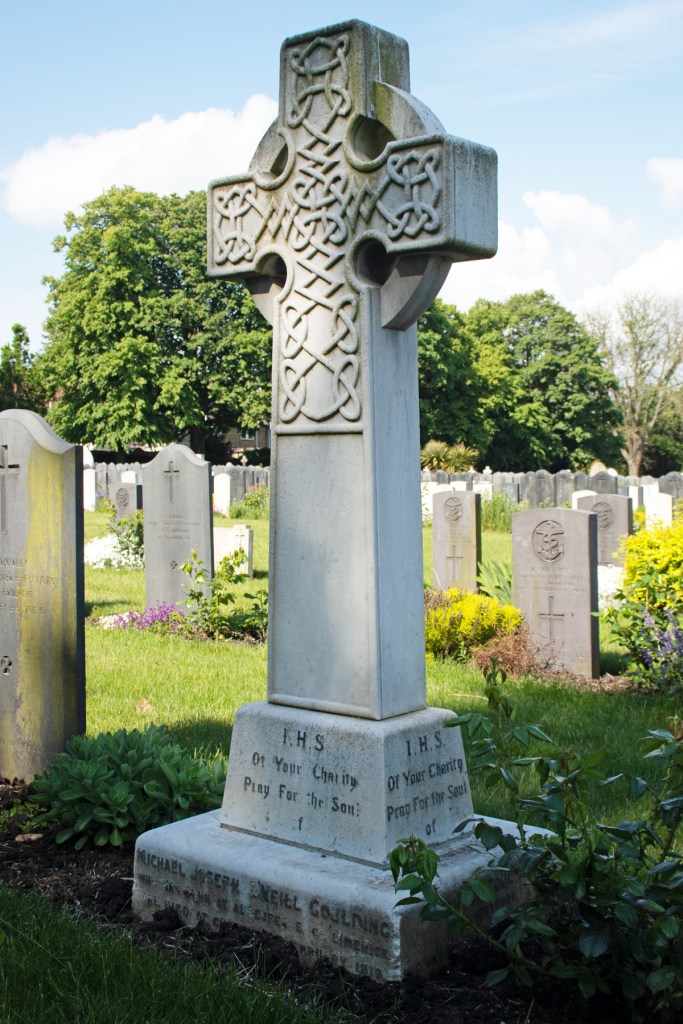
Able Seaman Michael Goulding

Able Seaman Michael Goulding

Michael Joseph O’Neill Goulding was born on 5th May 1884, the oldest of six children to Michael and Ellen Goulding (née O’Neill). Michael Sr worked for the inland revenue and his job took him around most parts of the British Isles.

Michael Jr had been born in Limerick – both of his parents came from Ireland – but his subsequent three siblings (Patrick, Margaret and William) had all been born in Scotland. His second youngest sibling, Lily, was born in County Durham, the youngest back in Scotland, while, by the time of the 1901 census, the whole family were living in Forest Gate, East London.

The census also shows that Michael Jr, having left school, was working at Customs House (presumably where his father was employed), as a boy copyist on tea accounts. The inland revenue at that time was a career for life; by the next census in 1911, the family had moved to Hertford, where Michael Sr was a customs and excise supervisor, and Michael Jr was an assistant clerk at the same place of employment.

War was on its way, but Michael seems not to have enlisted immediately. While specific dates for his joining up are not available, it appears that he was still working for the Inland Revenue when he got married in Shoreditch, in April 1917. His wife was called Bridget Mary Gough (known as Bryde), and she had also been born in Ireland. The couple went on to have a daughter, Ellen (or Eileen), the following year.

By this time, Michael had definitely enlisted. He joined the Royal Naval Volunteer Reserve, and was based at HMS Pembroke, the shore-based establishment in Chatham, Kent. This was the location for the Navy’s main accounting base, so it is likely that he was employed for financial, rather than his military, skills.

Able Seaman Goulding served through to the end of the war and beyond, and it was while he was based in Kent that he became unwell. Admitted to the Royal Naval Hospital in Chatham, he succumbed to a combination of bronchitis and pneumonia on 22nd February 1919. He was 34 years of age.

Michael Joseph O’Neill Goulding was laid to rest in the Woodlands Cemetery in nearby Gillingham. His family were still in Hertford, while his widow and daughter moved back to Ireland.


Michael Joseph O’Neill Goulding
(courtesy of ancestry.co.uk)

Chief Artificer James Davidson

Chief Artificer James Davidson

There are some lives that just don’t want to be discovered, that just hide tantalisingly out of reach. James Davidson’s was one of those lives.

The main two research websites I use – cwgc.org and findagrave.com – only have his initial and surname, which is understandable, as this is what is inscribed on his headstone. Unfortunately, that doesn’t act as a good base on which to carry out further research.

HMS Gunner was the wartime moniker for Granton Harbour, near Edinburgh. A naval history website managed to identify Chief Artificer Davidson’s first name – James – but again, with no other information to go on, this is still too common a name – particularly in Scotland – to narrow down any real results.

Sadly, then, the story behind James Davidson is destined to remain a mystery. All that can be confirmed for certain is that he passed away on 23rd January 1919, though the cause of his passing is lost to time, as is his age.

James Davidson lies at rest in the Woodlands Cemetery in Gillingham, Kent.