Tag Archives: tragedy

Private William Parry

Private William Parry

In St James’ Cemetery, Bath, is a headstone dedicated to one William Parry, once a Private in Devonshire Regiment. A lot of his life is lost to time, but his death highlights the length to which soldiers returning from the Great War were often left to fend for themselves.

On 4th November 1919, Private Parry “was found in an exhausted state lying under an arch in a suburb of [Bath], and told the police he had been there for 17 days. Crawling there to rest, he found himself afterwards too weak to move owing to trench feet” [Western Gazette: Friday 14th November 1919]

On 18th November, having been admitted to the Royal United Hospital in Bath, he passed away from pneumonia. “The police are endeavouring to ascertain something as to the man’s antecedents. He stated to them that he had no home.” [Western Gazette: Friday 21st November 1919]

An inquest into William’s death was held, and a miserable tale unfolded.

Parry was described as a seaman, and his address was given as 36 Catherine Street, Exeter…

[He had] said he was born at Swansea, had served in the 2nd Devons, and was demobilised at Exeter last March. He got into the arch because his feet were aching. He had come from Bristol. He did not say where he was going.

[When he died] Parry’s belongings… included a ration book, issued to him for the address in Exeter, his insurance card, and his out-of-work book. Parry had 10s 8d [approximately £11 in today’s money] in cash on him; but 10s 6d of this sum was given him by a lady since his arrival at the hospital. Parry had received various other gifts sent him by ladies from all over the country, who had read of the account of his discover in the Press. The last out-of-work donation received by him was on June 26th, and the ration book was issued at Exeter on March 24th. The address at Catherine Street, Exeter, as which Parry had stayed was that of a Church Army Home. He had also with him a card indicating membership of the Comrades of the Great War. The entries on his insurance card showed he was last employed on September 8th.

Inspector Lovell… gave the Coroner the result of exhaustive enquiries which he had made… regarding Parry’s antecedents… By the Exeter police he was informed that Parry registered at the Labour Exchange there as a seaman on March 25th. He then produced a certificate showing him to be a member of the Mercantile Marine. He had apparently served with the 2nd Battalion of the Devon Regiment for 2½ years. On May 16th, 1919, he obtained work as a painter in Exeter. He retained this employment till June 21st. A week later he obtained similar employment with another Exeter firm at 1s 3d [approx. £1.68] an hour and his earning averaged £2 [around £87] or more a week. He lest the Church Army Home on September 12th, explaining that he was going to Barrow-in-Furness, where he expected to obtain employment with Messrs Vickers, Sons, and Maxim. While staying at the Church Army Home he appeared to have been regarded as of a morbid disposition…

Inspector Lovell added that the members of the Exeter branch of the Comrades of the Great War had assisted him… and he was able to furnish the Court with a letter from Mr FW Drew, with whom Parry had lodged at the Church Army Home. The writer said he had met Parry in the latter part of April, and their friendship lasted until ten weeks ago, when deceased left Exeter. As they were two ex-Service men they became intimate friends, but apparently before the war he belonged to London.

After enlistment he had served in France, and was taken prisoner by the Germans. He was in their hands for three months; and acted as interpreter between his captors and the other British prisoners. He could speak German and other foreign languages, and undoubtedly was a man of superior education. Apparently, so far as his relations were concerned, he was “one of England’s lonely soldiers.” He said he was badly treated by the Germans, and suffered from a bad cough, the result of a wound in the chest. He was liable to depression when out of work, and the writer well remembered how pleased he was to think that he had obtained work at Barrow-in-Furness… “I deeply regret,” concluded the writer, “that he has come to such an untimely end. He was a good fellow, and would do anyone a good turn, if possible.”

In summing up, the Coroner remarked that exhaustive enquiries had been made into the case. There was no doubt from the medical evidence that the cause of death was pneumonia. It would appear that Parry had been on the road for some time when he crawled under the arch where he was found…

Bath Chronicle and Weekly Gazette: Saturday 22nd November 1919

Private William Parry died on 18th November 1919, aged around 44 years old. The British Federation of Discharged Soldiers and Sailors and the Comrades of the Great War jointly made arrangements for, and funded, his funeral, at which he was given full military honours. He was laid to rest in St James’ Cemetery, Bath.


Funeral of William Parry
(from britishnewspaperarchive.co.uk)

Reverend George Sweet

Reverend George Sweet

George Charles Walrond Sweet was born on 4th December 1889, the oldest of three children to Reverend Charles Sweet and his wife Maud. A Church of England vicar, Charles moved around with his work, and, when George was born, he was based in Winterborne Kingston in Devon.

George was sent away to school, and, by the time of the 1901 census, Charles and the family had moved to Milton Lilbourne in Wiltshire, to tend the local flock.

After school, George studied at Oxford, then followed in his father’s footsteps by taking holy orders, and was soon appointed rector of Symondsbury, Dorset.

When war broke out, his calling was to serve in the Royal Army Chaplain’s Department. Details of his time during the conflict are unclear, although by the spring of 1919, he was attached to the headquarters of the Army of the Rhine.

It was here that he met Phyllis Squire Hickson, who was serving as a Nurse in the Queen Mary’s Auxiliary Army Corps. The couple fell in love and, in June 1919 they returned to England to marry. The wedding occurred on 6th August 1919, and the newlyweds set off on honeymoon the following day.

On his honeymoon tour, the Revd. George C Walrond Sweet… was drowned on Thursday evening in the Cherwell at Oxford, in the presence of his wife.

Mr and Mrs Sweet engaged a punt at Tims’s boathouse and went for a trip on the river. On returning about seven o’clock, when within 300 yards of the boathouse, the punt pole was embedded in the mud and, in attempting to dislodge it the pole broke.

Mr Sweet fell on the side of the boat and then over-balanced into the river. His wife tried to reach him, but without success, and then jumped into a second punt and from that into another boat, but failed to reach him, and he disappeared. The body was not recovered until a quarter of an hour had elapsed, and life was then extinct.

Mr Sweet, who was an MA of Keble College, was only married on Wednesday at St James’s Church, West Hampstead…

[Phyllis’ father] Mr William Hickson… said his daughter became engaged to Mr Sweet in France. He did not meet him until last Tuesday. They came to England to be married. Mr Sweet met with a bicycle accident some years ago and [he] understood from his daughter that her husband was unable to swim or take any active exercise, but while he had been in France his health had much improved.

It was stated [at the inquest] that Mr and Mrs Sweet had been married only one day when the accident occurred and Dr Brooks, a university coroner, said that the tragedy was one of the saddest that had ever come under his notice.

Taunton Courier and Western Advertiser: Wednesday 13th August 1919

The inquest confirmed that the punt pole had broken about 2.5ft (0.76m) from the top. When George was dragged from the river, artificial respiration was carried out for around 50 minutes, but proved unsuccessful. The inquest returned a verdict of accidental death. George was just 29 years of age.

Reverend George Charles Walrond Sweet’s body was brought to Somerset for burial. He was laid to rest in the graveyard of Holy Cross Church in Sampford Arundel, more than likely because he or his father had been vicars there.


This was the second tragedy to befall the Sweet family. George’s younger brother, Leonard, had been schooled in Sherborne, then at the Military College in Sandhurst. He joined the 1st Battalion of the Hampshire Regiment as Second Lieutenant on 5th February 1913, and was promoted to full Lieutenant in September 1914, and Captain in October 1915.

Captain Sweet was then attached to the 29th Squadron of the Royal Flying Corps, and gained his wings at the British Flying School in Le Crotoy, France, in August 1915. On 22nd June 1916, he was on patrol duty over the British lines, when he was involved in a skirmish, and his plane crashed, killing him instantly. He was just 23 years of age.

Captain Leonard Sweet was laid to rest at the Lijssenthoek Military Cemetery in Poperinge, near Ypres.

Captain Leonard Sweet
(from findagrave.com)

Phyllis Sweet never remarried. By the time of the 1939 England and Wales Register, she was living in Bridport, Dorset, and working as a political organiser and speaker. She passed away in August 1944 in Cannock, Staffordshire, at the age of 63 years old.


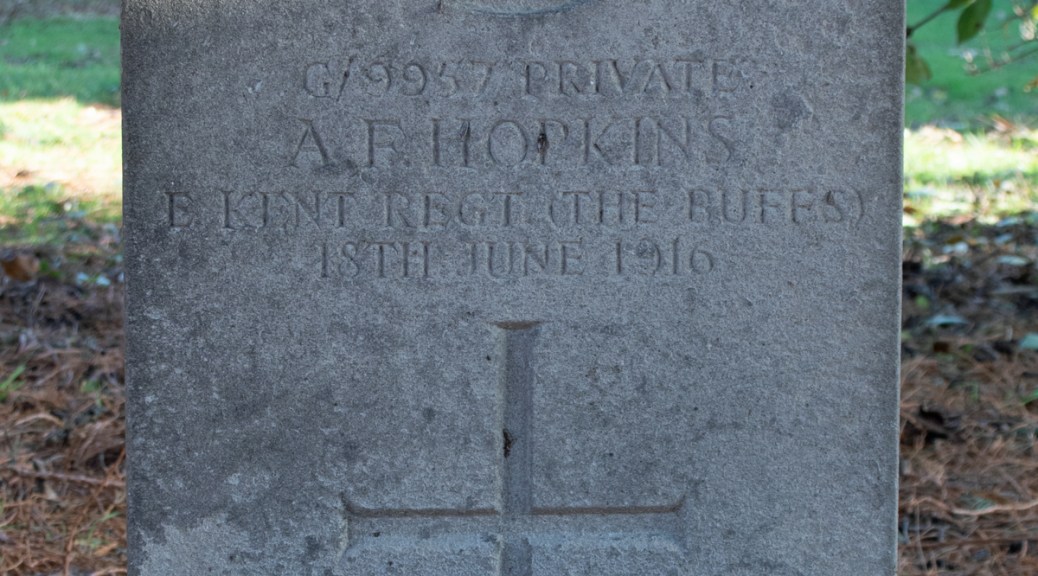
Private Ambrose Hopkins

Private Ambrose Hopkins

Ambrose Frank Hopkins was born in the autumn of 1886, in the Kent village of Ospringe. He was one of four children to shopkeeper-turned-farmer William Hopkins and his wife Julia.

When he finished school, Ambrose found employment in a brickyard in nearby Faversham. In August 1901, however, things took a turn for the worse for the Hopkins family.

Mr WJ Harris, Coroner, had a painful task on Monday evening, when he held an inquest on the body of William Hopkins, a farmer, who was found hanging in the cellar of his house that morning, having ended his life in consequence, it would appear, of business troubles.

Julie Hopkins, wife of the deceased, stated that her husband was 59 years of age… He went to bed on Sunday evening apparently in his usual health and at four o’clock that morning to light the fire which he usually did. Deceased had lately been troubled by business worries.

Blanche Sophia Hopkins, deceased’s daughter, stated that on going down the cellar about seven o’clock that morning (Monday) she saw her father hanging from a beam in the ceiling. She was too much frightened either to touch him or to notice if he was dead, but run up and sent to PC Ward and a doctor. The constable saw deceased just as she found him.

Faversham News: Saturday 31st August 1901.

The tragedy rocked the family and, within eighteen months, Julia too had died. By the summer of 1903, Blanche had auctioned off her once family home for the sum of £270, in order to support her and Ambrose, who was nine years her junior.

In 1906, Ambrose married Florence Harris, a widow thirteen years his senior, who had three children. The couple settled down in Faversham, and went on to have three children themselves – Elsie, Harold and William.

By now Ambrose was working as a labourer in Harty Ferry, just the other side of the Swale River on the Isle of Sheppey. But again, things were going to change as, in May 1916, he was called up for military service.

Private Hopkins was assigned to the 3rd Battalion of the The Buffs (East Kent Regiment). He was sent to Dover for training, before returning to home on leave in advance of further action.

An inquest was held at the Guildhall, Faversham, on Tuesday by the County Coroner… touching the death of Ambrose Frank Hopkins, aged 29… a Private in the 3rd Buffs, stationed at Dover, who hung himself on Sunday last.

Florence Amy Hopkins, the widow, stated that deceased has been… called to the colours three weeks that day. He had leave on Friday last until Sunday night. When he returned he seemed in very good health, but he told her he could not get on in the Army as he could not do his drill, etc.

He was a very quiet man of sober habits. They got on well together except for occasional tiffs. On the Sunday he said what a good breakfast and dinner she had got. All Sunday morning he was cleaning his buttons. He sat talking till after 3pm and then went out the back.

She went out for about twenty minutes, and when she returned she could not find him. Thinking he had gone to bed she went upstairs, but he was not there. Just about five she looked down the cellar stairs, thinking he might be at work there, and saw him hanging by a rope.

On the Saturday night she found the following note on the living room table in her husband’s handwriting. “Good night, my dear Flo, the last night here. My dear little wife, think of me and be good to the children.” She went upstairs, woke him up, and asked him what he had done it for, and he said it was only a joke. There had not been any words between them.

His one trouble was about going back. She told him to make the best of it, and that it would all be the better for him. He replied “Flo, I cannot and I never shall.” They owed a little, but nothing to worry about.

He complained of the food very much, and said that all he had on Thursday night was a piece of bread as hard as a brick. He had fallen away very much since he had been in the Army.

Alfred Willett, a munition worker.. stated that he was called by [Julia] about 5:30pm on Sunday and found deceased in the cellar hanging by a rope fastened to the rafters. The knees were about six inches from the ground, and the feet were touching the ground. Witness cut him down, but he was quite dead. His tunic and cap were off.

Lieutenant Hillier Hughes, of The Buffs, said that deceased had a clean conduct sheet, and he was quite up to average at drill. The food at dinner consisted of meat, two vegetables and pudding. An officer always went round to enquire if there were any complaints. The bread was fresh every day.

The Coroner, in summing up, said that apparently the deceased was not well balanced, and no doubt felt that he was not doing as well as he ought to.

The jury returned a verdict of “Suicide whilst temporarily insane.”

Faversham Time and Mercury and North East Kent Journal: Saturday 24th June 1916.

In very similar circumstances to his father, Private Ambrose Frank Hopkins had died on 18th June 1916. He was just 29 years of age. He was laid to rest in Faversham Borough Cemetery, finally finding some peace.


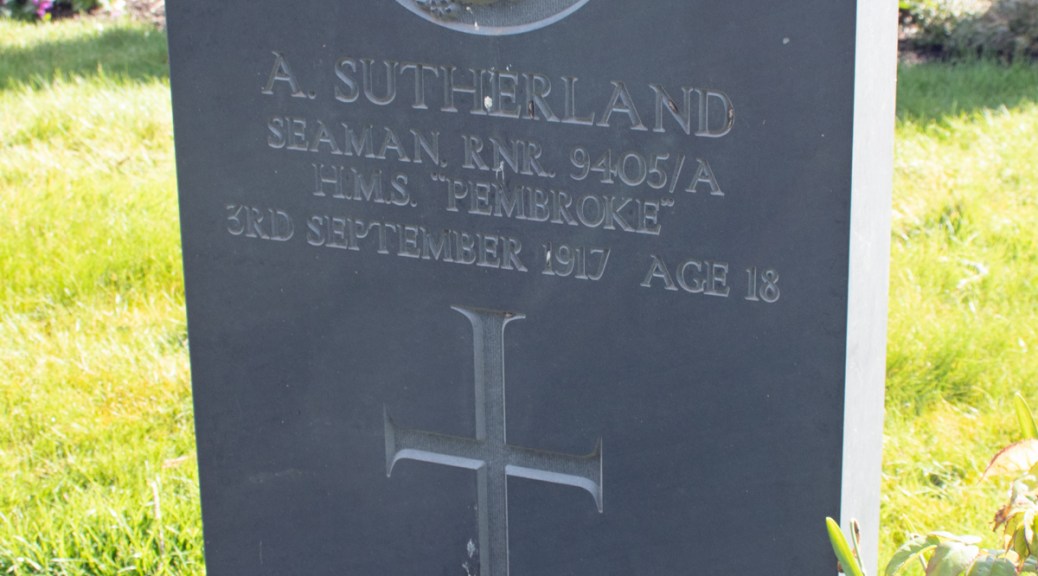
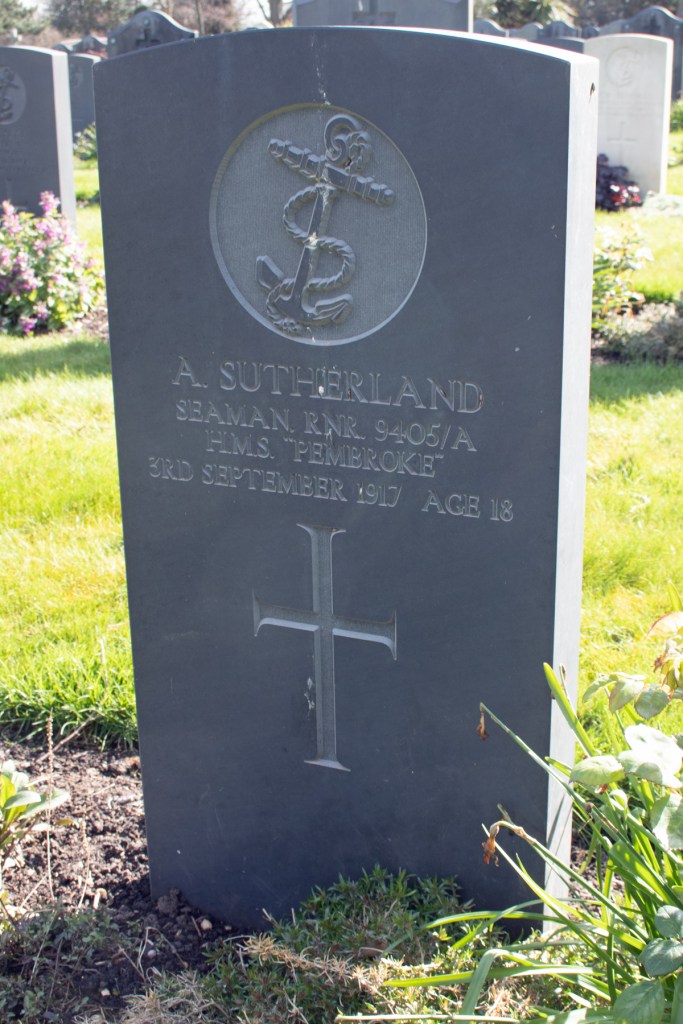
Seaman Alexander Sutherland

Seaman Alexander Sutherland

Alexander Sutherland was born on 20th May 1899 in the Scottish town of Brora. His parents were Peter and Jane Sutherland and he was one of four children, although, tragically, all three of his siblings died before they turned five.

There is little information documented about Alexander’s life: the 1901 census recorded him and his parents living with his paternal grandparents, but give little additional information. Peter died in March 1917, although, again, there is nothing to confirm a cause of death.

The document that provides the most detail about Alexander is his service record. He was too young to enlist when war broke out, but in August 1917, having turned 18, and possibly spurred on by the passing of his father, he joined the Royal Naval Reserve as a Seaman. The record shows that he was 5ft 11ins (1.8m) tall, had fair hair, blue eyes and a fresh complexion. He was also noted as having a scar on the left side of his neck.

Seaman Sutherlands’s first posting was at HMS Pembroke, the Royal Naval Dockyard in Chatham, Kent and he arrived there on 23rd August 1917. The base was a particularly busy place that summer, and Alexander was billeted in some overflow accommodation in the barracks’ Drill Hall.

On the night of the 3rd September 1917, Chatham was bombarded by a German air raid, and the Drill Hall received a direct hit. Tragically, Seamen Sutherland was amongst those killed. He was just 18 years old and had been at the base for just ten days, and on active service for just over a fortnight.

Alexander Sutherland’s body was laid to rest in the Woodlands Cemetery in Gillingham, alongside the other victims of the Chatham Air Raid.


Alexander’s death was particularly tragic for his mother, Jane. She had lost three children early on, and both her husband and last child within six months. Her torment must have been unimaginable.

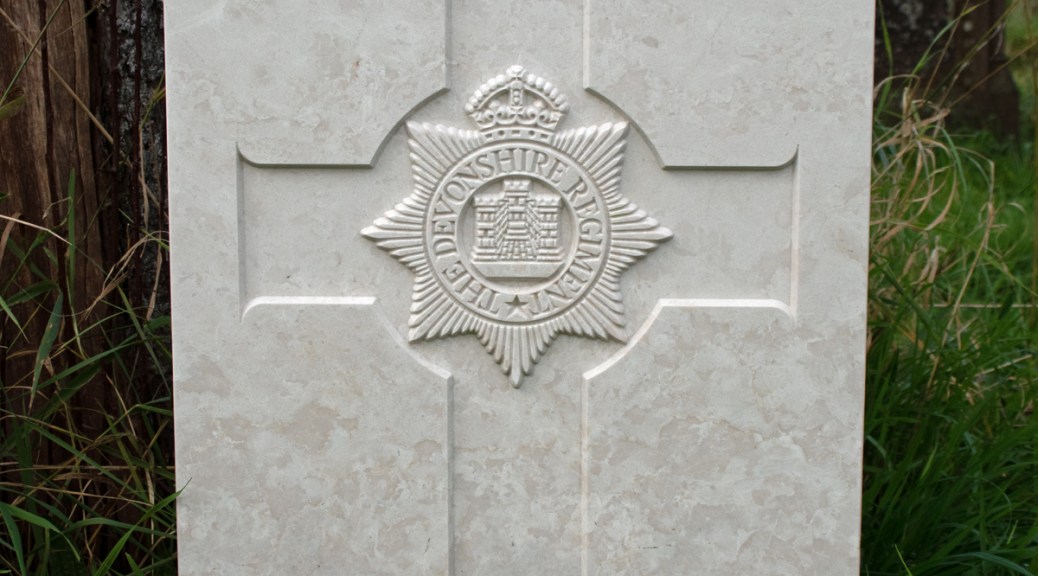
Private Frederick White

Private Frederick White

Frederick James White was born in the autumn of 1898, one of four children to Frederick and Emma White. Frederick Sr was a gas fitter from Frome, and the Somerset town was where the family were raised.

As a youngster, Frederick Jr attended the Primitive Methodist Sunday School in the town. He also acted as treasurer for the local YMCA. He was only 15 when war broke out, so was not able to enlist immediately.

However, by 1916 he had joined the 1st Battalion of the Devonshire Regiment as a Private and, at some point, was assigned to the Royal North Devon Hussars.

Either way, in whichever regiment he served, Frederick saw fighting in France, and was wounded in the autumn of 1917. Medically evacuated back to England, he was admitted to the temporary military hospital at Collegiate Hall in Sheffield.

The local newspaper shed a little more light into Frederick’s life:

Deceased, who was in the North Devon Hussars, died on November 22nd, at Sheffield, of wounds he received on November 5th. He was brought back to England three weeks to the day from the time he sailed for France.

Somerset Standard: Friday 30th November 1917

Private White’s wounds were too much; he passed away at the age of just 19 years old.

Frederick James White’s body was brought back to his home town. He was laid to rest in the Dissenters’ Cemetery in Vallis Road, Frome.


Frederick Sr and Emma White would have been understandably saddened by their son’s passing. They had four children; their eldest, Florence, had passed away before reaching her first birthday. Their youngest, Reginald, had died in childbirth. Frederick had died as a result of the First World War.

Sadly, the tragedy wasn’t yet over. Their only surviving child, Frederick’s younger brother William, passed away in August 1919, aged just 17 years old.

Frederick Sr and Emma had outlived all of their children, none of whom had reached or survived their teenage years.


Private Joseph Dodge

Private Joseph Dodge

Joseph Dodge was born in the summer of 1883, and was one of twelve children, including eleven boys. His parents were David and Eliza Dodge, who raised their growing family in Stoke-sub-Hamdon, a few miles to the east of Yeovil, Somerset.

David was a mason and stone sawyer, but his children went into other roles when they left school; Joseph found work as an agricultural labourer.

In October 1903, Joseph married Elizabeth Ann Case – better known as Annie – who came from just over the Dorset border in the village of Corscombe. Setting up home in Yeovil itself, the couple went on to have two children – both boys – Walter and Norman.

War was coming to Europe, and Joseph was intent on doing his bit. Full service details are not available, but the documents that exist confirm that he enlisted as a Private in the Wiltshire Regiment. Initially assigned to the 1/4th Battalion (which served in Egypt), he transferred to the 2/4th Battalion (which served in India).

Sadly, there is no documentation to give service dates, it is impossible to establish when or if Joseph actually served in these locations. India seems likely, however, as he later transferred to the 1st Garrison Battalion of the East Yorkshire Regiment, which was based in Lucknow.

Private Dodge survived the war and came back to England, but seems to have contracted pneumonia on the journey home. Admitted to hospital in Liverpool, the condition sadly got the better of him. He passed away on 16th February 1919, at the age of 35 years old.

Joseph’s body was brought back to the county of his birth; he was laid to rest in Yeovil Cemetery.


Joseph came from a very patriotic family, and local newspapers early in the war highlighted that many of the Stoke-sub-Hamdon brothers had enlisted to serve King and Country.

At the time of the article, six had enlisted – Thomas, Arthur and Percy (all in the Somerset Light Infantry), Albert (West Somerset Yeomanry), Evan (Royal Navy) and David (Canadian Infantry).

Corporal David Dodge seems definitely to have distinguished himself. Having emigrated to Canada before the war, he returned to Europe when conflict broke out. An article in the Western Chronicle reported that he had “been awarded the Military Medal for conspicuous bravery on the field under heavy fire.[Western Chronicle: Friday 15th November 1918]

Amazingly, of the seven brothers who fought in the conflict, only Joseph perished.


An earlier series of articles tells the tragic story of another of Joseph’s siblings. Henry Dodge (known as William) had moved to Senghenydd, to the north of Cardiff, in 1910; mining work was plentiful there and he and a number of his fellow villagers had sought money from the black gold.

On the 14th October 1913, and explosion happened in the mine and together with the resulting fire and subsequent poisonous gas outpouring killed more than 430 miners. Initially reported missing, William was later confirmed dead; he was just twenty years old and left a widow and child.


Private Percival Peacock

Private Percival Peacock

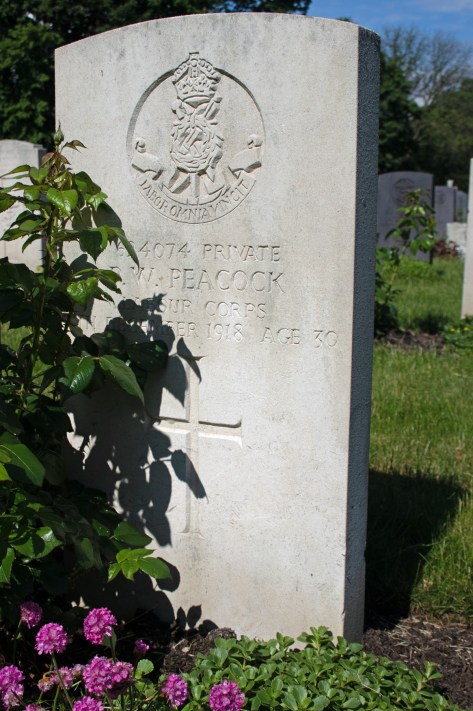
Percival William Peacock was born in early 1888, the son of Thomas and Louisa Peacock. Little information survives about Percival’s early life, other than that he was one of two children, and that, like his parents, he had been born in Gillingham, Kent. Thomas was a sexton and gravedigger, but Percival found work as a hairdresser.

The 1911 census shows him as head of the household in a cottage in the village of Stone, near Dartford; he was living there with his cousin James and his family.

On 21st April 1913, now living in Kensal Green, North London, Percival married Clara Milton, a labourer’s daughter from just a few doors up.

War was now imminent, but again there is limited information about Percival’s involvement. He did enlist, joining the Labour Corps as a Private, but this seems to have been later in the war. He appears to have served on home soil, although there is nothing to confirm this either way.

The next concrete evidence for Percival is the Army Register of Soldiers’ Effects. This confirms that he passed away on 5th December 1918 at the Paddington Military Hospital in London. No cause of death is provided, and the beneficiary given is his father, Thomas. Private Peacock was just 30 years old.

Percival William Peacock was laid to rest in the Grange Road Cemetery in Gillingham, Kent. Hs is commemorated in the nearby Woodlands Cemetery.


Tragedy was not far from the Peacocks’ life. Clara’s mother, Bessie, had passed away just a couple of weeks before Percival. Clara herself died on 5th March 1919, three months after her husband.


Private Joseph Redgrave

Private Joseph Redgrave

Joseph Redgrave was born at the start of 1897, the youngest of nine children to Charles and Hannah. Tragically, five of Joseph’s siblings passed away and, by the time of the 1911 census, the family were living in a three-roomed cottage within a few minutes’ walk of Charles’ place of work, the Naval Dockyard in Chatham, Kent.

Sadly, little documentation about Joseph remains. When it comes to his military service, his records confirm that he enlisted prior to November 1916, joining the Army Veterinary Corps as a Private. There is no evidence that he served overseas, but documents place him at the Larkhill Camp just north of Stonehenge in Wiltshire.

Tragically, Private Redgrave died from unrecorded causes at the camp’s hospital on 15th May 1917, at the age of just 20 years old.

Joseph’s body was brought back to Kent; he was laid to rest in the Woodlands Cemetery in Gillingham.


Engine Room Artificer Archibald Callon

Engine Room Artificer Archibald Callon

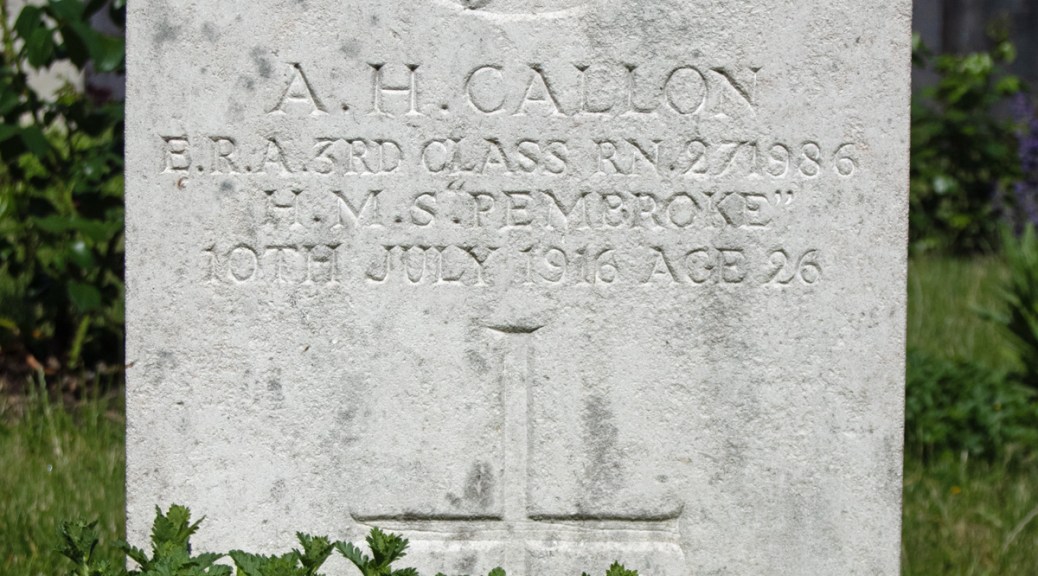
Archibald Hubert Callon – also known as Archie – was born on 2nd January 1890 in Pembroke Dock, South Wales. One of eight children, his parents were shipwright Michael Callon and his wife, Mary. Soon after Archie was born, Michael moved the family to Gillingham, Kent, presumably as work at the nearby Naval Dockyard was plentiful.

The sea was clearly in his blood as, in 1905, Archie joined the Royal Navy, initially as a Boy Artificer, before taking on full employment there once he reached the age of 18. The 1911 census found him working as an Engine Room Artificer 4th Class, one of a crew of 57 aboard the torpedo destroyer HMS Swale, moored in Grimsby.

Archie slowly rose through the ranks and, by 1913, had become Engine Room Artificer 3rd Class, while serving on HMS Clio. He remained on this vessel through to April 1916, before returning to HMS Pembroke, the shore-based naval establishment in Chatham, Kent.

Sadly, Archie’s time back home was short. The next record for him is stark; it is noted that on 10th July 1916, he committed suicide, during temporary insanity. I have been unable to uncover anything further about his passing. He was just 26 years old.

Archibald Hubert Callon was laid to rest in the Woodlands Cemetery in Gillingham, Kent, not far from where his family lived.


Serjeant Major Percy Hawkins

Staff Serjeant Major Percy Hawkins

Percy Harry Hawkins was born in Waltham Green, London, in 1886. One of five children, all boys, his parents were Frederick and Elizabeth Hawkins. Frederick initially worked as a brewer’s collector – collecting rent from tenant pub managers on behalf of the brewery – before working as a tobacconist.

In July 1908, Percy married Gladys Parnell. Sadly, tragedy was to strike and, over the next couple of years both Elizabeth and Frederick passed away in 1909 and 1910 respectively.

By the time of the following year’s census, Percy and Gladys were boarding with a dispensing doctor (or GP), and his wife. Percy listed his occupation as a ‘traveller’, was probably employed as some kind of salesman.

Tragedy was to strike Percy again. Months after the couple had their first child in July 1911, Gladys also passed away, leaving him as a widower and single parent at just 26 years old.

From his later military documentation, it seems that Percy married again in August 1915, this time to a woman called Mildred, and, by September 1919, he had gone on to have three children in total; one boy and two girls.

When war broke out, Percy was quick to enlist. He joined up in Birmingham on 10th August 1914, and gave his profession as a commercial traveller. His records show that he was 28 years and 120 days old, stood 5ft 6ins (1.69m) tall and weighed 131lbs (59.5kg).

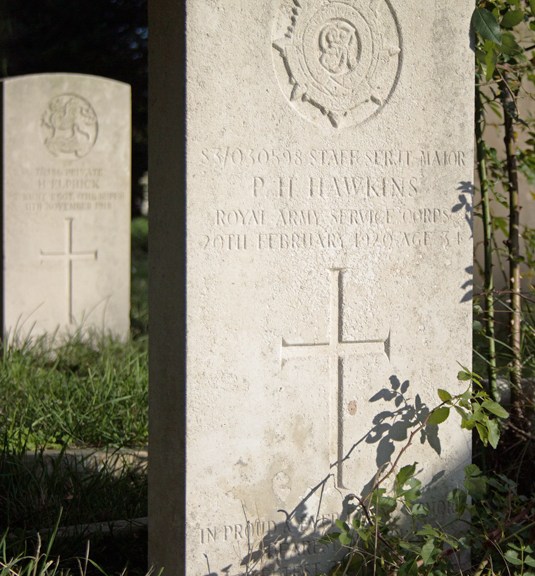
After initially joining the Royal Warwickshire Regiment, Private Hawkins was transferred to the Royal Army Service Corps, and was assigned to one of the supply companies.

Over the four years of the war, Percy served on home soil, and was promoted a number of times, rising from Private to Lance Corporal, Staff Sergeant to Quartermaster Staff Sergeant. In September 1917, he was again promoted, this time to Staff Sergeant Major, a position he held for the remainder of the conflict, and on into 1919, when he volunteered for an extra year’s service, rather than being demobbed.

In February 1920, Staff Serjeant Major Hawkins fell ill; he was admitted to the military hospital that had been set up in Brighton Pavilion, Sussex. The diagnosis was heart failure, and, sadly, it was to this that he was to succumb. He passed away on 20th February 1920, aged just 34 years old.

Percy’s family was, by this time, living down the coast in Worthing; his body was brought there for burial and he lies at rest in the Broadwater Cemetery in the town.