Robert Cantle’s life is one of hope and of tragedy. There is very little documentation on him, but what there is gives a hint to his life.
The 1911 census recorded him a living on Temple Street in Keynsham, Somerset. The head of the household was 86 year old John Cantle, a retired platelayer for Great Western Railway. His wife, Mary, was 22 years his junior, and they shared the house with their son, stationary cutter Ernest, his wife, Elsie, and their daughter, Madge. Robert was noted as being John and Mary’s adopted son. His age was given as 13, but his place of birth is ‘unknown’.
When war broke out, Robert joined the Wiltshire Regiment. Private Cantle set off for camp in Wiltshire in August 1917, and had been there for just two days when tragedy struck.
There were heavy thunderstorms in the Warminster district on Thursday, and while men of a unit of the Wiltshire Regiment were on the parade ground, three of them were struck by lightning. Pte. Robert Cantle, aged 19 years, whose home is at Keynsham, was killed on the spot, and the other two, Pte. Rowe and Pts Murgatroyd, were severely injured…
Sergeant Major HJ Bennett, of the Wilts Regiment, stated [at the inquest] the deceased lad had only just joined them. About 3pm on Thursday a squad was on the parade ground, when the signal was given to dismiss, as a storm was approaching. Immediately after there was a flash and a crash and it seemed to stagger everybody on the parade ground. Witness was brought to his knees, and when he recovered himself he saw three men, who of whom were struggling, on the ground. Private Cantle was found to be dead, and the other men recovered after being attended by a doctor. The squad consisted of recruits, and none of them were carrying arms.
Major Stocker, medical officer, said the crown of deceased’s cap was ripped off, and the body was burned from head to foot.
The jury returned a verdict of “Death from the effects of lightning.”
Somerset Standard: Friday 17th August 1917
Robert Cantle’s body was brought back to Keynsham for burial: he was laid to rest in the town’s cemetery.
John Connolly was born on 7th April 1887 in Liverpool, Lancashire. There is little information available about his early life, although his parents were Thomas and Marianne Connolly. A Roman Catholic, he was baptised at St James Church and went on to marry a woman called Bridget, although details for the wedding are lost to time.
John must have had a level of proficiency when it came to ships and sea-faring as, when war had broke out, he was call up for service with the Royal Naval Reserve (RNR). He enlisted as a Stoker on 1st October 1915, using the surname Campbell. His records show that he was 5ft 6ins (1.68m) tall, had blue eyes and a fair complexion.
Stoker Campbell was based at HMS Pembroke, the Royal Naval Dockyard in Chatham, Kent. His time in service, however, does not seem to have been a happy one. In fact, within a few months of being conscripted, John had absconded and made his way back to Liverpool.
John was caught and was being brought back to Kent under escort, when the unimaginable happened.
John Connolly, a stoker of the RNR, attached to the Royal Naval Barracks, Chatham, was found dead on the railway near Warren House Crossing, between Sole Street and Cuxton, on Wednesday, with terrible injuries to his head.
Connolly, who is known also as Campbell, had been arrested as a deserter at Liverpool, and was returning to Chatham under escort on Tuesday… The train was very full, and deceased, with his escort, stood in the corridor, where several soldiers were also standing.
Some time after the train had left Herne Hill the escort, Leading Stoker John Edward Craig, left his prisoner to proceed to the lavatory, and when he returned one of the soldiers shouted “Jack, your prisoner had gone out the window.” The train was stopped, but the guard suggested that Craig had better proceed to Rochester instead of searching for the deceased, as the night was very dark. At Rochester Bridge the matter was reported to the military authorities, and a search along the line, then ordered, resulted in the discovery of the body of deceased…
A Lance Corporal of the 2/5th King’s Liverpool Regiment, one of the soldiers in the corridor, gave evidence at the inquest… He said he was standing close by deceased, but did not see him go out of the window, which was open at the time.
It was stated that is was usual in the Navy for one man only to act as escort, as all expenses connected with desertions had to be paid by the prisoners.
The jury found the death resulted from injuries received by deceased in a fall from the train, but that there was not sufficient evidence to prove whether the fall was intentional or otherwise.
South Eastern Gazette: Tuesday 8th February 1916
Whether John had intended to throw himself from the train will never be known. All that can be confirmed is that he died of his injuries on 1st February 1916, aged just 28 years old.
John Connolly was laid to rest in Woodlands Cemetery, Gillingham, not far from the dockyard at which he had been based. His epitaph mentioned both of the names he chose to go by, and the inscription: “Beloved husband of Brigid, her one and only love. Re-united RIP. Jesus mercy Mary help.“
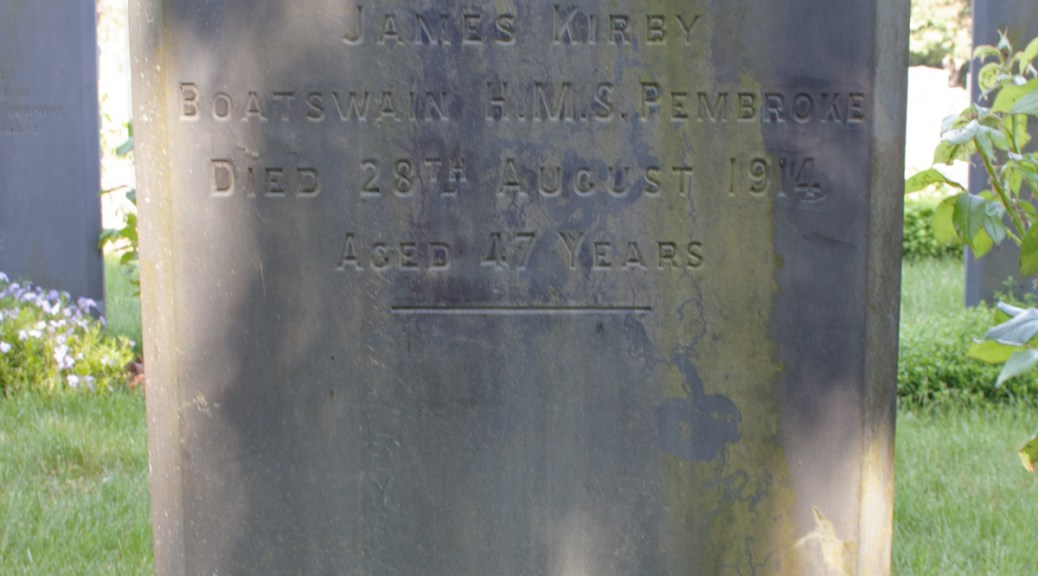
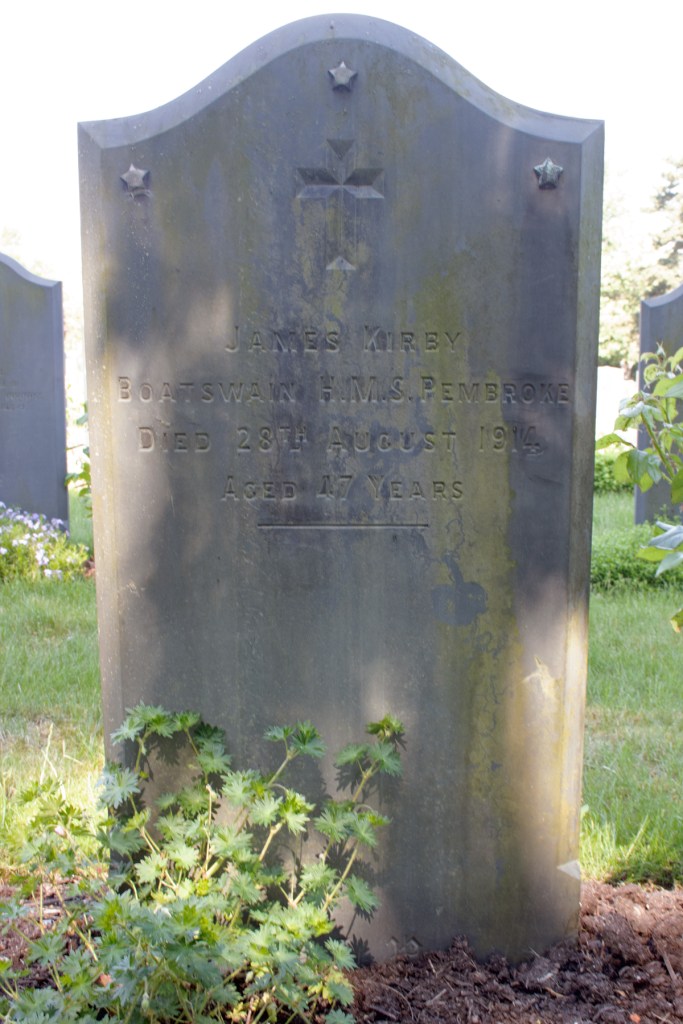
James Kirby’s life is one of intrigue and speculation. Born in Laytown, Ireland on 30th August 1867, the earliest documents relating to him are his Royal Naval Service Records.
He enlisted on 1st March 1883, while just fifteen years old, and was assigned the rank of Boy 2nd Class. Over the next couple of years, he served on two ships – HMS Lion and HMS Briton – and was promoted to Boy 1st Class.
On 30th August 1885, James came of age, and was formally enrolled in the Royal Navy. He enlisted for ten years’ service, and his records show that he stood 5ft 3ins (1.60m) tall, had brown hair, blue eyes and a fresh complexion. He was also noted as having a tattoo of an anchor on the back of his left hand.
Over the next ten years, Ordinary Seaman Kirby served on nine different vessels, and was obviously committed to his work. He rose through the ranks, making Able Seaman in January 1886, Leading Seaman (1889), Petty Officer (also 1889) and Chief Petty Officer (1895).
When his initial contract ended, he voluntarily continued with the Royal Navy, although his service record ends on 14th June 1896, at the point that he was promoted to Acting Boatswain.
A second service record picks up James’ details from 5th December 1902. Still serving as a Boatswain, he was assigned to the cruiser HMS Lancaster. His health, by this point, was beginning to suffer, and, it seems, his life was beginning to unravel.
In August 1904, he was injured in an accident involving a “hook rope” and “slightly amoral judgement”. Over the next couple of years his behaviour became increasingly erratic.
In December 1910, he was admitted to Shotley Hospital near Durham, suffering from acute mania and gonorrhoea, and was not be be fit for duty for a few weeks.
Just before Christmas that year, Boatswain Kirby was again admitted to hospital, this time in Chatham, Kent, remaining there for a number of months. He was deemed unfit for further service in March 1911, and was medically discharged with neurasthenia.
However, when war broke three years later, James volunteered his services once more, and was again employed by the Royal Navy. Tragically, this was a decision that would prove to be fatal.
The extraordinary death of a naval boatswain names James Kirby, aged 47, was the subject of an inquest at the Royal Naval Hospital, Chatham… Deceased, whose home was at Dublin, had retired, but had volunteered for service and was anxious to go to sea. On Friday evening [28th August 1914] he was watching a game of billiards in the warrant officers’ mess at the Royal Naval Barracks, Chatham, and appeared perfectly rational and sober. Suddenly he was observed to disappear through an open window beneath which he had been sitting. He went down, as one witness stated “with a smile on his face,” and called out “Good-bye.” A crash of glass below indicated that he struck the dining room window as he fell.
Kent Messenger & Gravesend Telegraph: Saturday 5th September 1914
The article gave further information about the injury James sustained previously: “It transpired that deceased fell out of a window at the Hospital eight years ago through walking in his sleep. He was then suffering from neurasthenia and had delusions.“
The inquest concluded that Boatswain James Kirby had committed suicide during temporary insanity. He was laid to rest in the Woodlands Cemetery, Gillingham, not far from the dockyard at which he was based.
James Kirby’s grave is maintained by the Commonwealth War Graves Commission on behalf of the Royal Navy Admiralty. However, as the naval authorities did not confirm Boatswain Kirby was a war casualty – possibly because of the nature of his death – he was never formally commemorated with a Commonwealth War Grave. However, I have included his story as it remains as pertinent as those of his contemporaries.
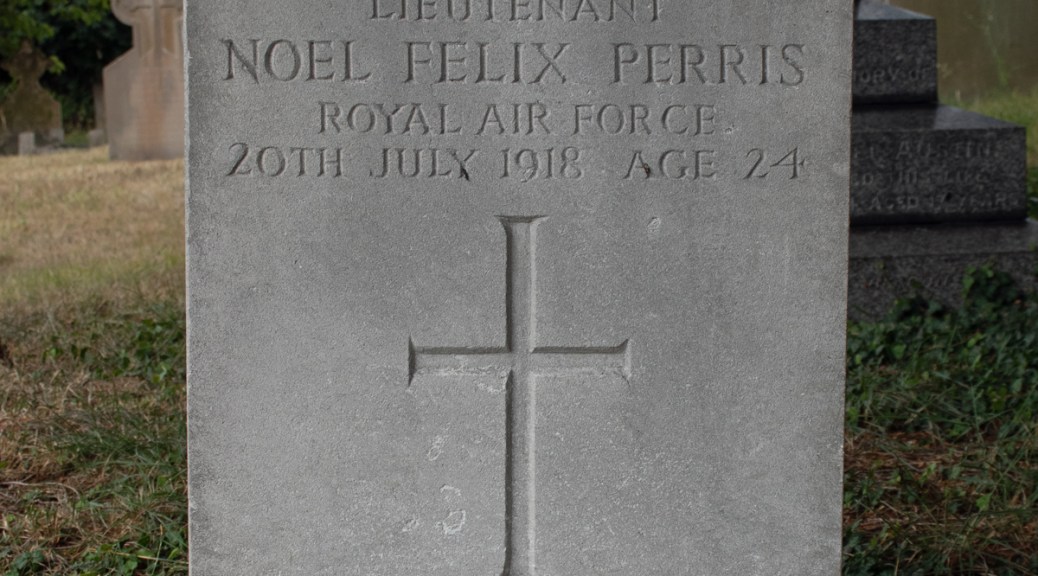
Noel Felix Perris was born early in 1894 in Chiswick, London and was the oldest of three children to George and Mary Perris. George was from Liverpool, and he and Yorkshire-born Mary made the move to south in the late 1880s.
Noel went on to study science at school, but when war broke out, he clearly felt a duty to play his part. George used his writing skills to become a war correspondent with the French army, while his son joined the 2nd London Regiment.
Quickly promoted to the rank of Lieutenant, Noel served in France and Egypt. In 1916, he was badly injured at Hébuterne, to the south of Arras, and returned to England to recuperate. When he had recovered, he transferred to the Royal Flying Corps, subsequently gaining his wings in the newly-formed Royal Air Force.
Lieutenant Perris was based in Kent as part of 143 Squadron. On the morning of 20th July 1918, he took off from Detling Airfield as part of a normal patrol flight. His aircraft – a single-seater RAF SE5a – collided with another plane, piloted by Lieutenant Thomas Wright, and both crashed to the ground in flames. Both piloted were killed on impact.
An inquest found that the cause of the pilots demise was accidental death. Lieutenant Perris was just 24 years old.
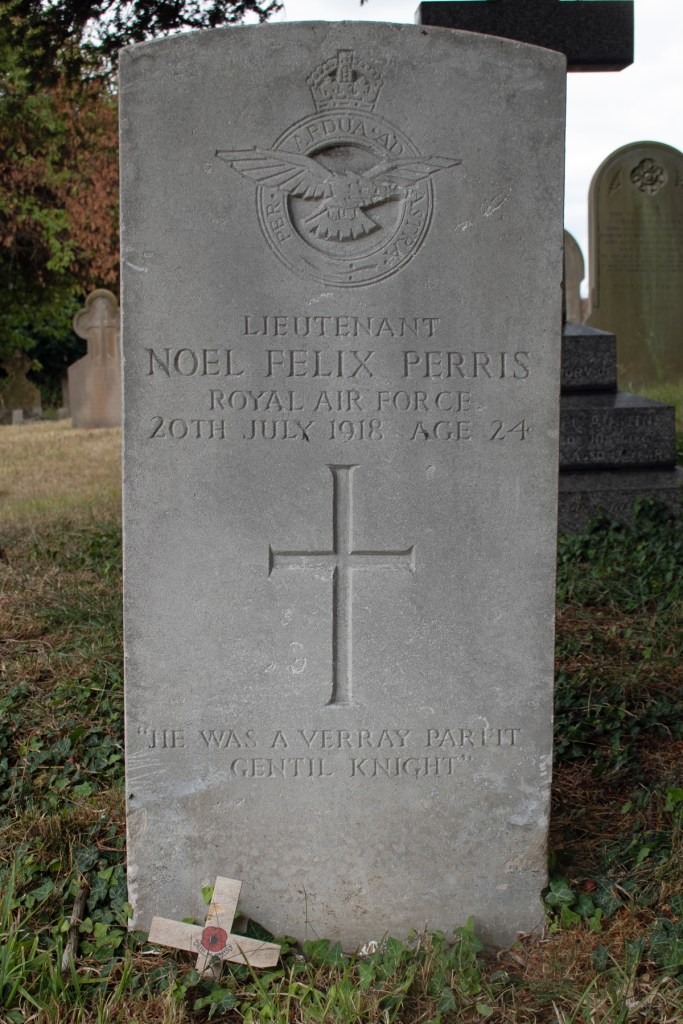
Thomas Wright’s body was taken home to Fleetwood, Lancashire, for burial. Noel Felix Perris was laid to rest in the quiet graveyard of St Martin’s Church in Detling, not far from the base.
Lieutenant Noel Perris (from findagrave.com)
The epitaph on Noel’s headstone comes from Geoffrey Chaucer’s The Knight’s Tale.
He was a verray parfit gentil knight
A modern day translation might be “He was a true, perfect knight of noble character.”
In the graveyard of St Augustine of Hippo Church in Penarth, Glamorgan, lies the Commonwealth War Grave for Private Edward Savage. The headstone confirms that he had died on 25th December 1915 and that he was in the Loyal North Lancashire Regiment.
The Commonwealth War Grave Commission website suggests that he was the son of Edward and Rachel Savage and that he was born in Beccles, Suffolk. Sadly, there are no available census documents to shed any further light on that early life.
The same website suggests that he served in Burma, and in the South African campaign, which would have placed him there in the late 1890s and early 1900s.
It is also noted that Edward was the husband of Emily Savage and that they were living in Fleetwood, Lancashire. Edward’s later pension ledger suggests this was an Emily Shannon, who is, in fact, noted as the guardian of his illegitimate child. Further information, however, is not available.
From a military perspective, it is likely that Private Savage was either still service at the point that the First World War broke out, or that he was called into service – or volunteered his services – shortly after its declaration. He was assigned to No. 5 Supply Company of the 3rd/4th Loyal North Lancashire Regiment and, by the autumn of 1915, he found himself based at Penarth Head Fort near Cardiff.
Edward’s death seems to have been a less than auspicious one, as a local newspaper reported at the time.
The district coroner held an inquest at Penarth on Tuesday touching the death of Private Edward Savage, who was found dead at the billets of the A Company of the Loyal North Lancashire Regiment on Sunday morning. Surgeon-Major Charles Parsons, the local medical officer, stated that the deceased had apparently fallen down some stone steps, causing a fracture of the base of the skull. The jury returned a verdict of “Accidental Death.”
Western Mail: Wednesday 29th December 1915
Private Edward Savage had died on Christmas Day, 25th December 1915. He was 54 years of age. He was laid to rest in the graveyard of St Augustine of Hippo Church in Penarth.
Edwards shares his grave with another member of the Loyal North Lancashire Regiment, Serjeant Frank Carter. Read his story here.
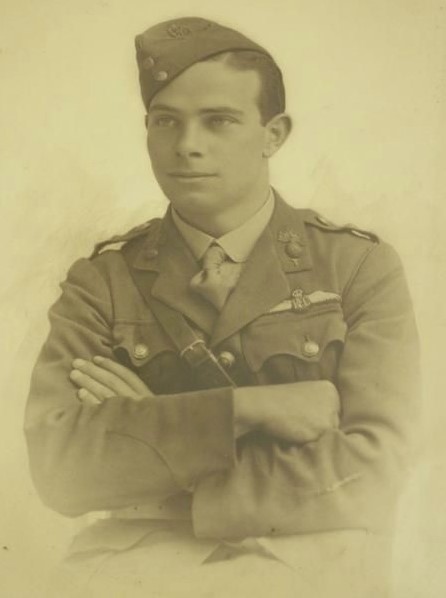
Lewis Morgan was born on 22nd May 1892 in Plymouth, Devon. He was one of six children to former army officer and rector Lewis Harold Gilbert Morgan and his wife, Mary.
Growing up in Plymouth, it seems inevitable that the sea life would take hold in Lewis Jr. He first took up a post in the Merchant Navy, rising to Second Mate in December 1911.
By this point, however, he had set his sights on something more formal and soon enlisted in the Royal Navy. He served on a number of vessels over the years, and was re-engaged when war broke out. By the summer of 1915, he transferred to the Royal Naval Air Service, earning his wings on 5th August that year.
The now Flight Lieutenant Morgan’s service grew as the war continued. The life of air crew at this point in the era of flight was notoriously dangerous, and Lewis was to meet his own fate. On 11th May 1917, he was flying with Probationer Flight Officer Randolph Seed around Edmonton, Middlesex, when an accident occurred. The local newspaper reported on the incident and the subsequent inquest:
Flight-Lieutenant Mitchell gave a graphic account of the accident. He said that about eight o’clock in the evening he was flying at a height of 1,000 feet, and the machine containing the deceased officers was just ahead, but 500 feet higher. The flying conditions were good, and at the time both machines were going steadily. Glancing upwards he notices that the other machine suddenly appeared to collapse, the front extension of the main plane crumpling up. The machine nose-dived, and a black object fell out of it. The machine continued its descent and fell into the Edmonton Sewage Farm… The machine was so entirely broken up that it was impossible to theorise upon the cause of the accident. Morgan was said to have fallen on a concrete path. The deaths were instantaneous.
Taunton Courier and Western Advertiser: Wednesday 23rd May 1917
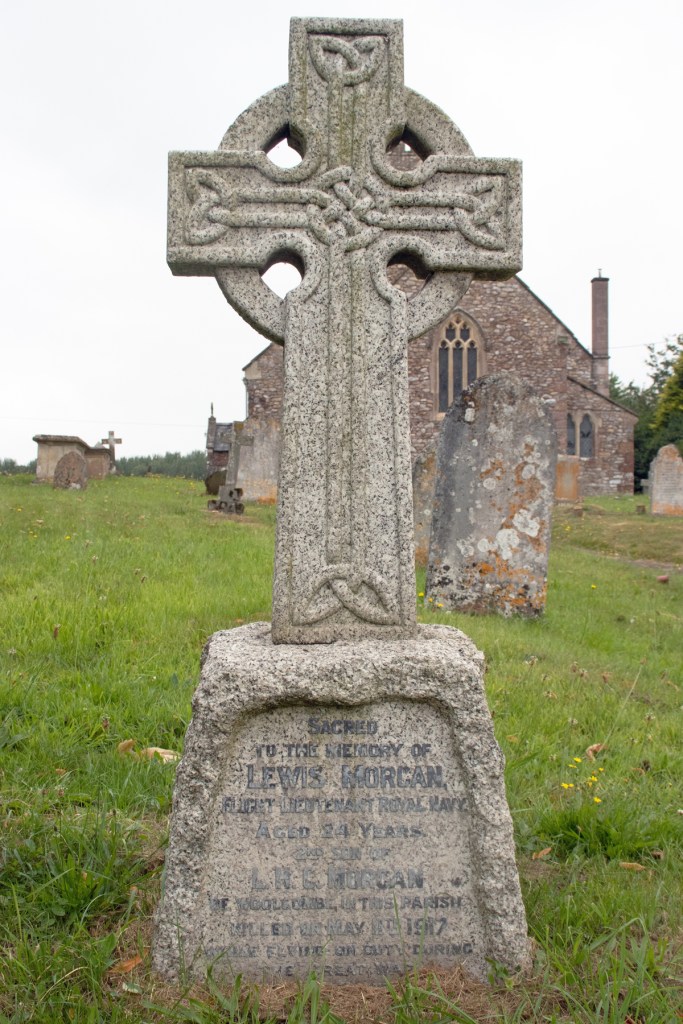
Lewis Morgan was just 24 years old, and days away from his 25th birthday. His body was brought back to Somerset, and laid to rest in the graveyard of Holy Cross Church in Sampford Arundel. By this point, his parents were living in the nearby Woolcombe House, so their son was, in a way, brought home.
The newspaper article went on to report that Flight Lieutenant Morgan was the third and last son to Lewis and Mary.
Francis Morgan – five years Lewis’ senior – enlisted in the Royal Field Artillery when war broke out. He rose to the rank of Captain, and was mentioned in Despatches for his actions. He was killed in the Dardanelles – potentially at Gallipoli – on 2nd May 1915, at the age of 28 years old.
Walter Morgan was a year younger than Lewis. He also played his part in the First World War, joining the South Lancashire Regiment, and rising to the rank of Second Lieutenant. Walter was also sent to fight in Gallipoli, and this is where he also lost his life. He was killed just three months after Francis, on 9th August 1915. He was just 22 years of age.
The loss of three sons in two years was to take a further toll on the Morgan family. Mary had suffered from poor health for a while, and the deaths of Francis, Walter and Lewis was to prove too much. She passed away at home on 15th July 1917, aged just 56 years old.
George Charles Walrond Sweet was born on 4th December 1889, the oldest of three children to Reverend Charles Sweet and his wife Maud. A Church of England vicar, Charles moved around with his work, and, when George was born, he was based in Winterborne Kingston in Devon.
George was sent away to school, and, by the time of the 1901 census, Charles and the family had moved to Milton Lilbourne in Wiltshire, to tend the local flock.
After school, George studied at Oxford, then followed in his father’s footsteps by taking holy orders, and was soon appointed rector of Symondsbury, Dorset.
When war broke out, his calling was to serve in the Royal Army Chaplain’s Department. Details of his time during the conflict are unclear, although by the spring of 1919, he was attached to the headquarters of the Army of the Rhine.
It was here that he met Phyllis Squire Hickson, who was serving as a Nurse in the Queen Mary’s Auxiliary Army Corps. The couple fell in love and, in June 1919 they returned to England to marry. The wedding occurred on 6th August 1919, and the newlyweds set off on honeymoon the following day.
On his honeymoon tour, the Revd. George C Walrond Sweet… was drowned on Thursday evening in the Cherwell at Oxford, in the presence of his wife.
Mr and Mrs Sweet engaged a punt at Tims’s boathouse and went for a trip on the river. On returning about seven o’clock, when within 300 yards of the boathouse, the punt pole was embedded in the mud and, in attempting to dislodge it the pole broke.
Mr Sweet fell on the side of the boat and then over-balanced into the river. His wife tried to reach him, but without success, and then jumped into a second punt and from that into another boat, but failed to reach him, and he disappeared. The body was not recovered until a quarter of an hour had elapsed, and life was then extinct.
Mr Sweet, who was an MA of Keble College, was only married on Wednesday at St James’s Church, West Hampstead…
[Phyllis’ father] Mr William Hickson… said his daughter became engaged to Mr Sweet in France. He did not meet him until last Tuesday. They came to England to be married. Mr Sweet met with a bicycle accident some years ago and [he] understood from his daughter that her husband was unable to swim or take any active exercise, but while he had been in France his health had much improved.
It was stated [at the inquest] that Mr and Mrs Sweet had been married only one day when the accident occurred and Dr Brooks, a university coroner, said that the tragedy was one of the saddest that had ever come under his notice.
Taunton Courier and Western Advertiser: Wednesday 13th August 1919
The inquest confirmed that the punt pole had broken about 2.5ft (0.76m) from the top. When George was dragged from the river, artificial respiration was carried out for around 50 minutes, but proved unsuccessful. The inquest returned a verdict of accidental death. George was just 29 years of age.
Reverend George Charles Walrond Sweet’s body was brought to Somerset for burial. He was laid to rest in the graveyard of Holy Cross Church in Sampford Arundel, more than likely because he or his father had been vicars there.
This was the second tragedy to befall the Sweet family. George’s younger brother, Leonard, had been schooled in Sherborne, then at the Military College in Sandhurst. He joined the 1st Battalion of the Hampshire Regiment as Second Lieutenant on 5th February 1913, and was promoted to full Lieutenant in September 1914, and Captain in October 1915.
Captain Sweet was then attached to the 29th Squadron of the Royal Flying Corps, and gained his wings at the British Flying School in Le Crotoy, France, in August 1915. On 22nd June 1916, he was on patrol duty over the British lines, when he was involved in a skirmish, and his plane crashed, killing him instantly. He was just 23 years of age.
Captain Leonard Sweet was laid to rest at the Lijssenthoek Military Cemetery in Poperinge, near Ypres.
Captain Leonard Sweet (from findagrave.com)
Phyllis Sweet never remarried. By the time of the 1939 England and Wales Register, she was living in Bridport, Dorset, and working as a political organiser and speaker. She passed away in August 1944 in Cannock, Staffordshire, at the age of 63 years old.
Albert Dowsett was born in the Essex village of Sible Hedingham in the spring of 1868. He was the fourth of six children – all of them boys – to Stephen and Susan Dowsett. Stephen was an agricultural labourer, while his wife worked as a straw plaiter to bring in a little extra money.
Albert seems to have been a bit of a tearaway. In July 1877, a local newspaper reported that:
Ezekiel Rulton and Albert Dowsett, boys each nine years of age, were indicted for breaking into the dwelling house of Matilda Jaggard, at Sible Hedingham, and stealing two books, value 1s, on the 20th June. Rulton, having once before committed burglary was sentenced to 10 days’ hard labour and five years in a Reformatory School. Dowsett was acquitted.
Essex Standard: Friday 6th July 1877
Stephen died in the autumn of 1884, while Susan died in March 1892. By this point Albert was 23 years of age, and had found solid work in the army. Full details of this early service no longer remain available, but he fought in South Africa in the 1890s.
By 1897 he returned to England and moved to Stone, near Greenhithe, in Kent. It was here that he met and married Anna Davis, the daughter of a local brewery man. The couple set up home in the village, and went on to have three children, William, Dorothy and Margaret.
The 1911 census recorded the family living in a small terraced house close to the railway station in Greenhithe. Albert was working as a labourer in the wash mill of the local cement works, and the family had a boarder, widower William Davies, who was a weighman at the same works.
Away from work, Albert had also found another calling, and was employed as a verger at St Mary’s Church, just a few minutes’ walk from home.
War was now encroaching on Europe, and, with his previous army service, Albert was perfect to resume his military role. Given the age limitations for new recruits early on in the conflict, it is likely that he volunteered for this role. He willingly took up a post with the 3rd Supply Company of the 2nd/4th Battalion of The Buffs (East Kent Regiment).
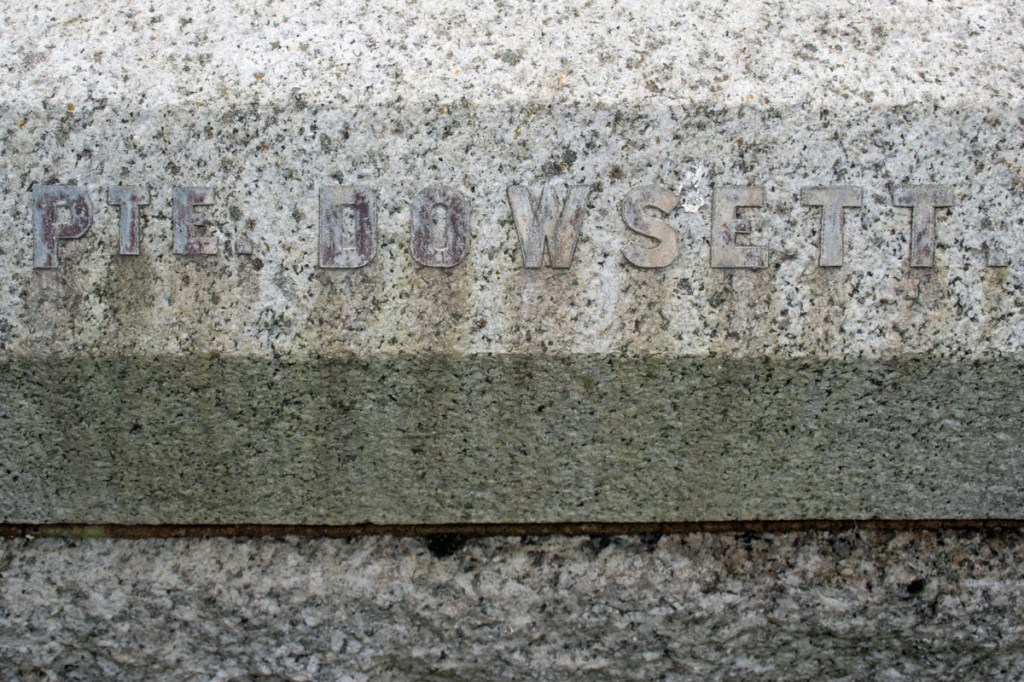
Private Dowsett was given a guard’s role, and was part of the team given the duty of patrolling two explosives factories near Faversham. He was on duty on the afternoon of Sunday 2nd April 1916 when a fire near one of the factory buildings set off a series of massive explosions. More than a hundred people were killed; sadly this included Private Dowsett. He was 48 years of age.
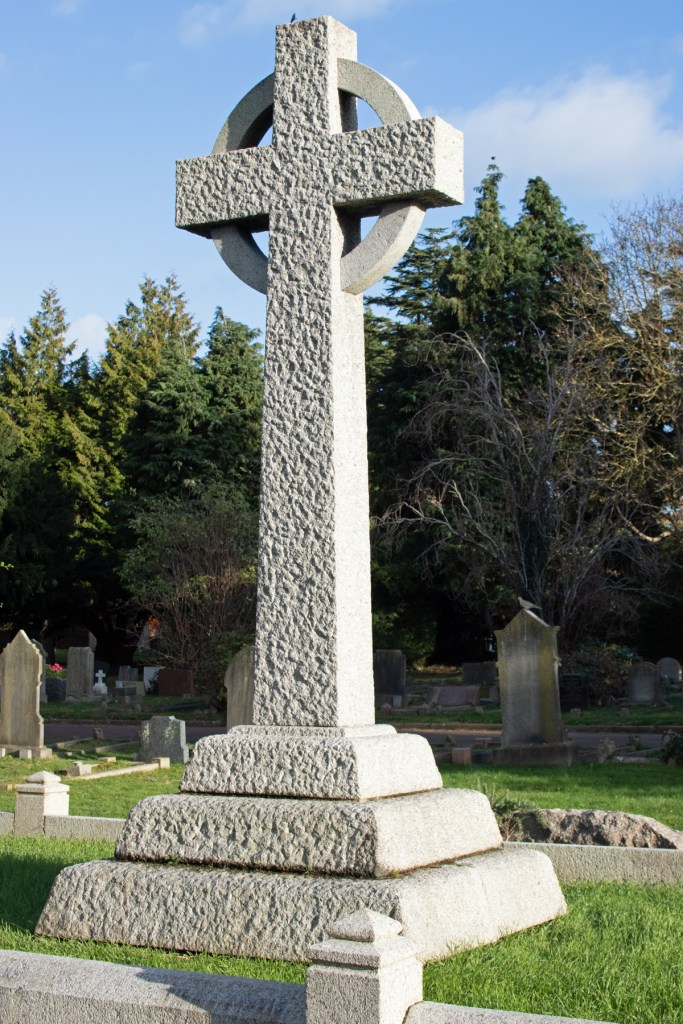
Albert Dowsett was laid to rest, along with the other victims of the Faversham Explosion, in a mass grave the town’s Borough Cemetery.
William Edward Jarvis was born in the spring of 1875, the son of silk printer Edward Jarvis and his wife Elizabeth. He was one of five children, and the family were raised in Crayford, Kent.
When he left school, William found work as a stoker, and this is what he was doing when, in the summer of 1903, he married local engineer’s daughter Maud Kitchener. The couple set up home with Maud’s widowed mother, and went on to have three children, Ivy, Edward and Edna.
War was coming to Europe, and while full details of William’s military service are unclear, it is evident that he had enlisted to play his part by October 1915. He was assigned to the 3rd Supply Company of the 2nd/4th Battalion of The Buffs (East Kent Regiment) and served as part of the territorial force.
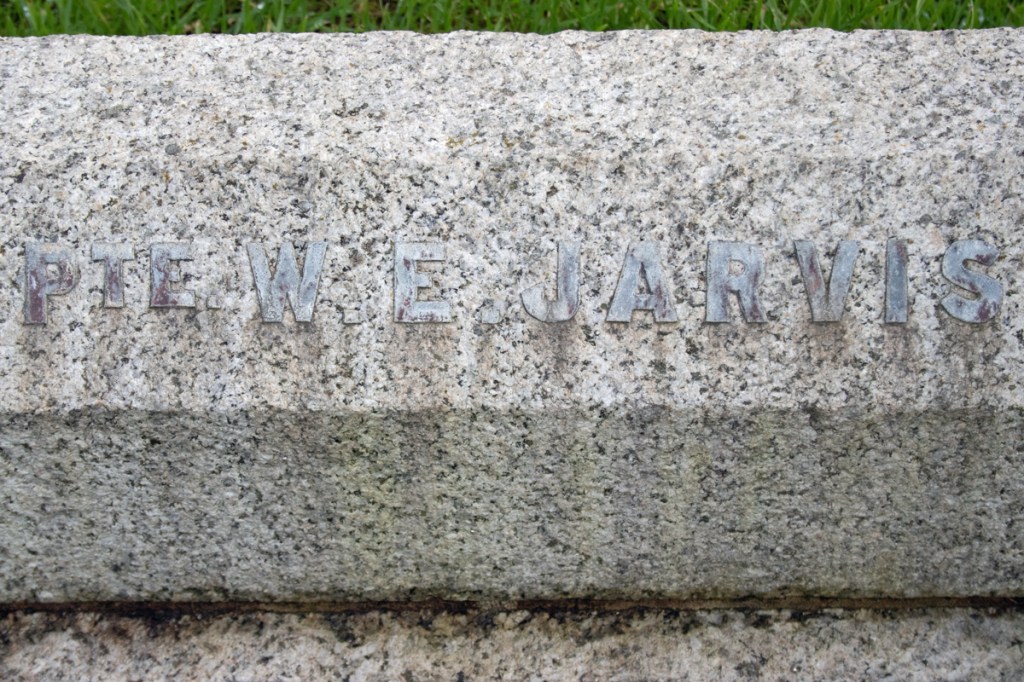
Private Jarvis was part of the team given the duty of guarding two explosives factories near Faversham. He was on duty on the afternoon of Sunday 2nd April 1916 when a fire near one of the buildings set off a series of massive explosions, killing more than 100 people, William included. He was 40 years of age.
William Edward Jarvis was laid to rest, along with the other victims of the Faversham Explosion, in the town’s Borough Cemetery.
Memorial to the Faversham Explosion, Borough Cemetery
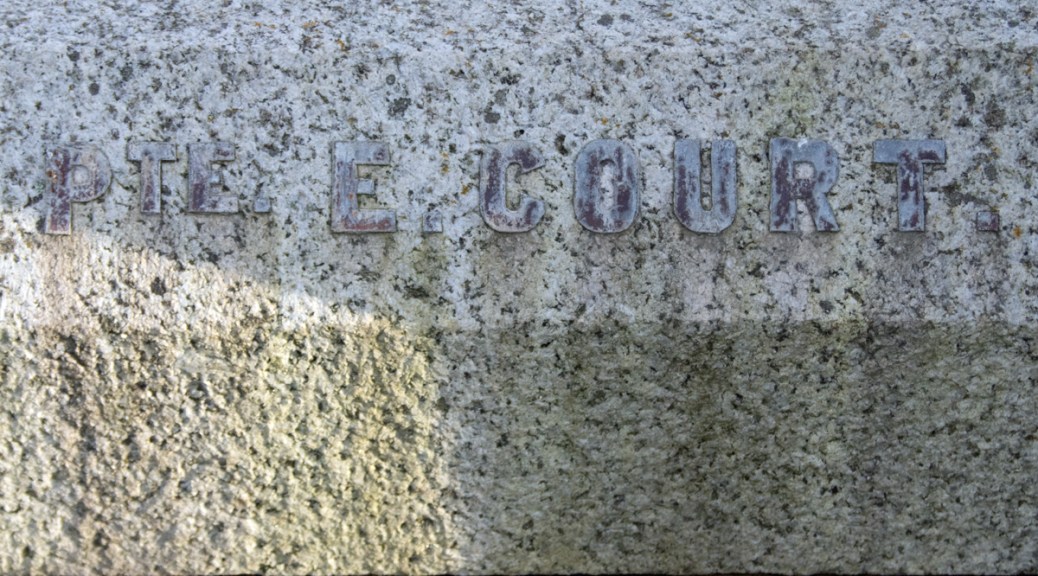
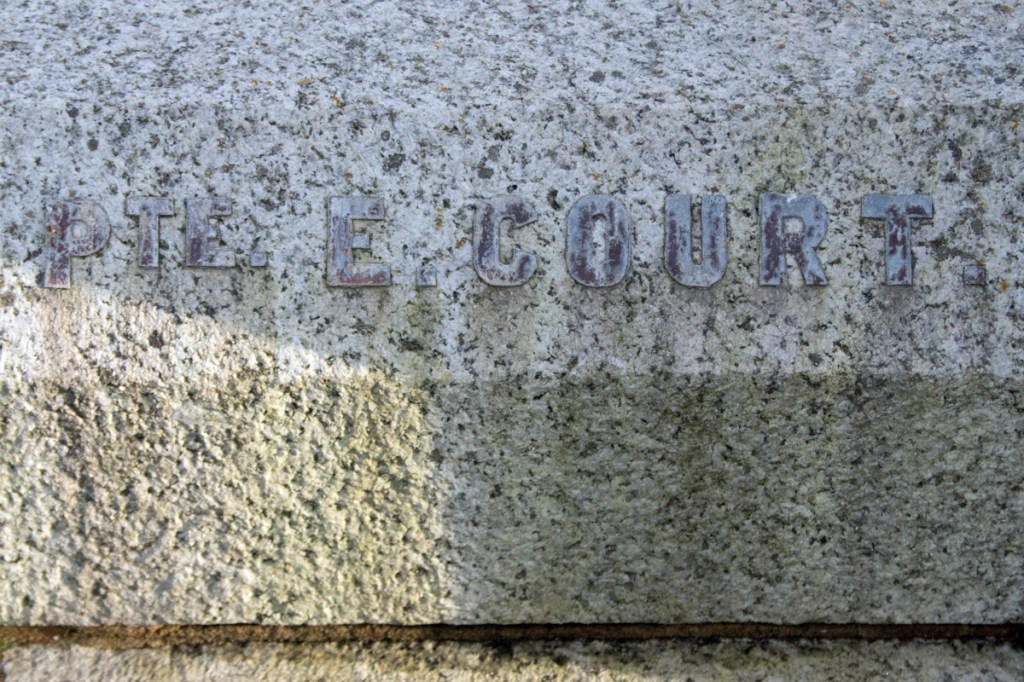
Ernest Court was born in the autumn of 1865, one of eleven children to Stephen and Harriet Court. Stephen was an agricultural labourer from Kent, and the family were raised in the village of St Nicholas at Wade, in the north of the county.
When he left school, Ernest followed his father and became a farm labourer. The 1881 census found him working at St Nicholas Court Farm, under William Broadley, a farmer of some 500 acres (202 hectares).
In the summer of 1894, at the age of 28, Ernest married Catherine Henman; she was a widow nine hears his senior. The couple went on to have a son, Frederick, who was born the same year, a younger half-brother to Catherine’s own son. They soon moved to Faversham, where work was more abundant.
Ernest continued to pick up jobs where he could. The 1901 census recorded him working in the stone pits; the same document gave Catherine working as a charwoman to bring in some extra money. Ten years later, Ernest was working as a road labourer for the town council. Catherine was no longer employed, but Frederick, having left school, was working as a jobbing gardener.
War was approaching Europe by this point and, by October 1915, Ernest had stepped up to play his part. Private Court was assigned to the 3rd Supply Company of the 2nd/4th Battalion of The Buffs (East Kent Regiment). While a good proportion of the regiment served overseas, Ernest remained on home soil, and was given a protective role at the Cotton Powder Company and Explosives Loading Company factories to the north of Faversham.
Private Court was based at the factories on the 2nd April 1916. That afternoon a fire set off a series of massive explosions at the site and around 110 people – Ernest included – were killed. He was 50 years of age.
Ernest Court was laid to rest, along with the other victims of the Faversham Explosion, in the town’s Borough Cemetery.
Memorial to the Faversham Explosion, Borough Cemetery








 Death and Service