Category Archives: Berkshire

Lieutenant Alexander Spurway

Lieutenant Alexander Spurway

Alexander Popham Spurway was born on 8th April 1891 in Newbury, Berkshire. He was the second of six children to Edward and Gertrude Spurway. Edward was a clergyman, and the family moved to Heathfield in Somerset when Alexander was a small boy. Education was key to Edward and, the 1901 census records show Alexander as being a boarder at the Portmore School in Weymouth, Dorset.

Reverend Spurway set the family up well in Heathfield: by the time of the next census in 1911, the family were living in the village rectory, with five members of staff.

Alexander, meanwhile, had taken a different route, entering the Royal Naval College at Osborne on the Isle of Wight in January 1904. He was a keen sportsman and, while there, he represented the college at both cricket and football.

In September 1908, he passed out from the college as a Midshipman, and served on HMS Canopus in the Mediterranean. His career continued, and he was made Sub-Lieutenant in December 1911, and Lieutenant two years later.

Reverend Spurway died at home in February 1914 and, by the time war broke out, Lieutenant Spurway was assigned to HMS Achilles. He remained on board the cruiser for the next two years and it was during this time that he developed diabetes: something that was to prove an ongoing issue for him.

Returning home in the autumn of 1915, the condition was to prove too much, and he passed away on 29th November 1915, at the age of 24 years old.

Alexander Popham Spurway was laid to rest in the graveyard of his late father’s church, St John the Baptist in Heathfield.


Lieutenant Spurway (from findagrave.com)

Sadly, Alexander was not the only member of the Spurway family to lose their life as a result of the war.

Richard Popham Spurway, Alexander’s older brother, was a 2nd Lieutenant in the Somerset Light Infantry, and was attached to the Hampshire Regiment, when it was moved to Gallipoli in 1915. He was killed on 13th August 1915, and is commemorated on the Helles Memorial at Canakkale, Turkey.

Alexander’s younger brother, George Vyvyan Spurway, joined the Royal Fusiliers, before transferring to the Machine Gun Corps. He had arrived in France in September 1916, and was killed while fighting on the Western Front on 28th March 1918. He was laid to rest at Arras and is commemorated on the memorial there.


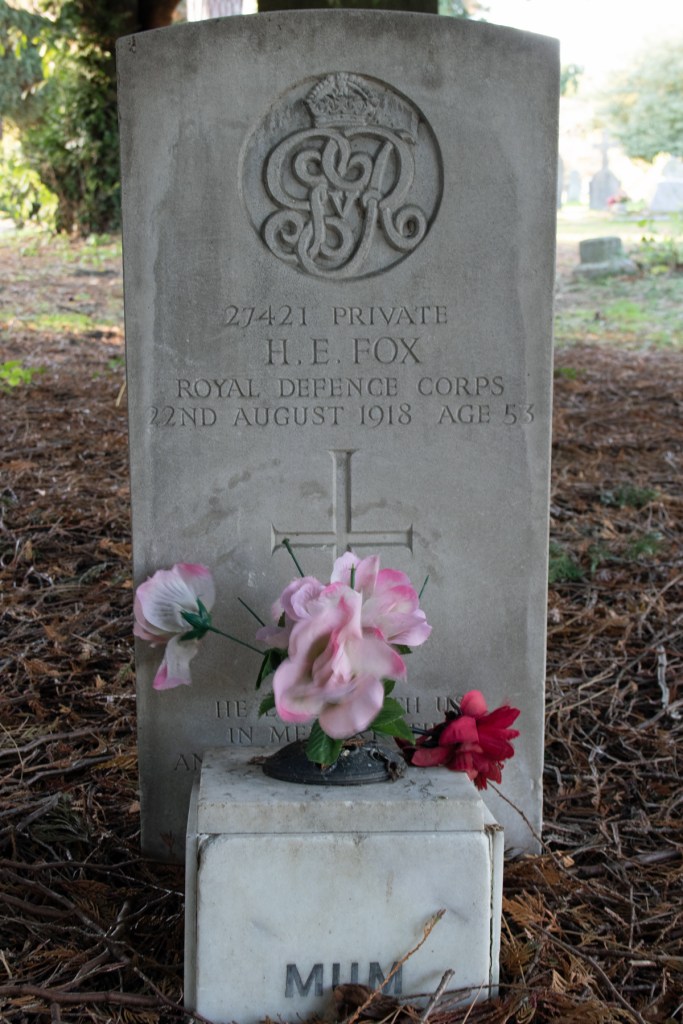
Private Hubert Fox

Private Hubert Fox

Hubert Edward Fox was born in the spring of 1865, the youngest of five children to Alfred and Eliza Fox. Alfred was a baker, from Faversham, and it was in the town that he and Eliza raised their young family.

When he finished school, Hubert found work as a carter and labourer. He served in the King’s Royal Rifles for eight years, spending two of those stationed in Egypt.

In 1894 John married Elizabeth Rebecca Harris in their home town. The couple set up home in the Abbey Road, to the north of the town, and went on to have six children between 1896 and 1909.

When war broke out, Hubert enlisted to play his part once more. He joined up in 1915, and was assigned to the Royal Defence Corps. Private Fox was on guard duty at the Uplees Munitions Factory on 2 April 1916, when a series of explosions ripped through the base. The loss of life was horrific – more than 100 men and boys were killed – and Hubert was fortunate enough to escape serious injury.

In May 1918, Private Fox was invalided out of the army on medical grounds. He was sent to a hospital in Reading, Berkshire, returning to Kent after around six weeks. He was treated in the town’s nursing home, but never fully recovered from his illness: he passed away on 22nd August 1918, at the age of 53 years of age.

Hubert Edward Fox was laid to rest in the Borough Cemetery of his home town, Faversham, not far from the family home in Abbey Road.


At the time of Hubert’s funeral, his eldest son, also called Hubert, was reported as missing in action.

Hubert Jr had enlisted in the 10th Battalion of the Queen’s Own (Royal West Kent Regiment) in August 1915, embarking for France the following May. After two years, Private Fox Jr moved to Italy with his division, but returned to the Western Front just a few months later.

In April 1918, Hubert was reported missing in action; he was later confirmed to be a Prisoner of War, and was eventually released and repatriated home in December 1918.

Hubert found work as a labourer and night watchman; the 1939 Register records him living in his Abbey Road home with his mother. He died the summer of 1968, at the age of 71 years old.


Lieutenant Alan Lloyd

Lieutenant Alan Lloyd

Alan Edward Lloyd was born in around 1899, the second of five children – all boys – to William and Edith Lloyd. Both of his parents were Welsh, and his older brother was born in Cardiff. Railway clerk William moved around the country with work, however, and Alan was born in Lydney, Gloucestershire, his younger brother in Paddington, London, and his two youngest siblings were born in Windsor, Berkshire.

There is little information about Alan’s early life; what is clear is that, by the autumn of 1918, he had been in the army, reaching the rank of Lieutenant. He transferred across to the newly formed Royal Air Force and, in December that year was training as a Flight Cadet at Shotwick Airfield near Chester.

On the 4th December, Alan was flying his Sopwith Camel, when he got into a flat spin; the aircraft crashed and Alan was killed. He was just 19 years old.

Alan Edward Lloyd was brought to Devon – where his family were now living – for burial. He was laid to rest in the graveyard of All Saints Church in Highweek, near Newton Abbot.


Lieutenant Alan Lloyd
(from ancestry.co.uk)

Private Bertie Ball

Private Bertie Ball

Bertie Ball was born in Westcott, Berkshire, in the spring of 1890, the oldest of ten children to John and Matilda Ball. John was from Berkshire, who raised his family in Wantage. He began life as a farm labourer, but, by the time of the 1901 census, he had found other employment, as a groom at a racing stable.

Details of Bertie’s life are scarce. When he left school, he found work as a garden labourer and, when war broke out, he enlisted in the Royal Army Service Corps. Private Ball was assigned to the Mechanical Transport Company, but whether he served overseas or on home soil is unknown.

Bertie died on 4th March 1915 from cerebrospinal meningitis. He was just 24 years old. He was laid to rest in the graveyard of St John the Baptist Church in Midsomer Norton – I can find no Somerset connection, so can only imagine that he passed away in or near the town.


Bertie’s younger brother Percival Ball also served in the First World War. He served with the 5th Battalion of the Wiltshire Regiment and fought in Mesopotamia. Sadly, he was killed there, dying on 5th April 1916. He was just 17 years of age. He is commemorated on the Basra Memorial in Iraq.


Private Alan Ladd

Private Alan Ladd

Alan Ladd was born in the summer of 1893, and was one of twins. His parents were plumber and gas fitter George Ladd and his wife Mary Ann, who was a midwife. The couple had eight children altogether, of whom Alan and his twin Arthur were the youngest.

George had been born in Exeter, Devon, and Mary Ann in Somerset, which is where they initially based their family. By 1887, however, they had moved to Berkshire, and were living in Knowl Hill, near Maidenhead, when their youngest four children were born.

The 1911 census found the family living in Dunster, Somerset, where everyone seemed to be bringing in a wage. George and Mary Ann had four of their children living with them, who were employed as an engine driver, grocer, baker’s apprentice and, in Alan’s case, a tailor’s apprentice.

War broke out in 1914, and, in November 1915, Alan enlisted. He joined the Royal Army Service Corps as a Private, and his enlistment papers showed he stood 5ft 5ins (1.65m) tall, and weighed in at 130lbs (59kg). He was stationed at the Corps’ Remount Department in Swaythling, Southampton and thus his military service was completed on the Home Front.

Shortly after enlisting, on 16th April 1916, Alan married Ada Westlake. She lived in the village of Long Sutton, near Langport in Somerset, and the couple married at the Wesleyan Methodist Chapel in Somerton. They do not appear to have gone on to have any children.

Further details of Private Ladd’s life are scant. What can be determined is that he was admitted to Netley Hospital in Southampton on 11th October 1918, having had symptoms of pneumonia for a few days. Sadly, his condition worsened, and Alan passed away just three days later, on 14th October 1918. He was just 25 years of age.

Alan Ladd was brought back to Long Sutton for burial. The war may have led him and Ada to adopt more of a Quaker way of life, as he lies at rest in the Friends Burial Ground on the outskirts of the town.


Private Montague Palmer

Private Montague Palmer

Montague Ashley Palmer was born in Weston-super-Mare, Somerset, in 1886, one of five children to Alfred and Martha. Montague’s father was a postman in the town for 25 years, retiring through ill health in February 1898. Sadly, Alfred’s retirement was not to last long, and he passed away that July aged 48, when his son was just 12 years old.

When he left school, Montague found work as a bus conductor and was now the oldest of Martha’s children to still be living at home. He was obviously an ambitious and inventive young man; by the time of the 1911 census, he had started work for the Ordnance Survey, and had moved to Didcot in Berkshire where he was boarding with Frances Battison, a suiter and greengrocer.

At this point, details of Montague’s life become a little hazier. At some point, he married a woman called Matilda, who either came from, or would go on to live in, Helston, Cornwall.

With war on the horizon, Montague enlisted – documented dates for this, again, are missing. He joined the 12th Battalion of the Somerset Light Infantry, which initially served in Egypt, before transferring to France in May 1918.

Where and for how long Private Palmer served is not clear, although he was definitely caught up in the fighting, and injured, towards the end of the war. Details of his wounds are not clear, but they were enough for him to be repatriated to England, and he was admitted to the Royal Hospital in Salford.

Private Palmer’s injuries appear to have been too severe for him to survive; he passed away in hospital on 5th January 1919. He was just 32 years old.

Montague Ashley Palmer’s body was brought back to Somerset, and he was laid to rest in the Milton Cemetery in Weston-super-Mare.


Private John Thick

Private John Thick

John Valentine Thick was born in 1883, the youngest of two children to John Thick and his wife Anna. John Sr was a plumber, and evidently moved around with his work. He was born in Surrey, Anna came from Berkshire; their older child, Grace was born in Hampshire, while John Jr was also born in Berkshire.

By the time of the 1891 census, John Sr had moved the family down to Blandford Forum in Dorset. Little more is known about his son’s early life, but by 1907, he was back in Berkshire, and married Henrietta Entwistle, who had grown up in Chelsea.

The young couple went on to have three children – John, Muriel and Margaret – and settled down in Reading, Berkshire. John, by this time, was working as a domestic gardener.

Little documentation exists relating to John’s military service. He enlisted in the Hampshire Regiment, and was assigned to the 1st Labour Company. Private Thick would have been part of the regiment’s territorial force, presumably using his gardening skills to help with the war effort.

While it is difficult to confirm the dates of his service, it seems that John had enlisted towards the end of 1916. It was early the following year that he fell ill, and was soon admitted to hospital with bronchitis. Sadly, this condition was to get the better of him, and Private Thick passed away on 8th March 1917. He was just 34 years old.

John Valentine Thick lies at rest in St Mary’s Cemetery in Taunton, Somerset.


Serjeant Ernest Stelling

Serjeant Ernest Stelling

Ernest Leonard Stelling was born in the summer of 1881, the oldest of six children to Charles and Bertha Stelling. Charles was a tailor from London, and while Ernest was born in Suffolk, by the time of the 1891 census, the family had settled in Reading, Berkshire.

Ernest followed in his father’s footsteps, becoming a tailor and cutter in his own right. He met a woman from Reading called Lettie Eliza Mazey, and the couple married in 1904. The couple set up home with Lettie’s brother and his family in Tilehurst, but didn’t go on to have any children themselves.

Details of Ernest’s military service are a bit scarce. He initially enlisted in the Royal Berkshire Regiment, but quickly moved to the Somerset Light Infantry in the early stages of the First World War.

Sadly, no formal documents of Ernest’s time in the army are available, but a local newspaper gave a good insight into his Somerset service.

Death of a Master Tailor

After an illness of only seven days, the death took place at the military hospital on Monday afternoon of Sergeant EL Stelling, who has been master tailor of the Depot for the past two years. The cause of death was pneumonia, and the loss of so popular a member of the Depot staff is deeply regretted by all ranks.

Sergeant Stelling, who was 37 years of age, came to the Somersets from the Royal Berkshire Regiment, and succeeded the late Sergeant-Master-Tailor Chambers. He was a native of Reading, and one of four brothers serving their King and country. His father, Mr Charles Stelling, for many years carried on business as a master tailor in Reading.

Since he had been at Taunton barracks, Sergeant Stelling had made many friends, and actively identified himself with the social life of the sergeants’ mess, taking a prominent part in the arrangement of concerts, etc.

He was of a bright, generous disposition, and before his illness he was making a collection at the Depot on behalf of the Buffaloes’ Christmas treat to poor children of the town. He was a valued member of the local Lodge of the Royal Order of Buffaloes, and his death is greatly regretted by all the brethren.

He leaves a widow but no family. Much sympathy is felt for Mrs Stelling, who has for some years been a confirmed invalid.

The funeral took place with full military honours at St Mary’s Cemetery on Friday afternoon.

Taunton Courier and Western Advertiser: Wednesday 27th December 1916

This gives a real insight into Ernest’s personal life. He was obviously very active socially, and committed to the community. Whether Lettie’s infirmity contributed to the couple’s lack of family will never be known, but, from his support of the poor children of Taunton, it seems evident that he would have been a good family man.

The next document relating to Serjeant Stelling is his pension record; this confirms the news article’s report that he contracted pneumonia and influenza, and he succumbed to the conditions on 18th December 1916. He had, in fact, just turned 38 years old.

Ernest Leonard Stelling lies at rest in St Mary’s Cemetery in his wartime adopted home town of Taunton, Somerset.


Serjeant Ernest Stelling (from Ancestry.co.uk)

Serjeant Frederick Wickens

Serjeant Frederick Wickens

Frederick Albert John Wickens was born in Newbury, Berkshire, in the summer of 1889. The oldest of four children to Alfred and Emily Wickens, his father was a brewer’s labourer.

The military life proved more of a draw to Frederick, however. While his full records no longer exist, by the time of the 1911 census, he was recorded as being a Sapper with the 2nd Field Troop of the Royal Engineers. He was based at Potchefstroom, around 75 miles (120km) south east of Johannesburg in South Africa, and his trade was listed as a tailor.

Sadly, it is at this point that Frederick’s trail goes tepid, if not cold.

From a personal perspective, he married a woman called Rose, who was a year younger then him. Her details are scarce, and there is nothing to confirm when or where they married (other than the 1911 census, when Frederick was listed as ‘single’).

The couple must have had some connection to Gillingham, as this is where they lived; given the proximity of the Royal Engineers Barracks in neighbouring Chatham.

Sapper Wickens’ military service continued into the Great War. He was awarded the medaille militaire by Belgium, and achieved the rank of Serjeant during his career. Unfortunately, there are no details of the actions around either the award or his promotion.

Serjeant Wickens passed away on 27th February 1921; he died in Chatham, although the cause was not recorded. He was 31 years old.

Frederick Albert John Wickens lies at rest in the Woodlands Cemetery in Gillingham, Kent.


Frederick’s younger brother Thomas, also served in the Great War. He enlisted in the Princess Charlotte of Wales’s (Royal Berkshire) Regiment, and was involved in the battles on the Western Front. Sadly he was killed in the fighting on 24th May 1916, at the age of 19 years old.