Category Archives: Devon

Leading Telegraphist Ernest Webber

Leading Telegraphist Ernest Webber

Ernest Webber was born on 19th April 1897 in Newton Abbot, Devon, although there is little further documented about his early life

The 1911 census records Ernest as being at the Scattered Home in Newton Abbot. This was, in fact, the Greenaway Home for Boys, part of the town’s Union Workhouse. It was run by a Mrs Louise Foote, had 22 ‘inmates’ and was located on the Highweek Road.

The following year, however, Ernest found a way to better himself, enlisting in the Royal Navy. His service records confirm that he joined up on 9th October 1912 and gave a physical description of him: he was 5ft 5ins (1.65m) tall, had fair hair, blue eyes and a fresh complexion. He was also noted as having a scar on his left index finger.

As he was below the age for full service, he was given the rank of Boy, and was sent to HMS Ganges, the naval base in Ipswich, Suffolk, and HMS Impregnable, a training ship, for his initial instruction. Some talent seems to have been unearthed as he was soon promoted to Boy Telegraphist.

In August 1913, Ernest was assigned to the battleship HMS Conqueror. He spent nearly two years on board and, during that time, came of age. Now formally inducted into the service, he was given the rank of Ordinary Telegraphist, before being promoted again – to the full role of Telegraphist – in April 1915.

Two months later Telegraphist Webber was transferred to HMS Phaeton; over the next year, he spent time on two further vessels, before being assigned to HMS Victorious in April 1916. With this assignment came a further promotion: Ernest was now a Leading Telegraphist.

In the summer of 1917, Ernest moved again, this time to HMS Vivid, the Royal Naval Dockyard in Devonport. At this point, however, he had fallen ill, and was medically discharged from duty on 5th September 1917, having contracted tuberculosis.

At this point, Ernest’s trail goes cold. He returned to Newton Abbot, but the events of the next year are lost to time. All that can be confirmed is that he passed away, presumably of his lung condition, on 11th December 1918. He was just 21 years of age.

Ernest Webber was laid to rest in the graveyard of All Saints Church in Highweek, near Newton Abbot.


Lieutenant Frederick Liardet

Lieutenant Frederick Liardet

Frederick Charles Evelyn Liardet was born in Brighton, now a suburb of Melbourne, Australia, in 1888, and the eldest son of Wilbraham and Eleanor Liardet.

There is little further information about Frederick’s early life, but, when war broke out, he wanted to play his part for King and Country, and enlisted in the Devonshire Regiment.

He had an adventurous career… Having been twice wounded while on active service in France, he was appointed an instructor in the Balloon Section of the Royal Flying Corps.

Exeter and Plymouth Gazette: Tuesday 18th December 1917

On 23rd October 1915, Frederick married Kathleen Norah Liardet in Highweek, Newton Abbot, Devon. She was the daughter of a retired Lieutenant Colonel in the Royal Marine Light Infantry, and may have been a cousin (while their surname is unusual enough for there to be a connection, I have been unable to identify a specific connection). The couple went on to have a daughter, Barbara, who was born in 1917.

In 1916, while on a night flight with the Royal Flying Corps, the now Lieutenant Liardet was involved in an accident and badly injured. He returned to England to recover, he and Kathleen living with her family. While his health initially improved, he relapsed and passed away on 13th December 1917, aged just 29 years old.

Frederick Charles Evelyn Liardet was laid to rest in the graveyard of All Saints Church in his adopted home of Highweek, Devon.


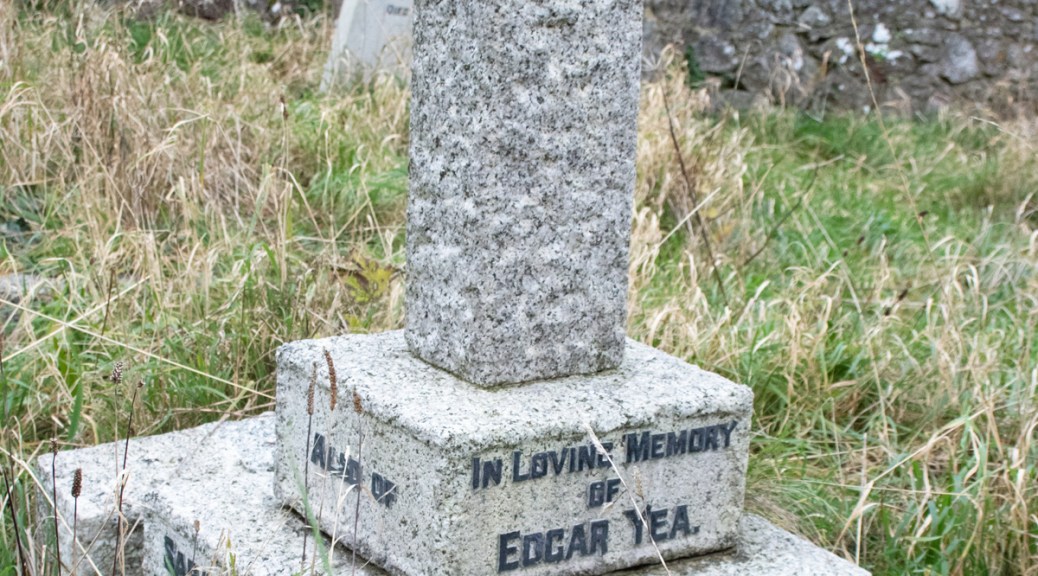
Private Edgar Yea

Private Edgar Yea

Edgar Thomas Yea was born on 23rd February 1898, the youngest of four children to Enoch and Sarah Yea. Enoch was road contractor from Devon, and it was in Highweek, near Newton Abbot, that he and Sarah raised their young family.

There is little documented on young Edgar’s life: he enlisted in the Royal 1st Devon Yeomanry not long after was war declared in August 1914. He served on home soil, and was medically discharged from service after just 241 days. There is no confirmation on the cause of his removal from the army, but Private Yea’s last day of service was 11th June 1915.

At this point, Edgar’s trail goes cold again. All that can be confirmed is that he passed away at home on 6th February 1919, just a couple of weeks shy of his 21st birthday. The cause of his passing is lost to time.

Edgar Thomas Yea was laid to rest in the graveyard of All Saints Church in his home town of Highweek, Devon.


Lieutenant Alan Lloyd

Lieutenant Alan Lloyd

Alan Edward Lloyd was born in around 1899, the second of five children – all boys – to William and Edith Lloyd. Both of his parents were Welsh, and his older brother was born in Cardiff. Railway clerk William moved around the country with work, however, and Alan was born in Lydney, Gloucestershire, his younger brother in Paddington, London, and his two youngest siblings were born in Windsor, Berkshire.

There is little information about Alan’s early life; what is clear is that, by the autumn of 1918, he had been in the army, reaching the rank of Lieutenant. He transferred across to the newly formed Royal Air Force and, in December that year was training as a Flight Cadet at Shotwick Airfield near Chester.

On the 4th December, Alan was flying his Sopwith Camel, when he got into a flat spin; the aircraft crashed and Alan was killed. He was just 19 years old.

Alan Edward Lloyd was brought to Devon – where his family were now living – for burial. He was laid to rest in the graveyard of All Saints Church in Highweek, near Newton Abbot.


Lieutenant Alan Lloyd
(from ancestry.co.uk)

Private Arthur King

Private Arthur King

Arthur Thomas Rendell King was born early in 1896, the oldest of six children to Thomas and Bessie King. Engine driver Thomas had been born in London, but, after marrying his wife the year before Arthur was born, he settled in Highweek near Newton Abbot, Devon.

When he left school, Arthur followed his father in working for Great Western Railways, working as a carriage cleaner at the town’s depot. War was on the horizon, however, and he enlisted in the Devonshire Regiment shortly after conflict was declared.

Private King was assigned to the 1st/5th Battalion and sailed for India in October 1914, arriving in Karachi a month later. After nearly three years, his regiment moved again, this time to Egypt, in advance of action in the Middle East.

Involved in the Battle of Nebi Samwil in November 1917, Arthur was badly wounded – and initially recorded as missing, presumed dead. However, he was found, and evacuated to England. Tragically, within hours of being admitted to a hospital on home soil on 31st January 1918, Private King died of his injuries. He had just turned 22 years of age.

Arthur Thomas Rendell King’s body was brought back to Devon for burial. He was laid to rest in the family grave in the graveyard of All Saints Church, Highweek.


Private Arthur King
(from findagrave.com)

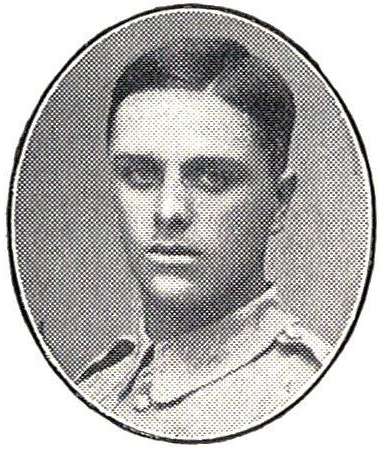
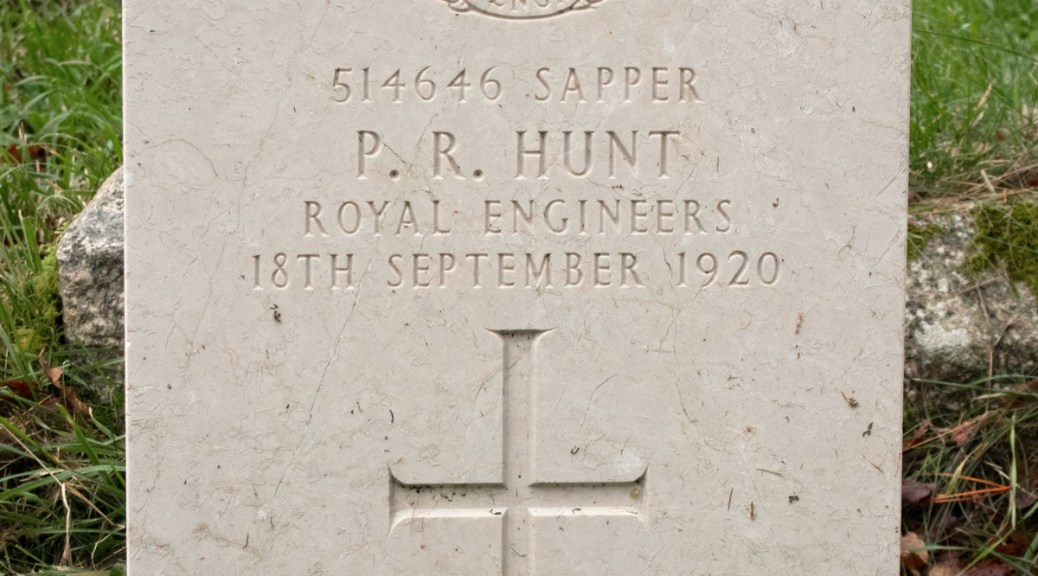
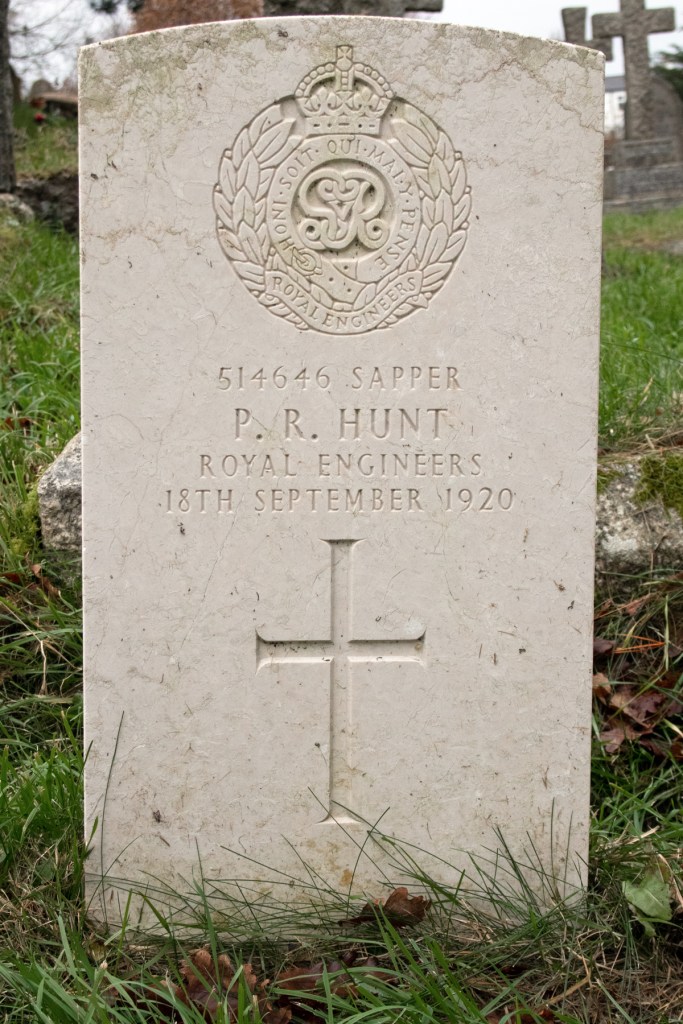
Sapper Percy Hunt

Sapper Percy Hunt

Percy Rendall Hunt was born on 25th May 1893, one of five children to Walter and Mary. Walter was a carpenter for the railway, and had been born in Newton Abbot, Devon, where he and Mary raised their young family.

When Percy left school, he found labouring work, but soon followed his father into carpentry. He met and married a woman called Ellen; the couple married, and went on to have two children. In his spare time, he volunteered for the Devonshire Royal Engineers and, when war broke out, despite now working in Chipping Sodbury, Gloucestershire, this was the regiment he joined.

Sapper Hunt enlisted on 2nd December 1914; his records show that he stood 5ft 7ins (1.70m) tall, had good vision and was of fit physical development. In March 1915, Percy was shipped off to Gibraltar, spending the next eighteen months in the territory. After a couple of months back in England, he was sent to France. He spent the next two years split between serving on home soil and with the British Expeditionary Force, before being demobbed in March 1919.

Percy returned to his old job with the railways, but, in December 1919, he found himself in court, charged with assault. Caroline Webber, an elderly married woman, was on the beach in Dawlish one afternoon, looking for shells, when a man approached her. According to a newspaper report:

“…suddenly he made a grab at me, put his hand under my clothes, and caught hold of my left knee. I screamed, and he ran away. ran after him because I was determined to see where he went. He went over to the railway wall, and disappeared under the archway of Dawlish tunnel.”

Western Times: Wednesday 24th September 1919

Mrs Webber went to the police, who returned to the police with her, then traced a trail of footprints back to the tunnel. Percy was questioned, but denied all knowledge of the incident, and of knowing Caroline. A plaster cast was taken of one of the footprints that evening, and a match alleged with his boots. Percy was committed for trial, with bail being allowed.

When the trial started in January 1920, the boots were again presented as evidence. However, on questioning, the policeman admitted than there had been a delay in getting the impression, and that “there were some other impressions in the sand at the time”.

For the defence, a number of witnesses saw Percy at work around the time of the incident, and the timings seemed to prove that he could not have had enough time to get to the beach and back to carry out the alleged assault. Based on this defence, the jury found Percy not guilty, and the case was concluded.

After this incident, Percy’s trail goes cold for a few months. The next record is that confirming his death, on 18th September 1920. The cause of his passing is not evident, but he was 27 years of age.

Percy Rendall Hunt was laid to rest in the graveyard of All Saints Church in Highweek, Newton Abbot, not far from his family home.


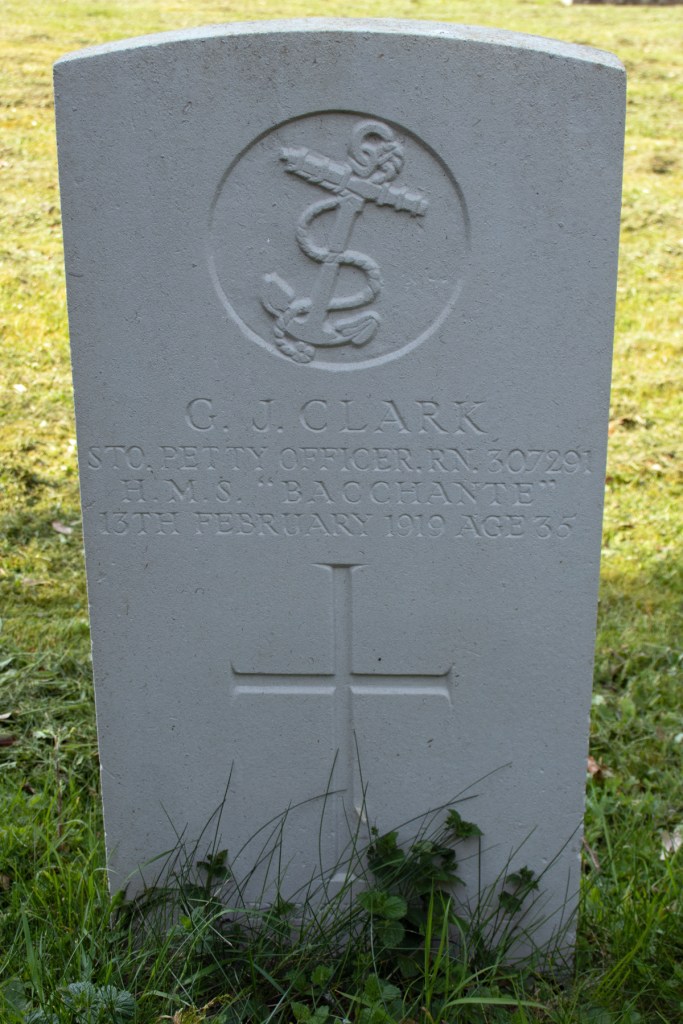
Stoker Petty Officer Gilbert Clark

Stoker Petty Officer Gilbert Clark

Gilbert John Clark was born in Bedminster, Somerset – now a suburb of Bristol – on 6th January 1884. He was one of eleven children to Jonah and Elizabeth Clark. Jonah was a coal miner from Devon, who travelled to find work. He and Elizabeth left Devon for Somerset in the early 1880s, before moving to Glamorgan, South Wales in 1891. This seemed not to last long, however, and, by 1895, the family were living back in Bristol.

The 1901 census recorded Jonah and Gilbert’ older brother, William, working the mines. Gilbert, however, had found different employment, working instead as a labourer for a brick maker. This did not turn out to be a long-term career for him, however, and, on 25th August 1904 he enlisted in the Royal Navy as a Stoker 2nd Class.

Gilbert’s service records show that he was 5ft 3ins (1.6m) tall, had black hair, dark brown eyes and a dark complexion. He was also noted to have a number of tattoos on his left arm, including a woman’s head, a figure of a woman and a cross with a man, crossed hands with a flower, a snake heart and an arrow.

Stoker 2nd Class Clark enlisted for a period of twelve years, and was initially based at HMS Vivid, the Naval Barracks in Devonport. After his training, he was given his first posting, on board HMS Barfleur. He quickly transferred, however, and in April 1905 was assigned to the battleship HMS Vengeance.

Gilbert’s three years on Vengeance were mixed. During that time, he spent two separate periods in the cells. The first, in February 1906, was for desertion, and resulted in ten days in the brig. The second, in August that year meant he was locked up for a further five days although the misdemeanour this time is not documented. This second period in the brig seemed to bring Gilbert to his senses, however, and the rest of his time on board Vengeance seems blemish-free, and even gave him a promotion to Stoker 1st Class.

The remainder of Gilbert’s twelve years’ service saw him assigned to a further eight vessels; between voyages he returned to the Devonport Naval Base. He also received a further two promotions: Leading Stoker in May 1912, and Stoker Petty Officer in February 1914.

War was imminent, by this point, and, at the end of his initial contract, he volunteered to remain in the Royal Navy for the period of the hostilities. After a six-month posting in Devon, Stoker Petty Officer Clark served on three more vessels. It was while he was on board HMS Bacchante, however that he fell ill with influenza. The ship was moored at the Royal Naval Dockyard in Chatham, Kent, at the time and he was admitted to the RN Hospital in the town.

Sadly, Gilbert’s influenza turned to pneumonia and proved too much for his body to bear. He passed away from the lung conditions on 13th February 1919, at the age of 35 years old.

Gilbert John Clark’s body was brought back to Somerset for burial. He was laid to rest in the graveyard of St John the Baptist Church in Peasedown St John, where his parents were then living.


Gunner William Withers

Gunner William Withers

William John Withers was born in the spring of 1883, in the Somerset town of Midsomer Norton. He was one of six children to William and Rose Withers. William Sr was a coal miner who went on to become a night bailiff, or caretaker, for the colliery. His son, however, sought different things, and, when he left school, he found work as a grocer’s assistant.

In the summer of 1909, William Jr married Florence Robbins, a miner’s daughter from Radstock. The couple went on to have a son, Allan, in June 1913 but tragically it appears than Florence either died in childbirth, or shortly afterwards.

In the summer of 1914, war came to Europe; by the end of the following year, William had enlisted, joining the Royal Garrison Artillery as a Gunner. His service records show that he stood 5ft 8.5ins (1.74m) tall, and weighted 147lbs (66.7kg). By this time he was working as a shop manager and, as a widower with a young son, it seems that, while he volunteered for service, he wasn’t formally mobilised for another year.

Gunner Withers was initially posted at the Citadel Fortress in Plymouth, but soon moved to Halton Park in Buckinghamshire. He spent time there training to be a Signaller, and in April 1918, he succeeded. That summer, he was posted overseas, serving as part of the 461st Siege Battery in France.

In March 1919, Signaller Withers returned to England. Details are a bit sketchy, but it seems that he was posted to Lincolnshire, and while there he fell ill. He was admitted to the Northern General Hospital in Lincoln with peritoneal adhesions; sadly these proved too much for his body to take; he passed away on 9th April 1919, at the age of 36 years old.

William John Withers’ body was brought back to Somerset for burial. He lies at rest in the graveyard of St Nicholas’ Church in Radstock.


The exact spot of William’s burial is unknown. The grave in the image is of his father, who passed away in 1921. It is likely that William Sr was buried with his son.


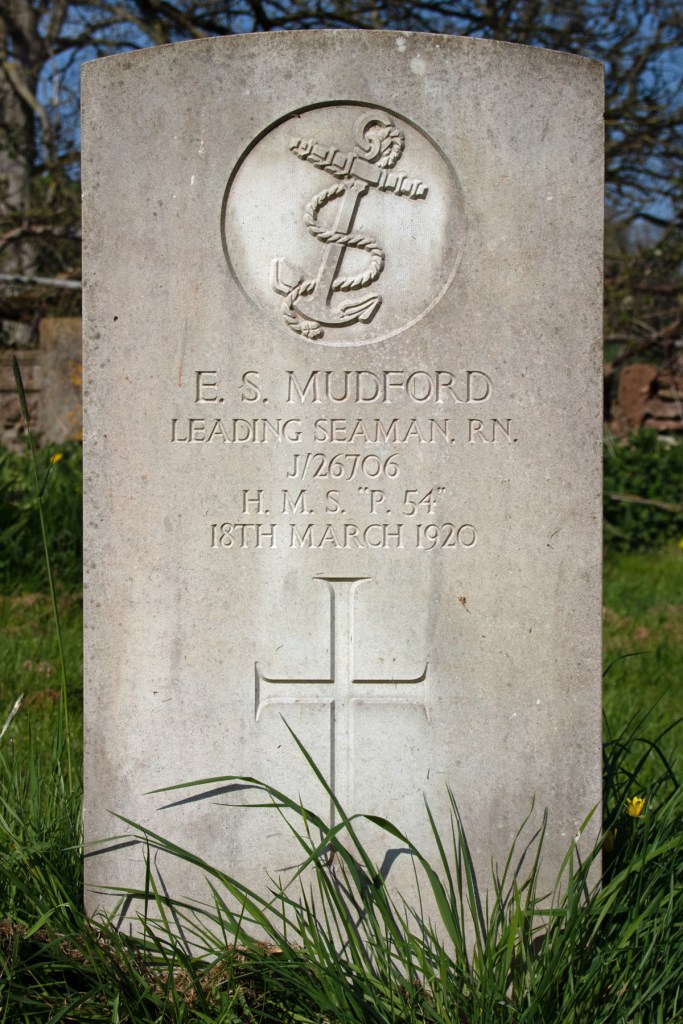
Leading Seaman Edward Mudford

Leading Seaman Edward Mudford

Edward Short Mudford was born on 29th March 1898 in the Somerset village of Stratton-on-the-Fosse. He was one of nine children to Joseph and Mary Mudford.

Information about his early life is confusing: the 1901 census gives his name as Edwin, rather than Edward; his father appears to have died by this point, leaving Mary to raise the family alone. The 1911 census records Edward and a younger sister living in the Union Workhouse in Shepton Mallet, while Mary has apparently remarried and was living in Radstock with two of Edward’s siblings and a daughter from her second marriage, although her new husband is noticeable in his absence from the document.

From this shaky start, however, Edward sought a new life for himself. On 21st August 1913 he enlists in the Royal Navy. His service records show that he stood just 5ft 1ins (1.55m) tall, had fair hair, hazel eyes and a fresh complexion. Being under age at the time, he was given the rank of Boy 2nd Class.

Edward was initially sent to HMS Ganges, the naval training establishment outside Ipswich, Suffolk. Promoted to Boy 1st Class in February 1914, he was soon given his first posting, on the cruiser HMS Crescent.

After another short spell at HMS Vivid, the Naval Dockyard in Plymouth, Boy Mudford found himself on board HMS Thunderer. Edward spent nearly four years aboard the battleship, coming of age and gaining the rank of Ordinary Seaman, while also being promoted to Able Seaman in March 1916.

Edward returned to Plymouth in February 1918, and spent the next couple of years between there, Portsmouth and Woolwich Dockyards. He was again promoted, given the rank of Leading Seaman in September 1918.

Life at sea and in barracks took its toll, however, and, in in the spring of 1920, Leading Seaman Mudford contracted influenza and pneumonia. Sadly the conditions proved too much to bear: he passed away on 20th March 1920, a week shy of his 22nd birthday.

Brought back to Somerset, where, presumably some of his family still lived, Edward Short Mudford was laid to rest in the graveyard of St John the Baptist Church in Chilcompton.


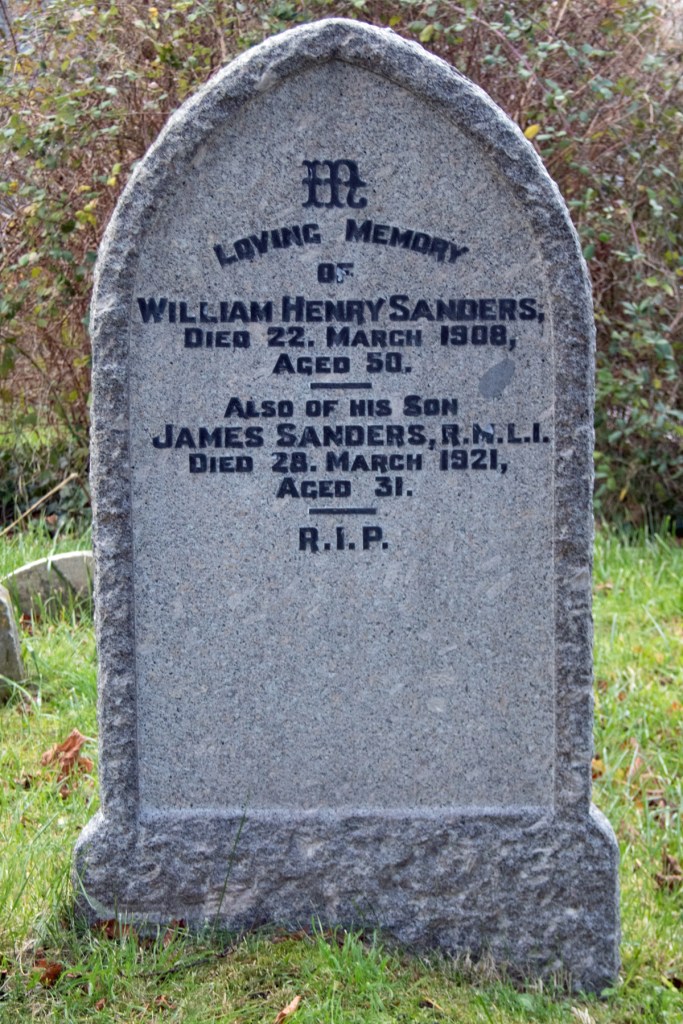
Private James Sanders

Private James Sanders

James Sanders was born on 17th April 1889. One of nine children, his parents were William and Emily Sanders. William worked for a clay company in his home town of Kingsteignton, Devon. He had various roles, including caretaker, inspector and messenger.

William’s son, however, was after bigger things in life and, on 17th July 1907, he enlisted in the Royal Marine Light Infantry. James’ service records show that he was 5ft 6ins (1.67m) tall, had light brown hair, grey eyes and a fresh complexion.

Based out of Plymouth, Private Sanders signed up for an initial period of twelve years. During this time, and throughout the war, he served on six vessels, including 30 months on HMS Argyll (where he was based for the 1911 census) and more than five years on HMS Colossus.

In April 1919, Private Saunders returned to land. When his initial contract was up, he re-enlisted, this time remaining at the Naval Dockyard in Plymouth.

James’ trail goes a little cold for the next couple of years, although he continued in his role with the Royal Marine Light Infantry. On the night of the 28th March 1921, however, he encountered some trouble. The local newspaper reported on the subsequent inquest.

Kingsteignton Man’s Mysterious Death

At an enquiry held at Teignmouth on Saturday afternoon into the circumstances attending the death of Private James Sanders, RMLI… who was found drowned in the river Teign on Friday, it was stated that deceased and seven other Kingsteignton men on Monday visited Teignmouth to attend a football match, at which Sanders acted as touch-judge.

After the match they went to a public house, where deceased had three or four pints of beer and some spirits, which made him unsteady.

They left to catch a bus, but at Station Road deceased turned back. One of his companions followed him, but could not persuade him to return, so he left deceased on his own to travel back home.

The man considered Sanders was in a condition to look after himself. An open verdict was returned.

Wester Times: Friday 8th April 1921

Private James Sanders died on 28th March 1921, aged 31 years old. He was laid to rest with his father, William, who had died in 1908, in the graveyard of St Michael’s Church in Kingsteignton.